
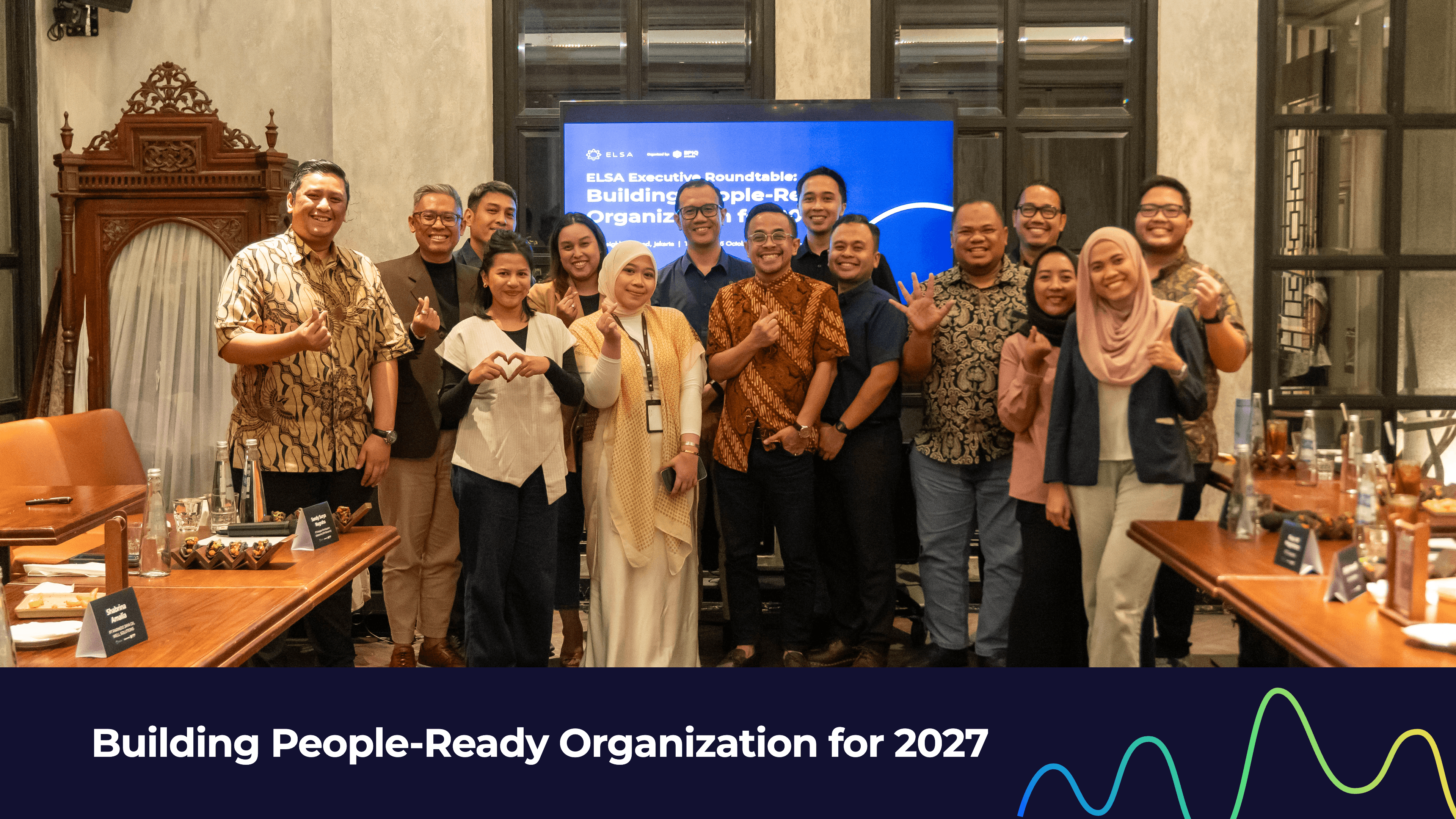
On 15 October, ELSA hosted an executive roundtable in Jakarta on one question: what will it take to have people ready for 2027? Eleven HR leaders joined, from oil and gas, FMCG, technology, property, financial services and hospitality. Dudi Arisandi, Chief People Officer at tiket.com, gave the keynote.
Most of the leaders are planning under the same limit. They can hire only for roles that bring in revenue, so the capability they need has to come from current employees. They also have to show leadership that the investment in those people paid off.
That last part is the hardest. For sales teams, HR can point to sales numbers. For every other team, most have only training evaluations, and their CEOs and CFOs want stronger evidence than that.
The keynote named communication as the capability at the center of 2027 plans. This post covers what was discussed at the roundtable, and how HR can show that communication is actually improving.
Why must HR build 2027 capability without new hires?
Hiring is limited to revenue roles while costs keep rising, so most 2027 capability has to come from the people companies already employ.
Costs are rising for reasons HR doesn't control. Leaders described fuel shortages, oil-linked packaging costs and weak demand from clients who have paused spending.
In his keynote, Dudi described HR's question changing from "How many people do we need?" to "What capabilities must our people demonstrate for the business to win?" His formula for the answer: organizational readiness = capability × clarity × collaboration × accountability.
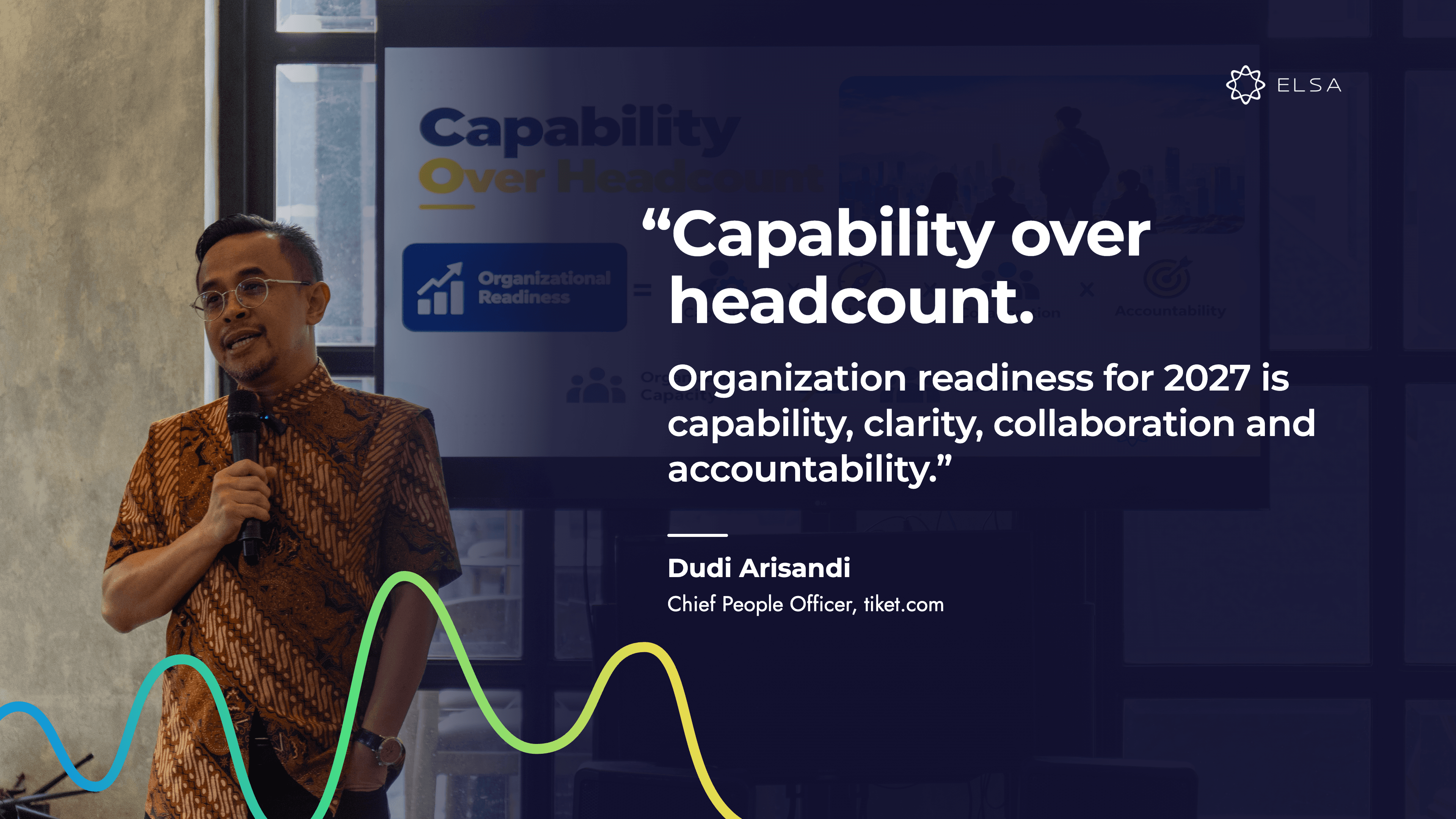
Capacity, in his model, is not headcount. Capability comes from a portfolio of four options: build it internally, buy it by hiring, borrow it from partners, or use technology ("bot"). Urgency, strategic value, internal bench strength and time to proficiency decide the mix.
Why is communication an execution capability, not a soft skill?
Communication is how strategy becomes priorities, trade-offs get explained and stakeholders stay aligned. When it breaks down, execution slows.
Dudi's keynote traced slower execution, rework and weaker customer outcomes back to communication friction. His examples were unclear priorities, siloed decisions, inconsistent messages from managers, late escalation and too many meetings. He then listed the skills that make up the capability: translating strategy into priorities, explaining trade-offs, aligning stakeholders, managing conflict, influencing decisions and building trust across differences.
Each level of the organization has a different job:
| Level | Communication job in the keynote |
|---|---|
| Executives | Create clarity and a consistent narrative |
| Managers | Translate direction into team action |
| Employees | Communicate with ownership, context and constructive challenge |
For many Indonesian teams, part of this job happens in English: regional calls, multinational clients, international partners. Among ELSA learners in Indonesia, 52% start at B1: they can read and listen in English, but struggle to speak and write it.
Globally, 81% of employers say integrating AI tools increases the need for workplace English proficiency (ETS TOEIC Global English Skills Report, 2026, survey of 1,300+ HR decision-makers in 17 countries).
Why can HR prove training impact for sales but not other teams?
Sales results come with a number attached. Most other roles don't, so HR falls back on training evaluations that leadership finds less convincing.
The pattern was consistent across industries. A home furnishings group could show sales uplift data from a sales development program, and management accepted it. For other functions, it relied on a Kirkpatrick-style training evaluation, which its stakeholders found insufficient.
A national bank applies a stricter test: a replacement sales hire is approved only with a cost-versus-revenue calculation.
Dudi's advice was to stop arguing training ROI in the abstract. Show behavior change, and speak each stakeholder's language. With a data-driven CFO, he leads with savings before he asks for budget.
What evidence did HR leaders in the room trust?
Concrete output from real work: a new product, a project pitched to the CEO, a change in a service level, a sales number.
- A national food and beverage manufacturer built credibility for its development budget through a leadership program run on real business projects. One project produced a new product line, and the development budget has grown every year.
- A fintech company ends its leadership program with each participant pitching a measurable project to the CEO in five minutes, with a C-level sponsor accountable for supporting it.
- A bank works in cross-directorate squads with a weekly cadence and measures non-revenue functions by process service levels.
None of these depend on a course completion rate. The evidence came from work people were already doing, judged by people outside HR.
How can HR measure communication capability in a pilot?
Start with one team, set a speaking baseline in week one, agree one business metric up front, and measure in the meetings people already attend.
The room already works this way with new tools. tiket.com piloted an AI assistant with 40 people before any wider rollout. A communication pilot can follow the same habit:
- Pick one team where English is used at work, such as a regional commercial team or engineers working with multinational clients.
- Agree the business metric with the business owner before the pilot starts, not after.
- Set a speaking baseline in the first week.
- Measure speaking in real meetings, then re-measure monthly.
- Report the speaking data and the business metric side by side.
For step 4, ELSA's Meeting Companion joins supported Zoom and Google Meet calls and scores the enrolled learner's English speaking. The learner sees scores for pronunciation, fluency, grammar, vocabulary and intonation, usually within a few minutes of the call. Admins don't receive meeting audio or transcripts.
This works alongside internal trainers. Trainers run the sessions. ELSA adds daily practice between sessions and data on whether speaking is changing.
Results take time to show. Among ELSA learners in Indonesia who stayed active for 12 months or more, average level moved from B1 to B2, and the ELSA Proficiency Score rose from 63.5 to 72.
At PLN, Indonesia's state electricity company, 58% of participants in a blended program for 1,500 learners advanced at least one CEFR level (PLN customer story).
Summary
- Most 2027 capability has to come from current employees.
- Communication is how strategy gets executed, at every level.
- HR can prove impact for sales. Elsewhere, it needs evidence from real work.
- A pilot with a baseline, one agreed business metric and speaking measured in real meetings gives HR that evidence for spoken English.
If communication is how 2027 plans get executed, it deserves the same evidence as the sales number.
Related reading: How to Measure the ROI of Corporate Language Training in Asia and How to Prepare Employees for Global Roles Before You Promote Them.
Ready to test this with one team? ELSA Business can set a speaking baseline in week one and report progress from real meetings, alongside the business metric you agree at the start. Book a demo to plan a pilot.