

100+ common English idioms to sound like a native speaker
elsaspeakadmin
July 22, 2026
Idioms
100+ common English idioms to sound like a native speaker
Idioms are everywhere in everyday English, but they can be tricky to understand and even harder to use correctly. Many learners know the words but miss the real meaning behind the expression. In this article, ELSA Speak will explain common English idioms, their meanings, and how to use them naturally with simple examples.
| Key takeaways |
An idiom is a phrase or expression whose overall meaning is different from the literal meanings of its individual words, so it must be understood as a whole rather than translated word for word. Popular everyday idioms:
Example: The teacher asks everyone to introduce themselves to break the ice.
Example: John is feeling under the weather today.
Example: She accidentally spilled the beans about our secret party. Tips to use English idioms naturally
|
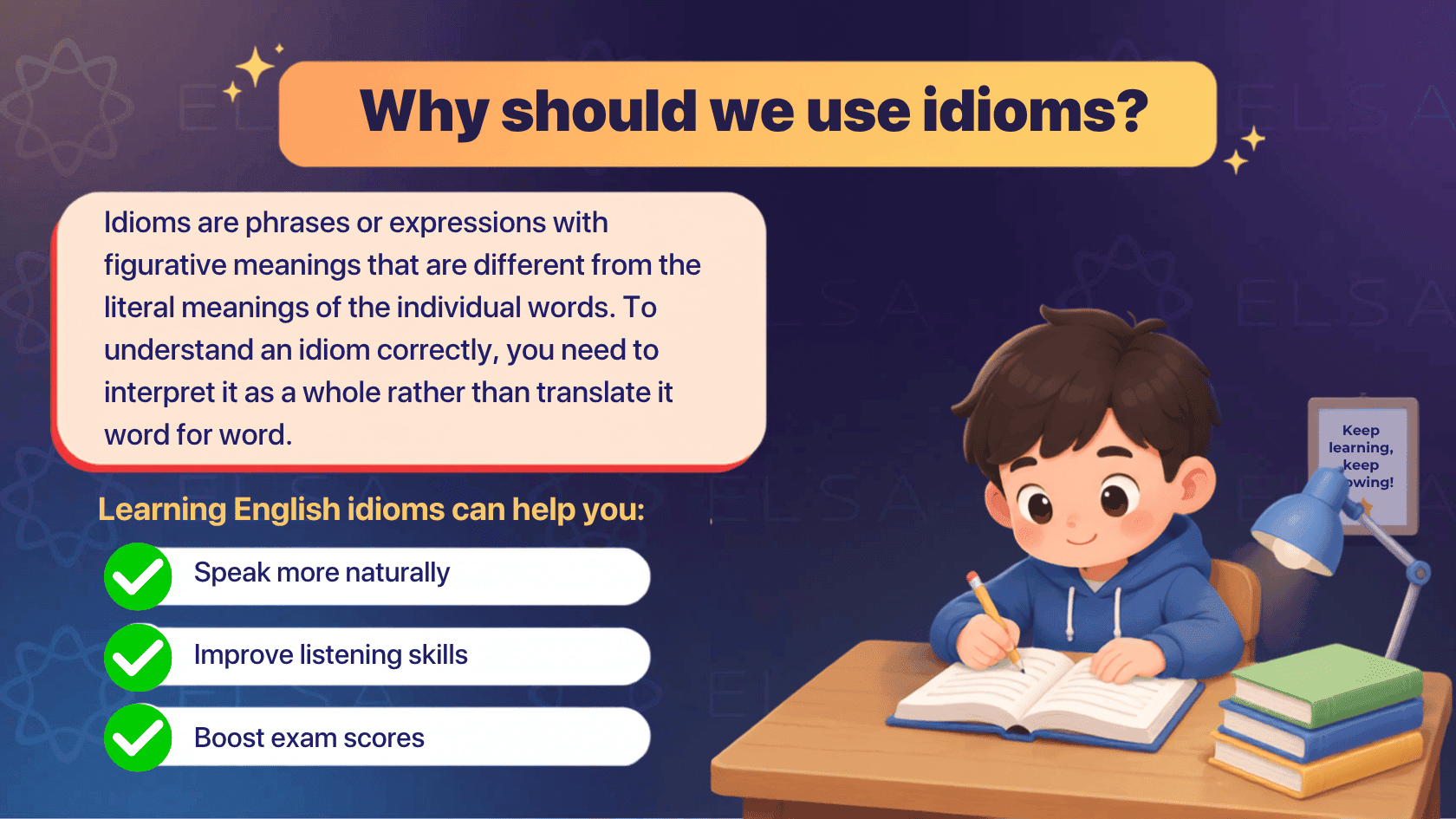
Why should we use idioms?
What are idioms? Idioms are phrases or expressions with figurative meanings that are different from the literal meanings of the individual words. To understand an idiom correctly, you need to interpret it as a whole rather than translate it word for word.
Learning English idioms can help you:
- Speak more naturally: Idioms make your English sound more fluent and closer to how native speakers communicate.
- Improve listening skills: Understanding idioms' meaning helps you follow movies, TV shows, podcasts, and everyday conversations more easily.
- Boost exam scores: Using idioms appropriately can improve your performance in speaking and writing sections of exams like IELTS and TOEIC.
Top 100+ common idioms organized by topic
Here are 100+ common idioms grouped by topic for easy learning.
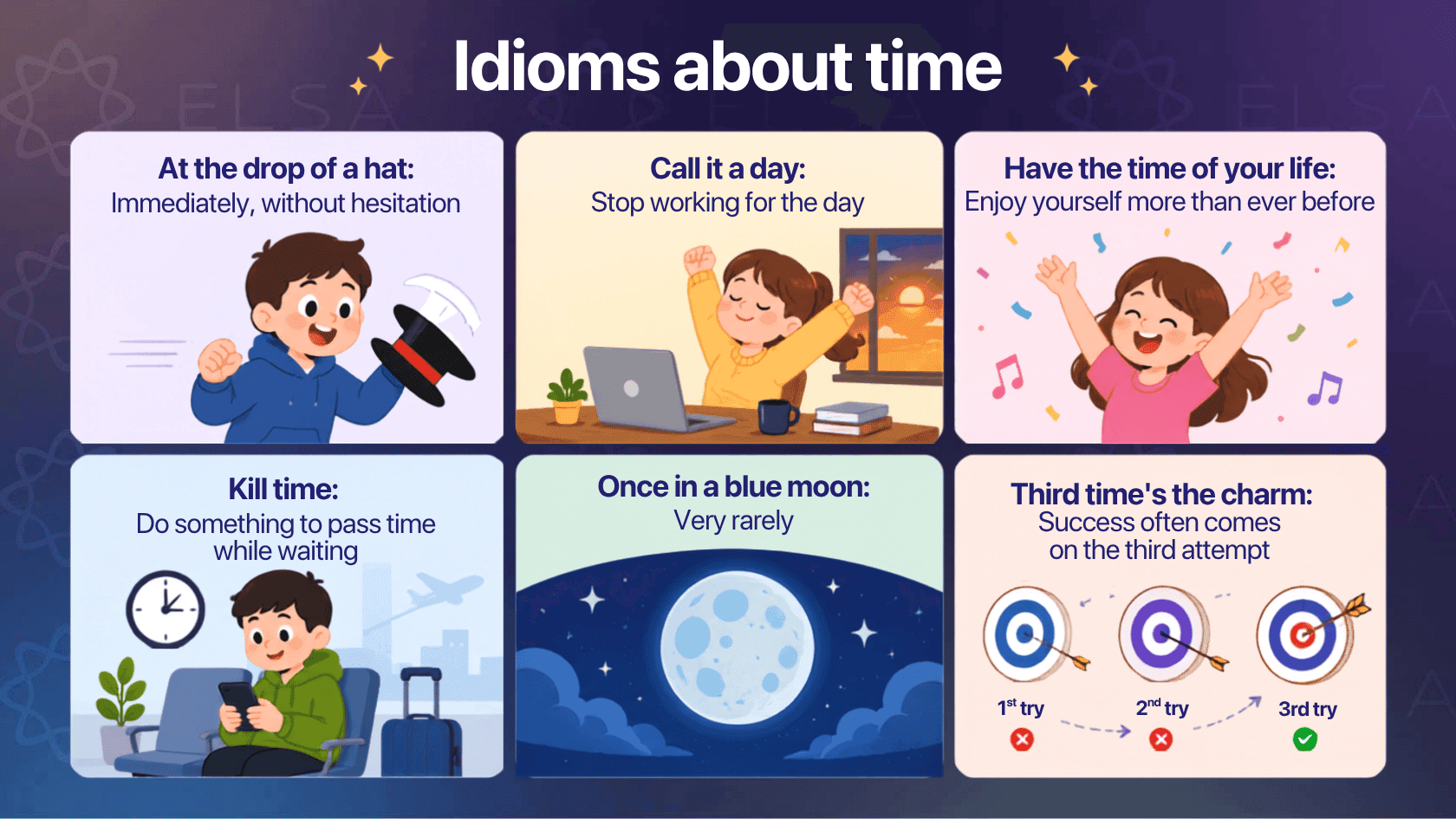
Idioms about time
These common idioms will help you talk about time and daily experiences like a native speaker.
| Idioms | Meaning |
| At the drop of a hat | Immediately, without hesitation |
| Against the clock | In a hurry to finish before a deadline |
| Around the clock | 24 hours a day, non-stop |
| Beat the clock | Finish something before the time runs out |
| Behind the times | Old-fashioned, not up to date |
| Better late than never | It's preferable to do something late than not at all |
| Call it a day | Stop working for the day |
| Have the time of your life | Enjoy yourself more than ever before |
| In the nick of time | Just before it's too late |
| In the long run | Over a long period of time |
| It's about time | Something should have happened sooner |
| Kill time | Do something to pass time while waiting |
| Make up for lost time | Work faster to compensate for time already lost |
| Once in a blue moon | Very rarely |
| On the spur of the moment | Done suddenly, without planning |
| Only time will tell | The future will show what happens |
| Race against time | Try to finish something before a deadline or disaster |
| The sands of time | The passing of time, especially life |
| Time will tell | The future will reveal the truth or outcom |
| Third time's the charm | Success often comes on the third attempt |
Examples of idioms:
- We only eat out once in a blue moon because we're saving money.
- She caught the train in the nick of time.
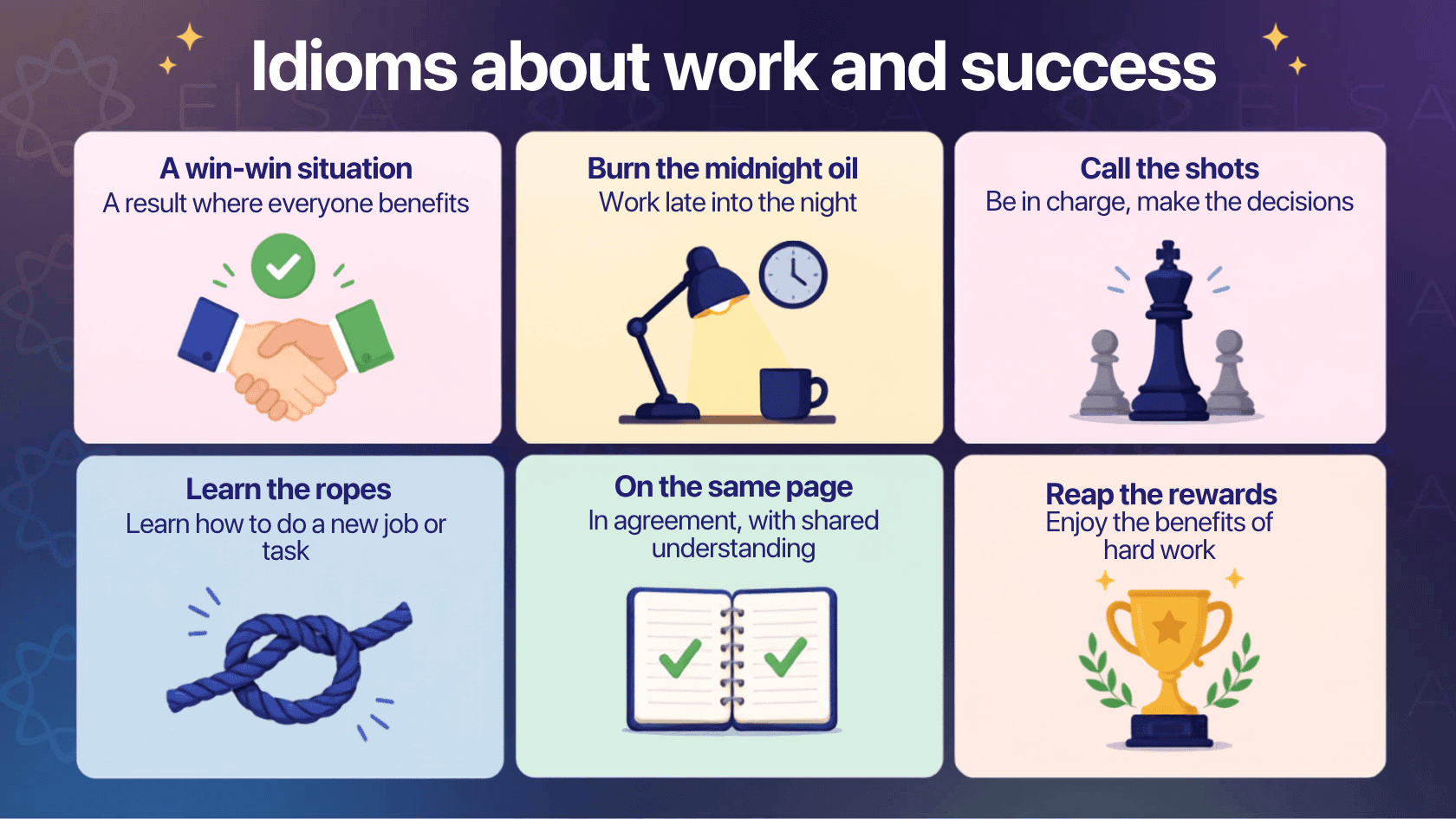
Idioms about work and success
Looking for workplace expressions? This idioms list will help you talk about work and success more naturally.
| Idioms | Meaning |
| Ahead of the curve | More advanced than others |
| A win-win situation | A result where everyone benefits |
| Back to the drawing board | Start over after a failure |
| Be snowed under | Have too much work to do |
| Burn the midnight oil | Work late into the night |
| Call the shots | Be in charge, make the decisions |
| Cut corners | Do something poorly to save time or money |
| Hit the nail on the head | Describe something exactly right |
| Hit the ground running | Start something immediately and successfully |
| Keep your nose to the grindstone | Work very hard and stay focused |
| Go the extra mile | Put in more effort than required |
| Get the ball rolling | Start something, get things moving |
| Learn the ropes | Learn how to do a new job or task |
| On the same page | In agreement, with shared understanding |
| Pull one's weight | Do one's fair share of work |
| Pull the strings | Secretly control or influence a situation |
| Raise the bar | Set a higher standard of performance |
| Touch base | Make brief contact to discuss something |
| Reap the rewards | Enjoy the benefits of hard work |
| Wear many hats | Have many different roles or responsibilities |
Examples of idioms:
- Let's get the ball rolling by discussing today's agenda.
- Before we start the project, let's make sure we're all on the same page.
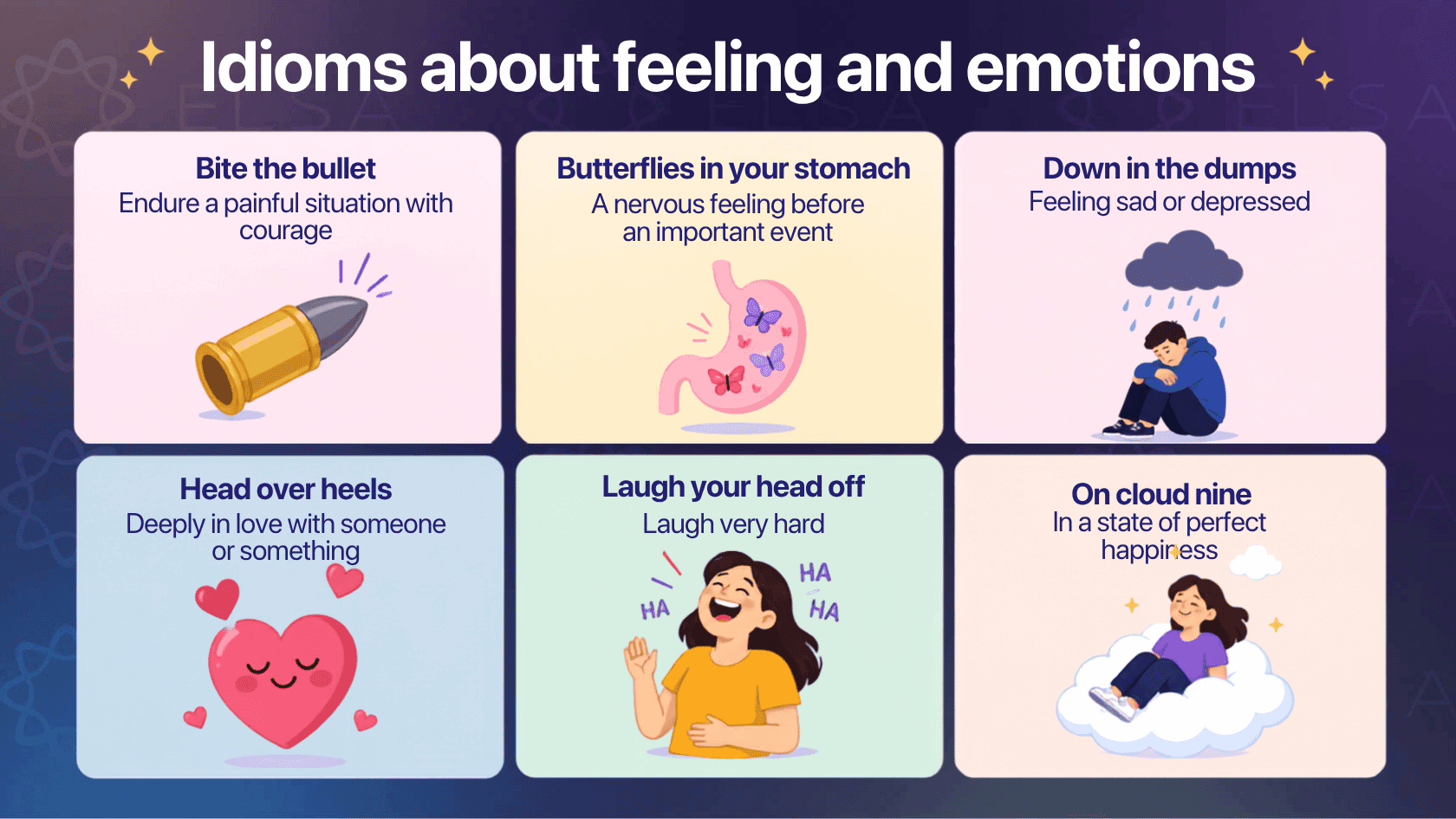
Idioms about feelings and emotions
Want to sound more natural? This list of idioms will help you talk about feelings and emotions like a native speaker.
| Idioms | Meaning |
| At the end of one's rope | Completely out of patience or energy |
| Bite the bullet | Endure a painful situation with courage |
| Butterflies in your stomach | A nervous feeling before an important event |
| Cry your heart out | Cry intensely for a long time |
| Down in the dumps | Feeling sad or depressed |
| Eat your heart out | Feel jealous or suffer because of unfulfilled desire |
| Feeling blue | Feeling sad or unhappy |
| Keep your chin up | Stay positive despite difficulties |
| Have a change of heart | Change one's opinion or feelings about something |
| Hot under the collar | Angry or embarrassed |
| Head over heels | Deeply in love with someone or something |
| Get cold feet | Become nervous or hesitant before doing something |
| Laugh your head off | Laugh very hard |
| Over the moon | Extremely happy and excited |
| On cloud nine | In a state of perfect happiness |
| On edge | Nervous, tense, or irritable |
| See red | Become very angry |
| Under the weather | Feeling slightly ill or unwell |
| Wear one's heart on one's sleeve | Show emotions openly and freely |
| Walk on air | Feel extremely happy and carefree |
Examples of idioms:
- I had butterflies in my stomach before my job interview.
- I'm feeling a bit under the weather today, so I'll stay home and rest.
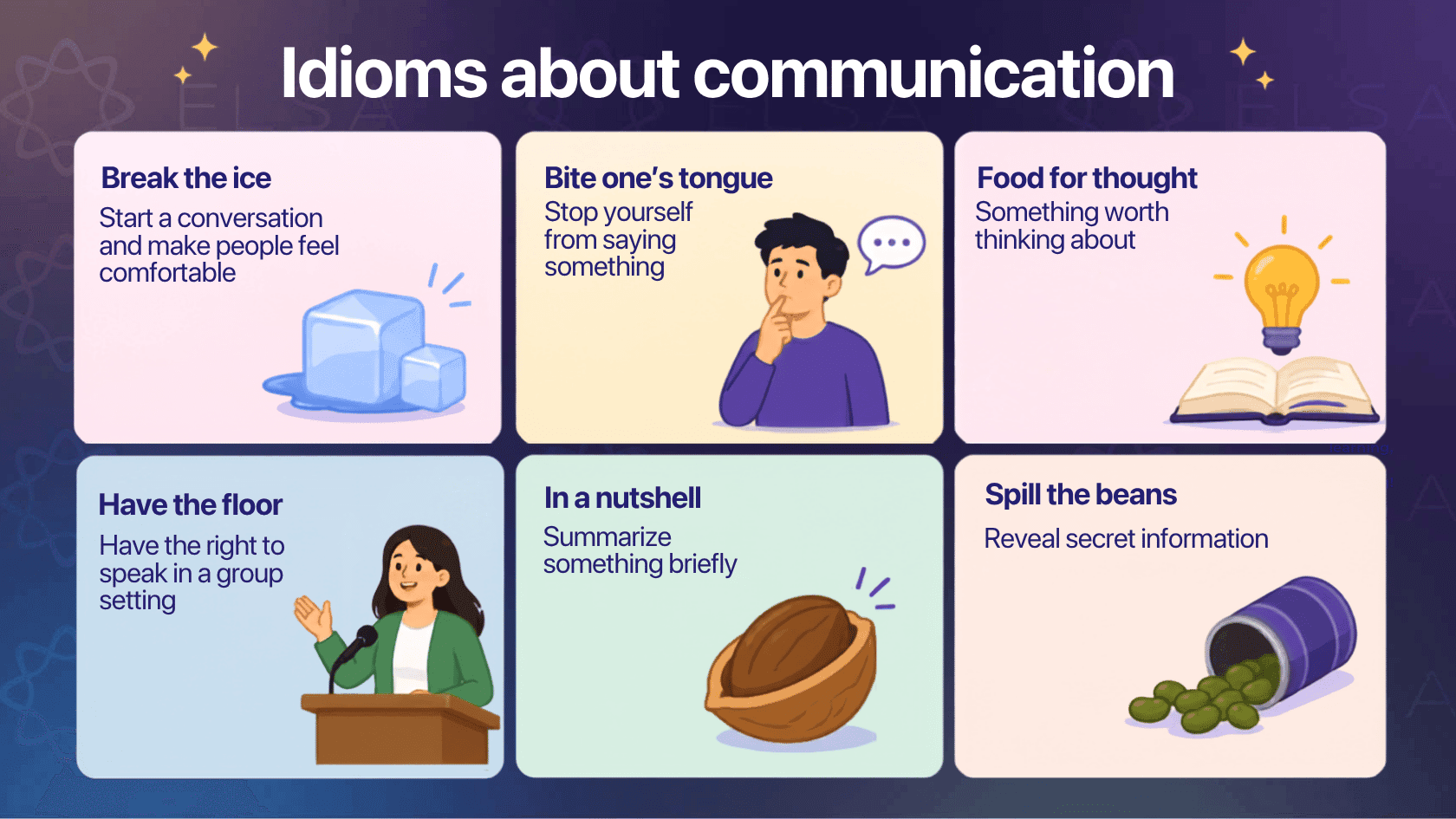
Idioms about communication
Here are some useful idioms that can help you express your ideas more naturally when communicating in English.
| Idioms | Meaning |
| Actions speak louder than words | What people do is more important than what they say |
| Break the ice | Start a conversation and make people feel comfortable |
| Beat around the bush | Avoid getting to the main point |
| Bite one's tongue | Stop yourself from saying something |
| Clear the air | Resolve tension or misunderstandings through discussion |
| Food for thought | Something worth thinking about |
| Get the message | Understand what someone is trying to communicate |
| Get straight to the point | Say exactly what you mean without wasting time |
| Have the floor | Have the right to speak in a group setting |
| Hear it through the grapevine | Learn news through rumors or unofficial sources |
| In a nutshell | Summarize something briefly |
| Let the cat out of the bag | Accidentally reveal a secret |
| On the tip of one's tongue | Almost able to remember something |
| Put it in a nutshell | Explain something briefly and clearly |
| See eye to eye | Agree completely with someone |
| Speak of the devil | Said when someone appears just as you were talking about them |
| Spill the beans | Reveal secret information |
| Sing from the same hymn sheet | Say the same things, be in agreement publicly |
| Read between the lines | Understand the hidden meaning of something |
| Word of mouth | Information shared through people rather than media |
Examples of idioms:
- The teacher told a funny story to break the ice on the first day of class.
- You need to read between the lines to understand what she really meant.
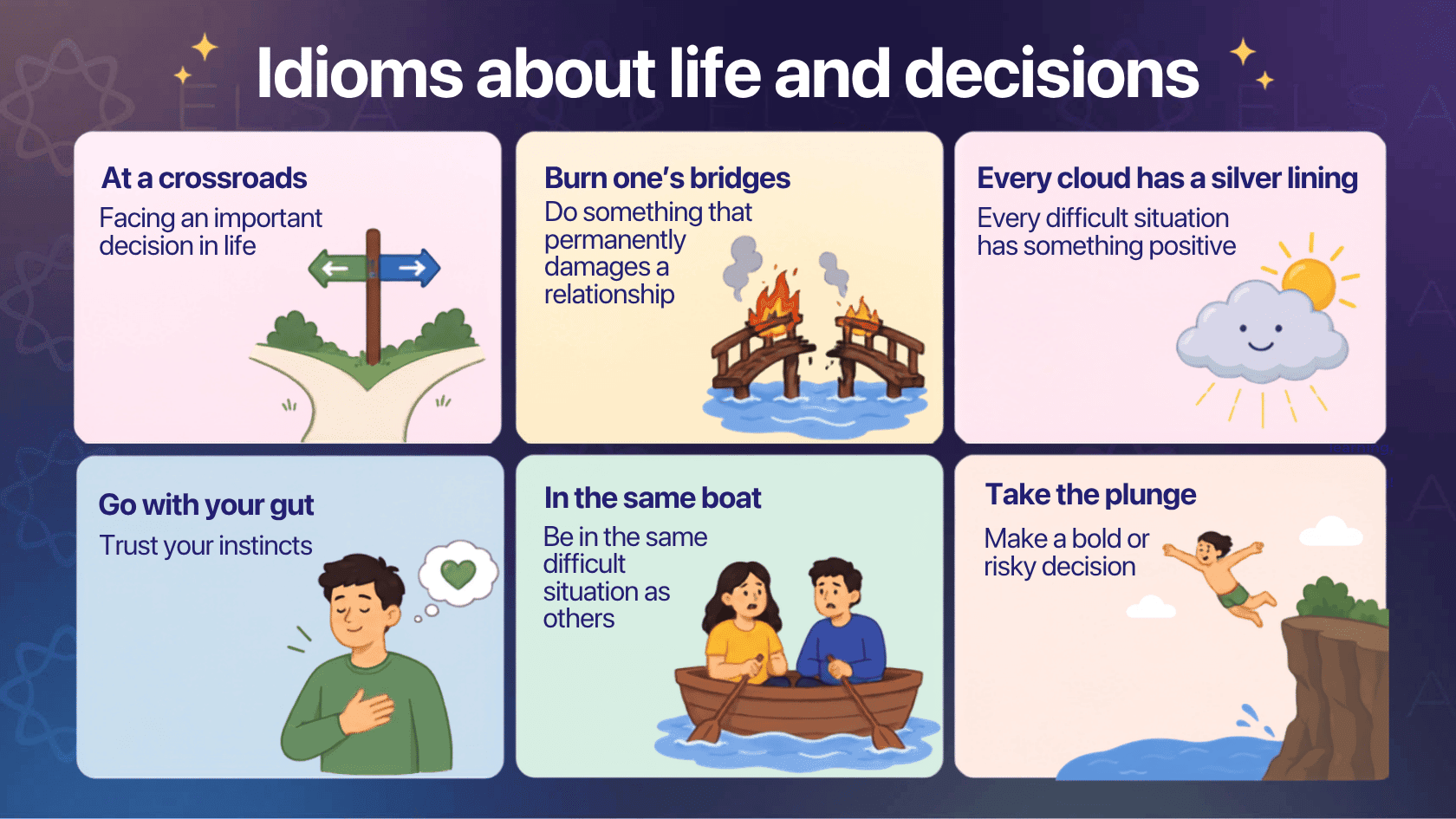
Idioms about life and decisions
Explore these common idioms to talk about life experiences and everyday decisions with confidence.
| Idioms | Meaning |
| A leap of faith | Doing something without being sure it will work out |
| At a crossroads | Facing an important decision in life |
| Blessing in disguise | Something that seems bad at first but turns out to be good |
| Burn one's bridges | Do something that permanently damages a relationship |
| Come full circle | Return to the original situation or starting point |
| Cross that bridge when you come to it | Deal with a problem only when it happens |
| Every cloud has a silver lining | Every difficult situation has something positive |
| Follow your heart | Make a decision based on your feelings |
| Go with your gut | Trust your instincts |
| Hit the ground running | Start something with full energy and enthusiasm |
| In the same boat | Be in the same difficult situation as others |
| Kill two birds with one stone | Achieve two things with one action |
| Light at the end of the tunnel | A sign that a difficult situation is nearly over |
| Learn from the school of hard knocks | Gain wisdom through difficult life experiences |
| Turn over a new leaf | Change your behavior for the better |
| Take the plunge | Make a bold or risky decision |
| Rome wasn't built in a day | Great achievements take time |
| When one door closes, another opens | New opportunities appear after setbacks |
| What goes around comes around | People's actions eventually have consequences |
Examples of idioms:
- I listened to an English podcast while exercising to kill two birds with one stone.
- Losing my job was hard, but it led me to a better opportunity. Every cloud has a silver lining.
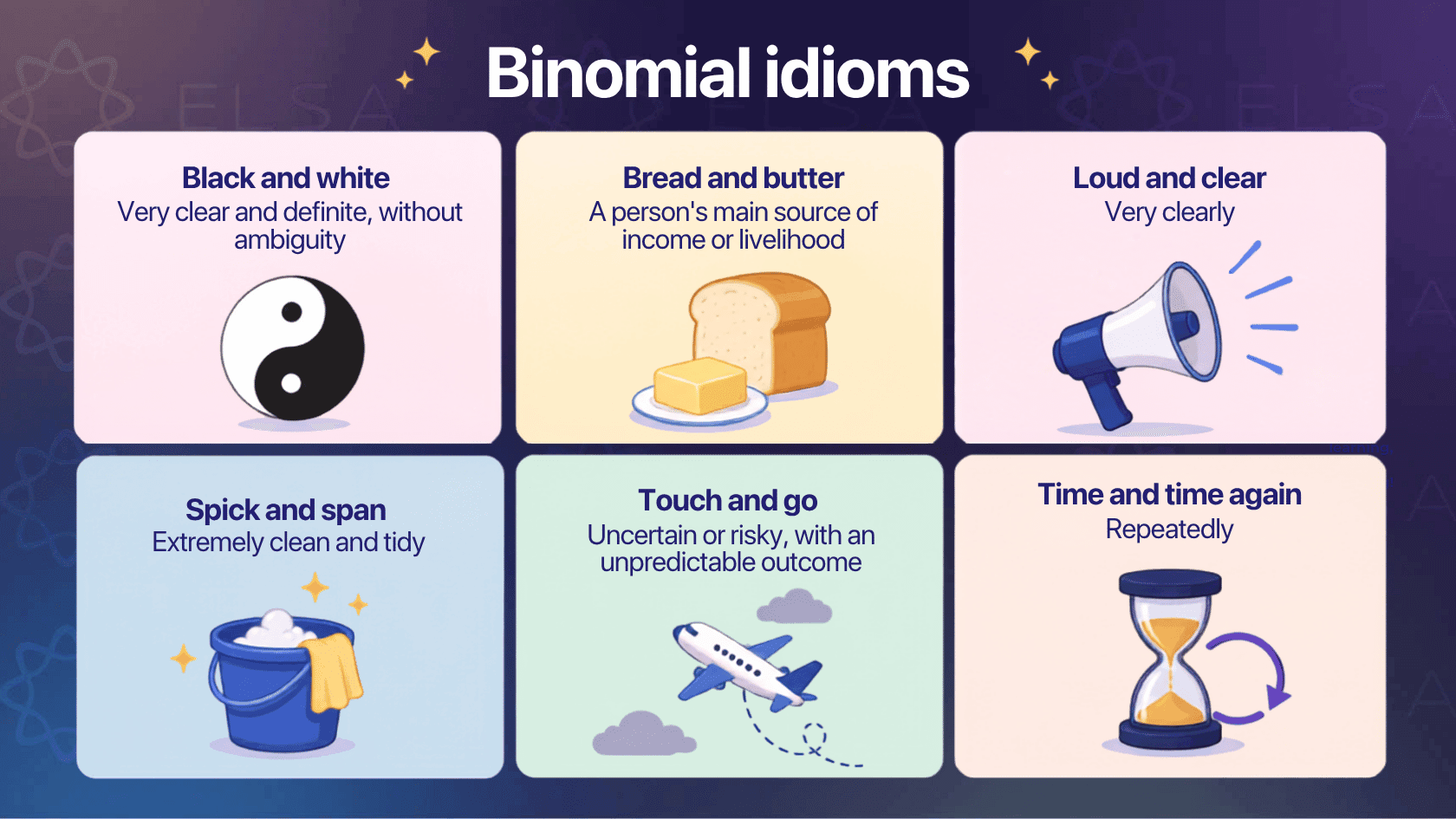
Binomial idioms
Binomial idioms in English are expressions made up of two words connected by and or or. These word pairs always follow a fixed order.
| Idioms | Meaning |
| Alive and kicking | Healthy, active, and still functioning |
| Back and forth | Moving repeatedly from one place or side to another |
| Black and white | Very clear and definite, without ambiguity |
| Bread and butter | A person's main source of income or livelihood |
| By and large | Generally, on the whole |
| Bits and pieces | Small parts of something |
| Down and out | Without money, work, or a home, in a very difficult situation |
| First and foremost | Most importantly |
| High and dry | Left without help or support |
| Hit and miss | Lacking consistency, sometimes successful, sometimes not |
| Kith and kin | Friends and relatives, one's family and close associates |
| Live and learn | You gain wisdom through experience, especially after mistakes |
| Loud and clear | Very clearly |
| Part and parcel | An essential or unavoidable part of something |
| Safe and sound | Unharmed; in good condition |
| Sooner or later | Eventually, at some point in the future |
| Spick and span | Extremely clean and tidy |
| Touch and go | Uncertain or risky, with an unpredictable outcome |
| Trial and error | Learning by trying different methods until one works |
| Time and time again | Repeatedly |
Examples of idioms:
- The children arrived home safe and sound after the school trip.
- She walked back and forth while waiting for the interview to begin.
Tips to learn and use English idioms naturally
Learning idioms takes practice. Here are some effective ways to make the process easier.
- Practice idioms with ELSA AI by using them in speaking exercises and real-life conversations.
- Learn from English movies, TV shows, and YouTube videos to see how native speakers use idioms naturally.
- Don't overuse idioms. Using too many in one conversation can sound unnatural.
- Study common collocations alongside idioms to improve your vocabulary and speak more fluently.

Frequently Asked Questions
What is the difference between an idiom and a phrase?
Idioms and phrases are often confused, but they have different meanings.
- A phrase is simply a group of words that works together as part of a sentence.
- An idiom is a special type of phrase whose meaning cannot be understood from the literal meanings of the individual words.
Are English idioms used in formal writing?
Not usually. Idioms are more common in everyday conversations and informal writing, so it's best to avoid them in academic or other formal contexts.
We hope this guide has helped you discover common English idioms and understand how to use them naturally in everyday conversations. Keep practicing with ELSA Speak to turn these expressions into part of your active vocabulary, and don't forget to visit our Vocabulary category for more useful words, phrases, and English learning guides.