

Second conditional: Complete guide to formulas, rules, and examples
elsaspeakadmin
November 9, 2026
Advanced Grammar
The second conditional helps you talk about unlikely situations, give polite advice, or talk about what you would've do if things were different. This guide explains the second conditional formula, grammar rules, common mistakes, with exercises to help you use it confidently.
What is the second conditional?
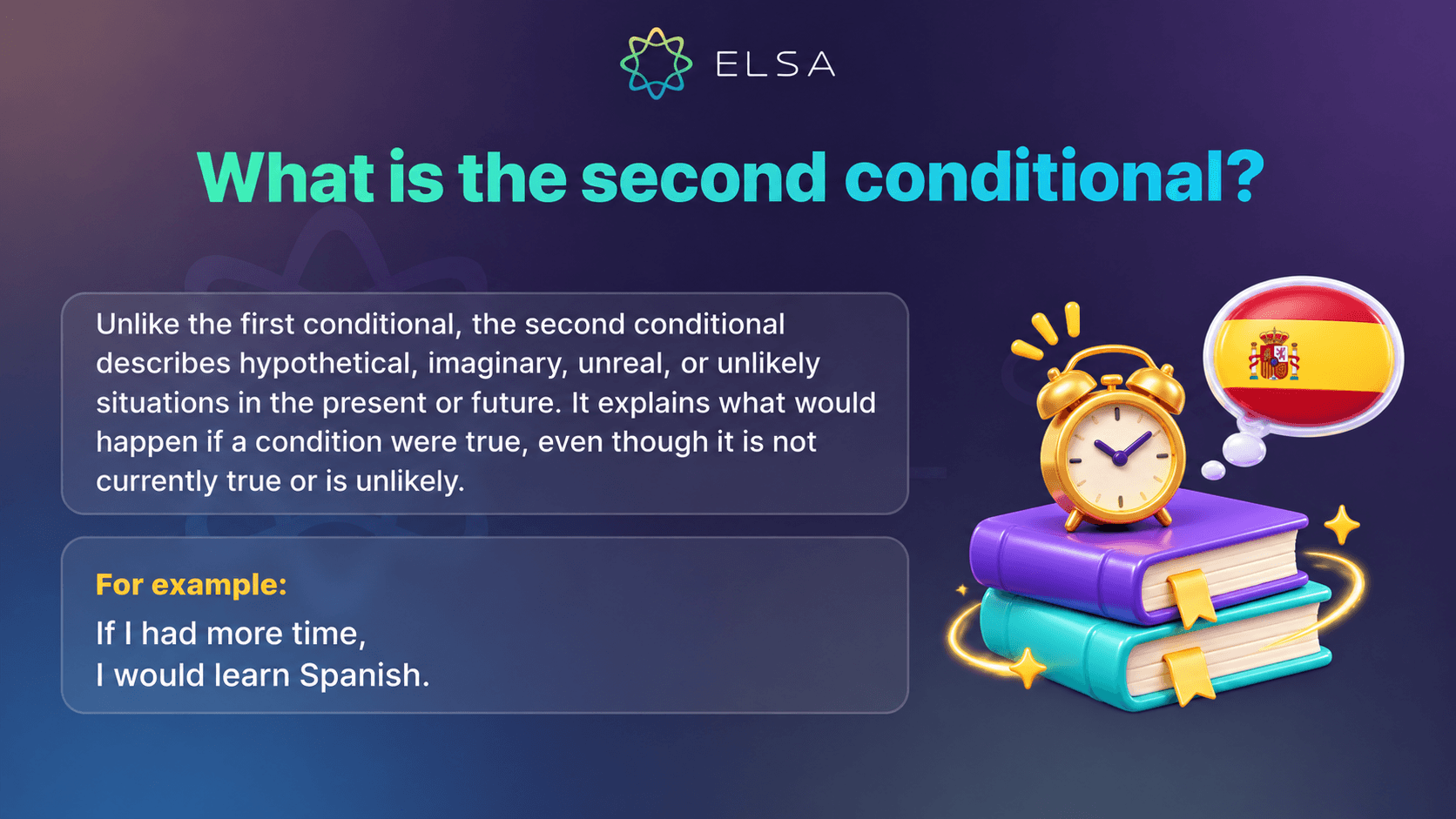
Unlike the first conditional, the second conditional is a grammatical structure to describe hypothetical, imaginary, unreal, or unlikely situations that happened in the present or future. It is used to explain what would happen if a particular condition were true, even though that condition is not currently true or considered unlikely.
For example:
- Hypothetical situation: If I had more time, I would learn Spanish.
- Reality: I don't have much free time right now, so learning Spanish is difficult.
The verb had does not indicate a completed action in the past. Instead, it expresses a hypothetical condition that is different from the speaker's current circumstances.
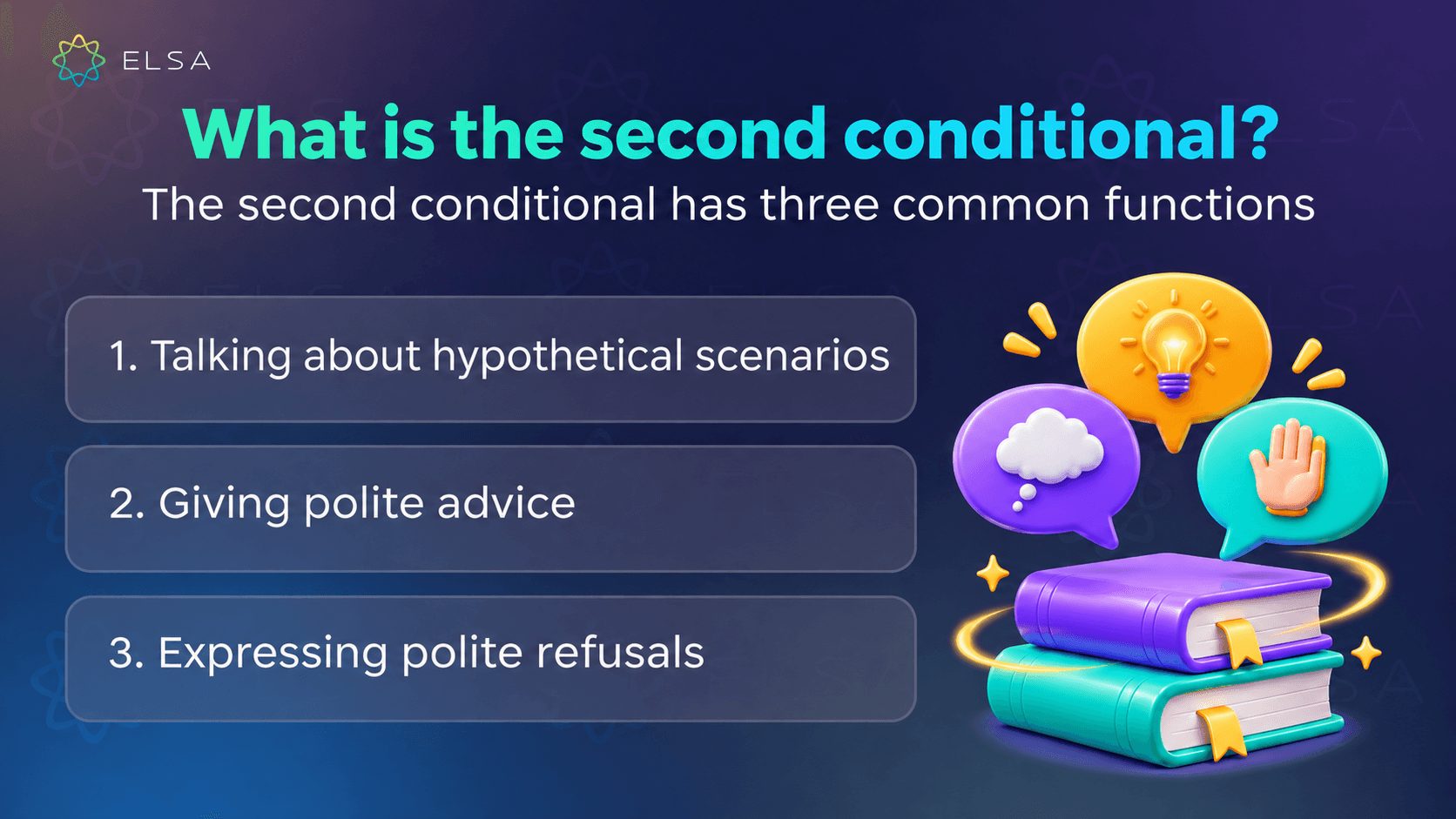
The second conditional has three common functions in everyday communication:
1. Talking about hypothetical scenarios
You can use the second conditional to imagine situations that are impossible, unrealistic, or unlikely.
Example: If I won the lottery, I would buy a house near the ocean.
2. Giving polite advice
The second conditional is especially useful when offering suggestions without sounding too direct or forceful.
Example: If I were you, I would ask the manager for feedback.
3. Expressing polite refusals
The second conditional can help explain why you cannot do something while maintaining a friendly or professional tone.
Example: If I weren't working this weekend, I would join your trip.
Second conditional formula and sentence structures
The basic second conditional formula combines a hypothetical condition in the past simple with an imagined result using would and the base form of a verb.
Second conditional formula
| If + subject + past simple, subject + would + V |
For example: If I knew the answer, I would tell you.
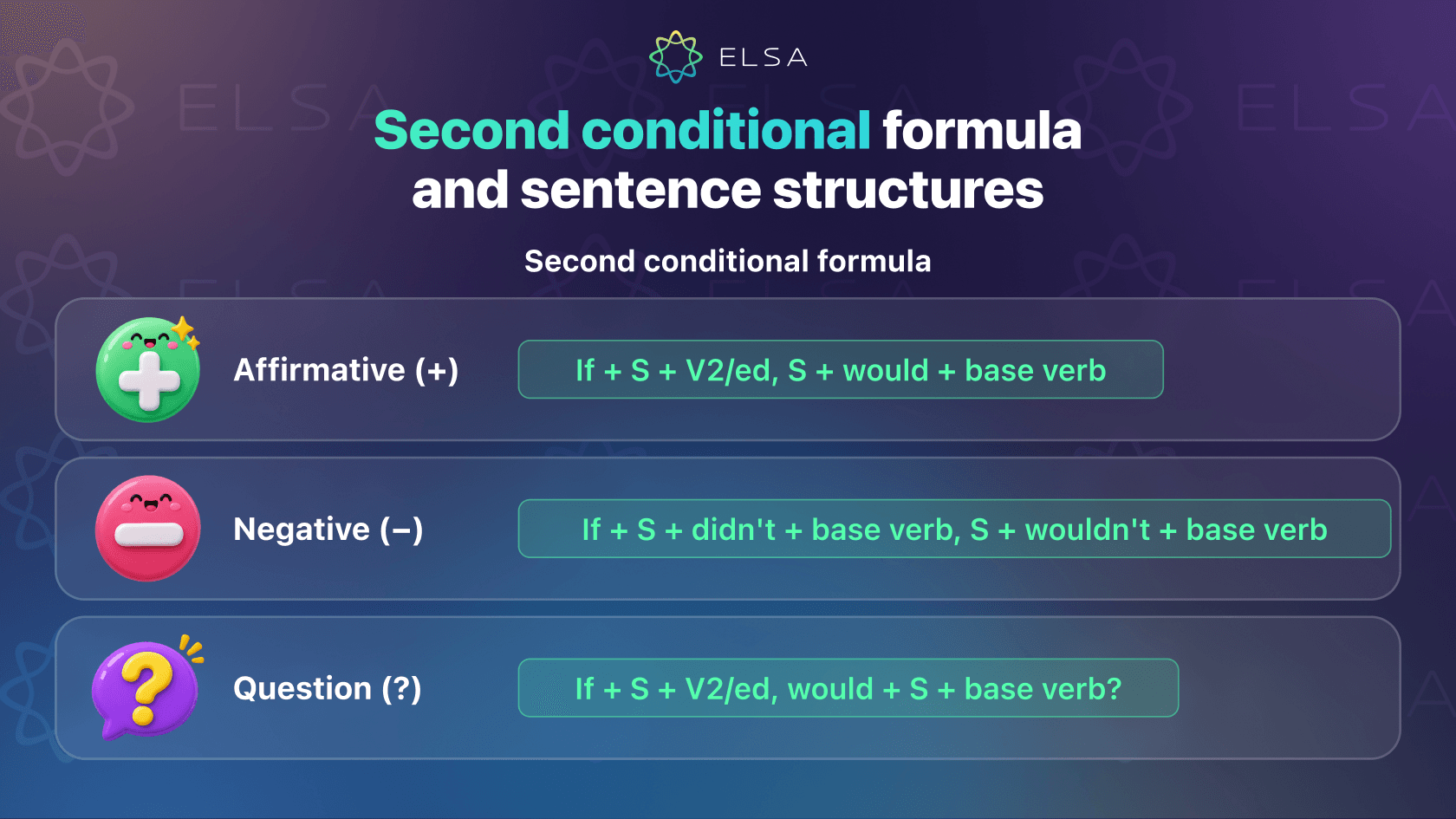
The second conditional can appear in affirmative, negative, and interrogative sentences.
| Sentence type | If clause | Main clause |
|---|---|---|
| Affirmative (+) | If + S + V2/ed | S + would + V |
| Negative (−) | If + S + didn't + V | S + wouldn't + V |
| Question (?) | If + S + V2/ed | Would + S +V? |
The negative pattern above shows both clauses in the negative, but either clause can be negative independently.
Remember the punctuation rules:
- When the if-clause comes first, place a comma between the two clauses.
- When the main clause comes first, a comma is normally unnecessary.
Affirmative second conditional
Affirmative second conditional sentences describe what someone would do or what would happen if an imaginary or unlikely condition were true.
Formula:
| If + S + V2/ed, S + would + V |
Example: If I earned a higher salary, I would travel internationally more often.
Negative second conditional
Negative second conditional sentences describe hypothetical situations involving something that would not happen or a condition that is not satisfied.
Formula:
| If + S + didn't + base verb, S + wouldn't + V |
Example: If I didn't have so many deadlines, I wouldn't work late every night.
You can also use a negative form in only one clause.
For example: If I had more confidence, I wouldn't avoid speaking English in meetings.
⇒ Here, the condition is affirmative (had more confidence), while the result is negative (wouldn't avoid).
Note: When the if-clause contains be, use weren't for formal hypothetical conditions:
For example: If she weren't so busy, she would join us.
Question second conditional
Second conditional questions ask what someone would do or what might happen in an imaginary situation.
Formula:
| Would + S + base verb + if + S + V2/ed? |
Example: Would you move to another country if you received an excellent job offer?
You can also form questions with what, where, how, or why. This structure is common in conversations, interviews, and speaking practice because it encourages people to discuss hypothetical choices.
For example: What would you do if you won a million dollars?
Modal verbs in the second conditional: Would, could, and might
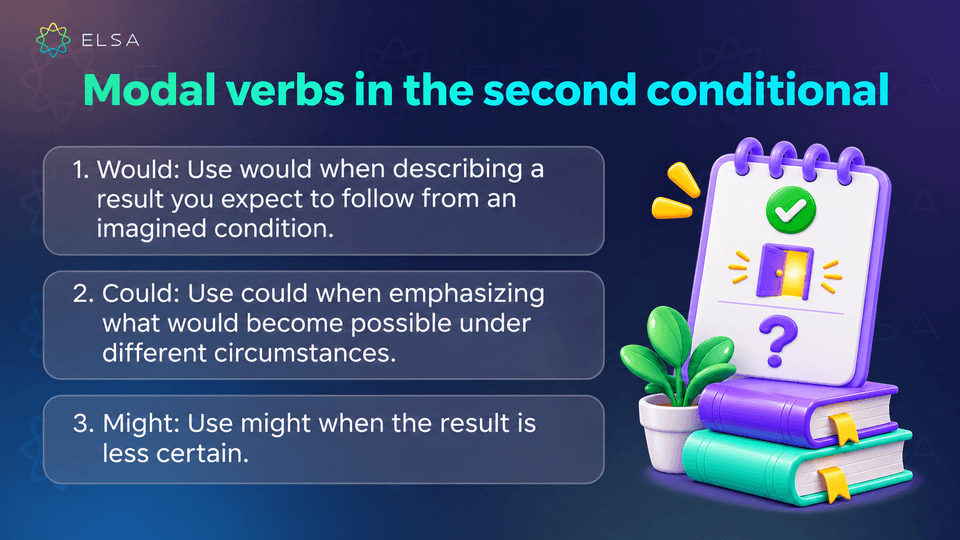
Although would is the most common modal verb in the second conditional, you can also use could and might to express different meanings. These modal verbs help distinguish between an expected hypothetical result, an ability or possibility, and an uncertain outcome.
| Modal verb | Certainty level | Function |
|---|---|---|
| Would | Expected or predicted result | Describes what the speaker believes would happen under the imagined condition |
| Could | Ability or possibility | Indicates what someone would be able to do or what might be possible |
| Might | Uncertain possibility | Suggests a result that is possible but not guaranteed |
These modal verbs do not correspond to fixed numerical probabilities. Their meanings depend on the situation and the speaker's intention.
1. Would: Expected hypothetical result
Use would when describing a result you expect to follow from an imagined condition.
Example: If I had enough savings, I would buy a new laptop.
2. Could: Ability or possibility
Use could when emphasizing what would become possible under different circumstances.
Example: If I spoke French fluently, I could apply for that position in Paris.
3. Might: Uncertain possibility
Use might when the result is less certain.
Example: If we lowered our prices, we might attract more customers.
The were vs. was subjunctive rule: If I were you
One of the most frequently tested second conditional grammar rules concerns the use of were instead of was in hypothetical statements. In formal English, "were" is preferred for all subjects, including I, he, she, and it, especially when describing a situation contrary to reality.
For example: If he were here, he would know how to solve the problem.
This use of were is traditionally called the past subjunctive, or also known as the irrealis were. It signals that the condition is hypothetical rather than factual.
Using "If I were you" to give advice
This expression is particularly useful in professional settings because it can offer advice without directly telling someone what to do,
Formula
| If I were you, I would + base verb |
For example: If I were you, I would practice English pronunciation for 15 minutes every day.
Were vs. was in American English
The distinction depends partly on the level of formality.
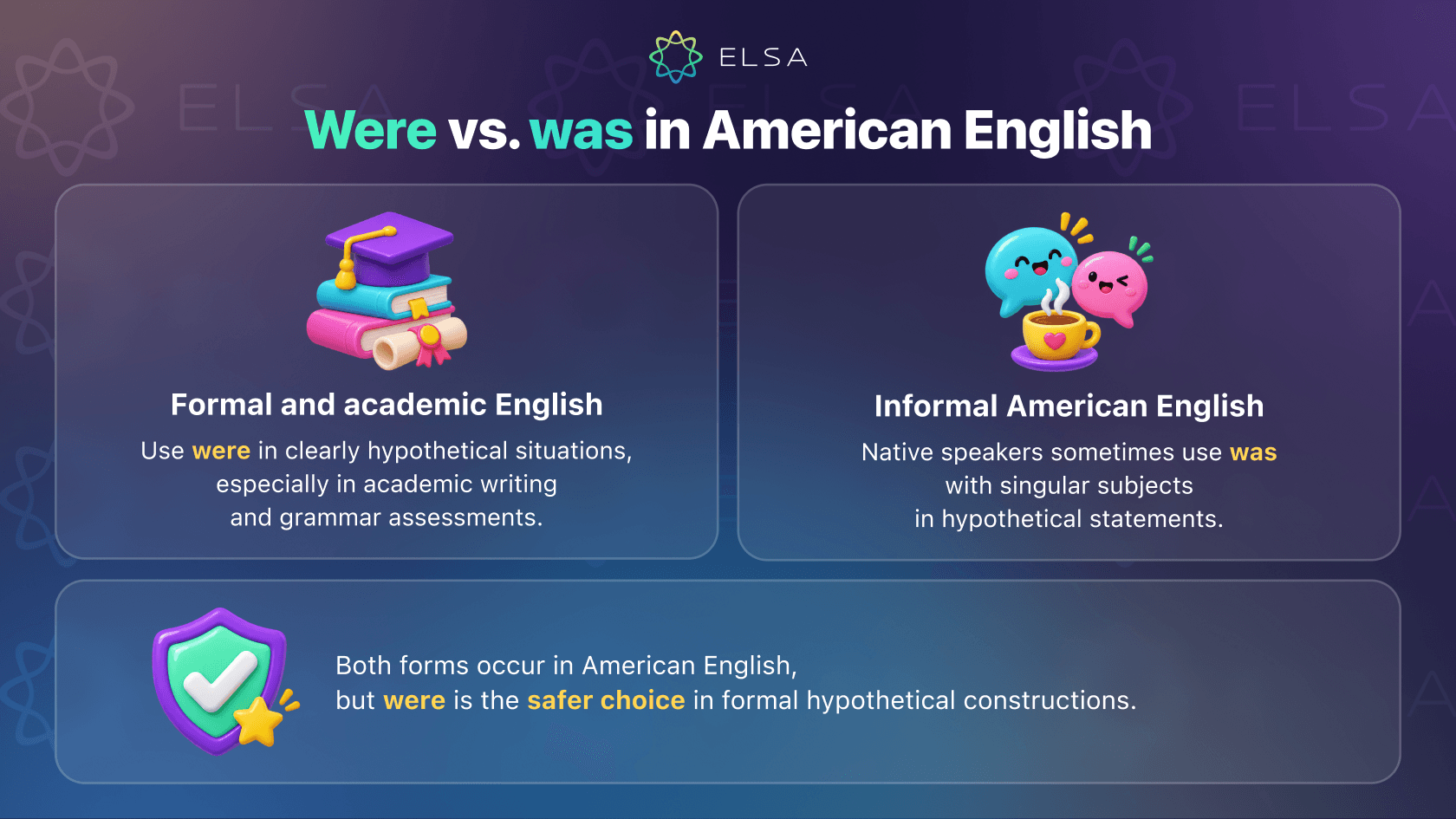
Formal and academic English
Use were in clearly hypothetical situations, especially in academic writing and grammar assessments.
Preferred: If I were the CEO, I would invest in employee training.
Informal American English
Native speakers sometimes use was with singular subjects in hypothetical statements. For example:
- Informal: If she was here, she'd know what to do.
- Formal: If she were here, she would know what to do.
Both forms can be used in American English, but "were" is the safer choice in formal hypothetical constructions. Especially with the established expression "If I were you", which is strongly preferred in edited writing and formal communication.
Note:
It is also worth to remember that "was" is also appropriate when discussing a real possibility in the past. Take a look at this example:
If she was at the office yesterday, she probably saw the announcement.
⇒ This sentence is about uncertainty concerning a past fact, not an unreal present situation.
Second conditional vs. first and third conditionals
Understanding the difference between the first, second, and third conditionals is essential for choosing the correct grammar structure.
| Conditional type | Reality/Probability | Time reference | Core formula |
|---|---|---|---|
| First conditional | Realistic or possible future condition | Present/Future | If + present simple, will + base verb |
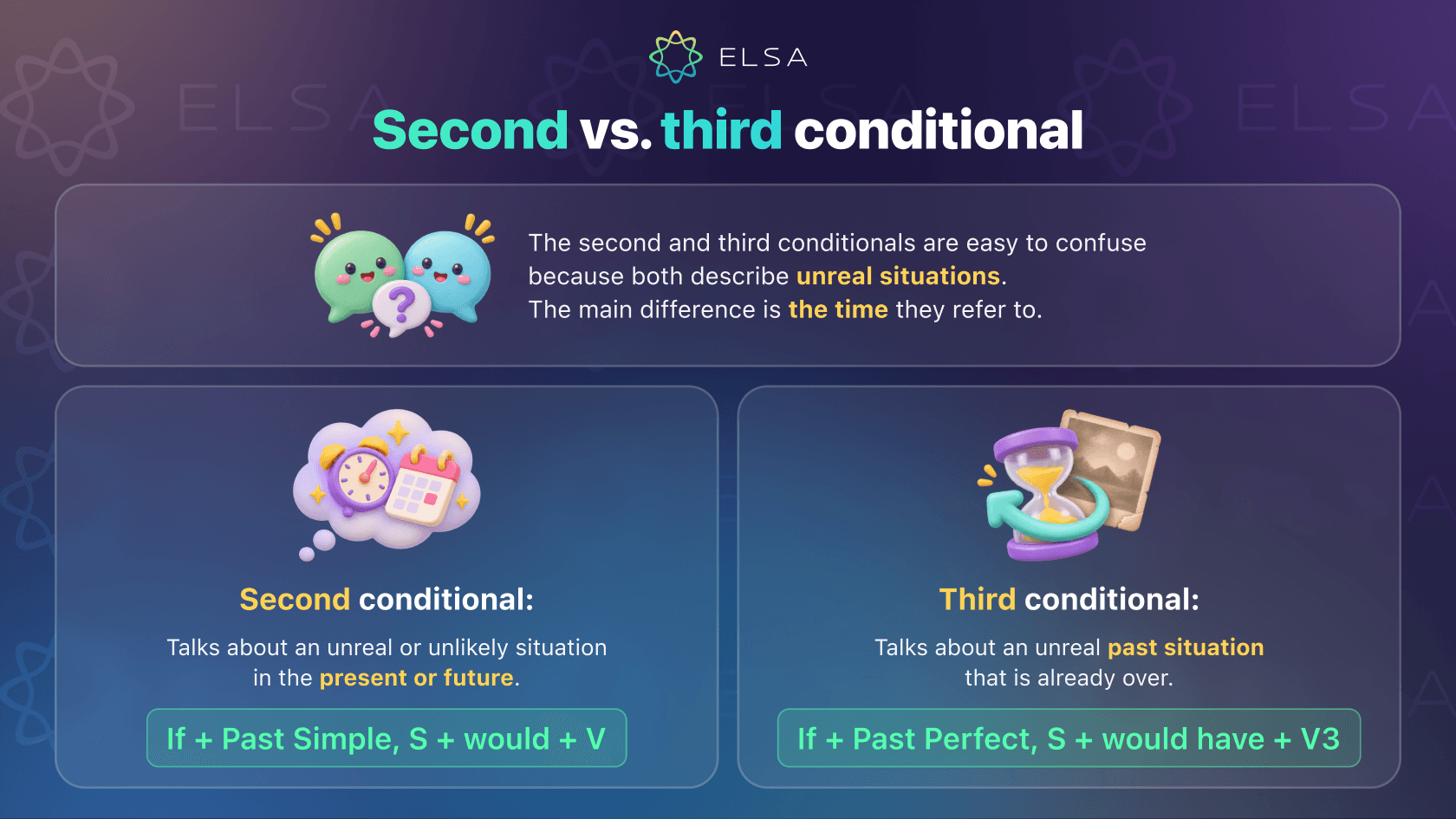
| Second conditional | Unreal, imagined, or unlikely condition | Present/Future | If + past simple, would + base verb |
| Third conditional | Imagined alternative to a past event | Past | If + past perfect, would have + V3 |
Consider these examples involving the same general situation.
- First conditional: If I study hard, I will pass the exam.
⇒ The speaker believes studying hard is a realistic possibility and expects it to improve the chance of passing. - Second conditional: If I studied harder, I would pass the exam.
⇒ The speaker imagines studying harder, suggesting that this is not what is currently happening or is unlikely. - Third conditional: If I had studied harder, I would have passed the exam.
⇒ The exam has already taken place, and the speaker imagines a different past outcome.
To remember the order easier, you can refer to this time chart below. The first and second conditionals can both refer to the future. The difference is how realistically the speaker views the condition.
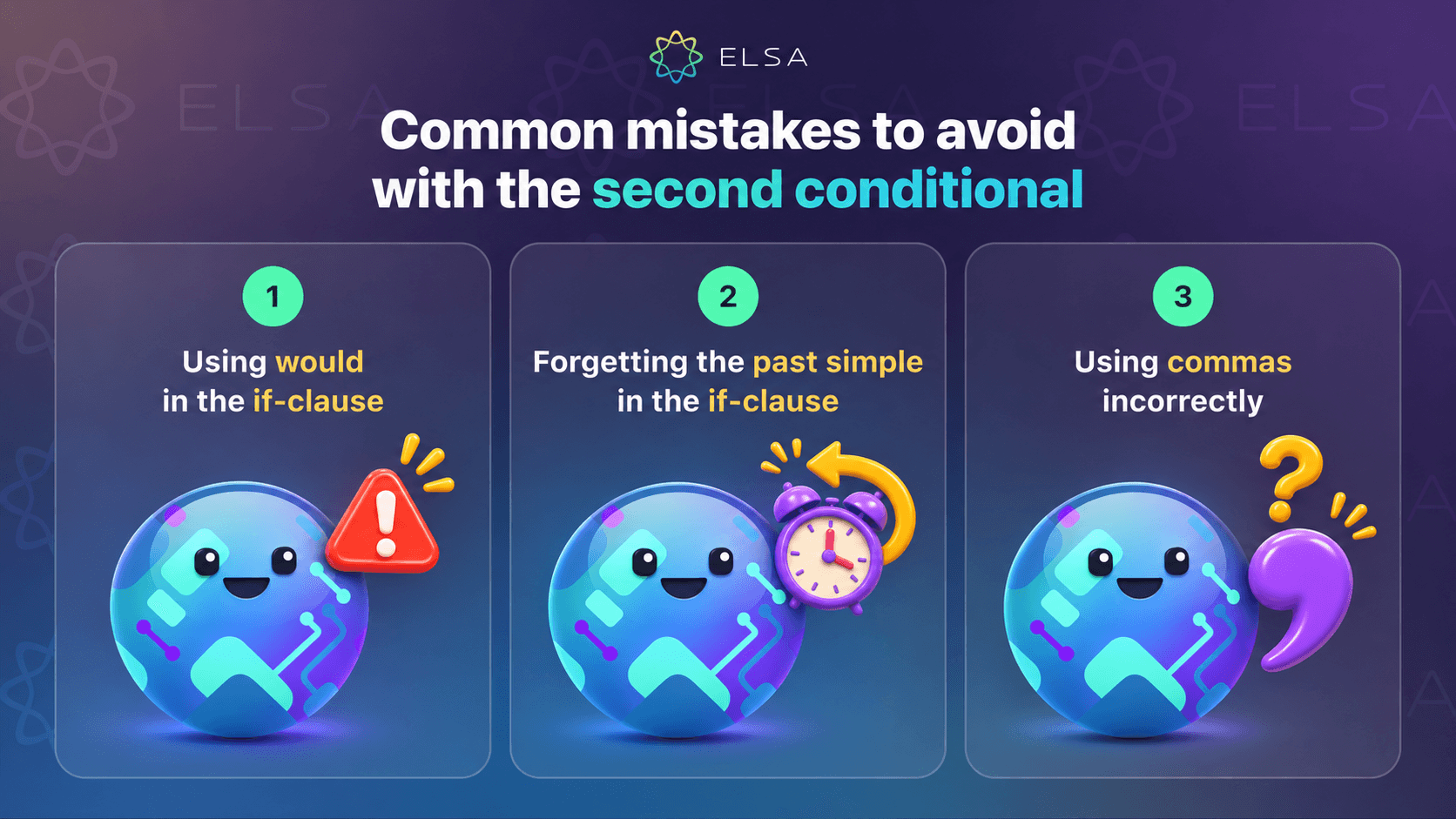
Common mistakes to avoid with the second conditional
Even intermediate English learners sometimes make mistakes with second conditional sentences. Three particularly common problems involve would, verb tenses, and punctuation.
1. Using would in the if-clause
In standard second conditional sentences, would normally belongs in the main clause, not the if-clause. The if-clause uses the past simple (had), while the main clause uses would + base verb.
- Incorrect: If I would have more money, I would buy a house.
- Correct: If I had more money, I would buy a house.
There are special constructions where would can appear after if, particularly to express willingness or make polite requests, such as "If you would wait here, I'll call the manager." However, these are not the standard second conditional pattern.
2. Forgetting the past simple in the if-clause
Learners sometimes combine a present simple if-clause with would in the result clause when they intend to express an unreal situation.
- Incorrect: If she has more free time, she would learn Italian.
- Correct: If she had more free time, she would learn Italian.
The past simple had expresses the hypothetical condition. For a realistic future possibility, use the first conditional instead
3. Using commas incorrectly
The placement of the if-clause determines whether a comma is normally needed.
- Incorrect: I would travel more often, if I had enough money.
- Correct: I would travel more often if I had enough money.
Remember: When the if-clause comes first, use a comma. However, when the main clause comes first, the comma is normally omitted.
Practice exercises on the second conditional
Practice the second conditional with the following 20 questions. Complete each exercise before checking the answer table and explanations.
Exercise 1: Conjugate the verbs in brackets
Instructions: Complete each sentence using the correct second conditional form of the verbs in parentheses.
- If I (have) ______ more free time, I (learn) ______ to play the guitar.
- If Sarah (be) ______ the manager, she (introduce) ______ flexible hours.
- If we (live) ______ closer to the beach, we (go) ______ swimming every weekend.
- If he (not spend) ______ so much money on takeout, he (save) ______ more.
- If you (speak) ______ Japanese, you (be able to) ______ work with that team.
- If they (not be) ______ so busy, they (join) ______ our study group.
- If I (know) ______ her email address, I (send) ______ her the invitation.
- If the company (offer) ______ remote work, more candidates (apply) ______.
- If my laptop (run) ______ faster, I (finish) ______ my assignments sooner.
- If we (not need) ______ a car, we (not pay) ______ for parking.
Exercise 2: Multiple-choice questions on conditional types
Instructions: Choose the best answer (A, B, C, or D) for each sentence.
1. If I ______ a million dollars, I would start a nonprofit organization.
A. have
B. had
C. will have
D. would have
2. If she were more confident, she ______ during meetings.
A. speaks
B. spoke
C. would speak
D. will speak
3. If it rains tomorrow, we ______ indoors.
A. would stay
B. had stayed
C. stayed
D. will stay
4. If I ______ you, I would review the contract carefully.
A. am
B. was
C. were
D. will be
5. If they had left earlier, they ______ the train.
A. would catch
B. would have caught
C. will catch
D. catch
6. If our office ______ closer to downtown, we could walk to lunch.
A. is
B. will be
C. were
D. would be
7. What ______ you do if you could work anywhere in the world?
A. will
B. did
C. do
D. would
8. If I didn't have an exam tomorrow, I ______ to the concert tonight.
A. would go
B. will go
C. went
D. had gone
9. If he ______ more regularly, he might feel less stressed.
A. exercises
B. exercised
C. would exercise
D. will exercise
10. I would buy that bicycle if it ______ less expensive.
A. is
B. will be
C. were
D. would be
FAQs about the second conditional
Can you ever use was instead of were in the second conditional?
Yes. In informal American English, speakers sometimes use was with singular subjects such as I, he, she, and it. However, "were" is preferred for clearly hypothetical situations in formal writing and grammar tests.
The standard advice expression is "If I were you." Remember that was is also normal when if introduces uncertainty about a real past event, rather than an unreal condition.
Why can't we use would in the if-clause?
In the standard second conditional, the if-clause states the hypothetical condition using the past simple, while would introduces the imagined result.
Say "If I knew the answer", "I would tell you", not "If I would know the answer...."
However, would can occur in other kinds of if-clauses to express willingness or a polite request, as in "If you would take a seat, we'll begin shortly."
What is the contraction form of would in spoken English?
Would is commonly contracted to 'd after personal pronouns: I'd, you'd, he'd, she'd, we'd, and they'd.
For example, "I'd go" is pronounced /aɪd ɡoʊ/ in American English. The contraction attaches to the pronoun, and the following verb stays in its base form. Note that 'd can also mean had in other constructions, so context matters.
The second conditional helps you discuss imagined situations, give thoughtful advice, and express possibilities naturally. For more English grammar guides and exercises, visit the Grammar category on ELSA Speak blog to build clearer pronunciation and more natural responses in everyday and professional conversations.