

Adjectives in English: Types, rules, and examples
elsaspeakadmin
October 28, 2026
Advanced Grammar
Adjectives are essential for describing people, places, things, and experiences in English. They help you add detail, compare characteristics, and communicate more precisely in everyday conversations and writing. In this guide, you’ll learn the main types of adjectives, where they appear in sentences, and the rules for using them correctly.
What are adjectives?
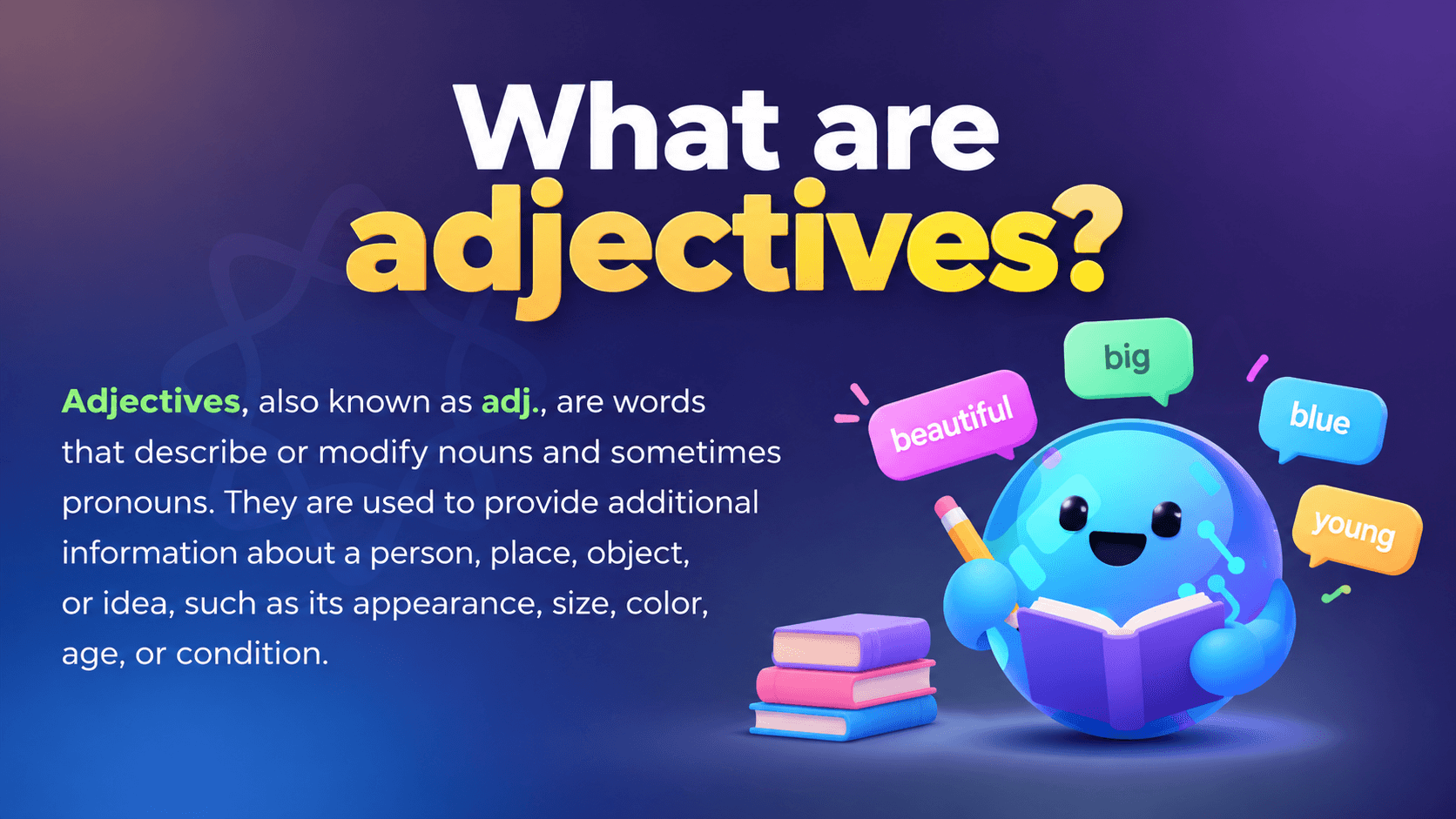
Adjectives, also known as as adj., are words that describe or modify nouns and sometimes pronouns. They are used to provide additional information about a person, place, object, or idea, such as its appearance, size, color, age, or condition.
Adjectives example: She bought a beautiful dress.
⇒ The adjective beautiful describes the noun dress by telling us what it looks like.
Types of adjectives
Traditionally, adjectives are grouped into several categories according to their meaning and function. Some categories overlap because a word can serve different grammatical roles depending on how it is used. However, in modern grammar, words such as my, this, and some are often classified as determiners when they appear before nouns.
Articles
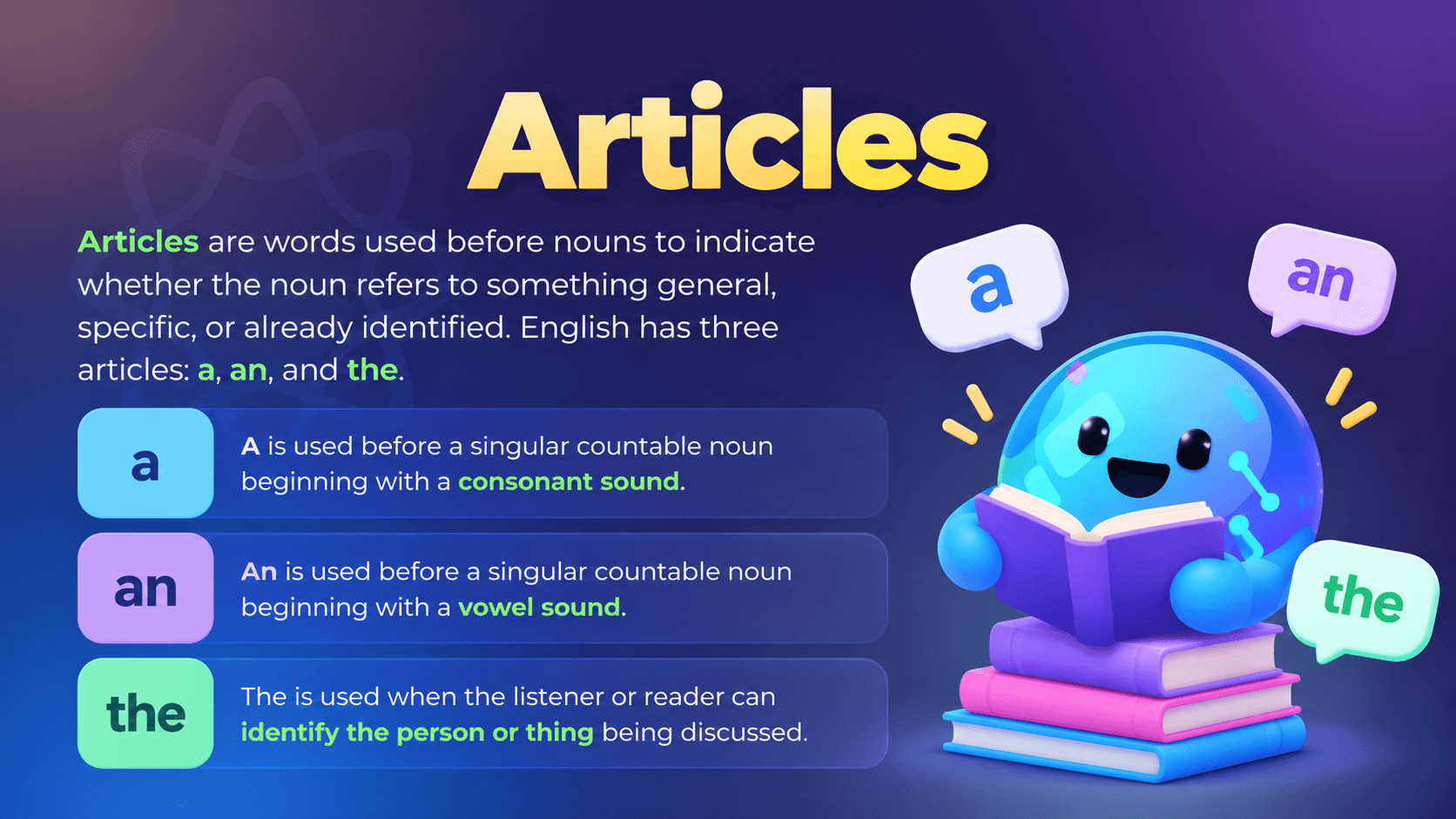
Articles are words used before nouns to indicate whether the noun refers to something general, specific, or already identified. English has three articles: a, an, and the.
- A is used before a singular countable noun beginning with a consonant sound.
- An is used before a singular countable noun beginning with a vowel sound.
- The is used when the listener or reader can identify the person or thing being discussed.
For example: She adopted a puppy.
⇒ A introduces a singular puppy that has not been identified previously.
Important: Choose a or an based on the initial sound, not simply the first letter. For example, we say a university because university begins with a /j/ sound, but an hour because the h is silent.
Possessive adjectives
Possessive adjectives, also called possessive determiners in modern grammar, indicate who owns or is associated with a person or thing. They appear before nouns.
| Possessive adjectives | Examples of adjectives |
|---|---|
| My | This is my notebook. |
| Your | Is this notebook yours? |
| His | His presentation was amazing. |
| Her | I saw her phone on the table. |
| Its | The dog wagged its tail. |
| Our | Our team won the game. |
| Their | Their apartment is near the park. |
Possessive adjectives are different from possessive pronouns. Compare:
- This is my book. (My comes before the noun book.)
- This book is mine. (Mine replaces the noun phrase my book.)
Demonstrative adjectives
Demonstrative adjectives, or also known as demonstrative determiners, are used to identify or point out particular people, animals, or things. The four commonly taught forms are this, that, these, and those.
| Demonstrative adjectives | Number and distance | Adjectives examples |
|---|---|---|
| This | Singular, relatively near | This chair is very comfortable. |
| That | Singular, relatively far | That chair is very comfortable. |
| These | Plural, relatively near | These chairs are very comfortable. |
| Those | Plural, relatively far | Those chairs are very comfortable. |
Note: When these words stand alone and replace a noun phrase, they are generally called demonstrative pronouns. When they appear directly before a noun, they function as demonstrative determiners, traditionally called demonstrative adjectives.
Coordinate adjectives
Coordinate adjectives are two or more adjectives that independently modify the same noun. They are commonly separated by commas or joined by "and".
Examples:
- We stayed in a quiet, peaceful village. Both quiet and peaceful describe the village independently.
- She gave a clear and concise explanation. Both adjectives describe the explanation, and and connects them.
How to identify coordinate adjectives
To check for coordinate adjectives, try inserting "and" between them. If the sentence remains natural and keeps essentially the same meaning, the adjectives are likely coordinate.
For example:
- A cold, rainy afternoon → A cold and rainy afternoon. The sentence still sounds natural, so a comma is appropriate between the adjectives.
- A small wooden box → A small and wooden box. This sounds less natural in the intended meaning, so small and wooden are generally not separated by a comma.
This is a useful test, although meaning and context can affect the result.
Descriptive adjectives
Descriptive adjectives describe the qualities, characteristics, conditions, or impressions associated with people, objects, places, and experiences. They can refer to appearance, color, size, age, personality, emotions, or quality.
| Category | Common adjectives | Example |
|---|---|---|
| Appearance | Beautiful, handsome, pretty, attractive | He is very handsome. |
| Color | Red, blue, green, yellow, purple | The children got a blue ball. |
| Size | Big, small, large, tiny, enormous | They live in a small cottage. |
| Age | Young, old, new, ancient, modern | We visited an ancient temple. |
| Shape | Round, square, flat, curved, narrow | The hallway was narrow. |
| Personality | Kind, friendly, honest, patient, generous | She is very kind. |
| Emotions | Happy, sad, nervous, excited, anxious | They were very excited. |
| Conditions | Clean, dirty, broken, healthy, damaged | The dishes are very dirty. |
| Quality | Excellent, terrible, useful, reliable, impressive | The machine was reliable. |
| Taste and texture | Sweet, bitter, spicy, smooth, rough | That cookie was too sweet for me. |
Quantitative adjectives
Quantitative adjectives traditionally describe the amount or quantity of a person, thing, or experience. Common examples include some, many, much, few, little, several, and enough.
| Quantitative adjectives | Used with | Examples of adjectives |
|---|---|---|
| Many | Countable plural nouns | There are many students in the library |
| Few | Countable plural nouns | We have few options left. |
| A few | Countable plural nouns | I have a few questions. |
| Several | Countable plural nouns | She visited several countries. |
| Much | Uncountable nouns | We don't have much time. |
| Little | Uncountable nouns | There is little water in the bottle. |
| A little | Uncountable nouns | Add a little sugar to the tea. |
| Some | Countable plural and uncountable nouns | We bought some apples and some milk. |
| Enough | Countable plural and uncountable nouns | We have enough chairs and enough space. |
Note: Remember the difference between few and a few, and little and a little.
- Few and little usually emphasize that the amount is insufficient or smaller than expected.
- A few and a little describe a small but available amount.
Numeral adjectives
Numeral adjectives traditionally indicate the number or order of people, objects, or events. They are commonly divided into two groups: cardinal numbers and ordinal numbers.
- Cardinal numbers tell us how many. Examples include one, two, three, and ten.
- Ordinal numbers tell us the position or order of something. Examples include first, second, third, and tenth.
These numbers are very useful if you want to talk quantities, dates, rankings, floors, and sequences. For more examples and pronunciation guidance, explore our dedicated guide to numbers in English.
Interrogative adjectives
Interrogative adjectives are traditionally defined as words that appear before nouns to ask questions about them. The three commonly taught forms are what, which, and whose.
Adjectives examples:
- What color do you prefer?
⇒ Here, what asks about the color.
- Which route is faster?
⇒ Here, which asks the listener to choose among possible routes.
- Whose bag is this?
⇒ Here, whose asks who owns the bag.
These words generally function as interrogative determiners in modern grammar when they introduce nouns.
Important: Whose vs. who's
- Whose asks about ownership: Whose keys are on the table?
- Who's is a contraction of who is or who has: Who's coming to dinner?
The two forms sound alike in many varieties of English, but their meanings and grammatical roles are different.
Distributive adjectives
Distributive adjectives traditionally refer to individual members of a group rather than treating the group only as a whole. Common examples include each, every, either, and neither.
| Distributive adjectives | Meaning and use | Examples |
|---|---|---|
| Each | Considers members individually | Each student received a certificate. |
| Every | Refers to all members of a group individually | Every employee must attend the training. |
| Either | Refers to one of two options | You can choose either seat. |
| Neither | Means not one and not the other of two options | Neither answer is correct. |
Remember: Each emphasizes individual members, while every emphasizes all members of a group. They are not interchangeable in every structure.
Indefinite adjectives
Indefinite adjectives is a traditional term for words placed before nouns to refer to an unspecified quantity, number, or range. Examples include some, any, several, many, few, all, and no.
Examples:
- Some people prefer working in the morning.
⇒ Some refers to an unspecified number of people.
- Any information would be helpful.
⇒ Any refers to information without specifying exactly what kind.
- All employees must complete the form.
⇒ All refers to the entire group.
- No tickets were available.
⇒ No indicates that the quantity is zero.
Note: Be careful to distinguish indefinite adjectives (or determiner) from indefinite pronouns.
Compare:
- Some students arrived early.
⇒ Some modifies the noun students.
- Some arrived early.
⇒ Some stands alone in place of a noun phrase and functions as a pronoun.
Proper adjectives
Proper adjectives are formed from proper nouns and describe a person, place, culture, language, or other entity associated with that name. They usually begin with a capital letter in English.
For example: We went to Japan and tried Japanese food.
⇒ In this sentence, "Japanese" is the proper adjectives of Japan.
Proper adjectives do not all follow the same formation rule. For example, France becomes French, while Greece becomes Greek. Check the standard spelling of each adjective rather than assuming one suffix works for every proper noun.
Compound adjectives
Compound adjectives contain two or more elements that work together to describe a noun. They can include combinations of adjectives, nouns, numbers, and participles.
For example: He is a well-known actor.
⇒ Here, "well-known" is the compound adjective which means famous or widely recognized.
Note: Compound adjectives are often hyphenated when they appear before a noun, especially when the hyphen clarifies how the words work together. However, not every compound adjective requires a hyphen. Usage depends on the construction, context, and style guide.

Where do adjectives go in a sentence?
Adjectives can appear in different positions depending on what they describe and how they function in the sentence.
Attributive adjectives
Attributive adjectives appear directly before the noun they modify or within the noun phrase that contains it.
Examples:
- She bought a red jacket.
- We stayed at a comfortable hotel.
In these sentences, red, comfortable, small, and energetic describe the nouns that follow them.
A noun can have more than one attributive adjective. When several adjectives appear together, their order usually follows conventional patterns, such as opinion before size and color. See the section on adjective order below.
Predicative adjectives
Predicative adjectives appear after linking verbs and describe the subject of a sentence. Common linking verbs include be, seem, become, feel, look, smell, sound, and taste when they express a state or characteristic.
Adjectives examples:
- The room is quiet.
- She seems nervous.
In each sentence, the adjective describes the subject rather than a noun immediately following it.
Note: Be aware that some verbs can function as either linking verbs or action verbs depending on the meaning. For example, "The soup tastes salty" describes the soup, while "She tasted the soup" describes an action.
Adjectives after indefinite pronouns
When an adjective describes an indefinite pronoun such as someone, anyone, something, nothing, or everybody, it usually appears after the pronoun.
Examples:
- I met someone interesting at the conference.
- There is nothing unusual about the result.
Rules for using adjectives
Knowing adjective types is only the first step. You also need to understand adjective order, how to make comparisons, and when to use adjectives with linking verbs.
Adjective order in English
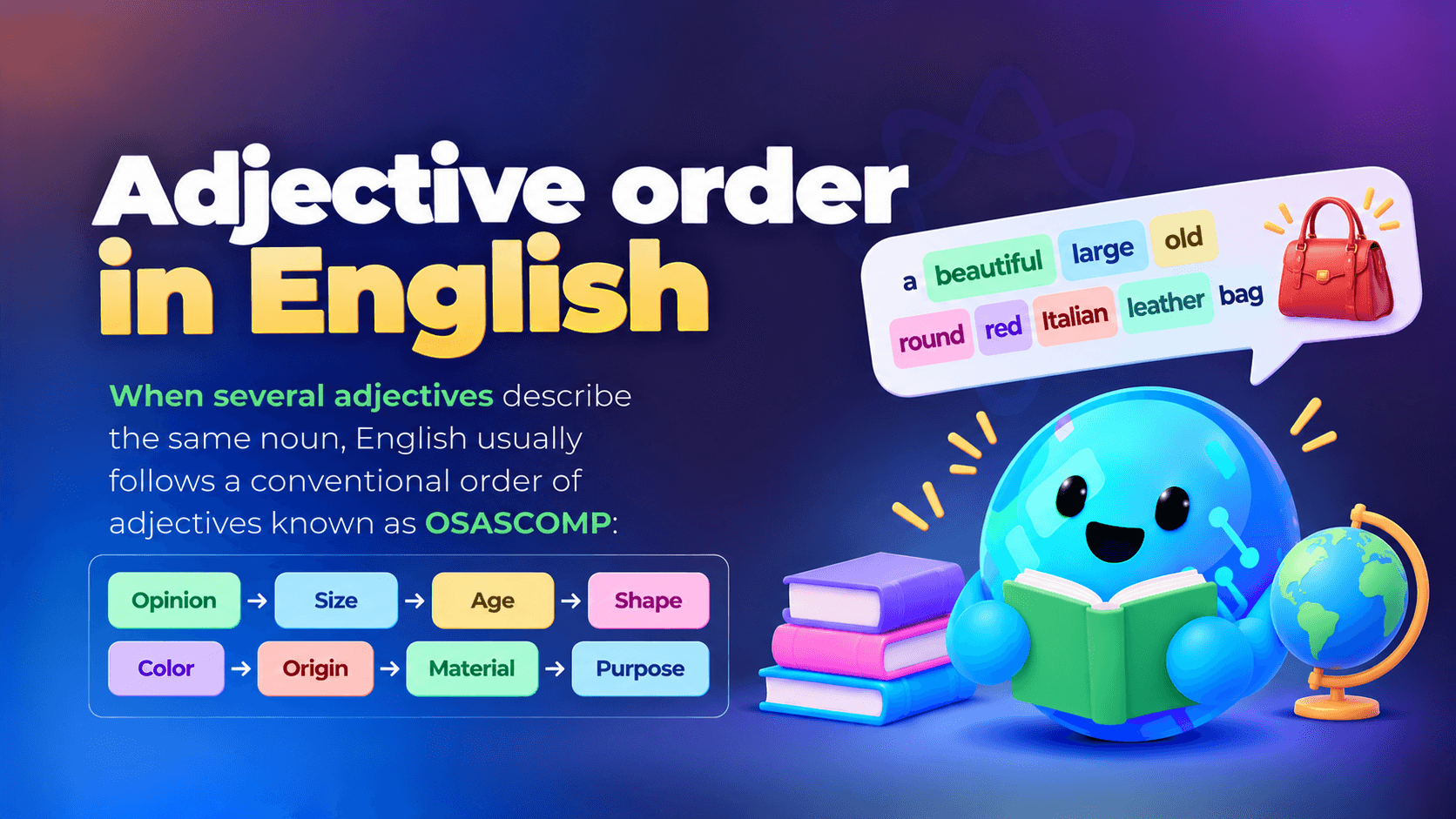
When several adjectives describe the same noun, English usually follows a conventional order of adjectives known as OSASCOMP:
| Opinion → Size → Age → Shape → Color → Origin → Material → Purpose |
| Order | Category | Examples |
|---|---|---|
| 1 | Opinion | Beautiful, lovely, useful |
| 2 | Size | Big, small, tall |
| 3 | Age | Old, young, new |
| 4 | Shape | Round, square, rectangular |
| 5 | Color | Red, blue, black |
| 6 | Origin | American, Italian, Japanese |
| 7 | Material | Wooden, cotton, plastic |
| 8 | Purpose | Running, sleeping, cooking |
For example:
- She bought a beautiful small old round red Italian wooden table.
- He wore a stylish black leather jacket.
Important points to remember:
- OSASCOMP is a useful guideline, not a rule that every sentence must include all eight categories.
- Most natural descriptions use only two or three adjectives.
- Coordinate adjectives may be separated by commas, while non-coordinate adjectives generally are not.
- Meaning and emphasis can sometimes affect the order.
Comparative and superlative adjectives
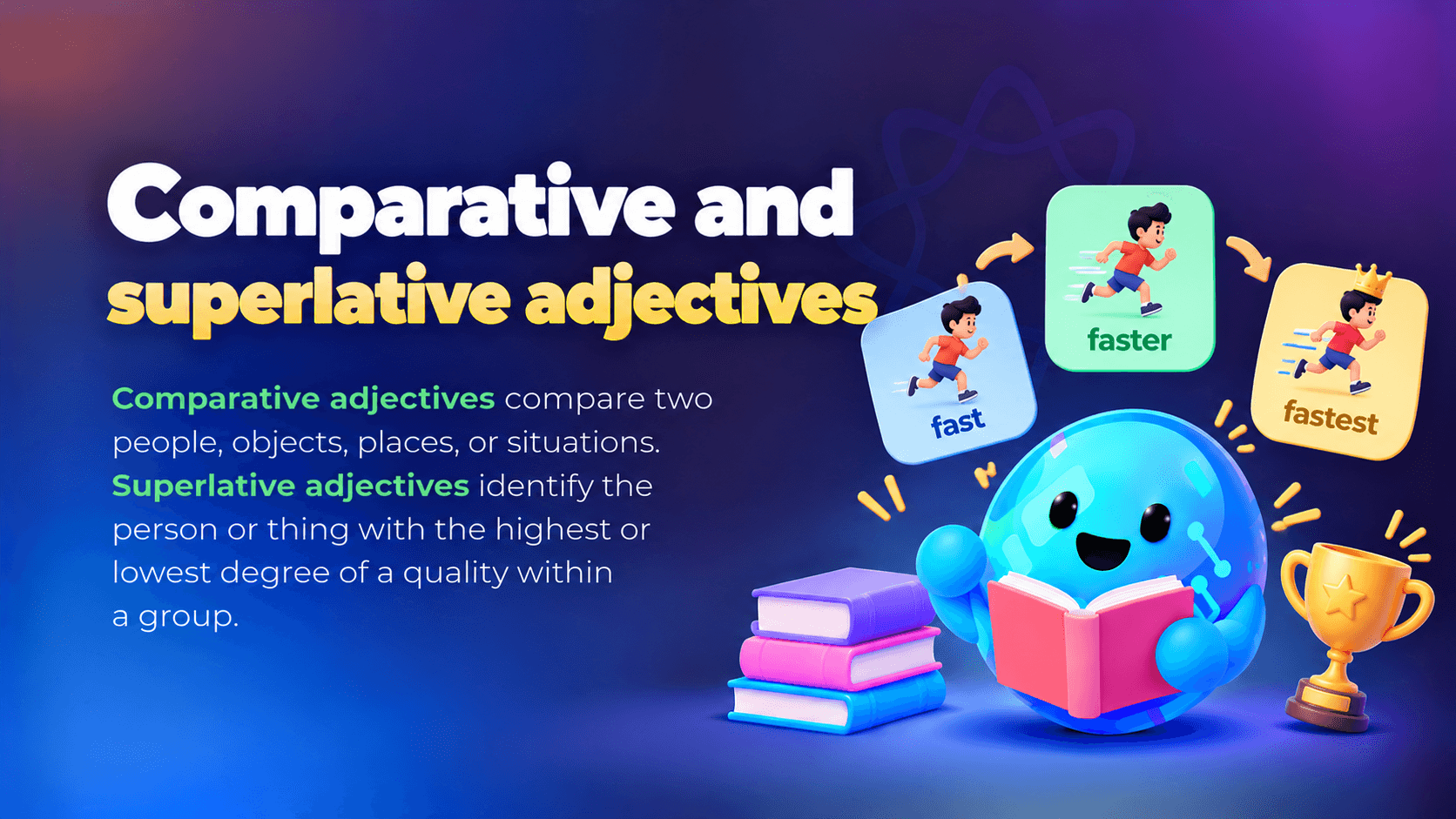
Comparative adjectives compare two people, objects, places, or situations. Superlative adjectives identify the person or thing with the highest or lowest degree of a quality within a group.
Examples of adjectives:
- My room is larger than yours.
- This is the largest room in the house.
Comparative and superlative formulas
| Form | Formula | Examples |
|---|---|---|
| Comparative | S + V + comparative adjective + than + comparison | This bag is lighter than that one. |
| Superlative | S + V + the + superlative adjective + in/of + group | It is the lightest bag in the store. |
| Long adjectives | More/most + adjective | This explanation is more detailed than the previous one. |
Rules for forming comparatives and superlatives
| Pattern | Comparative | Superlative | Example |
|---|---|---|---|
| Most short adjectives | Add -er | Add -est | tall → taller → tallest |
| Adjectives ending in silent -e | Add -r | Add -st | nice → nicer → nicest |
| Short adjectives ending in consonant-vowel-consonant | Often double the final consonant and add -er | Double the final consonant and add -est | big → bigger → biggest |
| Adjectives ending in consonant + y | Change y to i and add -er | Change y to i and add -est | happy → happier → happiest |
| Many longer adjectives | Use more | Use most | careful → more careful → most careful |
The spelling rules have exceptions, and some two-syllable adjectives can use either form depending on the word and usage. However, there are still some adjectives that do not follow these rules. Those included:
- Good → Better → Best
- Bad → Worse → Worst
- Far → Farther/Further → Farthest/Furthest
- Little (amount) → Less → Least
- Much/Many → More → Most
-ed and -ing adjectives
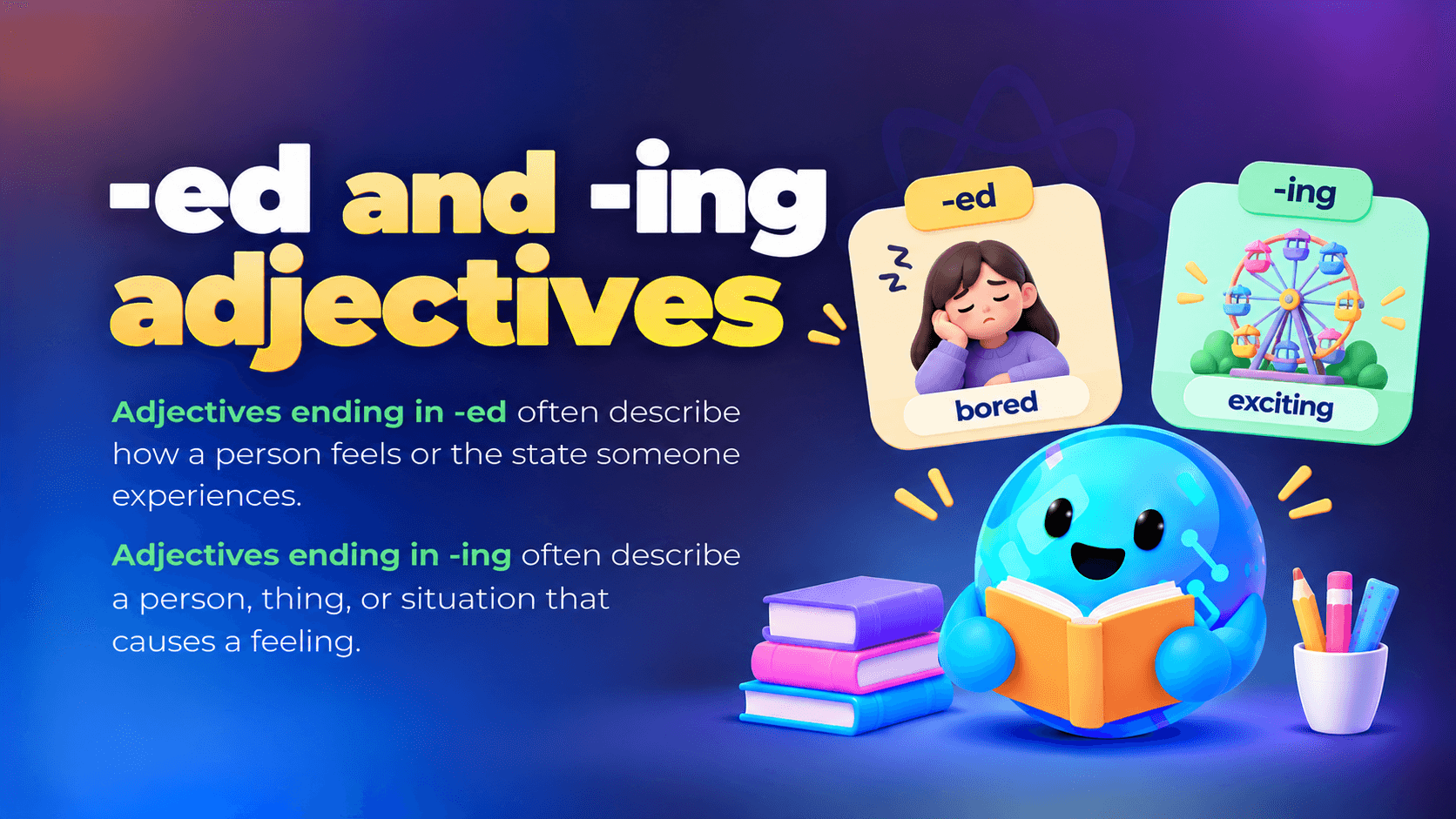
Adjectives ending in -ed often describe how a person feels or the state someone experiences. Adjectives ending in -ing often describe a person, thing, or situation that causes a feeling.
For example:
- The lecture was boring.
⇒ The adjective describes the lecture as something that causes boredom.
- The students were bored.
⇒ The adjective describes how the students felt.
Adjectives with linking verbs
Adjectives can follow linking verbs to describe the subject. Common linking verbs include be, seem, become, look, feel, smell, sound, and taste when they express a state or characteristic.
Examples:
- The flowers smell wonderful.
- He looks tired.
Remember: Use an adjective when describing the subject after a linking verb. Use an adverb when you need to describe how an action is performed. The same verb may function differently depending on the sentence.
Common adjectives in English
The following tables include frequently used adjectives with American English IPA pronunciations.
Common adjectives to describe people
| Adjectives | IPA pronunciation | Meaning |
|---|---|---|
| Friendly | /ˈfrɛndli/ | Kind and pleasant toward others |
| Kind | /kaɪnd/ | Caring and considerate |
| Honest | /ˈɑːnɪst/ | Truthful and sincere |
| Patient | /ˈpeɪʃənt/ | Able to wait without becoming upset |
| Confident | /ˈkɑːnfɪdənt/ | Believing in your abilities |
| Creative | /kriˈeɪtɪv/ | Able to produce original ideas |
| Quiet | /ˈkwaɪət/ | Making little noise or speaking very little |
| Funny | /ˈfʌni/ | Causing laughter or amusement |
| Generous | /ˈdʒɛnərəs/ | Willing to give or share |
| Reliable | /rɪˈlaɪəbəl/ | Able to be trusted or depended on |
Common adjectives to describe things and places
| Adjectives | IPA pronunciation | Meaning |
|---|---|---|
| Beautiful | /ˈbjuːtəfəl/ | Pleasing to look at |
| Comfortable | /ˈkʌmfərtəbəl/ | Providing physical ease or comfort |
| Spacious | /ˈspeɪʃəs/ | Having plenty of room |
| Crowded | /ˈkraʊdɪd/ | Filled with many people or things |
| Expensive | /ɪkˈspɛnsɪv/ | Costing a lot of money |
| Affordable | /əˈfɔːrdəbəl/ | Reasonably priced |
| Modern | /ˈmɑːdərn/ | Related to the present time or a recent style |
| Ancient | /ˈeɪnʃənt/ | Very old, often from a distant historical period |
| Convenient | /kənˈviːniənt/ | Suitable or easy to use |
| Noisy | /ˈnɔɪzi/ | Making a lot of noise |
Positive and negative adjectives
| Positive adjective | IPA pronunciation | Negative adjective | IPA pronunciation |
|---|---|---|---|
| Excellent | /ˈɛksələnt/ | Terrible | /ˈtɛrəbəl/ |
| Helpful | /ˈhɛlpfəl/ | Unhelpful | /ʌnˈhɛlpfəl/ |
| Polite | /pəˈlaɪt/ | Rude | /ruːd/ |
| Optimistic | /ˌɑːptɪˈmɪstɪk/ | Pessimistic | /ˌpɛsɪˈmɪstɪk/ |
| Careful | /ˈkɛrfəl/ | Careless | /ˈkɛrləs/ |
| Honest | /ˈɑːnɪst/ | Dishonest | /dɪsˈɑːnɪst/ |
| Patient | /ˈpeɪʃənt/ | Impatient | /ɪmˈpeɪʃənt/ |
| Friendly | /ˈfrɛndli/ | Hostile | /ˈhɑːstəl/ |
Adjectives vs. adverbs
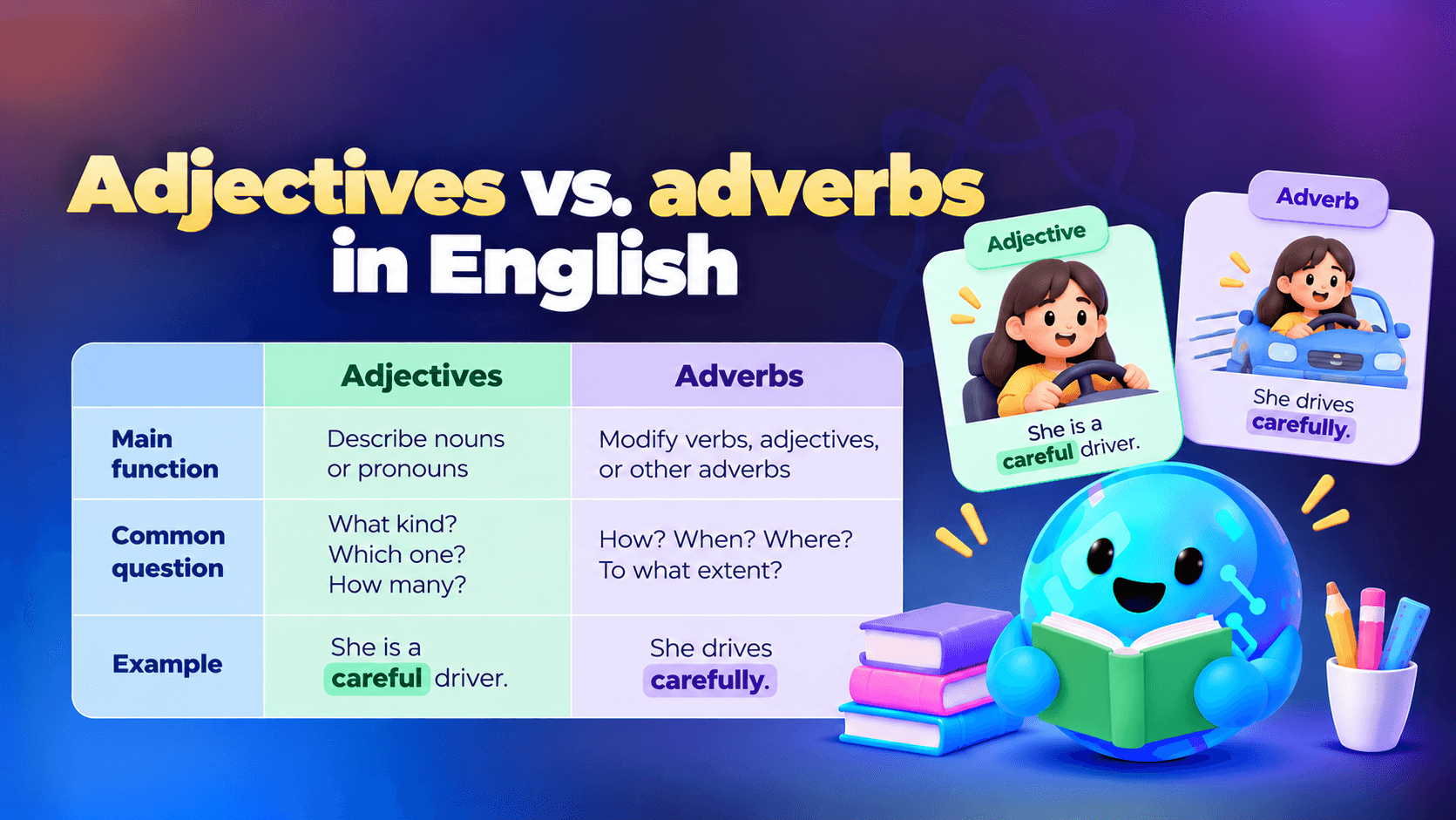
Adjectives and adverbs both add information to sentences, but they perform different grammatical functions. Adjectives generally describe nouns or pronouns, while adverbs can modify verbs, adjectives, or other adverbs.
| Feature | Adjectives | Adverbs |
|---|---|---|
| Main function | Describe nouns or pronouns | Modify verbs, adjectives, or other adverbs |
| Common question | What kind? Which one? How many? | How? When? Where? To what extent? |
| Example | She is a careful driver. | She drives carefully. |
Note:
Many adverbs are formed by adding -ly to an adjective, such as quick → quickly and careful → carefully. However, not every adverb ends in -ly, and not every word ending in -ly is an adverb.
For example, friendly is an adjective.
Some words can function as either adjectives or adverbs:
- Adjective: It was a fast train.
- Adverb: The train moved fast.
To choose the correct form, identify what the word modifies. If it describes a noun or pronoun, an adjective is usually appropriate. If it describes how an action happens, an adverb is often needed.
FAQs about adjectives
How do you identify an adjective in a sentence?
To identify an adjective, look for a word that describes or provides information about a noun or pronoun. Ask questions such as “What kind?”, “Which one?”, or “How many?”
For example, in “She wore a blue dress,” blue describes the noun dress. In “The children are happy,” happy describes the subject children and appears after the linking verb are.
Remember that adjectives can appear before nouns or after linking verbs. In certain structures, they can also follow indefinite pronouns, as in “someone helpful.”
Can a sentence have more than one adjective?
Yes. A sentence can contain two or more adjectives describing the same noun or different nouns.
For example:
- She bought a beautiful, small handbag.
- They live in a large modern apartment.
- The friendly, patient teacher explained the lesson.
When multiple adjectives describe the same noun, follow the usual order of adjectives. Use commas between coordinate adjectives, but do not automatically insert commas between every pair of adjectives.
Do adjectives change in the plural?
In English, adjectives generally do not change form to agree with singular or plural nouns.
For example:
- One small dog.
- Two small dogs.
- A beautiful flower.
- Several beautiful flowers.
The adjective stays the same, while the noun may change to its plural form. This differs from some other languages in which adjectives change according to the noun's gender or number.
Some adjectives have comparative and superlative forms, such as small, smaller, and smallest, but these changes express degree rather than plural agreement.
>> See more:
Adjectives help you describe people, places, objects, and experiences with greater clarity. For more practical grammar explanations and vocabulary-building tips, explore the Grammar category on the ELSA Speak blog. You can also practice speaking with ELSA Speak to improve your pronunciation and build confidence using English in real-life situations.