

Indefinite pronouns: Definition, types, and how to use them
elsaspeakadmin
August 7, 2026
English clauses
Indefinite pronouns are one of the most common pronouns in English. In this article, we will provide you indefinite pronouns meaning, list of most common ones, and examples to help you use them correctly.
| Key Takeaways |
An indefinite pronoun is a word which replaces a noun or pronoun without naming a specific person, place, or thing, allowing learners to speak or write about quantities and groups in general terms. There are 3 types of indefinite pronoun:
How to use indefinite pronouns correctly:
|
What are indefinite pronouns?
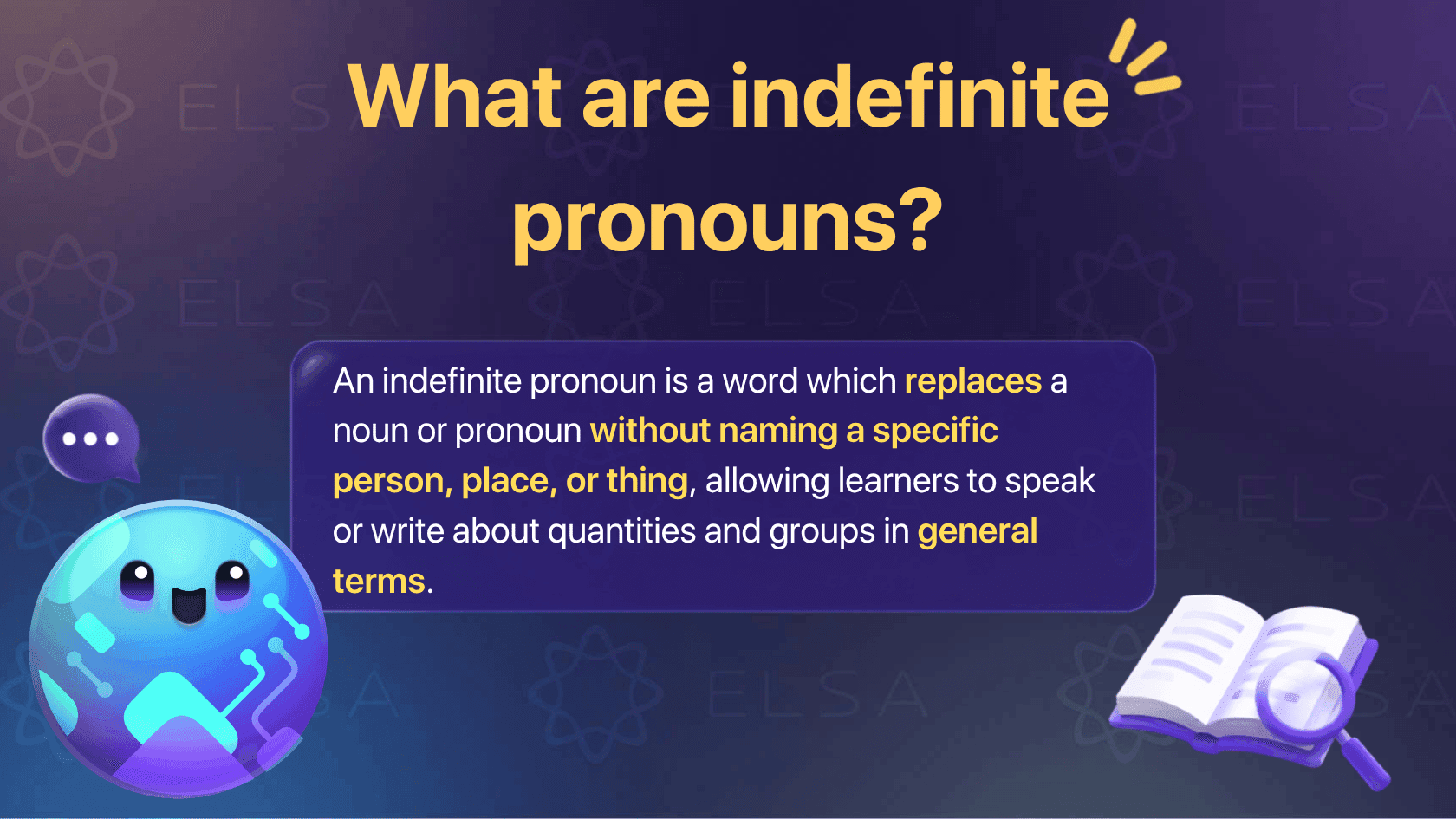
An indefinite pronoun is a word which replaces a noun or pronoun without naming a specific person, place, or thing, allowing learners to speak or write about quantities and groups in general terms.
Common type of indefinite pronouns
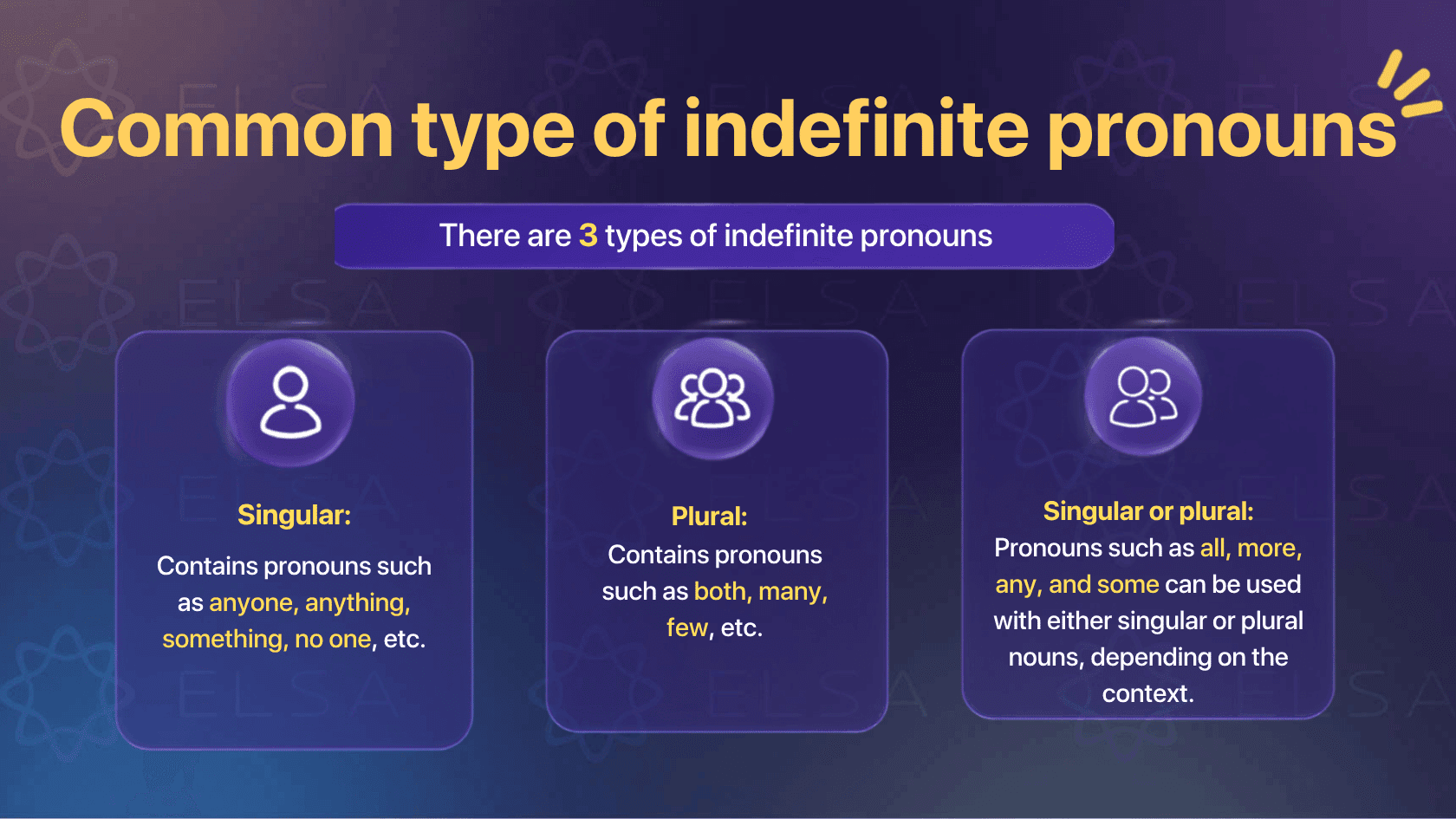
There are 3 types with examples of indefinite pronouns:
- Singular: Contains pronouns such as anyone, anything, something, no one, etc.
For example: No one saw it happen.
- Plural: Contains pronouns such as both, many, few, etc.
For example: Both were ready for the race.
- Singular or plural: Pronouns such as all, more, any, and some can be used with either singular or plural nouns, depending on the context.
For example:
- Singular: All of the cake is gone.
- Plural: All of the cookies are gone.
How to use indefinite pronouns correctly
Subject-verb agreement (singular vs plural)
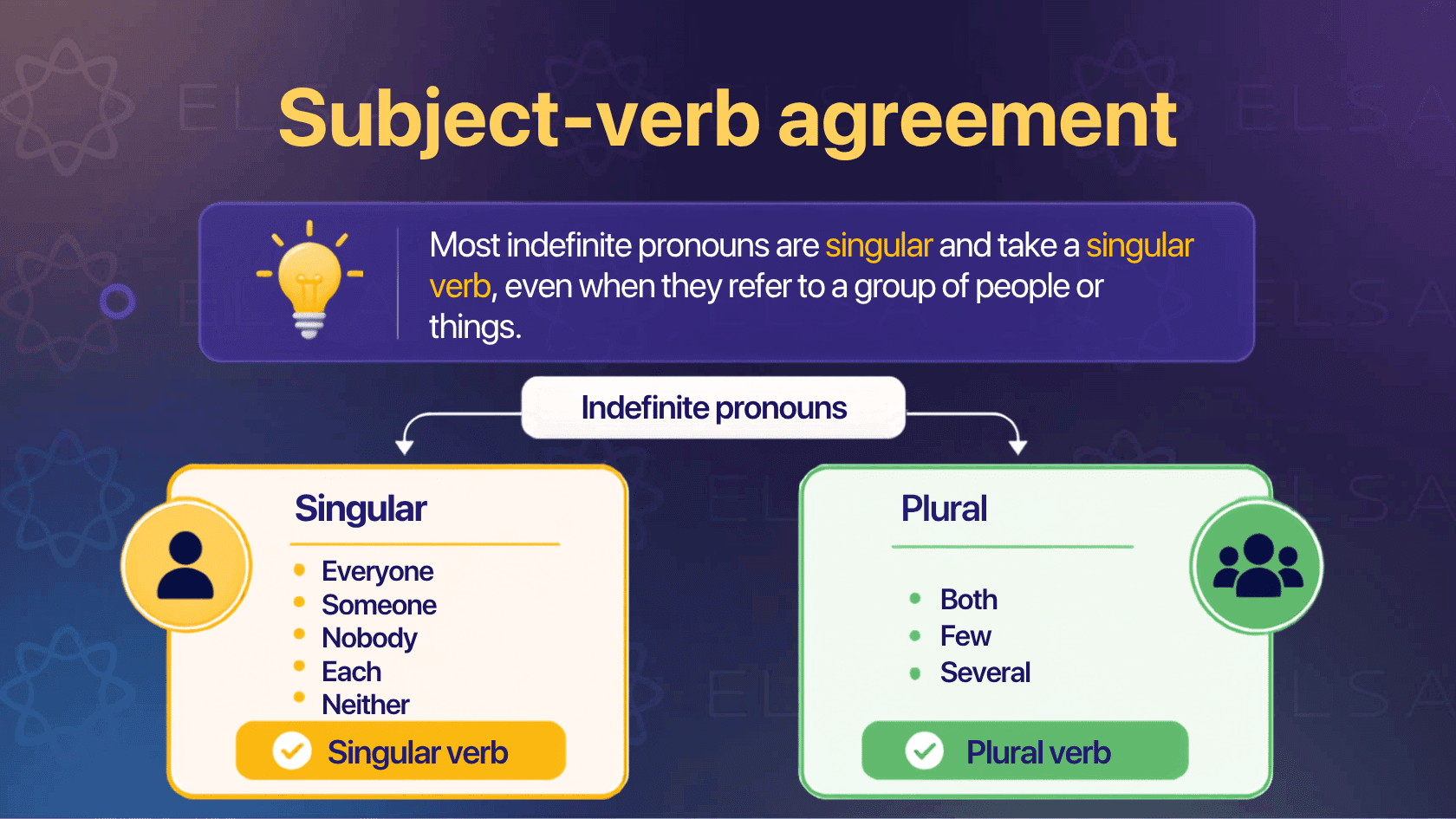
Most indefinite pronouns are singular and take a singular verb, even when they refer to a group of people or things.
| Type | Pronouns | Verb agreement |
| Singular | Everyone, someone, nobody, each, neither | Singular verb |
| Plural | Both, few, several | Plural verb |
For example:
- Singular: Everyone is ready for the monthly meeting.
- Plural: Several are waiting in the courtyard.
With singular or plural pronouns, such as all, any, more, etc, their verb agreement depends on whether the noun that follows is uncountable or countable:
| Type | Verb agreement | Example |
| Uncountable noun | Singular verb | Some of the information is useful. |
| Countable noun | Plural verb | Some of the students are ready. |
Quick tip:
To remember four indefinite pronouns, you can try grouping them by their prefixes:
- Some- → someone / something (there is)
- Any- → any person / any thing
- Every- → every person / every thing
- No- → no person / no thing
Subjective vs objective case
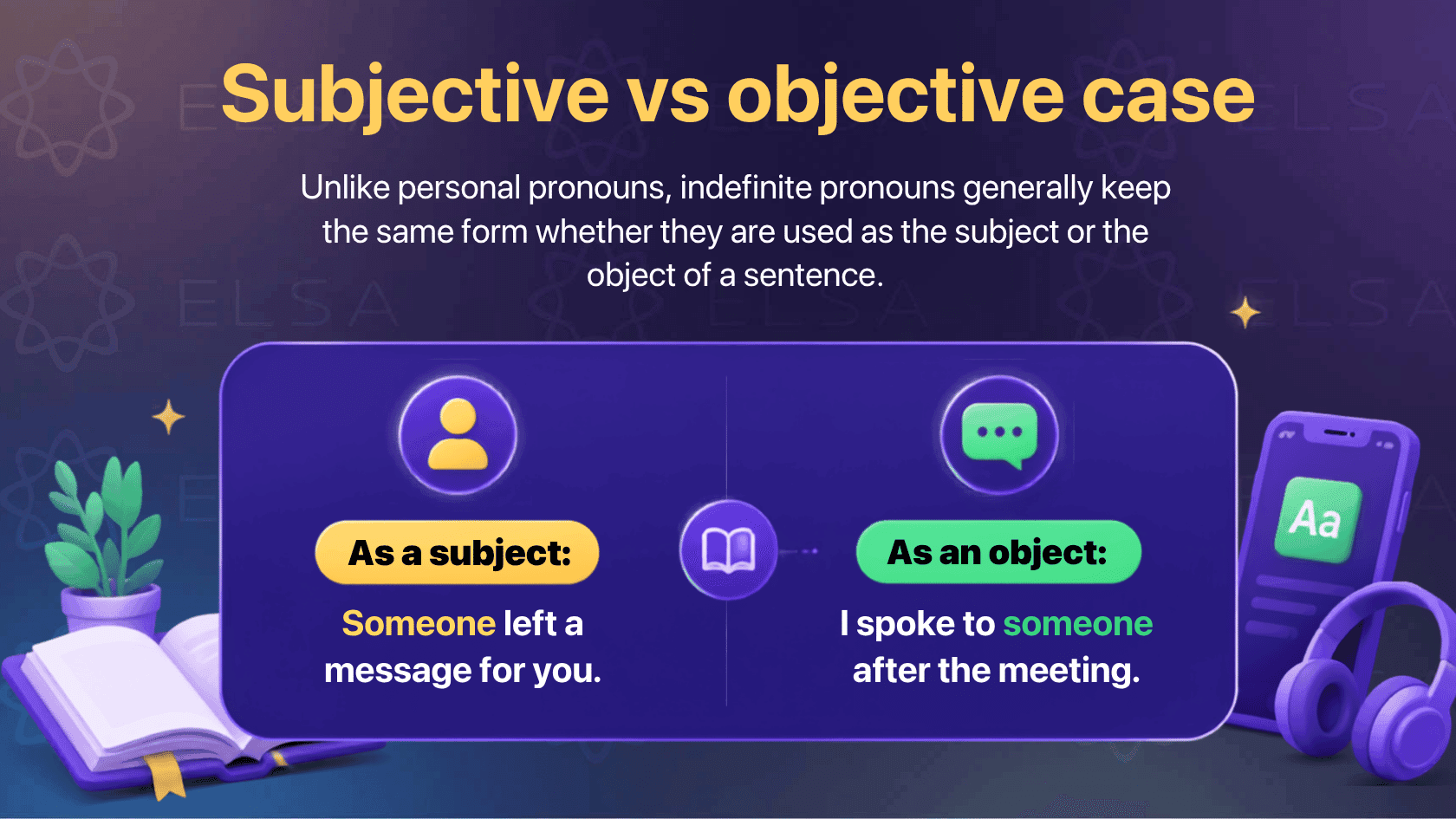
Unlike personal pronouns, indefinite pronouns generally keep the same form whether they are used as the subject or the object of a sentence. You do not need to change their form based on their grammatical role.
For example:
- As a subject: Someone left a message for you.
- As an object: I spoke to someone after the meeting.
Negation
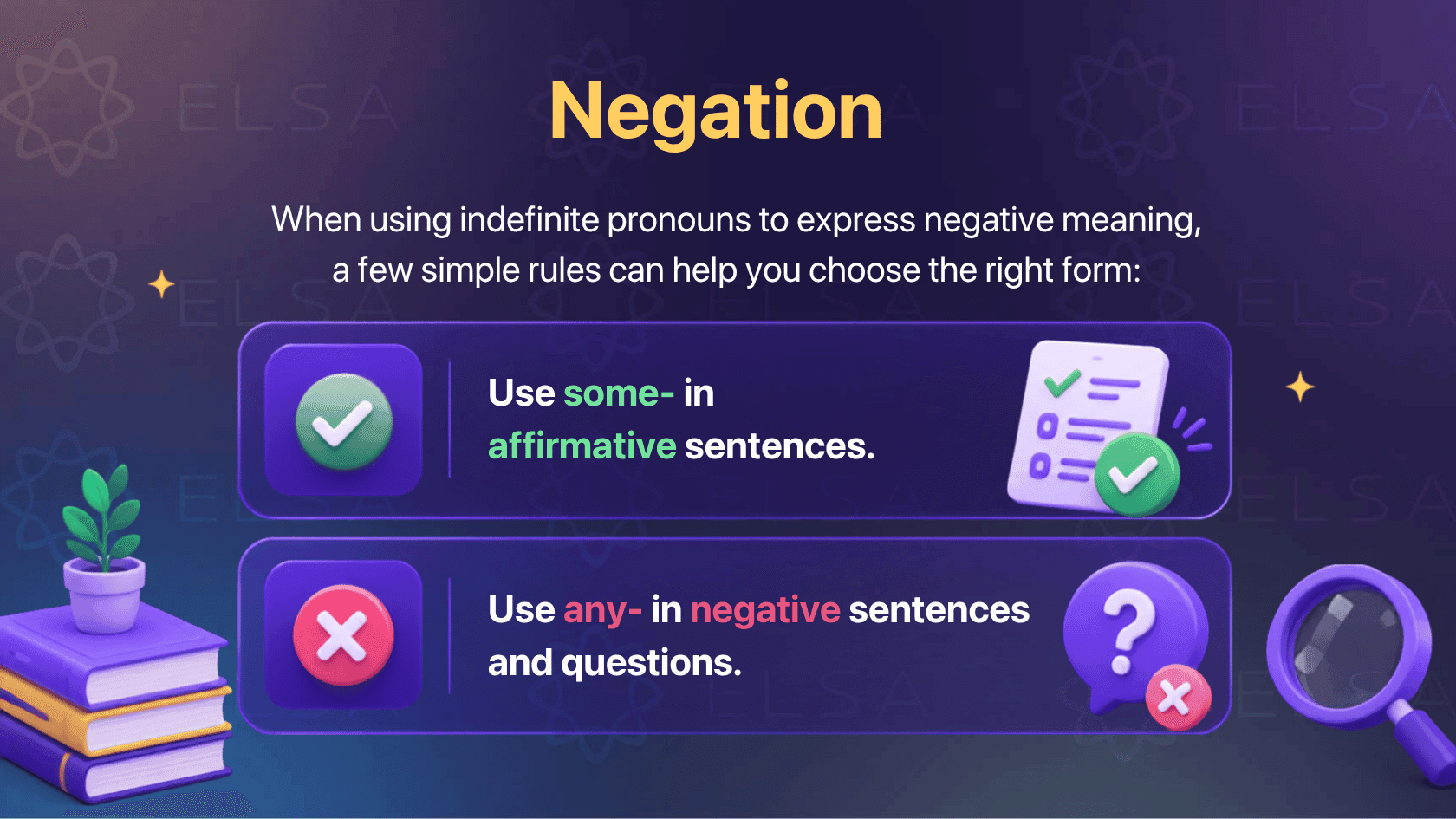
When using indefinite pronouns to express negative meaning, a few simple rules can help you choose the right form:
- Use some- in affirmative sentences.
- Use any- in negative sentences and questions.
For example:
- Someone left a message for you.
- Did he find anything useful?
Important:
- Avoid using some- after not. Instead, use an any- indefinite pronoun: I don’t know anyone here.
- Nobody, no one, and nothing already express a negative meaning, so they do not need not: Nobody called me.
- You can use some- in questions when making an offer or request: Would you like something to drink?
Modifiers
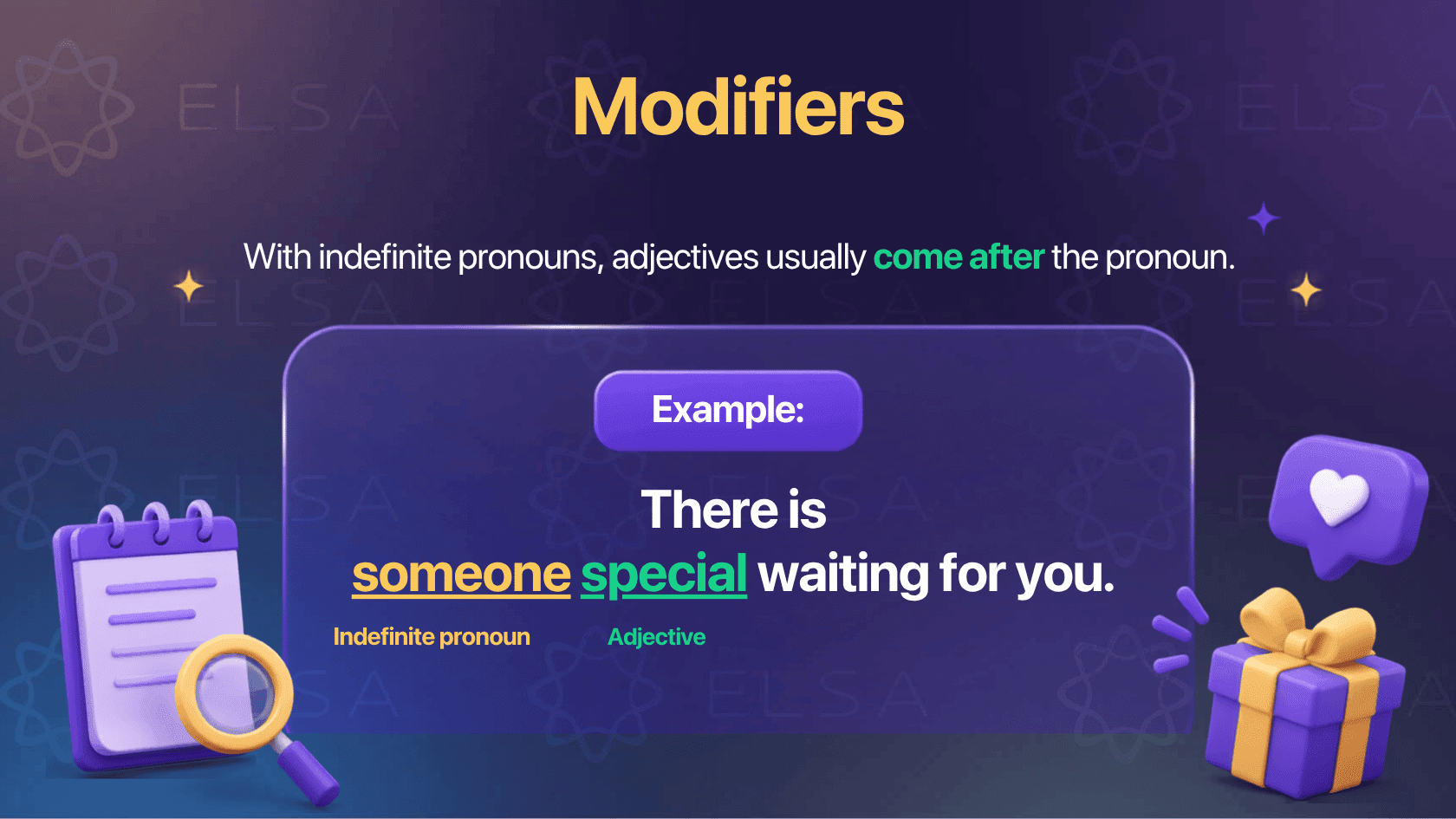
With indefinite pronouns, adjectives usually come after the pronoun, not before it. This word order is different from the usual adjective + noun pattern.
For example: There is someone special waiting for you.
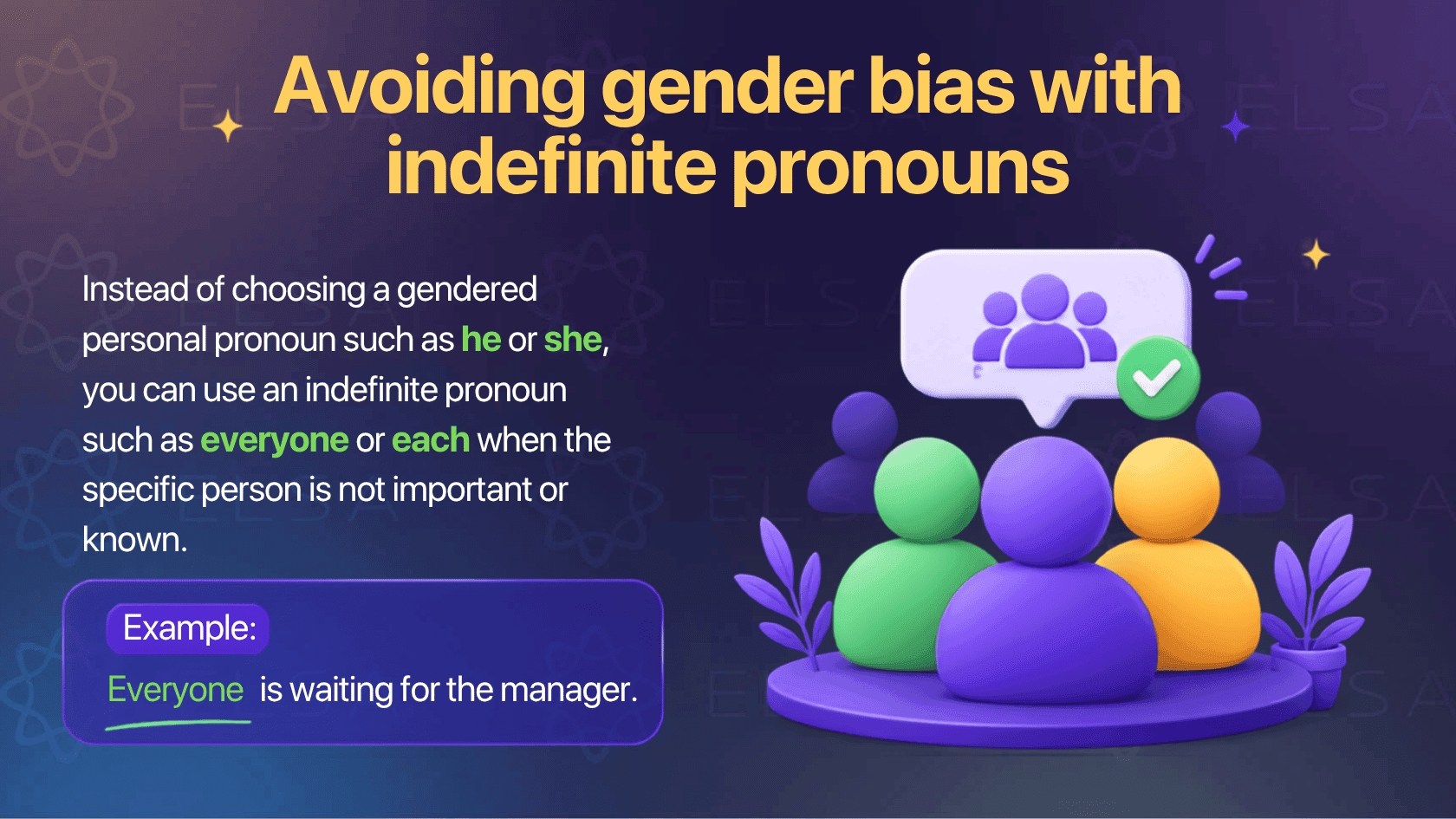
Avoiding gender bias with indefinite pronouns
Instead of choosing a gendered personal pronoun such as he or she, you can use an indefinite pronoun such as everyone or each when the specific person is not important or known.
For example: Everyone is waiting for the manager.
How to use the pronoun "one"
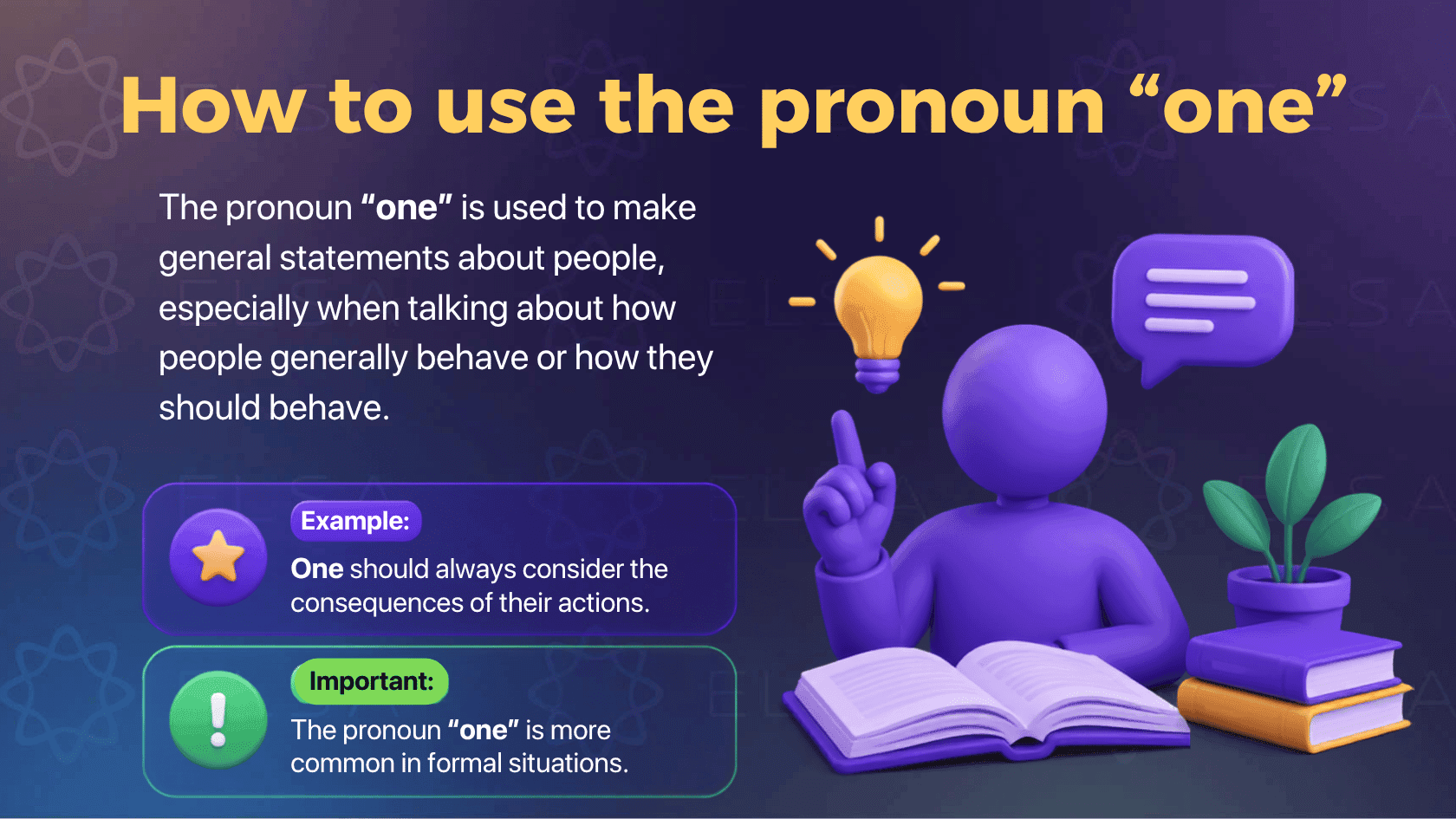
The pronoun “one” can also be considered a type of indefinite pronoun. It is used to make general statements about people, especially when talking about how people generally behave or how they should behave.
For example: One should always consider the consequences of their actions.
Important: The pronoun “one” is more common in formal situations, such as in academic writing, formal speeches, or official context.
Full list of indefinite pronouns in English
Singular indefinite pronouns
Here are the most common singular indefinite pronouns with examples:
| Pronoun | Example |
| Another | Would you like another? |
| Anybody | Anybody can learn a new language with enough practice. |
| Anyone | Can anyone hear me? |
| Anything | Anything can happen. |
| Each | Each has a different opinion. |
| Either | Either is a good choice. |
| Everybody | Everybody stands up. |
| Everyone | Everyone wants to feel understood. |
| Everything | He wants to buy everything. |
| Little | Little is known about the location. |
| Much | Much has changed since then. |
| Neither | Neither is suitable for me. |
| Nobody | Nobody is home. |
| No one | No one showed up at his concert. |
| Nothing | Nothing seems to be working. |
| One | One must always think before making a decision. |
| Somebody | Somebody is waiting at the front door. |
| Someone | Someone left a book on the table. |
| Something | Something smells delicious. |
Plural indefinite pronouns
Plural indefinite pronouns refer to more than one person or thing and take a plural verb.
| Pronoun | Example |
| Both | Both are ready to leave. |
| Few | Few have seen this before. |
| Fewer | Fewer are attending the event this month. |
| Many | Many have tried, but none succeeded. |
| Others | Some prefer working alone, while others enjoy teamwork. |
| Several | Several had already submitted their applications. |
Singular or plural indefinite pronouns
Some pronouns can be singular or plural depending on the noun they refer to. The indefinite pronouns list below shows how each pronoun can be used in both cases.
| Pronoun | Singular example | Plural example |
| All | All of the information is useful. | All of the students are ready for summer vacation. |
| Any | Is there any of the equipment available? | Are any of the books available? |
| More | More of the water is needed. | More of the students are joining us. |
| Most | Most of the furniture is new. | Most of the employees are working remotely. |
| None | None of the money was missing. | None of the participants were late |
| Some | Some of the cake is left. | Some of the cookies are left. |
| Such | Such is the nature of the work. | Such are the challenges we face. |
Common mistake: Avoiding double negatives
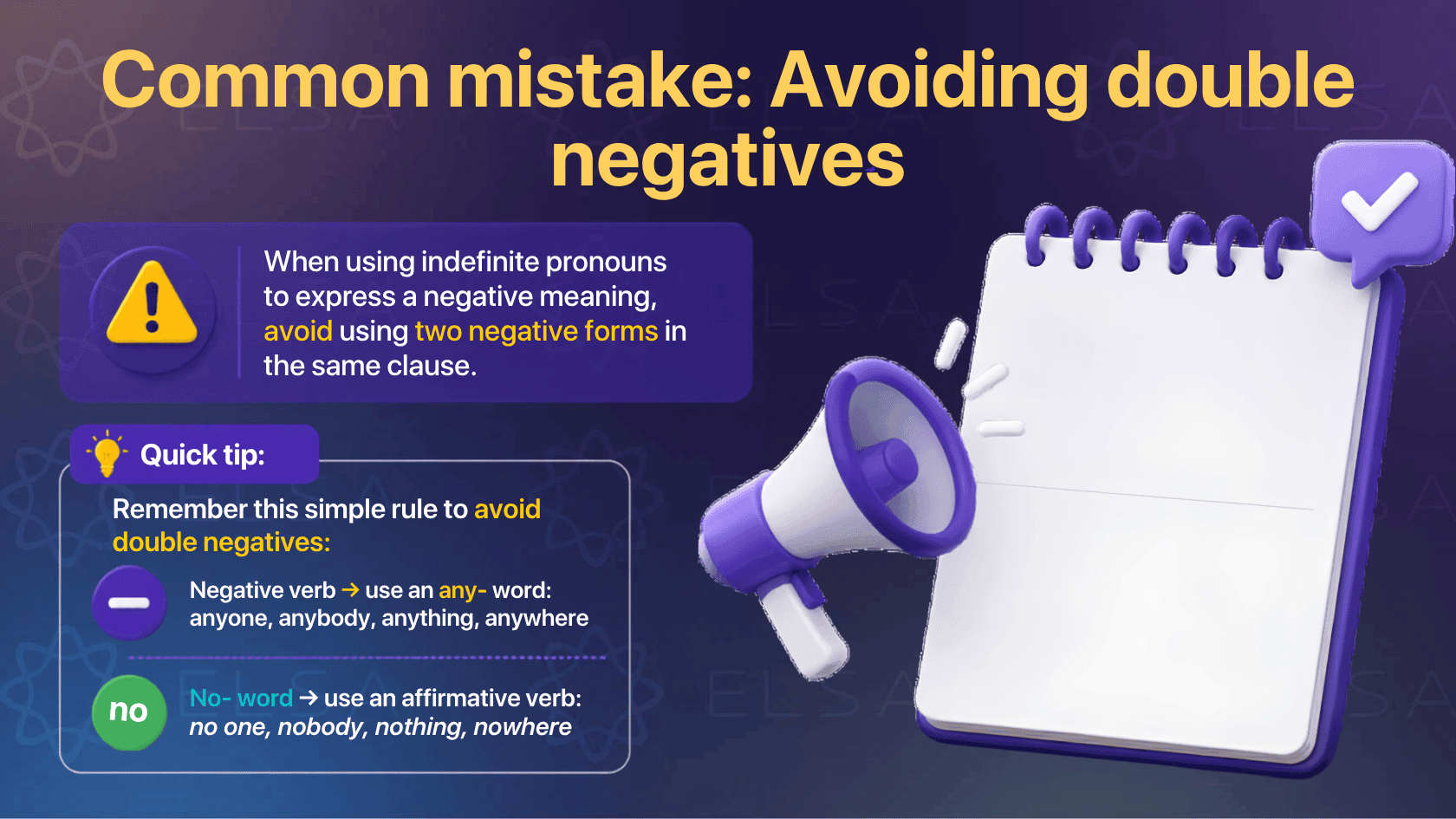
When using indefinite pronouns to express a negative meaning, avoid using two negative forms in the same clause.
- If the sentence already contains a negative pronoun → use an affirmative verb
For example: Nobody knows the answer.
- Use a negative verb with an indefinite pronoun beginning with any-.
For example: I don’t know anyone here.
Quick tip:
Remember this simple rule to avoid double negatives:
- Negative verb → use an any- word: anyone, anybody, anything, anywhere
- No- word → use an affirmative verb: no one, nobody, nothing, nowhere
Using indefinite pronouns correctly is important, but clear pronunciation matters just as much in real conversations. Practice the stress and connected speech of these pronouns with ELSA Speak’s AI to get instant feedback and improve your speaking accuracy. For more grammar tips and practical lessons, explore ELSA Speak’s Grammar category for more useful English lessons.