

Personal pronouns in English: Types, rules, examples & exercises
elsaspeakadmin
October 19, 2026
English clauses
Personal pronouns are among the most frequently used words in English, as they help speakers refer to people, animals, or things without having to repeat the same words in every sentences. In this guide, you'll learn personal pronoun definition, explore a personal pronoun chart and practical examples, and practice with exercises and answers.
What is a personal pronoun?
A personal pronoun is a word that replaces a noun or noun phrase referring to a person, animal, or thing. If you're wondering what is a personal pronoun, the simplest answer is that it helps avoid repetition and makes sentences clearer and more natural.
Here are some personal pronoun examples that show how these words work in context.
- Without a pronoun: Emily is a teacher. Emily teaches English.
- With a pronoun: Emily is a teacher. She teaches English.
- Without pronouns: Tom called Sarah. Tom invited Sarah to dinner.
- With pronouns: Tom called Sarah. He invited her to dinner.
⇒ In these examples, she, he, and her replace previously mentioned names, making the sentences less repetitive. The noun or noun phrase that a pronoun refers to is called its antecedent. In the first example, Emily is the antecedent of she.
Personal pronouns can also function as subjects or objects, depending on their roles in a sentence. The correct form depends on whether the pronoun performs an action, receives an action, or follows a preposition.
Complete personal pronoun explanation
Personal pronouns can be classified by person, number, and grammatical function. The most important distinction for everyday English learners is between subject pronouns and object pronouns.
Subject and object pronouns
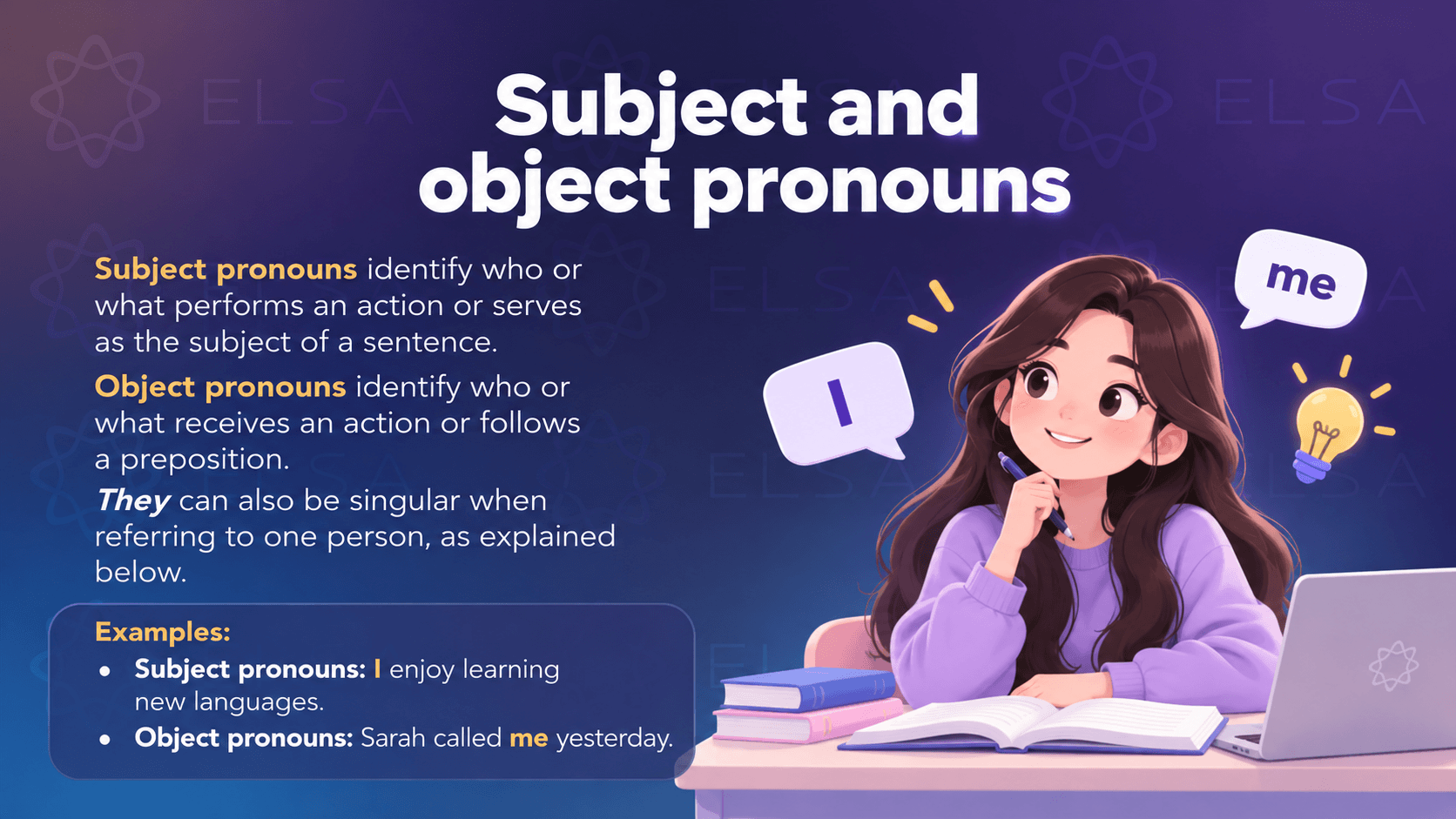
Subject pronouns identify who or what performs an action or serves as the subject of a sentence. Object pronouns identify who or what receives an action or follows a preposition.
The following personal pronoun chart provides a complete personal pronoun list of the subject and object forms commonly used in English.
| Person | Number | Subject pronoun | Object pronoun |
|---|---|---|---|
| First person | Singular | I | Me |
| Second person | Singular or plural | You | You |
| Third person | Singular | He | Him |
| Third person | Singular | She | Her |
| Third person | Singular | It | It |
| First person | Plural | We | Us |
| Third person | Plural | They | Them |
They can also be singular when referring to one person, as explained below.
Examples:
- Subject pronouns: I enjoy learning new languages.
- Object pronouns: Sarah called me yesterday.
Notice that some pronouns have the same subject and object forms. For example, you and it do not change, but their grammatical functions still differ.
Singular and plural personal pronouns
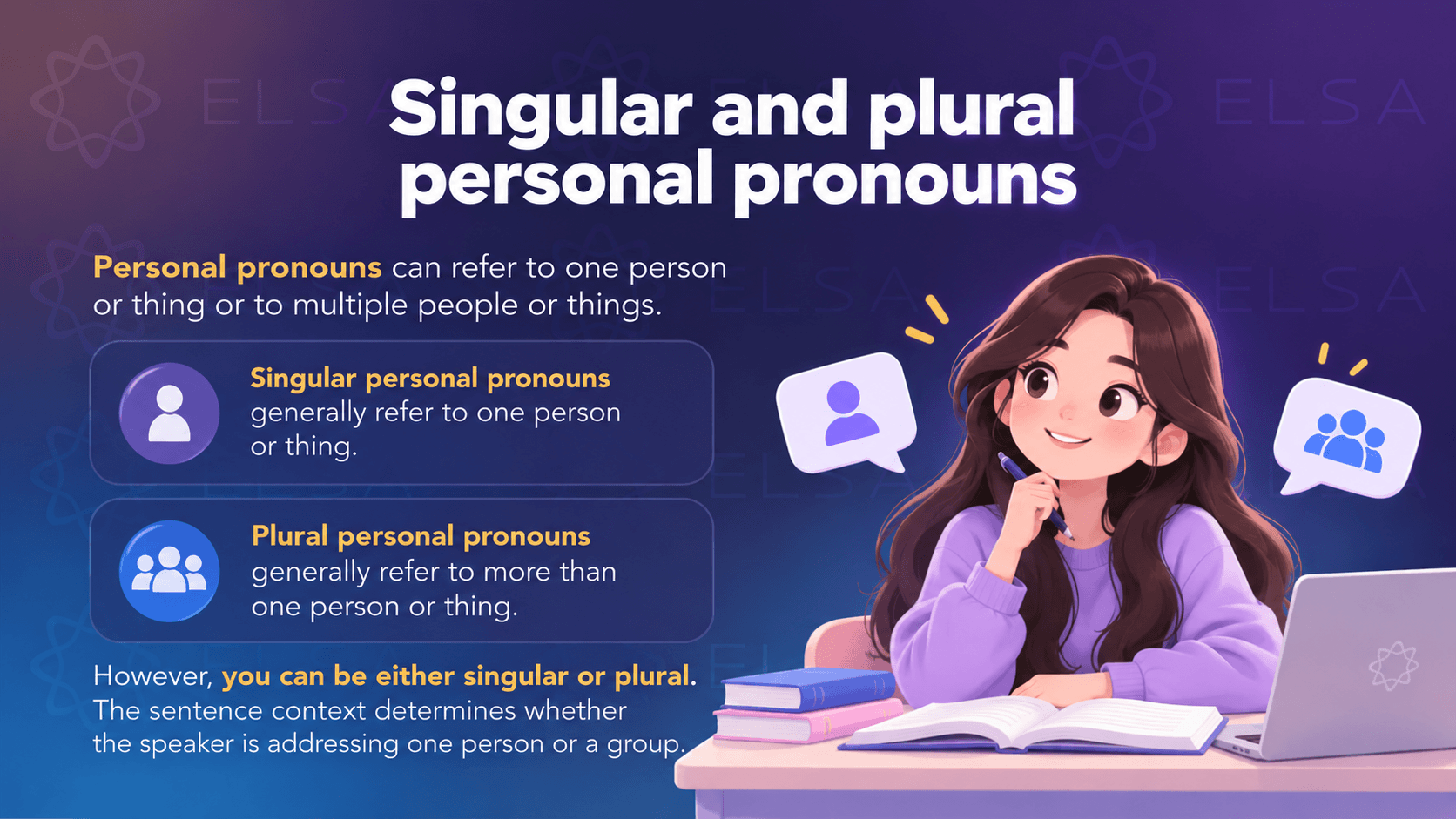
Personal pronouns can refer to one person or thing or to multiple people or things:
- Singular personal pronouns generally refer to one person or thing. For example:
- I am learning Spanish.
- She lives in California.
- It looks expensive.
- Plural personal pronouns generally refer to more than one person or thing. For example:
- We are ready to leave.
- They play basketball every weekend.
However, "you" can be either singular or plural. The sentence context determines whether the speaker is addressing one person or a group.
The singular pronoun “They”
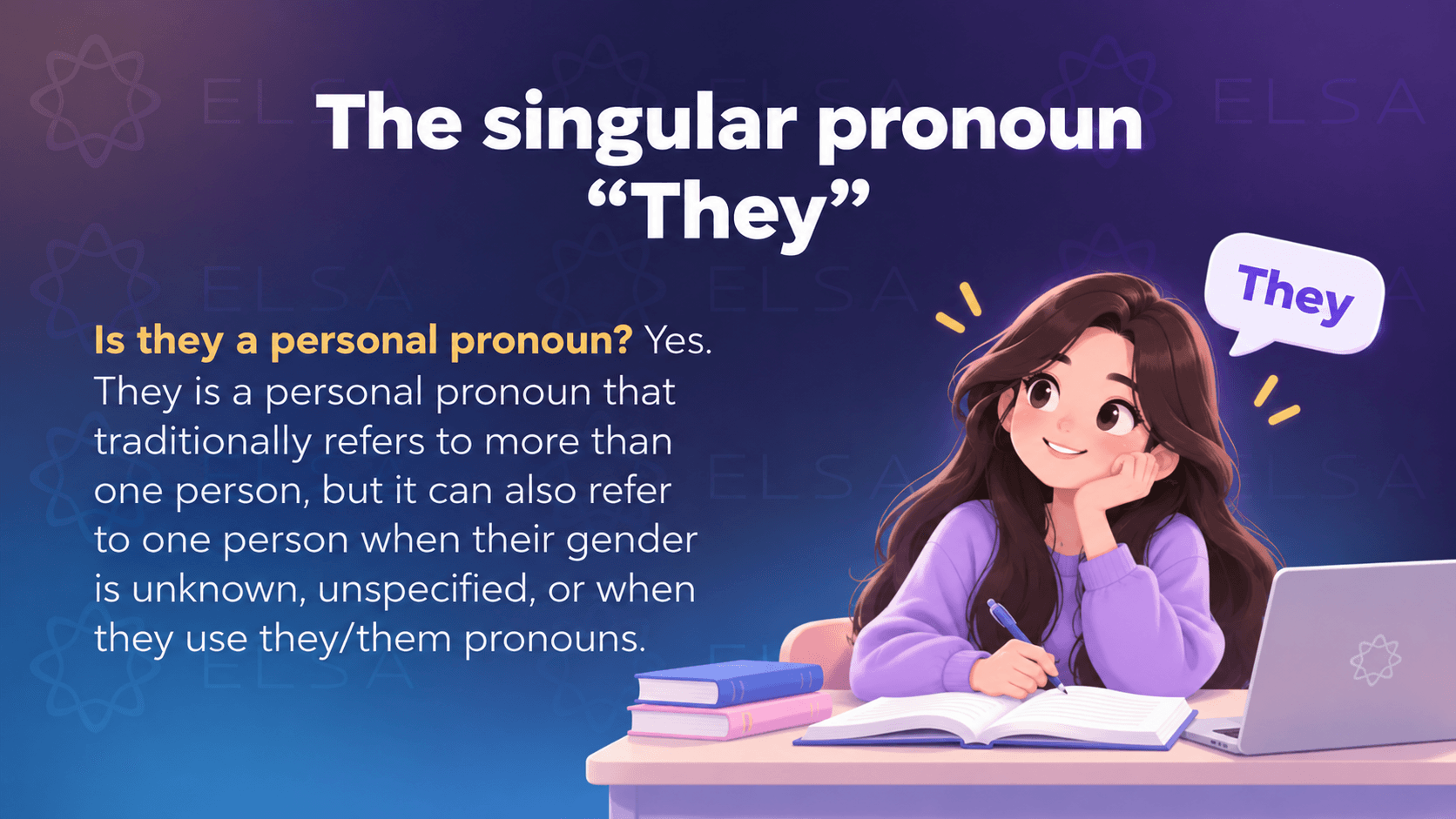
Is they a personal pronoun? Yes. They is a personal pronoun that traditionally refers to more than one person, but it can also refer to one person when their gender is unknown, unspecified, or when they use they/them pronouns.
Singular they helps writers avoid repetitive or awkward expressions such as he or she. It is also used by people who identify they/them as their personal pronouns.
Examples:
- Someone left their phone on the table.
- Every applicant should bring their resume to the interview.
- Jordan said they would join us later.
⇒ In the first example, the writer does not know who owns the phone. In the second, their refers to an applicant whose gender is not specified. In the third, they refers to Jordan, who uses they/them pronouns or whose gender is not specified in the context.
How does subject-verb agreement work with singular they?
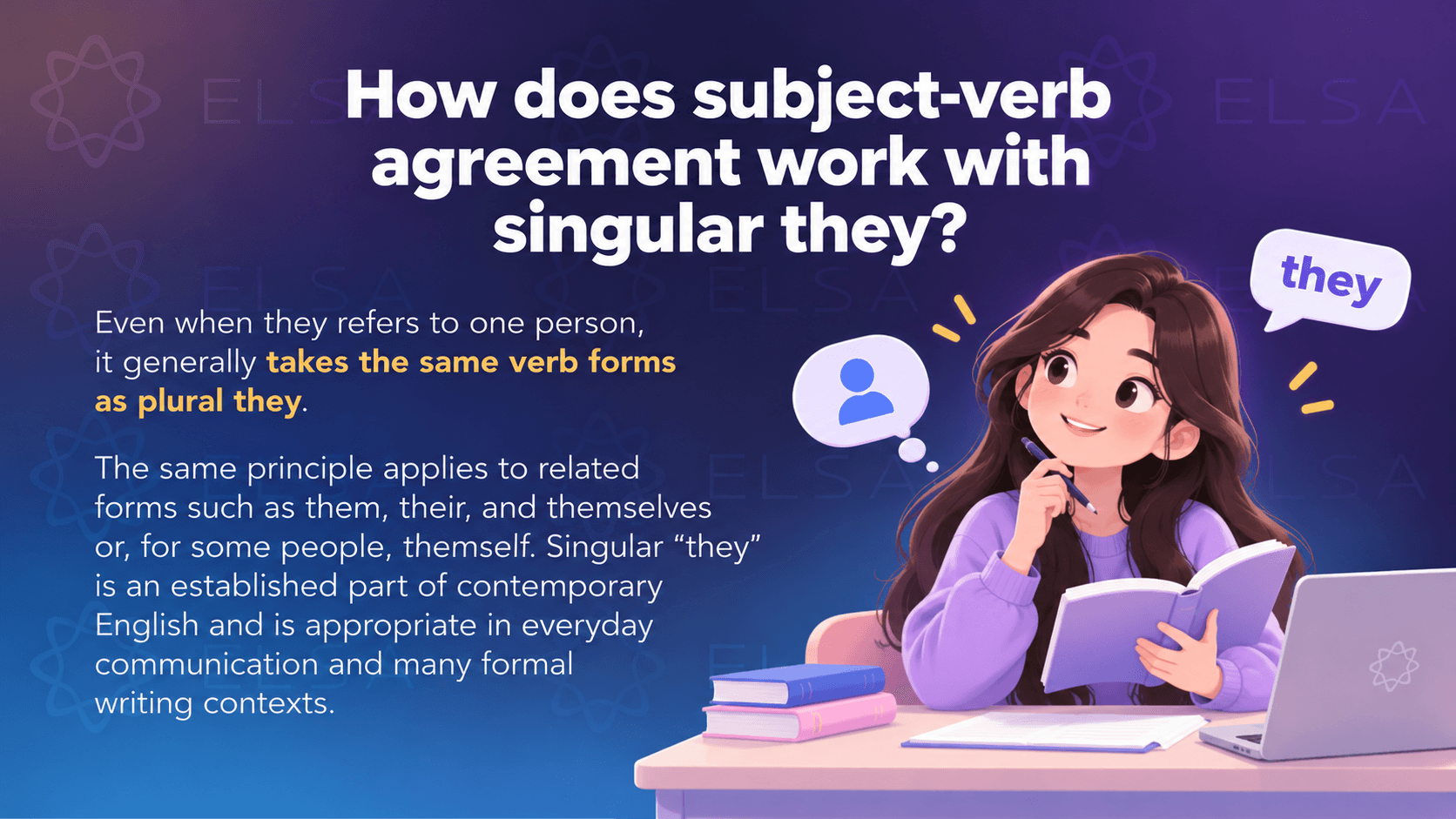
Even when they refers to one person, it generally takes the same verb forms as plural they.
| Correct | Incorrect |
|---|---|
| They are my new coworker. | They is my new coworker. |
| They have a meeting today | They has a meeting today. |
| They were happy with the results | They was happy with the results. |
The same principle applies to related forms such as them, their, and themselves or, for some people, themself. Singular "they" is an established part of contemporary English and is appropriate in everyday communication and many formal writing contexts.
How to use personal pronouns in English
To use personal pronouns correctly, identify the person or thing being referenced and determine the pronoun's role in the sentence. The following rules cover the most common situations.
Use subject pronouns before verbs
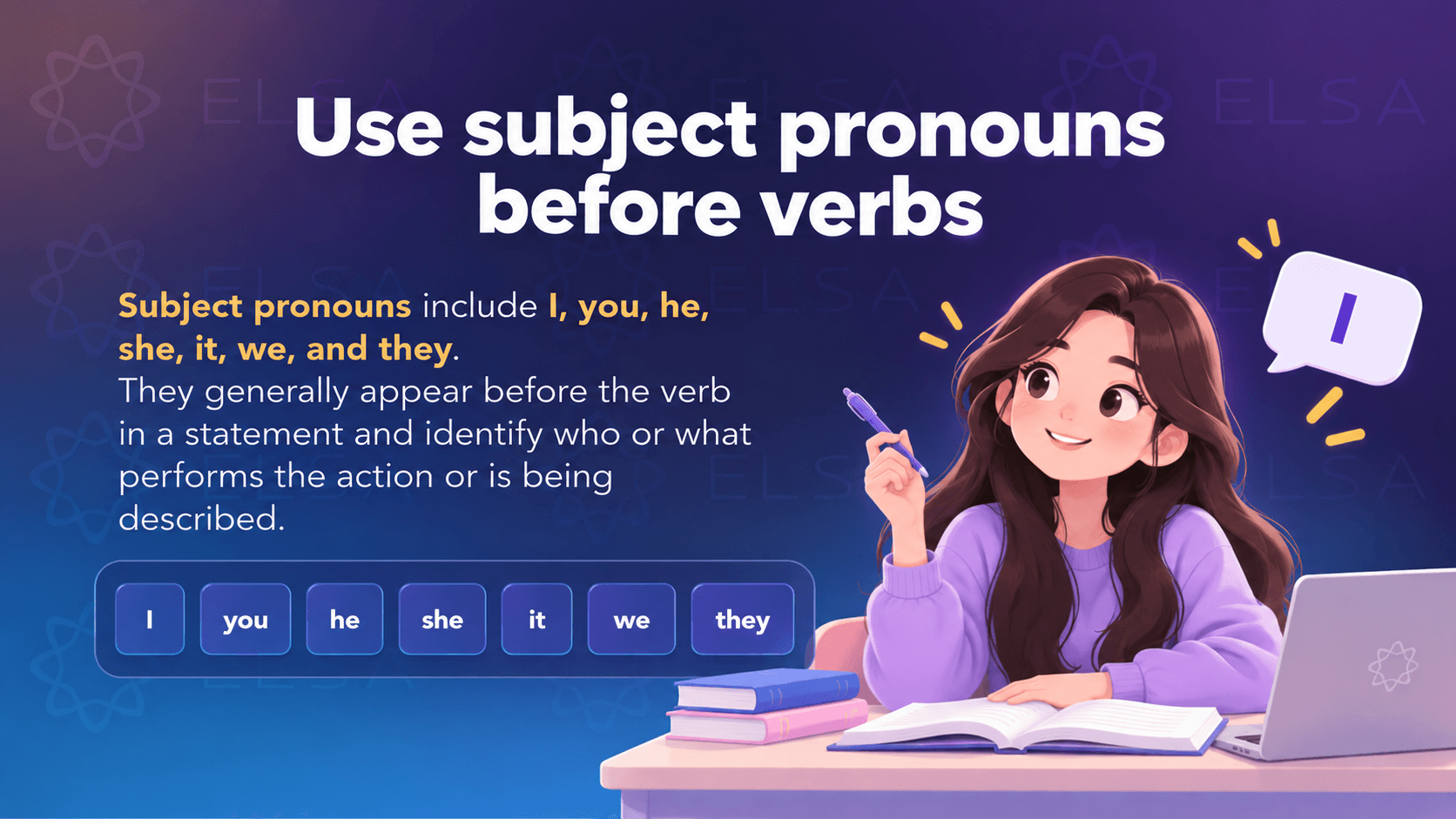
Subject pronouns include I, you, he, she, it, we, and they. They generally appear before the verb in a statement and identify who or what performs the action or is being described.
Basic structure:
| Subject pronoun + verb + ... |
Examples:
- She speaks English fluently.
- They work in the same office.
- We are ready for the interview.
- He is a talented designer.
⇒ In the first two examples, the subject pronouns identify the people performing the actions. In the last two, the pronouns serve as subjects with the linking verb to be.
In standard English, use a subject pronoun when the pronoun functions as the subject.
- Correct: She and I went to the library.
- Incorrect: Her and me went to the library.
Use object pronouns after verbs
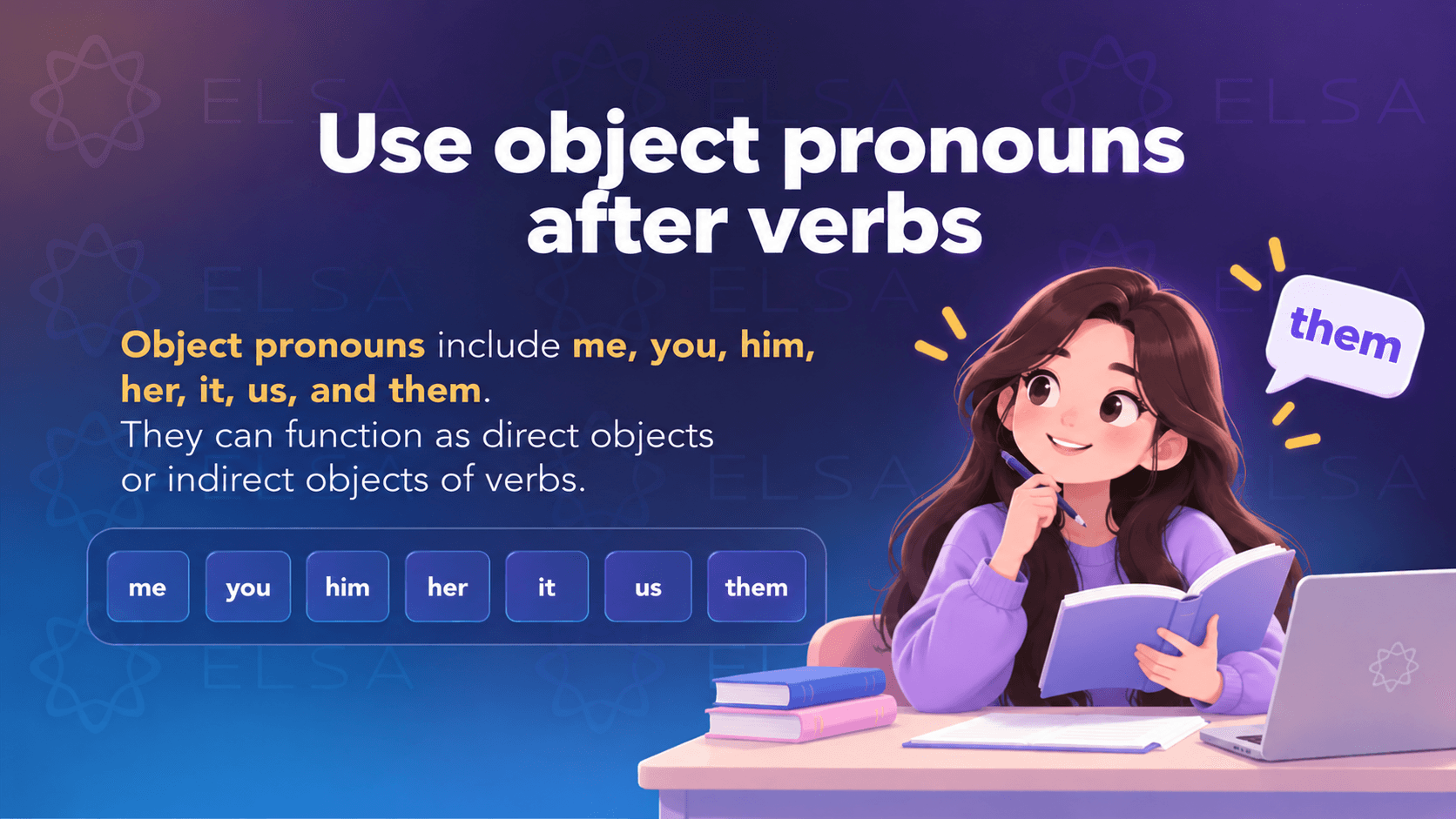
Object pronouns include me, you, him, her, it, us, and them. They can function as direct objects or indirect objects of verbs.
Basic structure:
| Subject + verb + object pronoun |
Examples:
- The teacher helped me with my homework.
- I called him this morning.
- Our team invited her to the event.
- The manager gave us additional instructions.
Some verbs commonly followed by object pronouns include help, call, invite, see, meet, and thank. Compare the following sentences:
- Correct: My friend invited her.
- Incorrect: My friend invited she.
⇒ The pronoun her is correct because it receives the action of the verb invited. The subject form she cannot replace it in this position.
Use object pronouns after prepositions
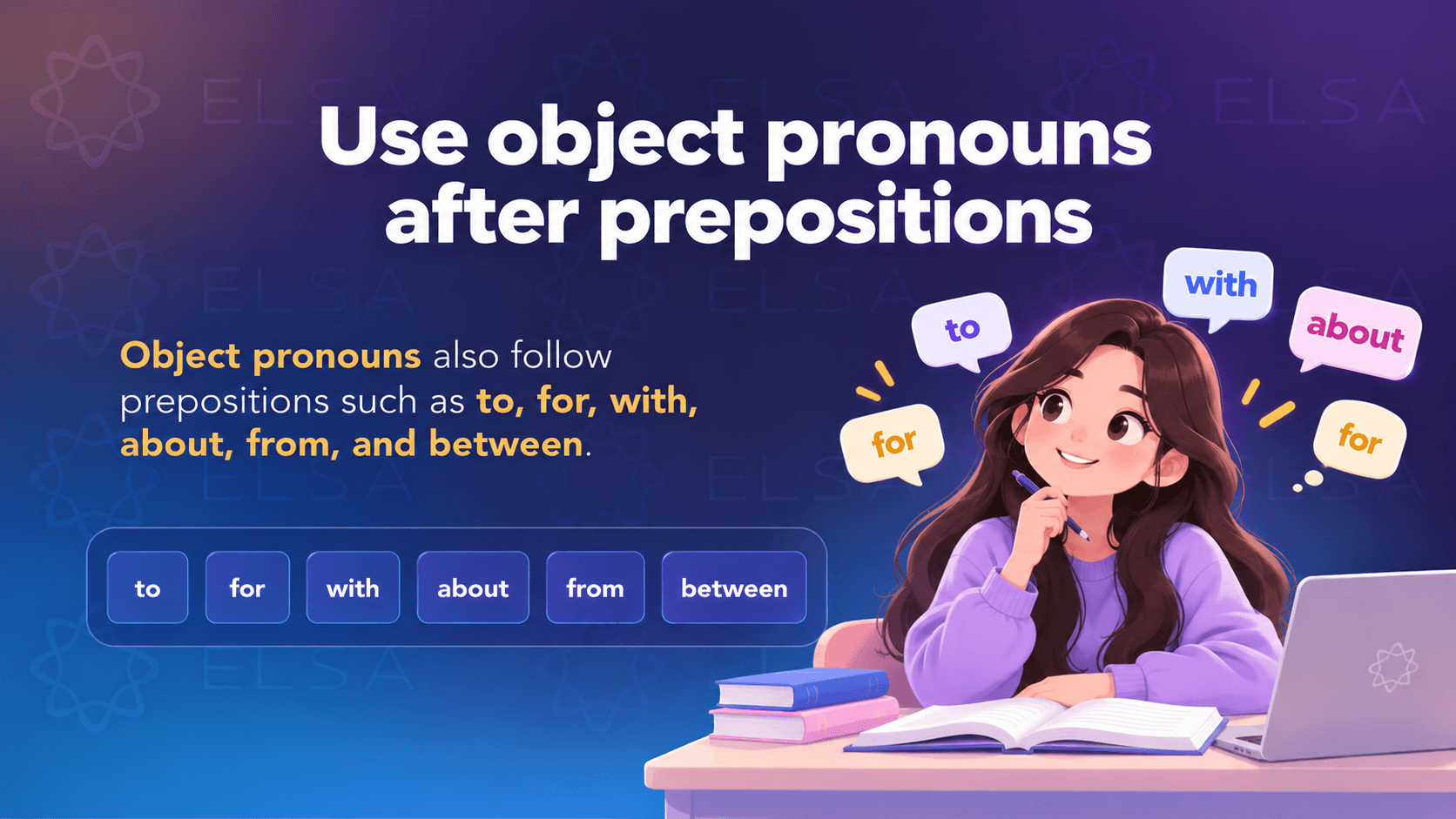
Object pronouns also follow prepositions such as to, for, with, about, from, and between.
Basic structure:
| Preposition + object pronoun |
Examples:
- This letter is for him.
- She went to the movies with us.
- The teacher spoke to them after class.
- Can you keep this information between you and me?
⇒ In the last example, me is correct because it follows the preposition between. The phrase between you and I is common in casual speech, but it is not the standard grammatical choice in formal English.
Choose pronouns based on context
Choosing the correct personal pronoun involves more than memorizing a chart. You also need to identify the intended reference and grammatical role. Follow these steps below:
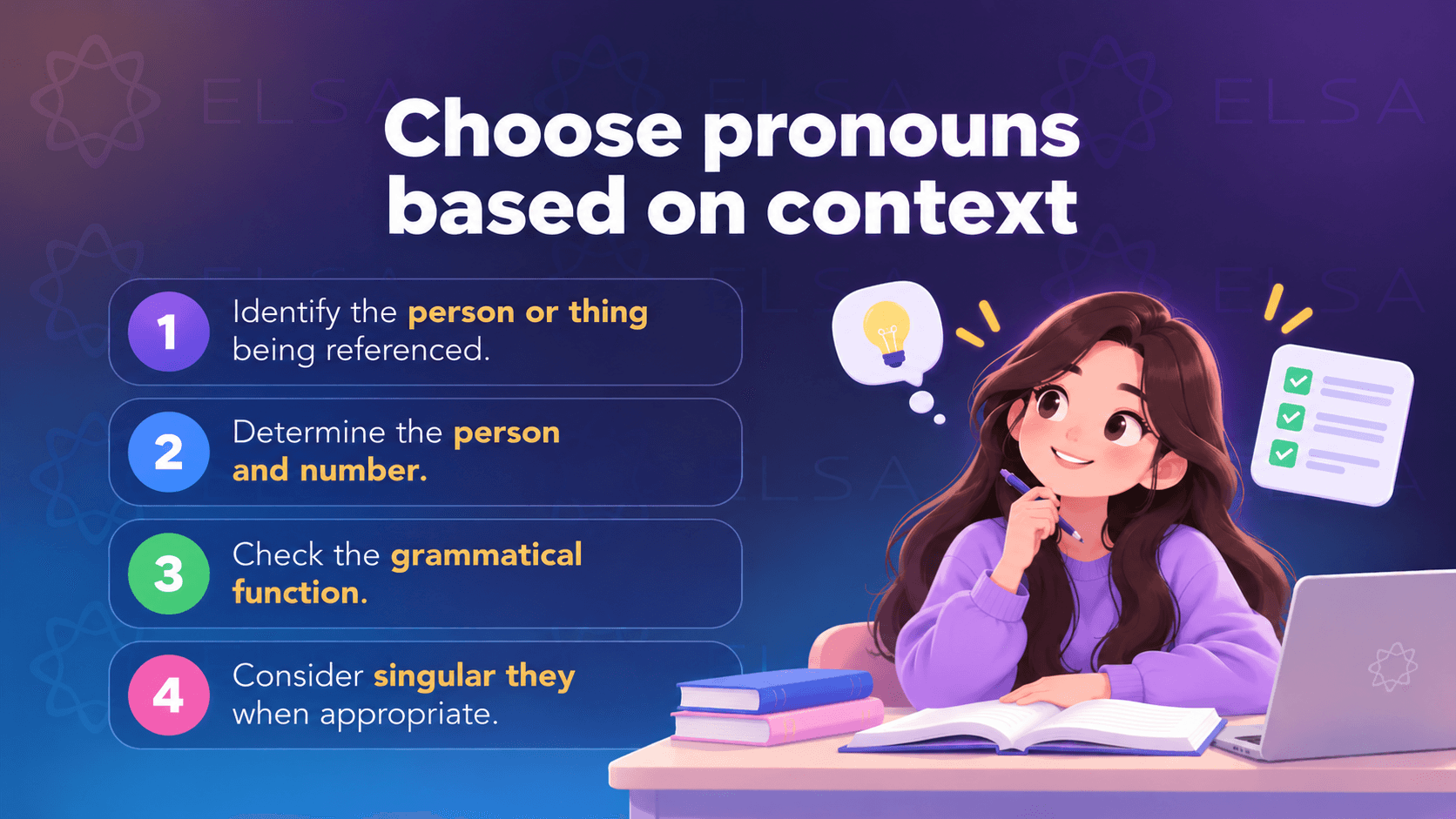
1. Identify the person or thing being referenced.
Use a pronoun that clearly refers to the intended noun or noun phrase.
For example: Lisa bought a new laptop because she needed one for work.
⇒ Here, "she" refers to Lisa.
2. Determine the person and number.
Identify whether the pronoun refers to the speaker, the listener, or someone or something else. Also determine whether it refers to one person or multiple people.
For example:
- I am ready. (First person, singular)
- We are ready. (First person, plural)
- You are ready. (Second person, singular or plural)
3. Check the grammatical function.
Use a subject pronoun when the pronoun is the subject and an object pronoun when it receives an action or follows a preposition. For instance:
- He called me.
- She sat beside him.
4. Consider singular they when appropriate.
Use they/them when a person's gender is unknown or unspecified, or when that person uses these pronouns.
- A customer left their bag at the counter.
- Alex said they would call back later.
When singular "they" is the subject, use verb forms such as they are, they have, and they were.
Personal pronouns exercises with answers
Practice the following exercises to test your understanding of subject pronouns, object pronouns, singular and plural forms, and pronoun agreement.
Basic exercises
Exercise 1: Choose the correct option to complete each sentence.
1. Emma is my best friend. ___ loves reading novels.
a. He
b. She
c. Her
d. They
2. My brother and I are students. ___ study at the same university.
a. Us
b. They
c. We
d. Them
3. The coach called Daniel after practice. The coach called ___.
a. he
b. his
c. they
d. him
4. My parents are visiting this weekend. I will cook dinner for ___.
a. them
b. they
c. their
d. we
5. This gift is for my sister. It is for ___.
a. she
b. hers
c. her
d. they
6. David and Mark are coworkers. ___ work in the same department.
a. He
b. Them
c. Us
d. They
7. My phone is new. ___ has a great camera.
a. It
b. He
c. They
d. Them
8. Can you help my friend and me? Can you help ___?
a. we
b. us
c. they
d. I
9. I saw Sarah at the store and spoke to ___.
a. she
b. they
c. her
d. hers
10. You and your classmates did well. ___ should be proud of yourselves.
a. Them
b. Us
c. We
d. You
Exercise 2: Complete each sentence with the correct personal pronoun.
- My name is Olivia. ___ am from Texas.
- Jack is my neighbor. ___ works at a bank.
- My sister and I love music. ___ listen to it every day.
- The teacher gave ___ (I) a new assignment.
- I met your cousins yesterday. I met ___ at the mall.
- This message is for ___ (he).
- My cat is sleeping. ___ looks comfortable.
- Sarah and Mia are friends. ___ often study together.
- Please come with ___ (we) to the concert.
- Someone forgot ___ jacket in the classroom.
Advanced exercises
Exercise 1: Choose the correct pronoun in each sentence.
1. My colleague and ___ are presenting the proposal.
A. me
B. I
C. us
D. them
2. The director asked Maya and ___ to stay after the meeting.
A. I
B. we
C. me
D. she
3. Between you and ___, I think the plan needs more work.
A. I
B. me
C. we
D. they
4. Neither James nor ___ was available to answer the call.
A. her
B. them
C. us
D. she
5. The company sent ___ an invitation to the launch event.
A. they
B. their
C. them
D. theirs
6. My parents wanted my brother and ___ to join them for dinner.
A. I
B. me
C. we
D. they
7. The person who left the package said ___ would return tomorrow.
A. them
B. their
C. they
D. theirs
8. Our manager spoke directly to ___ about the new policy.
A. we
B. they
C. our
D. us
9. The award was presented to Olivia and ___.
A. he
B. him
C. his
D. they
10. Taylor is a new team member. ___ have already shared their ideas with the group.
A. Them
B. They
C. Their
D. Theirs
Exercise 2: Each sentence contains one pronoun error. Rewrite the sentence correctly.
- Me and Sarah are going to the library.
- The teacher gave the certificates to Mark and I.
- Her is my new supervisor.
- The invitation is for they.
- My brother helped I with my project.
- Between you and I, the presentation was too long.
- Everyone should bring his or her laptop if they need it for the workshop. (Revise the pronouns to use consistent, inclusive wording.)
- Jordan said they is ready for the interview.
- The manager spoke with we about the schedule.
- Him and his coworkers attended the training session.
FAQ about personal pronouns
What is the difference between subject and object pronouns?
Subject pronouns identify who or what performs an action or serves as the subject of a sentence. Object pronouns receive an action or follow a preposition.
For example:
- She called him.
- They invited us.
⇒ In the first sentence, she is the subject and him is the object. In the second, they is the subject and us is the object.
What is the difference between personal pronouns and possessive pronouns?
Personal pronouns refer to people or things and can function as subjects or objects. Possessive pronouns indicate ownership and can stand independently in place of a noun phrase.
Examples:
- Personal pronoun: She called me.
- Possessive pronoun: That blue backpack is hers.
Are “My,” “Your,” and “Their” personal pronouns?
No. In standard grammar, my, your, and their are possessive determiners because they appear before nouns to show ownership.
Examples:
- My phone is on the desk.
- Is this your notebook?
- Their house is near the park.
By contrast, mine, yours, and theirs are possessive pronouns because they can stand alone without a following noun.
- This phone is mine.
- The notebook is yours.
- The house is theirs.
Is everyone a personal pronoun?
Is everyone a personal pronoun? No. Everyone is one of the indefinite pronouns, not a personal pronoun. It refers to all people in a group without naming them individually.
Example: Everyone is responsible for bringing their own materials.
Although everyone takes a singular verb, it can be followed by singular they or their in contemporary English. In this sentence, everyone is an indefinite pronoun, while their is a possessive determiner.
Personal pronouns make English sentences clearer and more natural by replacing repeated nouns. Remember to use subject pronouns for subjects, object pronouns after verbs and prepositions, and singular they when appropriate. For more grammar lessons, vocabulary guides, and English communication tips, explore the Grammar category on ELSA Speak blog.