

Possessive pronouns: Definition, list, and how to use them
elsaspeakadmin
August 19, 2026
English clauses
Possessive pronouns are one of the most common pronouns used by English learners. In this guide, you’ll learn about possessive pronouns meaning, a full list of possessive pronouns, and examples with a worksheet to practice your knowledge.
What are possessive pronouns?
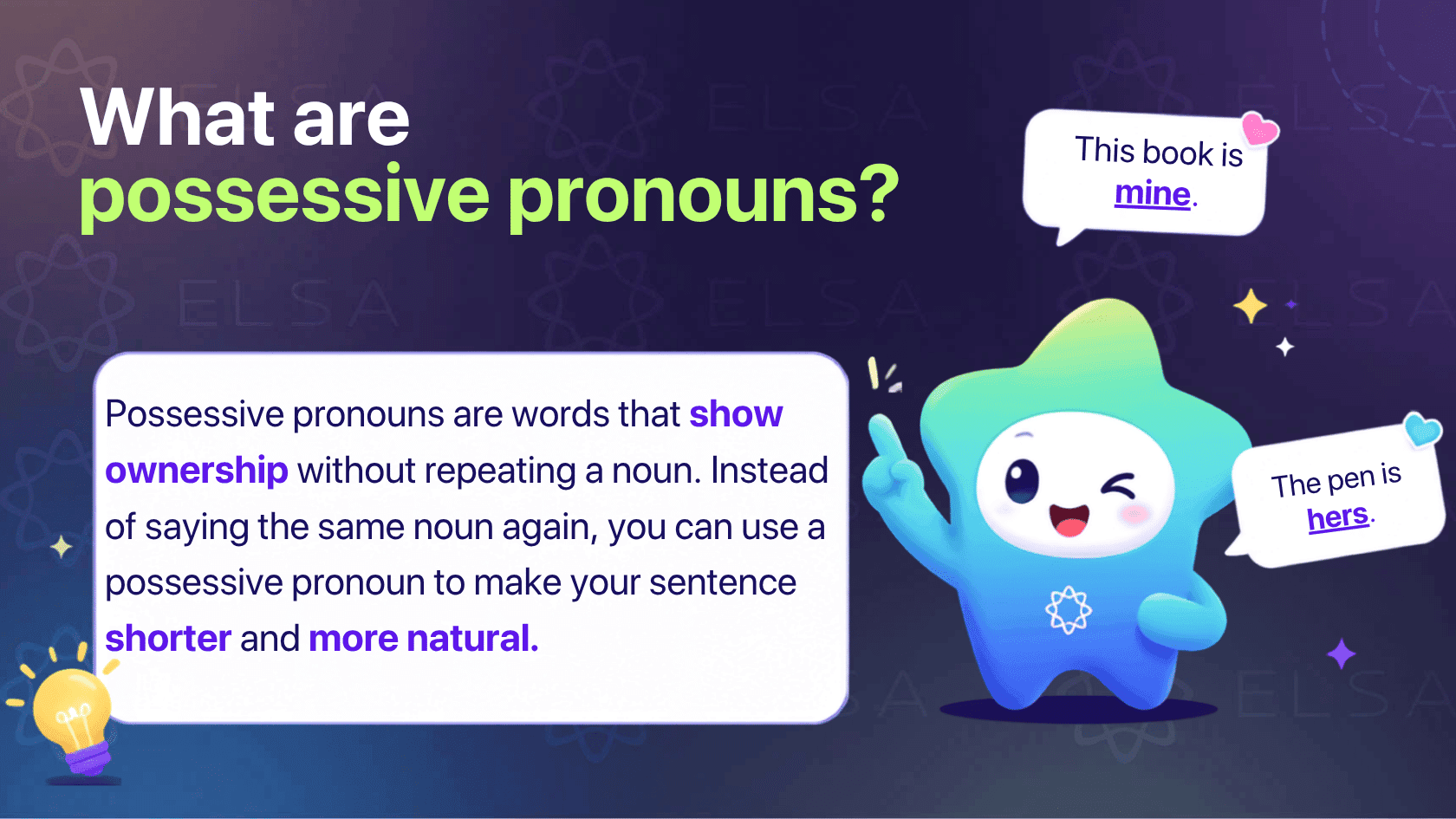
Possessive pronouns are words that show ownership without repeating a noun. Instead of saying the same noun again, you can use a possessive pronoun to make your sentence shorter and more natural.
There are 2 types of possessive pronouns:
- Stand-alone: Replace a noun completely and can stand alone in a sentence.
For example: These shoes are mine.
- Possessive adjectives (possessive determiners): Come before a noun to show ownership and must be followed by a noun.
For example: These are my shoes.
>> See more: What are pronouns and how to use them?
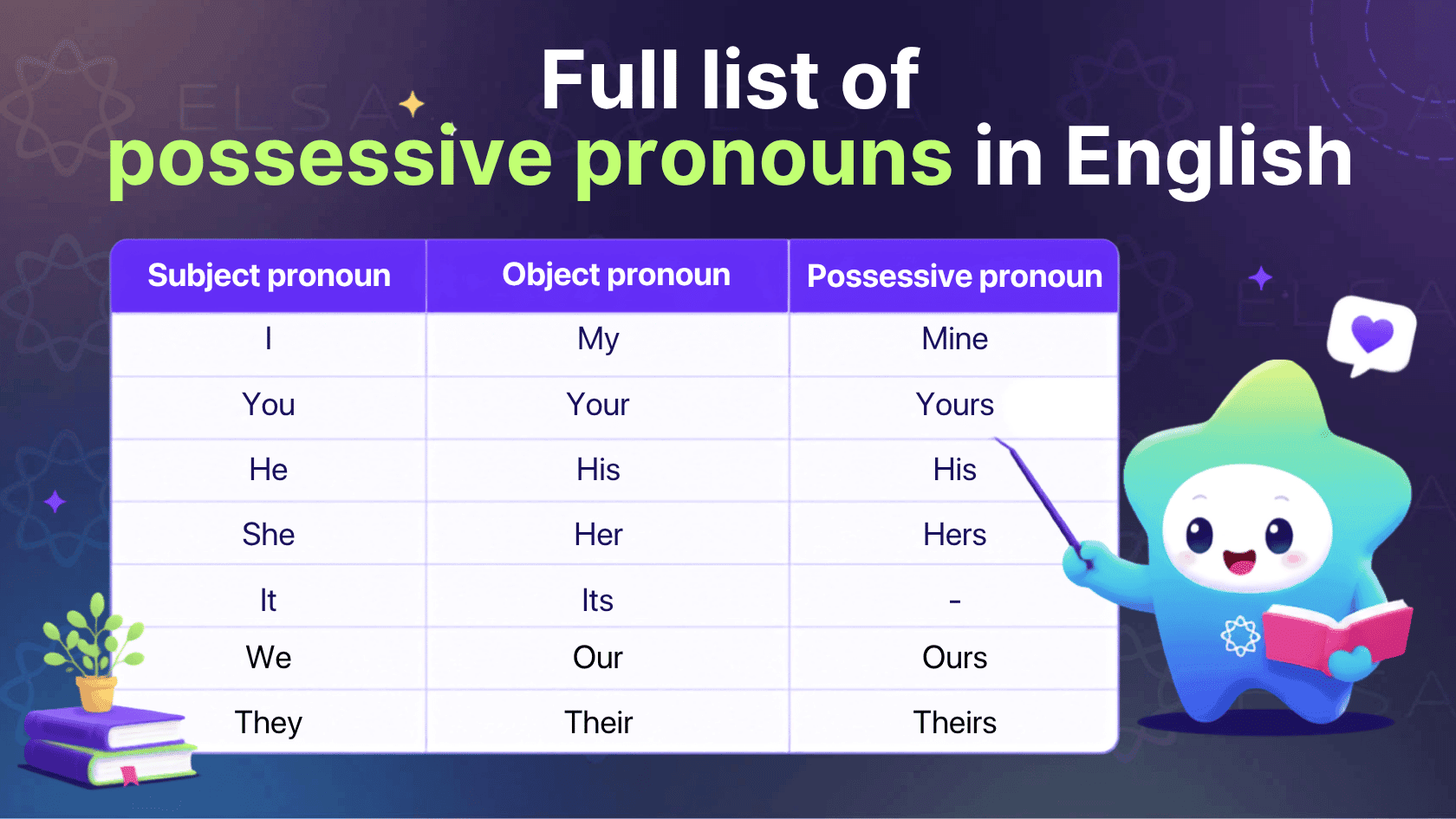
Full list of possessive pronouns in English
Here is the full possessive pronouns list in English. Each one replaces a noun phrase to show ownership, helping you avoid repeating the same noun in a sentence.
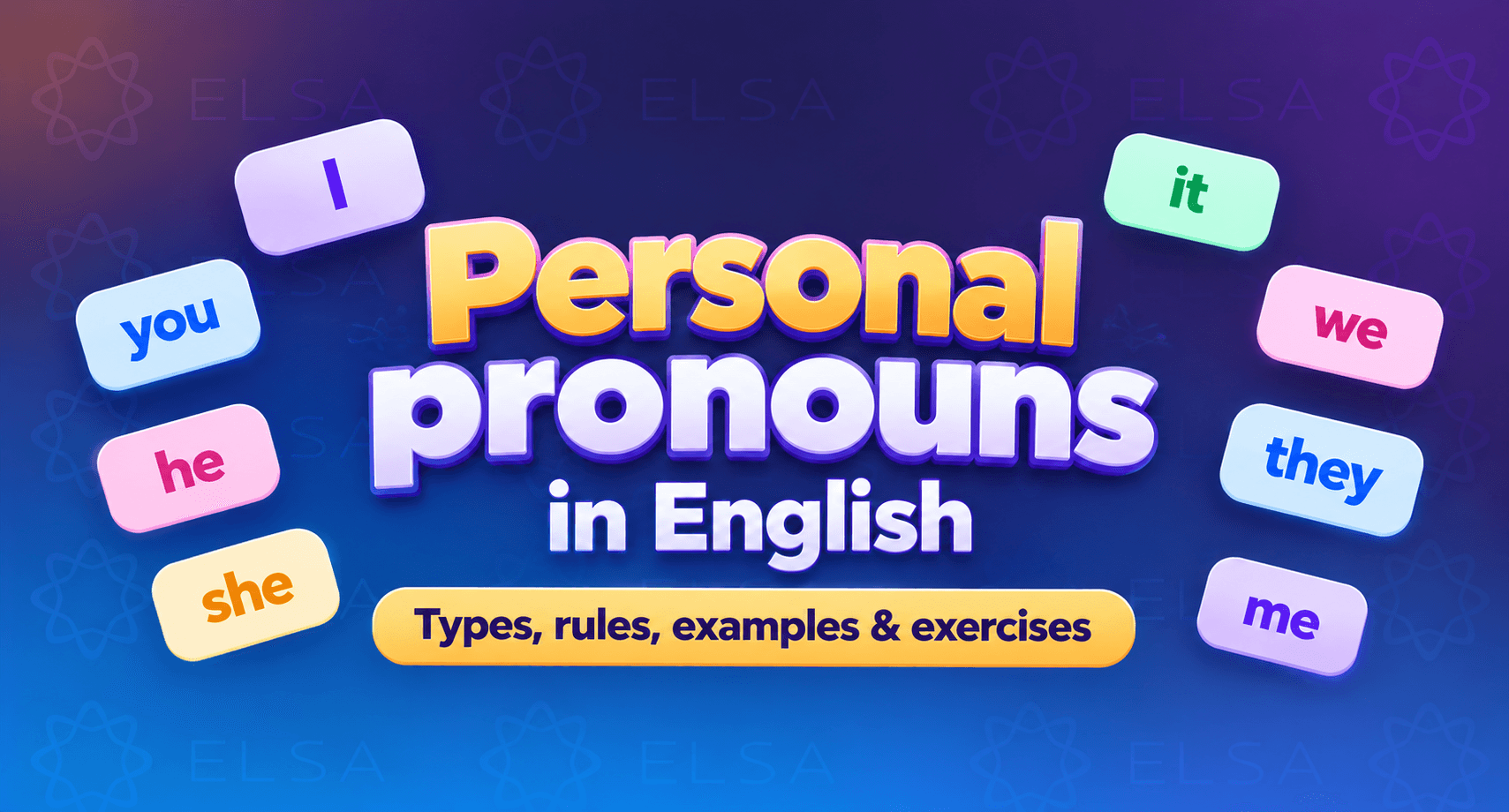
| Subject pronoun | Possessive adjective | Possessive pronoun |
| I | My | Mine |
| You | Your | Yours |
| He | His | His |
| She | Her | Hers |
| It | Its | - |
| We | Our | Ours |
| They | Their | Theirs |
Possessive pronouns vs possessive adjectives
Understanding the difference between possessive pronouns and possessive adjectives helps you avoid common mistakes and write more natural English sentences.
| Possessive pronouns | Possessive adjectives | |
| Usage | Stand alone and completely replace a noun. They do not need a noun after them. | Come before a noun to describe ownership. They must be followed by a noun. |
| Position | Usually appear at the end of a sentence or anywhere a noun would appear. | Always come directly before the noun they modify. |
| Example | This cake is hers. | This is her cake. |
How to use possessive pronouns correctly
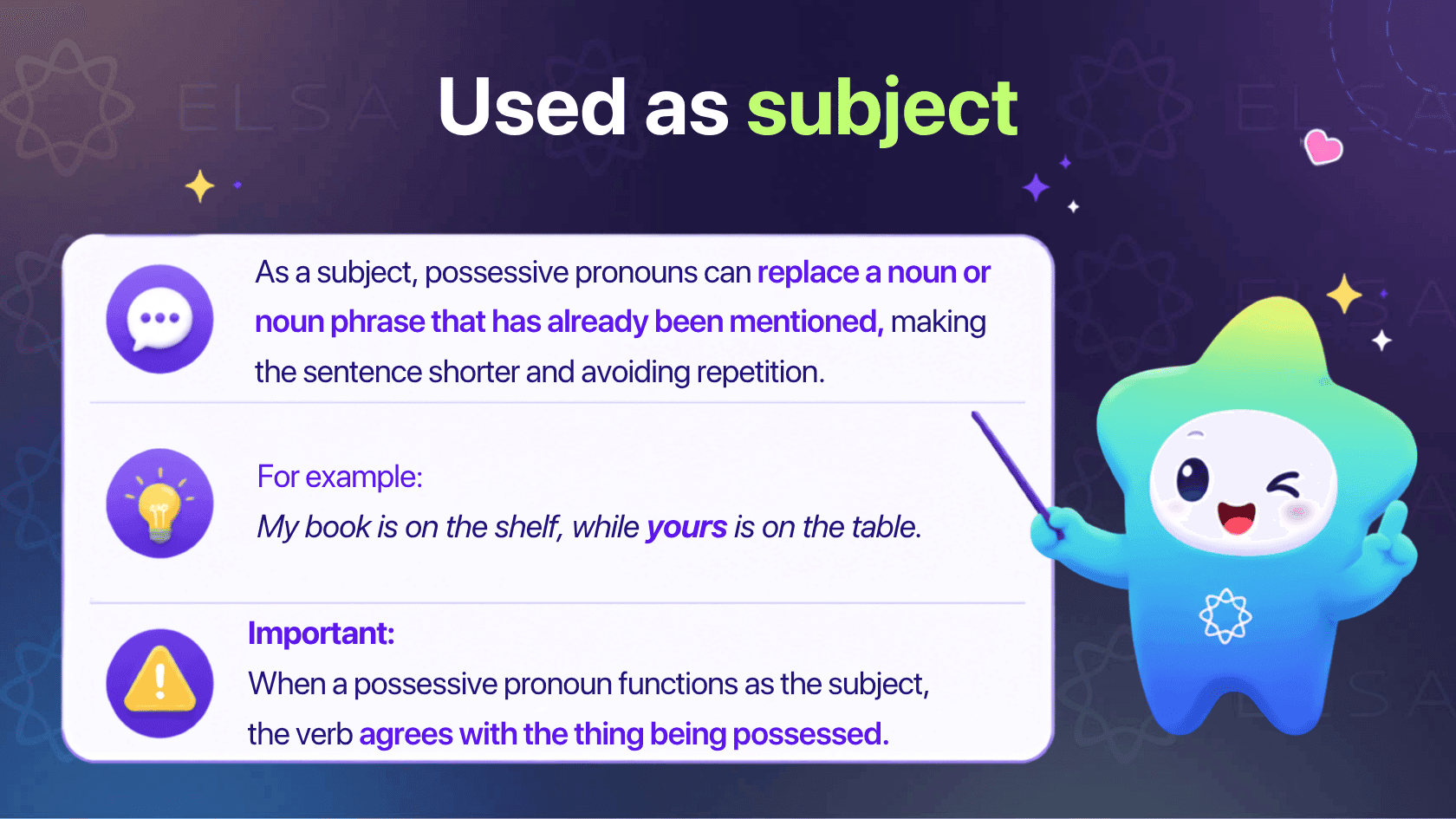
Used as subject
A possessive pronoun can be used as the subject of a sentence. It replaces a noun or noun phrase that has already been mentioned, making the sentence shorter and avoiding repetition.
For example: My book is on the shelf, while yours is on the table.
→ Yours replaces a previously mentioned object, which in this case is the book.
Important: When a possessive pronoun functions as the subject, the verb agrees with the thing being possessed, not the owner
Used as object
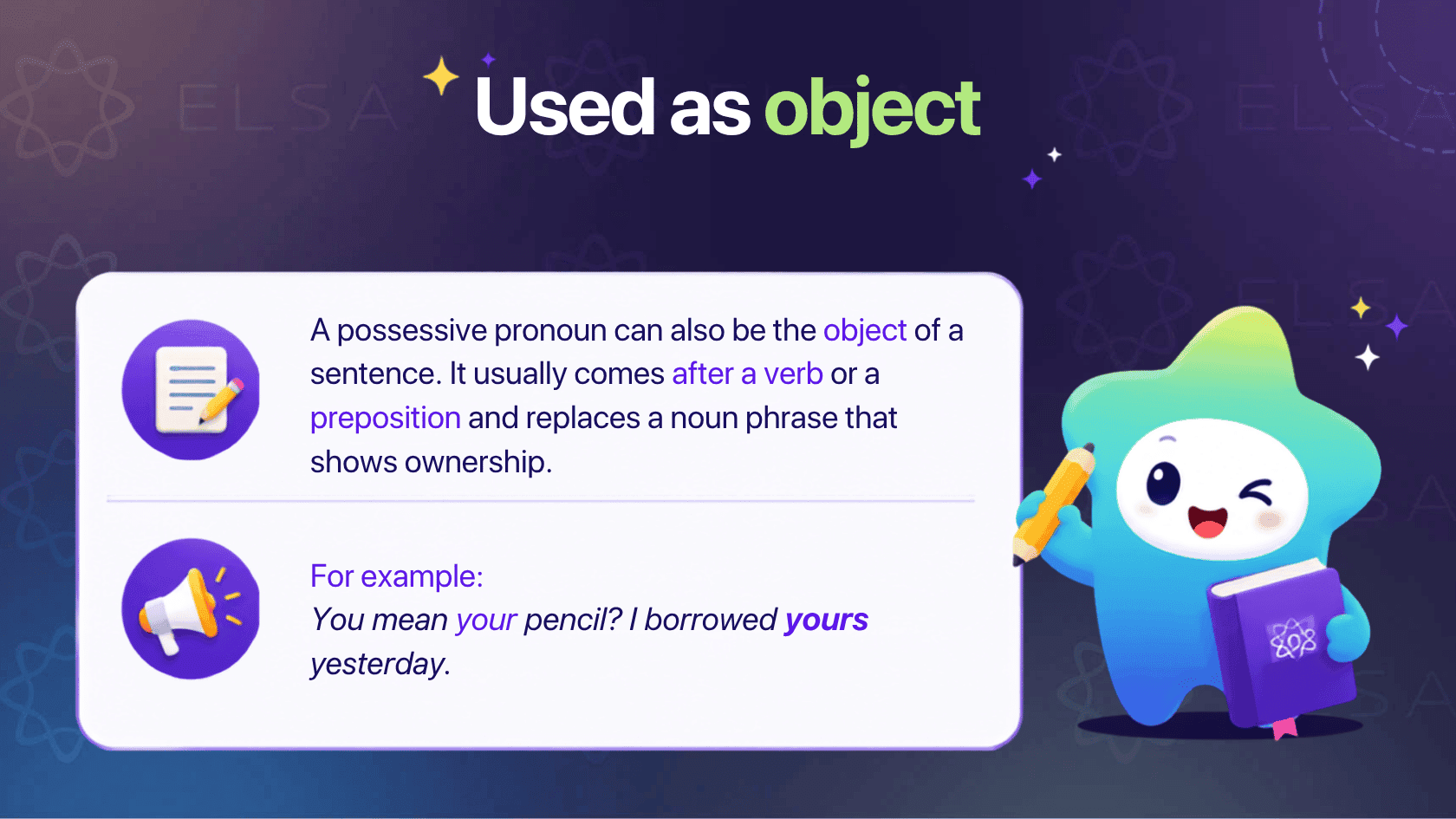
A possessive pronoun can also be the object of a sentence. It usually comes after a verb or a preposition and replaces a noun phrase that shows ownership.
For example: You mean your pencil? I borrowed yours yesterday.
→ Yours replaces a previously mentioned noun, which in this case, the pencil.
Used as subject complement
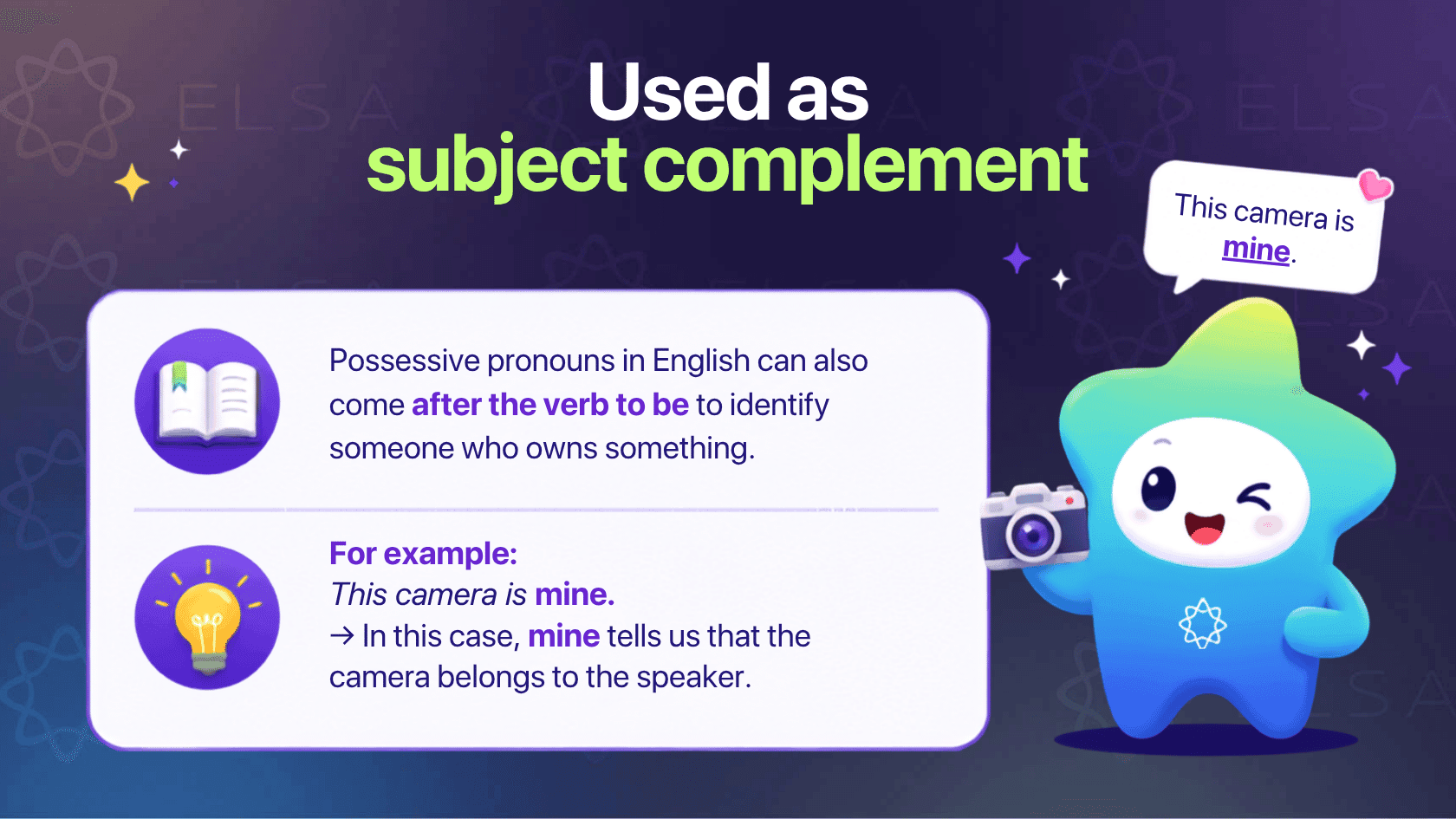
Possessive pronouns in English can also come after the verb to be to identify someone who owns something.
For example: This camera is mine.
→ In this case, mine tells us that the camera belongs to the speaker.
Whose
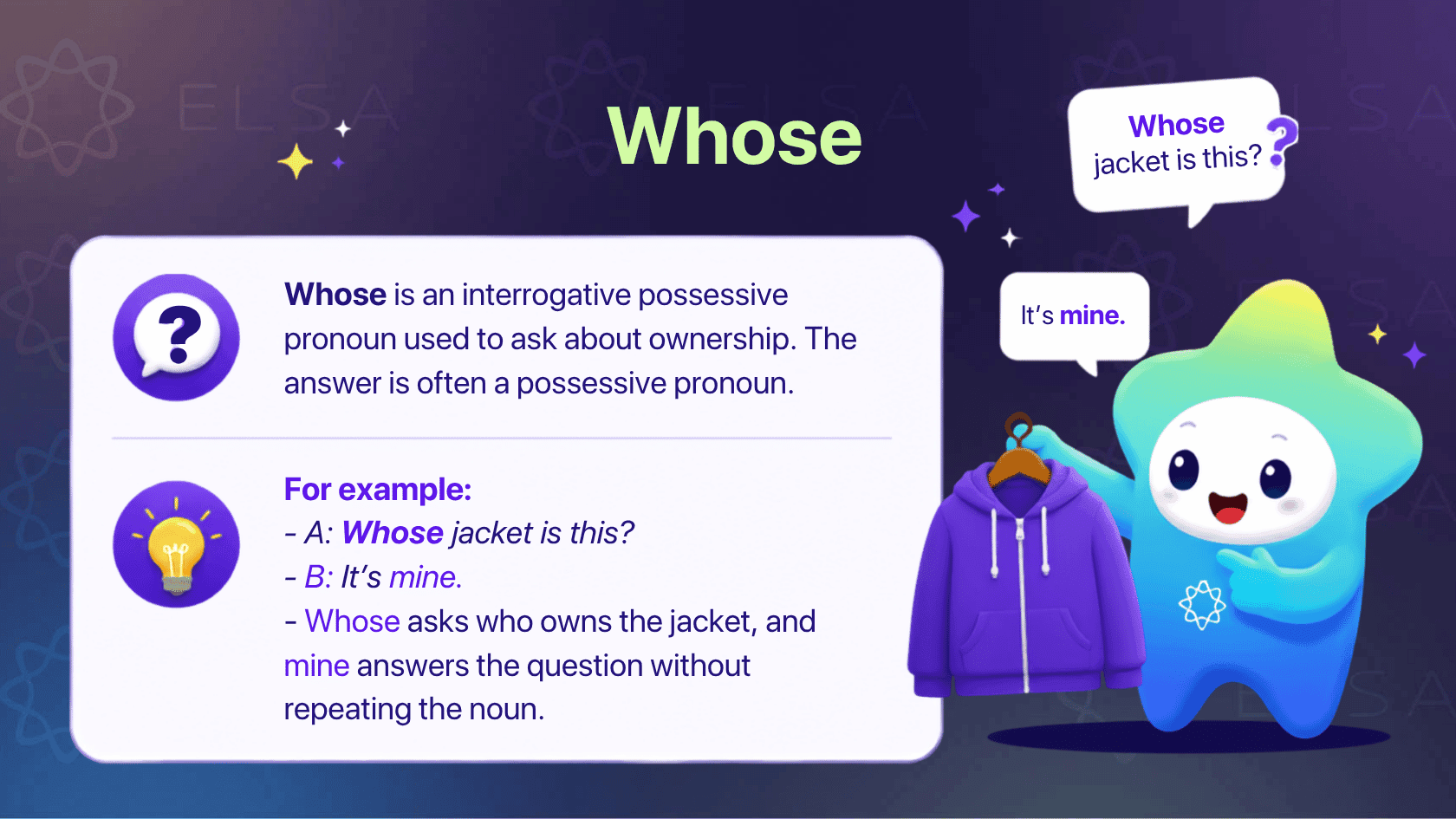
Whose is an interrogative possessive pronoun used to ask about ownership. The answer is often a possessive pronoun.
For example:
- A: Whose jacket is this?
- B: It’s mine.
→ Whose asks who owns the jacket, and mine answers the question without repeating the noun.
Double possessive
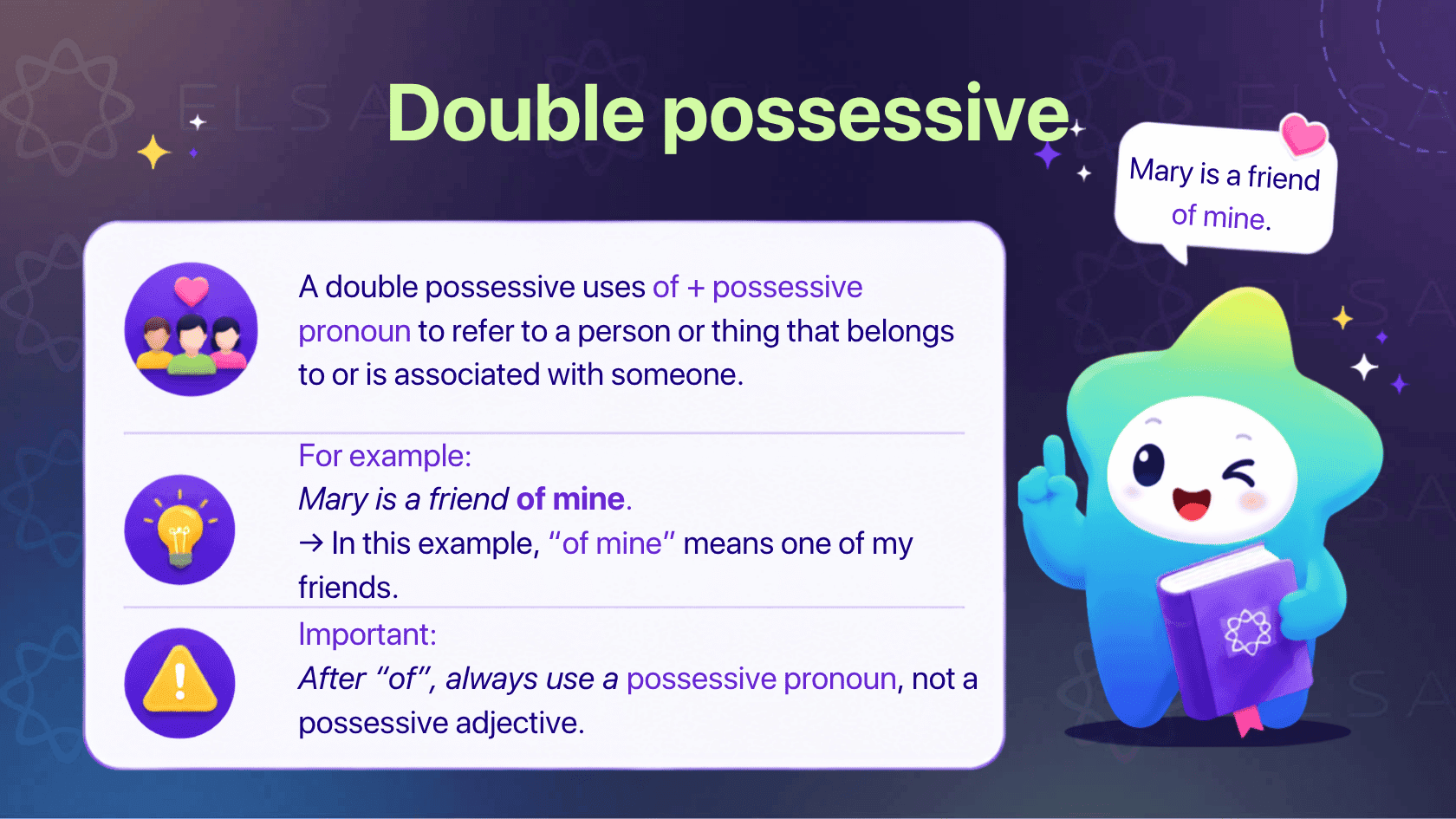
A double possessive uses of + possessive pronoun to refer to a person or thing that belongs to or is associated with someone. This structure is often used to emphasize membership, relationships, or one item among several.
For example: Mary is a friend of mine.
→ In this example, “of mine” means one of my friends.
Important: After “of”, always use a possessive pronoun, not a possessive adjective.
Common mistake
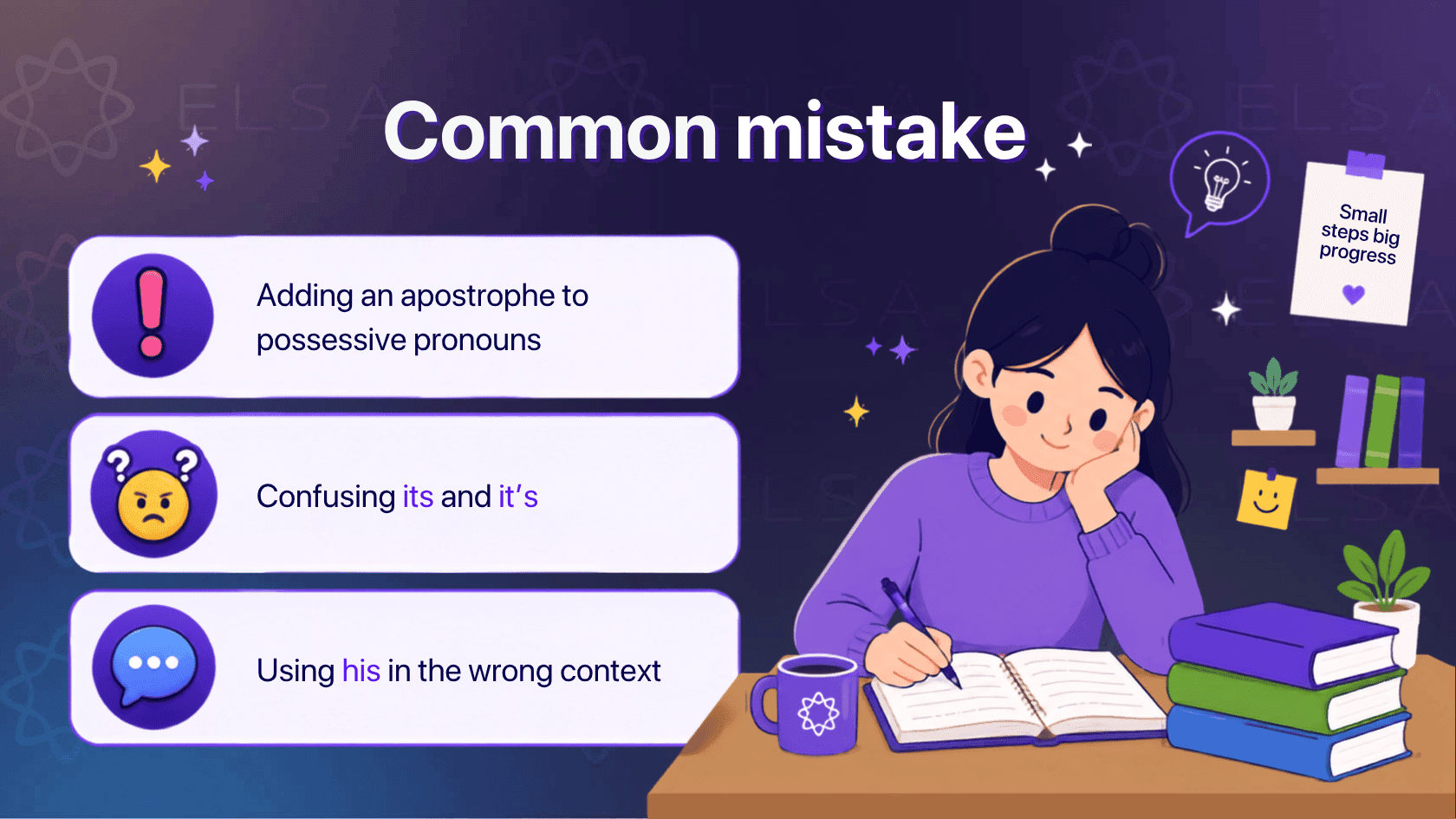
When using possessive pronouns, it's important to recognize the mistakes learners make most often.
- Adding an apostrophe to possessive pronouns: Possessive pronouns never take an apostrophe.
- Confusing its and it's: Its is a possessive form meaning ownership, while it's is the contraction of it is or it has.
- Using his in the wrong context: His can be both a possessive adjective and a possessive pronoun. Make sure to use his as a possessive pronoun only when it stands alone without a noun following it.
Possessive pronouns worksheet
Exercise 1: Complete each sentence with the correct possessive pronoun.
- This jacket is not mine. It's ________. (you)
- The blue bike is ________. (he)
- That beautiful house is ________. (they)
- We bought this car last summer. It's ________. (we)
- The decision was Mary's. It was ________. (she)
- I forgot my phone, so I borrowed ________. (you)
- These tickets belong to us. They are ________. (us)
- The red backpack is not his. It is ________. (I)
- That desk belongs to Emma. It is ________. (she)
- The dog found its toy, but the cat couldn't find ________. (it)
Answer key:
| 1. yours | 2. his | 3. theirs | 4. ours | 5. hers |
| 6. yours | 7. ours | 8. mine | 9. hers | 10. its |
Exercise 2: Replace the underlined words with a suitable possessive pronoun
- This is my bag.
- That laptop is their laptop.
- The blue jacket is her jacket.
- The final decision was our decision.
- Is this your pen?
- The large house is his house.
- Those seats are our seats.
- The white umbrella is your umbrella.
Answer key:
- This bag is mine.
- That laptop is theirs.
- The blue jacket is hers.
- The final decision was ours.
- Is this yours?
- The large house is his.
- Those seats are ours.
- The white umbrella is yours.
Exercise 3: Fill in each blank with the correct possessive pronoun.
Conversation 1:
Anna: Is this jacket (1) ________? (you) Ben: No, it isn't (2) ________. (I) I think it's Lily's. Anna: You're right. This one is (3) ________. (she) Ben: Then whose backpack is over there? Anna: I think it's Tom and Jack's. It's probably (4) ________. (they) |
Conversation 2:
Lucy: Have you seen our English books? I can't find (5) ________. (we) Mark: They're on the teacher's desk. Lucy: Thanks! By the way, is this pen (6) ________? (you) Mark: Yes, it's (7) ________. (I) Lucy: Great! Then this pencil must be Emma's. It's (8) ________. (she) |
Answer key:
Conversation 1:
| 1. yours | 2. mine | 3. hers | 4. theirs |
Conversation 2:
| 5. ours | 6. yours | 7. mine | 8. hers |
>> See more: Indefinite pronouns: Definition and how to use them
By learning when and how to use possessive pronouns correctly, you can express ownership clearly while avoiding unnecessary repetition. To continue improving your grammar, explore the Grammar category on the ELSA Speak blog for more practical lessons, examples, and exercises to build your English skills with confidence.