

Reflexive pronouns: Definition, list, and how to use them
elsaspeakadmin
August 21, 2026
English clauses
Reflexive pronouns are one of the most common pronouns in English. In this guide, you’ll learn about reflexive pronouns definition along with examples and practice what you’ve learned with exercises.
What are reflexive pronouns?
Reflexive verb pronouns are words that end in -self or -selves (for instance, myself, themselves). They are used when the subject and object of the sentence are the exact same person or thing, meaning the one performing an action also receives the action themselves.
Full list of reflexive pronouns in English
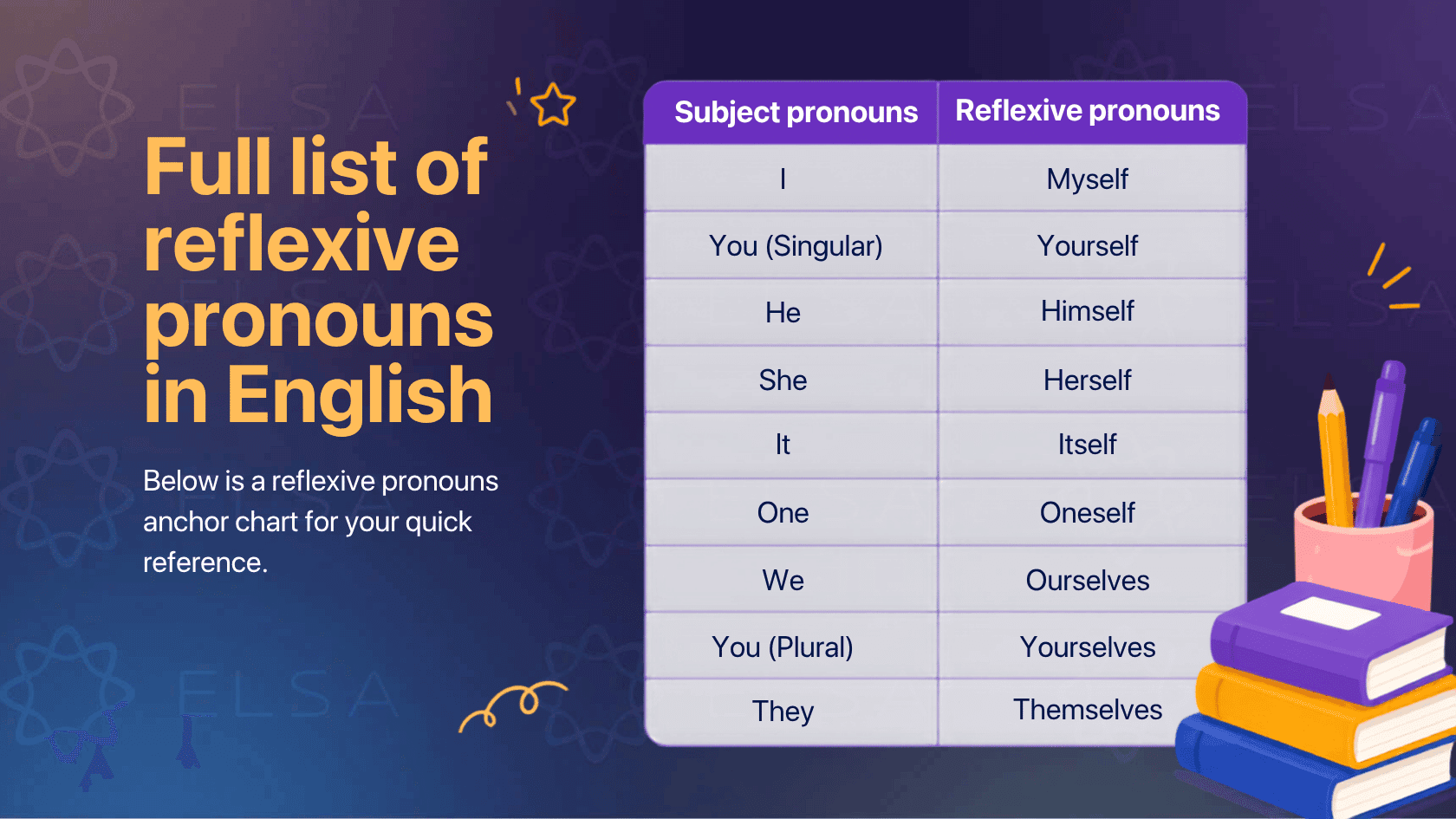
Below is a reflexive pronouns anchor chart for your quick reference.
| Subject pronoun | Reflexive pronoun |
| I | Myself |
| You (Singular) | Yourself |
| He | Himself |
| She | Herself |
| It | Itself |
| One | Oneself |
| We | Ourselves |
| You (Plural) | Yourselves |
| They | Themselves |
5 ways to use reflexive pronouns
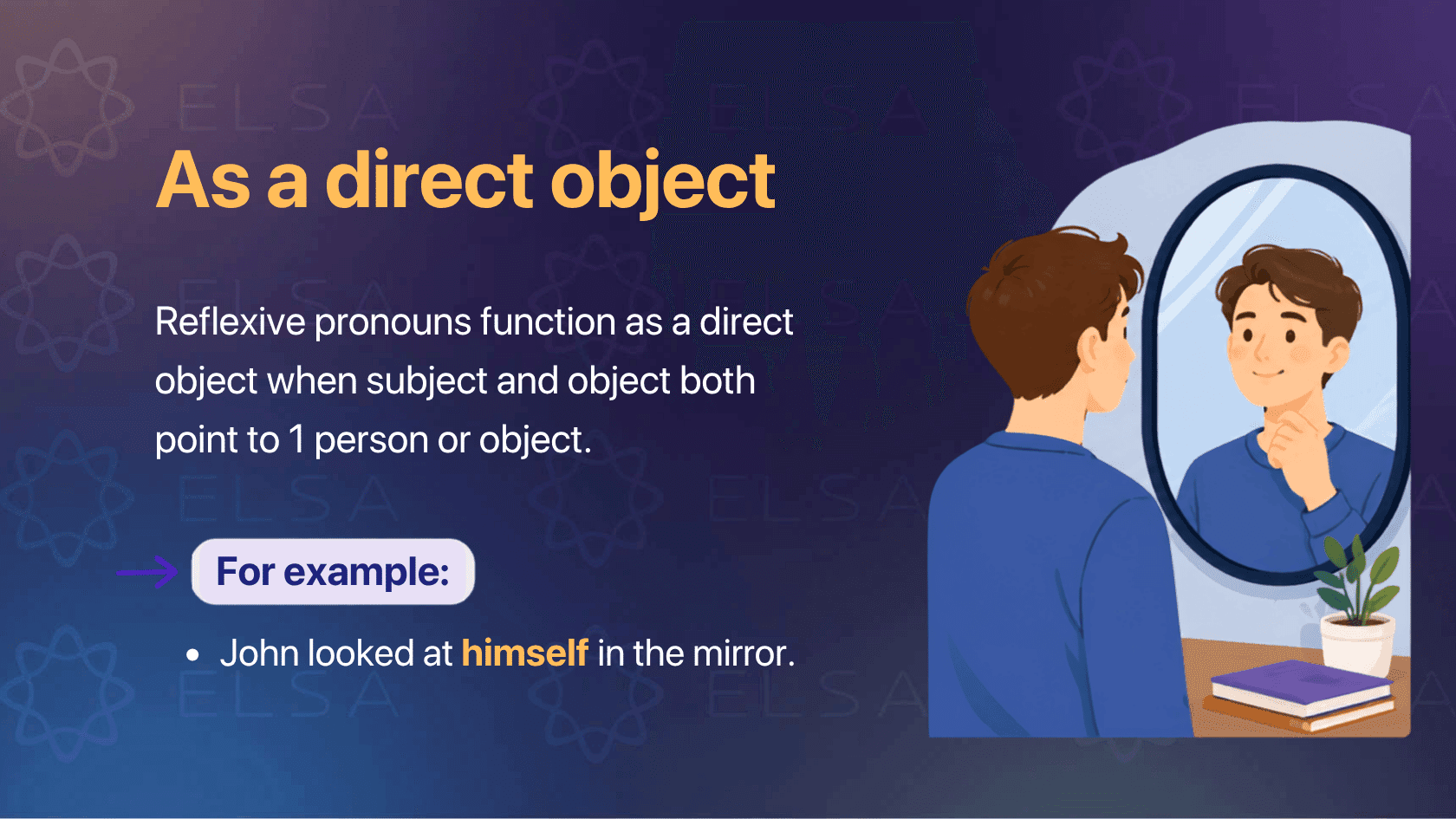
As a direct object
Reflexive pronouns function as a direct object when subject and object both point to 1 person or object.
For example: John looked at himself in the mirror.
As an indirect object
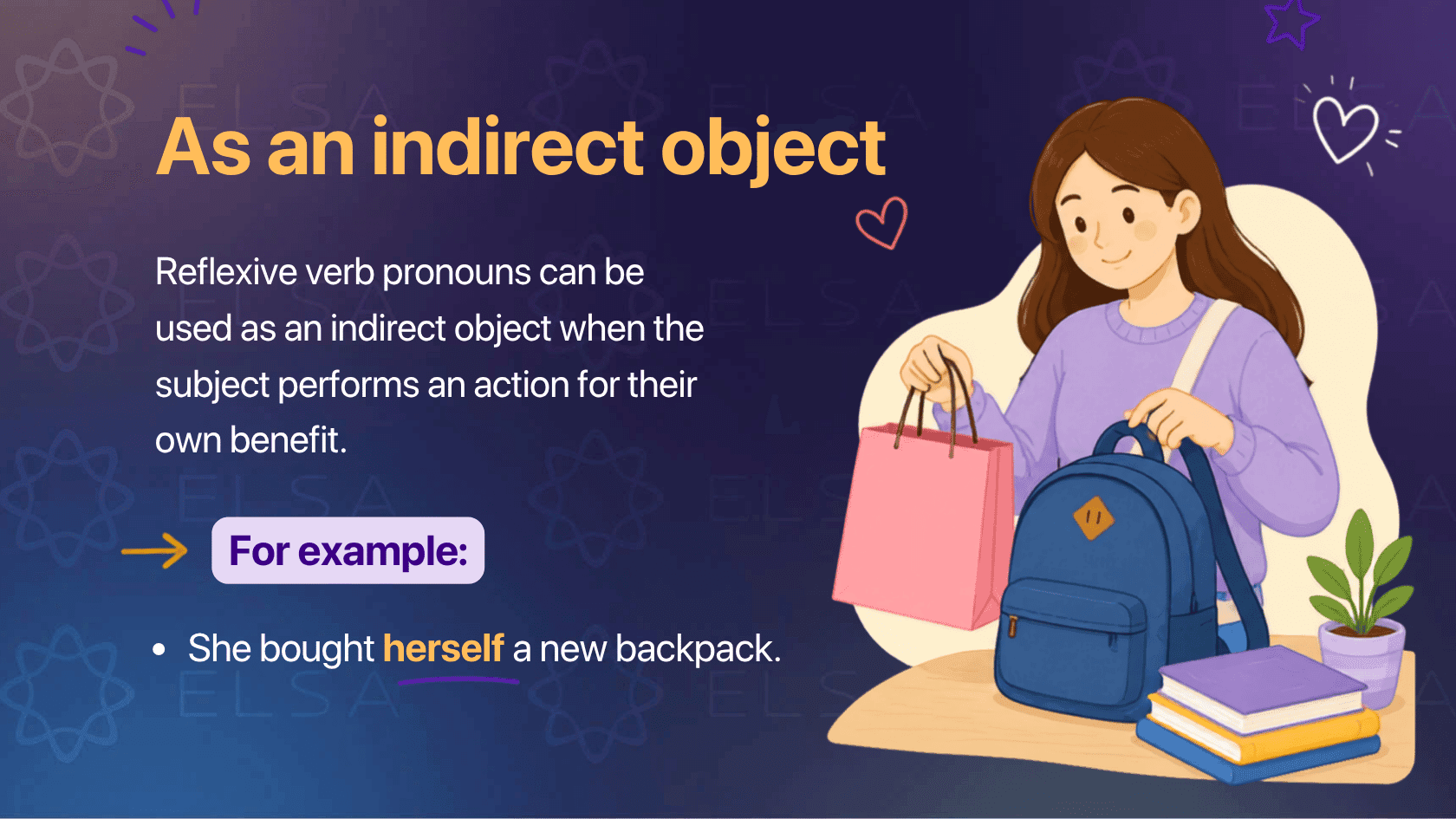
Reflexive verb pronouns can be used as an indirect object when the subject performs an action for their own benefit.
For example: She bought herself a new backpack.
After prepositions
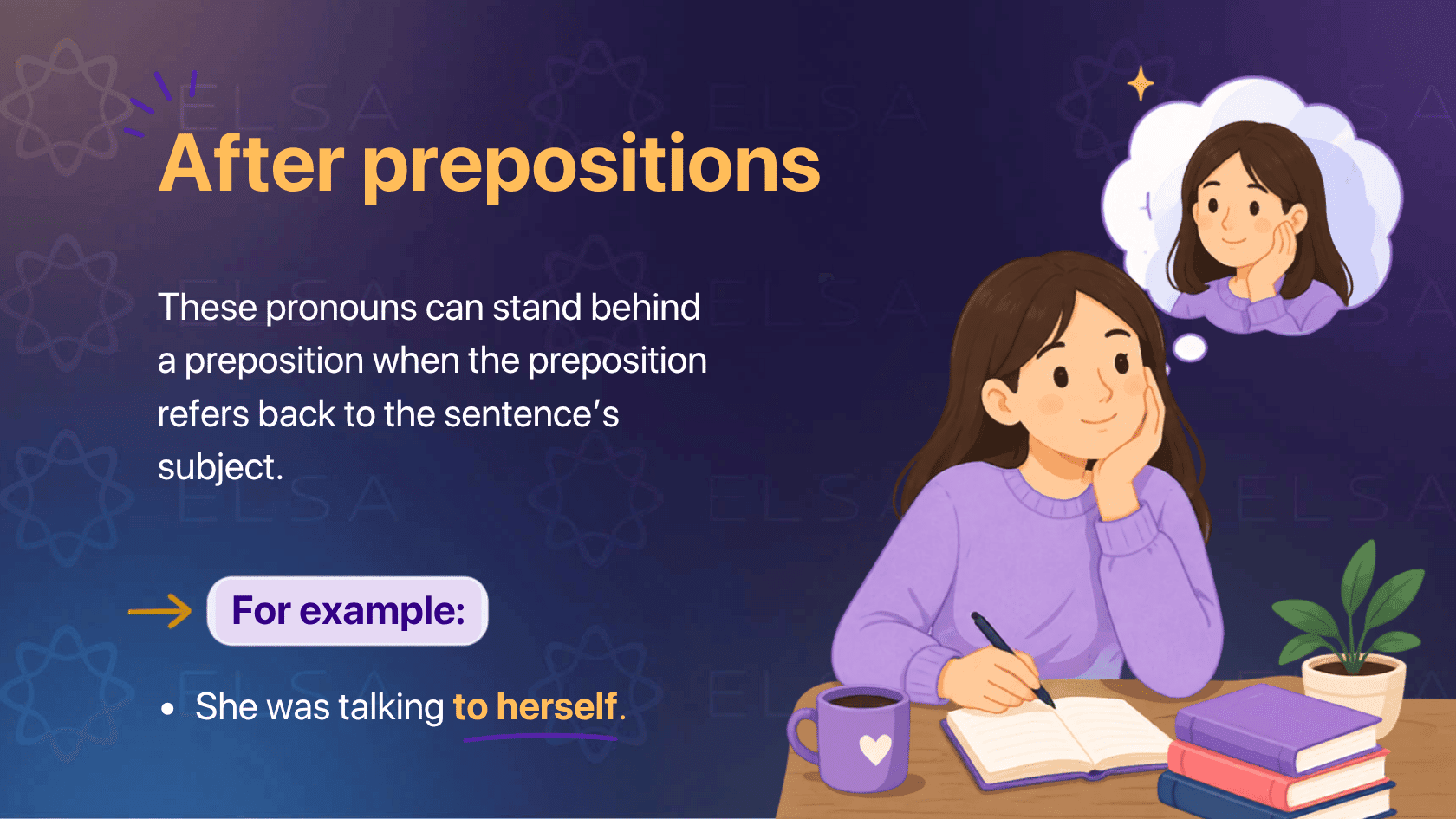
These pronouns can stand behind a preposition when the preposition refers back to the sentence’s subject.
For example: She was talking to herself.
Using reflexive pronouns to emphasize
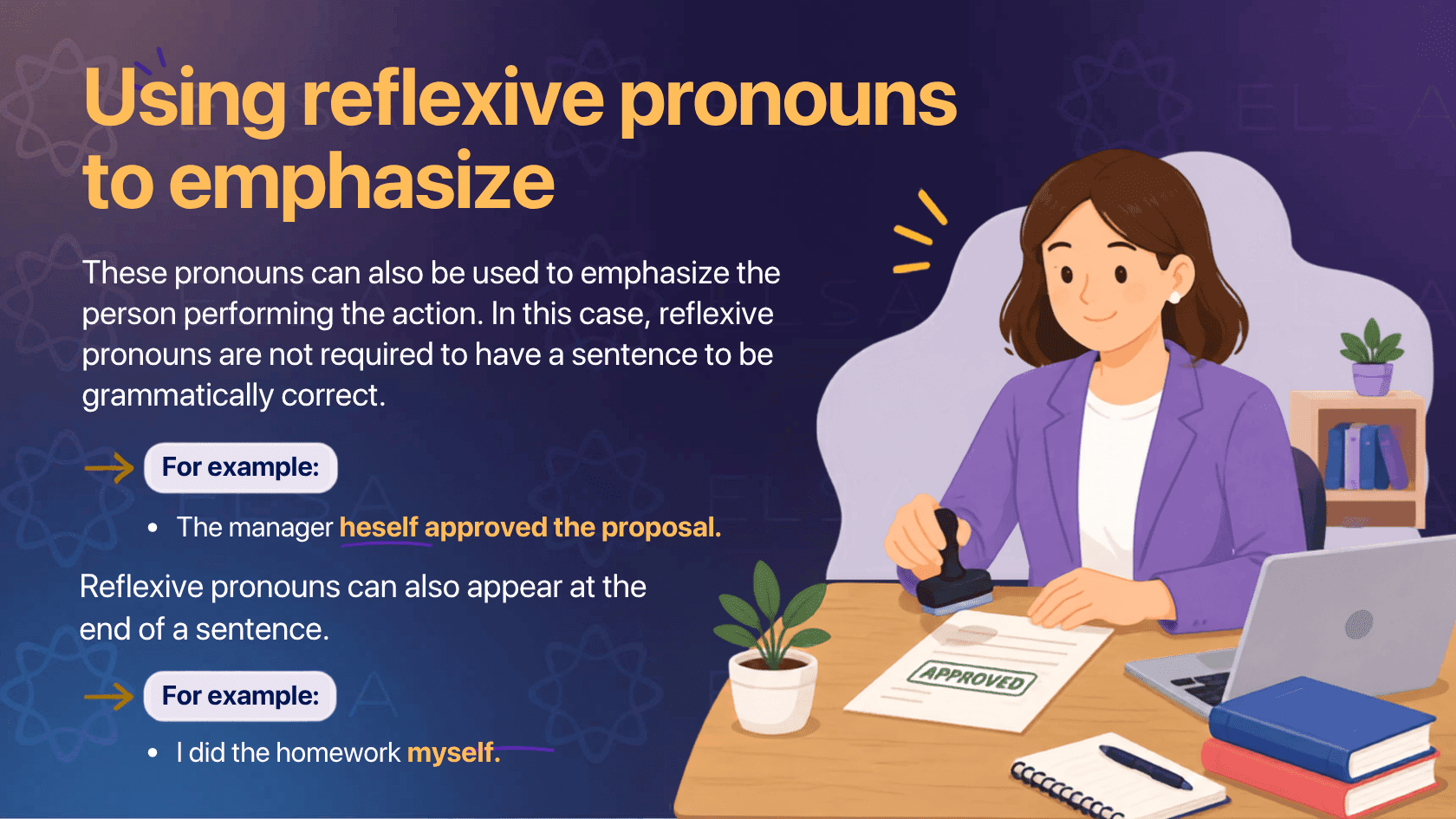
These pronouns can also be used to emphasize the person performing the action. In this case, reflexive pronouns are not required to have a sentence to be grammatically correct.
- For example: The manager herself approved the proposal.
Reflexive pronouns can also appear at the end of a sentence.
- For example: I did the homework myself.
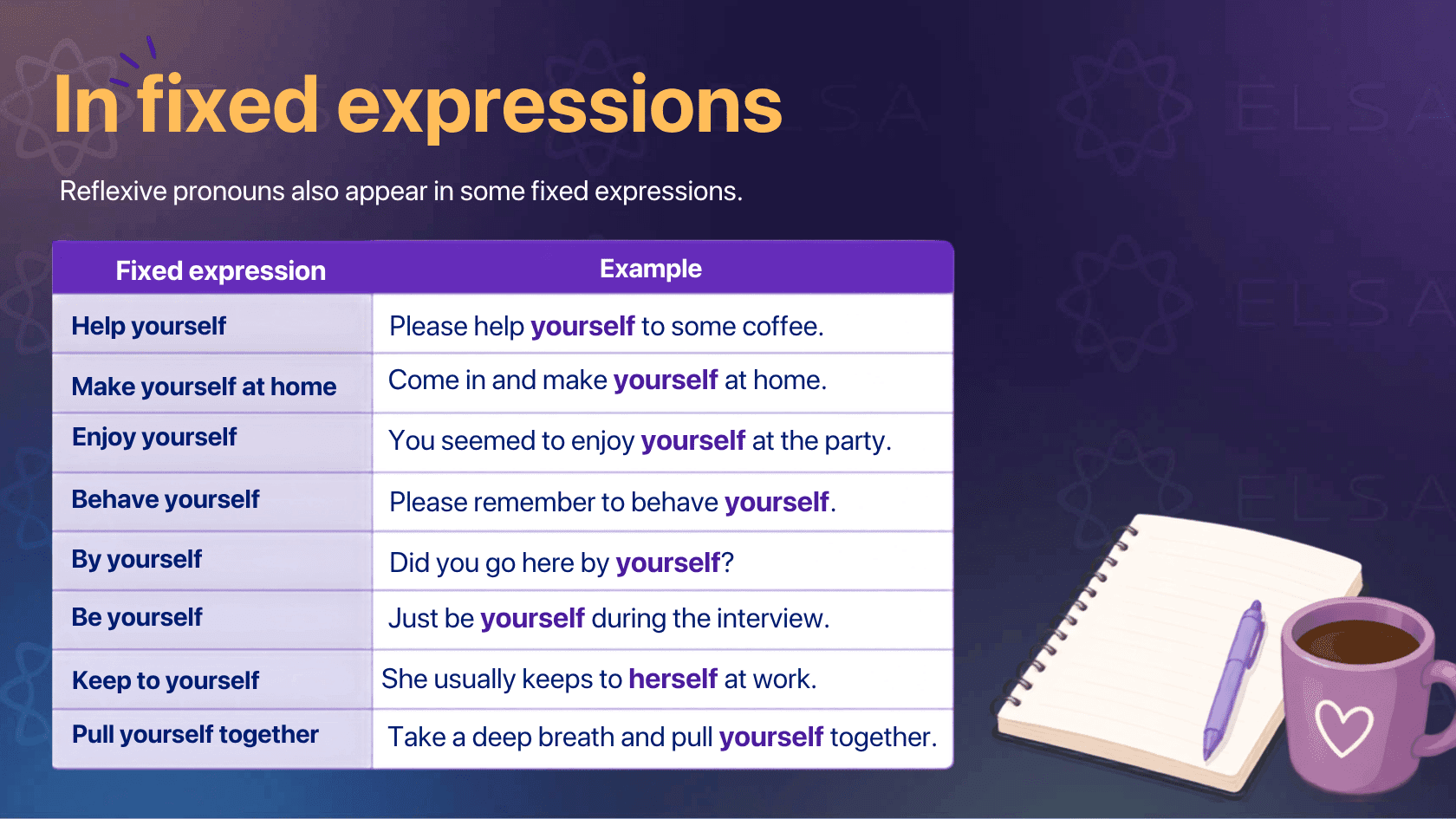
In fixed expressions
Reflexive pronouns also appear in some fixed expressions. Here are some reflexive pronouns examples:
| Fixed expression | Example |
| Help yourself | Please help yourself to some coffee. |
| Make yourself at home | Come in and make yourself at home. |
| Enjoy yourself | You seemed to enjoy yourself at the party. |
| Behave yourself | Please remember to behave yourself. |
| By yourself | Did you go here by yourself? |
| Be yourself | Just be yourself during the interview. |
| Keep to yourself | She usually keeps to herself at work. |
| Pull yourself together | Take a deep breath and pull yourself together. |
Reflexive pronouns vs. intensive pronouns
While both have the same forms, each pronoun serves different grammatical purposes.
| Reflexive pronouns | Intensive pronouns | |
| Usage | Refers to a person or a thing that is affected by the subject’s own action. | Emphasize the person or a thing that performs the action. |
| Usually necessary to express the sentence’s intended meaning. | Not necessary, it can be removed without changing the sentence’s intended meaning. | |
| Placement | Usually follow a verb or a preposition | Can stand behind a subject or at the end of the sentence. |
| Example | He blamed himself for breaking the vase. | They themselves completed the project. |
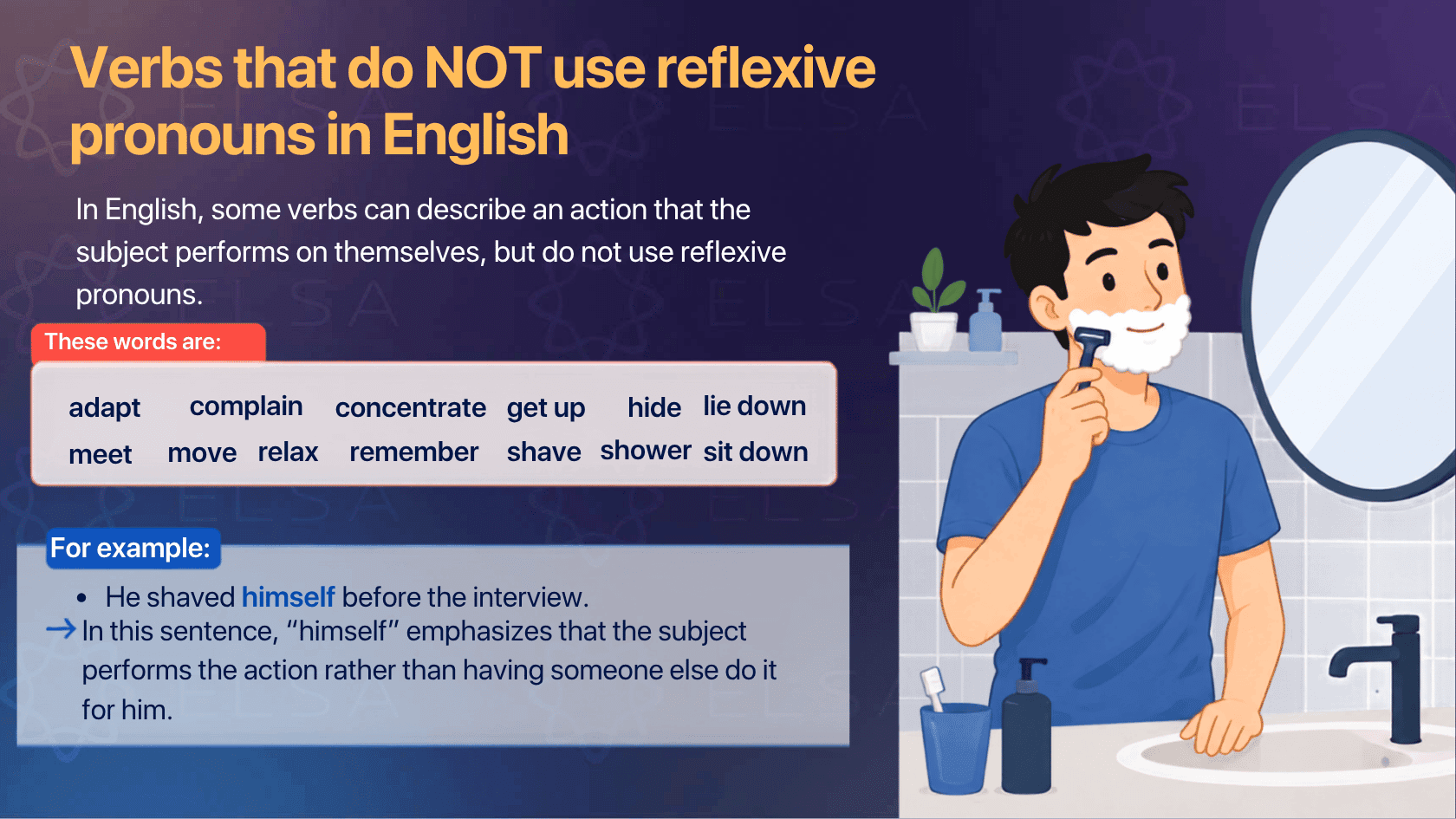
Verbs that do NOT use reflexive pronouns in English
In English, some verbs can describe an action that the subject performs on themselves, but do not use reflexive pronouns such as myself, yourself, himself, or themselves.
These words are: adapt, complain, concentrate, get up, hide, lie down, meet, move, relax, remember, shave, shower, sit down
For example:
| Wrong | Correct |
| I sat down myself at the table. | I sat down at the table. |
Note: Depending on the situation, sometimes these pronouns can also be used with these verbs. They can be used to emphasize the subject, clarify the object, or to express a different meaning.
For example: He shaved himself before the interview.
→ In this sentence, “himself” emphasizes that the subject performs the action rather than having someone else do it for him.
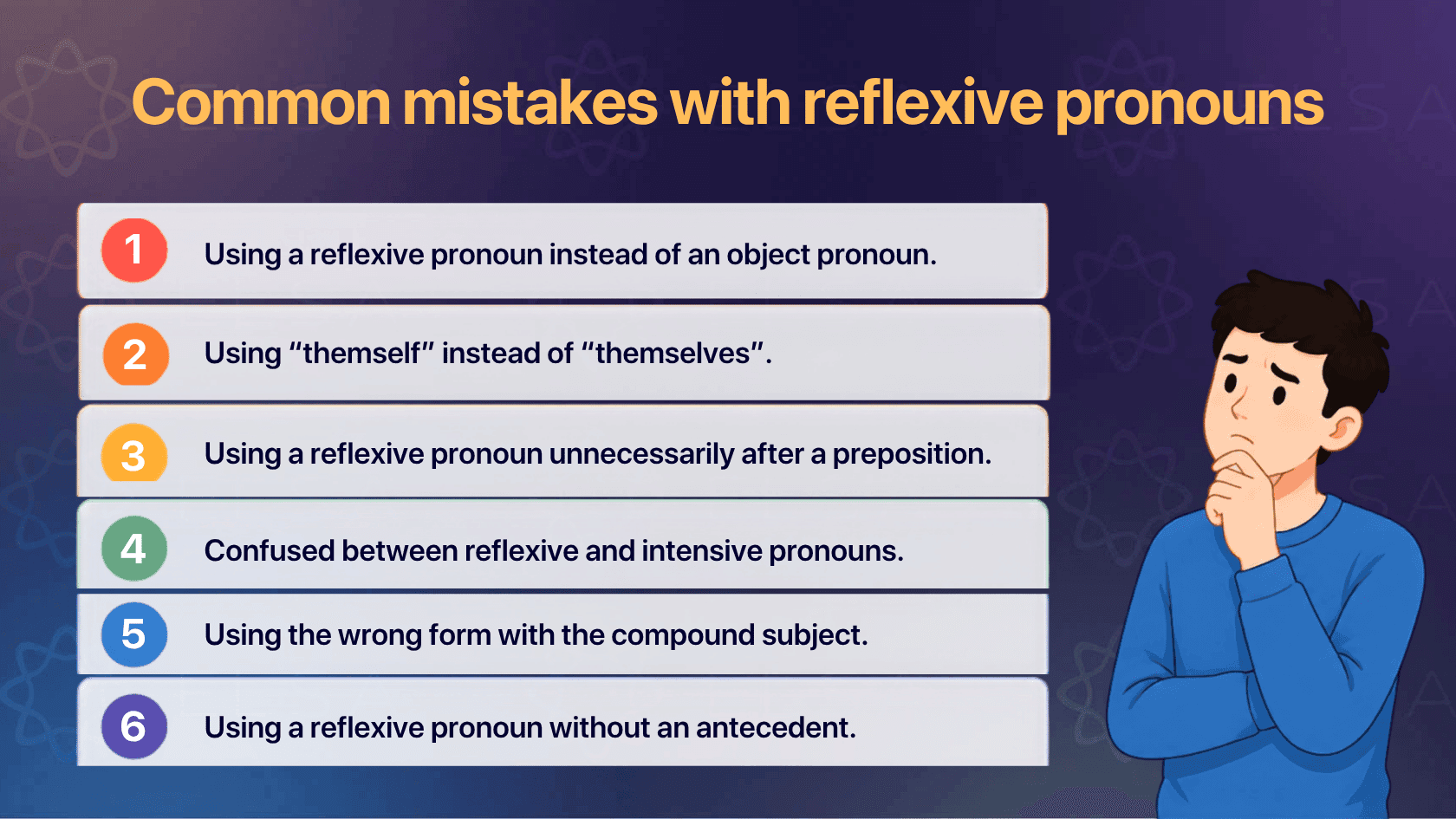
Common mistakes with reflexive pronouns
- Using a reflexive pronoun instead of an object pronoun. Reflexive pronouns should not be used to replace me, you, him, her, us, or them simply because the sentence sounds more formal.
- Using “themself” instead of “themselves”. In standard plural usage, the pronoun themselves is the traditional reflexive form of they.
- Using a reflexive pronoun unnecessarily after a preposition. A reflexive pronoun should only be used when it refers back to a subject, not simply because a preposition appears.
- Confused between reflexive and intensive pronouns. Even though both pronouns look the same, their forms can serve different functions.
- Using the wrong form with the compound subject. When the subject contains two or more people/objects, use the pronoun that matches the intended reference.
- Using a reflexive pronoun without an antecedent. Like other pronouns, reflexive pronouns also need a clear noun or pronoun to refer back to. Avoid sentences like “Myself went to the supermarket.” Use “I went to the supermarket.” instead.
Reflexive pronouns worksheet
Exercise 1: Complete each sentence with the correct reflexive pronoun.
- John taught ______ how to use the new software.
- Mary looked at ______ in the mirror.
- We prepared ______ for the mid-term exam.
- The cat cleaned ______ after eating.
- Did you make this cake by ______?
- They introduced ______ to the new teacher.
- She accidentally cut ______ while cooking.
- You should be proud of ______.
- The children enjoyed ______ at the amusement park.
- The manager ______ called the client.
Answer key:
| 1. himself | 2. herself | 3. ourselves | 4. itself | 5. yourself |
| 6. themselves | 7. herself | 8. yourself | 9. themselves | 10. himself |
Exercise 2: Identify whether the bolded pronoun is being used as a reflexive pronoun or an intensive pronoun.
- She blamed herself for the mistake.
- The CEO herself announced the decision.
- I made myself a cup of coffee.
- We ourselves organized the event.
- He hurt himself while playing football.
- The students completed the project themselves.
- They introduced themselves to the guests.
- I myself checked every document.
- She bought herself a new phone.
- The author himself attended the event.
Answer key:
| Answer | Explanation | |
| 1. | Reflexive | “Herself” refers to the action of “blamed”. |
| 2. | Intensive | “Herself” emphasizes who announced the decision. |
| 3. | Reflexive | “Myself” refers back to the subject “I” as the indirect object. |
| 4. | Intensive | “Ourselves” emphasizes the subject “we”. |
| 5. | Reflexive | “Himself” receives the action of “hurt”. |
| 6. | Intensive | “Themselves” emphasizes who completed the project. |
| 7. | Reflexive | “Themselves” is the object of “introduced” and refers back to “they”. |
| 8. | Intensive | “Myself” emphasizes the subject “I”. |
| 9. | Reflexive | “Herself” is the person who benefits from buying the phone. |
| 10. | Intensive | “Himself” emphasizes that the author attended. |
>> Read more: What are indefinite pronouns?
Reflexive pronouns can be much easier to use once you identify who performs the action and who receives or benefits from it. For more practical tips and lessons, remember to visit the Grammar category on ELSA Speak’s blog and continue improving your English skills.