

Imperative sentence: Definition, types, rules & examples
elsaspeakadmin
October 29, 2026
Advanced Grammar
Imperative sentences are essential in everyday American English, especially when you want to give workplace instructions, make polite requests, or warn someone about something. This guide covers the main types of imperative sentence, examples, and exercises for you to practice.
What is an imperative sentence?
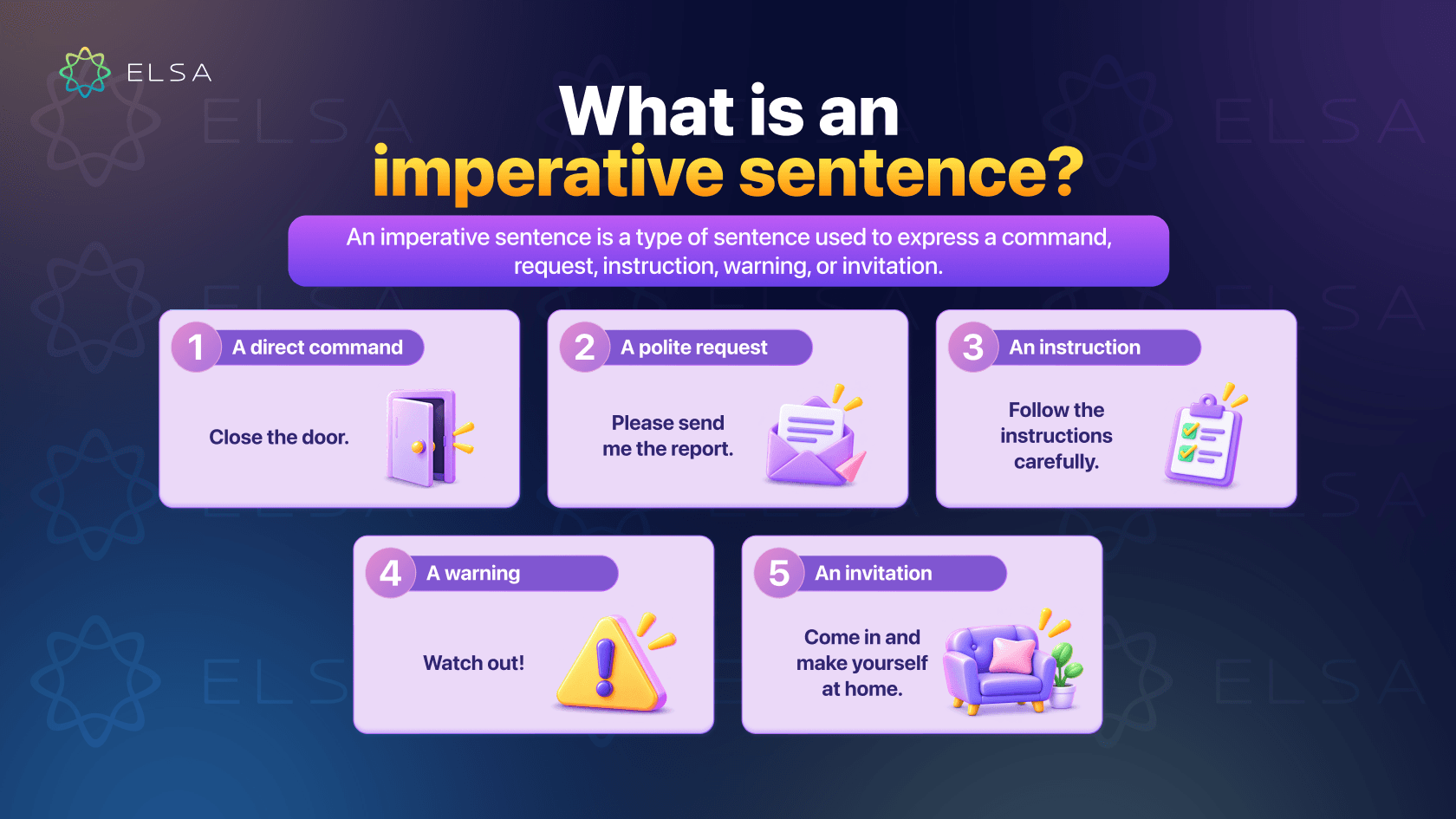
If you’re wondering what is imperative sentence, it is a type of sentence that is used to express a command, request, instruction, warning, or an invitation. They’re common in everyday conversations, including workplace communication, recipes, user manuals, public signs, and safety announcements.
Imperative sentence examples
Here are five examples that illustrate the different purposes of imperative sentences:
- A direct command: Close the door.
- A polite request: Please send me the report.
- An instruction: Follow the instructions carefully.
- A warning: Watch out!
- An invitation: Come in and make yourself at home.
Three key characteristics of imperative sentences
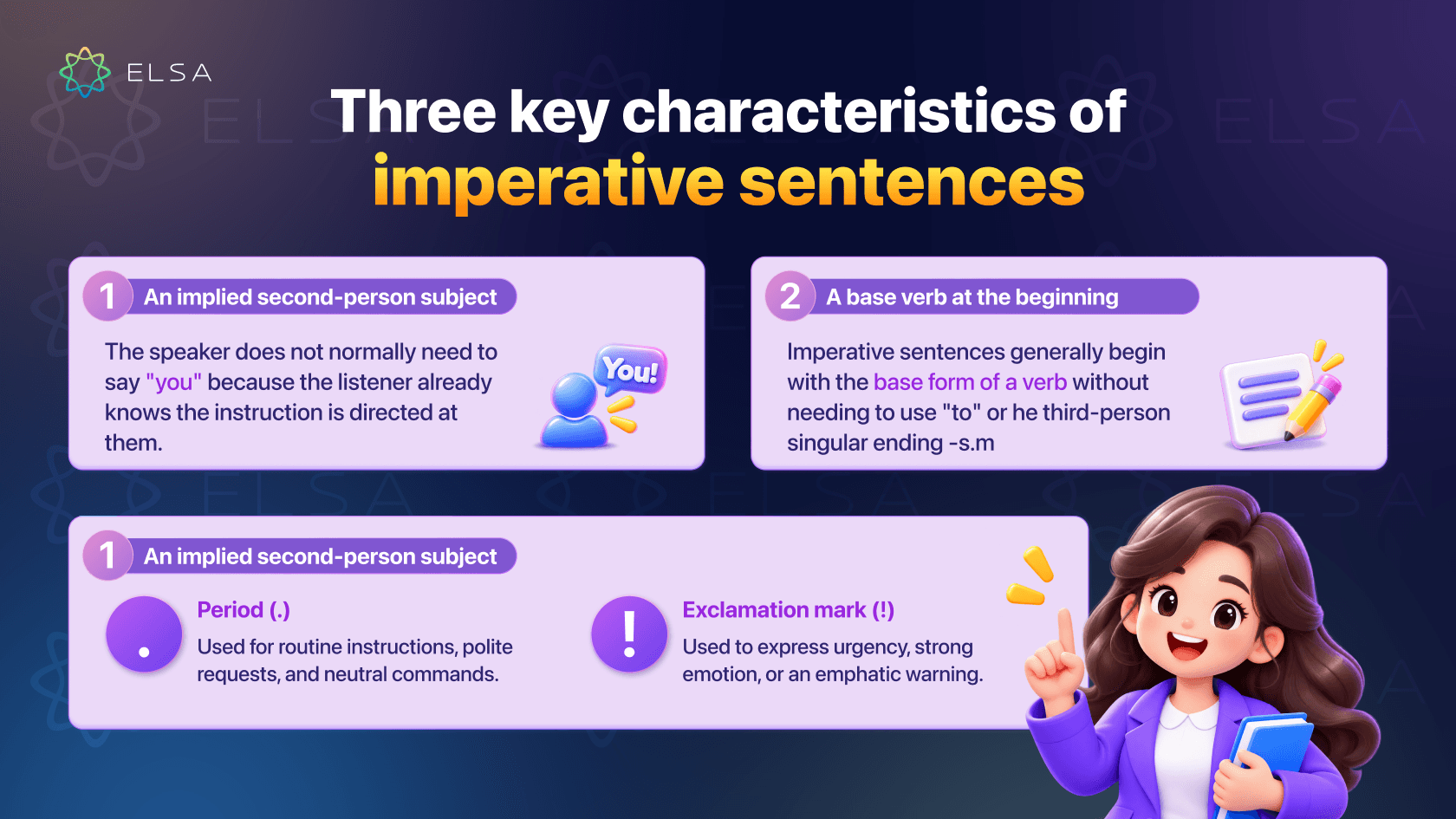
1. An implied second-person subject
The subject in these sentences is usually “you”, but it is understood rather than stated explicitly. Therefore, it is not necessary to say “you” because the listener is already aware that the instruction is directed at them. This hidden “you” is one of the personal pronouns in English.
For example: Open your book.
→ The implied subject is “you”.
2. A base verb at the beginning
Imperative sentences begin with the base form of a verb, or usually known as the bare infinitive. It does not use “to” and does not take the third person singular ending -s. This is different from the simple present tense, where he, she, or it takes -s, as in “She closes the door.”
For example: Take your seat.
Not:
- Takes your seat.
- To take your seat.
3. Flexible ending punctuation
Depending on the intended tone and context, the ending punctuation may vary between:
- Period (.): Used for routine instructions, polite requests, and neutral commands.
- For example; Please complete the report.
- Exclamation mark (!): Used to express urgency and neutral commands.
- For example: Stop right there!
Imperative sentence structure
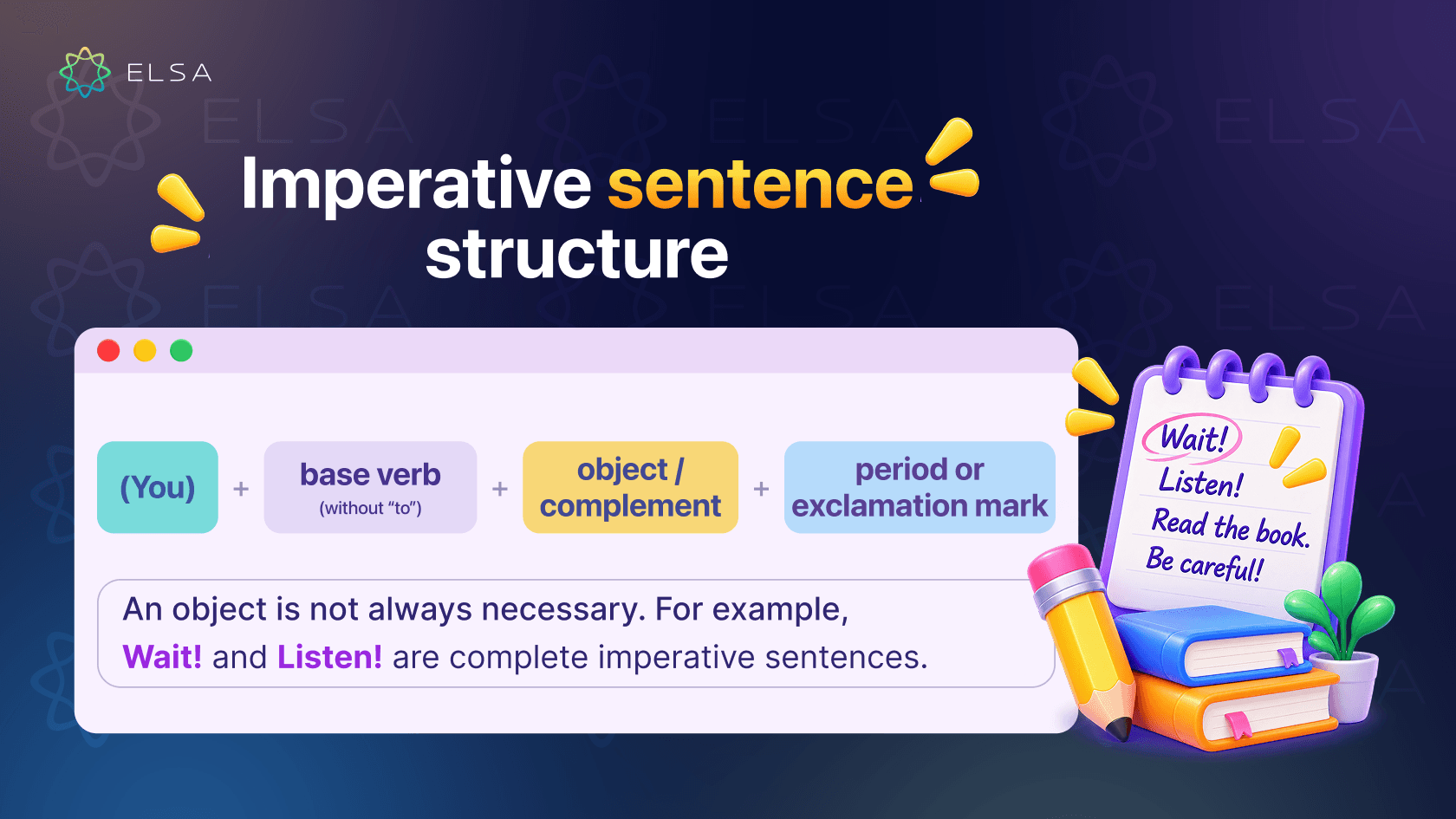
The basic structure is:
| (You) + base verb (without “to”) + object/complement + period or exclamation mark |
For example: Read the instructions carefully.
→ In here:
- The implied subject is you.
- The base verb is read.
- The object is the instructions.
- The adverb is carefully.
Types of imperative sentence: Affirmative, negative, and conditional
There are 3 main types of imperative sentences: affirmative, negative, and conditional. Each of these serves a different purpose, and understanding them can help you recognize these sentences easier and use them correctly.
| Type | Structure pattern | Function | Example |
|---|---|---|---|
| Affirmative | Base verb + object/complement | Tells someone to perform a specific action. | Submit your homework by Friday. |
| Negative | Don't / Do not / Never + base verb + object/complement | Tells someone not to perform an action or warns them against it. | Do not share your password. |
| Conditional | If-clause + imperative clause, or imperative clause + if-clause | Gives an instruction that depends on a condition. | If you need something, call me. |
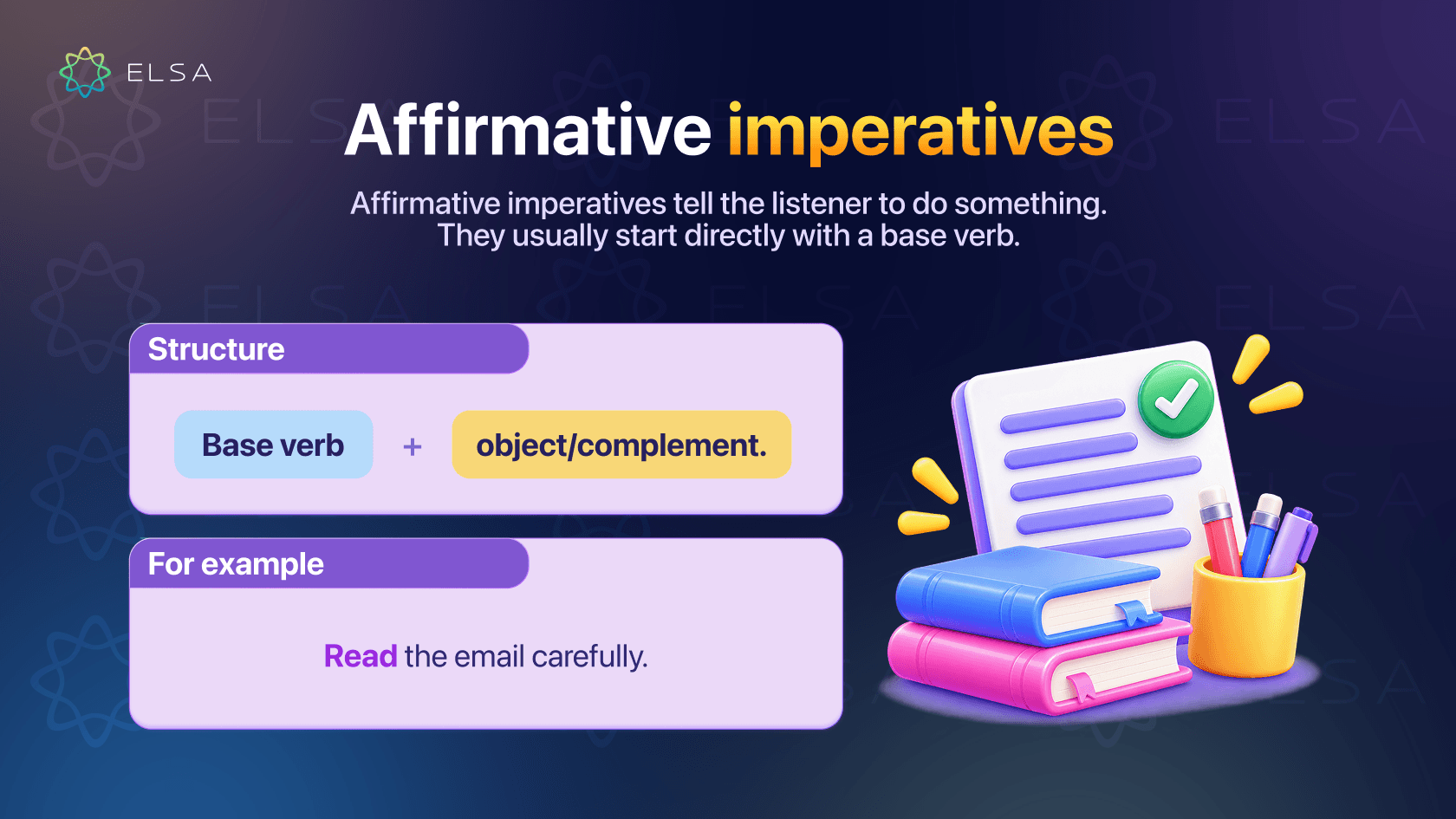
1. Affirmative imperatives
The affirmative form is used to tell the listener to do something. It starts directly with a base verb.
Structure:
| Base verb + object/complement |
For example: Close the door when you leave.
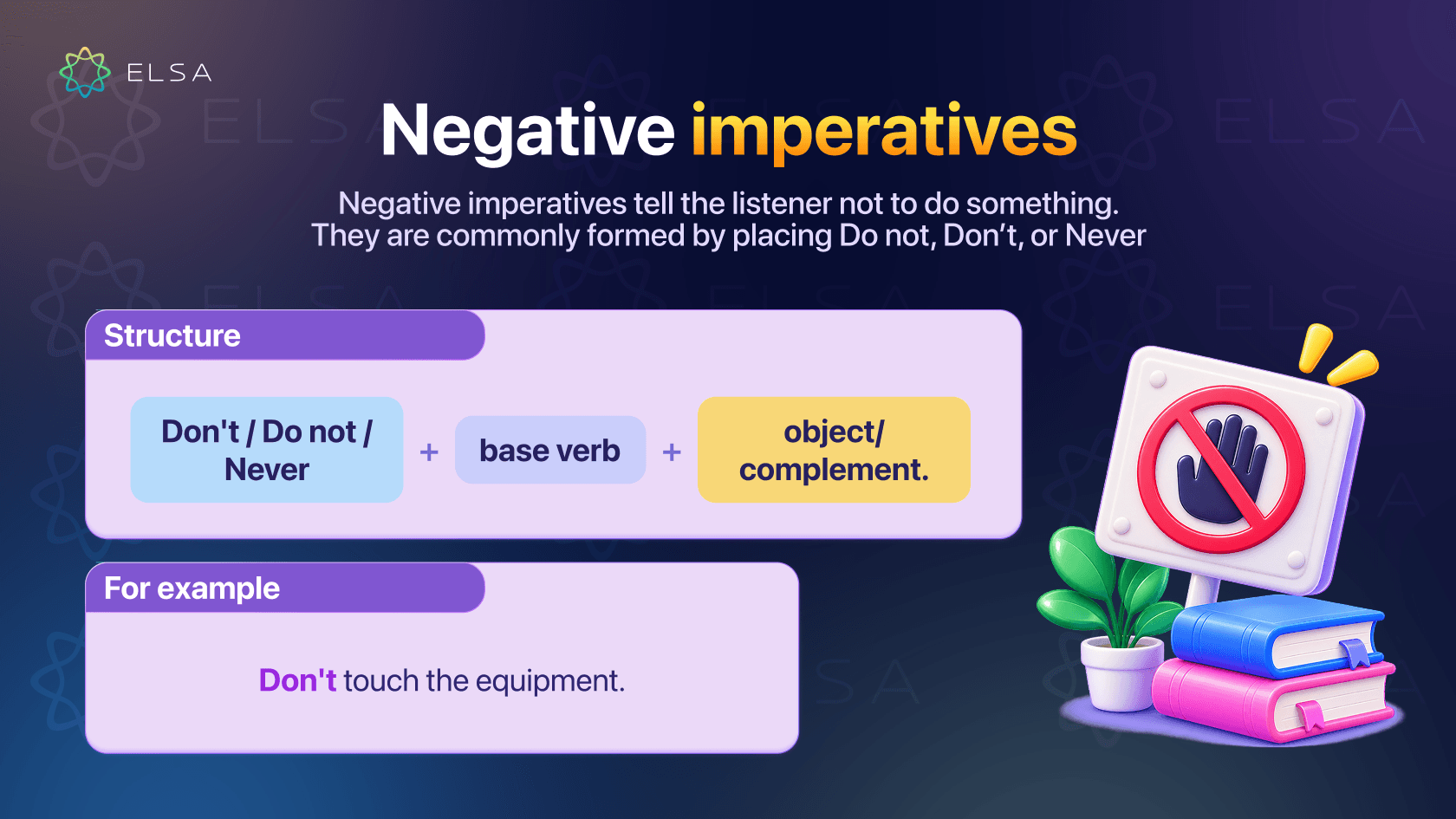
2. Negative imperatives
Negative imperatives tell the listener not to do something. They are commonly formed by placing “Don’t” or “Do not” before the base verb. To express a strong prohibition or warning, “Never” can also be used.
Structure:
| Don't / Do not / Never + base verb + object/complement |
For example: Don’t touch the pot.
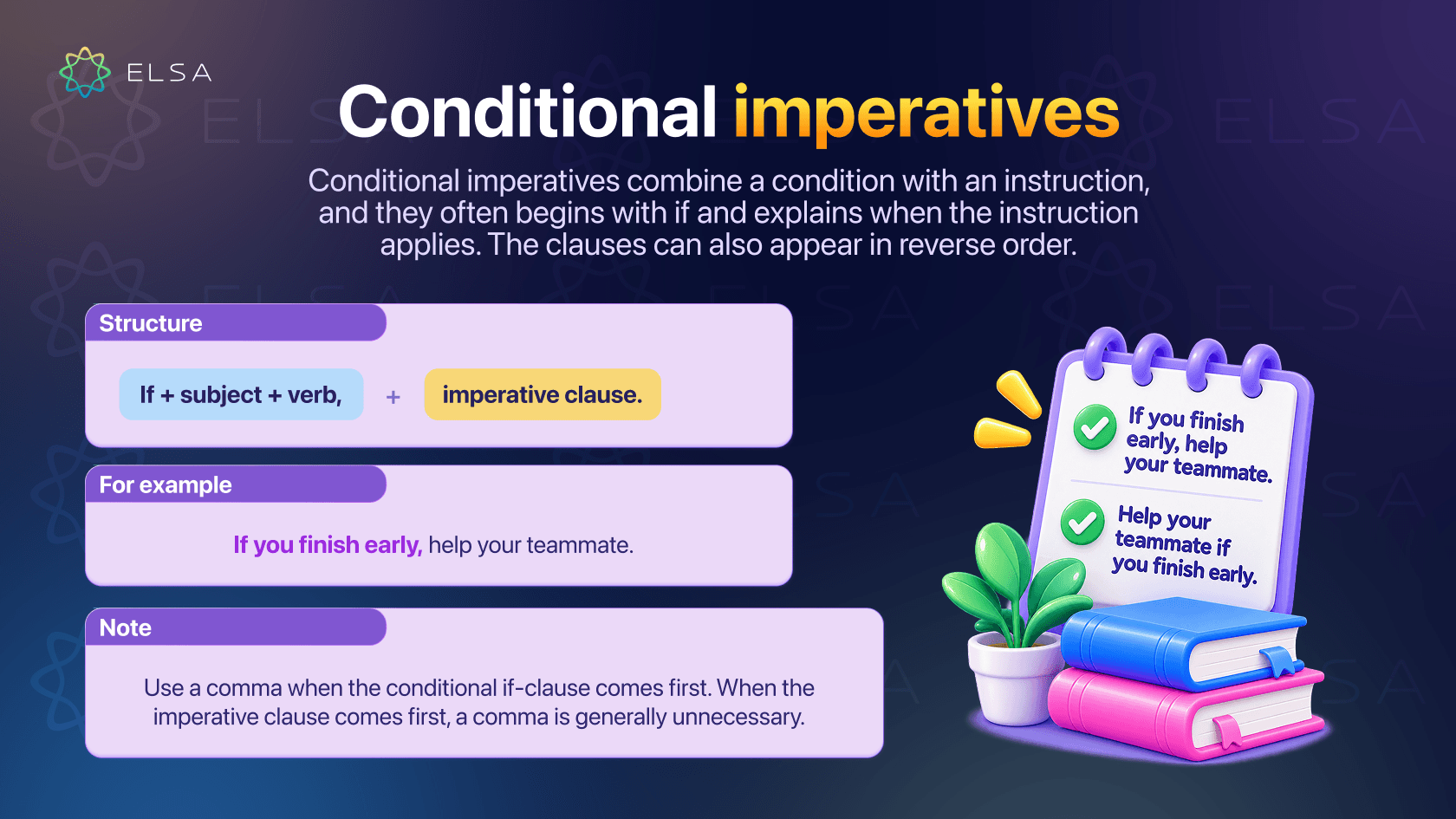
3. Conditional imperatives
Conditional imperative sentences combine a condition with an instruction. It often begins with “if” and explains when the instruction applies.
Structure:
| If + subject + verb, + imperative clause. |
Note: The clauses can also appear in reverse order.
Examples:
- If you finish early, go home.
- Call the receptionist if you have any problems.
The 5 primary functions of imperative sentences
Imperative sentences do more than just issuing orders. The following usages and examples show how the same structure and be served for different purposes depending on the situation.
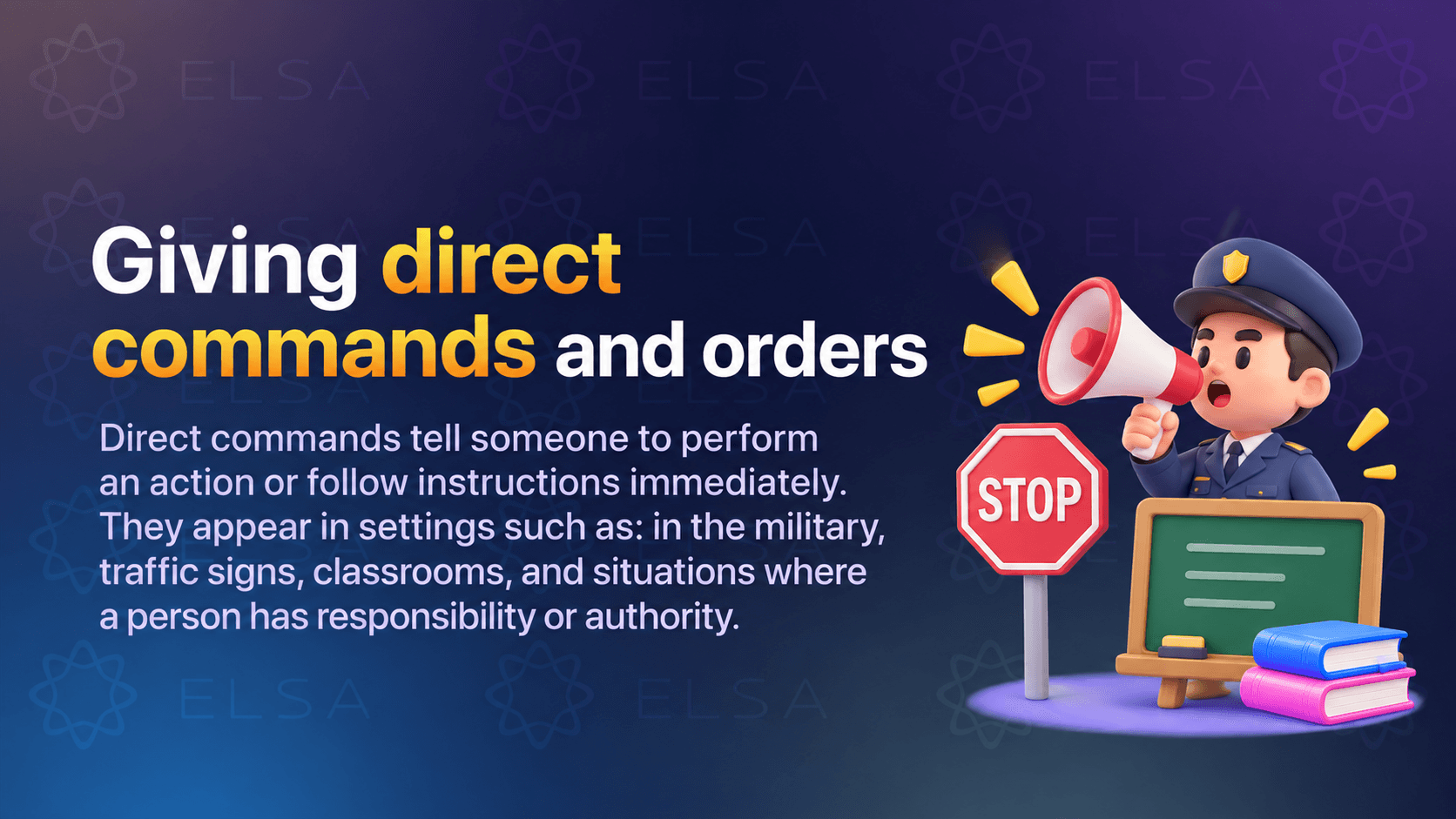
Giving direct commands and orders
Direct commands tell someone to perform an action or follow instructions immediately. They appear in settings such as: in the military, traffic signs, classrooms, and situations where a person has responsibility or authority.
For example:
- Stop talking and focus on the lesson.
- Follow the safety protocol.
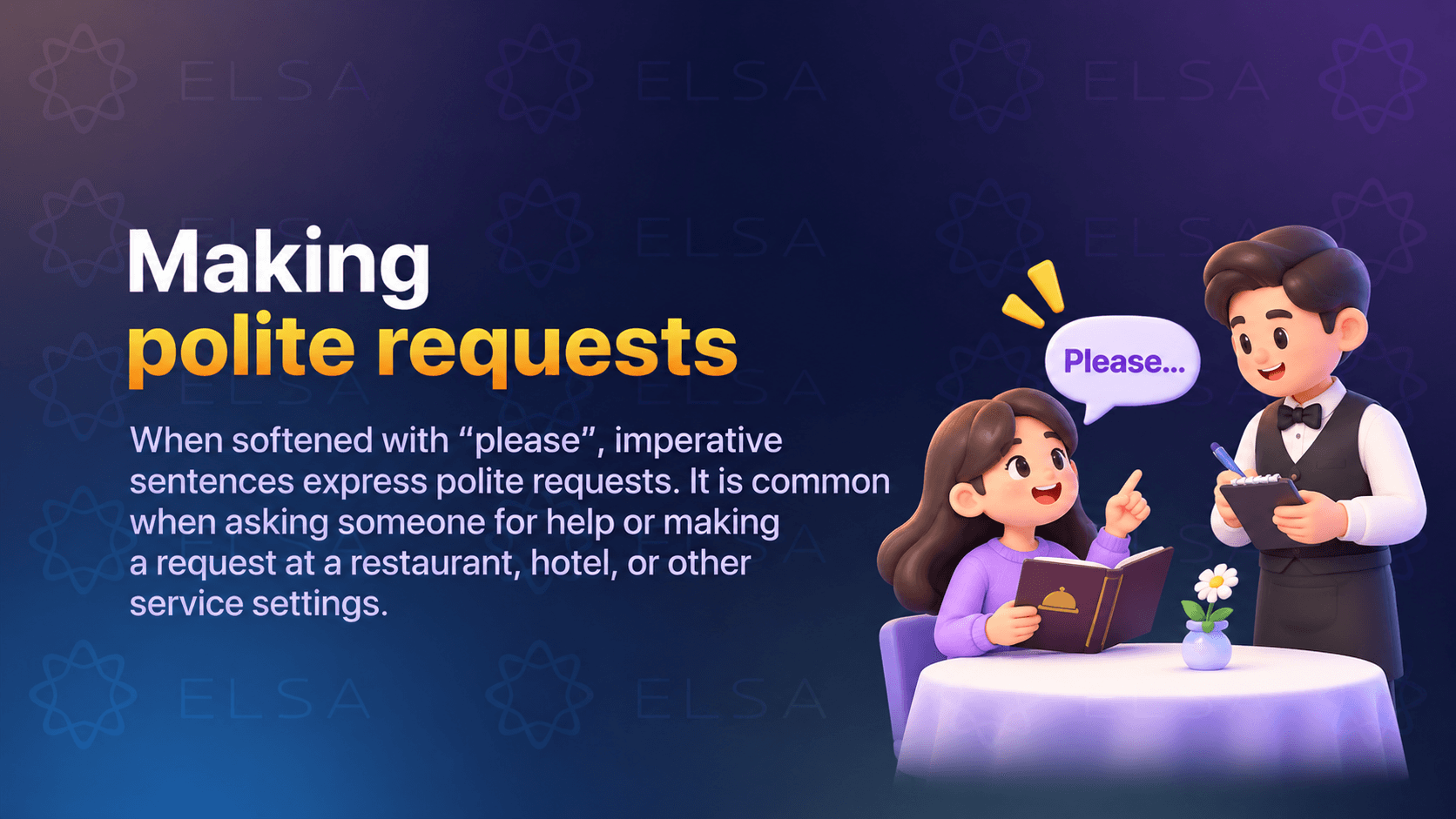
Making polite requests
When softened with “please”, imperative sentences express polite requests. It is common when asking someone for help or making a request at a restaurant, hotel, or other service settings.
For example:
- Can you help me with the project, please?
- Please give me the menu.
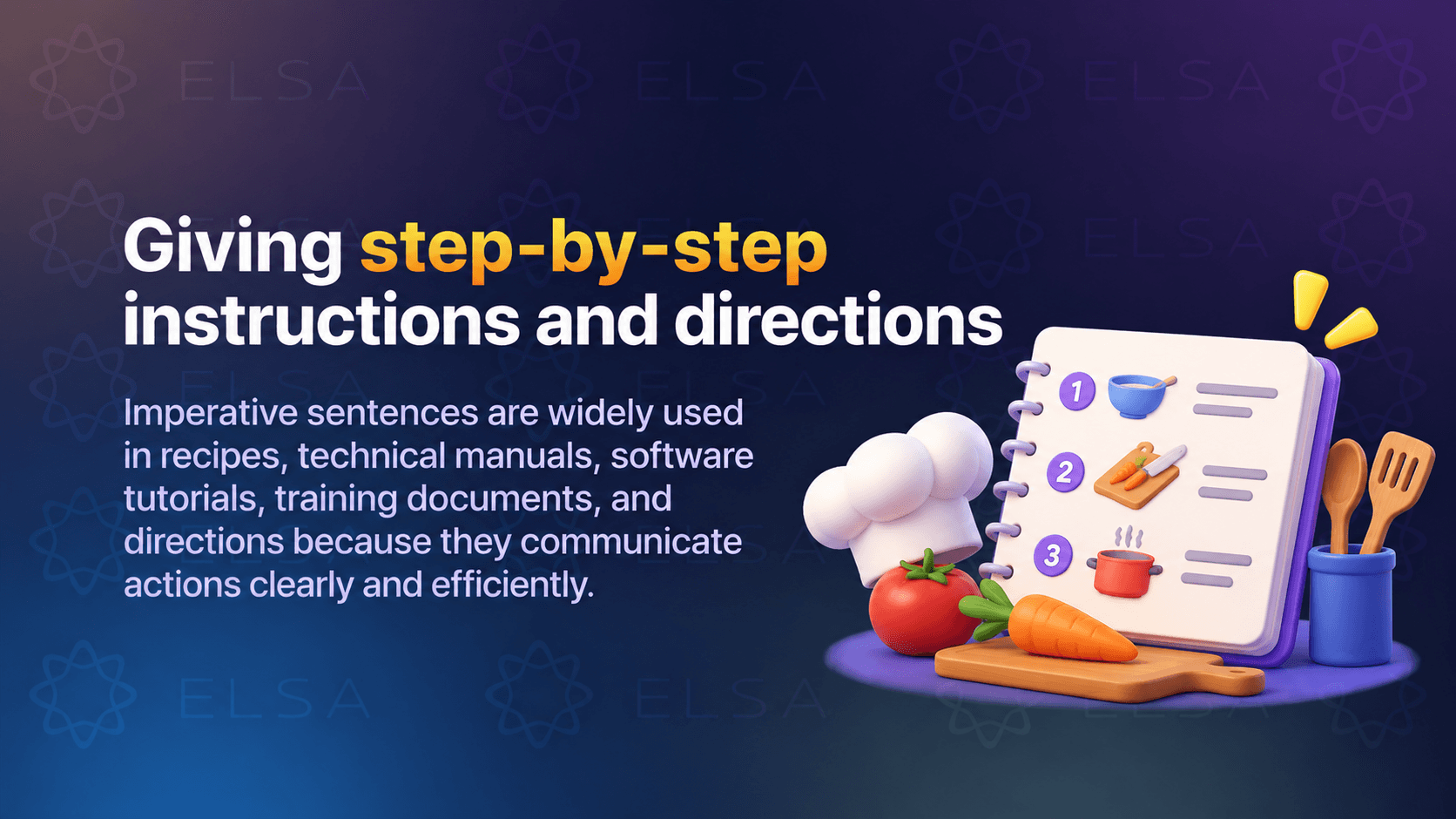
Giving step-by-step instructions and directions
Imperative sentences are widely used in recipes, technical manuals, software tutorials, training documents, and directions because they communicate actions clearly and efficiently.
Imperative sentence examples:
- Turn left at the intersection and walk two blocks.
- Preheat the oven to 375 degrees Fahrenheit.
For multi-step instructions, use action verbs in a logical order. Words such as “first”, “next”, “then”, and “finally” can make the sequence easier to follow.
Issuing urgent warnings
Imperative sentences can warn people about immediate danger or prevent unsafe behavior. These sentences are often short and direct, and an exclamation mark may emphasize the urgency.
For examples:
- Watch out! The floor is slippery.
- Don't lean against the train doors!
Extending casual invitations and offers
Imperatives can also express hospitality, friendliness, and generosity. In American English, they are common when welcoming guests, offering food, or inviting friends to participate in an activity.
For example:
- Come in and make yourself at home.
- Have another slice of pumpkin pie.
Although these sentences use the imperative form, they do not necessarily sound like orders. The situation and the speaker's tone help communicate that the action is an invitation or offer. Many of these expressions, such as make yourself at home or help yourself, use reflexive pronouns.

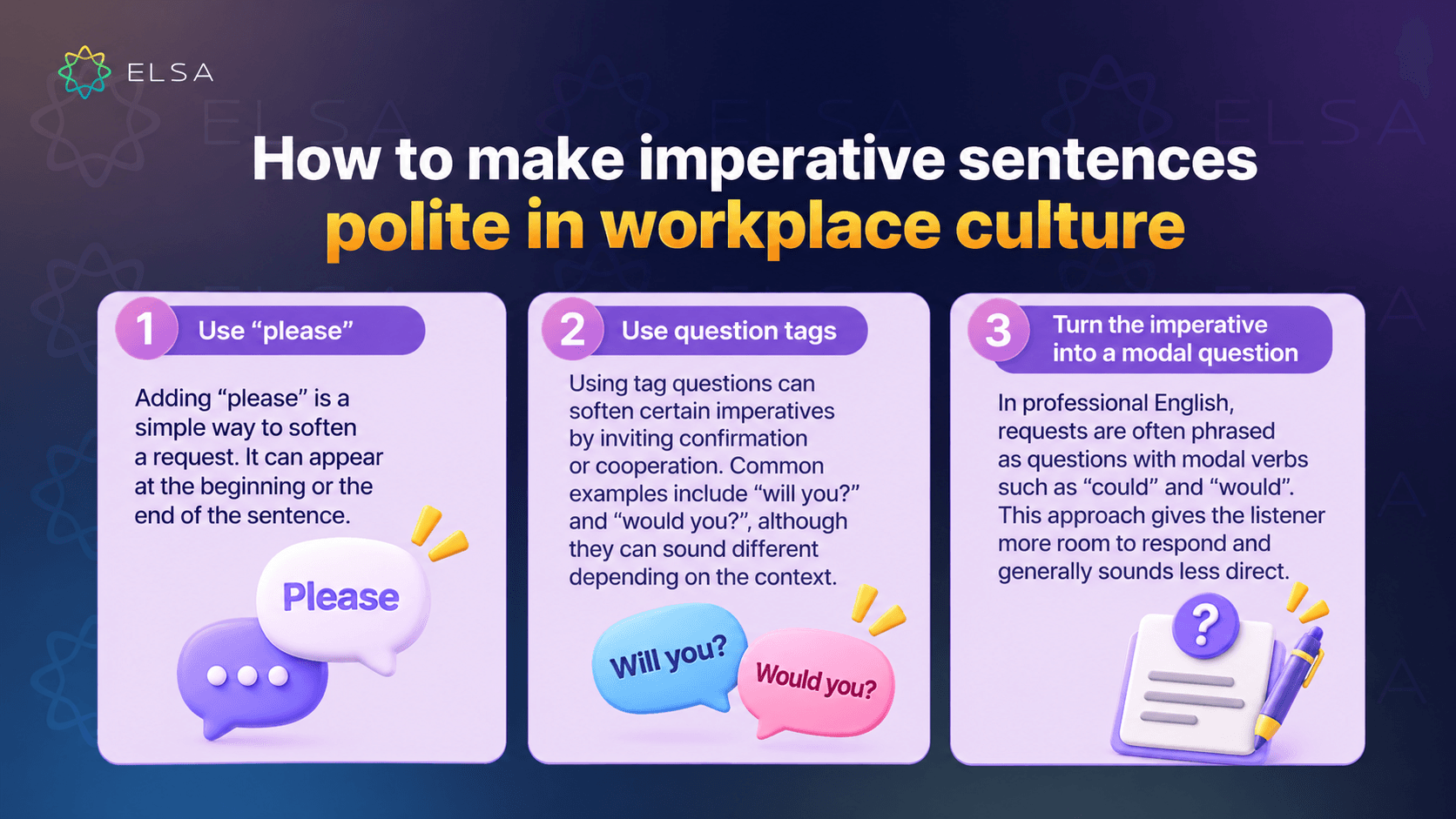
How to make imperative sentences polite in workplace culture
Clear communication in the workplace culture is important, but so are courtesy and respect. Blunt sentences such as “Send me the file.” or “Double check the data.” may be appropriate in urgent situations or established working relationships, but without the proper context, it can sound abrupt and unprofessional.
1. Use “please”
Adding “please” is a simple way to soften a request. It can appear at the beginning or the end of the sentence.
For example:
Direct: Send me the file.
→ More polite: Please send me the file.
→ Also polite: Send me the file, please.
For a more considerate tone, include a time frame or brief context when appropriate.
- Please send me the file by 3 p.m.
- Please send me the updated file when you have a chance.
2. Use question tags
Using tag questions can soften certain imperatives by inviting confirmation or cooperation. Common examples include “will you?” and “would you?”, although they can sound different depending on the context.
Examples:
- Double-check the data before submitting, will you?
- Please review the final slide, would you?
3. Turn the imperative into a modal question
In professional English, requests are often phrased as questions with modal verbs such as "could" and "would". This approach gives the listener more room to respond and generally sounds less direct.
Common structures include:
| Could you please + base verb...? Would you please + base verb...? Would you mind + verb-ing...? |
Examples:
| Direct imperative | More polite alternative |
|---|---|
| Review the Q3 budget draft. | Could you please review the Q3 budget draft? |
| Send me the meeting notes. | Would you please send me the meeting notes? |
| Move the meeting to Friday. | Would you mind moving the meeting to Friday? |
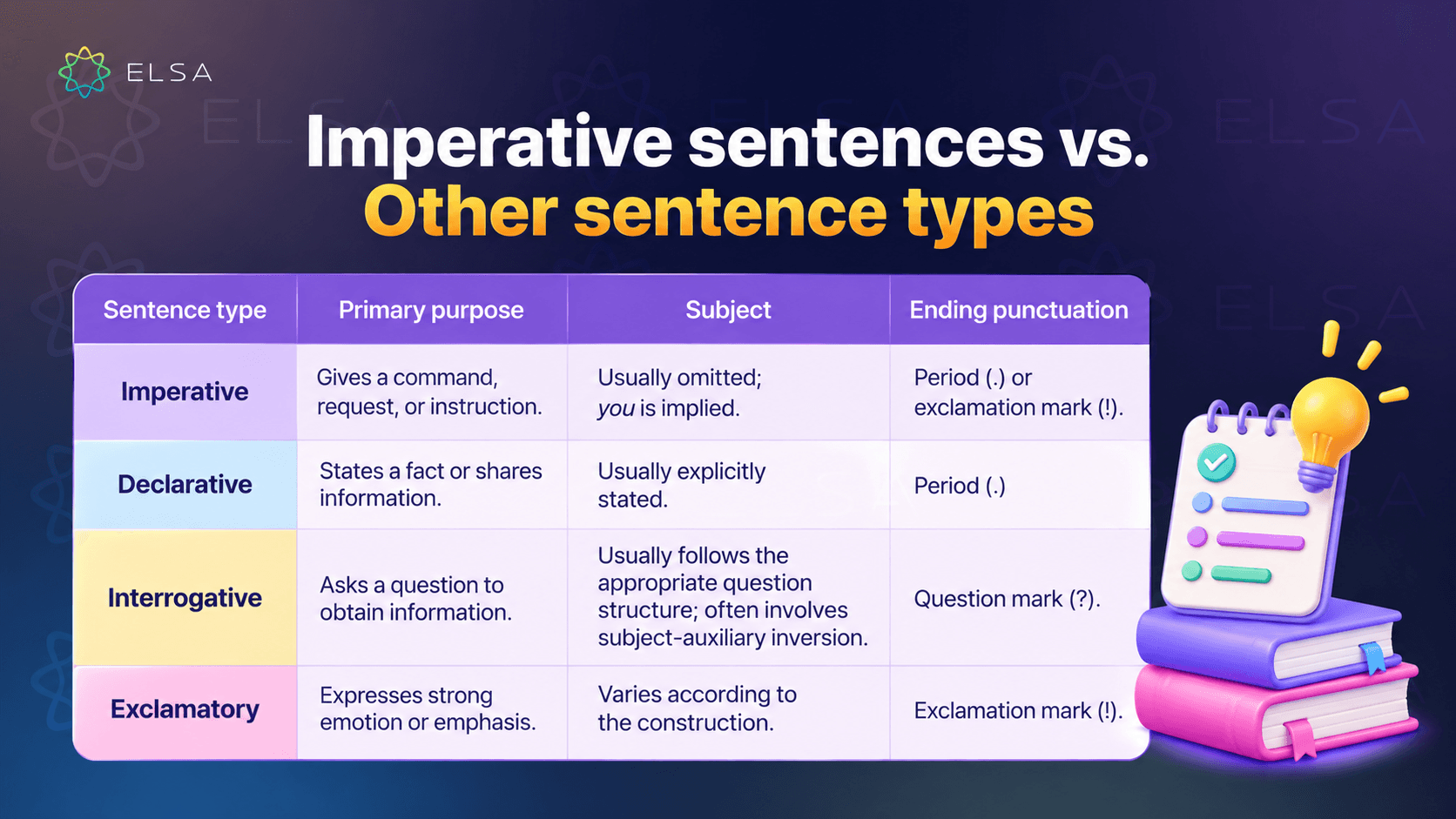
Imperative sentences vs. Other sentence types
English has four basic sentence types based on communicative purpose: imperative, declarative, interrogative, and exclamatory. Understanding their differences helps you recognize sentence structure and choose the correct punctuation.
| Sentence type | Primary purpose | Subject | Ending punctuation | Example |
|---|---|---|---|---|
| Imperative | Gives a command, request, or instruction | Usually omitted; you is implied | Period (.) or exclamation mark (!) | Close the window. |
| Declarative | States a fact or shares information. | Usually explicitly stated. | Period (.) | You closed the window. |
| Interrogative | Asks a question to obtain information. | Usually follows the appropriate question structure; often involves subject-auxiliary inversion. | Question mark (?) | Did you close the window? |
| Exclamatory | Expresses strong emotion or emphasis. | Varies according to the construction. | Exclamation mark (!) | What a beautiful view! |
How to tell them apart:
Let's compare these four sentences:
- Imperative: Turn off the computer.
⇒ Tells someone what to do. - Declarative: You turned off the computer.
⇒ States what happened. - Interrogative: Did you turn off the computer?
⇒ Asks whether it happened. - Exclamatory: What a powerful computer this is!
⇒ Expresses strong emotion or emphasis.
The main difference is the communicative purpose, not simply the punctuation. For example, "Stop!" is an imperative because it tells someone to stop, while "What a mess!" is exclamatory because it expresses a reaction.
Also, not every exclamatory sentence begins with "what" or "how". A sentence such as "That was incredible!" is exclamatory, too.
Practice exercises on imperative sentences
Test your understanding of imperative sentence structures, negative forms, conditional clauses, and polite requests with the following exercises. Complete each activity before checking the answers and explanations.
Exercise 1: Identify and rewrite into polite imperatives
Instructions: Rewrite each sentence according to the cue in parentheses. Use an appropriate affirmative, negative, conditional, or polite imperative structure.
- You must send me the report today. (Make it a polite request using “please.”)
- You should not touch the electrical wires. (Rewrite as a negative imperative.)
- You need to call the receptionist if you arrive after 6 p.m. (Rewrite as a conditional imperative.)
- You should review the presentation before the meeting. (Make it a polite request using “Could you please...?”)
- You must not park in front of the emergency exit. (Rewrite as a negative imperative using “Do not.”)
- You should help your teammate if they need assistance. (Rewrite as a conditional imperative beginning with “If.”)
- You need to keep your phone silent during the presentation. (Rewrite as a polite imperative using “please.”)
- You should never share your account password. (Rewrite as a negative imperative beginning with “Never.”)
- You should check the figures before submitting the spreadsheet. (Make it a polite request using “Would you please...?”)
- You should contact your supervisor if the system stops working. (Rewrite as a conditional imperative with the command first.)
Answers and explanations for exercise 1
Exercise 2: Multiple-choice questions on imperative forms
Instructions: Choose the correct answer for each question.
1. Which sentence is a correct affirmative imperative?
A. Opens the door, please.
B. To open the door.
C. Open the door, please.
D. You opens the door.
2. Which sentence correctly expresses a prohibition?
A. Don't touch the wet paint.
B. Doesn't touch the wet paint.
C. Not touch the wet paint.
D. No touch the wet paint.
3. Which sentence contains a conditional imperative?
A. You are checking the report.
B. If you have questions, ask your manager.
C. Did you check the report?
D. What a useful report!
4. Which sentence is the most suitable polite workplace request?
A. Send the file now!
B. You send me the file.
C. Sends the file, please.
D. Could you please send me the file?
5. Which sentence uses the correct base verb?
A. Takes your seat.
B. Taking your seat.
C. Take your seat.
D. To take your seat.
6. Which punctuation mark is commonly used for a routine instruction?
A. Question mark (?)
B. Period (.)
C. Comma (,)
D. Colon (:)
7. Which sentence correctly uses “Never” in a negative imperative?
A. Never shares your password.
B. Never to share your password.
C. Never sharing your password.
D. Never share your password.
8. Which sentence is an imperative used as an invitation?
A. Come in and make yourself at home.
B. Are you coming inside?
C. You came inside.
D. What a lovely home!
9. Which sentence correctly uses “would you mind” to make a polite request?
A. Would you mind to open the window?
B. Would you mind open the window?
C. Would you mind opening the window?
D. Would you mind opened the window?
10. Which sentence is a negative imperative?
A. You are not using your phone.
B. Don't use your phone during the meeting.
C. Did you use your phone?
D. You don't use your phone yesterday.
Answers and explanations for exercise 2
FAQs about imperative sentence
What is an imperative sentence?
An imperative sentence gives a command, request, instruction, warning, or invitation. It usually begins with a base verb and has an implied subject, you.
What is an example of an imperative sentence?
An imperative sentence example is "Please close the door". It uses the base verb "close" and the implied subject "you", while "please" makes the instruction more polite.
What are the three types of imperative sentence?
The three common types of imperative sentence are affirmative, negative, and conditional.
- Affirmative: Follow the instructions.
- Negative: Don't touch the equipment.
- Conditional: If you need help, call me.
Can an imperative sentence have a visible subject?
Yes. Although the subject you is usually omitted, it can appear explicitly for emphasis, to identify a particular listener, or to convey a strong attitude.
Examples:
- You, come here right now!
⇒ The speaker singles out a particular person. - Don't you dare touch that!
⇒ The subject you adds emphasis and expresses a strong prohibition.
A noun or name can also identify the intended listener, as in Everyone, take your seats. However, the typical imperative construction still uses an implied second-person subject.
Can an imperative sentence end with an exclamation mark?
Yes. An imperative sentence can end with an exclamation mark when the speaker wants to convey urgency, strong emotion, or an emphatic warning.
Examples:
- Watch out!
- Run!
- Stop!
Is “Let's” considered an imperative sentence?
Yes. "Let's" is a contraction of "let us". It is commonly used to form a first-person plural imperative to suggest that the speaker and the listener should do something together.
Examples:
- Let's begin the meeting.
- Let's take a short break.
- Let's review the plan together.
To make a negative suggestion, use Let's not + base verb, as in "Let's not waste any time."
What is the negative form of an imperative sentence?
The negative form is generally made by placing don't or do not before the base verb. Never can also be used to express a strong prohibition.
Examples:
- Don't worry.
- Do not enter this room.
- Never give up.
The rule applies whether the instruction is directed at one person or several people. The verb remains in its base form.
In summary, imperative sentences are very useful if you want to make polite requests, commands, or give instructions. Remember to use it with words such as “please” or modal verbs to make your sentences more professional in workplace settings. For more learning tips, explore the Grammar category on ELSA Speak blog to strengthen your grammar and communicate more naturally everyday.