

Simple present tense: Rules, uses, examples, and exercises
elsaspeakadmin
August 28, 2026
English tenses
The simple present tense is one of the first English tenses learners usually study. It is mainly used to talk about habits, routines, facts, and things that are generally true. In this guide, you’ll learn the simple present tense rules, formulas, common uses, third-person singular forms, adverbs of frequency, and practical exercises.
What is the simple present tense?
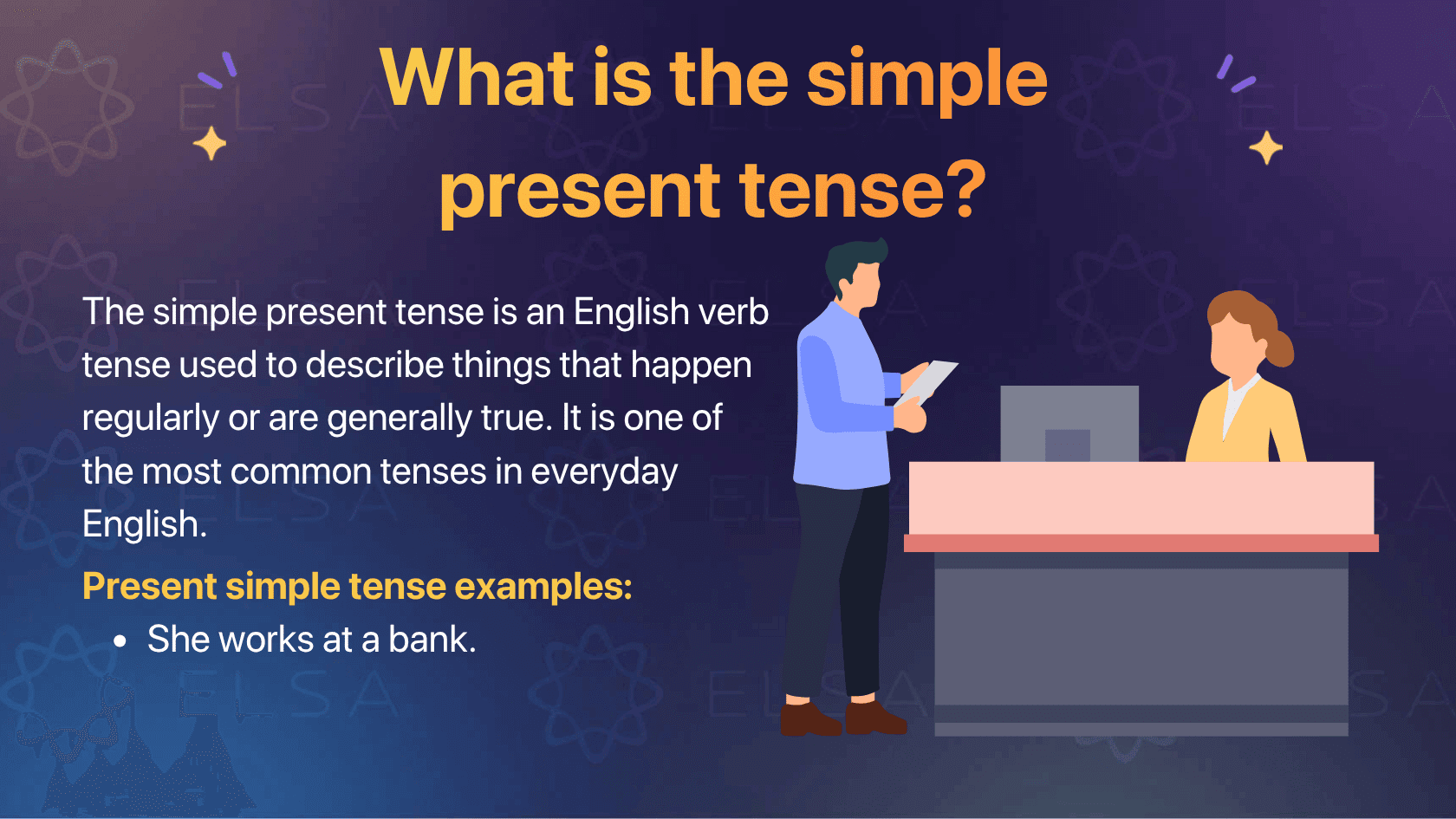
The simple present tense is an English verb tense used to describe things that happen regularly or are generally true. It is one of the most common tenses in everyday English.
Present simple tense examples:
- She works at a bank.
- He leaves the house at 7 A.M every morning.
When to use simple present tense?
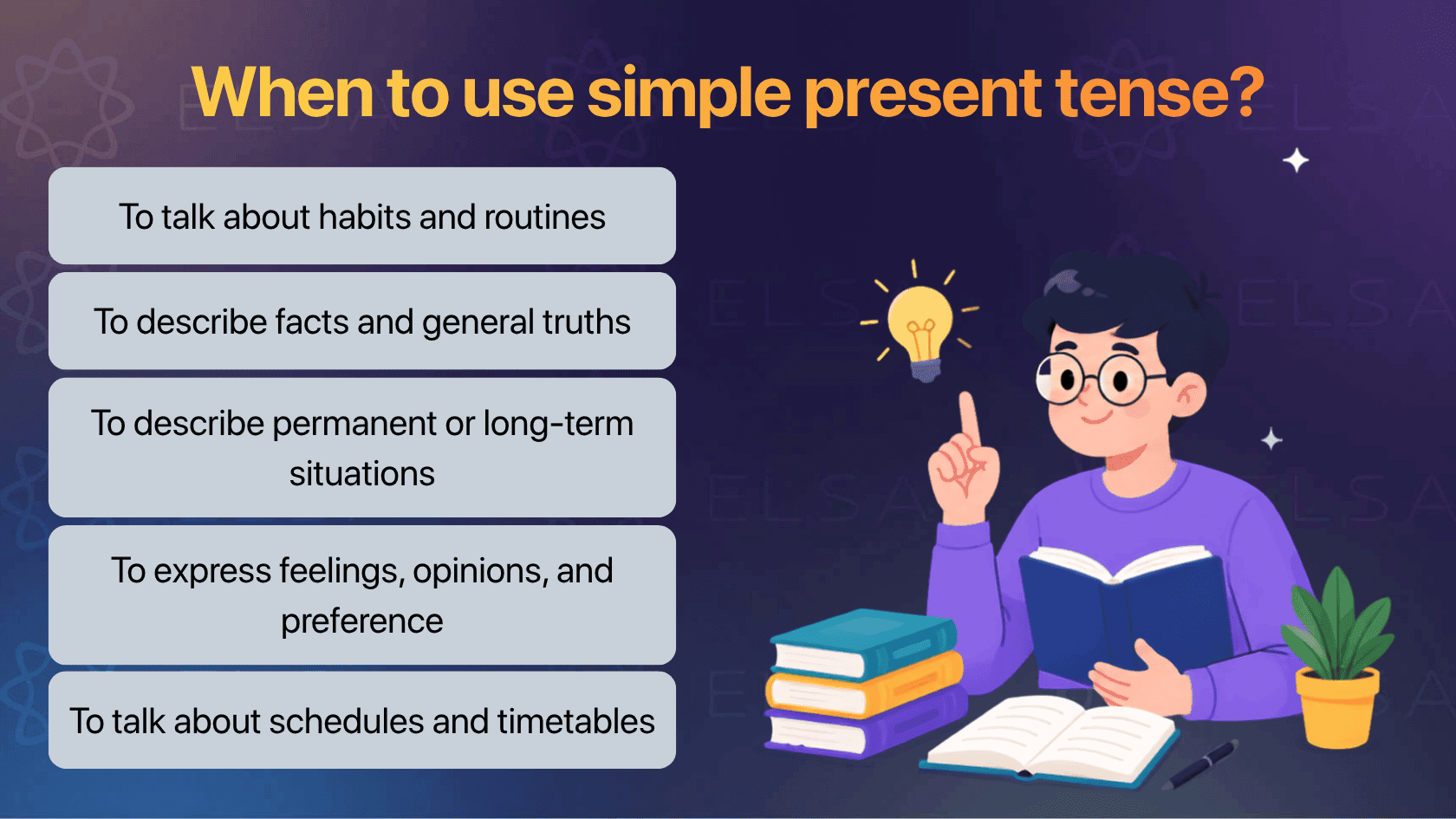
The present simple tense has several common uses in everyday English.
- To talk about habits and routines: Use the simple present to describe actions that happen regularly.
- For example: He checks his email every morning.
- To describe facts and general truths: Use it for facts that are generally or universally true.
- For example: Water boils at 100°C.
- To describe permanent or long-term situations: The tense can describe situations that are stable or continue for a long period.
- For example: He lives in Seattle.
- To express feelings, opinions, and preferences: Some verbs describing thoughts, feelings, possession, or preferences are commonly used in the simple present.
- For example: She prefers coffee.
- To talk about schedules and timetables: The tense is often used for fixed schedules, especially for public transportation, classes, events, and other planned activities.
- For example: The class starts at 9 A.M
Simple present tense formula
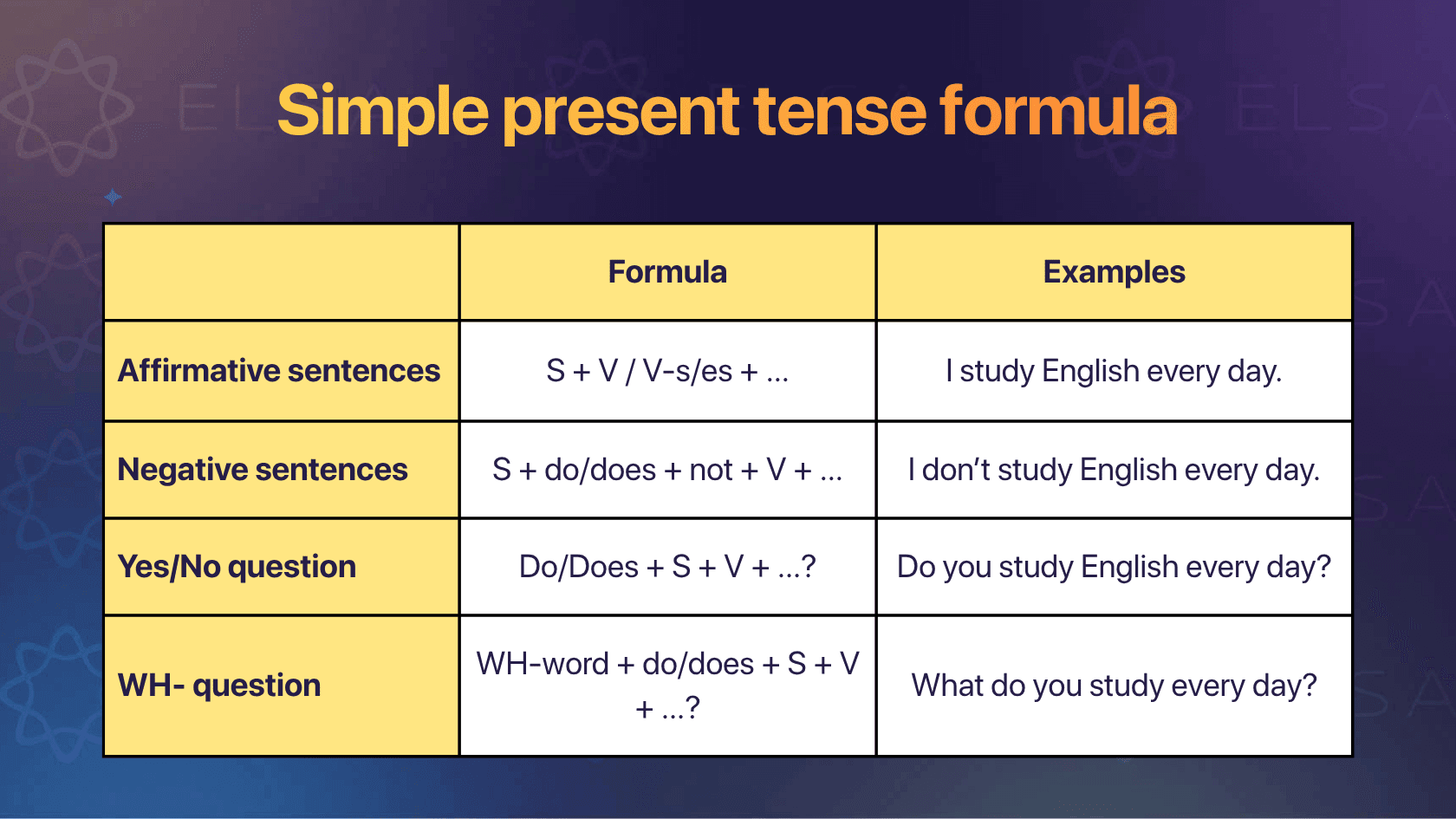
Affirmative sentences
Formula:
| S + V / V-s/es + … |
For example:
- I study English every day.
- She studies English every day.
Remember:
- He/She/It + Vs/es
- I/You/We/They + V
Negative sentences
Formula:
| S + do/does + not + V + |
For example:
- She does not play tennis.
- They don’t watch TV every day.
Remember:
- Do + not = don’t
- Does + not = doesn’t
Question forms
Yes/No question
Formula:
| Do/Does + S + V + …? |
For example: Do you play basketball everyday?
WH- question
Formula:
| WH-word + do/does + S + V + …? |
Common WH- words include what, where, when, why, who, and how.
For example: Where does he live?
Simple present tense with third-person singular
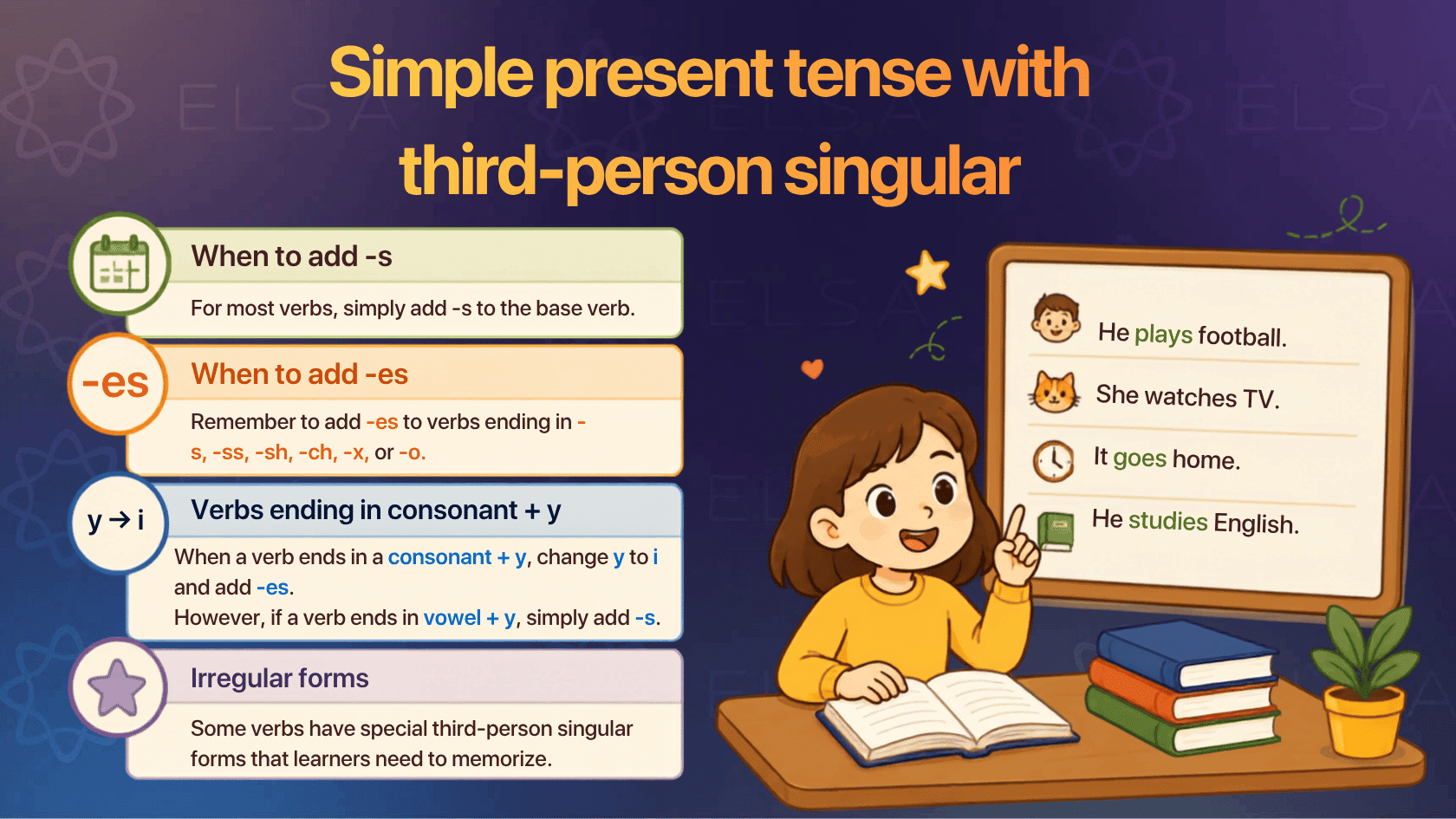
One of the most important present simple tense rules of English grammar is knowing how to change a verb when the subject is he, she, or it.
When to add -s
For most verbs, simply add -s to the base verb.
For example:
- work → works
- read → reads
- play → plays
- drink → drinks
When to add -es
Remember to add -es to verbs ending in -s, -ss, -sh, -ch, -x, or -o.
For example:
- wash → washes
- watch → watches
- fix → fixes
- go → goes
Verbs ending in consonant + y
When a verb ends in a consonant + y, change y to i and add -es.
For instance:
- study → studies
- try → tries
However, if a verb ends in vowel + y, simply add -s.
For example:
- play → plays
- enjoy → enjoys
Irregular forms
Some verbs have special third-person singular forms that learners need to memorize.
For example:
- have → has
- do → does
- be → is
>> See more: What are irregular verbs?
Simple present tense with adverbs of frequency
Adverbs of frequency are words that tell us how often something happens. They are especially useful with the simple present tense because this tense often describes habits and routines.
Common adverbs of frequency
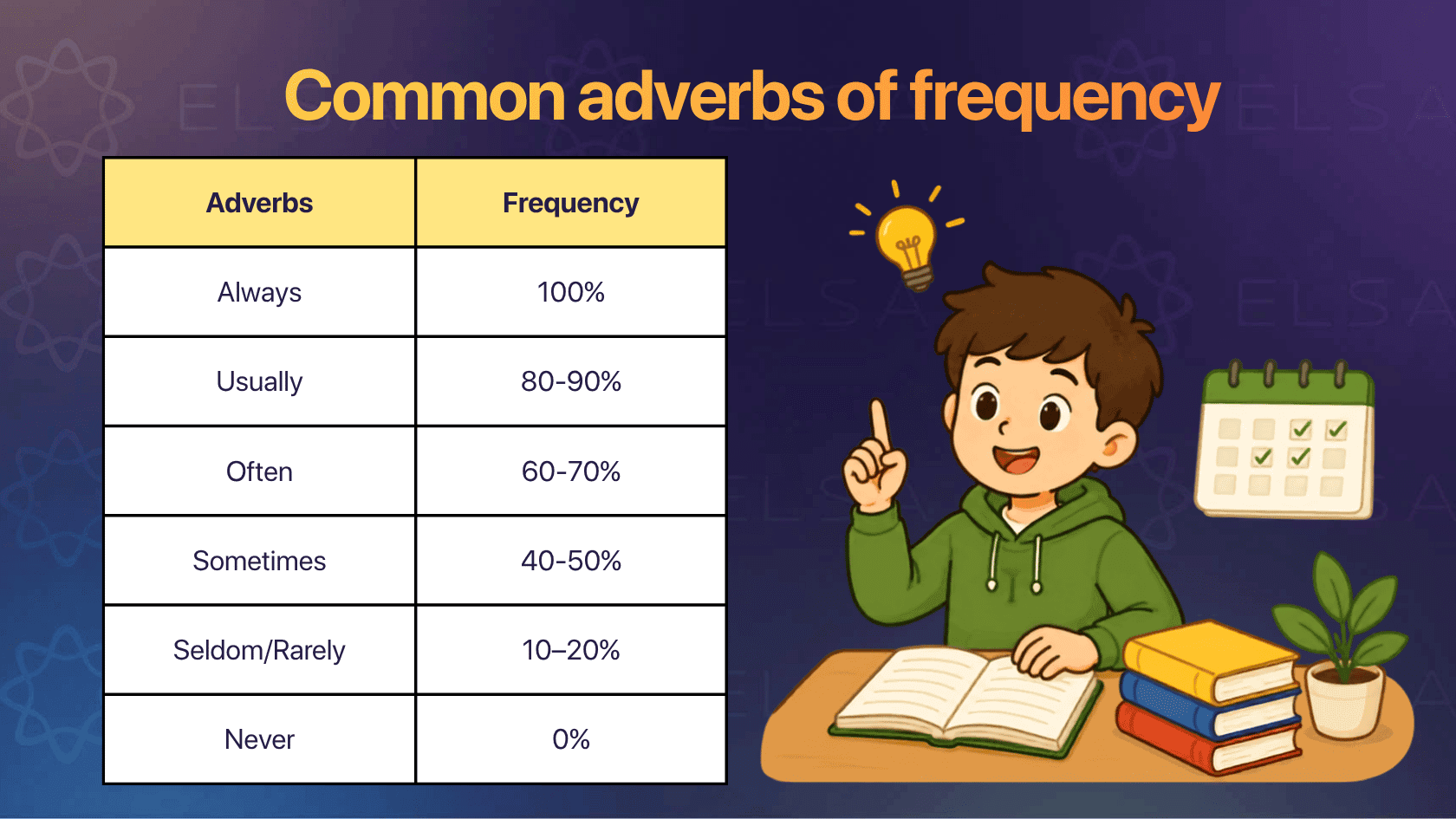
Here are some common adverbs of frequency and their approximate meanings:
| Adverbs | Approximate frequency |
| Always | 100% |
| Usually | 80–90% |
| Often | 60–70% |
| Sometimes | 40–50% |
| Rarely / Seldom | 10–20% |
| Never | 0% |
Where to put adverbs of frequency
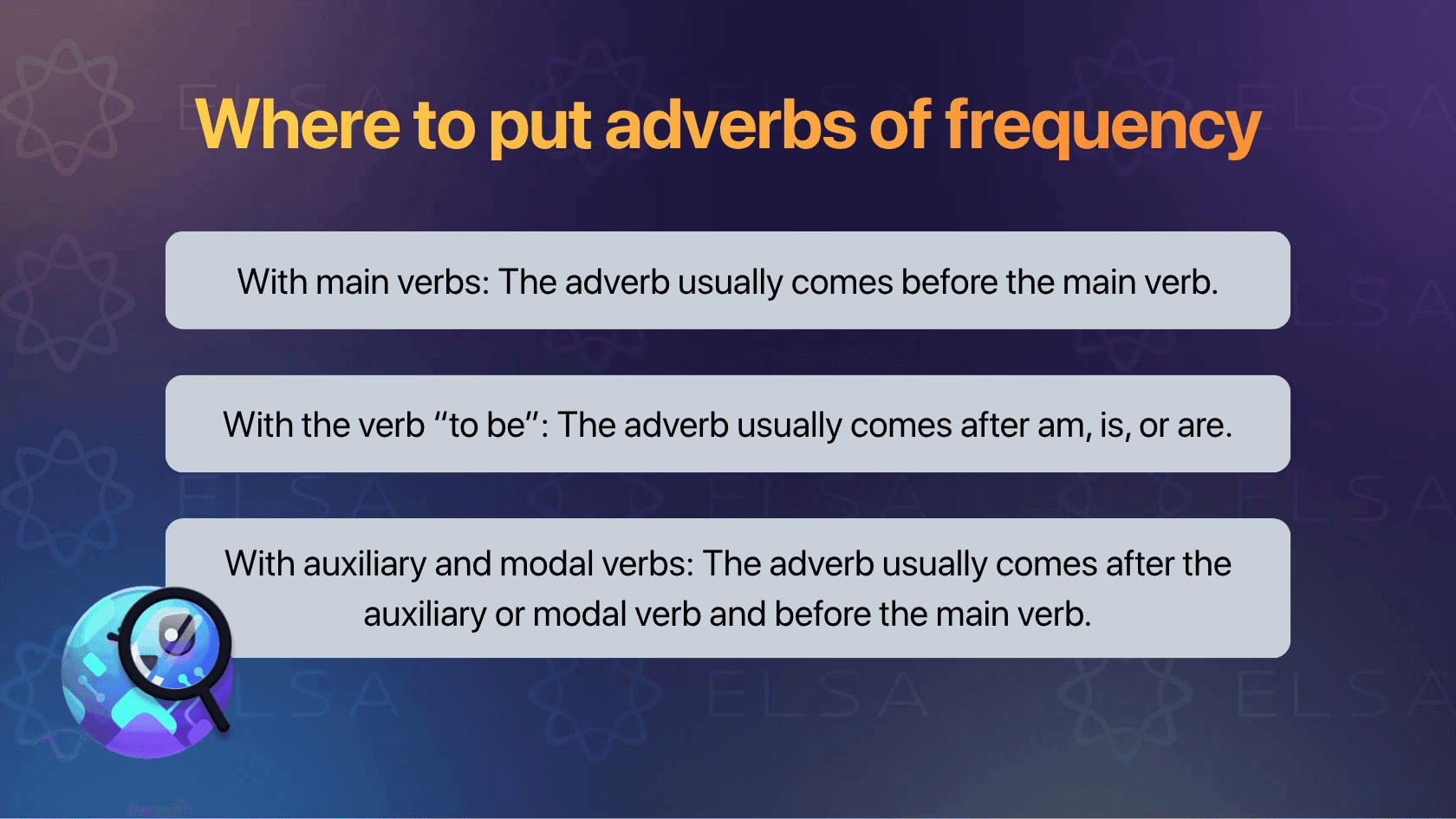
The position of an adverb of frequency depends on the verb structure.
- With main verbs: The adverb usually comes before the main verb.
For example: I often study English at night.
- With the verb “to be”: The adverb usually comes after am, is, or are.
For example: She is always on time.
- With auxiliary and modal verbs: The adverb usually comes after the auxiliary or modal verb and before the main verb.
For example: You can always ask for help.
Common mistakes with the simple present tense
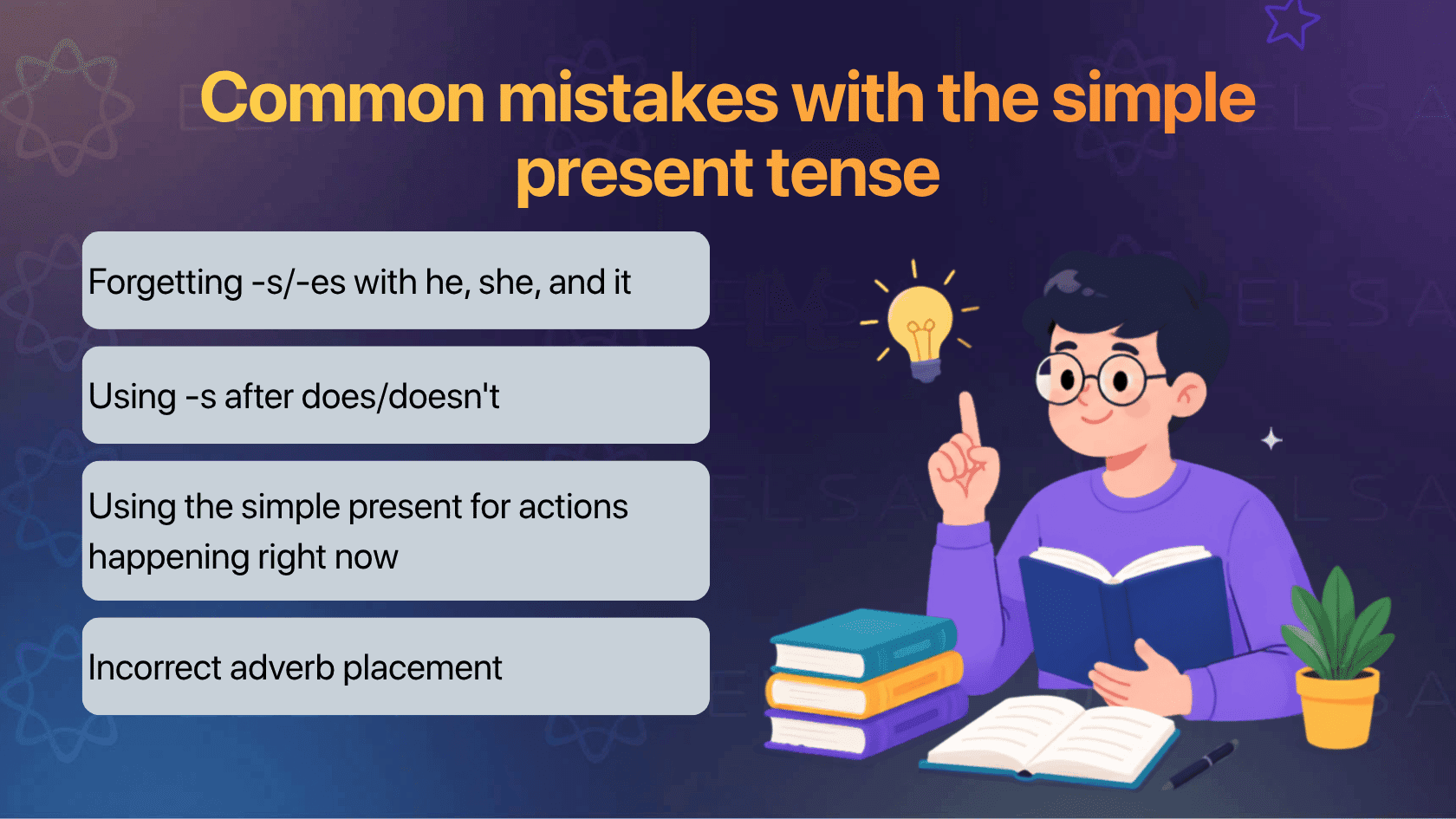
- Forgetting -s/-es with he, she, and it:
| Wrong | Correct |
| She work in a hospital. | She works in a hospital. |
- Using -s after does/doesn't:
| Wrong | Correct |
| He doesn’t likes coffee. | He doesn’t like coffee. |
- Using the simple present for actions happening right now: For an action happening at this moment, the present continuous is usually more appropriate.
- Incorrect adverb placement:
| Wrong | Correct |
| I go always to work by bus. | I always go to work by bus. |
Simple present tense worksheet
Exercise 1: Complete each sentence with the correct simple present tense verbs in parentheses.
- James ________ (work) at a hospital.
- I ________ (drink) tea every morning.
- Tom ________ (watch) TV after dinner.
- They ________ (study) English together.
- My sister ________ (go) to school by bus.
- We ________ (play) football on Saturdays.
- Anna ________ (have) two dogs.
- She ________ (try) to exercise every day.
- You ________ (speak) French very well.
- The shop ________ (close) at 9 p.m.
Answer key:
| 1. works | 2. drink | 3. watches | 4. study | 5. goes |
| 6. play | 7. has | 8. tries | 9. speak | 10. closes |
Exercise 2: Choose the correct option to complete each sentence.
- He (like / likes) chocolate.
- They (don’t / doesn’t) work on Sundays.
- (Do / Does) he live in Manchester?
- My parents (watch / watches) TV every evening.
- She (don’t / doesn’t) eat meat.
- Where (do / does) your sister study?
- I (go / goes) to the gym after work.
- The train (leave / leaves) at 7 p.m.
- We (don’t / doesn’t) usually eat lunch at school.
- (Do / Does) your friend speak English?
Answer key:
| 1. likes | 2. don't | 3. Does | 4. watch | 5. doesn't |
| 6. does | 7. go | 8. leaves | 9. don't | 10. Does |
With regular practice and attention to common mistakes, you can use the simple present tense more naturally and confidently in both speaking and writing. For more practical English grammar lessons, explore the Grammar category on the ELSA Speak blog to build your grammar skills, learn useful rules, and communicate more confidently in English.