


Simple present tense exercise: Practice with answers and rules
elsaspeakadmin
September 30, 2026
Grammar exercises
Practicing the English tense regularly can help you remember its verb forms, sentence patterns, and common grammar rules more effectively. Whether you’re reviewing the basics or looking for an exercise to test your grammar skills, th simple present tense exercises below will cover it all, from basic verb conjugation to advanced exercise. Test your skills now!
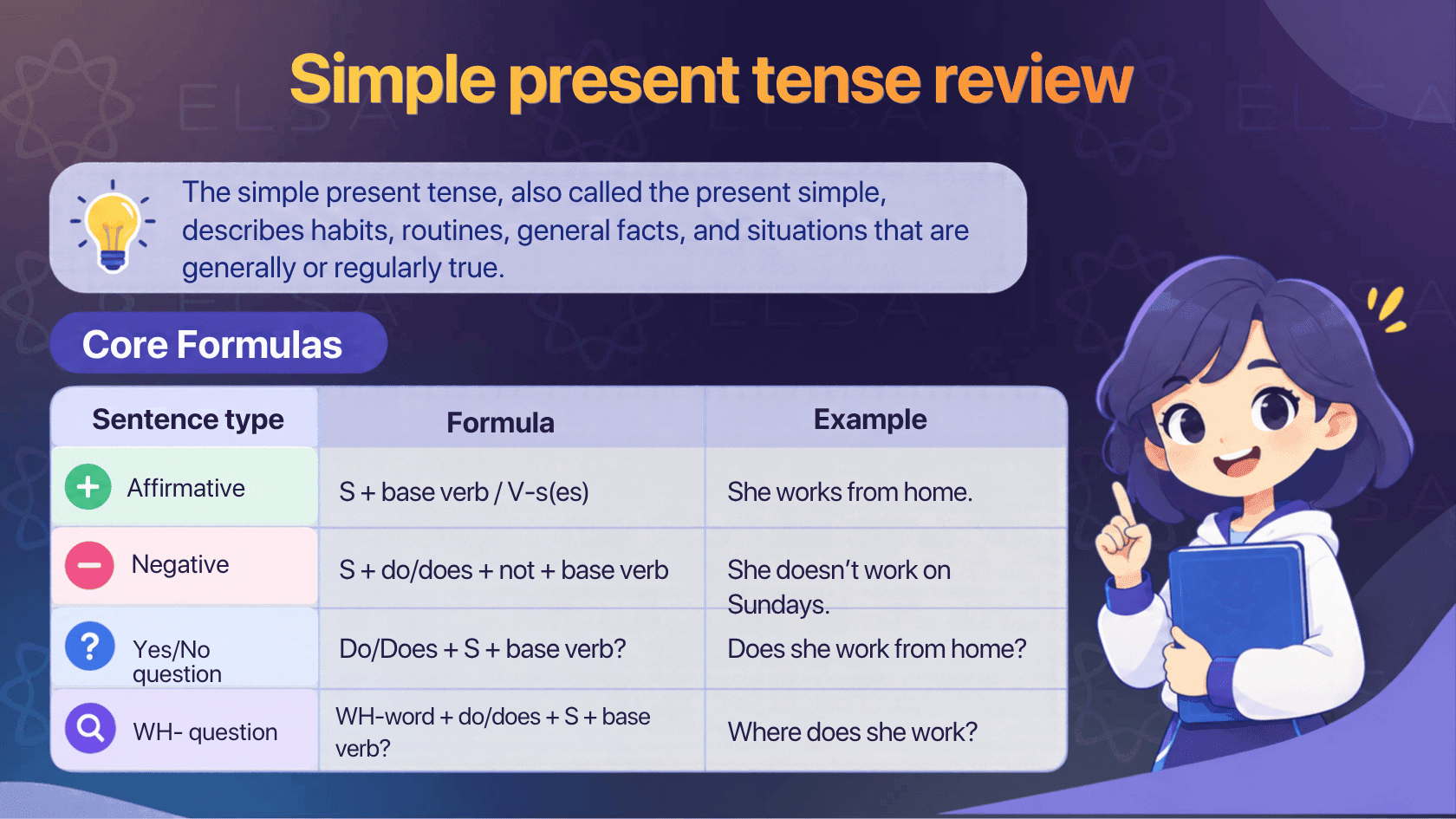
Simple present tense review
Definition and when to use
The simple present tense, also called the present simple, describes habits, routines, general facts, and situations that are generally or regularly true.
For example:
- I check my email every morning. → a regular routine
- The Earth revolves around the Sun. → a general fact
Core formulas
| Formula | Example | |
| Affirmative | S + base verb / V-s(es) | She works from home. |
| Negative | S + do/does + not + base verb | She doesn't work from home. |
| Yes/No question | Do/Does + S + base verb? | Does she work from home? |
| WH- question | WH-word + do/does + S + base verb? | Where does she work? |
Basic simple present tense exercise:
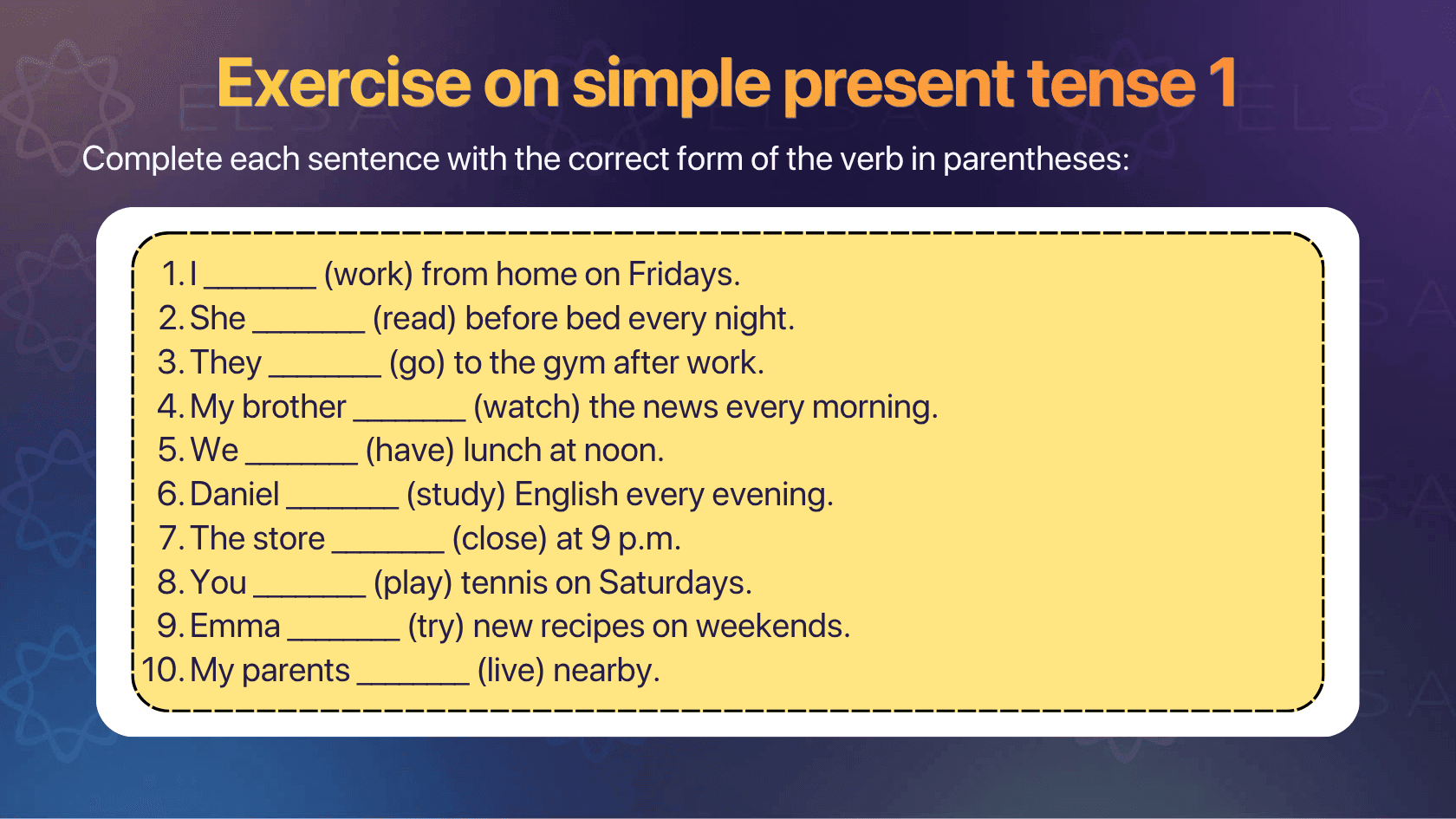
Exercise on simple present tense 1:
Complete each sentence with the correct form of the verb in parentheses.
- I ________ (work) from home on Fridays.
- She ________ (read) before bed every night.
- They ________ (go) to the gym after work.
- My brother ________ (watch) the news every morning.
- We ________ (have) lunch at noon.
- Daniel ________ (study) English every evening.
- The store ________ (close) at 9 p.m.
- You ________ (play) tennis on Saturdays.
- Emma ________ (try) new recipes on weekends.
- My parents ________ (live) nearby.
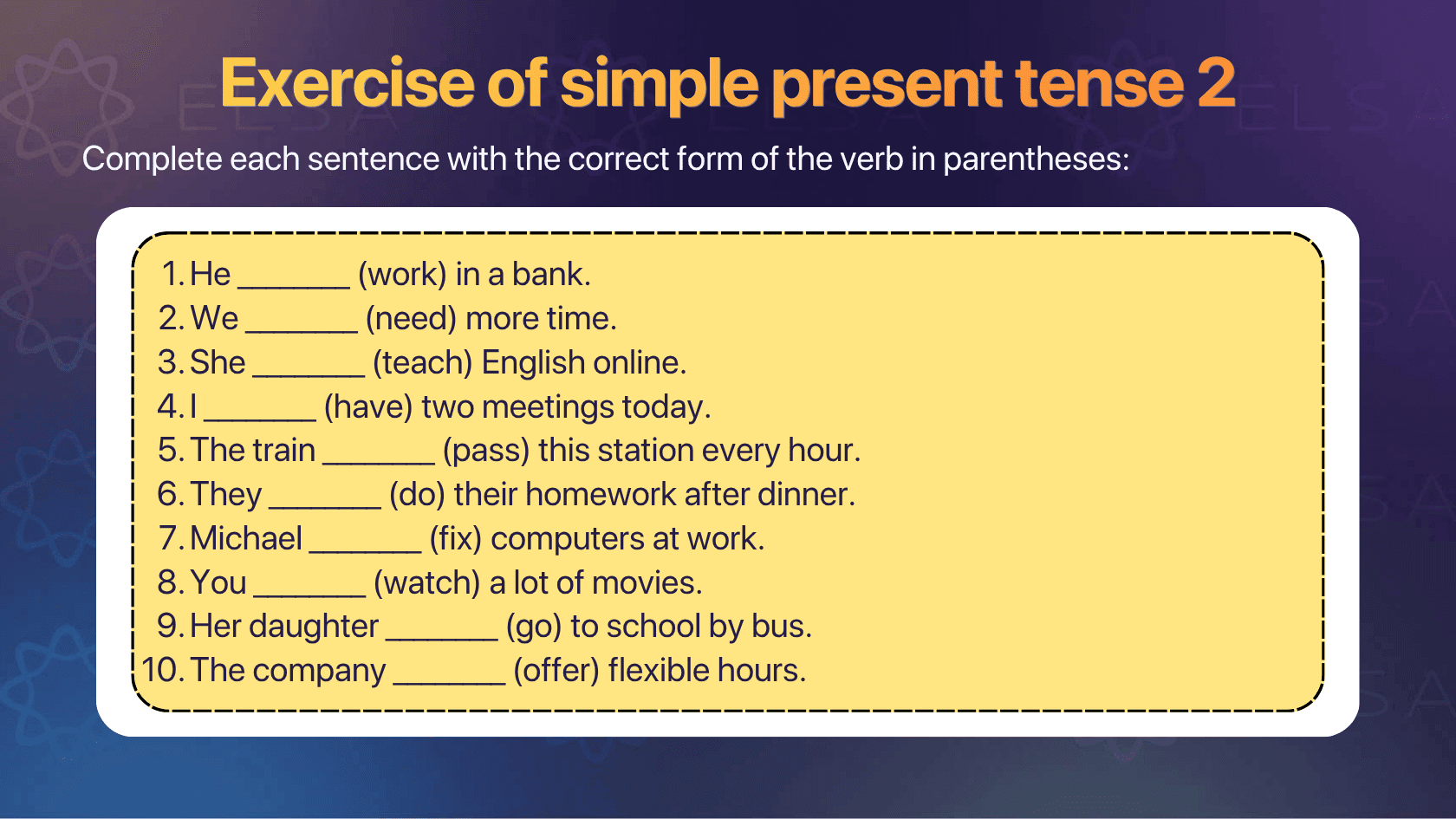
Exercise of simple present tense 2:
Complete each sentence with the correct form of the verb in parentheses.
- He ________ (work) in a bank.
- We ________ (need) more time.
- She ________ (teach) English online.
- I ________ (have) two meetings today.
- The train ________ (pass) this station every hour.
- They ________ (do) their homework after dinner.
- Michael ________ (fix) computers at work.
- You ________ (watch) a lot of movies.
- Her daughter ________ (go) to school by bus.
- The company ________ (offer) flexible hours.
Exercise simple present tense 3:
Choose the correct answer.
1. My sister _____ to work by bus every day.
a. go
b. going
c. goes
d. gone
2. _____ your parents live in this city?
a. Do
b. Does
c. Are
d. Is
3. The Earth _____ around the Sun.
a. revolve
b. revolving
c. revolved
d. revolves
4. Tom _____ coffee in the morning.
a. drink
b. drinks
c. drinking
d. drank
5. We _____ our grandparents every weekend.
a. visits
b. visiting
c. visit
d. visited
6. Sarah _____ like spicy food.
a. doesn't
b. don't
c. isn't
d. not
7. How often _____ he play tennis?
a. are
b. do
c. is
d. does
8. Water _____ at 100°C.
a. boil
b. boils
c. boiling
d. boiled
9. They _____ usually watch TV after dinner.
a. don't
b. doesn't
c. aren't
d. isn't
10. Which sentence is correct?
a. She study English every evening.
b. She studying English every evening.
c. She studies English every evening.
d. She studied English every evening.
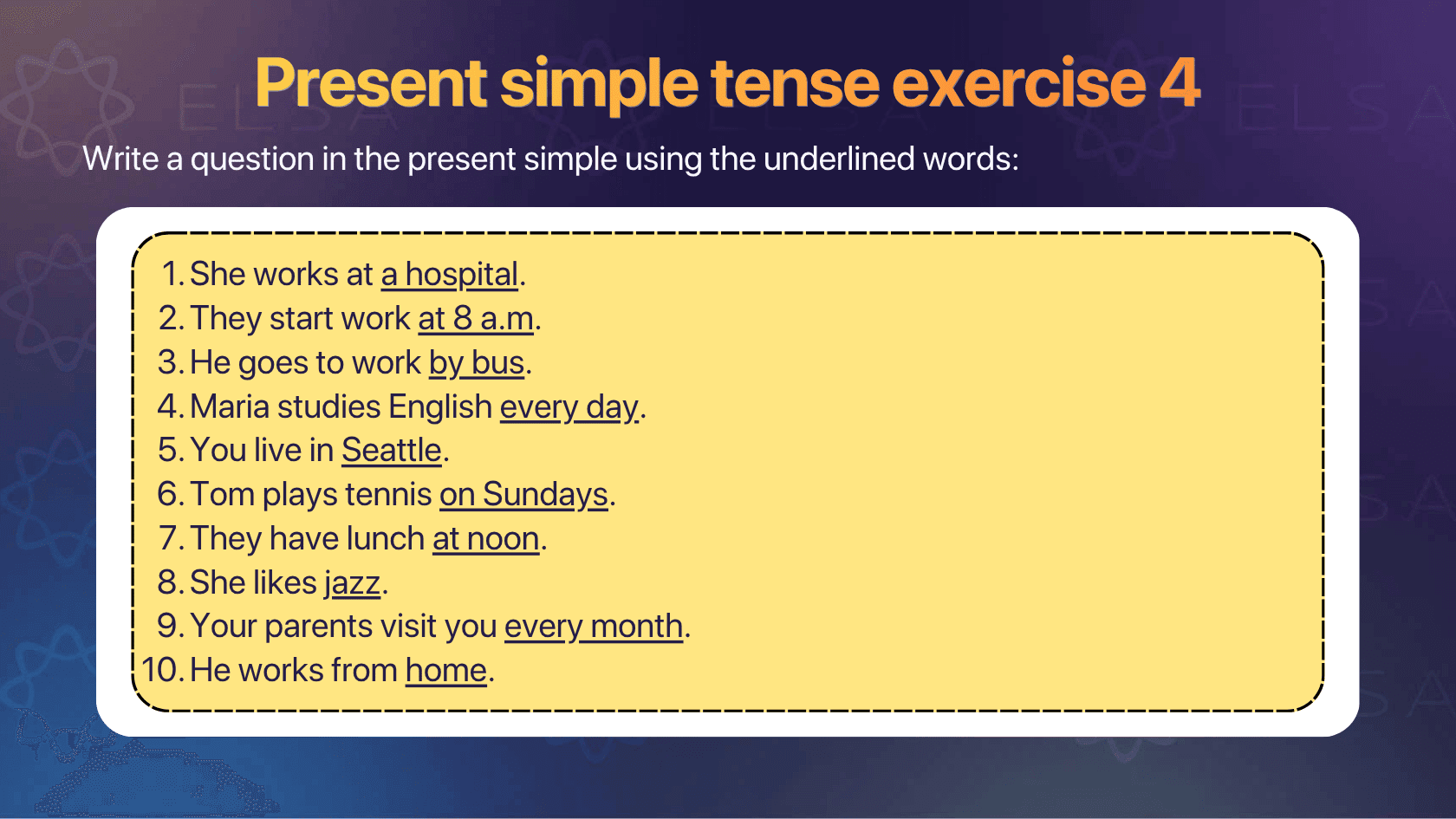
Present simple tense exercise 4:
Write a question in the present simple using the underlined words.
- She works at a hospital.
- They start work at 8 a.m.
- He goes to work by bus.
- Maria studies English every day.
- You live in Seattle.
- Tom plays tennis on Sundays.
- They have lunch at noon.
- She likes jazz.
- Your parents visit you every month.
- He works from home.
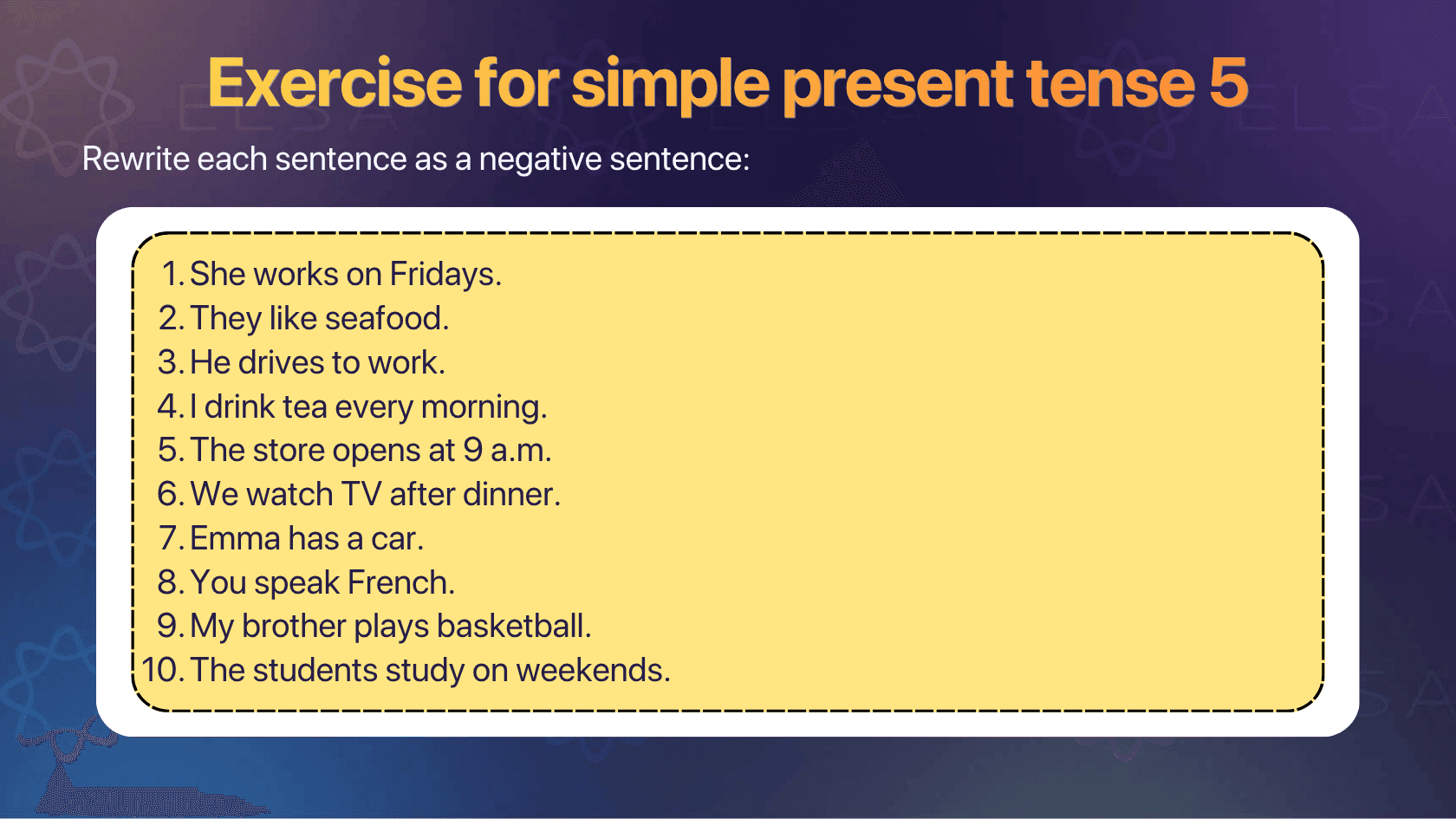
Exercise for simple present tense 5:
Rewrite each sentence as a negative sentence.
- She works on Fridays.
- They like seafood.
- He drives to work.
- I drink tea every morning.
- The store opens at 9 a.m.
- We watch TV after dinner.
- Emma has a car.
- You speak French.
- My brother plays basketball.
- The students study on weekends.
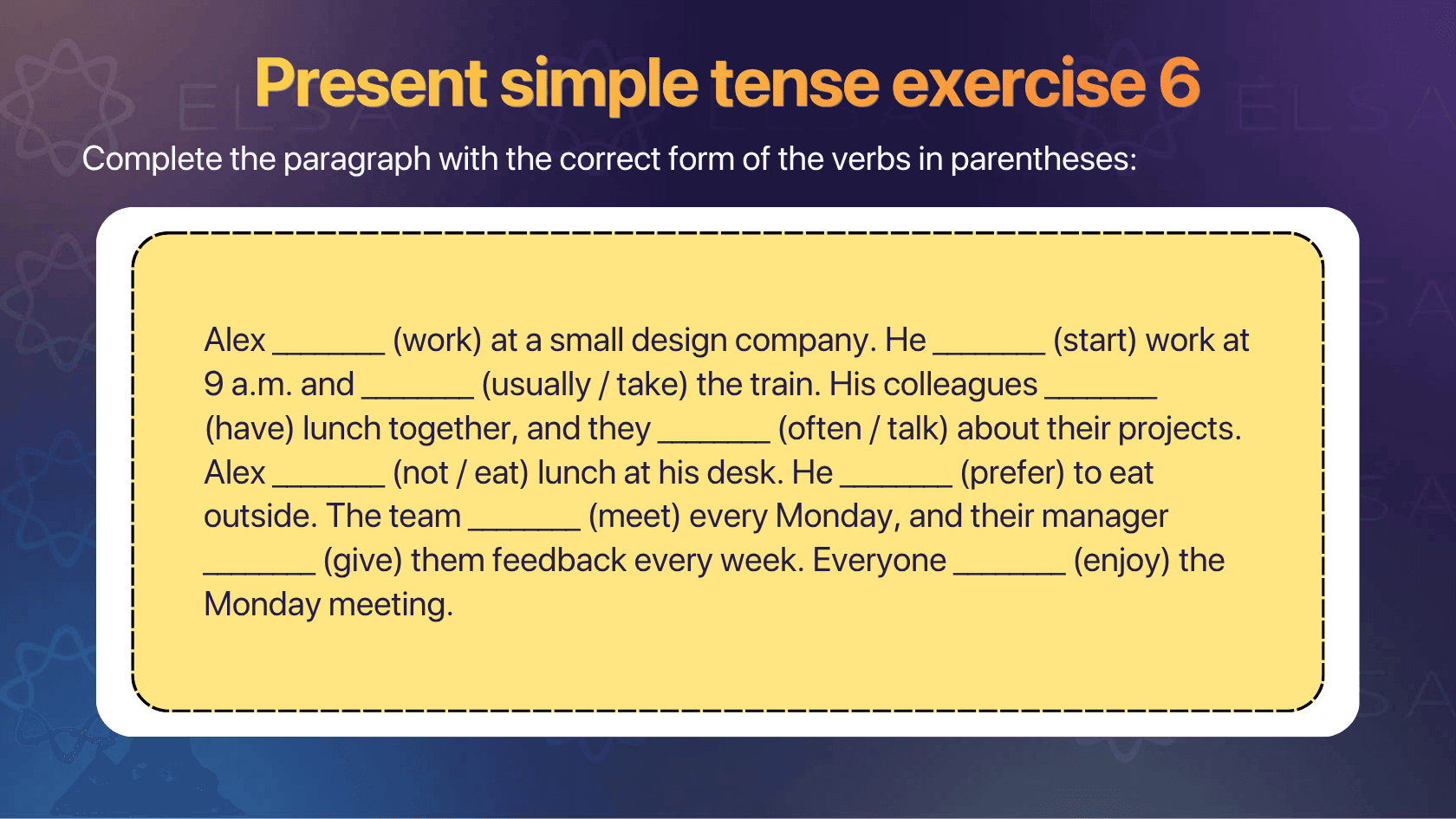
Present simple tense exercise 6:
Complete the paragraph with the correct form of the verbs in parentheses.
| Alex ________ (work) at a small design company. He ________ (start) work at 9 a.m. and ________ (usually / take) the train. His colleagues ________ (have) lunch together, and they ________ (often / talk) about their projects. Alex ________ (not / eat) lunch at his desk. He ________ (prefer) to eat outside. The team ________ (meet) every Monday, and their manager ________ (give) them feedback every week. Everyone ________ (enjoy) the Monday meeting. |
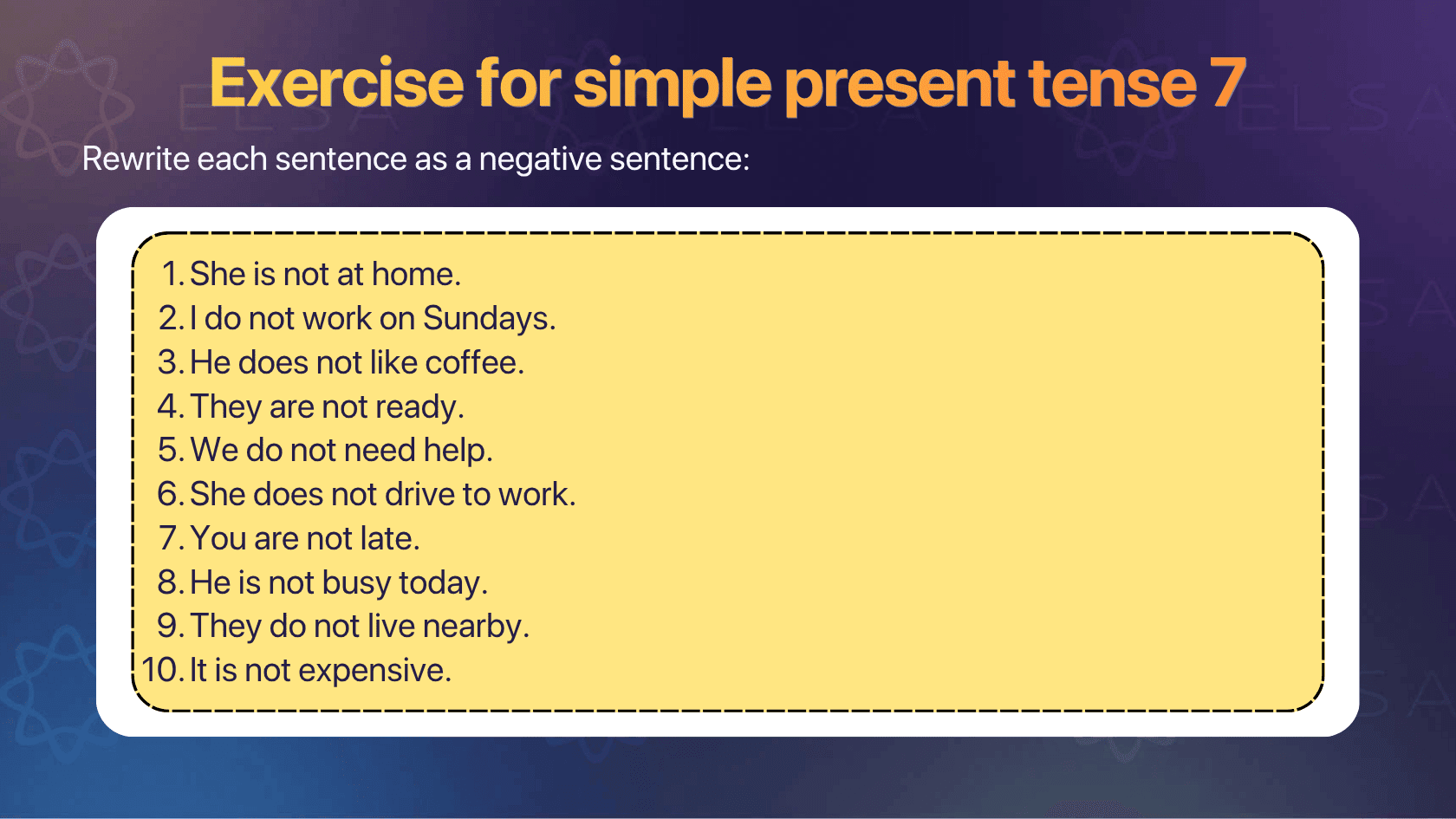
Exercise for simple present tense 7:
Rewrite each sentence using the appropriate contraction.
- She is not at home.
- I do not work on Sundays.
- He does not like coffee.
- They are not ready.
- We do not need help.
- She does not drive to work.
- You are not late.
- He is not busy today.
- They do not live nearby.
- It is not expensive.
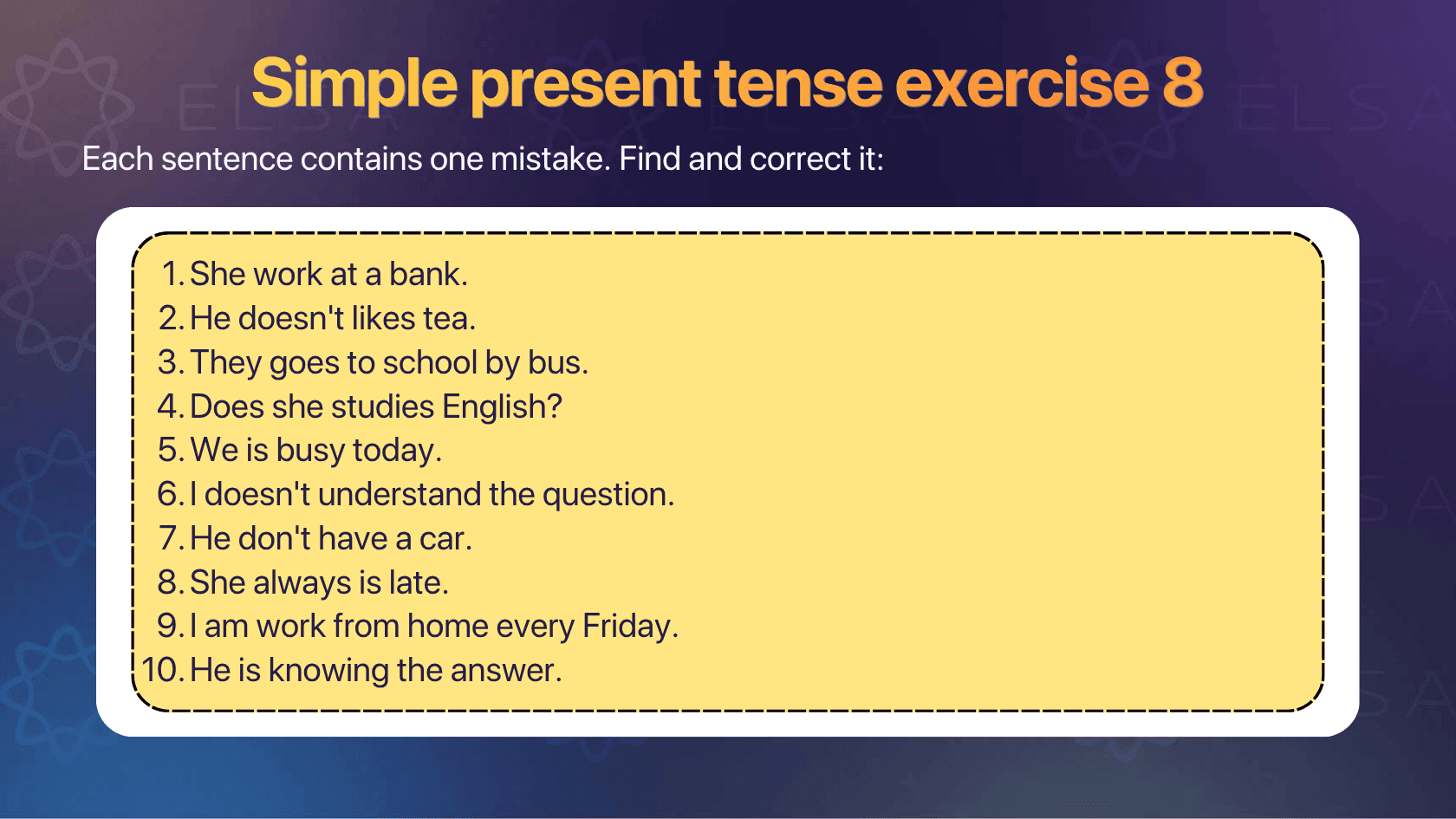
Simple present tense exercise 8:
Each sentence contains one mistake. Find and correct it.
- She work at a bank.
- He doesn't likes tea.
- They goes to school by bus.
- Does she studies English?
- We is busy today.
- I doesn't understand the question.
- He don't have a car.
- She always is late.
- I am work from home every Friday.
- He is knowing the answer.
Advanced exercise for simple present tense
Ready for a more challenging exercise for simple present tense? These activities focus on the areas that commonly cause problems: third-person singular spelling, sentence formation, adverb placement, and mixed error correction.
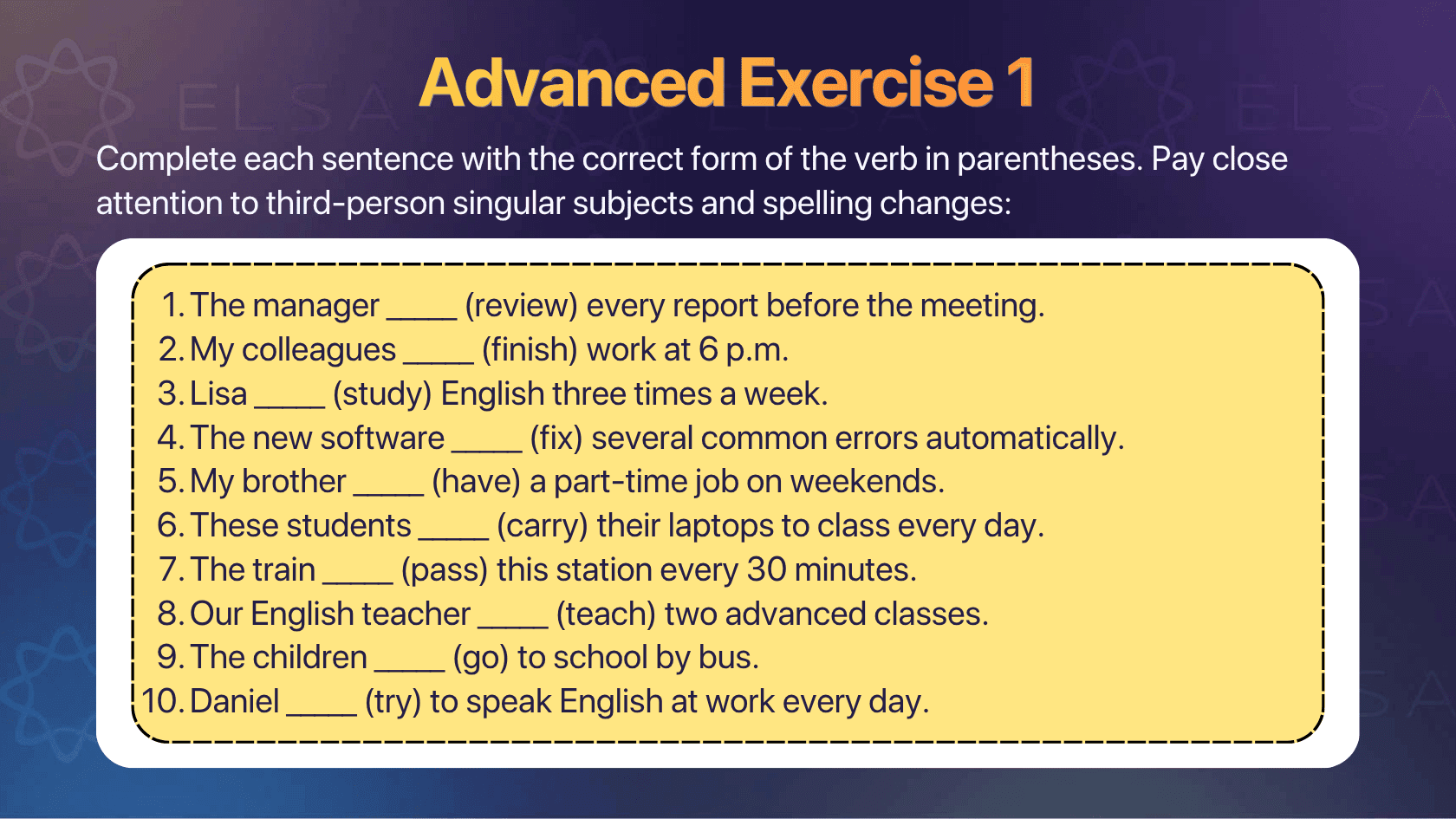
Advanced for simple present tense 1:
Complete each sentence with the correct form of the verb in parentheses. Pay close attention to third-person singular subjects and spelling changes..
- The manager _____ (review) every report before the meeting.
- My colleagues _____ (finish) work at 6 p.m.
- Lisa _____ (study) English three times a week.
- The new software _____ (fix) several common errors automatically.
- My brother _____ (have) a part-time job on weekends.
- These students _____ (carry) their laptops to class every day.
- The train _____ (pass) this station every 30 minutes.
- Our English teacher _____ (teach) two advanced classes.
- The children _____ (go) to school by bus.
- Daniel _____ (try) to speak English at work every day.
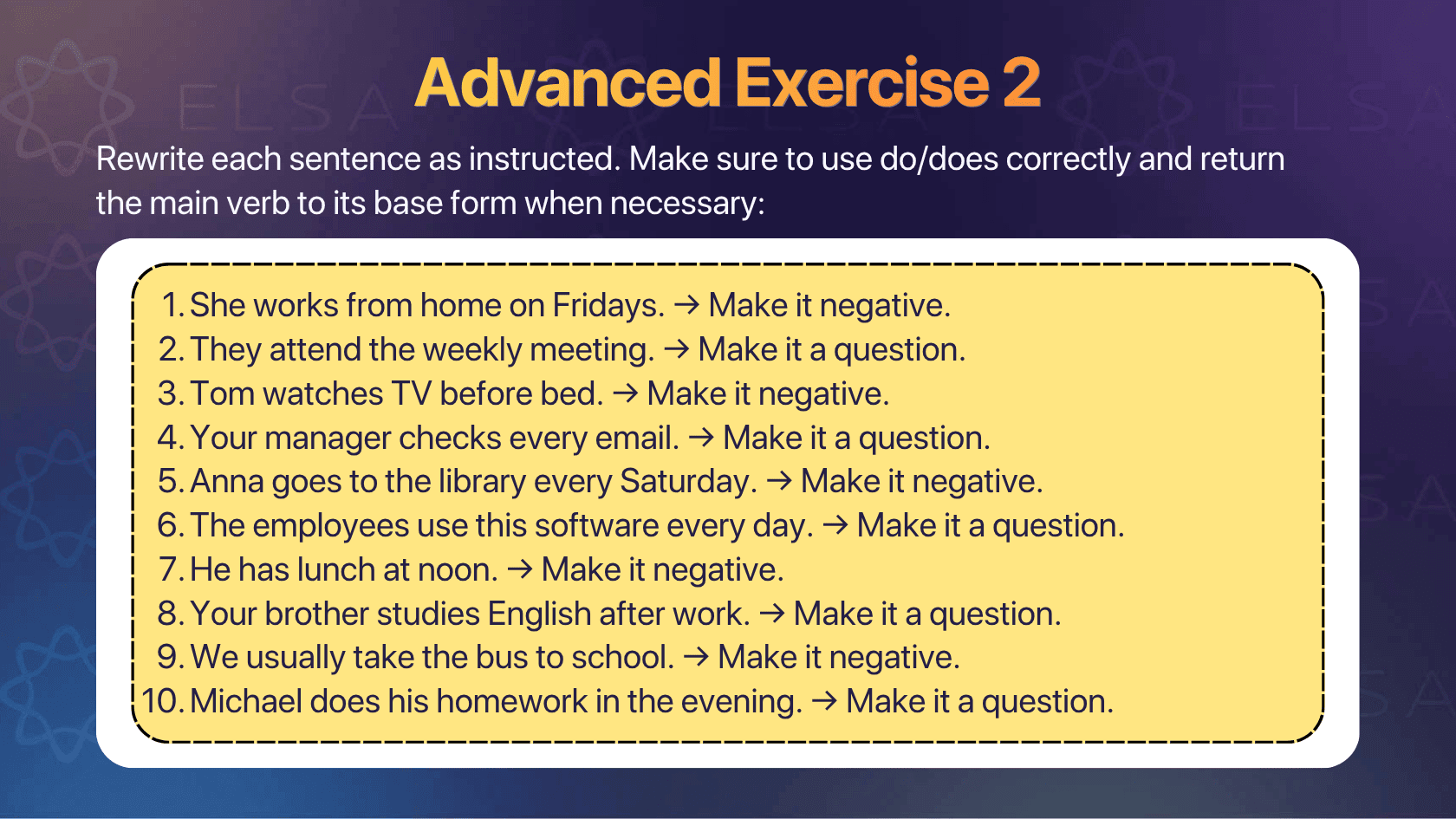
Advanced exercise on simple present tense 2:
Rewrite each sentence as instructed. Make sure to use do/does correctly and return the main verb to its base form when necessary.
- She works from home on Fridays. → Make it negative.
- They attend the weekly meeting. → Make it a question.
- Tom watches TV before bed. → Make it negative.
- Your manager checks every email. → Make it a question.
- Anna goes to the library every Saturday. → Make it negative.
- The employees use this software every day. → Make it a question.
- He has lunch at noon. → Make it negative.
- Your brother studies English after work. → Make it a question.
- We usually take the bus to school. → Make it negative.
- Michael does his homework in the evening. → Make it a question.
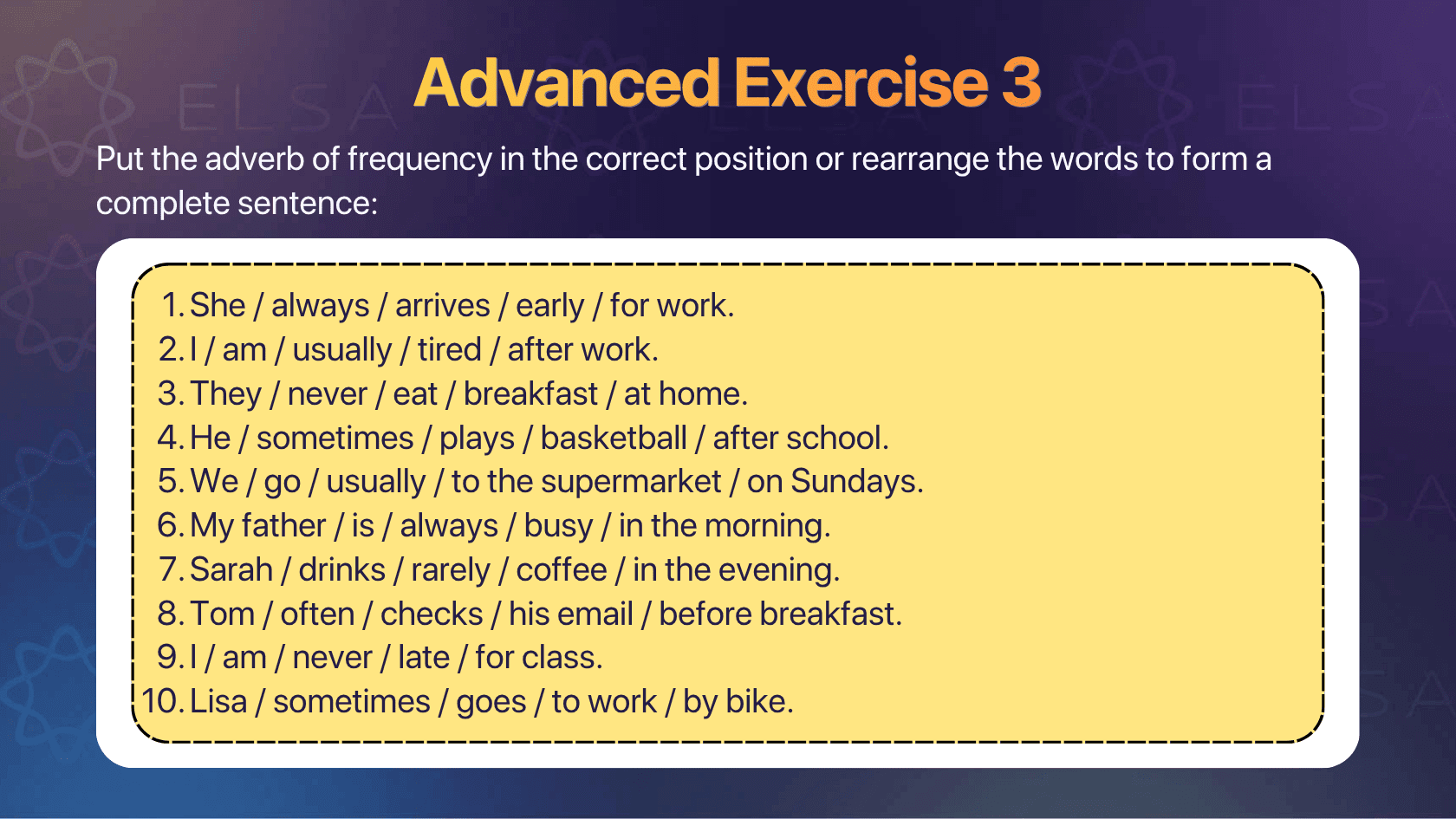
Advanced exercise simple present tense 3:
Put the adverb of frequency in the correct position or rearrange the words to form a complete sentence.
- She / always / arrives / early / for work.
- I / am / usually / tired / after work.
- They / never / eat / breakfast / at home.
- He / sometimes / plays / basketball / after school.
- We / go / usually / to the supermarket / on Sundays.
- My father / is / always / busy / in the morning.
- Sarah / drinks / rarely / coffee / in the evening.
- Tom / often / checks / his email / before breakfast.
- I / am / never / late / for class.
- Lisa / sometimes / goes / to work / by bike.
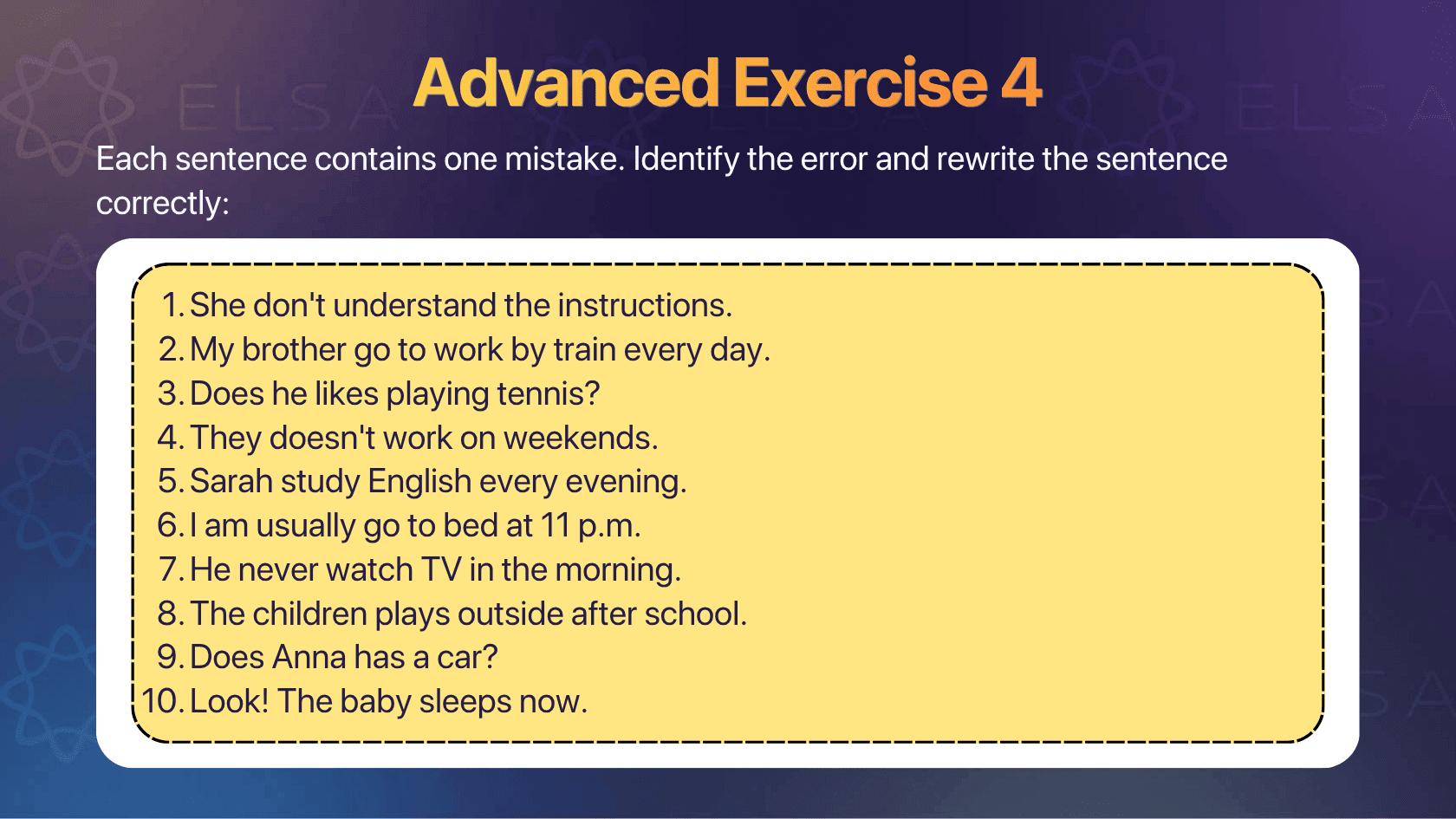
Advanced present simple tense exercise 4:
Each sentence contains one mistake. Identify the error and rewrite the sentence correctly. Watch for common mistakes with verb endings, do/does, to be, and the simple vs. present continuous.
- She don't understand the instructions.
- My brother go to work by train every day.
- Does he likes playing tennis?
- They doesn't work on weekends.
- Sarah study English every evening.
- I am usually go to bed at 11 p.m.
- He never watch TV in the morning.
- The children plays outside after school.
- Does Anna has a car?
- Look! The baby sleeps now.
Exercise on simple present tense: The test
Want to practice without looking at the answers first? Download the complete simple present tense exercise PDF to test your skills and check your answers afterward.
The PDF includes practice on:
- Verb conjugation
- Third-person singular spelling
- Multiple-choice questions
- Present simple questions
- Negative sentences
- Fill-in-the-gap exercises
- Short forms
- Error correction
- Advanced mixed review
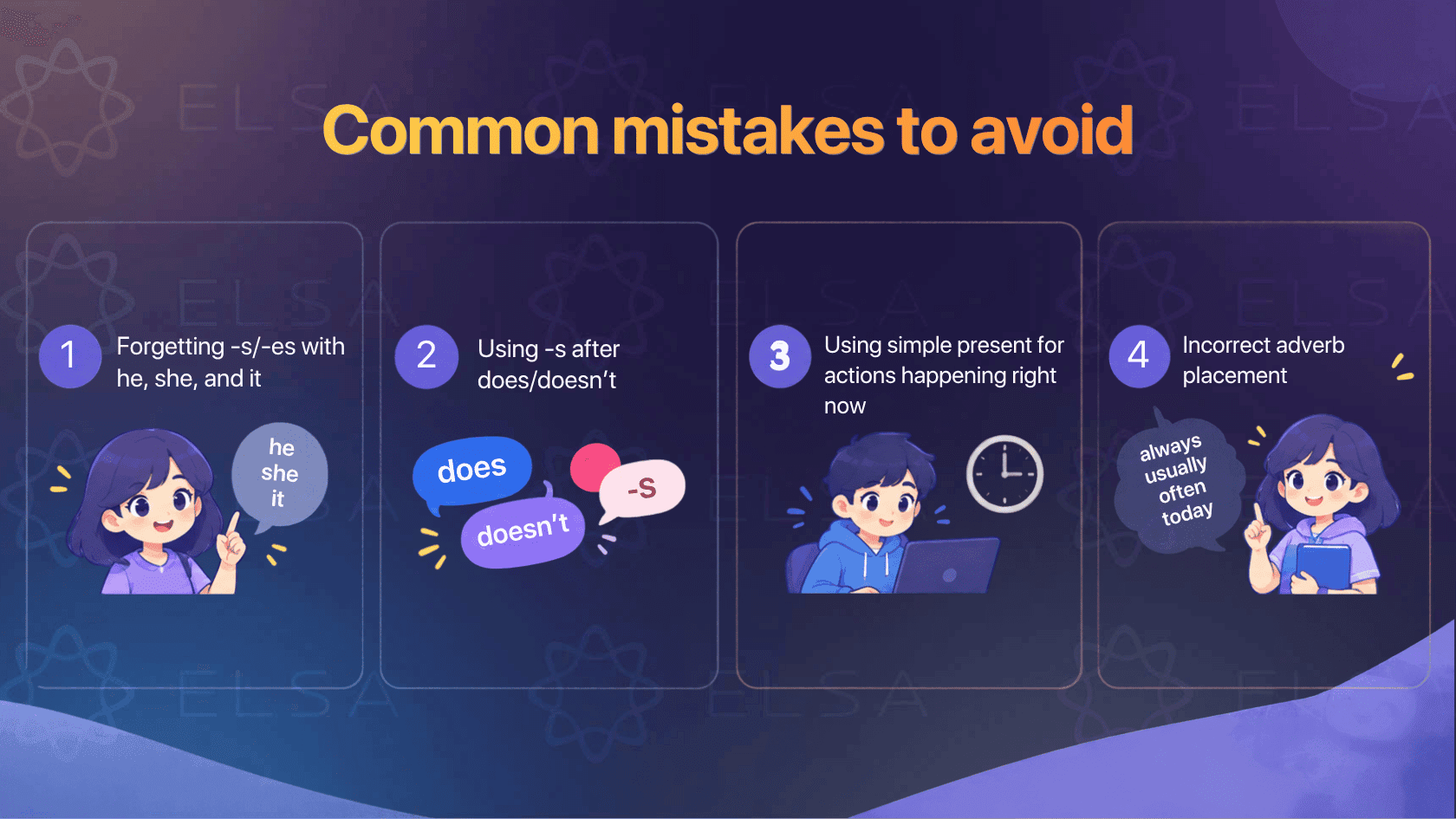
Common mistakes to avoid in simple present tense exercises
- Forgetting -s/-es with he, she, and it: Use works, watches, studies, etc. in affirmative sentences with third-person singular subjects.
- Using -s after does/doesn't: After does or doesn't, always use the base verb.
- Using simple present for actions happening right now: For an action happening at the moment of speaking, use the present continuous.
- Incorrect adverb placement: Frequency adverbs usually come before the main verb but after to be.
Regular practice is one of the best ways to remember simple present tense rules and use them more accurately. After completing these simple present tense exercises, try using the structures in your own conversations and everyday writing. You can also practice grammar and speaking together with exercises in the Grammar category on ELSA Speak blog to build greater confidence using English in real-life situations.