

Past perfect tense: Uses, structure, rules and examples
elsaspeakadmin
September 18, 2026
English tenses
In English, the past perfect is used to talk about that one event in the past which happened before another. It is very useful if you want to make the order of past events clear in conversation. This guide below will help you understand what past perfect tense is, how to use it, along with formulas, examples, and exercises.
What is past perfect tense?
Unlike present perfect tense, the past perfect tense is used to describe an action, or an event that was completed before another event or time in the past.
Past perfect tense examples:
- When I returned home, they had already left.
- Mary had brushed her teeth before she went to bed.

When to use the past perfect tense?
Here are some common situations along with past perfect tense usage examples:
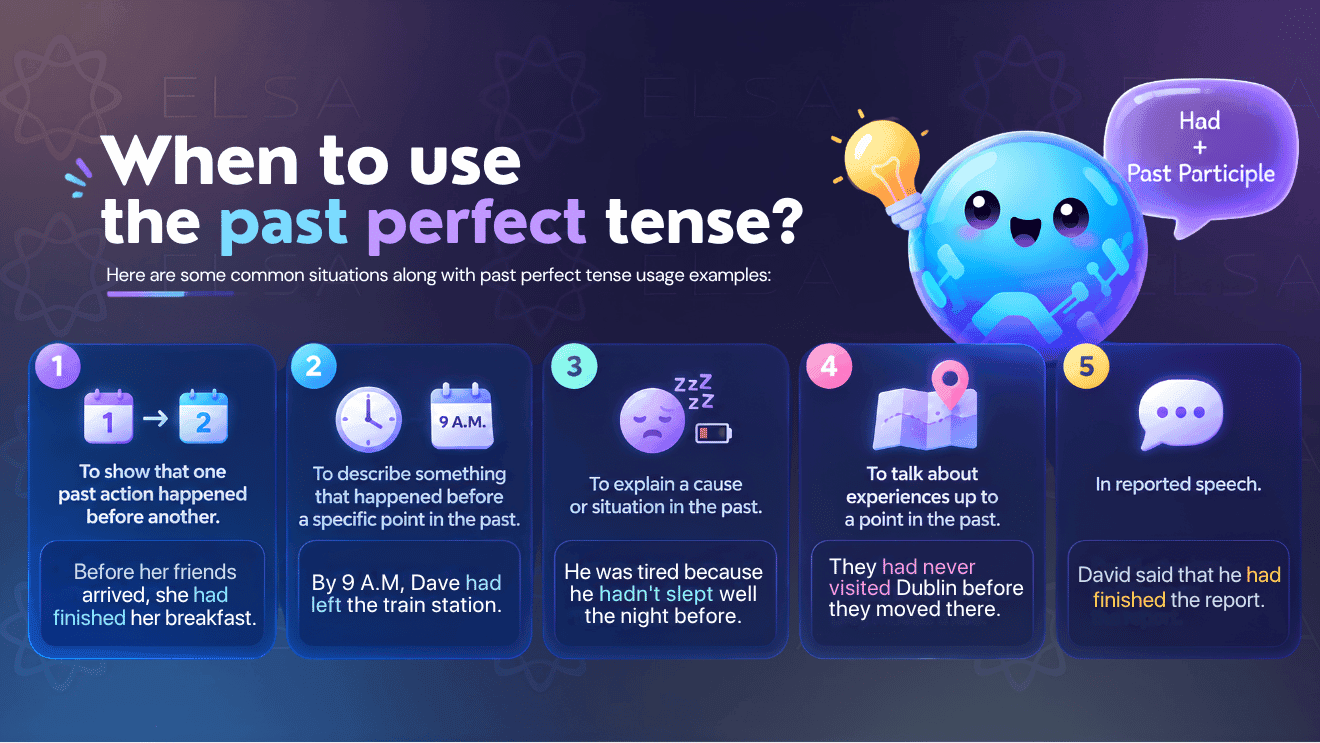
- To show that one past action happened before another.
- For example: Before her friends arrived, she had finished her breakfast.
- To describe something that happened before a specific point in the past.
- For example: By 9 A.M, Dave had left the train station.
- To explain a cause or situation in the past.
- For example: He was tired because he hadn’t slept well the night before.
- To talk about experiences up to a point in the past.
- For example: They had never visited Dublin before they moved there.
- In reported speech.
- For example: David said that he had finished the report.
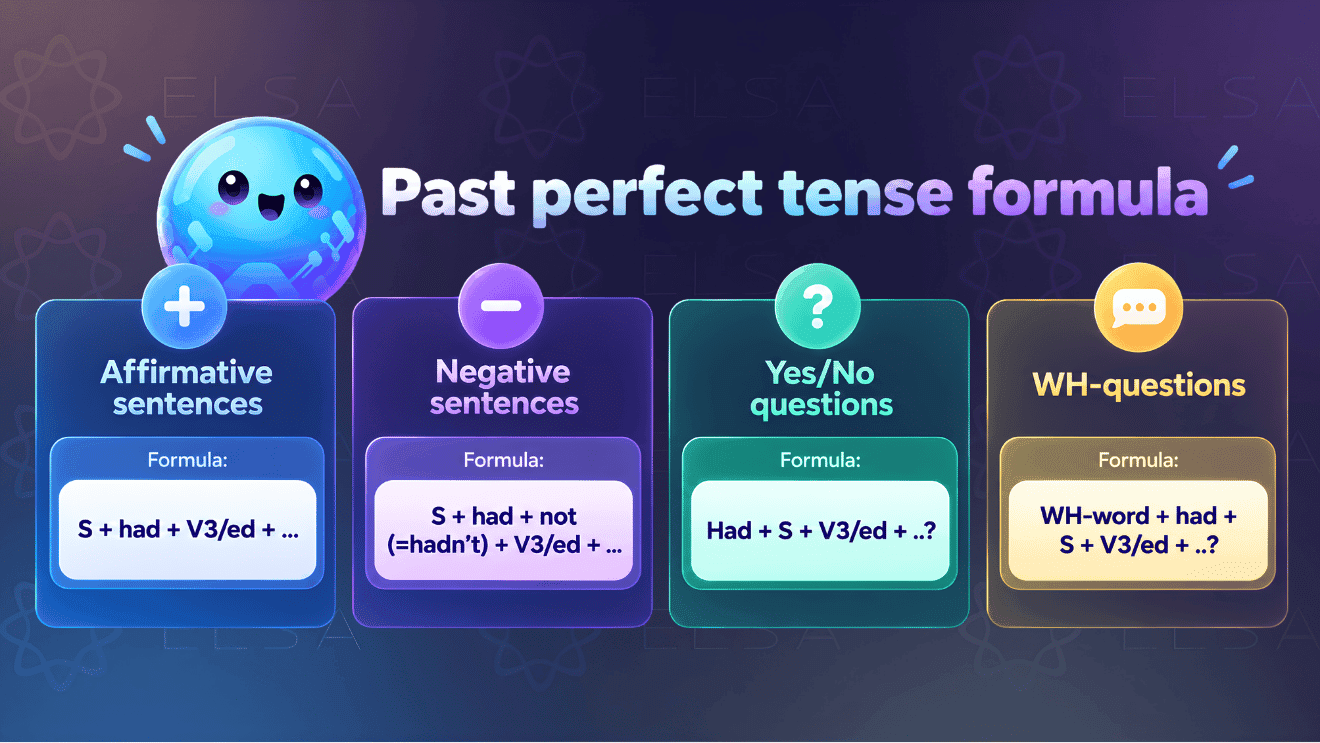
Past perfect tense formula
Affirmative sentences
Formula:
| S + had + V3/ed + ... |
For example: By 6 P.M, we had already left the office.
Negative sentences
Formula:
| S + had + not (=hadn’t) + V3/ed + … |
For example: She hadn’t seen the movie before.
Yes/No questions
Formula:
| Had + S + V3/ed + ..? |
For example: Had you finished your report before the meeting?
WH-questions
Formula:
| WH-word + had + S + V3/ed + ..? |
For example: Where had you been after 5 P.M?
Past perfect tense in conditional sentences
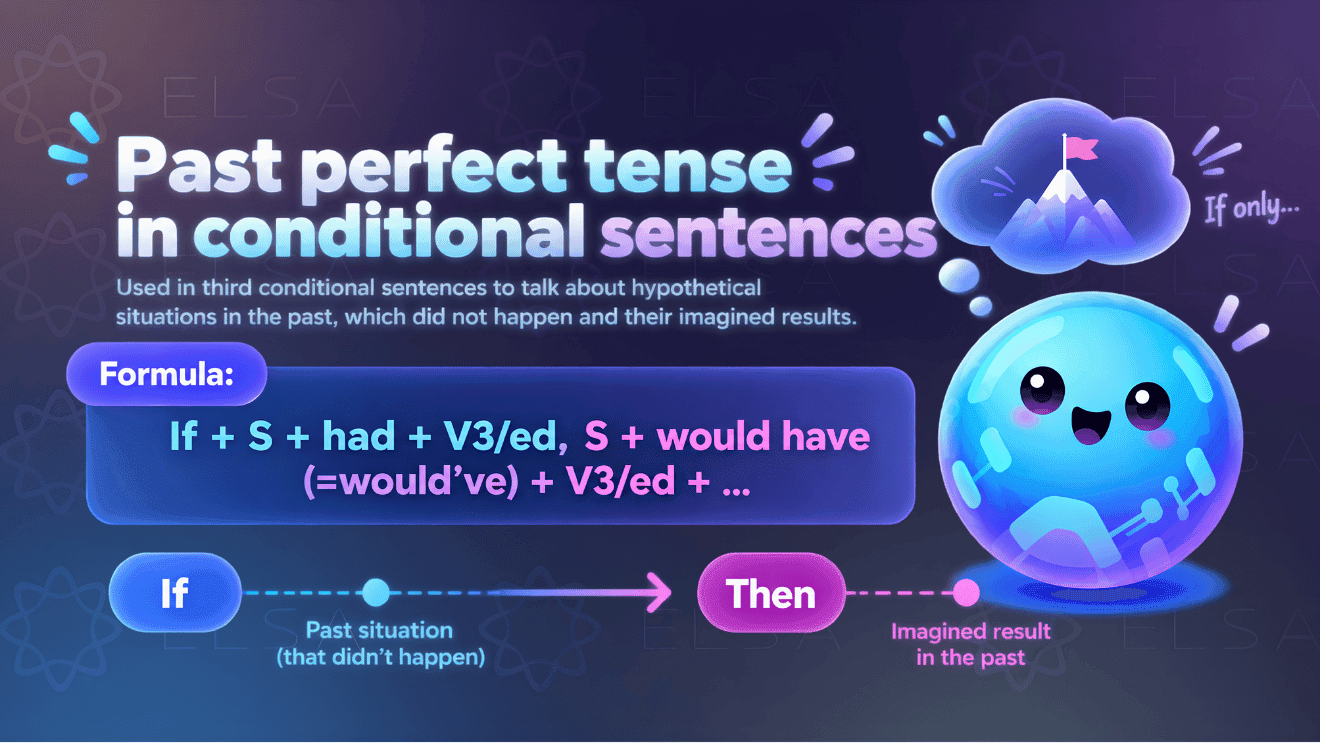
In third conditional sentences, the past perfect tense is commonly used to talk about hypothetical situations in the past, which are things that did not happen and their imagined results.
Formula:
| If + S + had + V3/ed, S + would have (=would’ve) + V3/ed + … |
For example: If I had studied harder, I would’ve passed the exam.
You can also place the result clause first:
For example: I would’ve passed the exam if I had studied harder.
Common time expressions with the past perfect
| Expressions | Examples |
| Already | She had already left when he called. |
| Before | Before John came home, his wife had cooked dinner. |
| After | He went to school after he had eaten breakfast. |
| By | Harry had completed the project by Friday. |
| By the time | By the time they arrived, the shop had closed. |
| Just | The train had just left when they reached the station. |
| Never | He had never heard that song. |
| Ever | Had you ever visited New York before you moved there? |
| Until then | We had never used the program until then. |

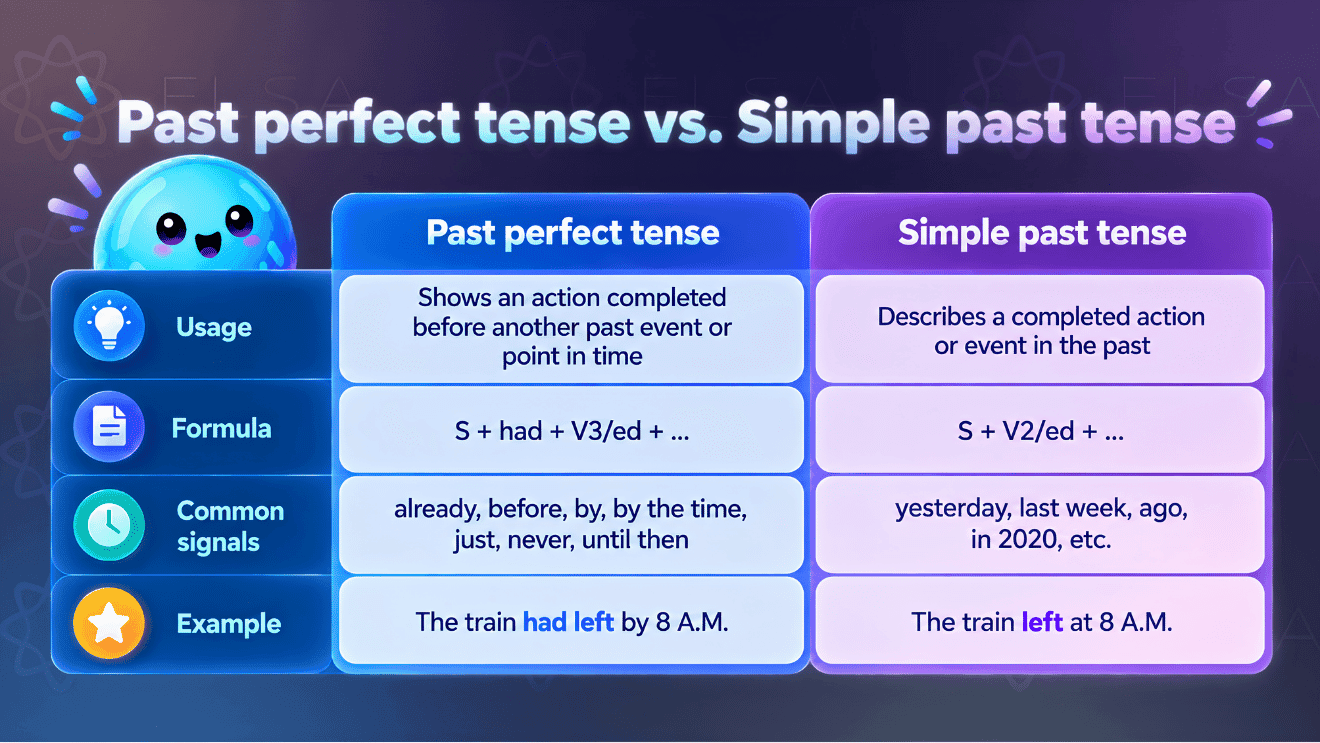
Past perfect tense vs. Simple past tense
| Past perfect tense | Simple past tense | |
| Usage | Shows an action completed before another past event or point in time | Describes a completed action or event in the past |
| Formula | S + had + V3/ed + … | S + V2/ed + … |
| Common signals | already, before, by, by the time, just, never, until then | yesterday, last week, ago, in 2020, etc. |
| Example | The train had left by 8 A.M. | The train left at 8 A.M. |
The past perfect tense exercises
Exercise 1: Complete each sentence with the correct past perfect form of the verb in parentheses.
- When Dave and Gary arrived, the movie __________. (start)
- She was hungry because she __________ dinner. (not / eat)
- They __________ the reports before the manager arrived. (finish)
- I __________ that restaurant before last Monday. (never / visit)
- By the time he got home, his family __________ lunch. (have)
- The train __________ when we reached the station. (already / arrive)
- He __________ the book before he watched the movie. (read)
- We were tired because we __________ all day. (work)
Exercise 2: Choose the past perfect tense or the simple past tense to complete each sentence.
- After he __________ his homework, he watched TV. (finish)
- When they got to the airport, the plane __________. (leave)
- She __________ to the supermarket yesterday. (go)
- Harry was nervous because he __________ the test before. (never / take)
- They __________ dinner at 6 P.M. last night. (eat)
- By the time the teacher arrived, the students __________ their seats. (take)
- We __________ our parents two days ago. (call)
- After she __________ the email, she called her manager. (send)
Exercise 3: Complete the third conditional sentences using the correct form of the verbs in parentheses.
- If I __________ earlier, I would have caught the train. (leave)
- If she had studied harder, she __________ the test. (pass)
- They would have arrived on time if they __________ earlier. (leave)
- If we __________ the weather forecast, we would have stayed home. (check)
- She would have called you if she __________ your number. (have)
- If Jack had known about the meeting, he __________ there. (go)
- She would have bought the ticket if she __________ enough money. (have)
- If we had booked earlier, we __________ a better room. (get)
By remembering the basic structure of the past perfect tense, you can easily show which past event happened first without confusing the audience, especially when two or more events are connected. For more practical lessons, visit the Grammar category on the ELSA Speak blog and explore more resources to strengthen your English skills.