

First conditional: Formula, rules & real-life examples
elsaspeakadmin
November 13, 2026
English tenses
The first conditional helps learners make promises, plan around the weather, and negotiate practical terms in everyday English. To understand how to use this tense more accurately, this guide explains the formulas, shows real-life examples, and includes 30 practice questions with detailed answers. Since it combines the present simple and will, a quick review of English tenses can make the structure easier to follow.
What is the first conditional?
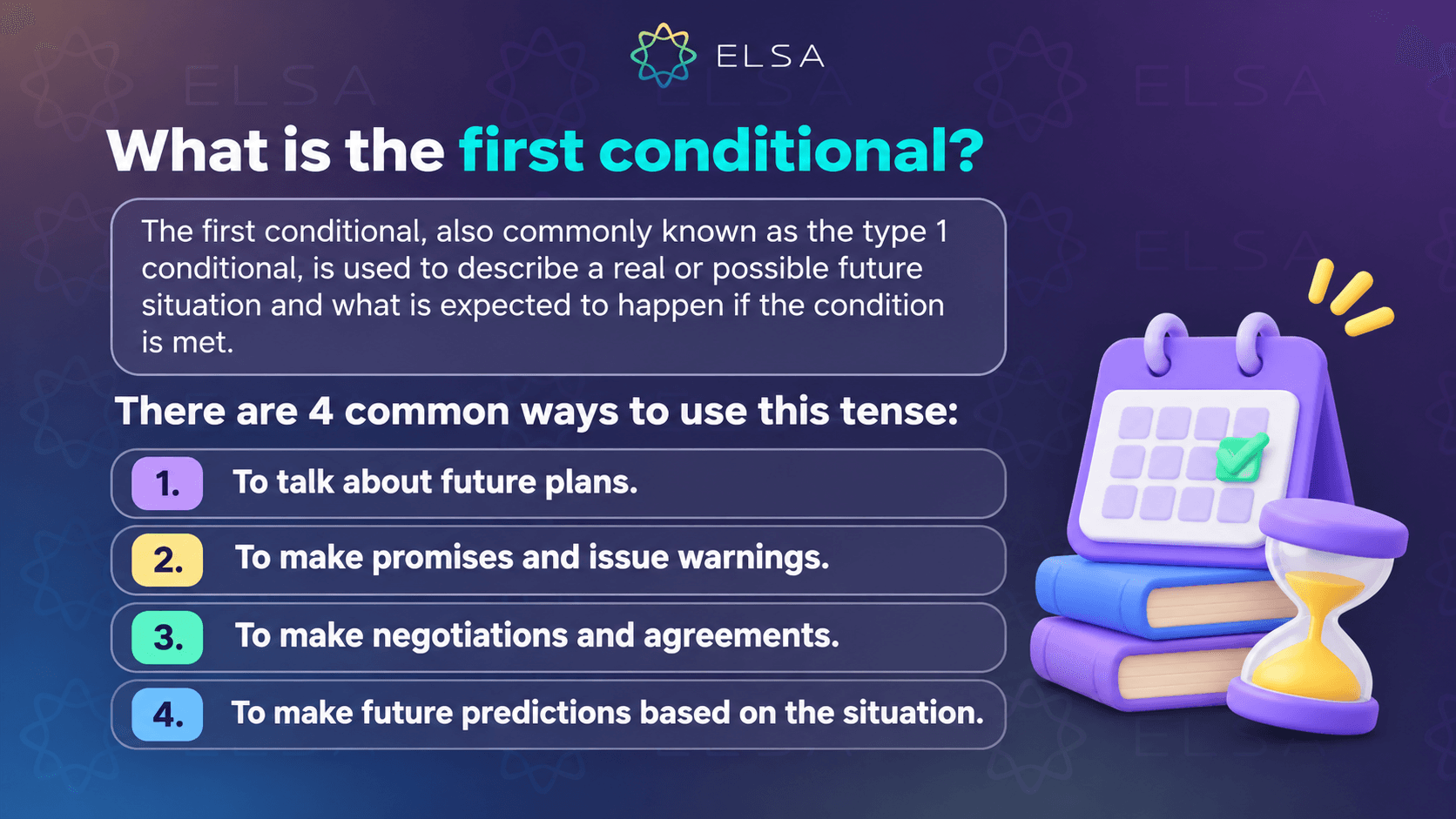
The first conditional, also commonly known as the type 1 conditional, is used to describe a real or possible future situation and what is expected to happen if the condition is met. Take a look at this example:
- If it rains tomorrow, we will move the picnic indoors.
→ In this sentence, the condition part is "If it rains tomorrow", and the result is "we will move the picnic indoors." The sentence basically explains that the speaker is considering rain as a realistic possibility and explaining what they would do for that situation.
There are 4 common ways to use this tense:
- To talk about future plans. For example: If I finish work by five, I’ll meet you downtown.
- To make promises and issue warnings. For example: If you send me your draft tonight, I’ll review it tomorrow.
- To make negotiations and agreements. For example: If you order 500 units, we’ll offer a 10% discount
- To make future predictions based on the situation. For example: If traffic stays this heavy, we’ll arrive after six.
First conditional formula and sentence structures
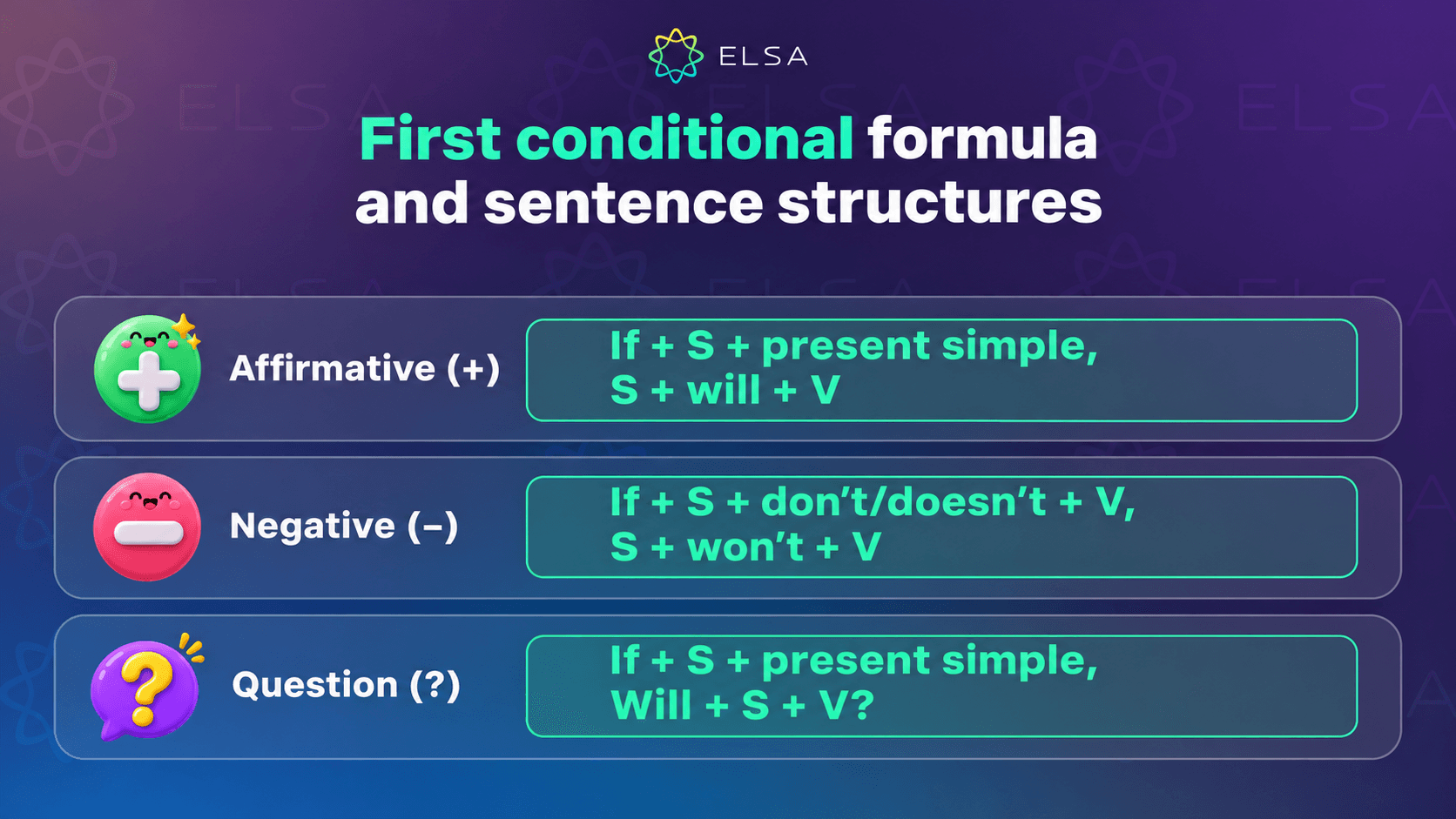
The general formula for the first conditional is:
| If + S + present simple, S + will + V. |
Remember the clause order and comma rules:
You can put either clause first without changing the basic meaning. However, a comma is normally unnecessary when the if-clause comes second.
For instance:
- If we receive your payment today, we’ll ship the order tomorrow.
- We'll ship the order tomorrow if we receive your payment today.
Note: Do NOT use will in the if- clause. Save will for the main clause, where it works just like the simple future tense.
| Sentence type | Condition | Result | Example |
|---|---|---|---|
| Affirmative (+) | If + S + present simple | S + will + V | If she finishes early, she will join us. |
| Negative (-) | If + S + don’t/doesn’t + V | S + won’t + V | If she doesn't finish early, she won't join us. |
| Question (?) | If + S + present simple | Will + S + V? | Will she join us if she finishes early? |
Variations in the main clause: Modal verbs and imperatives
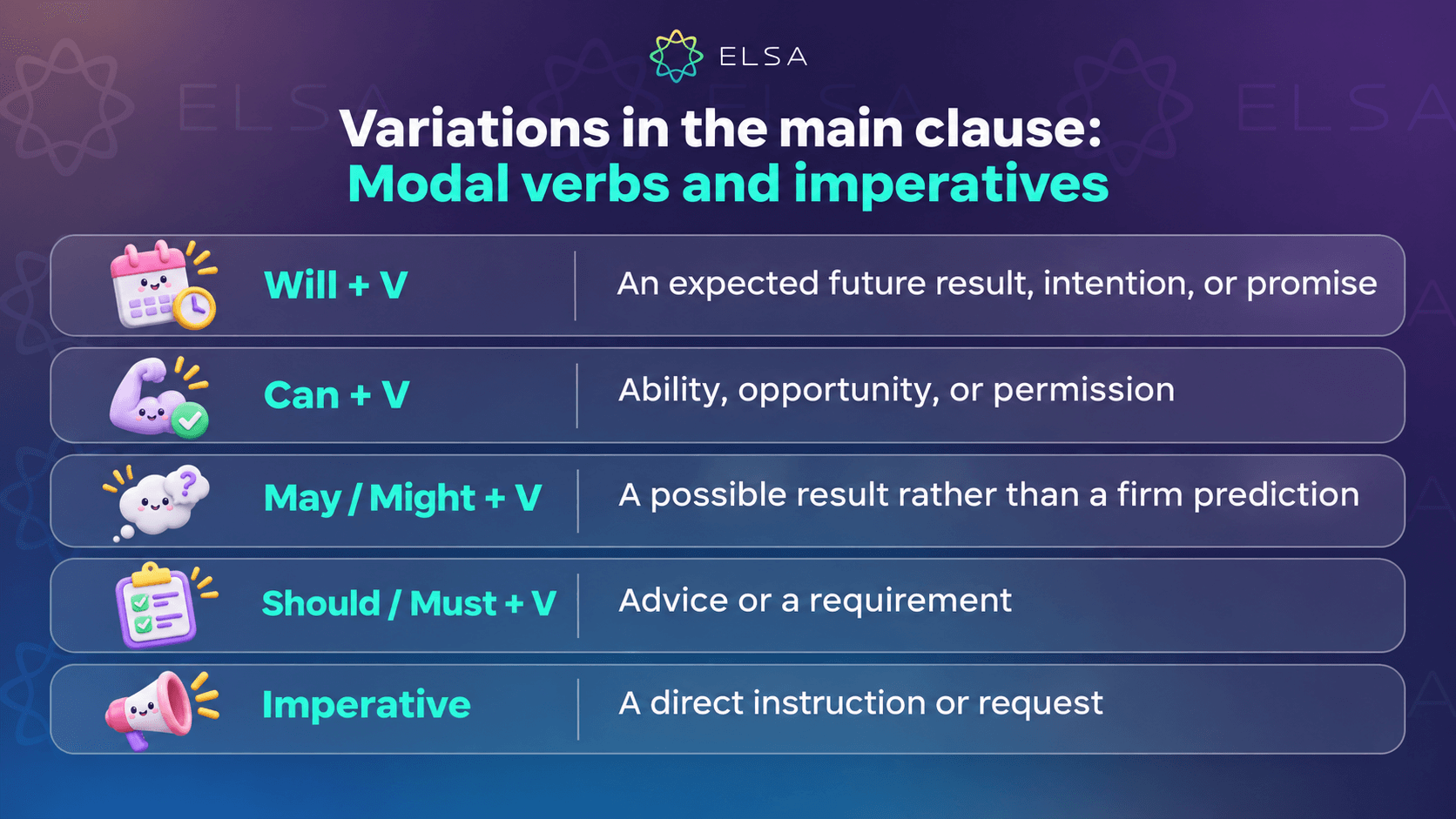
Many first conditional examples use will, but the result clause can express more than a prediction. Other modals help you communicate permission, uncertainty, advice, or a requirement.
| Variant | Function | Pattern |
|---|---|---|
| Will + V | An expected future result, intention, or promise | If + present simple, S + will + V |
| Can + V | Ability, opportunity, or permission | If + present simple, S + can + V |
| May / Might + V | A possible result rather than a firm prediction | If + present simple, S + may/might + V |
| Should / Must + V | Advice or a requirement | If + present simple, S + should/must + V |
| Imperative | A direct instruction or request | If + present simple, V / don’t + V |
Replacing will with other modal verbs
Aside from will, you can also choose the modal verbs that matches what you want to communicate.
- Can: Use can if you want to talk about an ability or permission, however, it does not predict that the situation will definitely happen.
For example: If you finish the assignment early, you can leave before five. - May / Might: Use may/might when you want to talk about a possibility rather than a settled plan.
For example: If the weather improves, we might have dinner outside. - Should / Ought to: Use this modal when you want to express an advice. However, note that "should" takes a base verb directly, while "ought to" is followed by "to".
For example: If the instructions seem unclear, you should ask the instructor for an example. - Must / Have to: Use this when you want to express a requirement. Note that unlike "must", have to changes with the subject.
For example: If you join tomorrow’s workshop, you must bring your registration confirmation.
Using imperatives in the result clause
You can also use an imperative sentence when the result clause gives an instruction, request, or direct warning. The usual subject "you" is understood, so it is omitted.
Formula:
Affirmative pattern: If + S + present simple, V + the rest of the instruction. Negative pattern: If + S + present simple, don’t + V + the rest of the instruction |
Examples:
- If you need another copy, ask the receptionist.
- If the document contains confidential information, don’t forward it.
Note: You do not need an exclamation mark. A period is appropriate for most written instructions.
Special conjunctions in the first conditional
Besides "if", English also uses other expressions (such as "unless", "as long as", and provided that") to introduce conditions. You will also see related future-time structures with when and as soon as, as well as precautionary statements with in case. These expressions are useful, but they do not all mean the same thing.
Unless
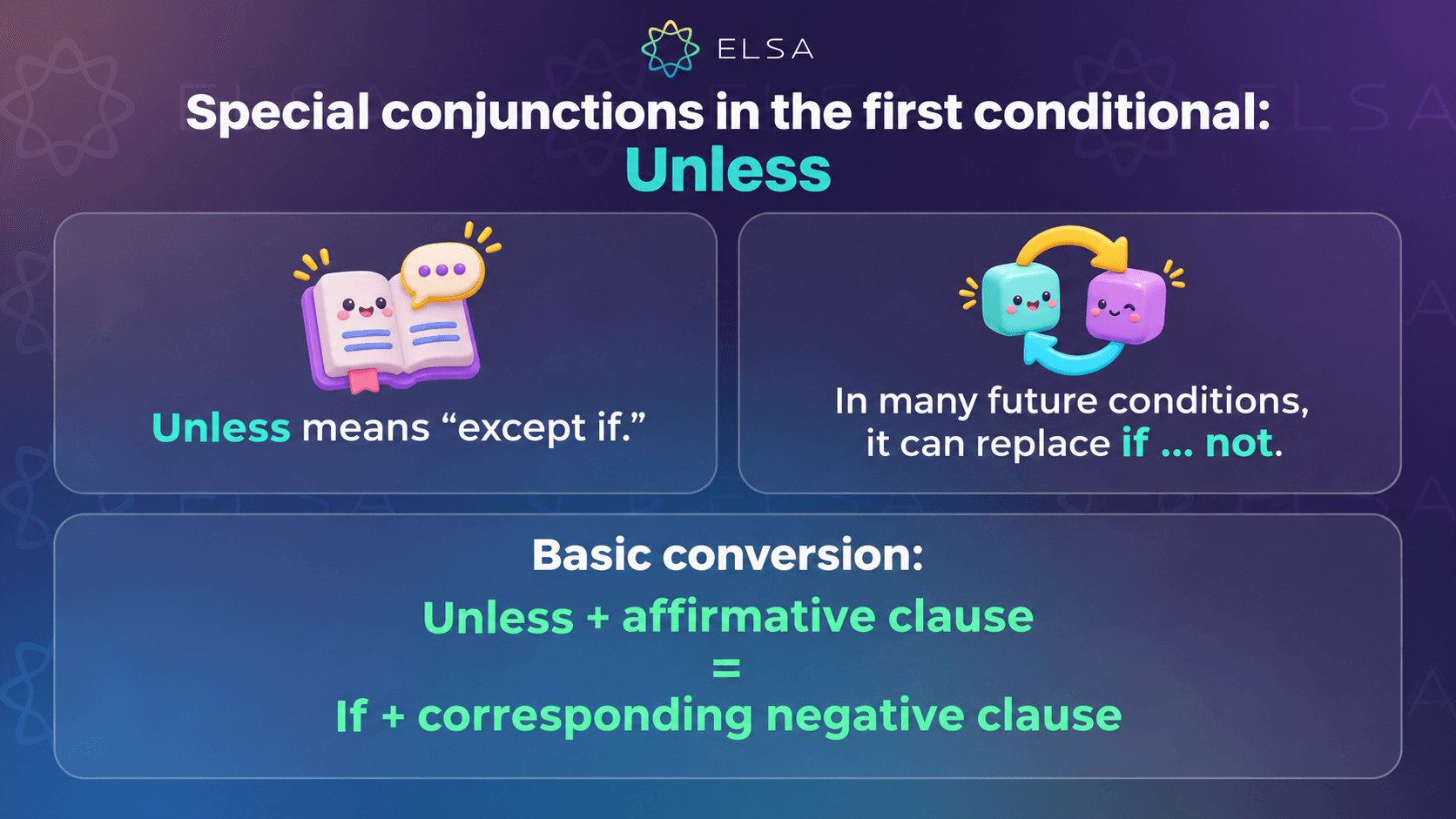
Unless means “except if.” In many future conditions, it can replace if … not.
Basic conversion:
| Unless + affirmative clause = If + corresponding negative clause |
Examples:
- If you don’t register by Friday, you won’t receive a conference pass.
→ Unless you register by Friday, you won’t receive a conference pass. - We’ll hold the event outside if it doesn’t rain.
→ We’ll hold the event outside unless it rains.
Note: When making this conversion, remove the negative from the condition. Keep the result clause unchanged.
Distinguishing "when" vs "if"
- Use "if" when you leave open whether an event will happen.
For example: If I see Jordan tomorrow, I’ll give him your message. - Use "when" when you present the event as expected and focus on its timing.
For example: When I get home tonight, I’ll text you.
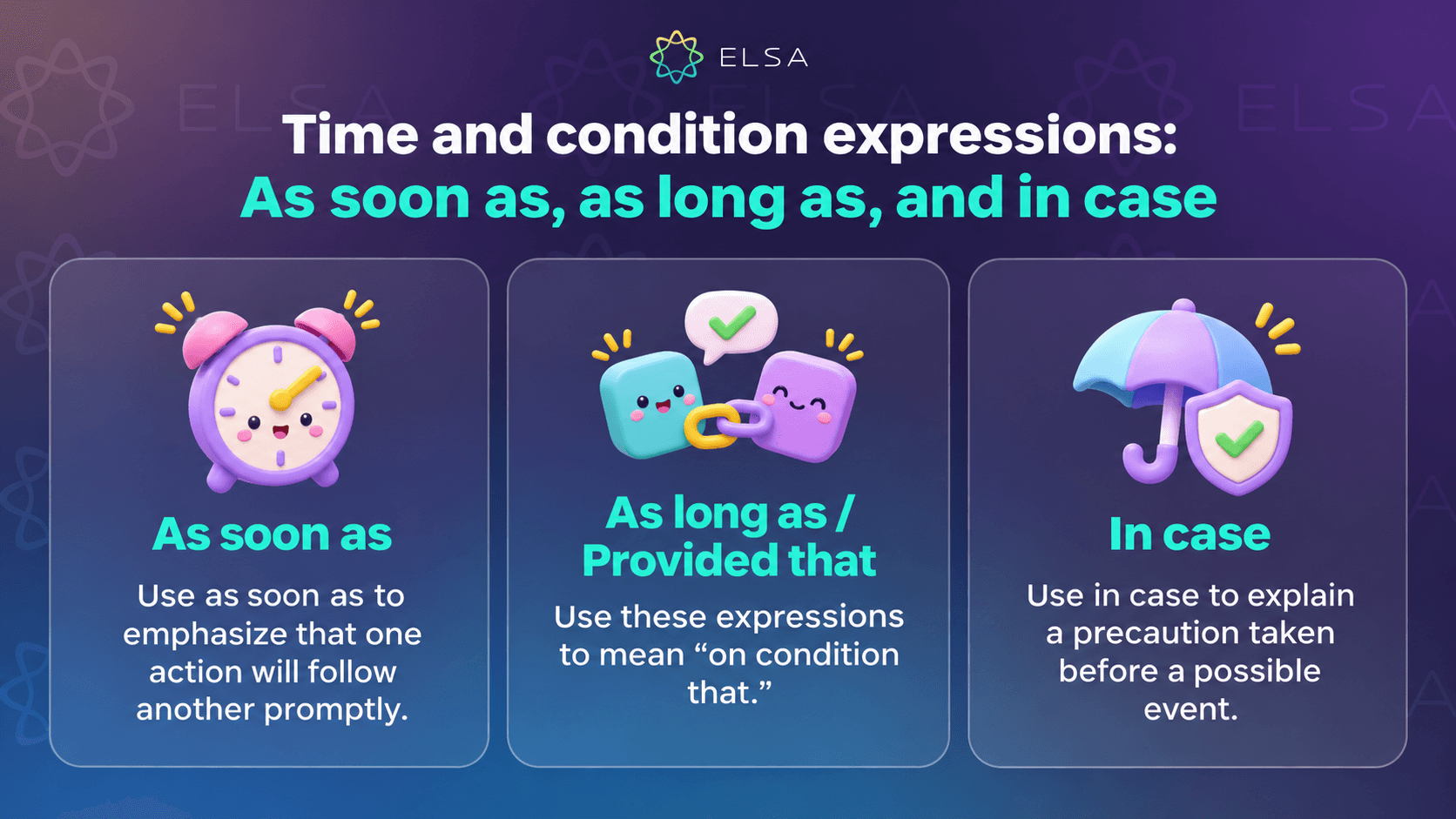
Time and condition expressions: As soon as, as long as, and in case
- As soon as: Use as soon as to emphasize that one action will follow another promptly.
For example: As soon as the delivery arrives, I’ll send you a confirmation. - As long as / Provided that: Use these expressions to mean “on condition that.”
For example: You can borrow my car as long as you return it by eight. - In case: Use in case to explain a precaution taken before a possible event.
For example: Save an offline copy in case the Wi-Fi stops working.
First conditional vs zero and second conditionals
The easiest way to distinguish conditional types is to ask what the speaker is describing: a general pattern, an open future possibility, or an imagined situation
| Conditional type | Meaning and likelihood | If- clause | Main clause |
|---|---|---|---|
| Zero conditional | A general truth, rule, or repeated pattern | Present simple | Present simple |
| First conditional | A specific future situation treated as a real possibility | Present simple | Will + V |
| Second conditional | An imagined present or future situation treated as unlikely or contrary to fact | Past simple | Would + V |
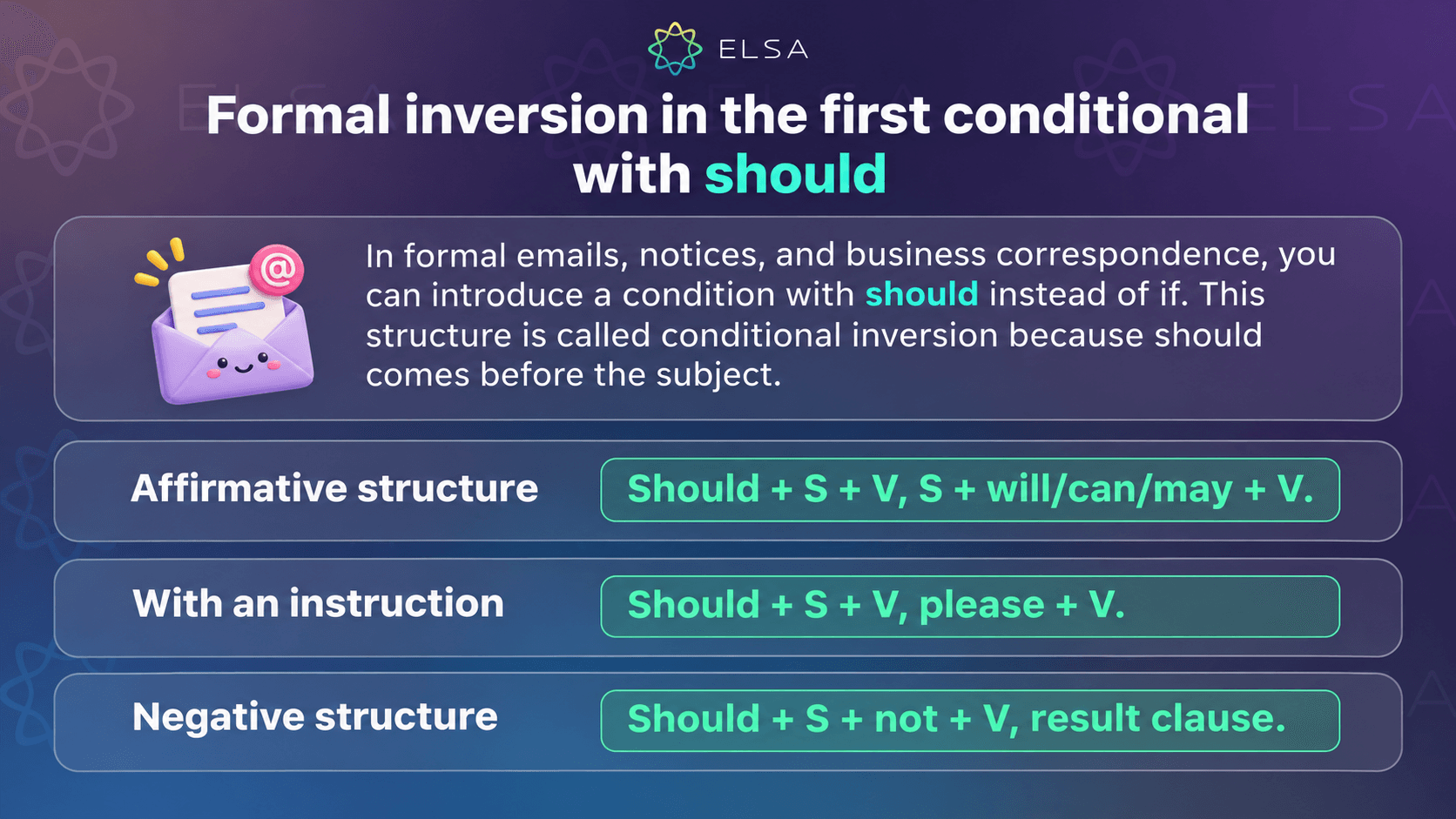
Formal inversion in the first conditional with should
In formal emails, notices, and business correspondence, you can introduce a condition with should instead of if. This structure is called conditional inversion because should comes before the subject.
Formulas:
Affirmative structure: Should + S + V, S + will/can/may + V. With an instruction: Should + S + V, please + V. Negative structure: Should + S + not + V, result clause. |
Examples:
- Standard form: If you need additional copies, please contact our office.
- Formal inverted form: Should you need additional copies, please contact our office.
- Negative inverted form: Should you not receive a confirmation by Friday, please contact our office.
Common mistakes when using the first conditional and how to avoid them
The most common errors involve verb forms, unnecessary negatives, and choosing a conjunction that changes the intended meaning.
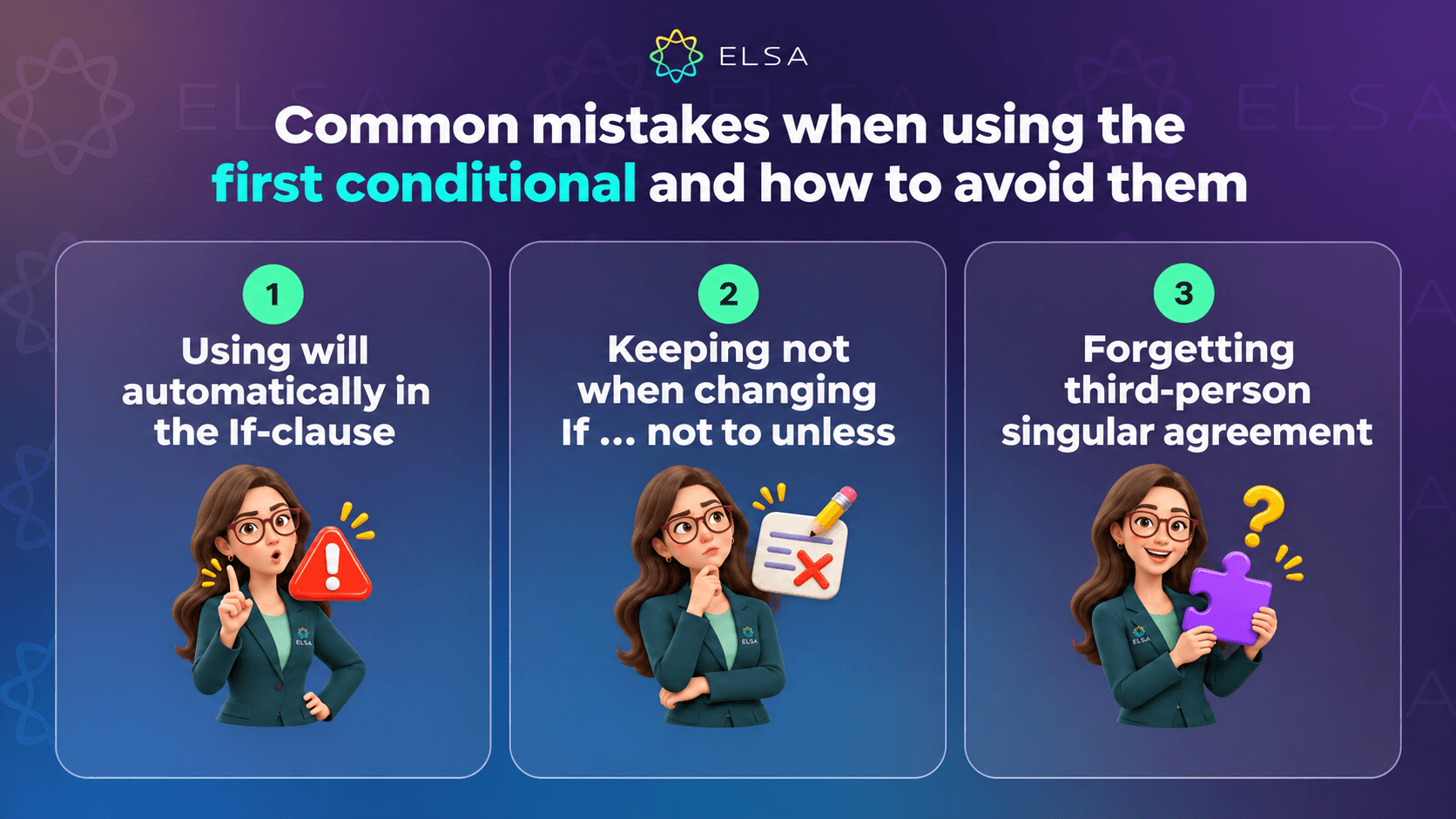
Using will automatically in the If-clause
The condition already has a future meaning, so it normally uses the simple present tense.
- For an ordinary future condition, write: If the supplier confirms the date, we’ll update the schedule.
- Avoid: If the supplier will confirm the date, we’ll update the schedule.
Keeping not when changing If … not to unless
Start with:
If you don’t save the file, you’ll lose your changes.
→The corresponding unless sentence is: Unless you save the file, you’ll lose your changes.
Keeping don’t would change the condition.
Forgetting third-person singular agreement
The if-clause follows present simple agreement:
- If he needs help, he’ll call.
- If she finishes early, she’ll leave.
- If it rains, we’ll stay inside.
After doesn’t, return to the base verb: If she doesn’t finish early, she’ll stay late.
| Common pitfall | Incorrect or mismatched example | Corrected version | Rule / Fix |
|---|---|---|---|
| Adding will to an ordinary future condition | If it will rain tomorrow, we’ll cancel the picnic. | If it rains tomorrow, we’ll cancel the picnic. | Use the present simple for the ordinary future condition. |
| Keeping the negative in an unless rewrite | Intended: If you don’t hurry, you’ll miss the bus. Rewrite: Unless you don’t hurry, you’ll miss the bus. | Unless you hurry, you’ll miss the bus. | When converting this pattern, replace if … not with unless and remove the negative. |
| Forgetting third-person singular agreement | If she finish early, she’ll join us | If she finishes early, she’ll join us. | Add -s/-es to an ordinary affirmative present simple verb with he/she/it. |
| Using if when the intended focus is timing | Intended: the speaker expects to arrive. “If I arrive, I’ll text you.” | When I arrive, I’ll text you. | If is grammatical but leaves arrival uncertain. When matches the intended expectation. |
Practice exercises on the first conditional
Complete these three practice sets before checking the answers. Pay attention to subject–verb agreement, the meaning of unless, and the base verb after modal verbs.
Exercise 1: Conjugate the verbs in brackets
Instructions: Complete each sentence using the present simple in the if-clause and will + base verb in the result clause. Use negative forms where indicated.
Example: If the company ___ (expand), we ___ (hire) more employees. → If the company expands, we will hire more employees. |
- If the company ___ (expand) into a new market, we ___ (hire) twenty project managers.
- If it ___ (rain) tomorrow, we ___ (move) the event indoors.
- She ___ (miss) the bus if she ___ (not/leave) now.
- If you ___ (send) the file tonight, I ___ (review) it tomorrow.
- We ___ (not/start) the meeting if the manager ___ (be) absent.
- If the customer ___ (choose) express shipping, the package ___ (arrive) sooner.
- What ___ you ___ (do) if the flight ___ (be) canceled?
- If our team ___ (meet) its target, everyone ___ (receive) a bonus.
- If he ___ (not/practice), he ___ (not/improve).
- ___ you ___ (join) us if you ___ (finish) work early?
Exercise 2: Rewrite sentences using unless
Instructions: Rewrite each sentence using unless without changing its meaning. Replace if … not with unless and make the necessary changes to the verb.
Example: If you don’t register by Friday, you won’t receive a pass. → Unless you register by Friday, you won’t receive a pass. |
- If you don’t confirm your reservation, we’ll release your table.
- We won’t start the workshop if everyone isn’t ready.
- If she doesn’t leave now, she’ll miss the train.
- If the client doesn’t approve the budget, we won’t begin the project.
- You won’t receive updates if you don’t subscribe.
- If it doesn’t stop raining, we’ll cancel the game.
- They won’t let us enter if we don’t show our tickets.
- If he doesn’t back up his files, he’ll risk losing his work.
- I won’t change the schedule if you don’t request an adjustment.
- If the store isn’t open, we’ll order online.
Exercise 3: Multiple choice on modal variations and inversion
Instructions: Choose the answer that is grammatically correct and matches the stated meaning.
1. Choose the word that completes the formal inverted condition.
“___ the client require additional information, please contact our sales team.”
A. If
B. Should
C. Unless
D. When
2. Choose the modal that explicitly gives permission.
“If you finish your assignment, you ___ leave early.”
A. can
B. must
C. should
D. might
3. Choose the modal that presents the result as an uncertain possibility.
“If demand increases, we ___ open another store, but we haven’t decided yet.”
A. must
B. will definitely
C. might
D. have to
4. Choose the modal that gives advice.
“If you find the instructions confusing, you ___ ask for clarification.”
A. will
B. should
C. can’t
D. mustn’t
5. Complete the negative imperative.
“If the file contains private information, ___ share it publicly.”
A. not
B. doesn’t
C. don’t
D. won’t
6. Choose the word that means “if … not” in this sentence.
“We won’t begin ___ all participants are ready.”
A. because
B. although
C. unless
D. so
7. Complete the ordinary first conditional sentence.
“If the supplier ___ the order today, we’ll receive it this week.”
A. ship
B. ships
C. will ships
D. shipping
8. Complete the negative inverted condition.
“Should you ___ receive a confirmation, please check your spam folder.”
A. don’t
B. doesn’t
C. not
D. won’t
9. Choose the correct verb form after can.
“If we finish early, we can ___ the next task.”
A. starts
B. to start
C. starting
D. start
10. Choose the modal that explicitly expresses a requirement.
“If you attend the workshop, you ___ bring your registration confirmation; it is required for entry.”
A. might
B. must
C. can
D. may
FAQs about the first conditional
Why can’t we use will in the If-clause of the first conditional?
In the standard first conditional, the if-clause uses the present simple to express a future condition. You do not normally add will just because the condition refers to the future.
However, saying that will can never follow if is too broad as it can express willingness or a polite request. For ordinary first conditional practice however, follow if + present simple, will + base verb.
Can "unless" be replaced by "if not" in all situations?
No. The replacement works well when unless introduces an exception and if … not preserves that meaning:
For example: Unless you call, I’ll assume the meeting is on.
= If you don’t call, I’ll assume the meeting is on.
However, unless is not a universal substitute for every negative if-clause, especially when the sentence discusses a known past fact or a different logical relationship.
For example: I don’t know what we would have done if we hadn’t met you.
When should I use should instead of if at the beginning of a sentence?
Use "should + S + V" when you want a more formal or tentative condition, especially in business correspondence, customer notices, or polite offers. Use ordinary if in most everyday conversations.
Note that inversion is a style choice, not a requirement for professional English.
What is the main difference between if and in case?
- If makes one action depend on a condition.
- For example: I’ll buy batteries if the remote stops working.
⇒ The speaker will buy batteries if that problem occurs.
- For example: I’ll buy batteries if the remote stops working.
- In case explains a precaution.
- For example: I’ll buy spare batteries in case the remote stops working.
⇒ The speaker will buy batteries beforehand to be prepared.
- For example: I’ll buy spare batteries in case the remote stops working.
Basically speaking, think of if as introducing a condition and in case as explaining preparation for a possibility.
The first conditional helps you explain what you will do if a realistic situation occurs. Write three examples about your own plans, work, or studies, and practice saying them aloud with ELSA Speak. Visit the Grammar category to explore more grammar guides and practice activities on the ELSA Speak blog.