

Simple future tense: Definition, usage, rules, examples and exercises
elsaspeakadmin
September 25, 2026
English tenses
The future present tense is commonly used in English to talk about future predictions, promises, offers, and other situations. In this guide, you’ll learn the future simple tense definition, along with formulas, worksheets and detailed examples to help you use it with confidence.
What is simple future tense?
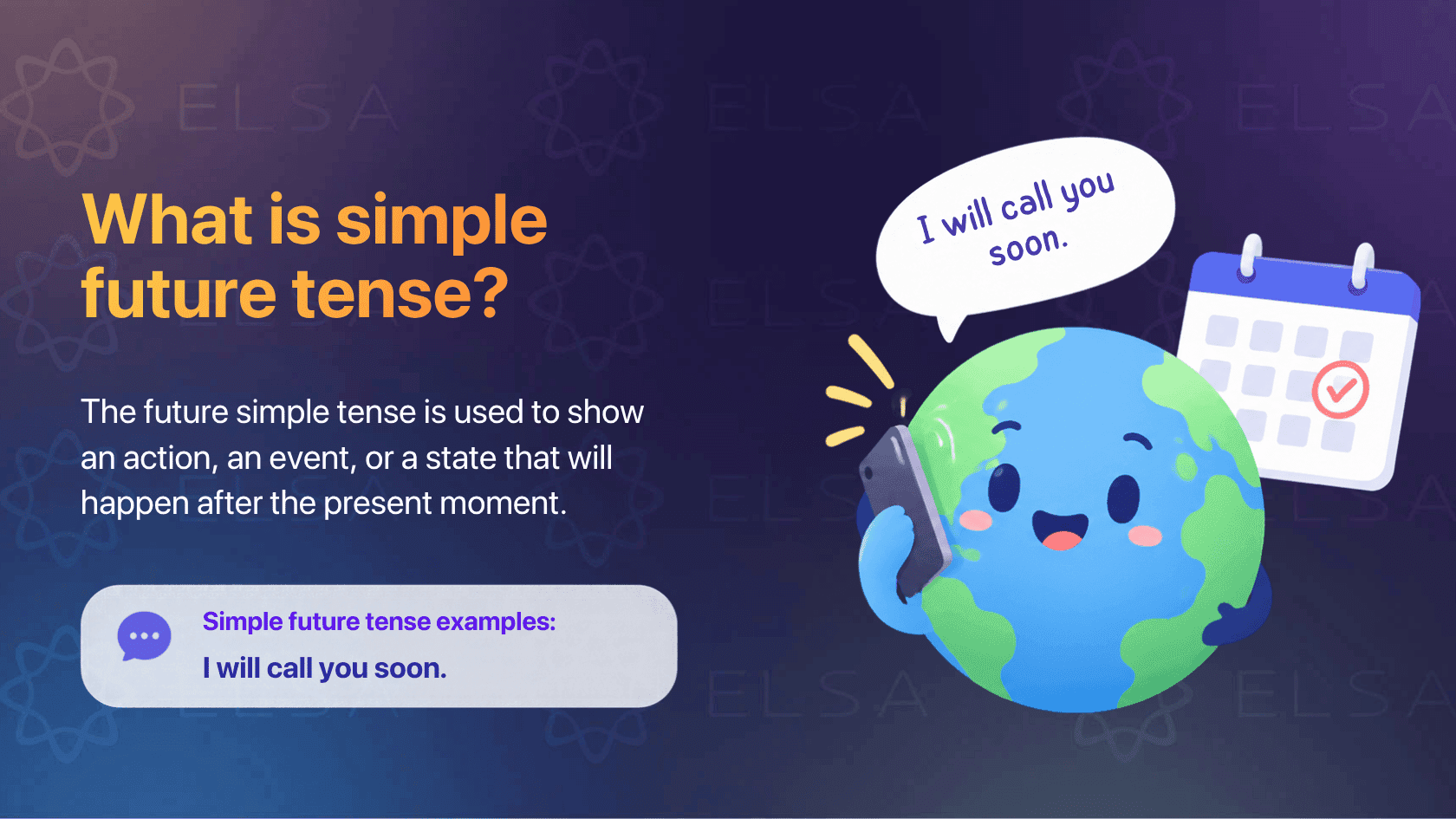
The future simple tense is used to show an action, an event, or a state that will happen after the present moment.
Simple future tense examples:
- I will call you soon.
- It will rain tomorrow.
When to use future simple tense English?
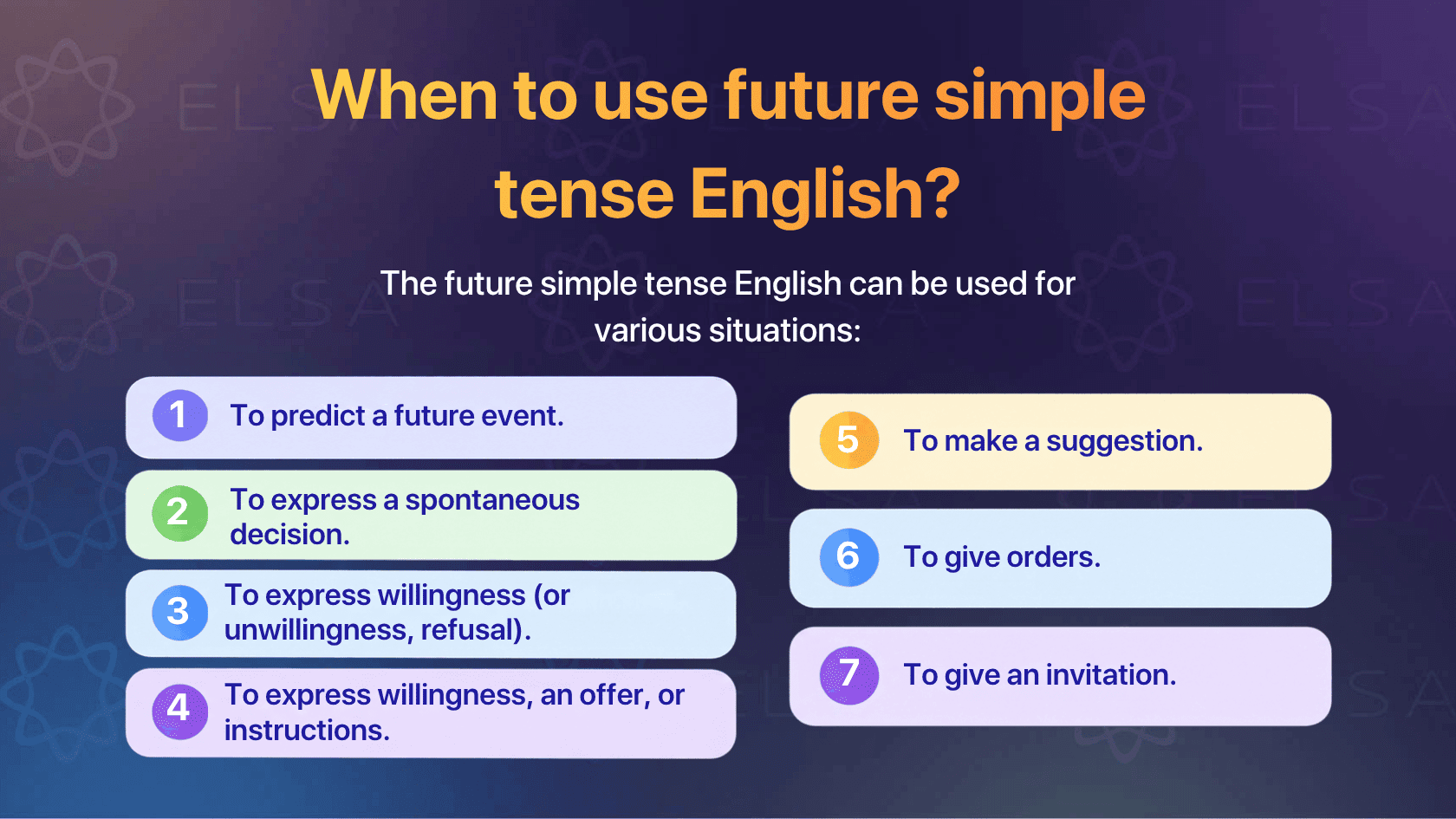
The future simple tense English can be used for various situations:
- To predict a future event. Use “will” when you want to predict something in the future based on your opinion, belief, or expectation rather than concrete evidence.
- For example: I think the opponent team will win the game.
- To express a spontaneous decision. By using “will” with “I’ or “we”, you can make a decision in the moment of speaking rather than planning it beforehand.
- For example: Someone’s at the door. I’ll get it.
- To express willingness (or unwillingness, refusal in negative form).
- For example: I’ll help you with the project.
- To express willingness, an offer, or instructions. In modern English, the modal verb “shall” is less common than “will”. However, it is still used with “I” to make an offer or ask what to do.
- For example: Shall I clean up your table, sir?
- To make a suggestion. Use “Shall we...?” to make a suggestion or ask whether someone would like to do something.
- For example: Shall we dance?
- To give orders. With the subject “you”, it can be used to give strong instructions or orders. However, this structure can sound firm or authoritative, so it’s best to use in situations where the speaker has the authority or wants to emphasize the situation.
- For example: You will clean up your room before 5 p.m.
- To give an invitation. By beginning a question with “Will you..?”, you can invite someone to do something.
- For example: Will you marry me?
Simple future tense formula
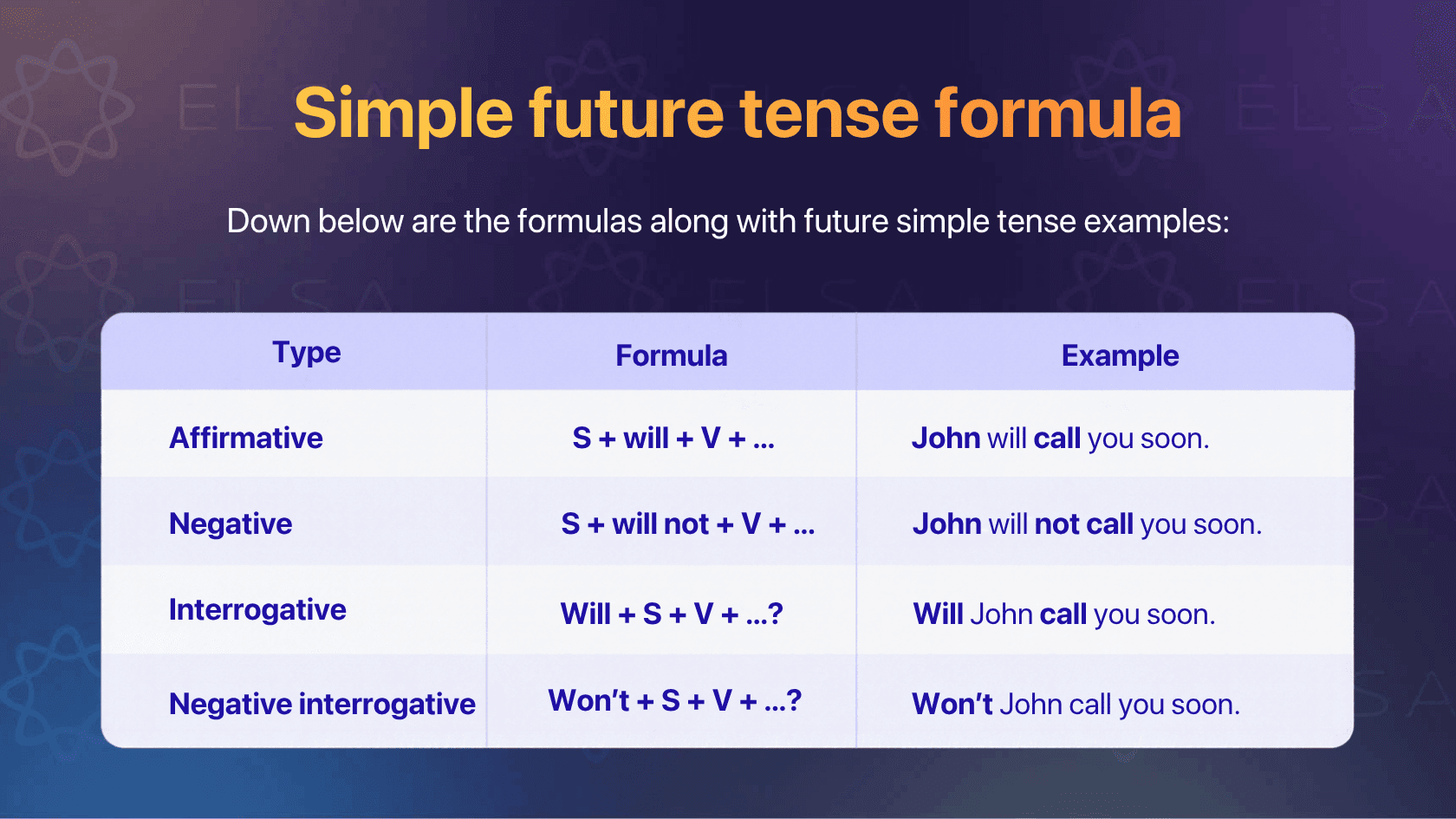
Down below are the formulas along with future simple tense examples:
| Formula | Example | |
| Affirmative | S + will + V + … | John will call you soon. |
| Negative | S + will not + V + … | John will not call you soon. |
| Interrogative | Will + S + V + ...? | Will John call you soon? |
| Negative interrogative | Won’t + S + V + …? | Won’t John call you soon? |
Future simple tense signal words
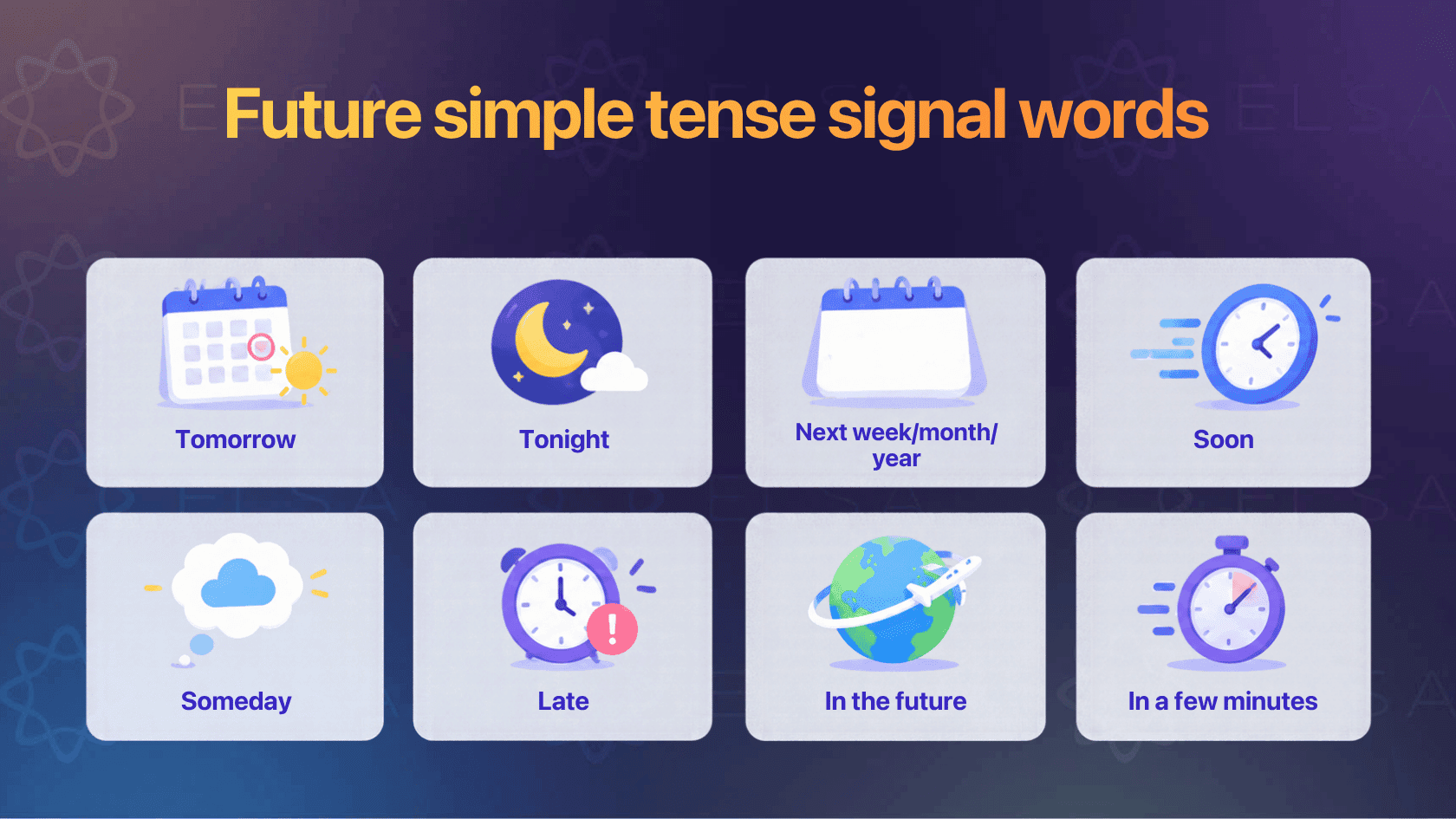
Aside from the formulas, here are some of the signal words for the future simple tense:
| Formula | Example |
| Tomorrow | It’ll snow tomorrow. |
| Tonight | I’ll come to your house tonight. |
| Next week/month/year | She’ll start her new job next month. |
| Soon | My brother will be home soon. |
| Someday | I’ll visit Canada someday. |
| Later | I’ll send you the report later. |
| In the future | People will use AI tools much more in the future. |
| In a few minutes | I’ll be there in a few minutes. |
Comparison between simple future tense with other tenses
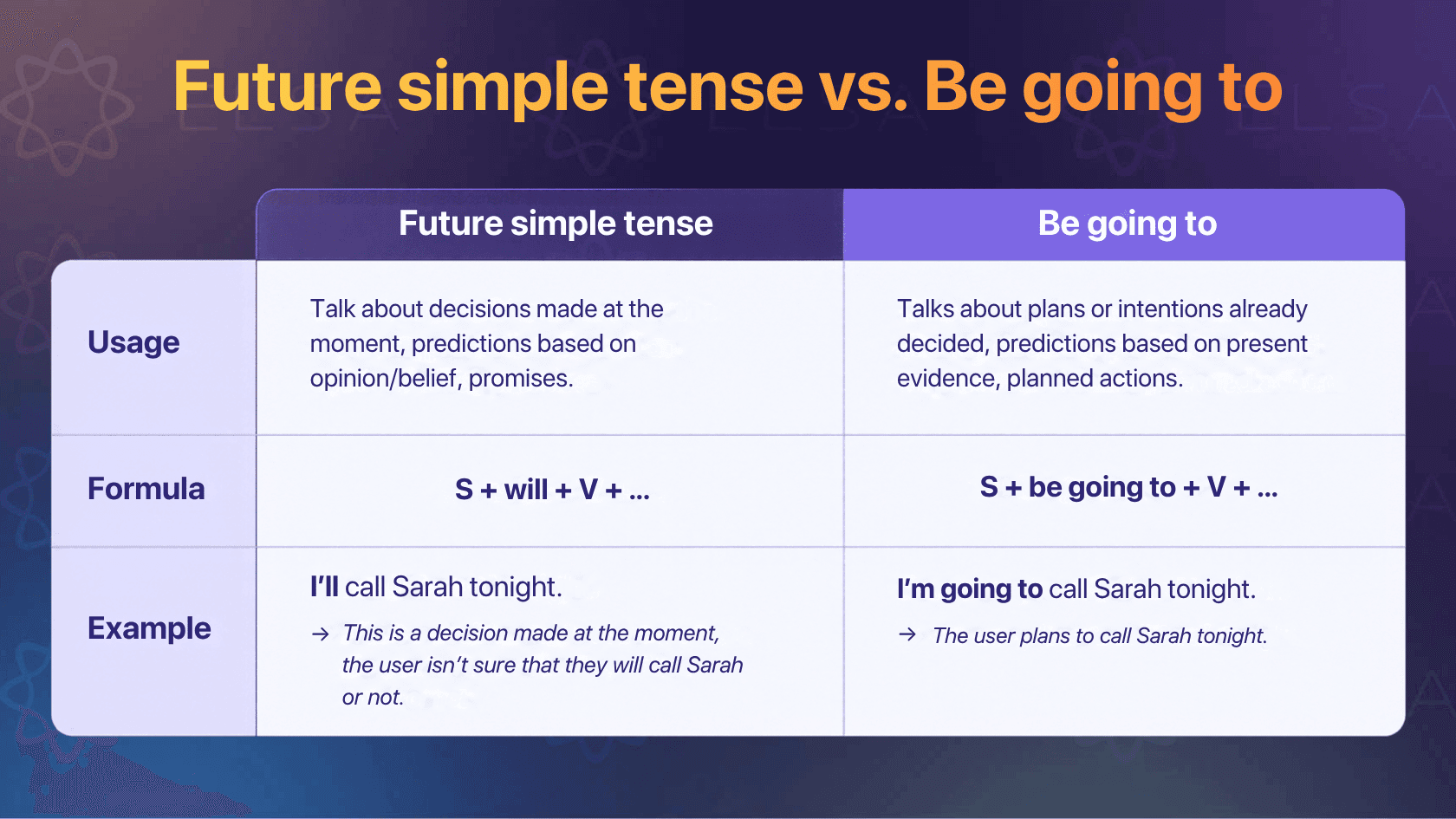
Future simple tense English vs. Be going to
| Future simple tense | Be going to | |
| Usage | Talk about decisions made at the moment, predictions based on opinion/belief, promises | Talks about plans or intentions already decided, predictions based on present evidence, planned actions |
| Formula | S + will + V + … | S + be going to + V + … |
| Example | I’ll call Sarah tonight. → This is a decision made at the moment, the user isn’t sure that they will call Sarah or not. | I’m going to call Sarah tonight. → The user plans to call Sarah tonight. |
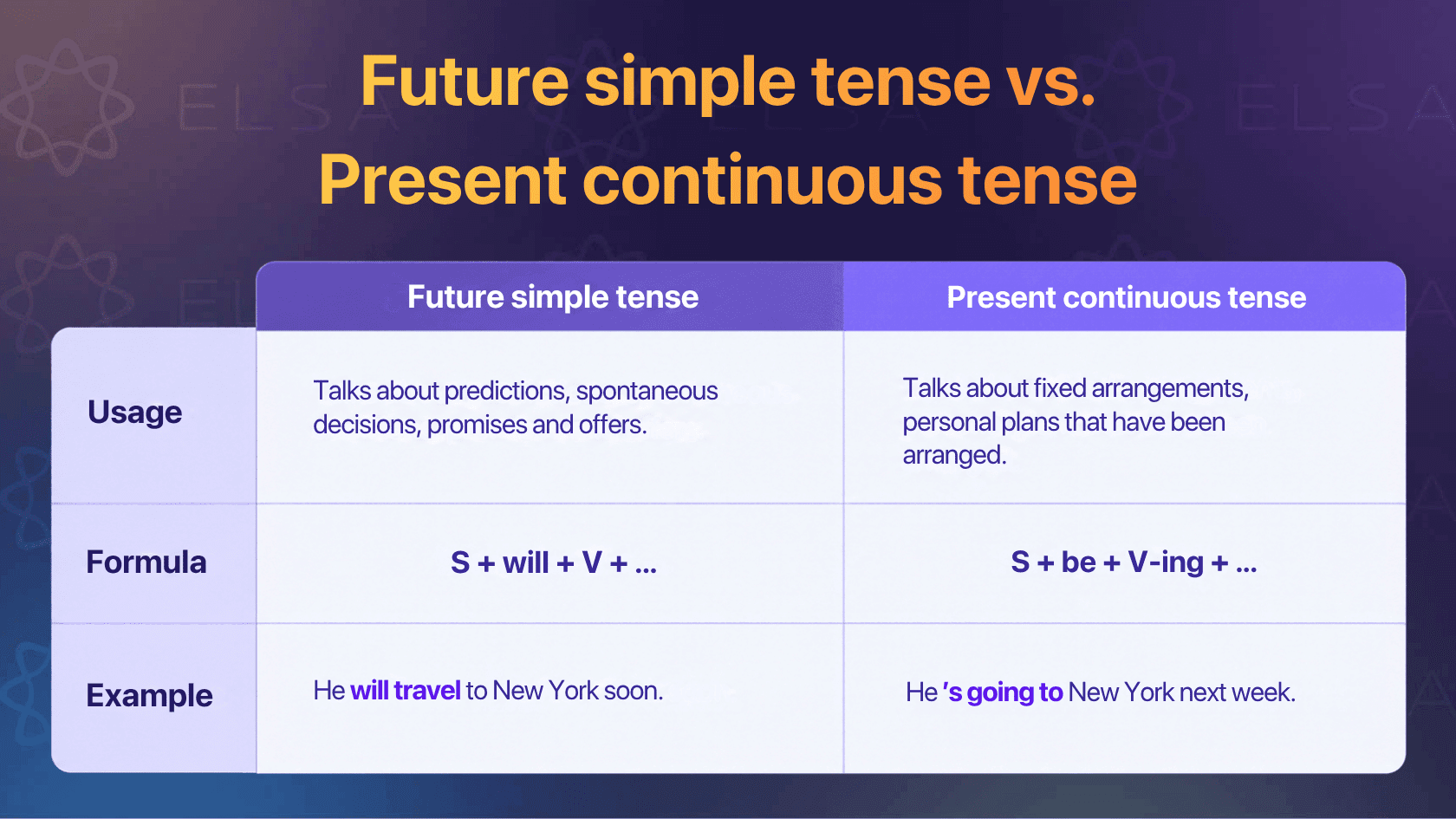
Simple future tense vs. Present continuous tense
| Future simple tense | Present continuous tense | |
| Usage | Talks about predictions, spontaneous decisions, promises and offers | Talks about fixed arrangements, personal plans that have been arranged |
| Formula | S + will + V + … | S + be + V-ing + … |
| Example | He will travel to New York soon. | He’s going to New York next week. |
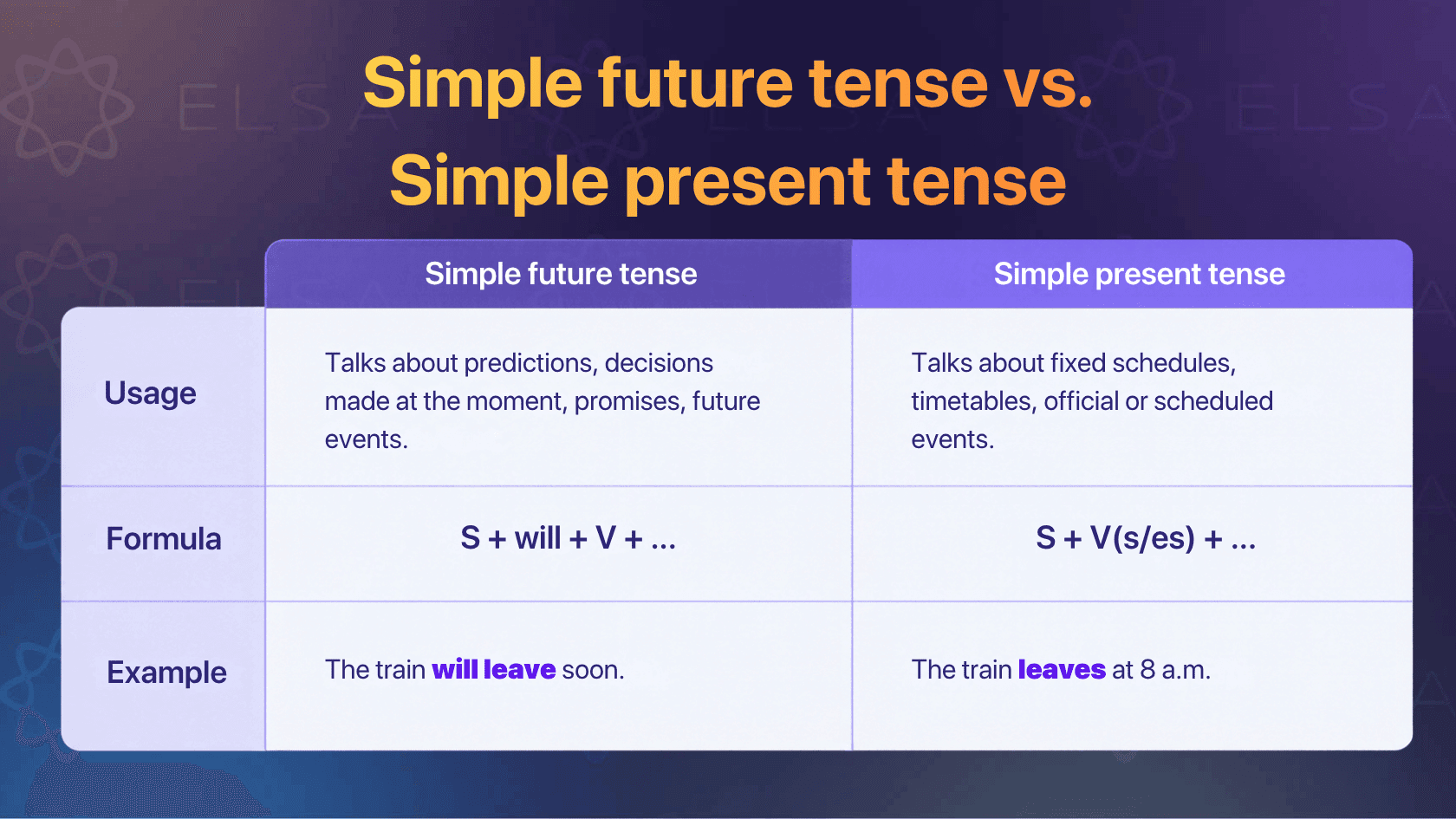
Future simple tense vs. Simple present tense
| Simple future tense | Simple present tense | |
| Usage | Talks about predictions, decisions made at the moment, promises, future events | Talks about fixed schedules, timetables, official or scheduled events |
| Formula | S + will + V + … | S + V(s/es) + … |
| Example | The train will leave soon. | The train leaves at 8 a.m. |
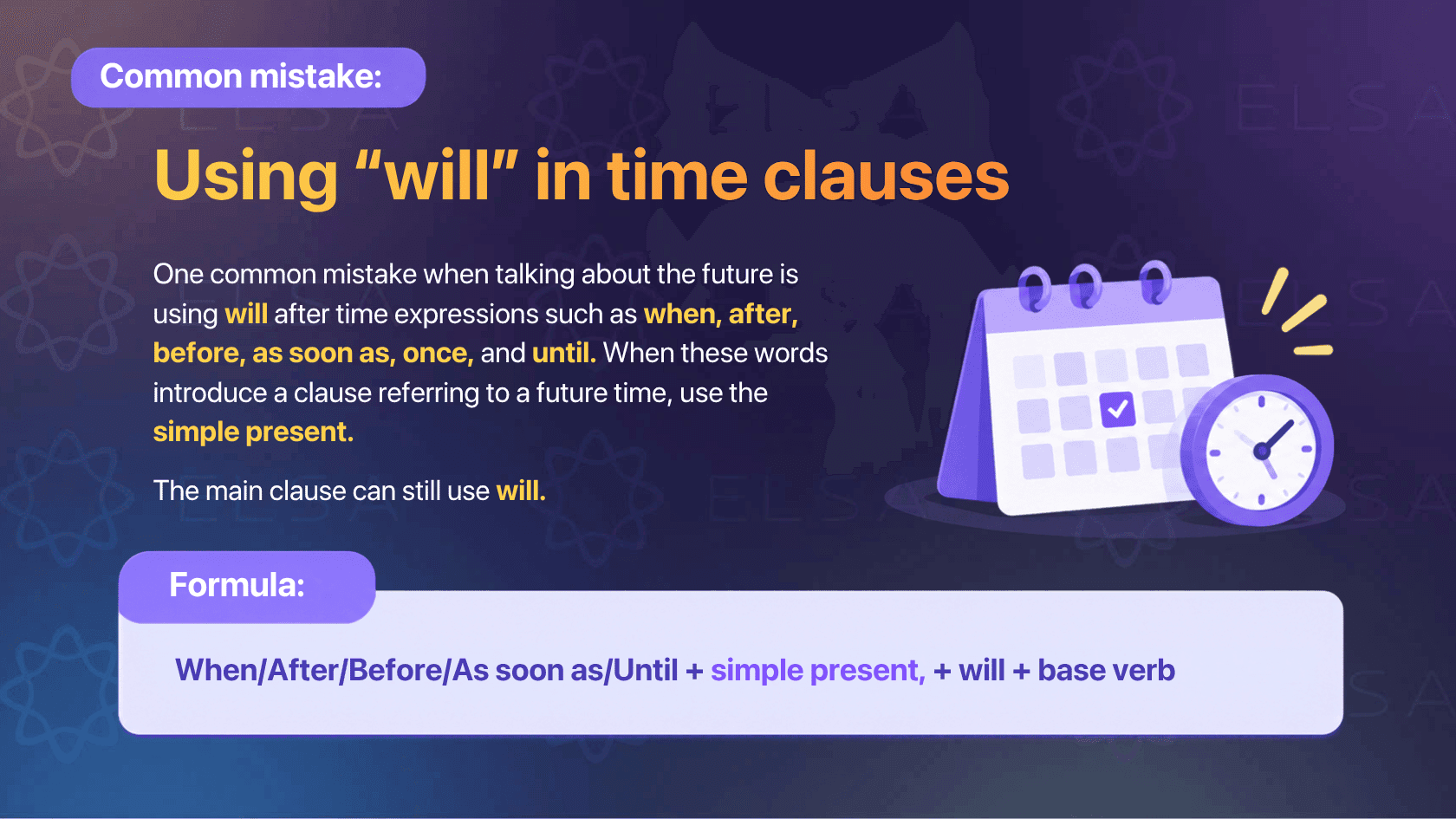
Common mistake: Using "will" in time clauses
One common mistake when talking about the future is using will after time expressions such as when, after, before, as soon as, once, and until. When these words introduce a clause referring to a future time, use the simple present in that time clause rather than will. The main clause can still use will.
Formula:
| When/After/Before/As soon as/Until + simple present, + will + base verb |
For example: When I get home, I’ll call you.
Not: When I will get home, I’ll call you.
Simple future tense exercises
Exercise 1: Complete each sentence with the correct form of will and the verb in parentheses.
- I think it ______ tomorrow. (rain)
- Don’t worry. I ______ you with your homework. (help)
- The phone is ringing. I ______ it. (answer)
- She ______ you the details later. (send)
- I’m sure they ______ the competition. (win)
- We ______ you at the airport tomorrow. (meet)
- I promise I ______ anyone your secret. (tell)
- He ______ be late for the meeting. (not / be)
Exercise 2: Choose will, be going to, or present continuous to complete each sentence.
1. A: “Someone’s at the door.”
B: “I ______ get it.”
a. will
b. am going to
c. am getting
2. We ______ our grandparents this Sunday. We’ve already booked the tickets.
a. will visit
b. are going to visit
c. are visiting
3. Look at those clouds! It ______ rain.
a. will
b. is going to
c. is raining
4. I’ve decided to learn Spanish next year. I ______ take an online course.
a. will
b. am going to
c. am taking
5. A: “I’m really tired.”
B: “Okay. I ______ make you some tea.”
a. will
b. am going to
c. am making
6. We ______ the client at 10 a.m. tomorrow. The meeting is already scheduled.
a. will meet
b. are going to meet
c. are meeting
7. I think electric cars ______ become even more common in the future.
a. will
b. are going to
c. are becoming
8. She has already decided to move to Chicago next year. She ______ look for an apartment soon.
a. will
b. is going to
c. is looking
Exercise 3: Each sentence contains one mistake related to the future tense. Rewrite it correctly.
- When I will finish work, I’ll call you.
- She will goes to the conference next week.
- I am going to call him when I will arrive home.
- Look at those clouds! It will rain soon.
- Shall you help me with this report?
- We will meeting the client tomorrow afternoon.
- I think she is win the competition.
- They won’t to arrive before noon.
The simple future tense is one of the most useful ways to talk about the future in English. The more you practice these differences in real conversations, the easier it becomes to choose the natural form without translating word for word from your first language. For more practical lessons, visit the Grammar category on the ELSA Speak Blog for expert tips, clear explanations, and useful English learning resources.