

Present Continuous Tense: Rules, uses, formulas, and exercises
elsaspeakadmin
September 22, 2026
English tenses
The present continuous tense, also known as the present progressive tense, is one of the most used tenses in English grammar. In this guide, you'll learn the present continuous tense rules, formulas, uses, spelling patterns, common mistakes, and exercises so you can use it confidently in everyday English.
What is present continuous tense?
Present continuous tense definition
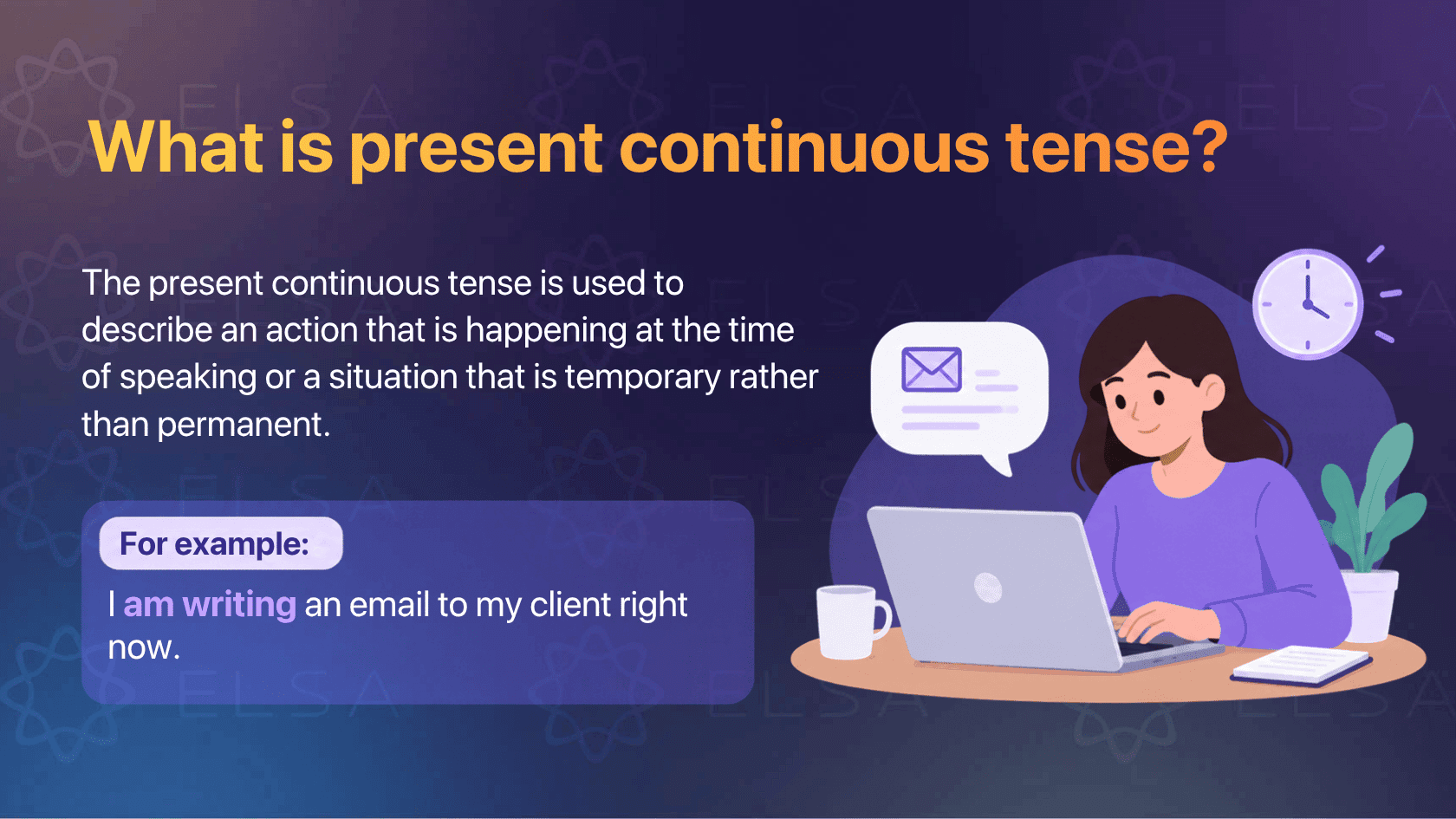
The present continuous tense is used to describe an action that is happening at the time of speaking or a situation that is temporary rather than permanent.
For example:
- I am writing an email to my client right now.
- Look! The children are playing in the garden.
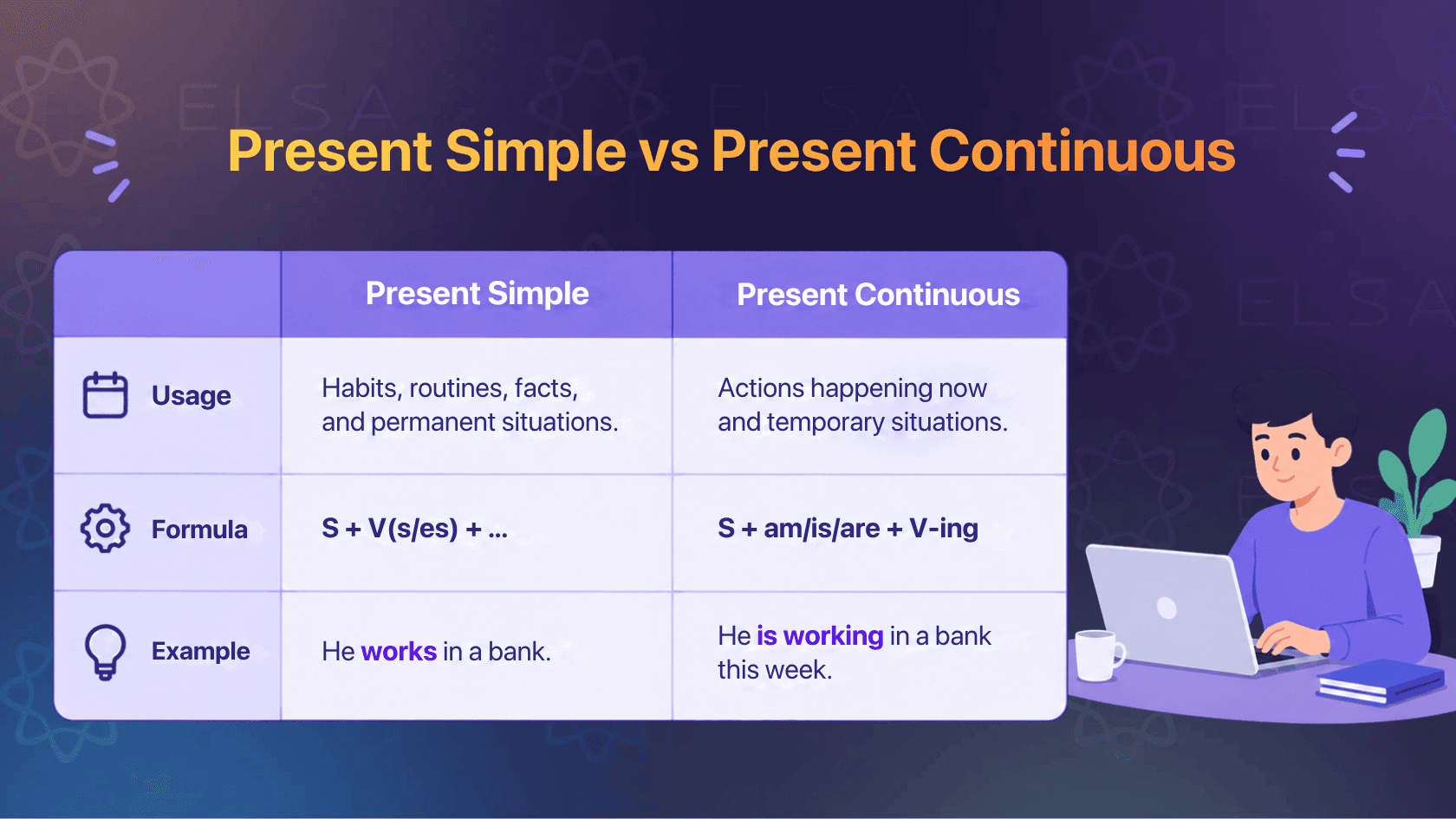
Present Continuous vs Present Simple
| Present simple tense | Present continuous tense | |
| Usage | Habits, routines, facts, and permanent situations | Actions happening now and temporary situations |
| Formula | S + V(s/es) + … | S + am/is/are + V-ing |
| Example | He works in a bank. | He is working in a bank this week. |
How to use present continuous tense?
When to use the present continuous tense
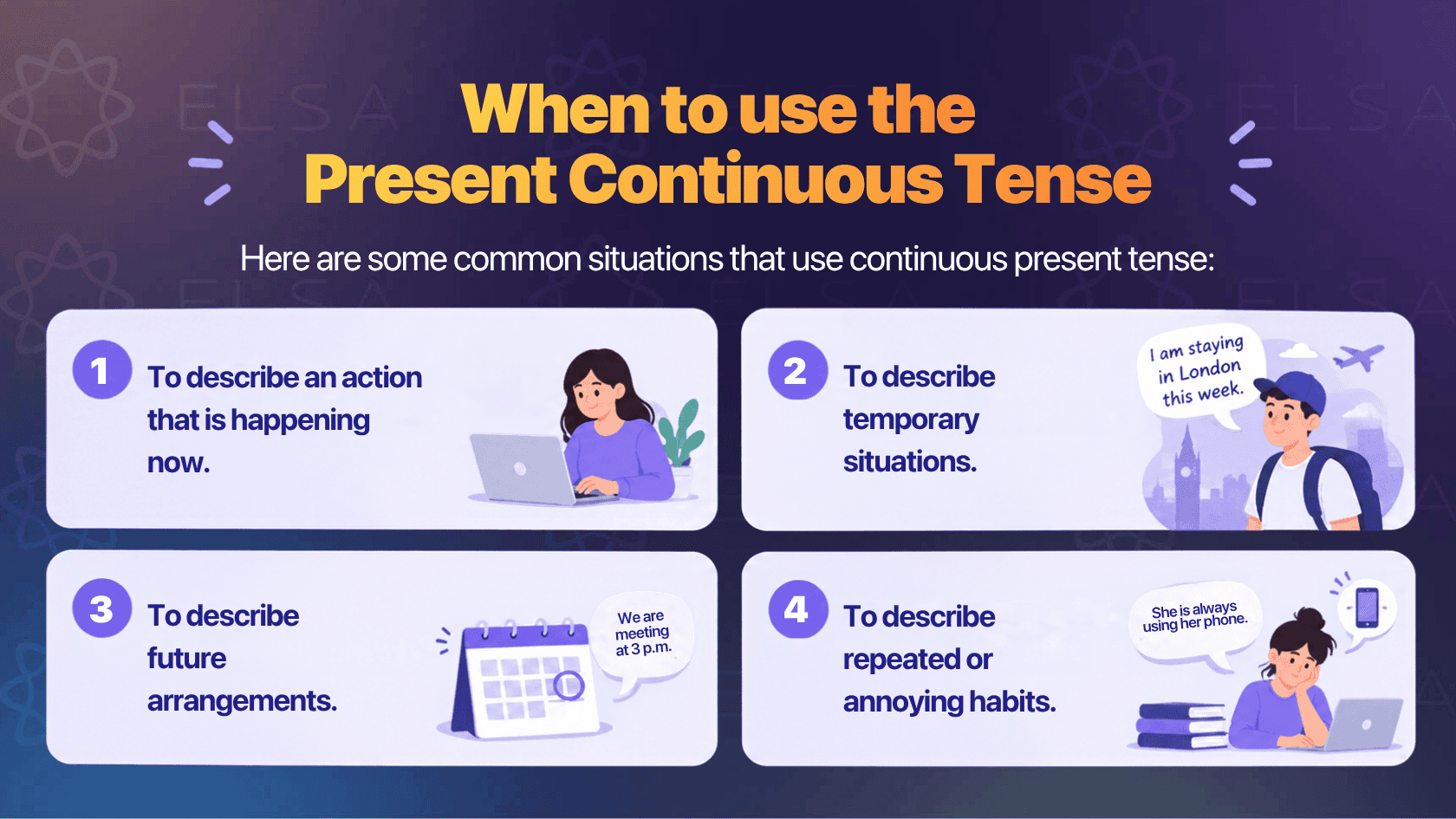
Here are some common situations that use the present continuous tense:
- To describe an action that is happening now. Words such as now, right now, and at the moment often appear with this use.
- For example: He is studying now.
- To describe temporary situations.
- For example: I’m staying in a hotel until I find a new house.
- To describe future arrangements.
- For example: We’re going to New York next month.
- To describe repeated or annoying habits.
- For example: You’re tapping on the desk again.
When not to use the present continuous tense
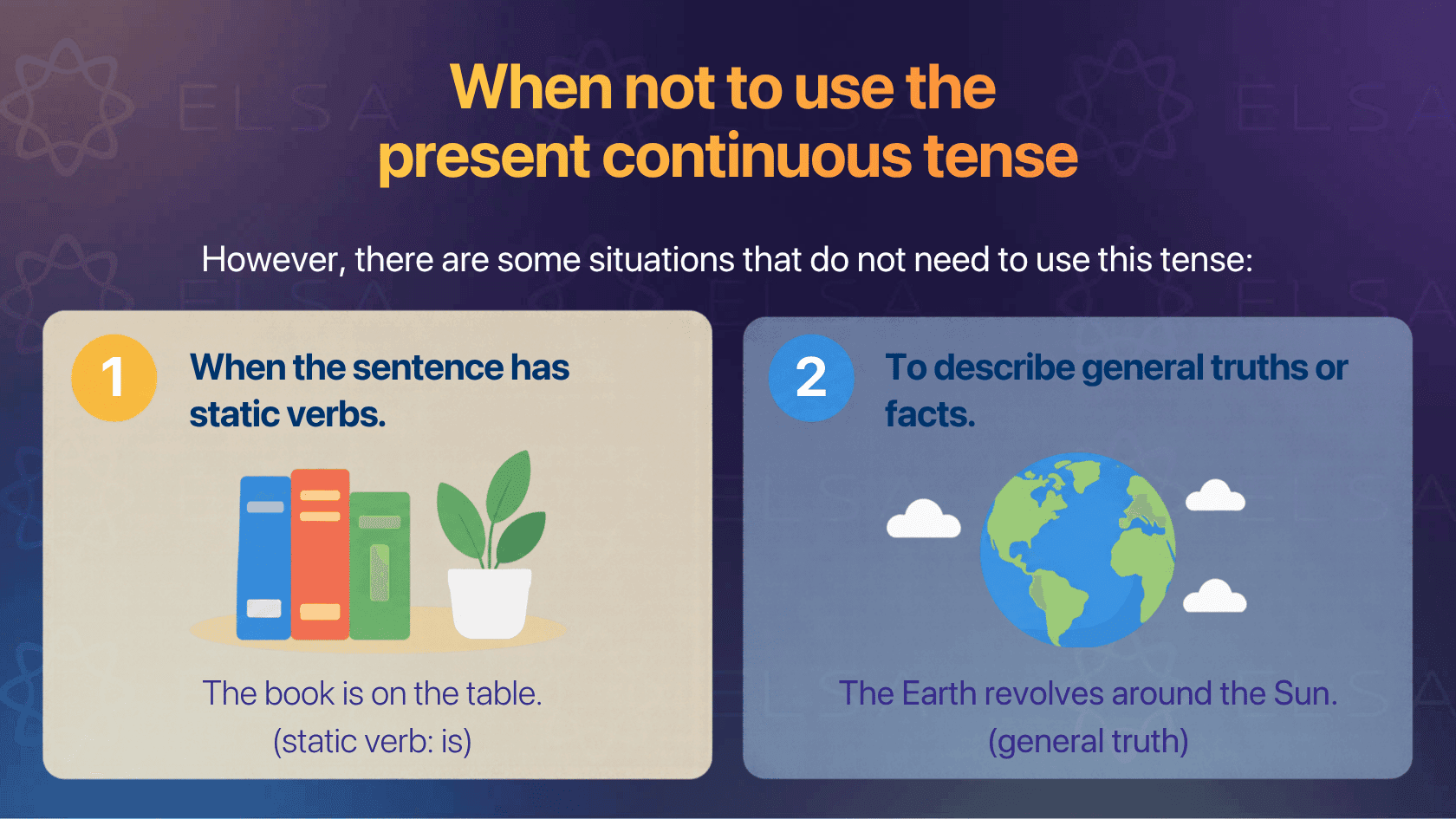
However, there are some situations that do not need to use this tense:
- When the sentence has stative verbs. Common stative verbs include: love, like, hate, know, believe, understand, want, need, belong, remember.
- For example: He wants a new phone.
- To describe general truths or facts. For this, use the present simple tense.
- For example: Water boils at 100°C.
Present continuous tense formula
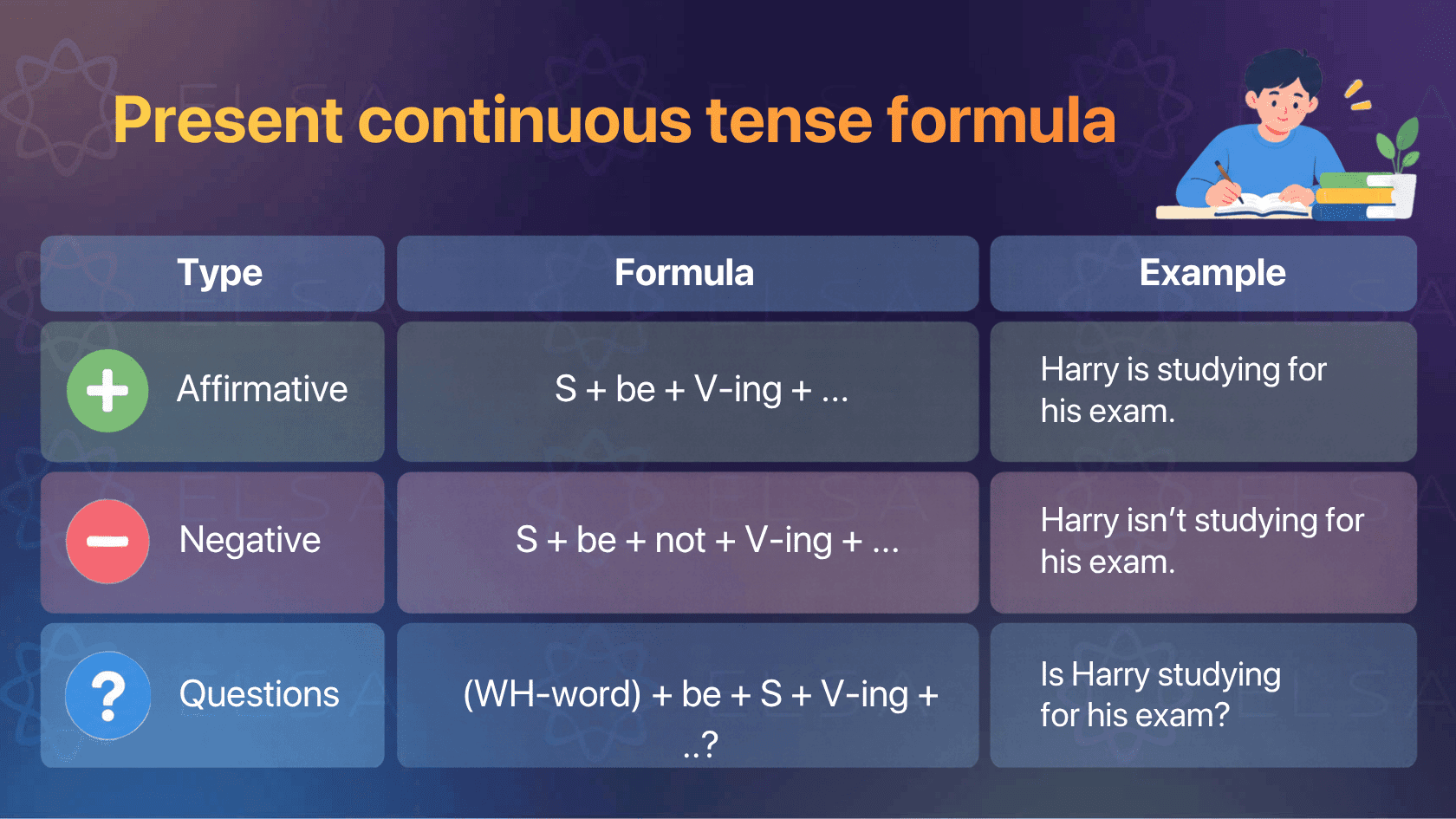
| Formula | Example | |
| Affirmative | S + be + V-ing + … | Harry is studying for his exam. |
| Negative | S + be + not + V-ing + … | Harry isn’t studying for his exam. |
| Questions | (WH-word) + be + S + V-ing + ..? | Is Harry studying for his exam? |
Spelling rules for adding "-ing"
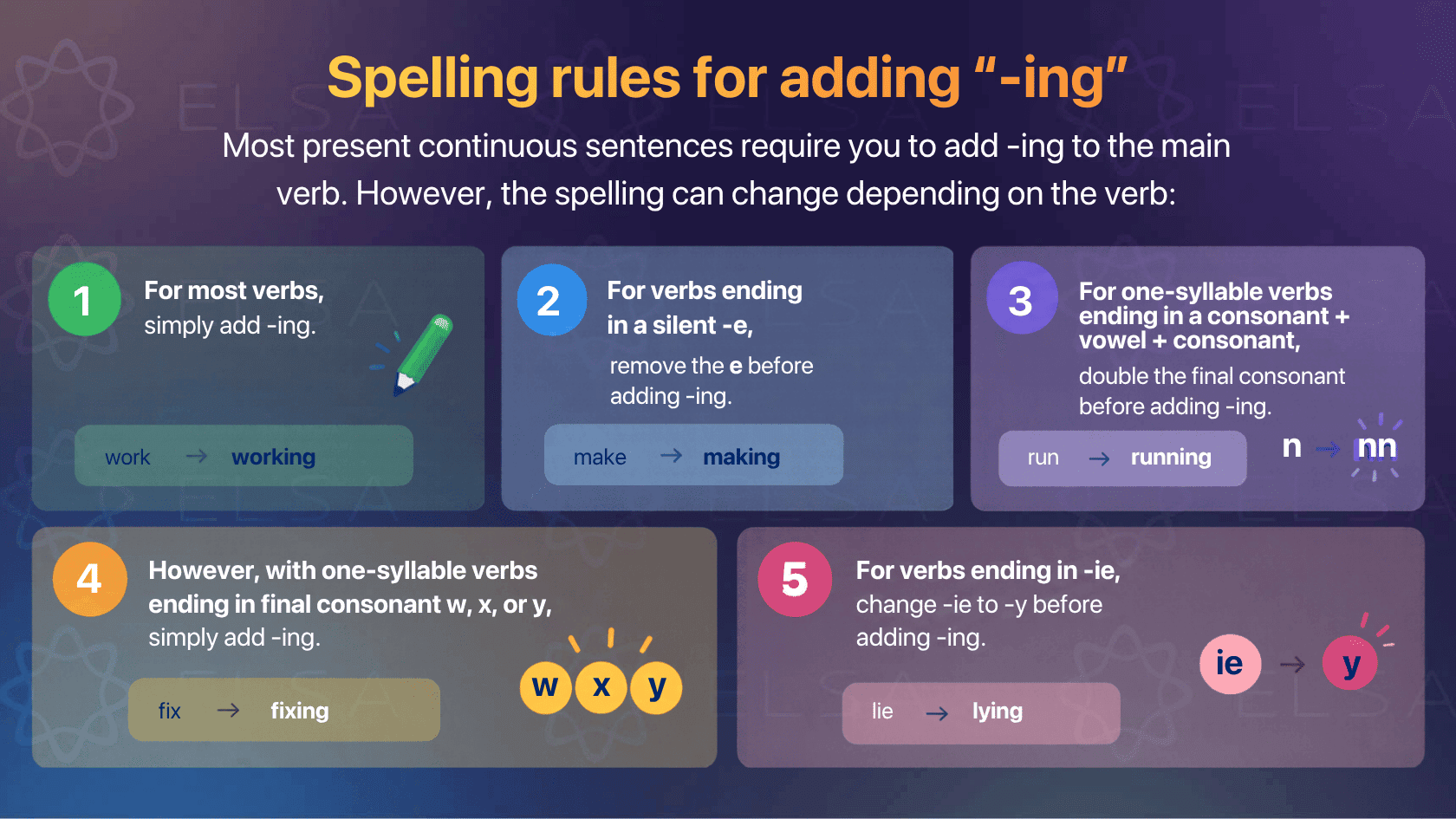
Most present continuous sentences require you to add -ing to the main verb. However, the spelling can change depending on the verb:
- For most verbs, simply add -ing.
- For example: watch → watching
- For verbs ending in a silent -e, remove the e before adding -ing.
- For example: write → writing
- For one-syllable verbs ending in a consonant + vowel + consonant, double the final consonant before adding -ing.
- For example: swim → swimming
- However, with one-syllable verbs ending in final consonant w, x, or y, simply add -ing.
- For example: fix → fixing
- For verbs ending in -ie, change -ie to -y before adding -ing.
- For example: lie → lying
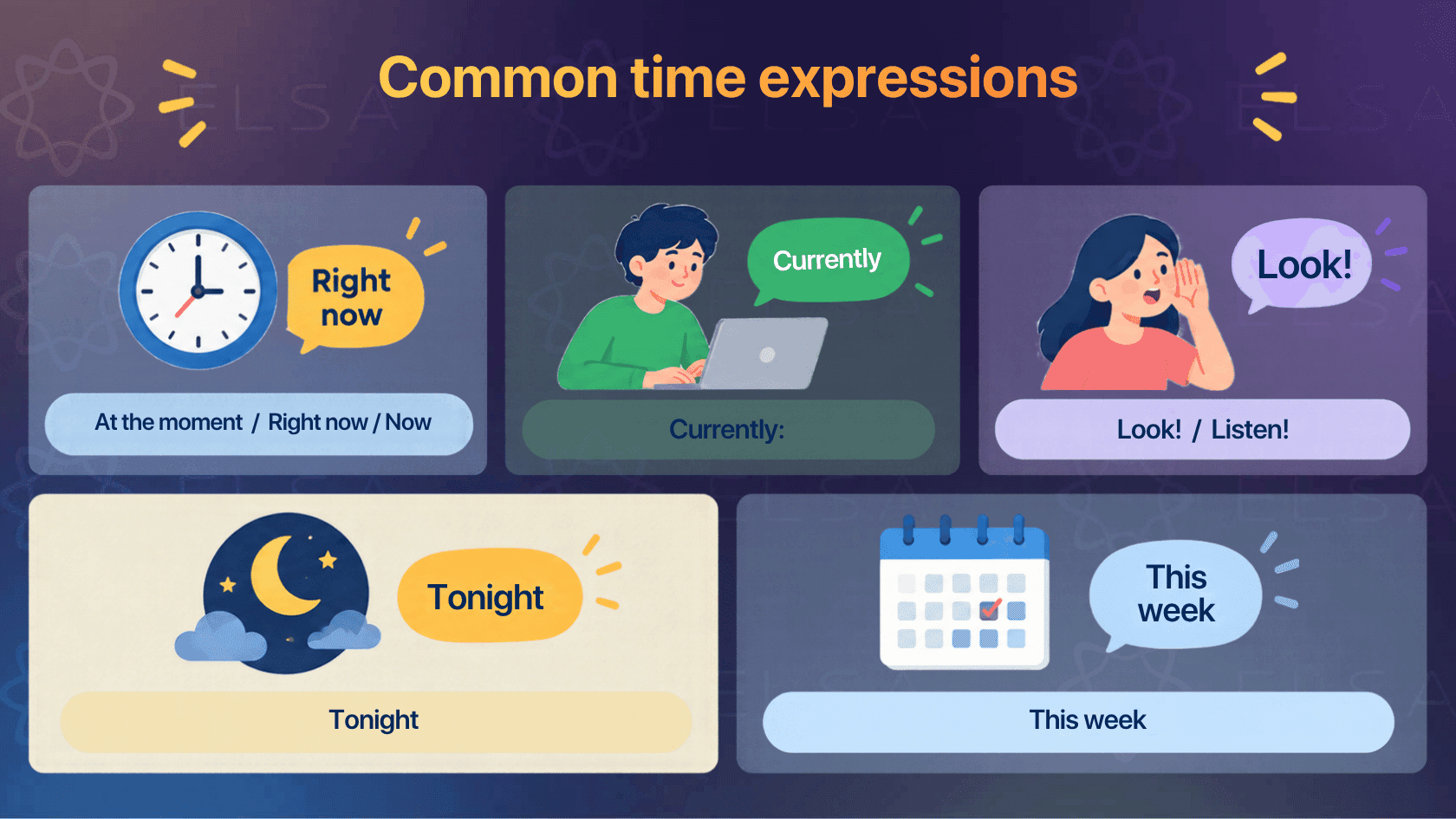
Common time expressions
Certain time expressions commonly appear with the present continuous tense. They help show that an action is happening now, around the present time, or as part of a future arrangement.
| Time expressions | Usage | Examples |
| Now | Refers to something happening at or around the current moment. | He is eating now. |
| At the moment | She’s sleeping at the moment. | |
| Right now | They’re going to the store right now. | |
| Currently | Describes something happening around the current period. | She’s currently cooking dinner. |
| Look! | To draw attention to something happening right now. | Look! The train is leaving! |
| Listen! | Listen! Someone is playing the violin. | |
| Tonight | To talk about future arrangements or temporary situations. | We’re eating out tonight. |
| This week | They’re heading to their uncle’s cabin this week. | |
| This month | She’s going on a vacation this month. |
Present Continuous Tense Exercises
Exercise 1: Fill in the blanks with the correct present continuous form of the verb in parentheses.
- Sarah ________ (study) for her exam right now.
- We ________ (wait) for the train at the moment.
- I ________ (not/watch) TV tonight.
- ________ you ________ (work) from home today?
- They ________ (have) dinner with their clients tomorrow.
- Look! The children ________ (run) across the field.
- He ________ (not/listen) to the teacher.
- Why ________ she ________ (cry)?
Exercise 2: Choose present simple or present continuous.
- I usually (drink / am drinking) coffee in the morning.
- She (works / is working) from home this week.
- Look! It (rains / is raining) outside.
- He (knows / is knowing) the answer.
- We (meet / are meeting) our manager at 3 PM tomorrow.
- My brother (plays / is playing) basketball every Saturday.
- They (stay / are staying) at a hotel while their apartment is being renovated.
- Water (boils / is boiling) at 100°C.
Understanding present continuous tense rules becomes easier when you focus on its main uses: actions happening now, temporary situations, and planned future arrangements. Remember the core formula and practice regularly to use this tense more naturally. For more English tips and practical lessons, visit the Grammar category on the ELSA Speak Blog.