


Passive voice in English: Rules, uses, formulas and exercises
elsaspeakadmin
September 21, 2026
English tenses
The passive voice is an important grammar structure in English. In this guide, you’ll learn the passive voice definition, when to use it, how to form it, and how to change active sentences into passive ones, along with clear examples and practice exercises.
What is passive voice?
Passive voice definition
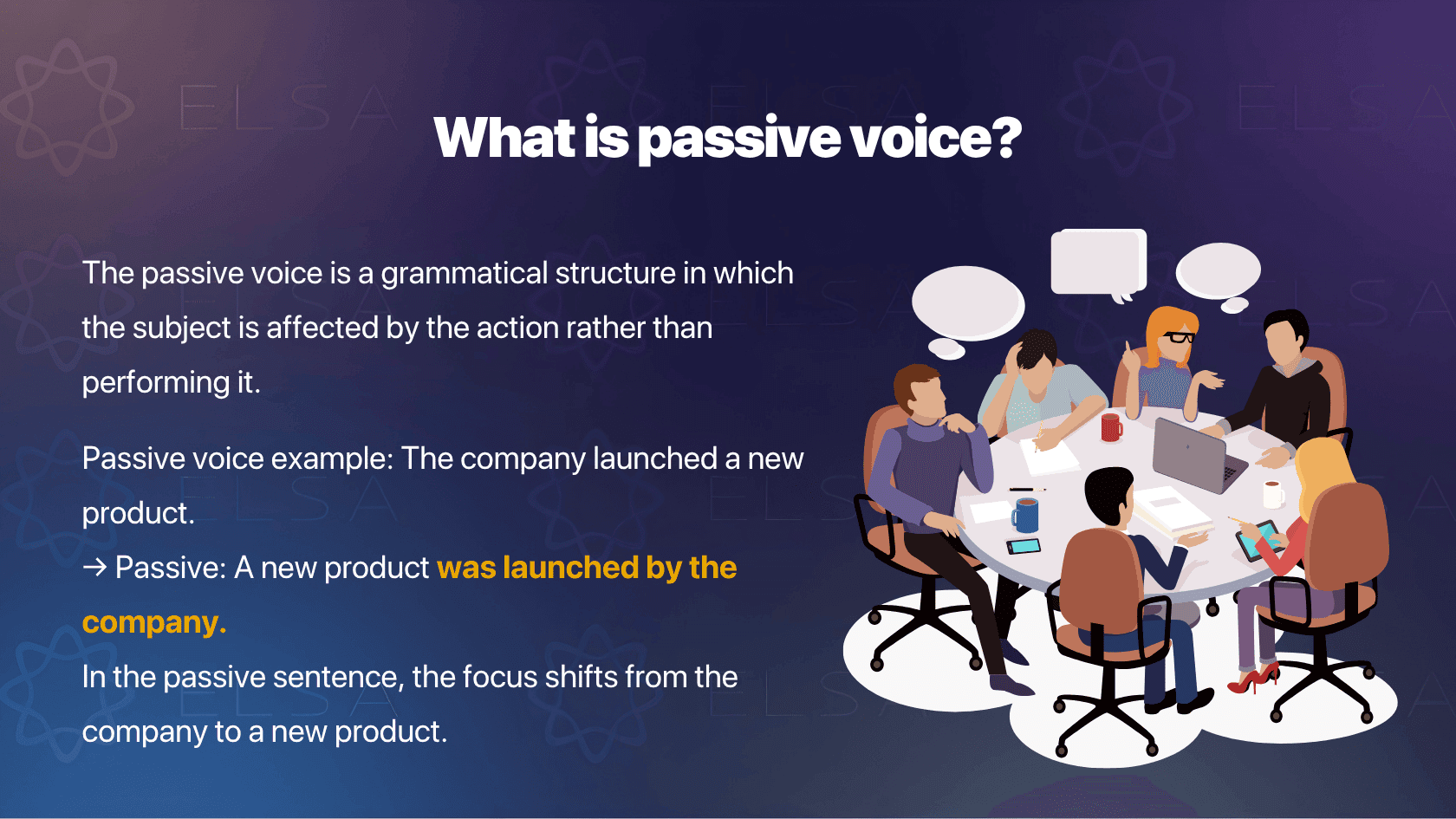
The passive voice is a grammatical structure in which the subject is affected by the action rather than performing it.
Passive voice example: The company launched a new product.
→ Passive: A new product was launched by the company.
In the passive sentence, the focus shifts from the company to a new product.
Active vs. Passive Voice
| Active voice | Passive voice | |
| Focus | The person or thing that performs the action | The person or thing affected by the action |
| Formula | Subject + Verb + Object | Subject + be + V3 + (by + agent) |
| Example | She sang the song. | The song was sung by her. |
How to use passive voice?
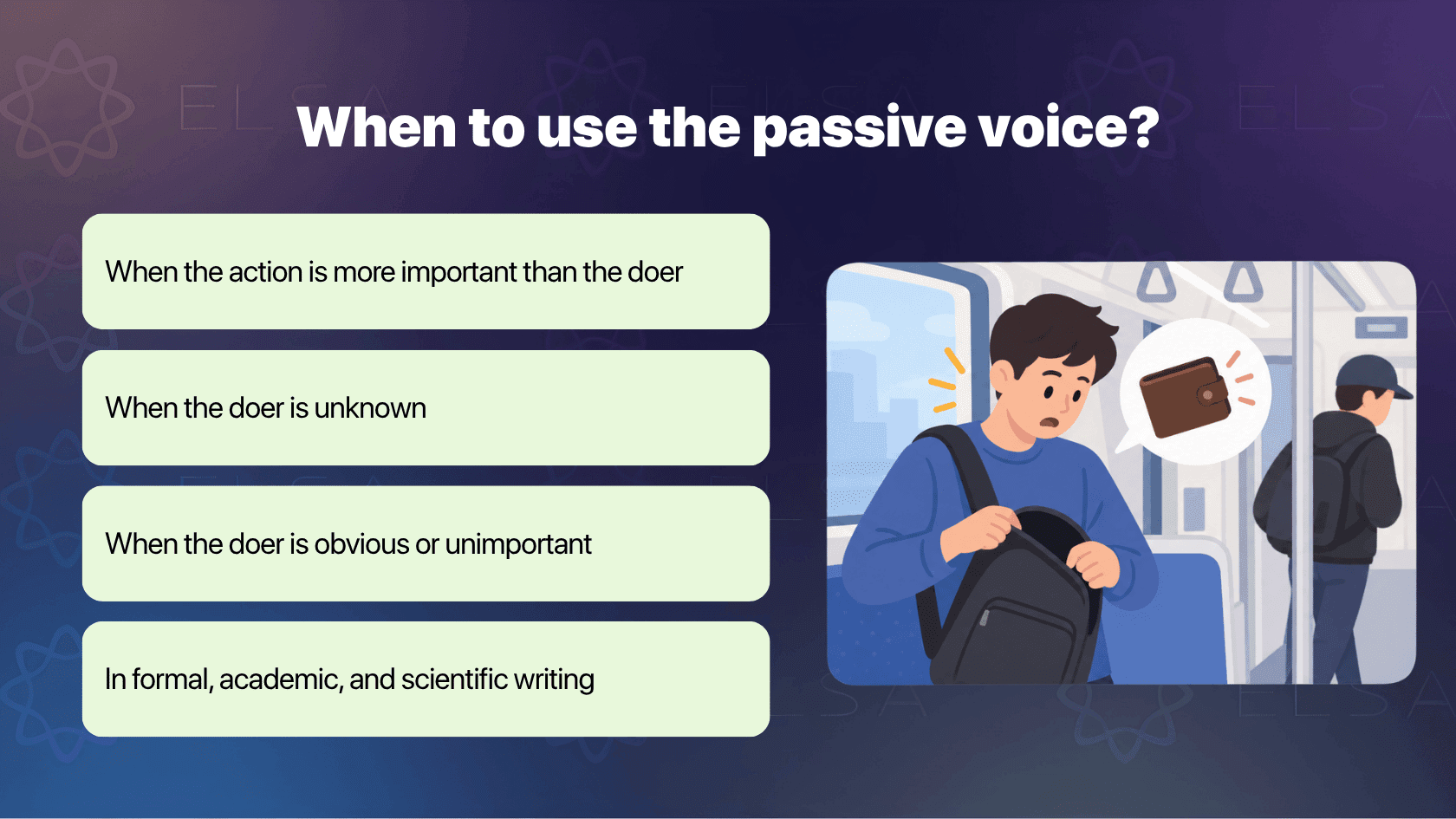
When to use the passive voice?
Here are some of the most common situations:
- When the action is more important than the doer: Use passive voice when you want readers to focus on the result or event rather than the person responsible.
- Example: The new policy was introduced last month.
- When the doer is unknown: Passive voice is useful when you do not know who performed the action or cannot identify them.
- Example: My wallet was stolen on the train.
- When the doer is obvious or unimportant: You can leave out the agent when the person responsible is already clear from the context or does not add useful information.
- Example: The students were asked to submit their assignments by Friday.
- In formal, academic, and scientific writing: Passive constructions can help maintain an objective tone when the process, method, or result is more important than the researcher or writer.
- Example: The samples were analyzed under controlled conditions.
When not to use the passive voice
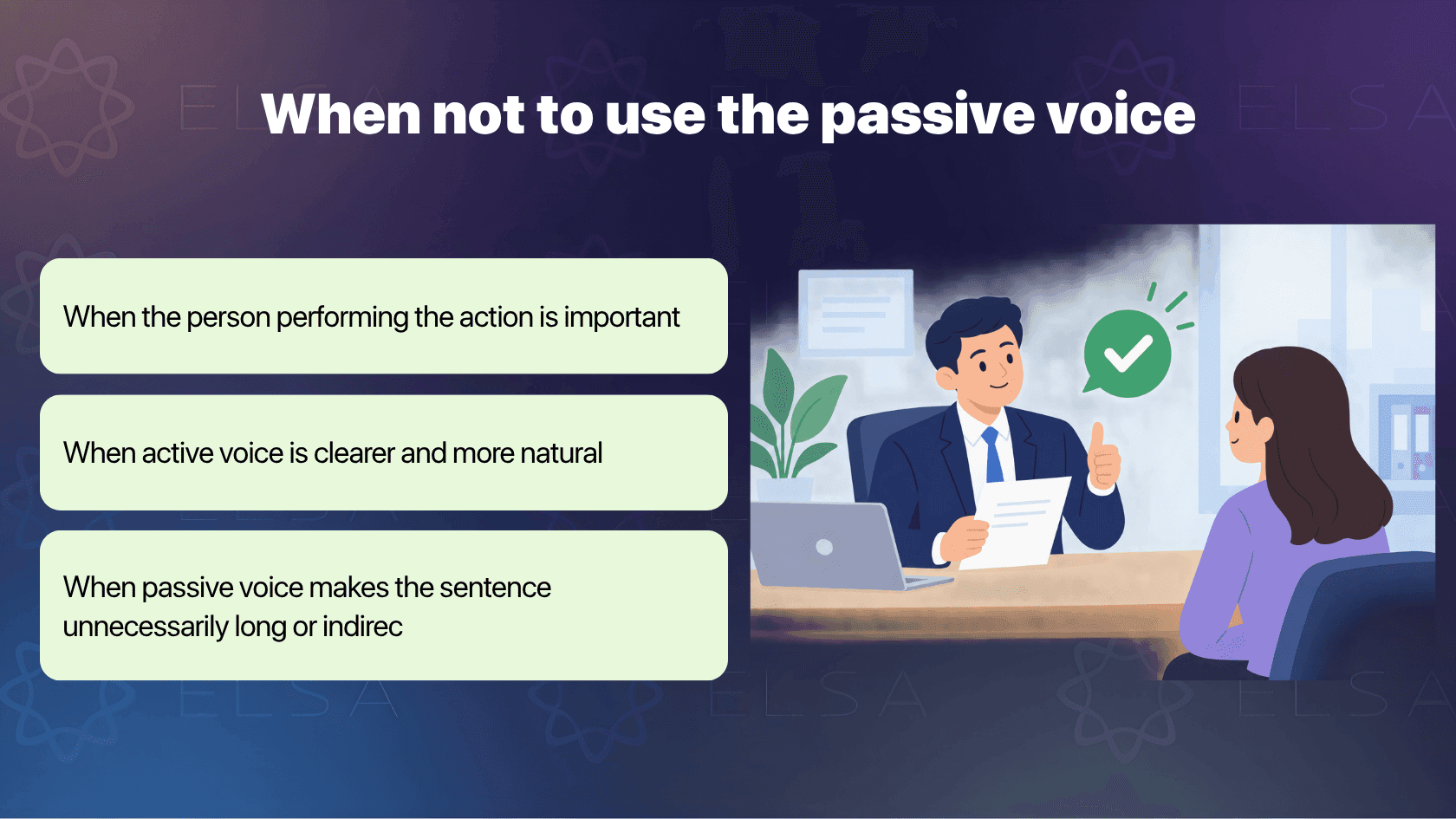
Although passive voice has many useful applications, active voice is often better when it makes the sentence clearer and more direct.
- When the person performing the action is important: Using active voice when identifying the doer helps the reader understand the message.
- Example: The research team developed a new testing method.
- When active voice is clearer and more natural: Everyday English generally favors active constructions because they are easier to follow.
- Example: The manager approved the request .
- When passive voice makes the sentence unnecessarily long or indirect: Too many passive constructions can make writing feel vague or difficult to read.
- Example: The manager reviewed the report, and the director approved it.
Passive voice formula
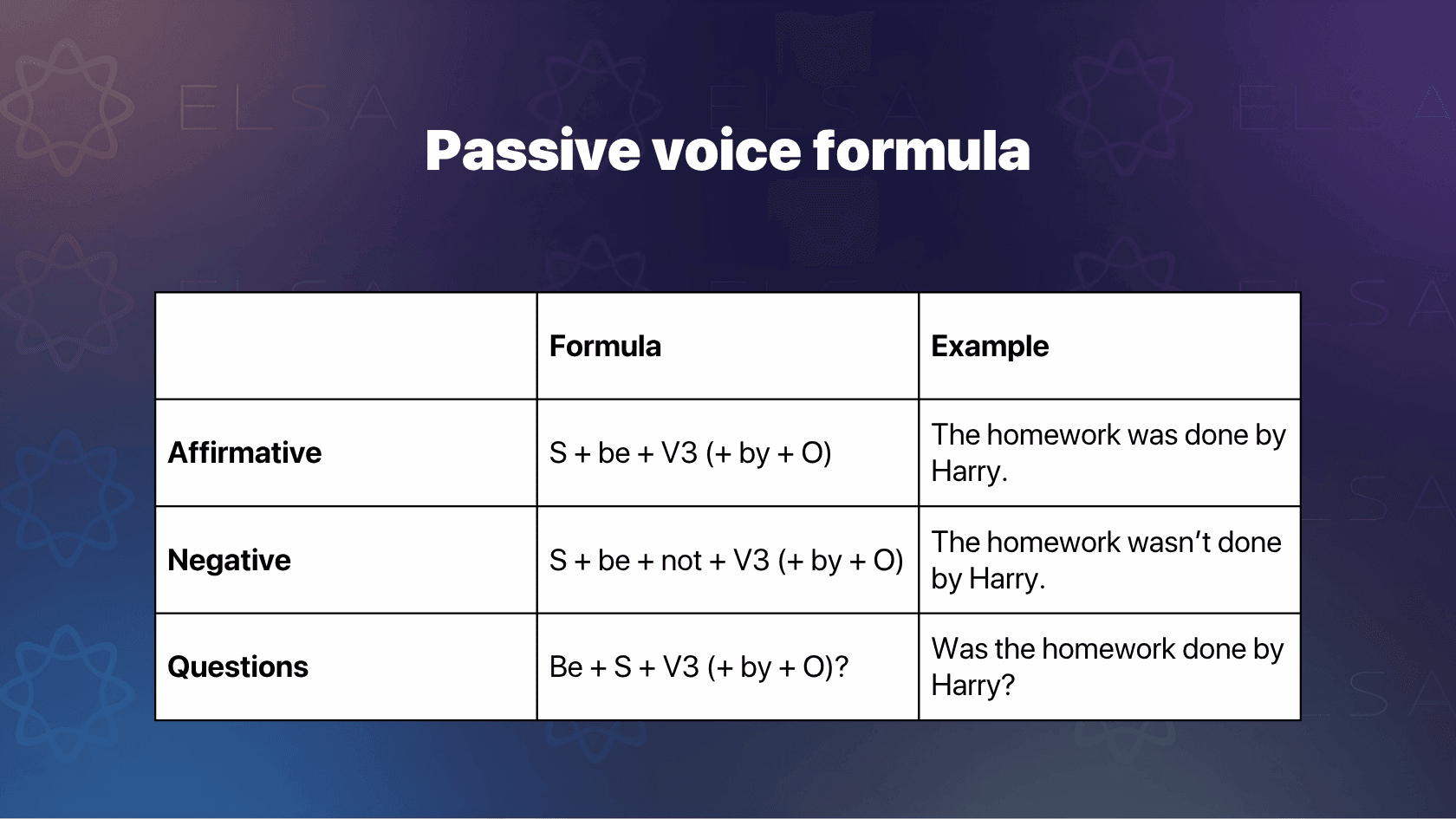
The basic structure of a passive sentence is a form of be + past participle (V3). The form of be changes according to the tense.
| Formula | Example | |
| Affirmative | S + be + V3 (+ by + O) | The homework was done by Harry. |
| Negative | S + be + not + V3 (+ by + O) | The homework wasn’t done by Harry. |
| Questions | Be + S + V3 (+ by + O)? | Was the homework done by Harry? |
Special passive voice structures and their uses
Below are some common special formulas along with passive voice example:
Passive voice with modal verbs
Formula:
| Subject + modal + be + V3 |
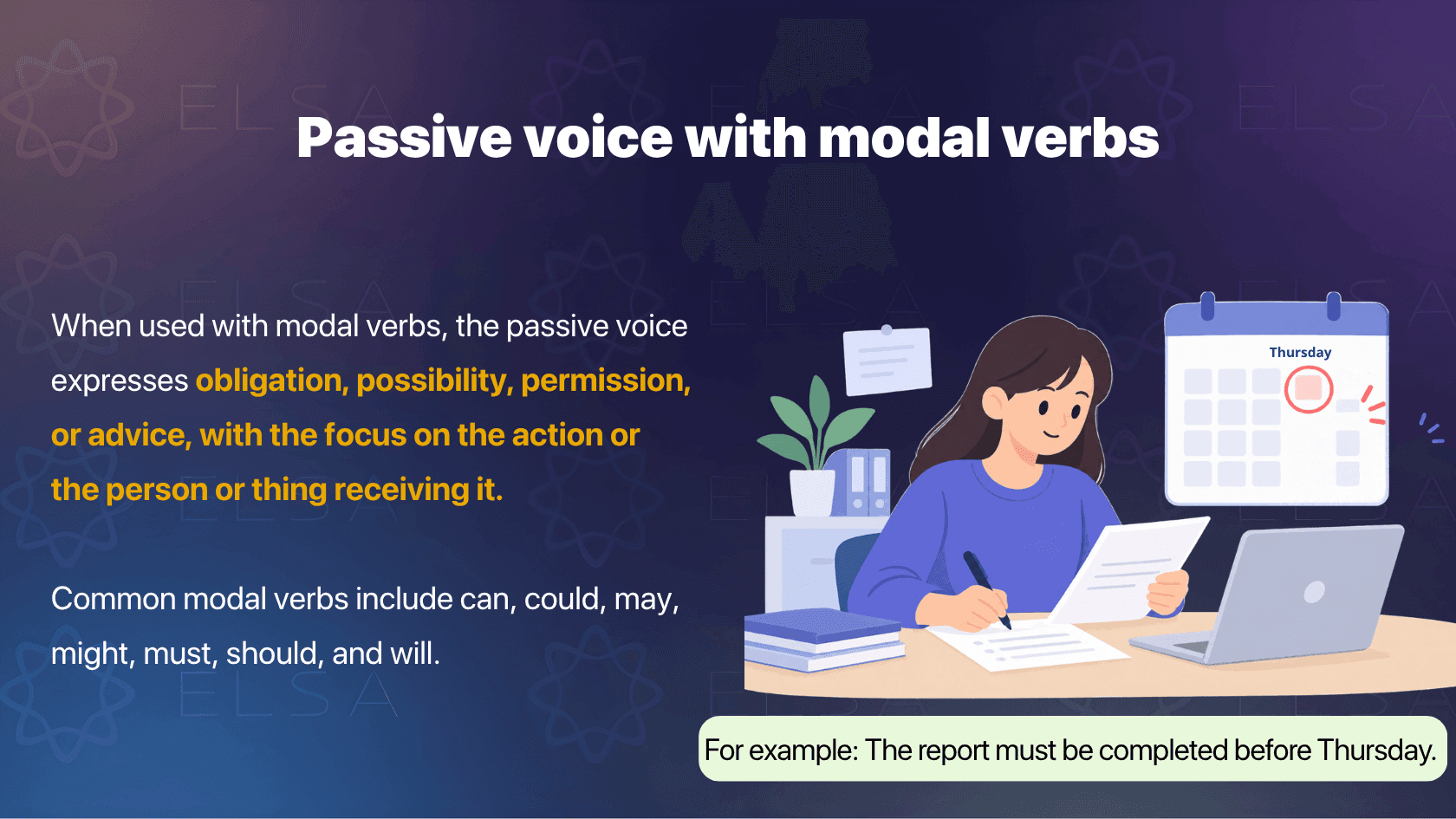
When used with modal verbs, the passive voice expresses obligation, possibility, permission, or advice, with the focus on the action or the person or thing receiving it.
Example:
You must complete the report before Thursday.
→ Passive: The report must be completed before Thursday.
Common modal verbs include can, could, may, might, must, should, and will.
Passive voice with two objects
Formula:
| S + be + V3 + indirect object S + be + V3 + to/for + direct object |
In English, some verbs can take two objects in the same sentence. When these sentences are changed into the passive voice, either object can sometimes become the subject, depending on what the speaker wants to emphasize.
These verbs include: give, send, offer, show, tell, and lend
Example: Mary gave her daughter a new phone.
There are two possible passive forms:
→ A new phone was given to Mary’s daughter. (emphasizes the new phone)
→ Mary’s daughter was given a new phone. (emphasizes Mary’s daughter)
Passive voice with reporting verbs
Formula:
| It + be + V3 + that-clause Subject + be + V3 + to-infinitive |
Commonly used with reporting verbs (such as say, believe, think, report, expect, and know), this structure is useful in formal, academic, and news writing because it presents information, beliefs, or claims in an objective way.
Example: The office is believed to move to a new location.
You can also use the impersonal structure:
→ It is believed that the office will move to a new location.
Get + passive
Formula:
| Subject + get + V3 |
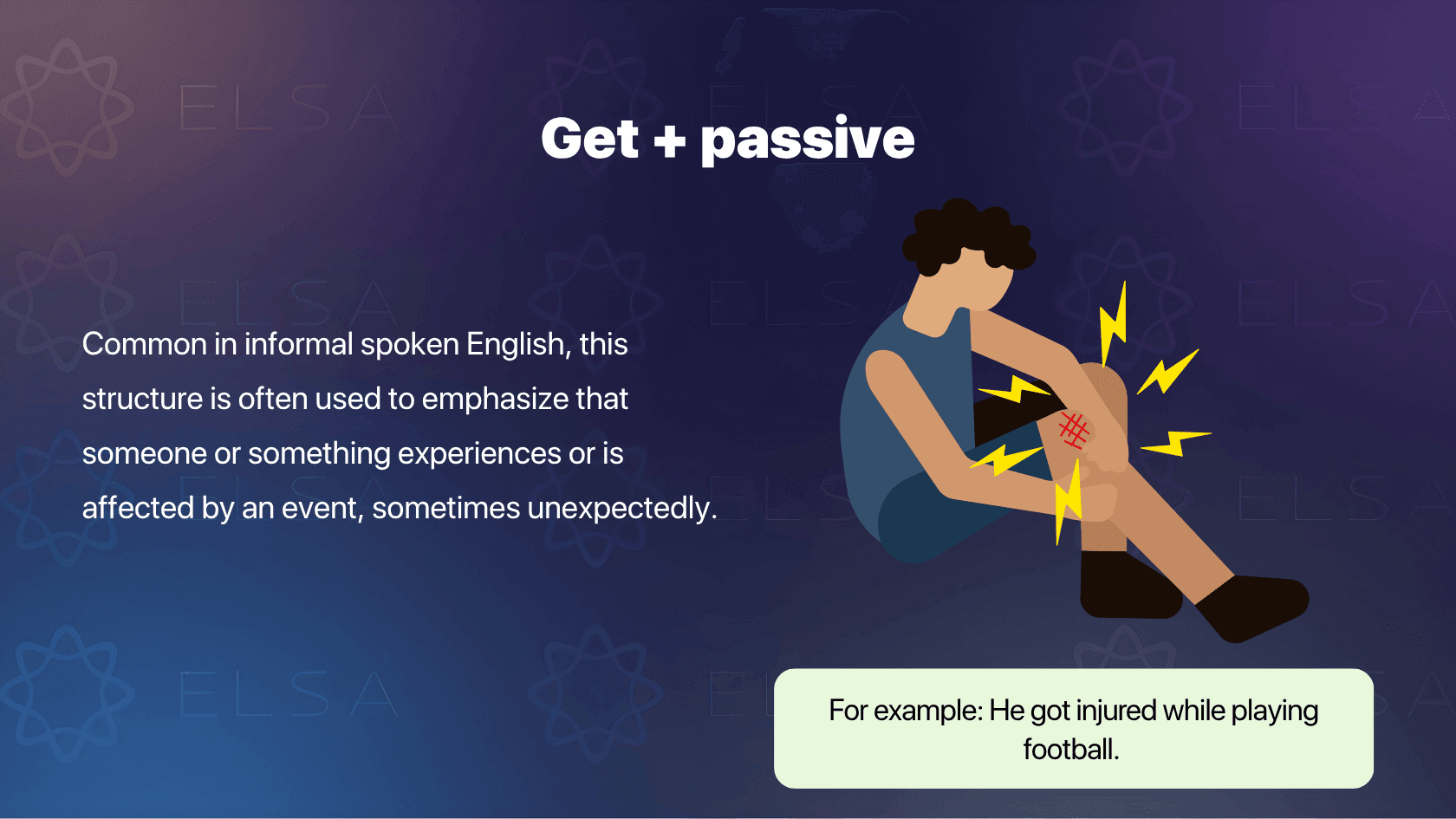
Common in informal spoken English, this structure is often used to emphasize that someone or something experiences or is affected by an event, sometimes unexpectedly.
Example: He got injured while playing football.
Passive voice with prepositional verbs
Formula:
| Subject + be + V3 + preposition |
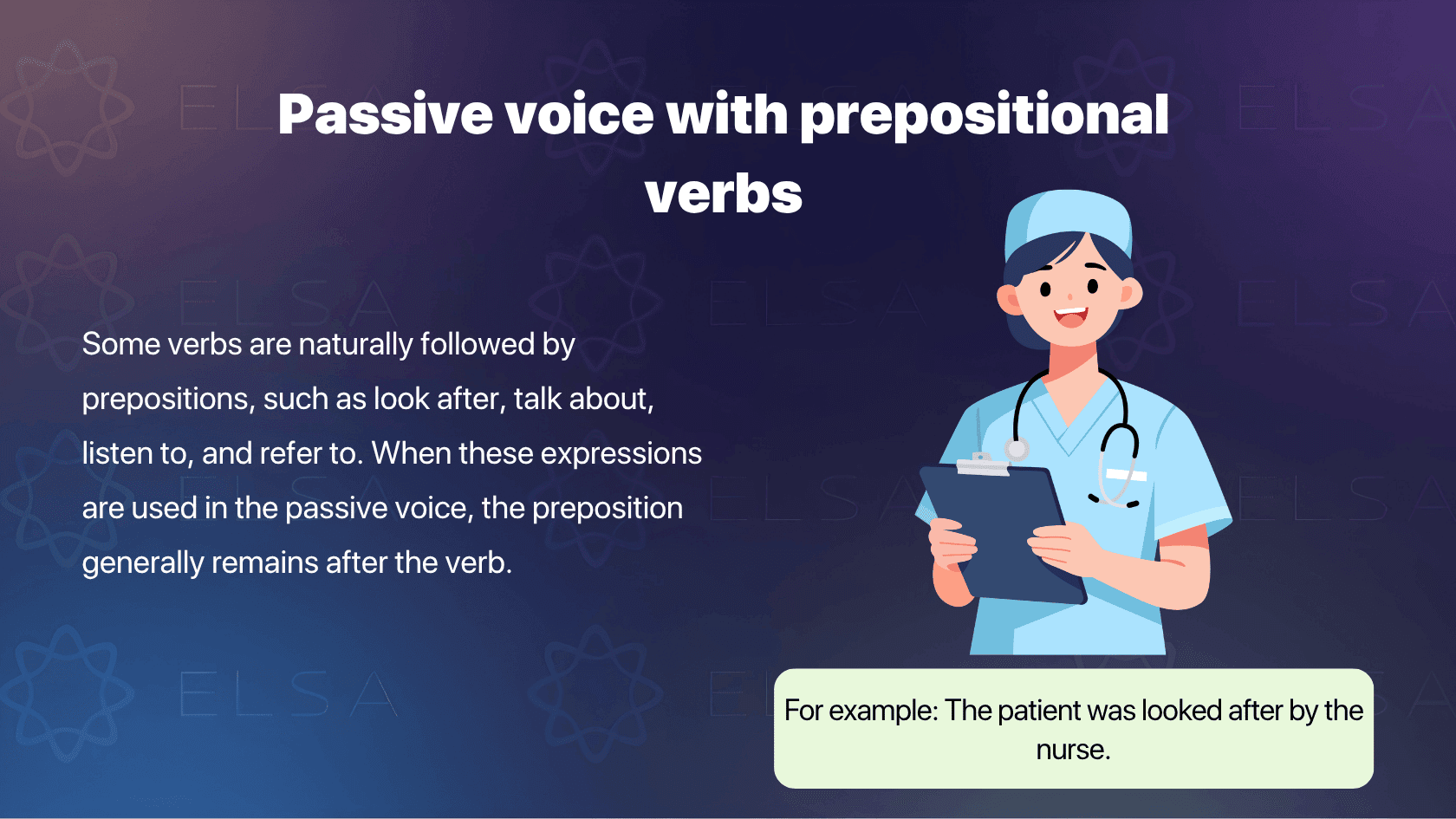
Some verbs are naturally followed by prepositions, such as look after, talk about, listen to, and refer to. When these expressions are used in the passive voice, the preposition generally remains after the verb.
Example: The nurse looked after the patient.
→ Passive: The patient was looked after by the nurse.
Passive voice with and without “by”
When to use “by + agent”
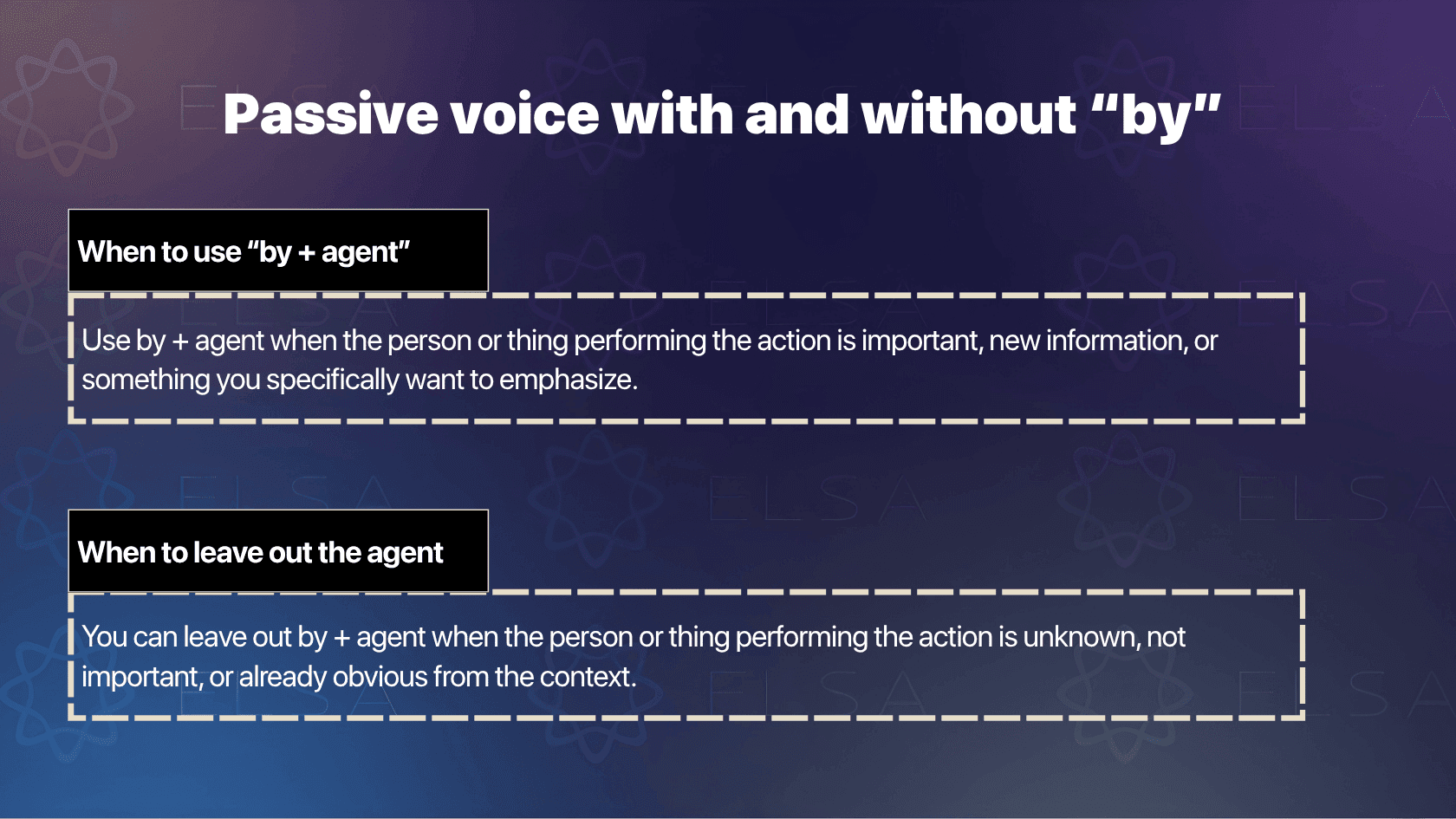
Use by + agent when the person or thing performing the action is important, new information, or something you specifically want to emphasize.
Example: This script was written by a famous British author.
→ Here, identifying the author provides useful information, so the agent is included.
When to leave out the agent
You can leave out by + agent when the person or thing performing the action is:
- Unknown: My wallet was stolen.
- Not important: The room was renovated last month.
- Already obvious from the context: The criminal was arrested.
By leaving out the agent, the sentence is shorter and more natural.
How to change active voice to passive voice
Formula:
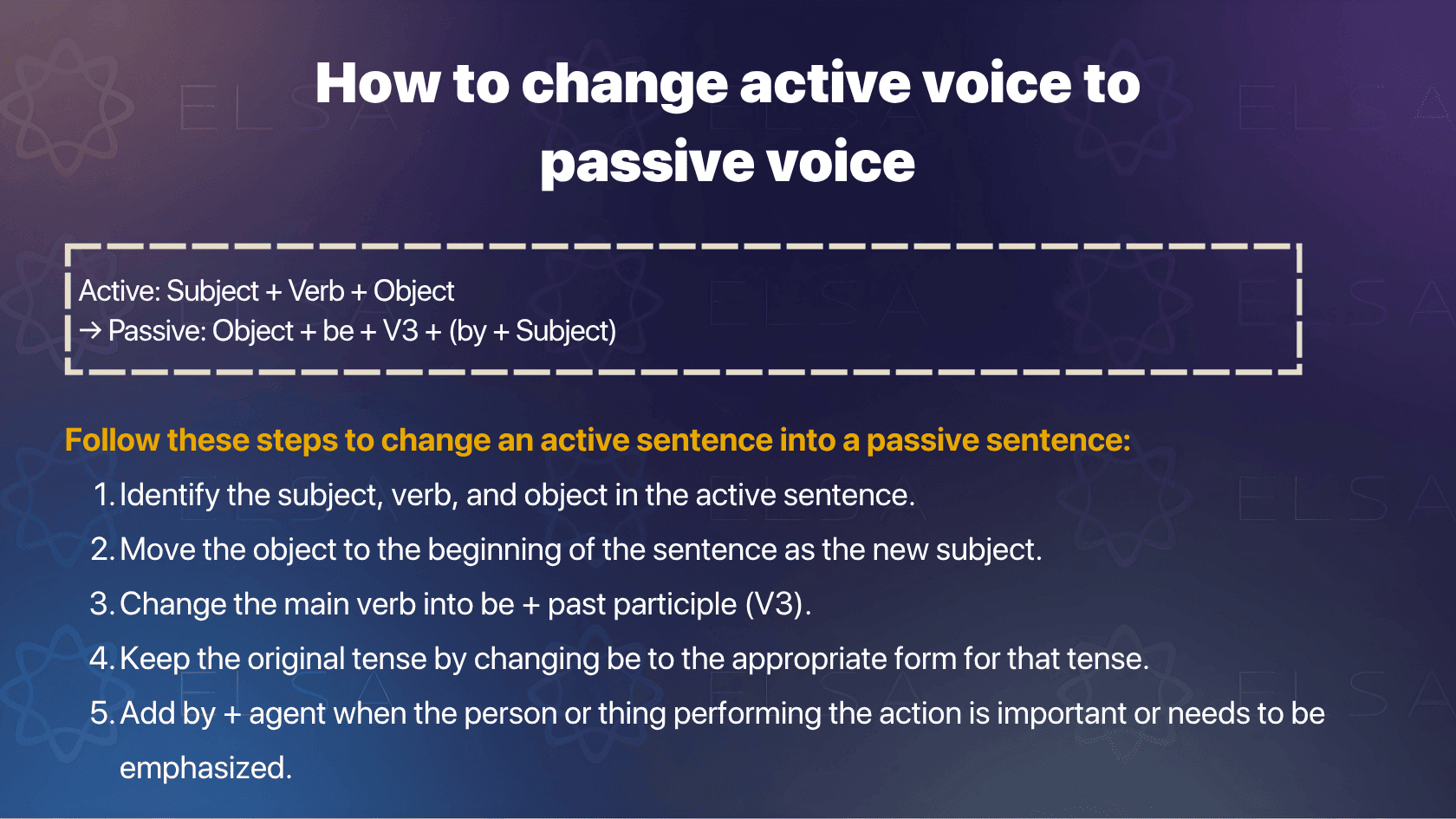
| Active: Subject + Verb + Object → Passive: Object + be + V3 + (by + Subject) |
Follow these steps to change an active sentence into a passive sentence:
- Identify the subject, verb, and object in the active sentence.
- Move the object to the beginning of the sentence as the new subject.
- Change the main verb into be + past participle (V3).
- Keep the original tense by changing be to the appropriate form for that tense.
- Add by + agent when the person or thing performing the action is important or needs to be emphasized.
Example:
Active: The company launched a new product.
Step 1: Identify the parts:
- Subject: the company
- Verb: launched
- Object: a new product
Step 2: Move the object to the beginning:
→ A new product...
Step 3–4: Keep the past simple tense and use was + V3:
→ A new product was launched...
Step 5: Add the agent because it provides useful information:
→ A new product was launched by the company.
Active and passive voice exercises
Practice is one of the best ways to become comfortable with active and passive voice. Try each exercise before checking the answer key.
Exercise 1: Identify whether each sentence is active or passive.
- The teacher explained the grammar rule.
- The documents were signed yesterday.
- Someone has taken my umbrella.
- The new bridge was opened in June.
- The marketing team created the campaign.
- The emails will be sent this afternoon.
- The company offers free training to new employees.
- The final decision was made by the director.
- The technician is repairing the computer.
- The computer is being repaired by the technician.
Exercise 2: Rewrite each sentence in the passive voice.
- The chef prepared the meal.
- The company will launch a new app next month.The students completed the assignment.
- Someone stole my bicycle.
- The manager has approved the proposal.
- The team is organizing the event.
- The technician repaired the printer.
- The teacher will give the students their test results tomorrow.
- The researchers conducted the experiment under controlled conditions.
- The company must protect customer information.
Exercise 3: Complete each sentence using the correct passive form of the verb in parentheses.
- The office __________ every morning. (clean)
- The package __________ yesterday. (deliver)
- The report __________ yet. (not / finish)
- A new hospital __________ in the city next year. (build)
- The invitations __________ already. (send)
- The problem __________ by the IT team right now. (solve)
- English __________ in many countries around the world. (speak)
- The final results __________ tomorrow. (announce)
- The documents must __________ before the meeting. (sign)
- The missing files __________ by the assistant. (find)
When learning passive voice, the key is knowing when to focus on the action or receiver and when active voice is clearer. Keep practicing by identifying passive structures and converting active sentences into passive ones. For more practical English grammar lessons and learning tips, visit the Grammar category on ELSA Speak blog and explore more resources to build your English skills with confidence.