

Future perfect tense: Formula, examples, and uses in English
elsaspeakadmin
October 10, 2026
English tenses
The future perfect tense describes an action that will be completed before a specific time or another event in the future. It is useful when discussing work deadlines, study goals, and future plans. In this guide, you’ll learn the future perfect tense formula, explore practical examples, and understand how this tense differs from other future tenses.
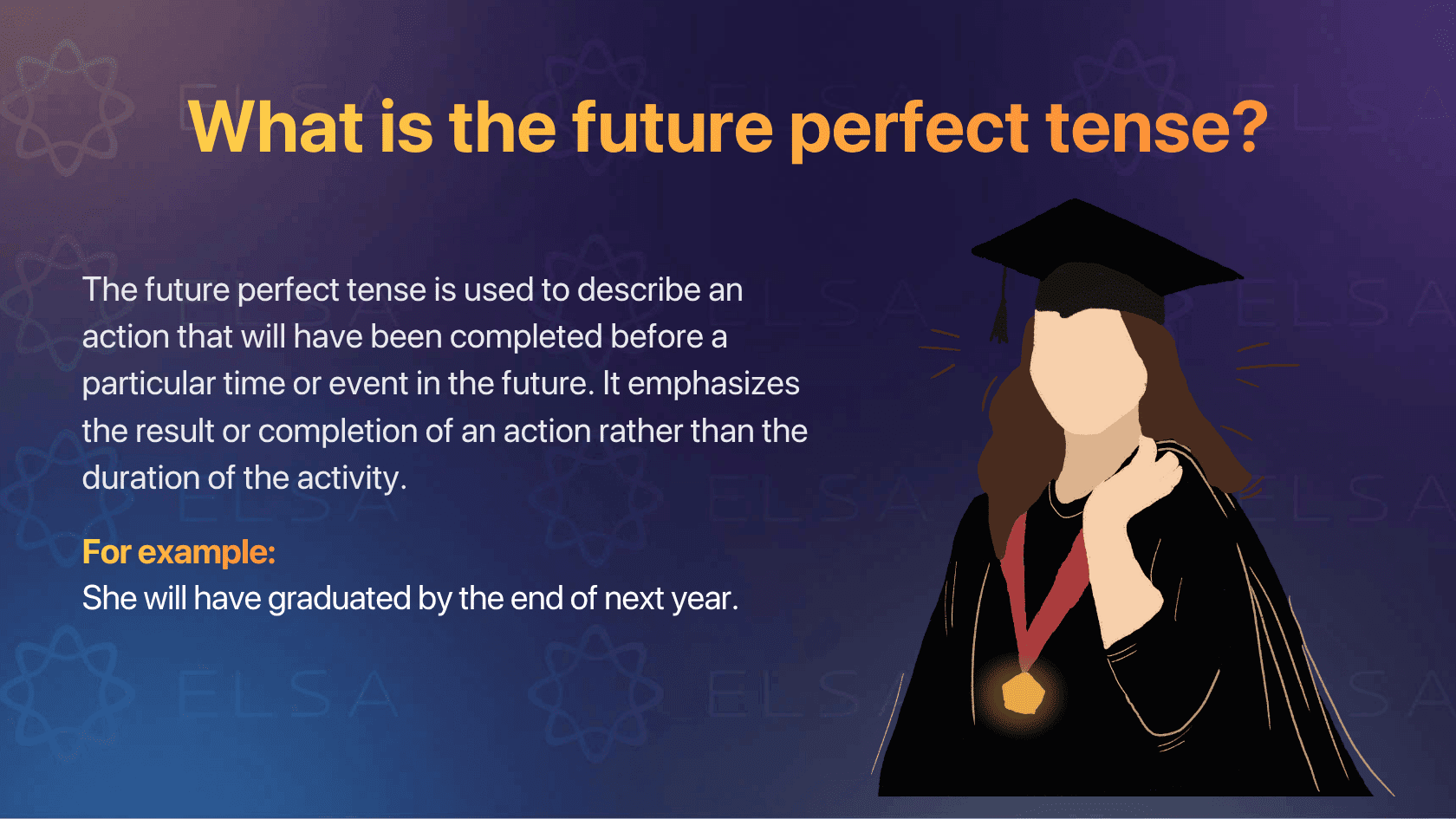
What is the future perfect tense?
The future perfect tense is used to describe an action that will have been completed before a particular time or event in the future. It emphasizes the result or completion of an action rather than the duration of the activity.
For example:
- By Friday, I will have finished the report.
- She will have graduated by the end of next year.
- They will have completed the project before the deadline.
In these examples, the actions are expected to be complete by a specified future point. Think of the future perfect as looking back from a point in the future. Instead of focusing on what will happen, you focus on what will already be finished by then.
Future perfect tense formula and sentence structures
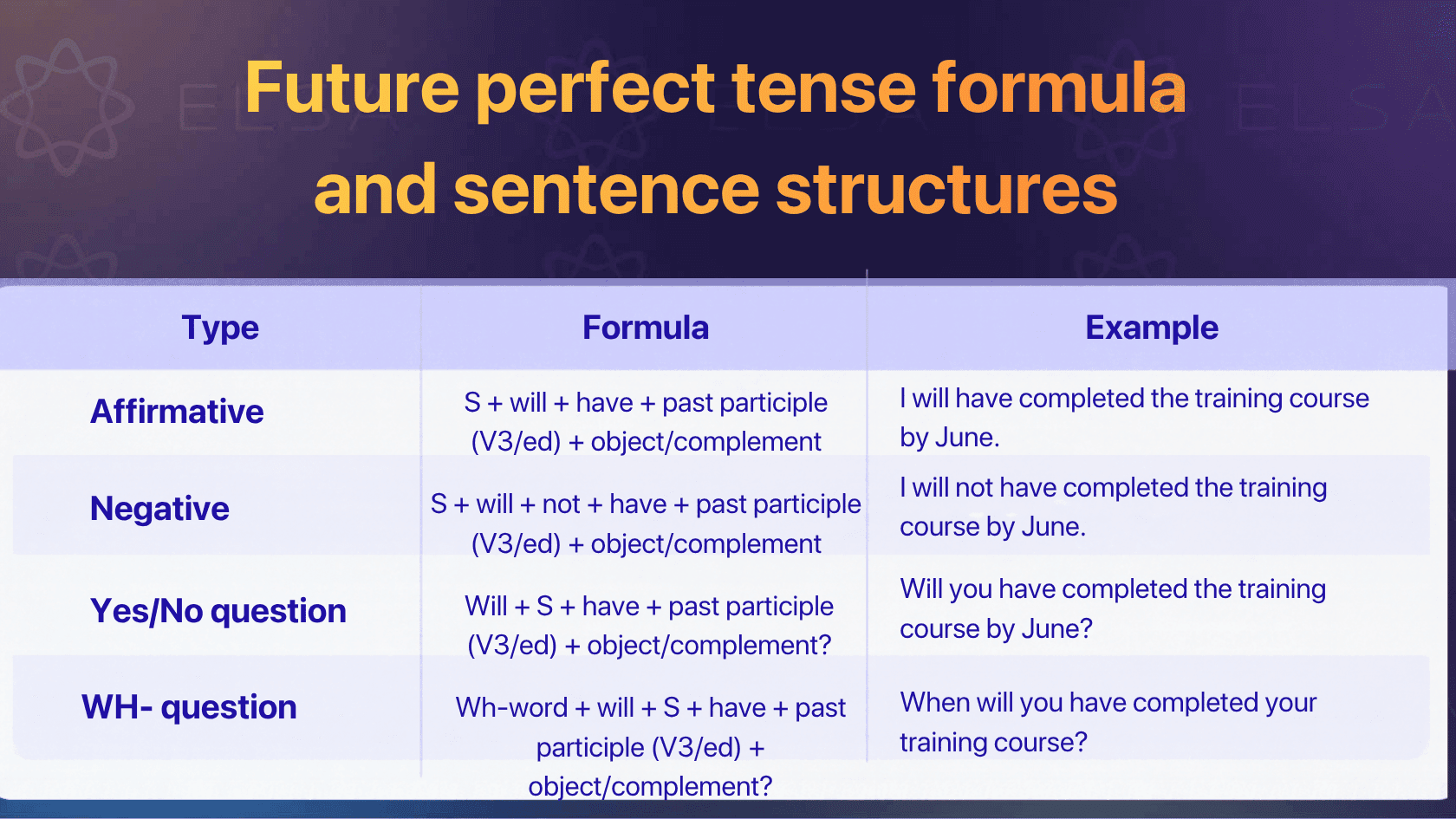
The future perfect tense has three main sentence structures: affirmative, negative, and interrogative. Each follows the same core pattern, with changes to the placement of not or the auxiliary verb will.
Affirmative sentences
Use the affirmative form to describe an action that will be completed before a specific future time or event.
Formula:
| S + will + have + past participle (V3/ed) + object/complement |
You can also use the contraction subject + ’ll have + past participle in informal conversations.
Examples:
- I will have completed the training course by June.
- She will have saved enough money to buy a laptop by the end of the year.
⇒ In the first example, the training course will be complete before June. In the second, the speaker expects to have enough money by the end of the year.
Negative Sentences
Use the negative form to say that an action will not be completed before a specific future time or event.
Formula:
| S + will + not + have + past participle (V3/ed) + object/complement |
The contraction won’t have is common in everyday English.
Examples:
- We will not have finished the presentation by 3 p.m.
- He won’t have received the package before the weekend.
These sentences indicate that the actions are not expected to be complete by the stated future points.
Interrogative sentences
Use the interrogative form to ask whether an action will be complete by a particular time or event.
Yes/no question formula:
| Will + S + have + past participle (V3/ed) + object/complement? |
For example: Will you have finished the assignment by tomorrow?Will they have arrived before the meeting starts?
Short answers follow these patterns:
- Yes, I/we/you/they will.
- No, I/we/you/they won’t.
To ask for specific information, use a wh- question word.
Wh-question formula:
| Wh-word + will + S + have + past participle (V3/ed) + object/complement? |
For example:
- When will you have completed the project?
- How many books will she have read by the end of the month?
Use when to ask about the completion time and how many to ask about the expected quantity.
When to use the future perfect tense
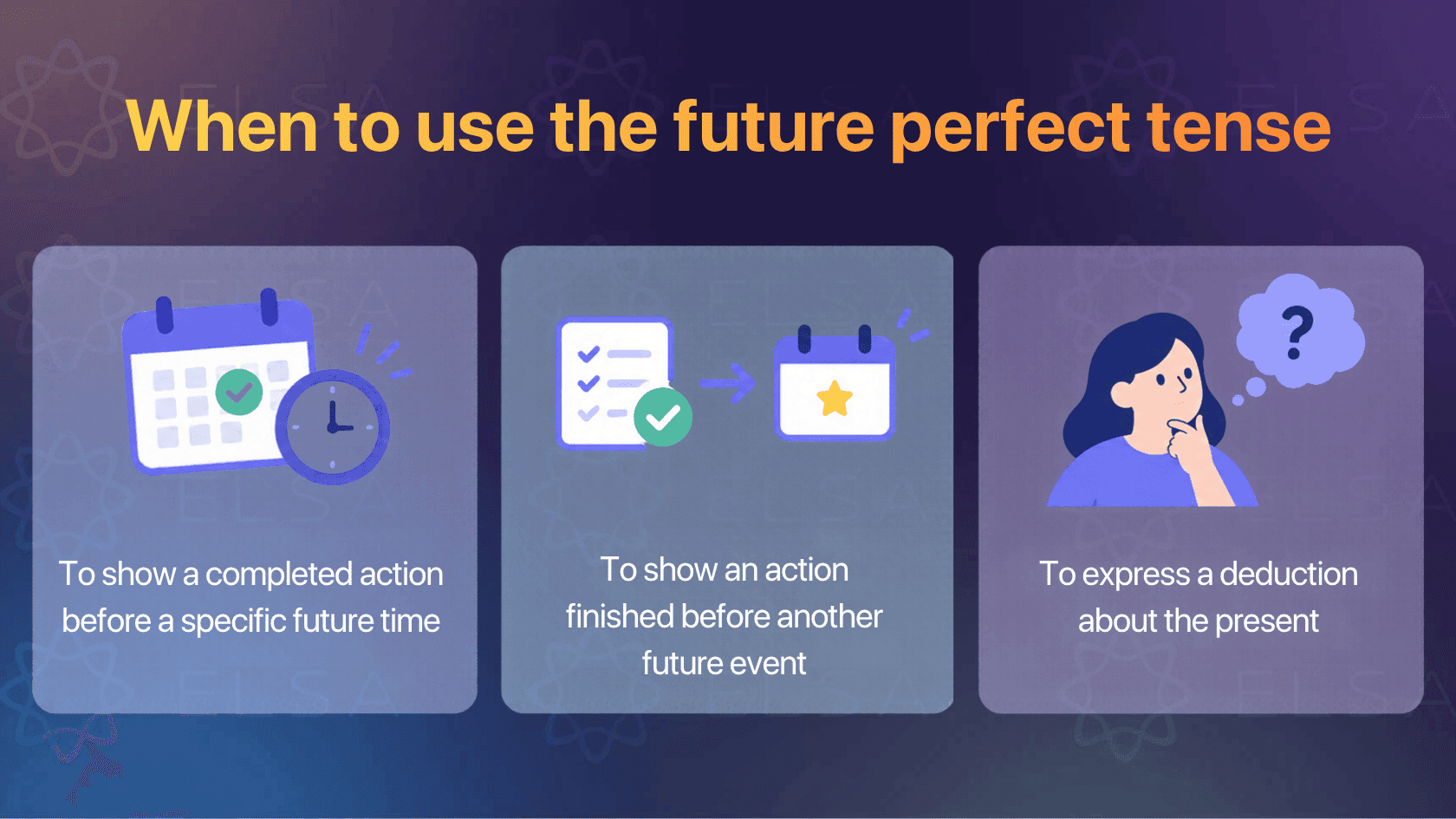
The future perfect tense is especially useful when you need to establish a deadline, show that one action will be complete before another, or make an inference about a situation.
To show a completed action before a specific future time
Use the future perfect to emphasize that an action will be finished by a particular time in the future. Time expressions such as by Friday, by 2030, and by the end of the month often appear in these sentences.
Examples:
- Affirmative: I will have submitted my application by Friday.
- Negative: She won’t have completed the course by the end of this week.
- Interrogative: Will you have finished the report by noon?
⇒ In each example, the future time provides a deadline for the action. The focus is on whether the action will be complete by that point.
To show an action finished before another future event
The future perfect can also describe an action that will be completed before another event happens in the future. The second event is often introduced by time expressions such as by the time, before, or when.
In standard future time clauses, use the simple present tense after these expressions rather than will.
Examples:
- Affirmative: By the time the meeting starts, we will have prepared all the documents.
- Negative: She won’t have finished dinner before her guests arrive.
- Interrogative: Will you have completed the report by the time your manager returns?
⇒ The first action is expected to be complete before the second event takes place. This structure is useful for describing schedules, preparations, and deadlines.
To express a deduction about the present
The future perfect can sometimes express a confident inference about an action that is likely to have happened by now. In this use, speakers imagine what has probably been completed by the present moment.
Examples:
- Affirmative: They will have arrived by now, so let's call them.
- Negative: He won’t have heard the news yet, so please don't mention it.
- Interrogative: Will she have received the email by now?
⇒ This use is context-dependent. The future perfect often sounds more natural when the speaker makes an inference about a likely result. In everyday English, the present perfect may also be suitable, depending on the intended meaning.
Common time expressions and signal words
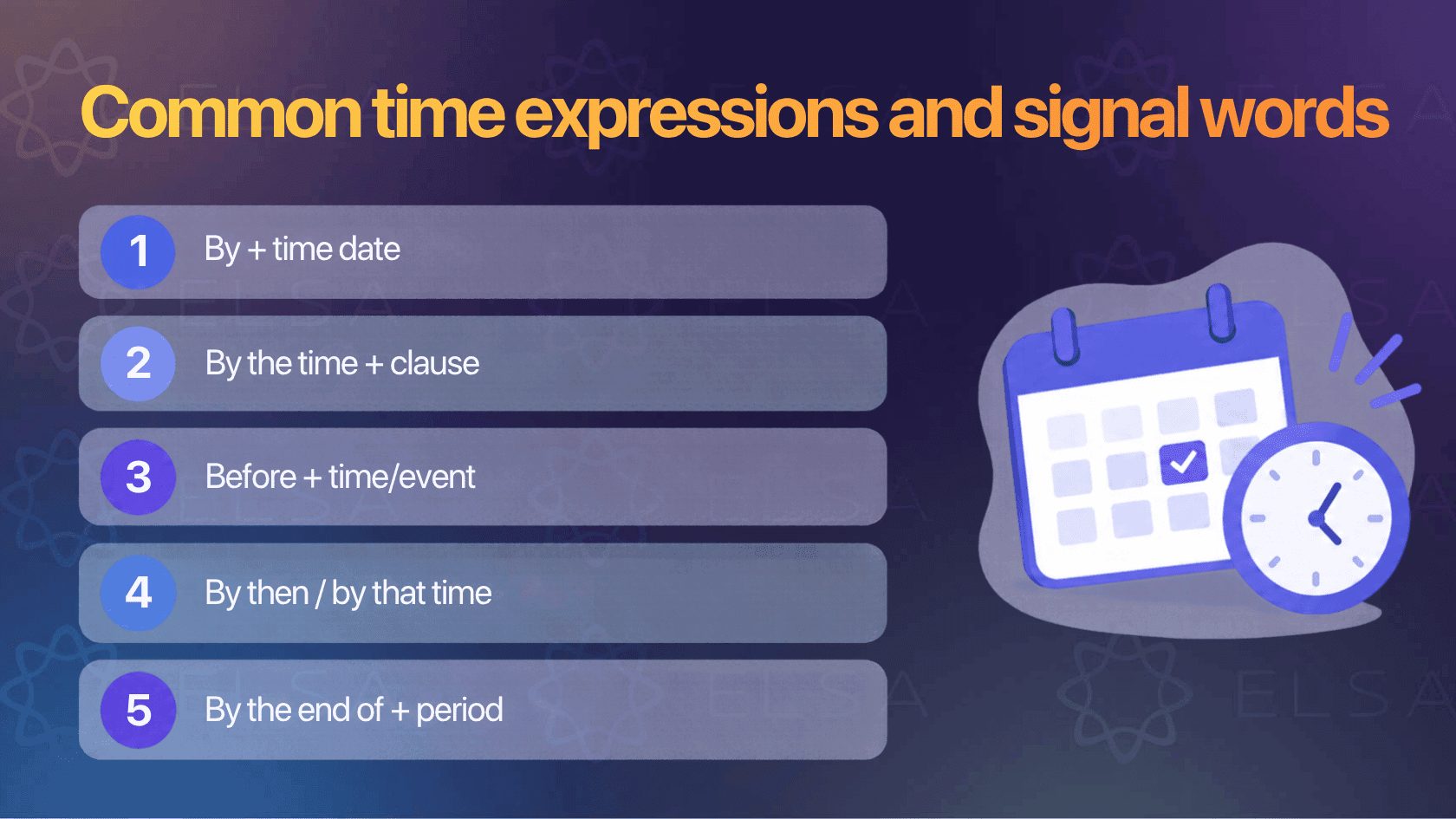
Time expressions help identify the future point by which an action is expected to be complete. They often appear at the beginning or end of a sentence.
| Time expression | Meaning or usage | Example |
| By + time/date | Indicates a deadline or latest completion time | I will have finished the report by 5 p.m. |
| By the time + clause | Connects completion with another future event; use the simple present in the time clause | By the time you arrive, we will have prepared dinner. |
| Before + time/event | Shows that an action will be complete earlier than another point | She will have left before the office closes. |
| By then / by that time | Refers to a future time already mentioned or understood | By then, they will have completed the project. |
| By the end of + period | Specifies the end of a day, week, month, year, or other period | He will have saved enough money by the end of the year. |
Future perfect vs. Future continuous
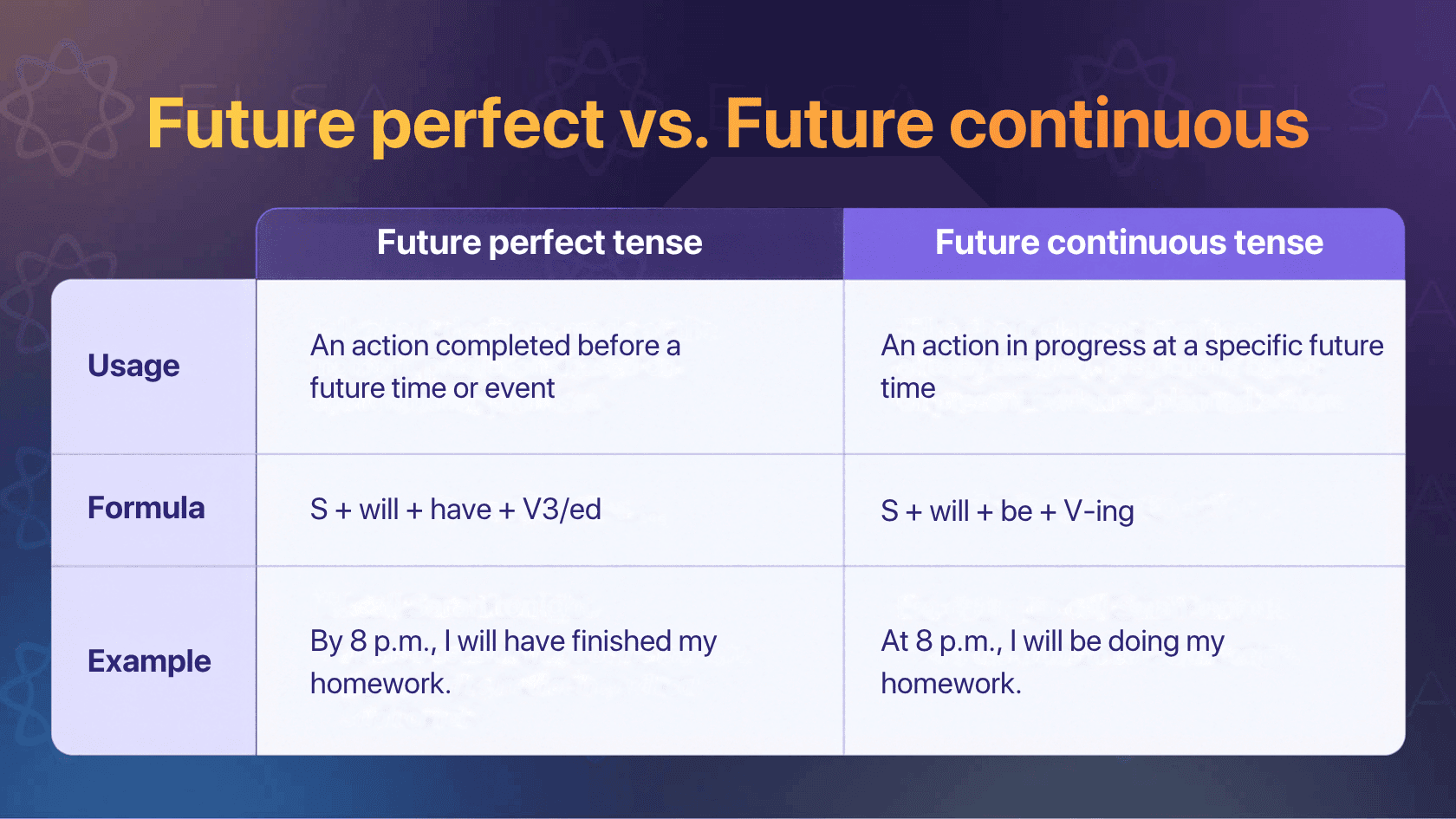
The future perfect tense and future continuous tense both refer to the future, but they emphasize different aspects of an action. Understanding future perfect vs future continuous makes it easier to choose the right tense when talking about plans, schedules, and expected activities.
| Future perfect tense | Future continuous tense | |
| Main focus | An action completed before a future time or event. | An action in progress at a specific future time. |
| Formula | S + will + have + V3/ed | S + will + be + V-ing |
| Common time expressions | By Friday, by then, by the time, before the deadline | At 8 p.m. tomorrow, this time next week, at noon |
| Example | By 8 p.m., I will have finished my homework. | At 8 p.m., I will be doing my homework. |
| Key question | What will be completed by that time? | What will be happening at that time? |
Compare these examples:
Future perfect: By 6 p.m., she will have finished her presentation.
⇒ The presentation will be complete before or at that point.
Future continuous: At 6 p.m., she will be giving her presentation.
⇒ The presentation will be in progress at that time.
The key difference is completion versus progression. Use the future perfect when the result or completion matters, and use the future continuous when you want to describe an activity in progress at a future moment.
Practice exercises on future perfect tense
Practice helps you recognize the correct structure and use the future perfect tense in context. Complete the exercises below, then check your answers and explanations.
Exercise 1: Conjugate the Verbs in Brackets
Complete each sentence using the future perfect tense of the verb in brackets.
- By next Monday, I __________ (finish) my English assignment.
- She __________ (complete) her training by the end of this month.
- They __________ (not / arrive) at the station by 7 p.m.
- __________ you __________ (submit) the form before the deadline?
- By the time the teacher arrives, we __________ (prepare) the classroom.
- He __________ (save) enough money to buy a new phone by December.
- We __________ (not / complete) the project by tomorrow morning.
- How many lessons __________ you __________ (finish) by the end of the week?
- The movie __________ (start) by the time we get to the cinema.
- By 2030, scientists __________ (develop) new solutions to some existing problems.
Answers and Explanations
Exercise 2: Multiple-Choice Questions
Choose the correct answer to complete each sentence.
1. By the end of this week, we _____ the first draft.
A. will finish
B. will have finished
C. will be finishing
D. have finished
2. She _____ her degree by the time she turns 22.
A. will earn
B. earns
C. will have earned
D. will be earning
3. They _____ the presentation by 10 a.m., so we need to give them more time.
A. won't have completed
B. don't complete
C. aren't completing
D. won't completing
4. _____ you have read the report by tomorrow morning?
A. Do
B. Are
C. Have
D. Will
5. By the time the guests arrive, we _____ dinner.
A. prepare
B. will have prepared
C. will preparing
D. prepared
6. By 2035, many cities _____ new public transportation systems.
A. will have developed
B. develop
C. will developing
D. have developed
7. Which sentence uses the future perfect correctly?
A. He will has finished the task by noon.
B. He will be finished the task by noon.
C. He will have finished the task by noon.
D. He will finished the task by noon.
8. By the time you get home, I _____ for the airport.
A. leave
B. will leaving
C. will be leave
D. will have left
9. How many books _____ by the end of the year?
A. will she have read
B. she will have read
C. will have she read
D. will she has read
10. At 9 p.m. tomorrow, I _____ my assignment, so I can relax.
A. will work on
B. am working on
C. will have finished
D. have finished
Answers and Explanations
FAQ about the future perfect tense
What is the main difference between the simple future and the future perfect?
The simple future describes an action that will happen, while the future perfect emphasizes an action that will be complete before a specific future time or event.
Can we use “Will” in time clauses with “Before” or “By the time”?
In standard future time clauses, use the simple present rather than will after expressions such as before, by the time, and when.
- Correct: By the time she arrives, we will have finished dinner.
- Incorrect: By the time she will arrive, we will have finished dinner.
⇒ The main clause can use the future perfect, while the time clause uses the simple present to refer to a future event.
Does “Have” ever change to “Has” in the future perfect tense?
No. In the future perfect, have remains the same for every subject because it follows the modal verb will. Modal verbs are followed by the base form of a verb.
- Correct: She will have completed the course by June.
- Incorrect: She will has completed the course by June.
Remember the formula: subject + will + have + past participle.
Want to improve your English grammar and communication skills? Explore the Grammar category on the ELSA Speak blog for more practical lessons, examples, and tips to help you use English with greater confidence.