

Future continuous tense in English: Definition and formula
elsaspeakadmin
September 30, 2026
English tenses
The future continuous tense is one of the common tenses in English. It helps learners show that an action or activity will be happening over a period of time rather than simply saying it will happen. This guide below will show you future continuous tense explanation, formula, along with examples and differences from other tenses.
Future continuous tense explanation
Future continuous tense definition
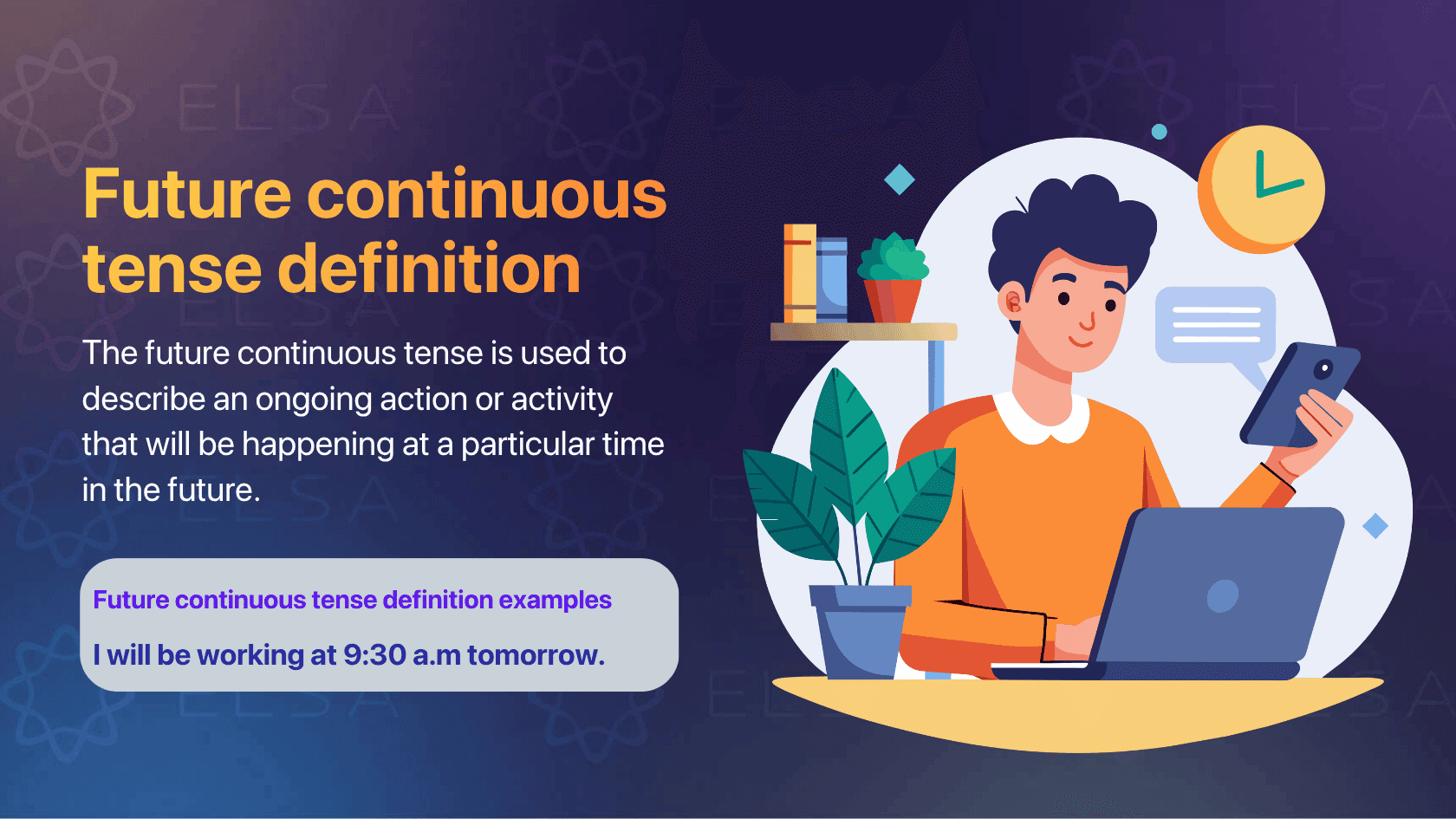
The future continuous tense is used to describe an ongoing action or activity that will be happening at a particular time in the future.
Future continuous tense definition examples:
- I will be working at 9:30 a.m tomorrow.
- She will be taking her IELTS exam at 11 a.m the next day.
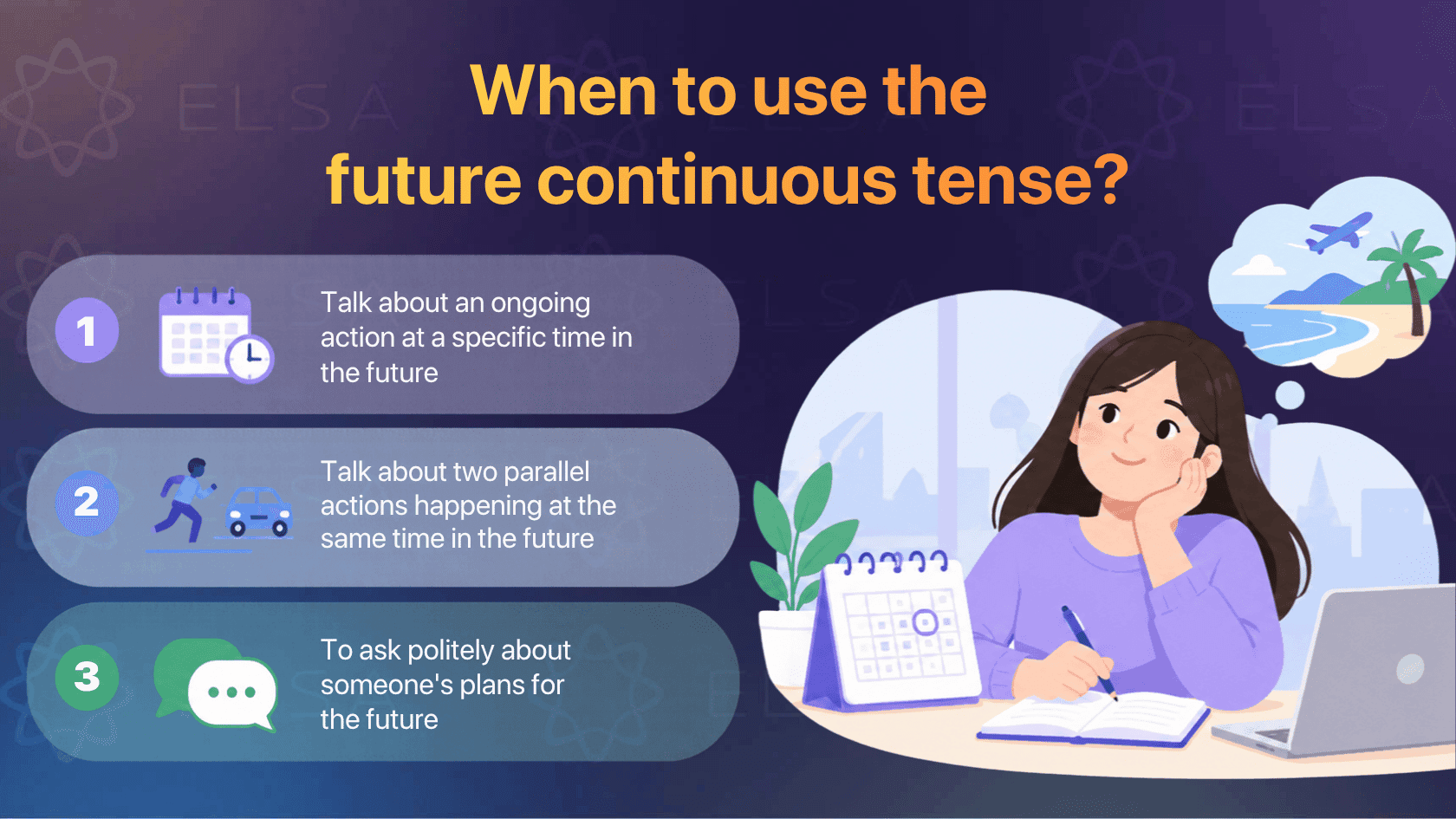
When to use the future continuous tense?
Here are common situations along with future continuous tense usage examples:
- Talk about an ongoing action at a specific time in the future. Use the continuous future tense when you want to emphasize that an activity will be happening in that exact future moment.
- For example: At 8 p.m tomorrow, we will be having dinner.
- Talk about two parallel actions happening at the same time in the future. The tense can also be used to show that two activities will be in progress during the same future moment.
- For example: While my mom is cooking, we will be studying.
- To ask politely about someone's plans for the future. The interrogative form can be used to ask about someone’s plan without sounding like you are asking them to make a decision or commitment.
- For example: Will you be joining us for tonight’s dinner?
How to form the future continuous tense?
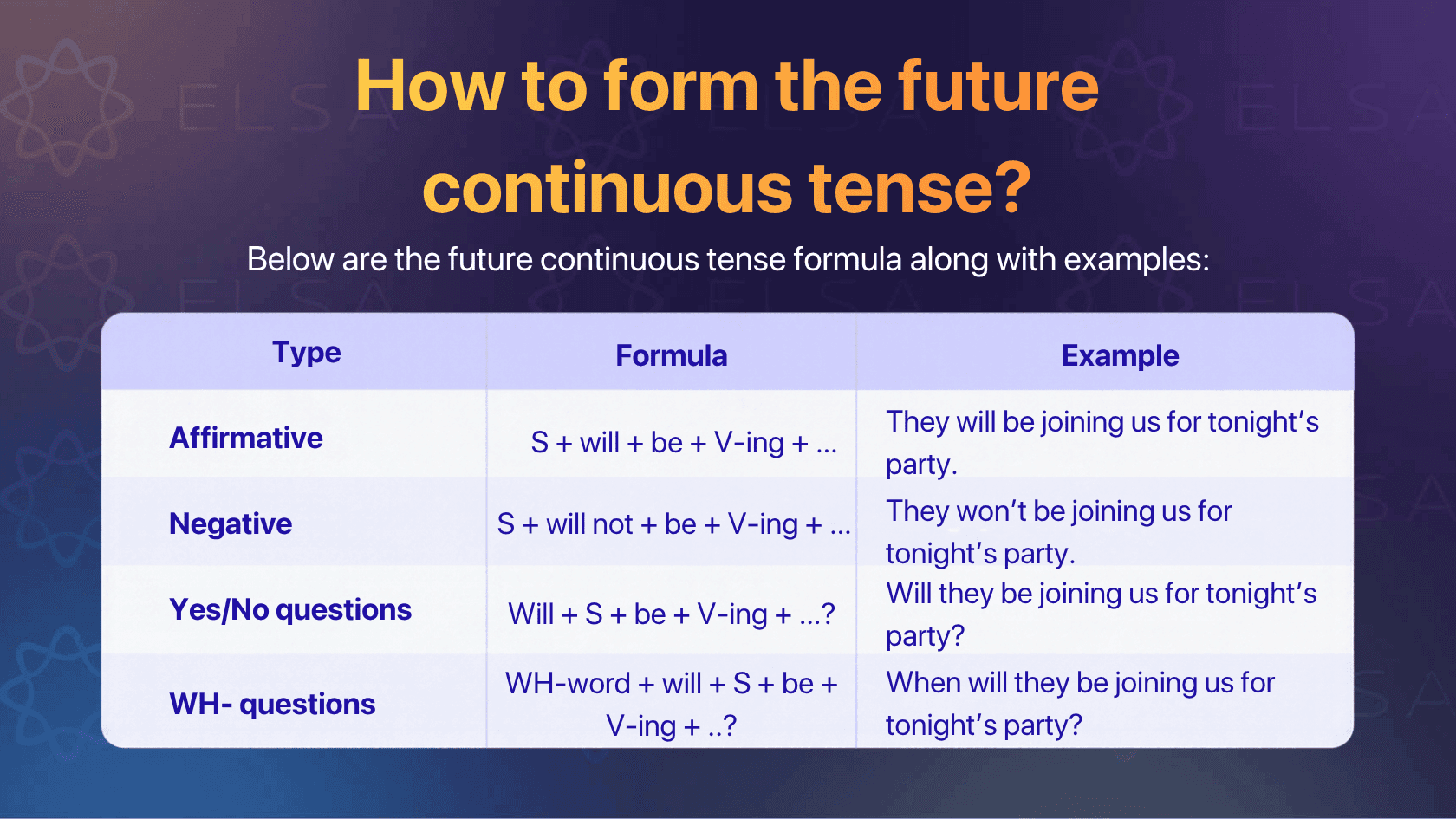
Below are the future continuous tense formula along with examples:
| Formula | Example | |
| Affirmative | S + will + be + V-ing + … | They will be joining us for tonight’s party. |
| Negative | S + will not + be + V-ing + … | They won’t be joining us for tonight’s party. |
| Yes/No question | Will + S + be + V-ing + …? | Will they be joining us for tonight’s party? |
| WH- question | WH-word + will + S + be + V-ing + ..? | When will they be joining us for tonight’s party? |
Signal words for future continuous
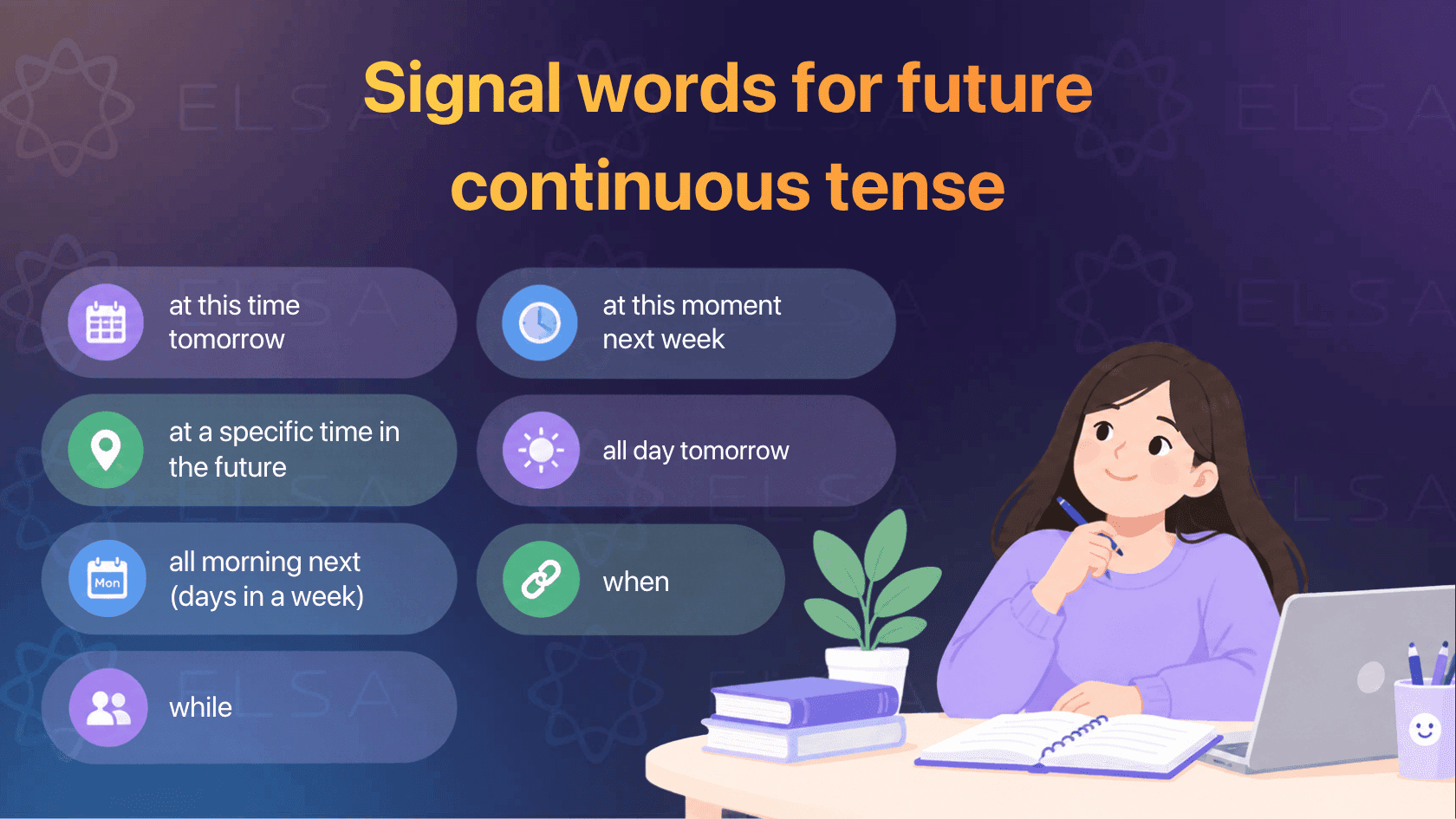
| Signal word | Example |
| at this time tomorrow | At this time tomorrow, we will be travelling to Japan. |
| at this moment next week | They will be taking the mid-term exam at this moment next week. |
| at a specific time in the future | We will be studying at 7 p.m tomorrow. |
| all day tomorrow | He’ll be working all day tomorrow. |
| all morning next (days in a week) | They’ll be attending training all morning next Tuesday. |
| when | He will be sleeping when his friends arrive. |
| while | While you’re cooking, I’ll be cleaning the room. |
Future continuous vs. other tenses
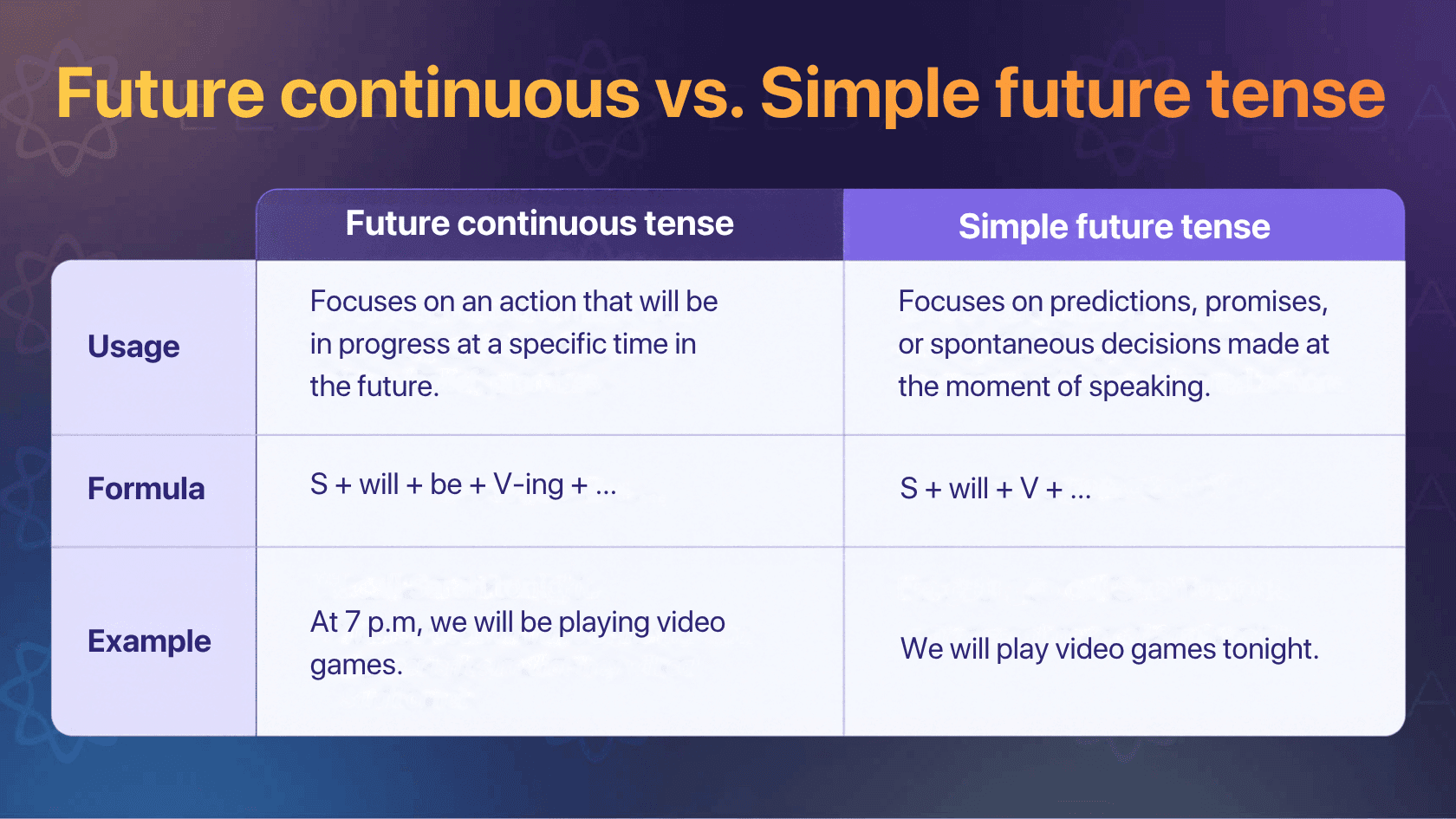
Future continuous vs. Simple future tense
| Future continuous tense | Simple future tense | |
| Usage | Focuses on an action that will be in progress at a specific time in the future. | Focuses on predictions, promises, or spontaneous decisions made at the moment of speaking. |
| Formula | S + will + be + V-ing + … | S + will + V + … |
| Example | At 7 p.m, we will be playing video games. | We will play video games tonight. |
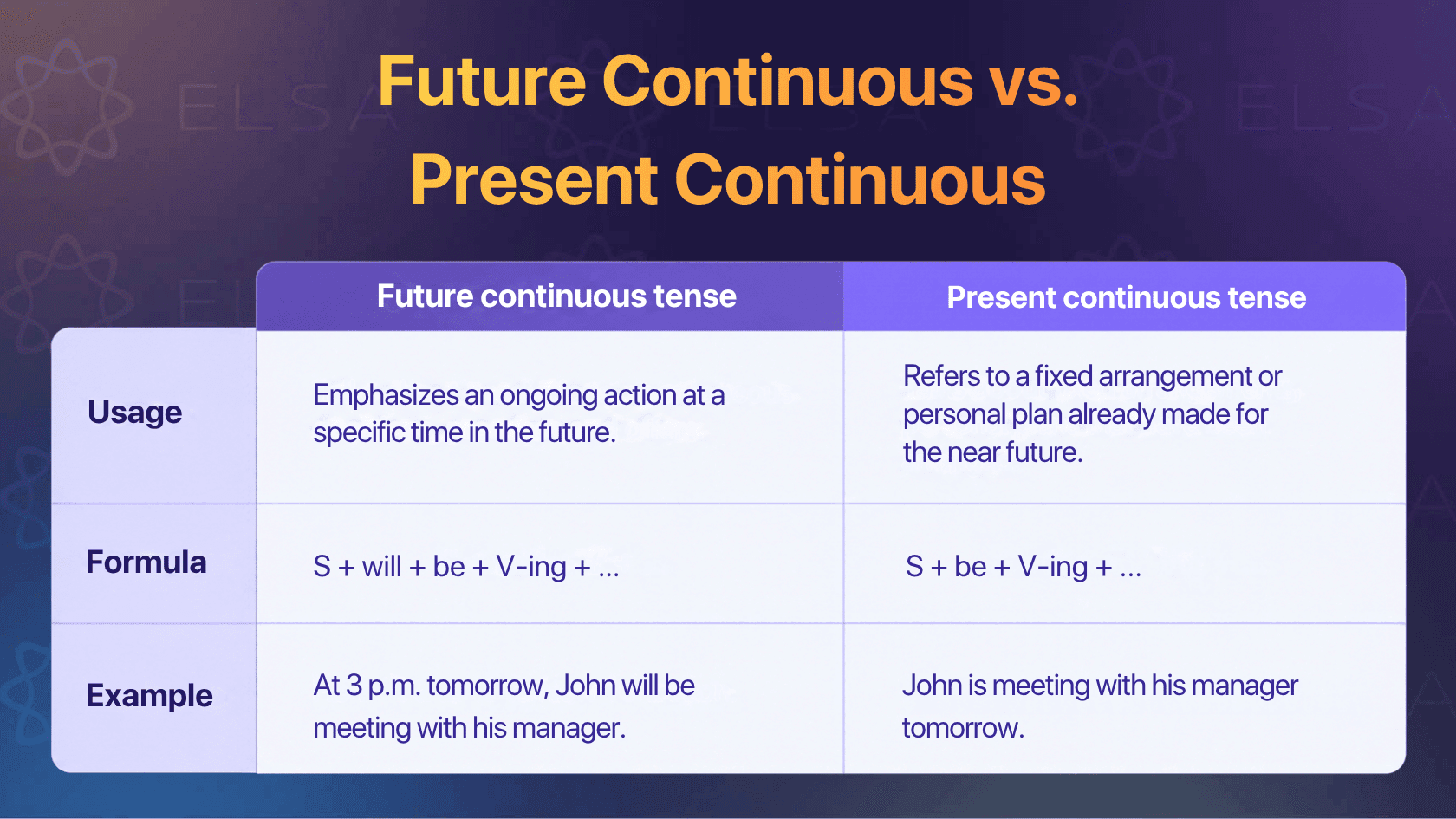
Future Continuous vs. Present Continuous
| Future continuous tense | Present continuous tense | |
| Usage | Emphasizes an ongoing action at a specific time in the future. | Refers to a fixed arrangement or personal plan already made for the near future. |
| Formula | S + will + be + V-ing + … | S + be + V-ing + … |
| Example | At 3 p.m. tomorrow, John will be meeting with his manager. | John is meeting with his manager tomorrow. |
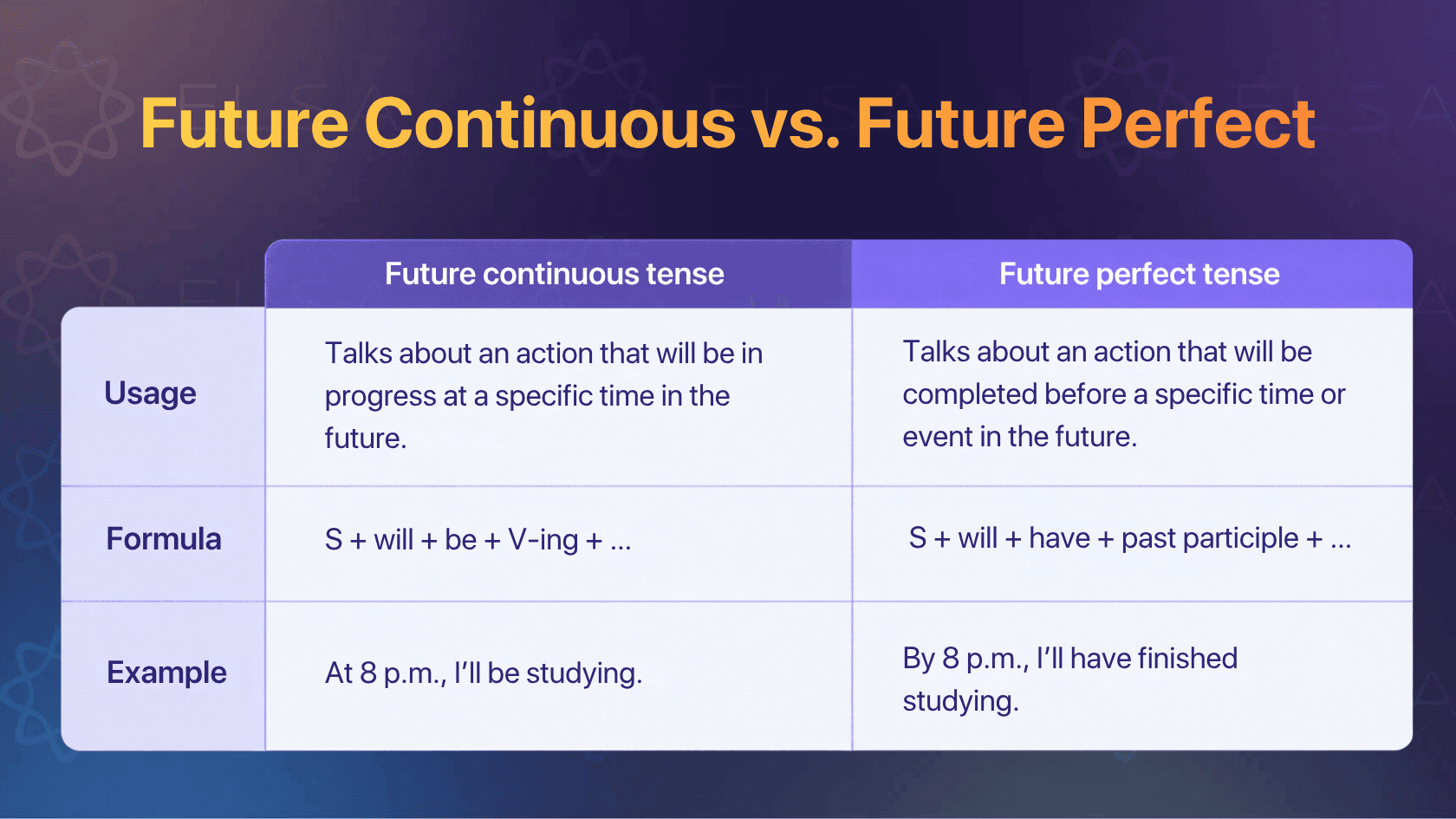
Future Continuous vs. Future Perfect
| Future continuous tense | Future perfect tense | |
| Usage | Talks about an action that will be in progress at a specific time in the future. | Talks about an action that will be completed before a specific time or event in the future. |
| Formula | S + will + be + V-ing + … | S + will + have + past participle + … |
| Example | At 8 p.m, I’ll be studying. | By 8 p.m, I’ll have finished studying. |
Stative verbs and the future continuous
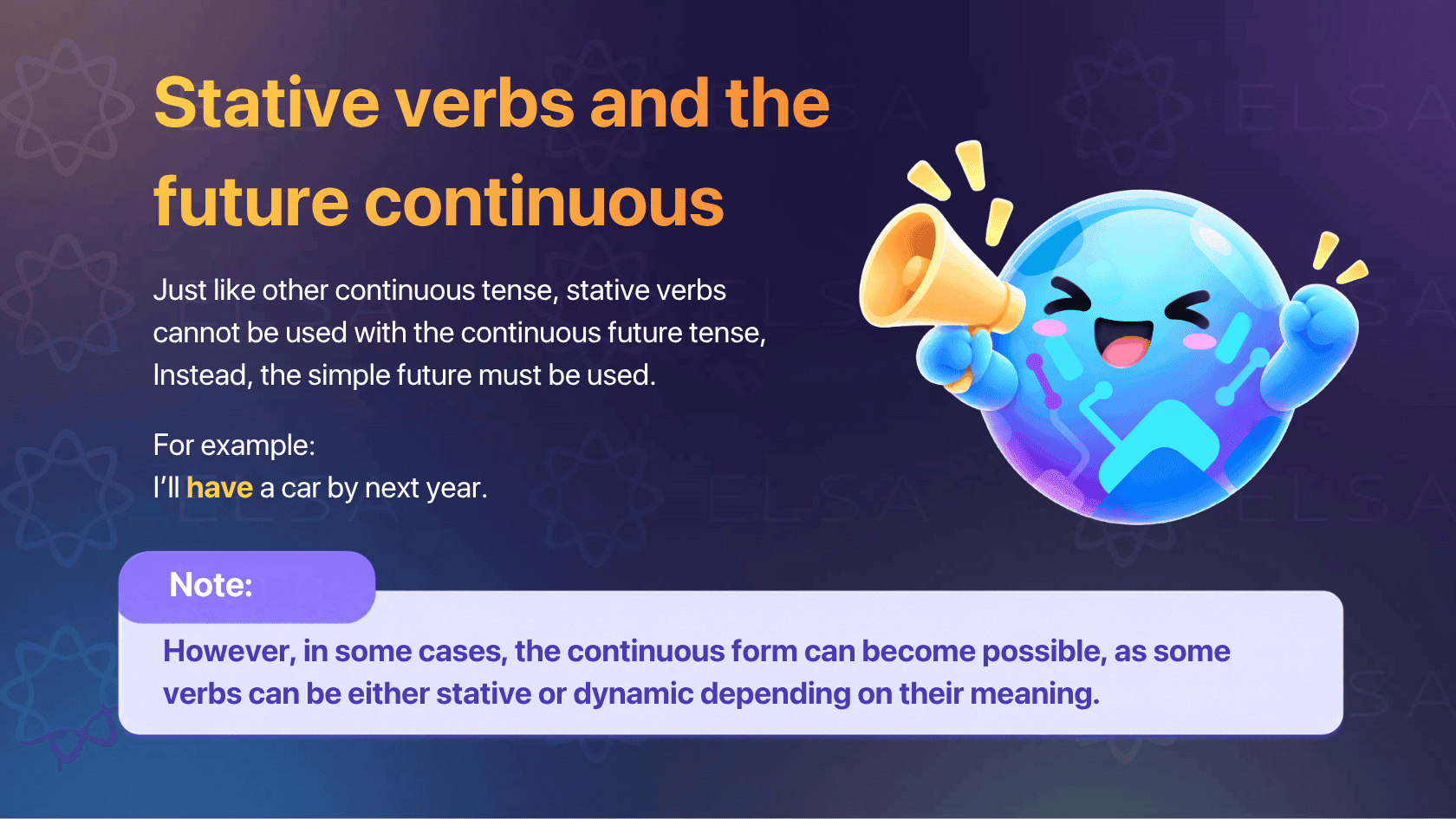
Just like other continuous tense, stative verbs (such as know, believe, think, etc.) cannot be used with the continuous future tense. Instead, the simple future must be used. However, in some cases, the continuous form can become possible, as some verbs can be either stative or dynamic depending on their meaning.
For example:
- I’ll have a car by next year.
→ Here, "have" refers to possession, so it is stative.
- I’ll be having lunch at noon tomorrow.
→ Here, "have" means eat or participate in a meal, which describes an activity and can be used in the continuous form.
Future continuous tense exercises
Exercise 1: Complete each sentence using the correct form of the future continuous.
- At 8 p.m. tonight, I ______ for my exam. (study)
- This time tomorrow, she ______ to Los Angeles. (fly)
- At noon, we ______ lunch with our clients. (have)
- They ______ at the office all morning tomorrow. (work)
- When you arrive, I ______ for you outside. (wait)
- At 10 a.m. next Monday, he ______ a presentation. (give)
- This time next week, we ______ on the beach. (relax)
- While you’re working, I ______ the children. (look after)______ you ______ the car tonight? (use)
- What ______ she ______ at 7 p.m. tomorrow? (do)
Exercise 2: Choose the correct answer.
1. At 9 p.m. tonight, I ______ a movie with my family.
a. will watch
b. will be watching
c. am watching
2. This time next year, she ______ at a university in California.
a. will study
b. will be studying
c. studies
3. Don’t call me at 6 p.m. I ______ dinner with my family.
a. will have
b. will be having
c. am having
4. I think it ______ tomorrow.
a. will be raining
b. will rain
c. is raining
5. At this time tomorrow, they ______ to New York.
a. will be flying
b. will fly
c. are flying
6. By 10 p.m., I ______ my report.
a. will be finishing
b. will have finished
c. will finish
7. ______ you be using the conference room this afternoon?
a. Will
b. Are
c. Do
8. I ______ the manager at 2 p.m. tomorrow. The appointment is already scheduled.
a. will be meeting
b. will meet
c. am meeting
9. I ______ the answer tomorrow.
a. will be knowing
b. will know
c. will be know
10.While you are traveling, I ______ your emails.
a. will check
b. will be checking
c. check
In summary, the future continuous tense is particularly useful when you want to talk about an action or an activity that will be happening at a particular time in the future. For more practical grammar lessons, visit the Grammar category on the ELSA Speak Blog for clear explanations, useful examples, and English learning tips.