

Third conditional: A complete guide to formulas, rules, and examples
elsaspeakadmin
November 11, 2026
English tenses
The third conditional helps users talk about how things could have turned out differently in the past, explain past decisions, and express regret. In this guide, we cover the third conditional formula, rules, and examples to help you use this structure with more confidence.
What is the third conditional?
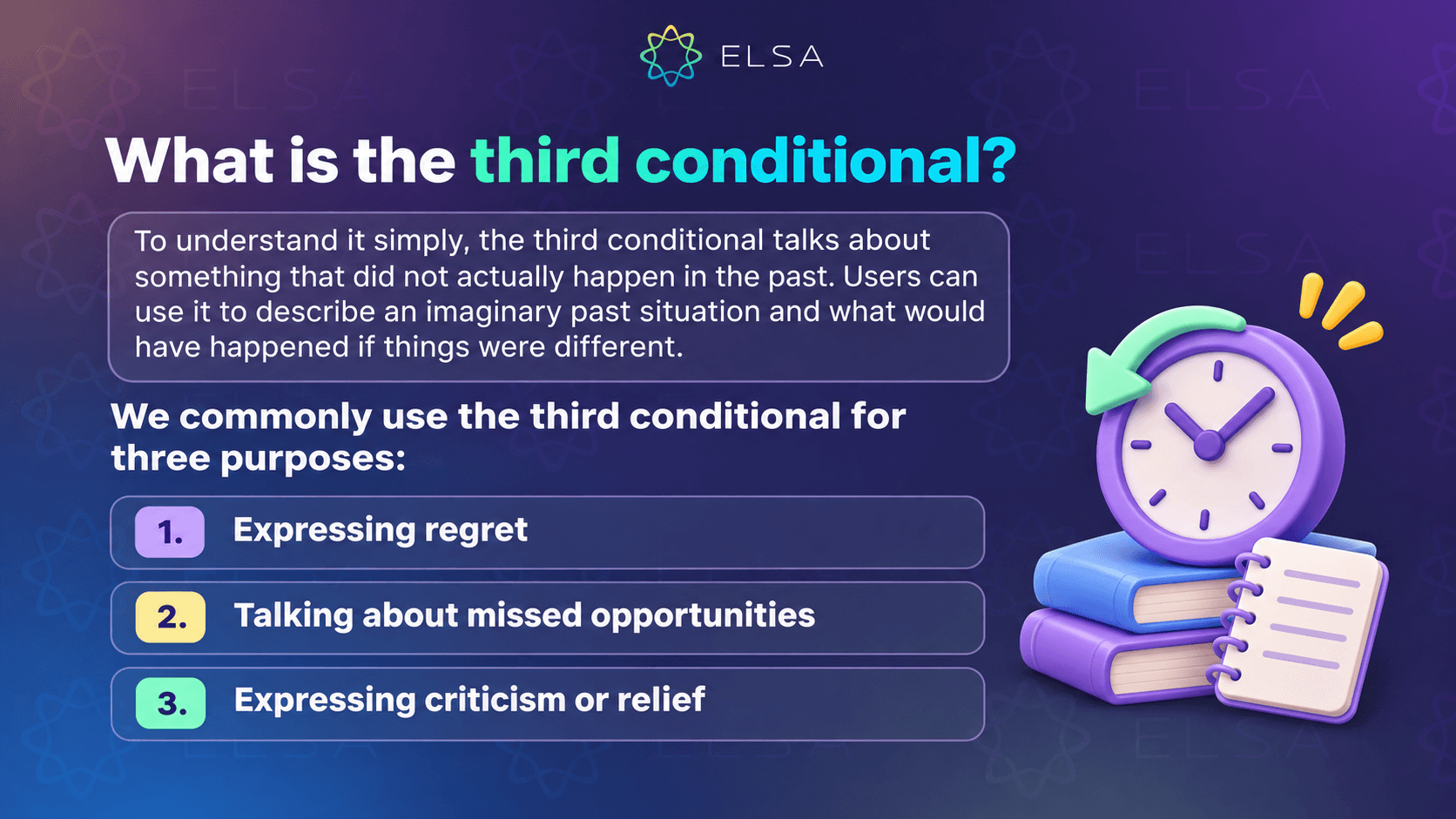
To understand it simply, the third conditional talks about something that did not actually happen in the past. Users can use it to describe an imaginary past situation and what would have happened if things were different. Take a look at this example:
Reality: I left home late, so I missed my flight at JFK Airport.
⇒ Third conditional: If I had left earlier, I wouldn't have missed my flight.
We commonly use the third conditional for three purposes:
- Expressing regret: Looking back and wishing you had done something differently.
- Talking about missed opportunities: Imagining a better result that might have happened if things had gone differently.
- Expressing criticism or relief: Pointing out a past mistake or feeling thankful that something bad did not happen.
Third conditional formulas and sentence structures
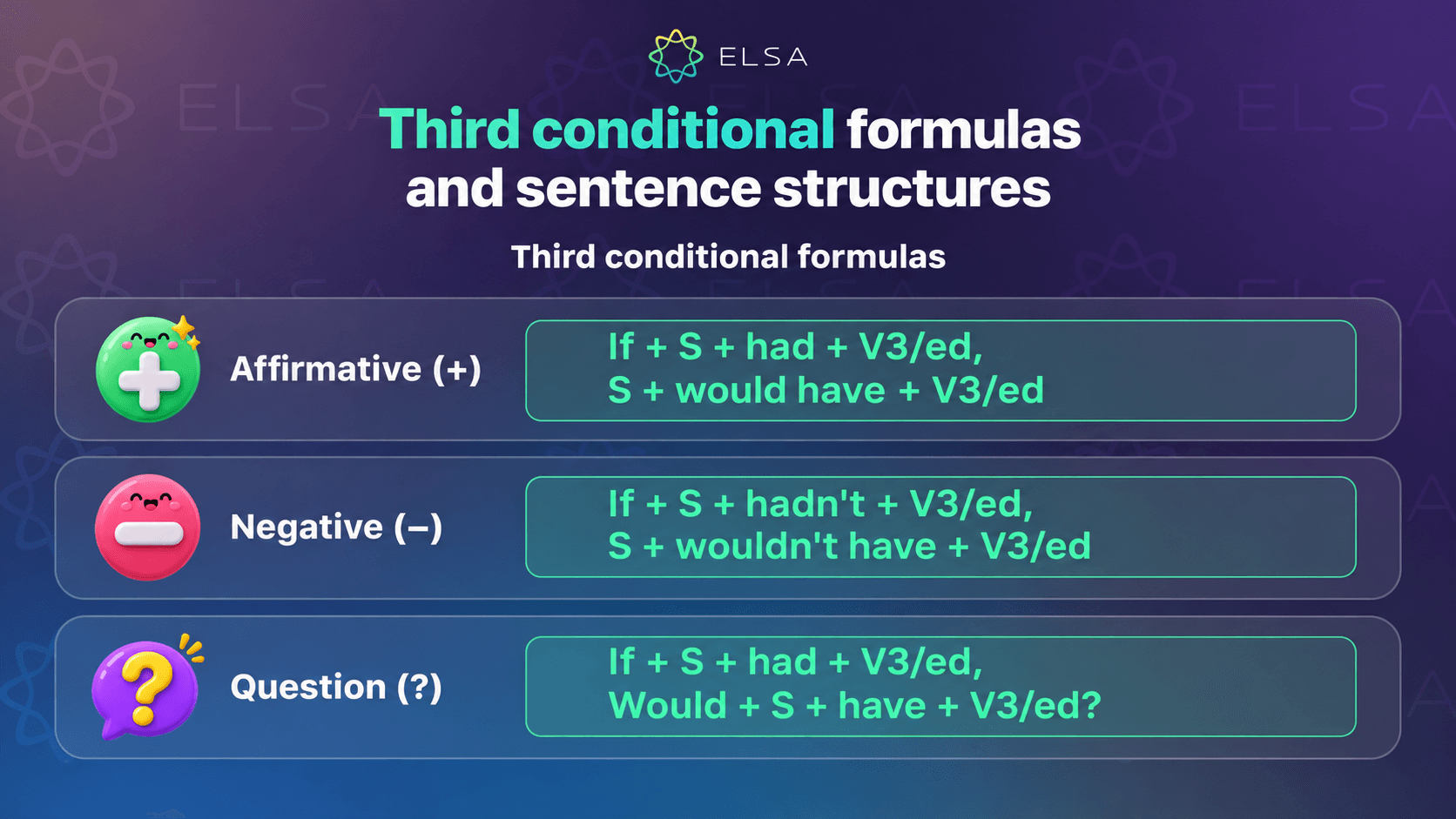
To form correct third conditional sentences, it helps to understand the affirmative, negative, and question forms. Keep these two punctuation rules in mind:
If the if-clause comes first, use a comma before the main clause.
If the main clause comes first, do not use a comma between the clauses.
| Sentence type | If clause | Main clause |
|---|---|---|
| Affirmative (+) | If + S + had + V3/ed | S + would have + V3/ed |
| Negative (-) | If + S + hadn't + V3/ed | S + wouldn't have + V3/ed |
| Question (?) | If + S + had + V3/ed | Would + S + have + V3/ed? |
Affirmative third conditional sentences
Use the affirmative form to describe what would have happened if a past condition had been met. The result is imaginary because the situation did not happen that way.
Formula:
| If + S + had + V3/ed, S + would have + V3/ed |
For example: If we had prepared the proposal more thoroughly, the client would have signed the contract immediately.
Negative third conditional sentences
Use the negative form to explain how a different past action could have prevented a particular result. You can make the if-clause negative, the main clause negative, or both, depending on what you want to say.
Formula:
| If + S + had not (hadn't) + V3/ed, S + would not have (wouldn't have) + V3/ed |
For example: If they had not overlooked the safety guidelines, the machine wouldn't have broken down.
Third conditional questions
Use third conditional questions to ask what someone would have done or what might have happened if the past had been different.
Formulas:
Would + S + have + V3/ed + if + S + had + V3/ed? Wh-word + would + S + have + done + if + S + had + V3/ed? |
For examples:
- Would you have accepted the overseas promotion if the company had offered a higher compensation package?
- What would the team have done if the project director had resigned suddenly?
Using would have, could have, and might have
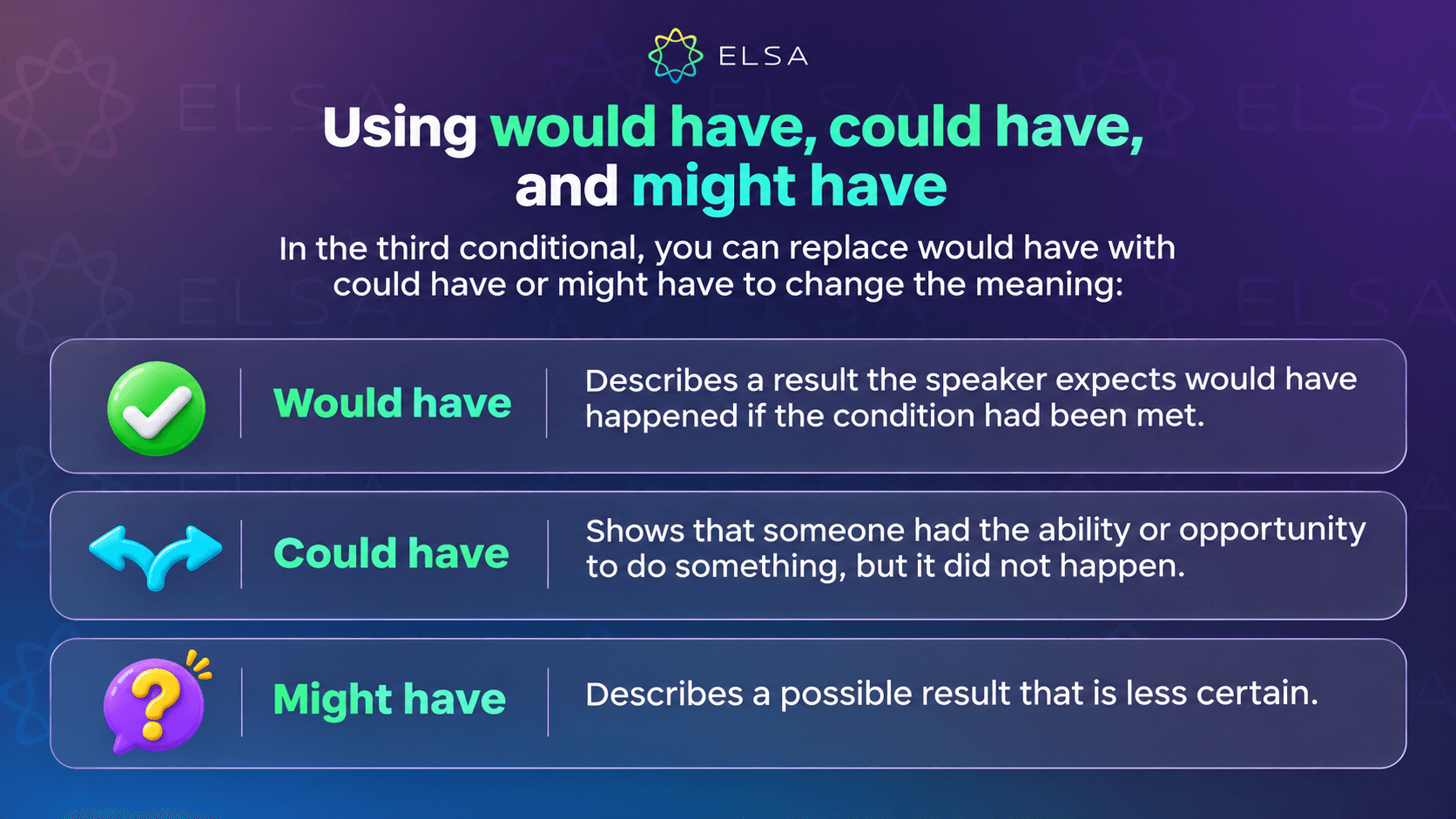
You can use different modal verbs in the main clause to show how likely or possible an imaginary result was. In the third conditional, you can replace would have with could have or might have to change the meaning:
- Would have: Describes a result the speaker expects would have happened if the condition had been met.
- Example: If I had brought an umbrella, I would have stayed dry.
- Could have: Shows that someone had the ability or opportunity to do something, but it did not happen.
- Example: If we had obtained additional budget, we could have hired two senior developers.
- Might have: Describes a possible result that is less certain.
- Example: If she had attended the seminar, she might have met key potential partners.
| Modal verb | Certainty level | Function | Example |
|---|---|---|---|
| Would have | Expected result | Describes the result the speaker expects if the past condition had been met. | If he had studied, he would have passed. |
| Could have | Past ability / opportunity | Shows that someone had the ability or opportunity to do something. | If we had run, we could have caught the bus. |
| Might have | Possibility / uncertainty | Shows that something might have happened, but was not certain. | If you had asked, he might have helped. |
Third conditional inversion: Leaving out if
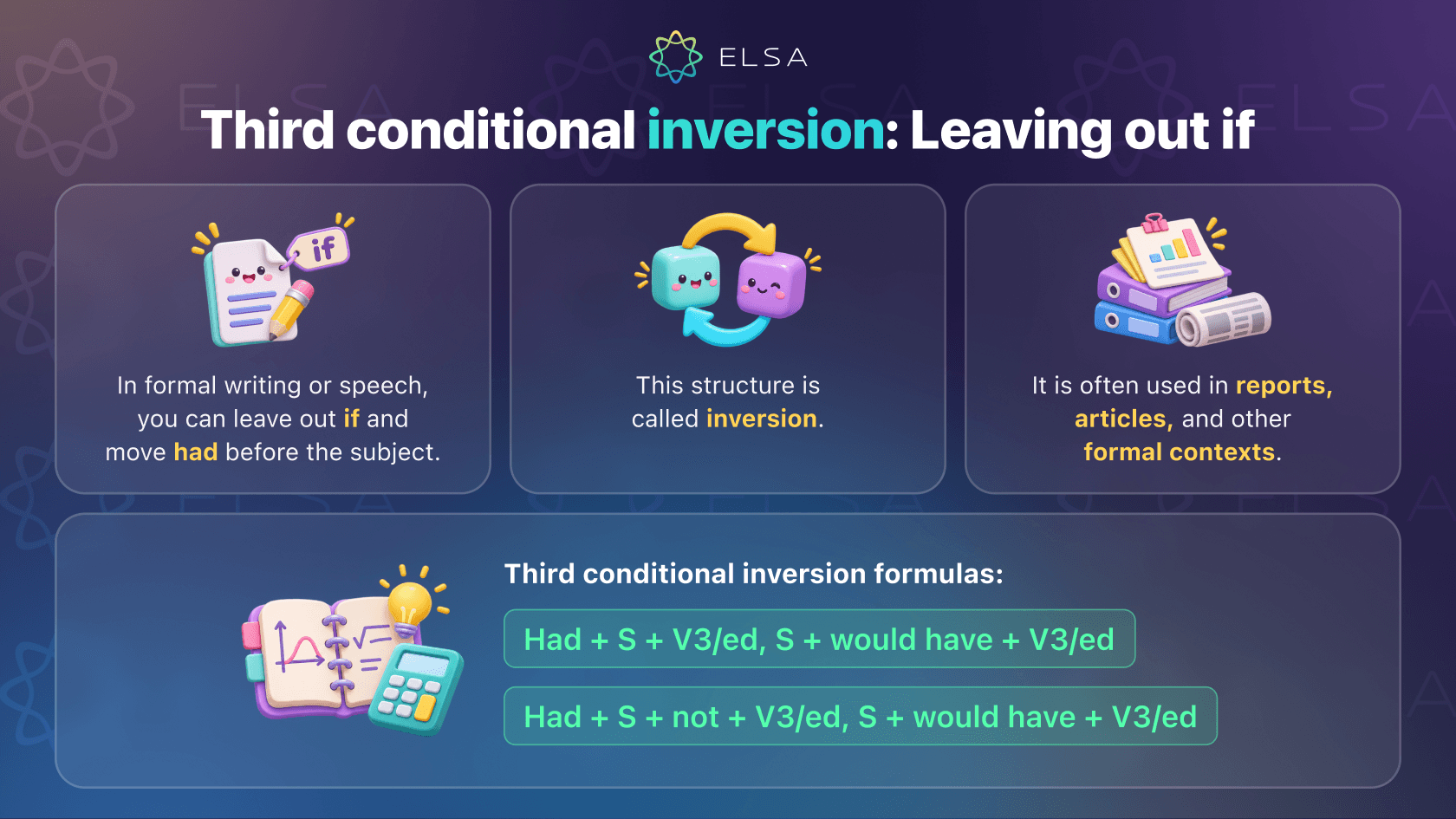
In formal writing or speech, you can leave out if and move had before the subject. This structure is called inversion. It is often used in reports, articles, and other formal contexts.
Third conditional inversion formulas:
| (+) | Had + S + V3/ed, S + would have + V3/ed |
| (-) | Had + S + not + V3/ed, S + would have + V3/ed |
Important: In negative inversion, do not use the contraction hadn't before the subject. Write had + subject + not instead.
Examples:
- Standard form: If I had known about the traffic jam, I would have taken the subway.
- Inverted form: Had I known about the traffic jam, I would have taken the subway.
- Negative inversion: Had we not intervened in time, the firm would have faced bankruptcy.
Second vs. third conditional
The second and third conditionals are easy to confuse because both describe unreal situations. The main difference is the time they refer to.
| Conditional type | Time reference | Situation reality | Core formula | Example |
|---|---|---|---|---|
| Second conditional | Present or future | An unreal or unlikely situation in the present or future | If + Past Simple, S + would + V | If Mark had a car now, he would drive to work. |
| Third conditional | Past | An unreal past situation that is already over | If + Past Perfect, S + would have + V3/ed | If Mark had had a car last year, he would have driven to work. |
Let's look at the examples more closely:
- Second conditional: If Mark had a car now, he would drive to work. (In reality, Mark does not have a car now, so he does not drive to work.)
- Third conditional: If Mark had had a car last year, he would have driven to work. (In reality, Mark did not have a car last year. That past situation cannot be changed.)
Common third conditional mistakes to avoid
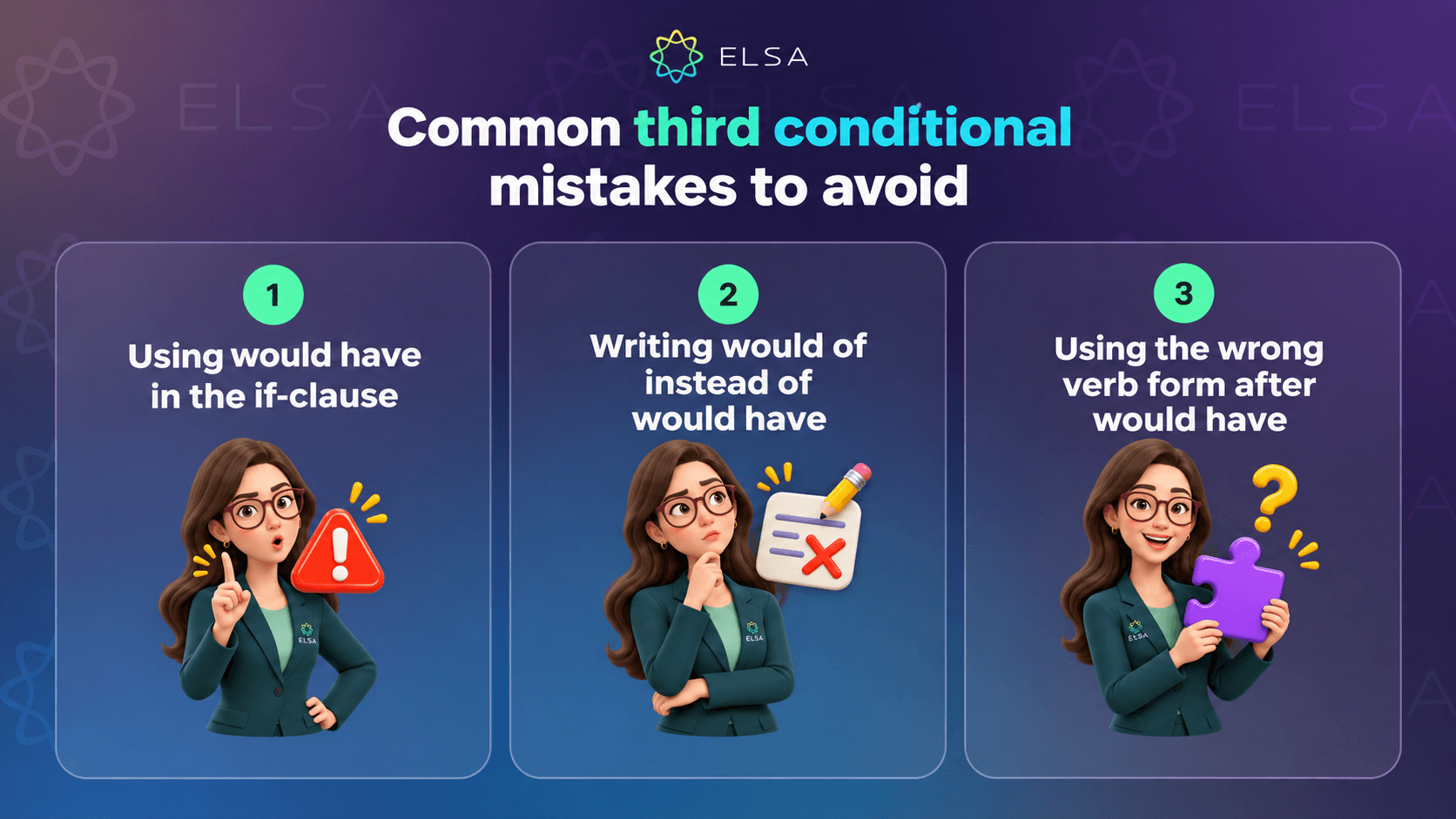
Learning to spot common mistakes will help you use the third conditional more accurately. Here are three mistakes to watch out for and how to fix them:
- Using would have in the if-clause: This is a common mistake. In a standard third conditional sentence, the if-clause uses the past perfect (had + past participle), not would have.
- Incorrect: If you would have told me, I would have helped you.
- Correct: If you had told me, I would have helped you.
- Writing would of instead of would have: In speech, would've (/ˈwʊd.əv/) sounds very similar to would of. However, would of is incorrect in standard written English. Use would have or would've instead.
- Incorrect: We would of completed the report earlier.
- Correct: We would have completed the report earlier.
- Using the wrong verb form after would have: Always use the past participle (V3), not the base form or simple past, after would have.
- Incorrect: She would have write a better email if she had checked the template.
- Correct: She would have written a better email if she had checked the template.
Third conditional practice exercises
Practice helps you turn grammar rules into sentences you can use naturally. Try the verb exercises and multiple-choice questions below, then check your answers and explanations.
Exercise 1: Complete the sentences with the correct verb forms
Instructions: Use the third conditional to put the verbs in brackets into the correct forms.
- If they (start) earlier, they (finish) the construction before the storm.
- Sarah (not miss) the interview if her alarm (go) off this morning.
- If we (know) your arrival time, we (meet) you at the airport.
- (You / buy) that apartment if the bank (approve) the loan?
- If the technician (inspect) the engine, the plane (not experience) technical issues.
- We (reach) our quarterly target if market demand (not drop) sharply.
- If Alex (listen) to your advice, he (avoid) that financial loss.
- What (happen) if the emergency medical team (arrive) five minutes later?
- If the weather (be) favorable yesterday, the team (conduct) the field test.
- Julia (accept) the offer if the salary (meet) her expectations.
Exercise 2: Multiple-choice questions about unreal past situations
Instructions: Choose the correct answer for each of the 10 questions below.
1. If the driver _____ the red light, the accident wouldn't have happened.
A. didn't run
B. hadn't run
C. wouldn't run
D. hasn't run
2. We _____ the flight if we had taken a taxi instead of the bus.
A. caught
B. would catch
C. would have caught
D. will have caught
3. Had they informed us earlier, we _____ our schedule to accommodate them.
A. would adjust
B. had adjusted
C. will adjust
D. would have adjusted
4. If I had known it was your birthday, I _____ a cake for you.
A. would bake
B. would have baked
C. had baked
D. baked
5. What _____ if the company had rejected your application?
A. would you have done
B. would you do
C. had you done
D. will you have done
6. If the team had practiced more, they _____ the championship trophy.
A. might win
B. could have won
C. can win
D. will have won
7. Had the alarm _____ on time, the security guards would have caught the intruder.
A. ring
B. rang
C. rung
D. ringing
8. She _____ the project successfully if her colleagues hadn't supported her.
A. wouldn't have completed
B. hadn't completed
C. won't complete
D. wouldn't complete
9. If the weather _____ so stormy last night, the rescue team would have arrived sooner.
A. wasn't
B. hadn't been
C. wouldn't be
D. isn't
10. Had we _____ the contract details, we wouldn't have signed it.
A. not understood
B. not understand
C. hadn't understood
D. haven't understood
Frequently asked questions about the third conditional
Why do some native speakers write would of instead of would have?
Would of is a common writing mistake because it sounds like the contraction would've in everyday speech. When spoken quickly, would've is pronounced /ˈwʊd.əv/, which can sound like would of. In standard written English, the correct forms are would have and would've, not would of.
Can we shorten both had and would to ’d in the third conditional?
Yes. Both had and would can be shortened to 'd, but their meaning depends on where they appear. In the if-clause, 'd means had: If I'd known = If I had known. In the main clause, 'd before have means would: I'd have called = I would have called.
How can the third conditional express relief instead of regret?
The third conditional can express relief by imagining a bad result that did not actually happen. For example: If we hadn't worn seatbelts, we would have been severely injured. In reality, we wore seatbelts and avoided serious injuries.
Once you understand the third conditional, you can talk more confidently about past situations and share your thoughts about past decisions at work. Want to make these grammar rules part of your everyday speech? Visit the Grammar category on ELSA Speak blog today and build your confidence in English communication.