

Reported speech: Complete rules, tense shifts & examples
elsaspeakadmin
November 11, 2026
English tenses
Reported speech is a very useful structure to use in workplace settings and everyday social interactions, especially when summarizing meetings, sending project updates, or conveying crucial discussions. However, some learners still struggle with backshifting tenses, selecting between say and tell, or maintaining the correct word order. This guide below covers not only those problems, but also fundamental guidelines, practical examples and exercises for you to use more accurately.
What is reported speech?
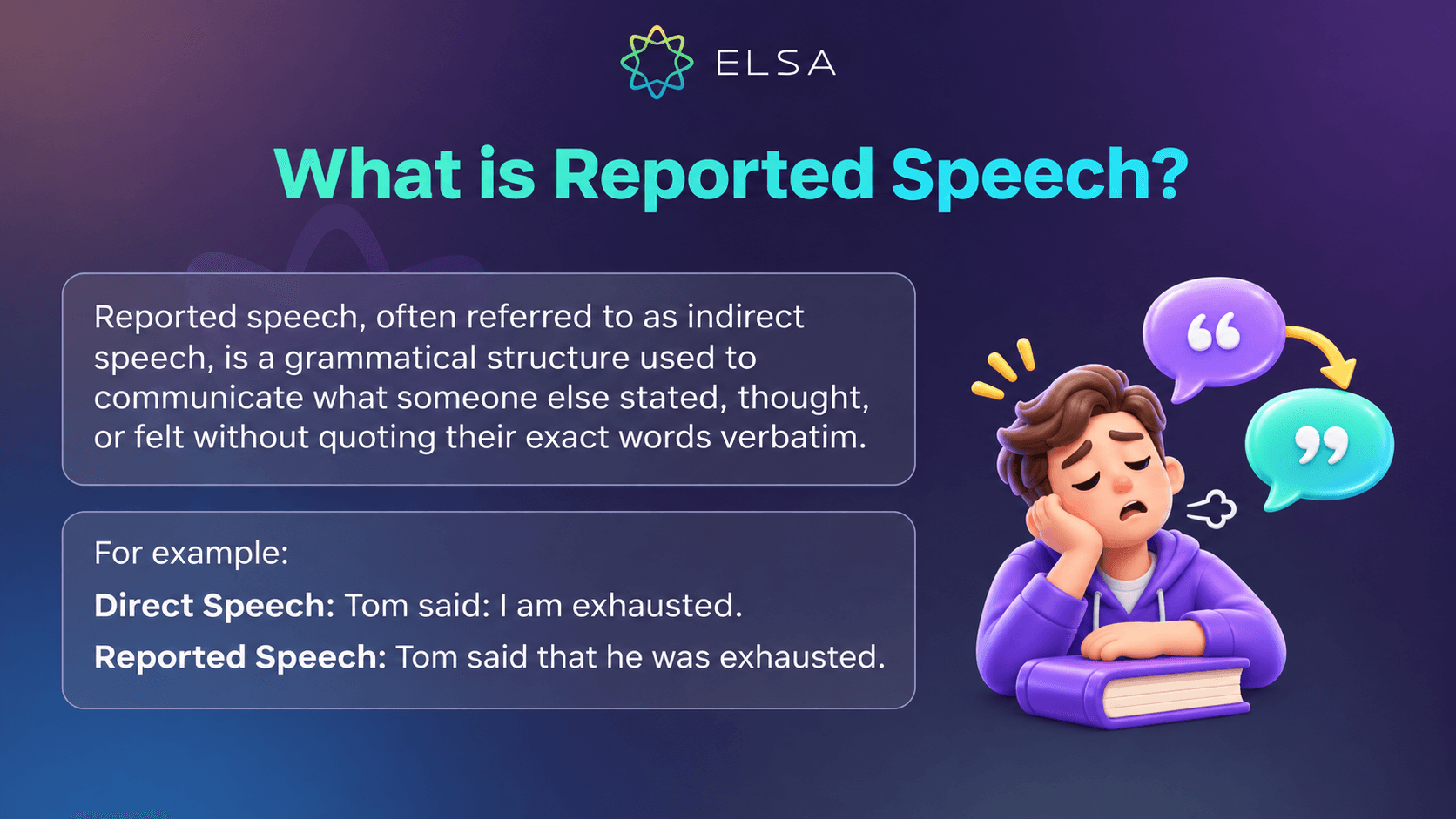
Reported speech, or also known as indirect speech, is a grammartical structure used to communicate what someone else stated, thought, or felt without quoting their exact words. However, to apply this structure effectively, learners first must distinguish between the two methods of relaying information:
- Direct speech: Repeats the exact wording of the original speaker, traditionally placed inside quotation marks in written English.
⇒ For example: "I'm exhausted.", Tom said. - Reported speech: Relays the core message from the perspective of the narrator without having the quotation marks. Speakers must also shift verb tenses backward, and adjust the personal pronouns, time, and place indicators to reflect the current settings.
⇒ For example: Tom said that he was exhausted.
Direct speech and reported speech
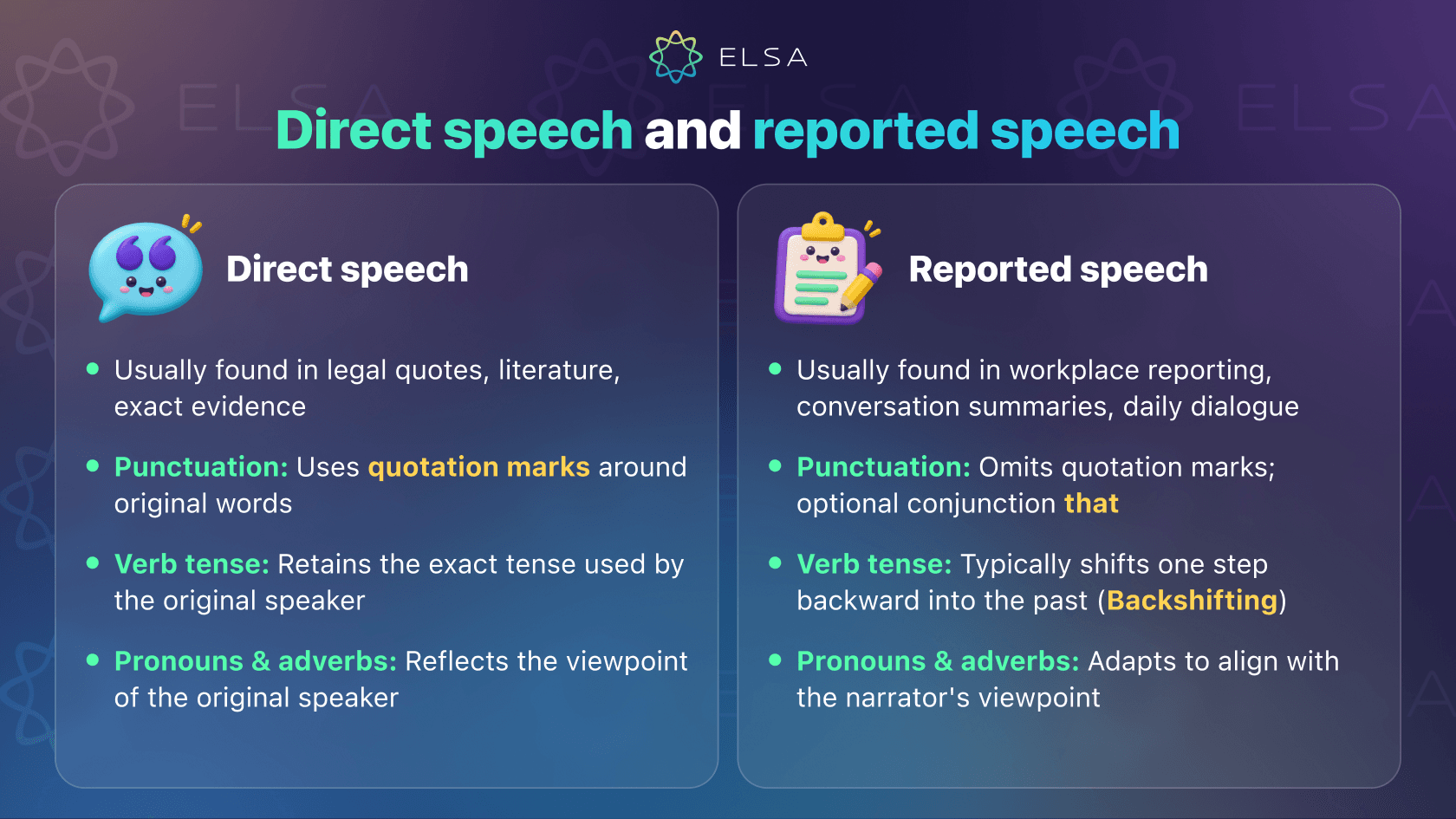
Comparing direct and indirect communication side by side provides clear visual boundaries between grammatical mechanics and real-world application.
| Criteria | Direct speech | Reported speech |
|---|---|---|
| Punctuation | Uses quotation marks around original words | Omits quotation marks; optional conjunction that |
| Verb tense | Retains the exact tense used by the original speaker | Typically shifts one step backward into the past (Backshifting) |
| Pronouns & adverbs | Reflects the viewpoint of the original speaker | Adapts to align with the narrator's viewpoint |
| Meaning | Legal quotes, literature, exact evidence | Workplace reporting, conversation summaries, daily dialogue |
Take a look at this example:
Direct speech: Anna said: I want to improve my communication skills.
⇒ Reported speech: Anna said that she wanted to improve her communication skills.
Rules for converting direct to reported speech
Transforming statements into indirect speech requires a systematic four-step procedure to preserve the original meaning while adhering to established reported speech rules.
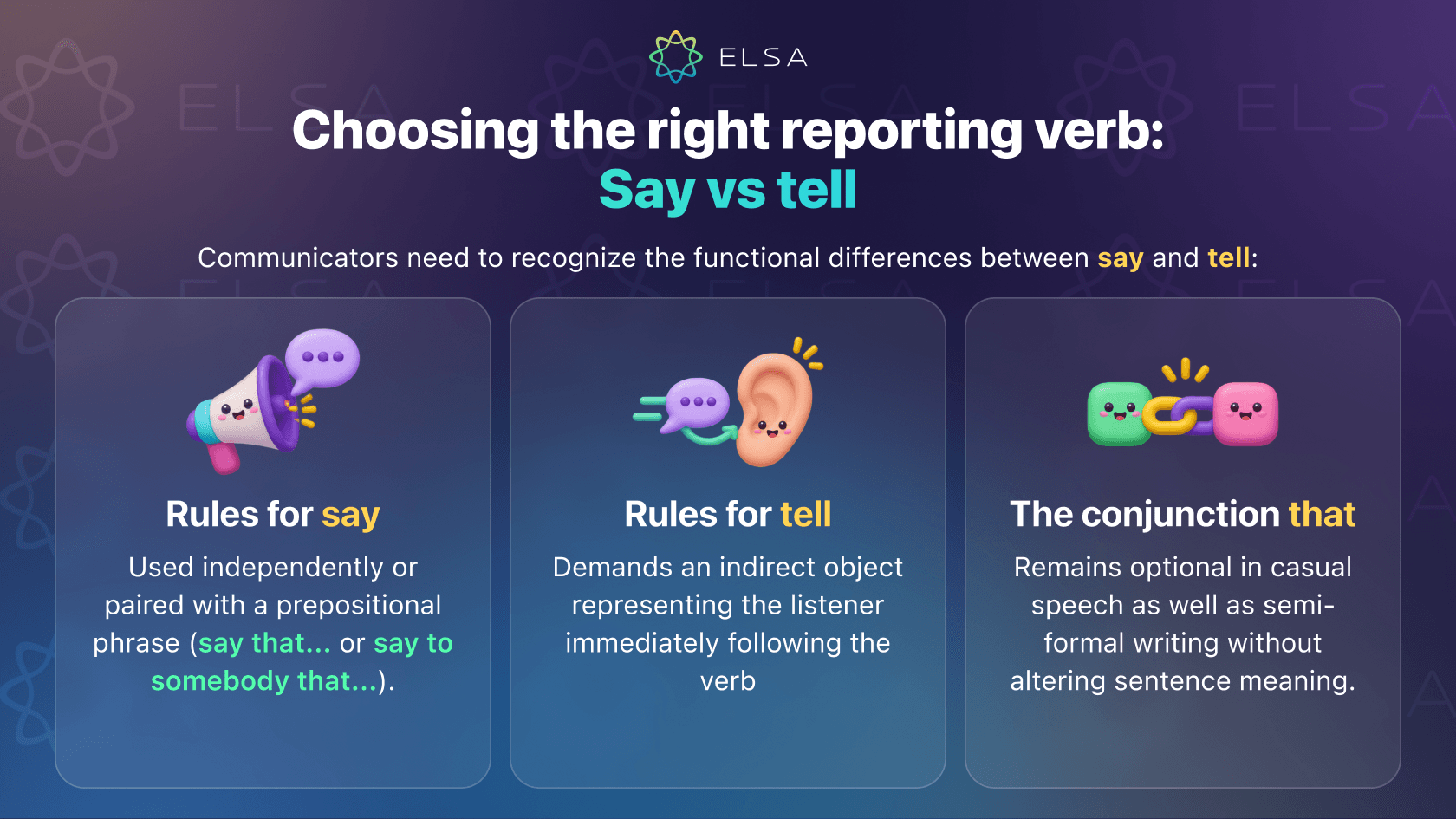
Choosing the right reporting verb: say vs tell
Knowing when to choose between "say" and "tell" can establish a grammatically sound foundation right at the beginning of the introductory clause.
- Say: Can be used independently or paired with a prepositional phrase (say that, say to somebody that, etc.). The primary focus remains on the spoken content itself.
- Tell: Used to demand an indirect object representing the listener immediately following the verb (tell somebody that...).
- The conjunction "that": Remains optional in casual speech as well as semi-formal writing without altering sentence meaning.
Formulas:
| S + said + (that) + ... S + said + to + O + (that) + ... S + told + O + (that) + ... |
For example: She said that she was busy.
⇒ She said to me that she was busy.
⇒ She told me that she was busy.
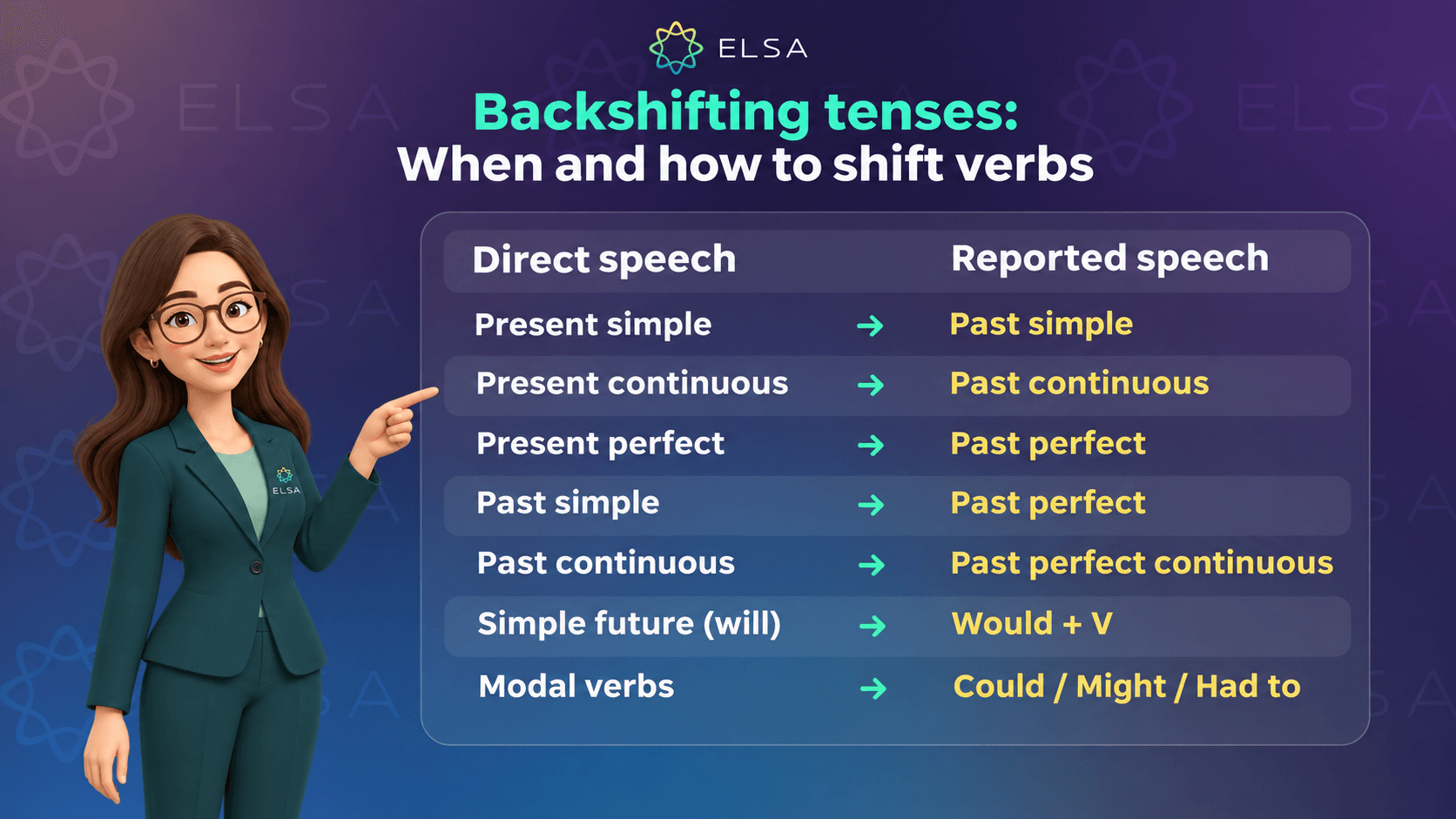
Backshifting tenses: When and how to shift verbs
When the reporting verb appears in a past tense form (such as said, told, informed), the primary verb inside the reported clause shifts one step into the past according to the table below:
| Direct speech | Reported speech | Verb shift | Example |
|---|---|---|---|
| Present simple | Past simple | work → worked | "I work here." → He said he worked there. |
| Present continuous | Past continuous | am watching → was watching | "I'm watching TV." → She said she was watching TV. |
| Present perfect | Past perfect | have been → had been | "I have visited Paris." → He said he had visited Paris. |
| Past simple | Past perfect | went → had gone | "I went home." → She said she had gone home. |
| Past continuous | Past perfect continuous | was driving → had been driving | "I was driving." → He said he had been driving. |
| Simple future (will) | Would + V | will call → would call | "I will call you." → She said she would call me. |
| Modal verbs | Could / Might / Had to | can → could | "I can swim." → He said he could swim. |
Note:
However, there are still some exceptions where backshifting is strictly omitted:
- The reporting verb appears in the present simple, present perfect, or future simple (says, tells, has said, will say).
- Example: She says she is tired.
→The reported statement expresses a universal scientific truth, a natural law, or an immutable general fact. - Example: The teacher said that the sun rises in the east.
→The reported situation remains ongoing or fully valid at the moment of reporting. - Example: She said: I live in New York.
→ She said she lives in New York (if the speaker currently resides in New York).
- Example: She says she is tired.
Shifting pronouns and possessive adjectives
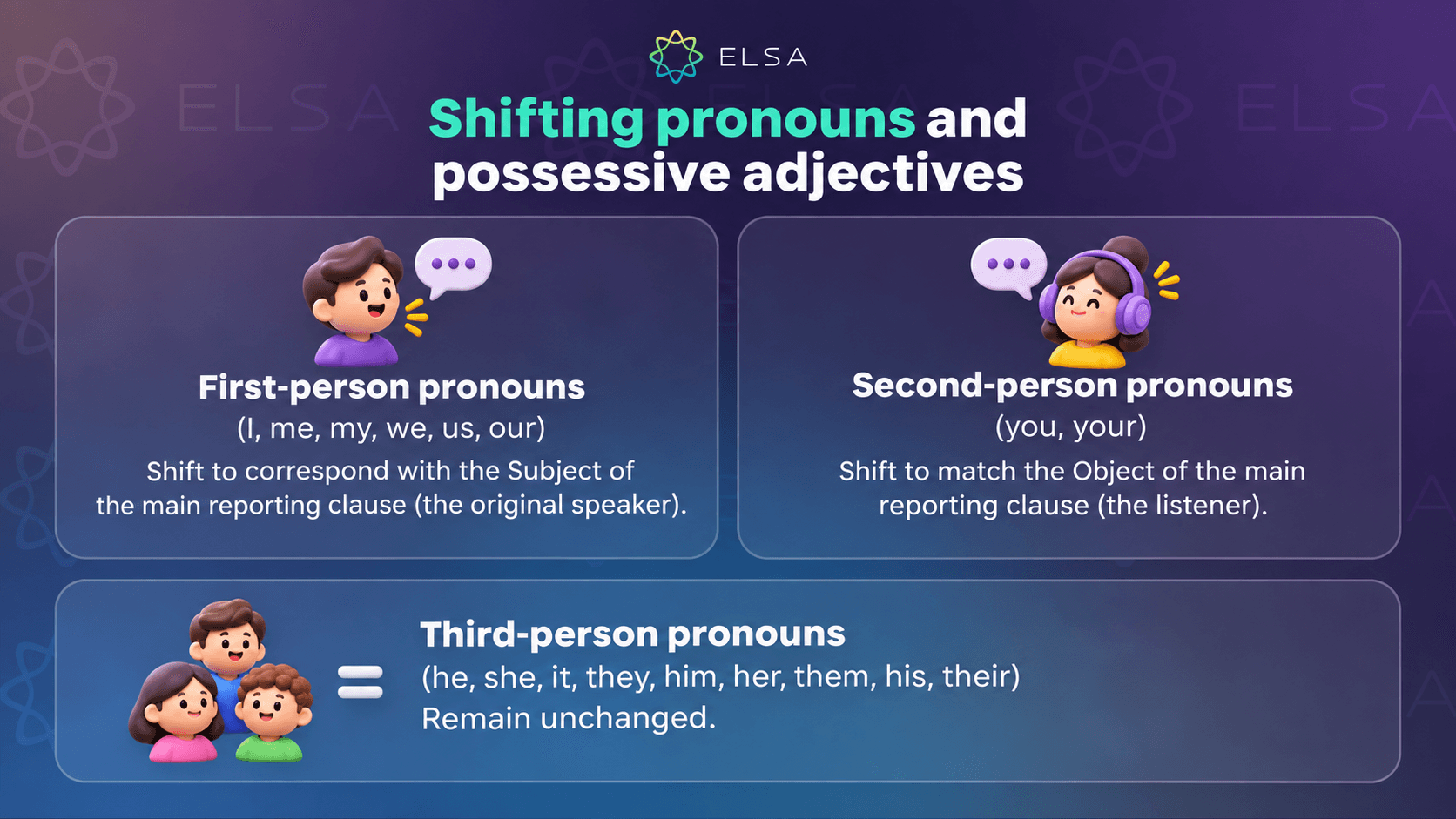
Adjusting personal pronouns and possessive determiners prevents confusion regarding who performed each action within the narrative. Pronoun conversions align directly with the roles of participants in the conversation:
- First-person pronouns (I, me, my, we, us, our): Shift to correspond with the Subject of the main reporting clause (the original speaker).
- Second-person pronouns (you, your): Shift to match the Object of the main reporting clause (the listener).
- Third-person pronouns (he, she, it, they, him, her, them, his, their): Remain unchanged.
For example:
Direct: John said to Mary: You have borrowed my book.
→ Reported: John told Mary that she had borrowed his book.
Adjusting time and place expressions
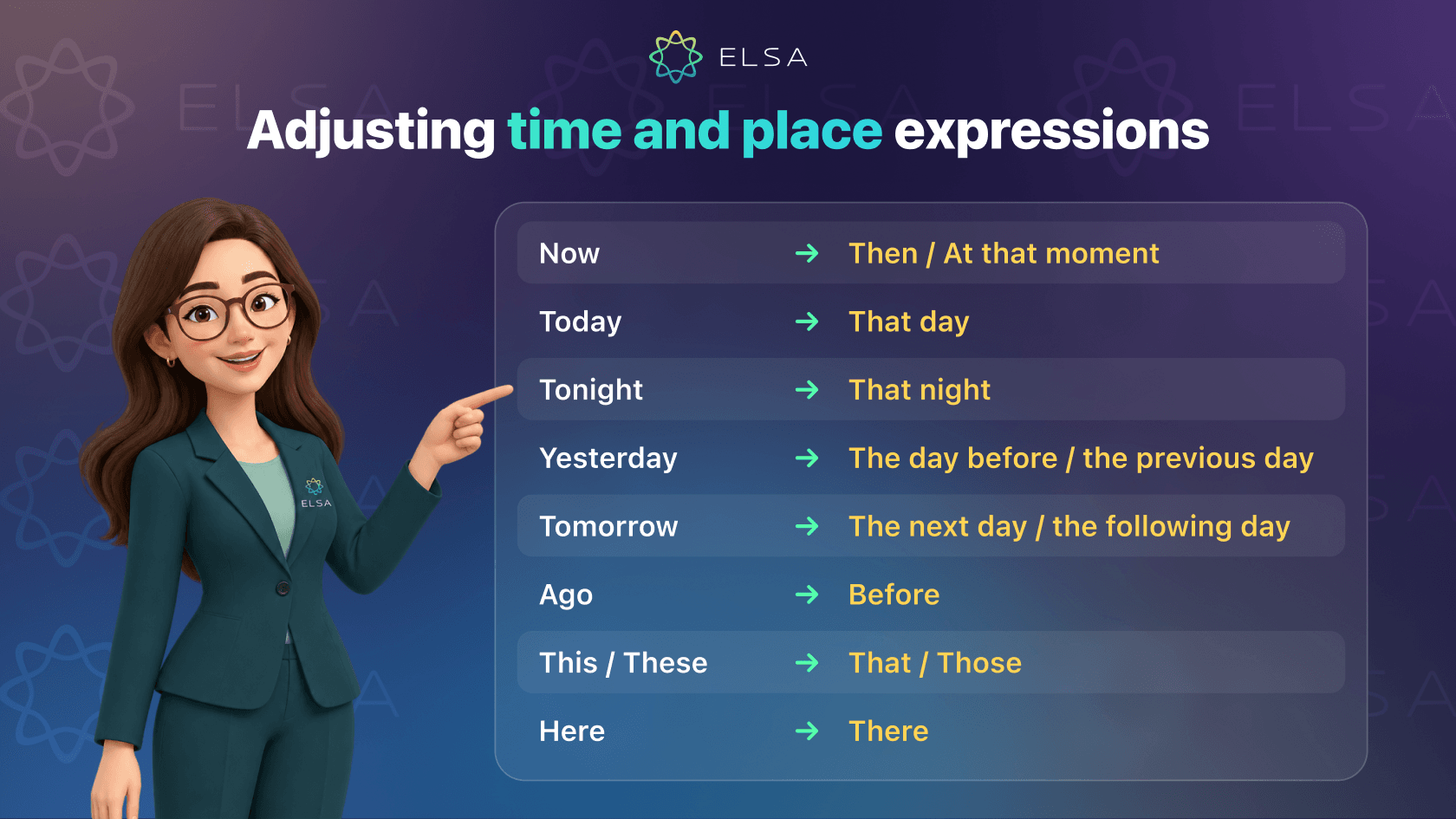
Modifying temporal and spatial markers accounts for the physical and chronological separation between the original utterance and the reporting setting. Near demonstratives and immediate time adverbs shift systematically to more distant equivalents.
| Direct speech | Reported speech | Example |
|---|---|---|
| Now | then / at that moment | "I am leaving now." → He said he was leaving then. |
| Today | that day | "We have a meeting today." → She said they had a meeting that day. |
| Tonight | that night | "I will finish it tonight." → He said he would finish it that night. |
| Yesterday | the day before / the previous day | "I arrived yesterday." → She said she had arrived the day before. |
| Tomorrow | the next day / the following day | "I will fly tomorrow." → He said he would fly the next day. |
| Ago | before | "I met him two days ago." → She said she had met him two days before. |
| This / These | that / those | "I like this shirt." → He said he liked that shirt. |
| Here | there | "Place the box here." → She told me to place the box there. |
Reporting questions
Converting interrogative structures into reported statements requires transforming inquiry syntax into standard affirmative sentence order.
Reporting Wh- questions
Handling information questions requires retaining the specific question word as a connector while eliminating question-based auxiliary inversions. Speakers keep the original interrogative word (Who, What, Where, When, Why, How), remove inverted auxiliary forms, and backshift the main verb in accordance with standard rules.
Formula:
| S + asked (+ O) / wanted to know / inquired + Wh-word + S + backshifted V |
For example:
- Direct speech: Where do you live? he asked.
- Reported speech: He asked me where I lived.
Reporting yes/no questions
Formula:
| S + asked (+ O) / wondered + if / whether + S + backshifted V |
For example:
- Direct speech: Have you completed the assignment? the teacher asked.
- Reported speech: The teacher asked if I had completed the assignment.
Reporting Commands, Requests, and Suggestions
Communicating directives, courteous inquiries, and recommendations in indirect speech commonly relies on infinitive verb structures or gerund patterns rather than standard that-clauses. This approach maintains the initial communicative intent while producing a concise and professional statement.
Commands and Polite Requests
Directives and polite requests require specific reporting verbs paired with infinitive phrases while omitting conversational politeness markers like please. Standard reporting verbs include tell, order, command (for directives and orders); ask, beg, request (for courteous requests).
Affirmative structural formula:
| S + told / asked / ordered + O + to + V |
Example:
- Direct Speech: Please submit your feedback before noon, the manager said.
- Reported Speech: The manager asked us to submit our feedback before noon.
Passive form
| S + told / asked / ordered + O + not + to + V |
For example:
- Direct Speech: Do not share this confidential document, the director said to him.Reported Speech: The
- director told him not to share that confidential document.
Suggestions and Advice
Sharing actionable recommendations and constructive guidance in reported discourse incorporates gerund structures or subjunctive clauses. Frequent reporting verbs for this category include suggest, recommend, and advise. Learners can apply two versatile patterns:
Gerund Pattern:
| S + suggested / recommended + V-ing |
For example:
- Direct Speech: Let us review the contract together, Emily said.
- Reported Speech: Emily suggested reviewing the contract together.
Subjunctive Clause Pattern:
| S + suggested that + S + (should) + V |
For example:
- Direct Speech: You should take a short break after working for hours, the doctor said.
- Reported Speech: The doctor advised that he should take a short break after working for hours.
Practice exercises on reported speech
Exercise 1: Convert Direct Speech into Reported Speech
Apply the full sequence of tense backshifting, pronoun adjustments, and temporal shifts to the ten direct statements below.
- I am working on a new marketing campaign, Linda said.
- We visited our grandparents two weeks ago, James said.
- Can you send me the financial report tomorrow? the director asked Helen.
- I have never seen such an impressive presentation, Mark told me.
- Why did you not attend the conference yesterday? the manager asked Susan.
- Do not open this attachment, the IT specialist told the employees.
- I will help you with your project tonight, Henry said to Mary.
- Are you planning to study abroad next year? Liam asked his sister.
- Let us organize a team-building trip, Jessica said.
- The Earth orbits the Sun, the geography lecturer explained.
Exercise 2: Multiple Choice Questions on Reported Speech Rules
Test your ability to identify correct reporting syntax and avoid common grammatical pitfalls through ten objective multiple-choice questions.
1. She told me that she _____ her keys that morning.
A. lost
B. has lost
C. had lost
D. is losing
2. The supervisor asked us where _____ the project files.
A. did we store
B. we had stored
C. had we stored
D. we store
3. My colleague said that water _____ at 100 degrees Celsius.
A. boils
B. boiled
C. had boiled
D. was boiling
4. Emma asked me _____ I wanted to join their study group.
A. that
B. weather
C. if
D. what
5. The team leader told everyone _____ noise during the presentation.
A. to not make
B. not making
C. not to make
D. do not make
6. He said to me: I will call you tomorrow. → He told me that he _____ me the next day.
A. would call
B. will call
C. called
D. had called
7. John asked his manager: Why are you rescheduling the meeting? → John asked his manager why _____ the meeting.
A. was he rescheduling
B. he was rescheduling
C. is he rescheduling
D. he rescheduled
8. Sophia said: I finished my report two days ago. → Sophia said that she had finished her report two days _____.
A. ago
B. later
C. before
D. after
9. Daniel said that he _____ in London since 2018.
A. has been living
B. had been living
C. is living
D. lives
10. The teacher advised that we _____ more time practicing pronunciation.
A. should spend
B. spent
C. had spent
D. spending
FAQs about Reported Speech
When do you NOT need to backshift in reported speech?
Backshifting is unnecessary when the reporting verb is in the present or future tense (such as says, tells, will say). Furthermore, when the statement conveys an established scientific truth, a permanent natural law, or a situation that remains fully active and true at the time of speaking (for instance: David said he is 25 years old), the verb remains in its present form.
What is the main difference between "say" and "tell"?
The verb tell requires an indirect object indicating the recipient immediately after the verb (structure: tell somebody something). Conversely, say focuses on the verbal message itself and does not take a direct personal object; if the listener is mentioned with say, the preposition to is mandatory (structure: say to somebody). Standard usage requires He told me or He said to me, whereas He said me is grammatically incorrect.
Why does word order change in reported questions?
When an interrogative statement transforms into indirect speech, the inquiry ceases to function as a standalone question and becomes a declarative noun clause acting as the object of the sentence. English grammar mandates standard declarative word order for these clauses: Subject precedes Verb (S + V). Inverted question auxiliaries (do, does, did) are removed, and a period concludes the statement instead of a question mark.
Mastering reported speech builds a dependable foundation for communicating ideas, instructions, and discussions with professional polish. To transform grammatical rules into natural speaking reflexes with precision down to individual syllables, practice with ELSA Speak today. Powered by award-winning proprietary speech recognition AI, ELSA Speak empowers English learners to participate confidently in meetings, speak with authentic intonation, and achieve comprehensive English fluency every single day.