

Present perfect continuous tense in English: Definition and formula
elsaspeakadmin
September 25, 2026
English tenses
The present perfect continuous tense is especially useful when you want to emphasize the longevity of action or an activity has been happening or its connection to the present. This article will show you the present perfect continuous tense definition, along with the formulas, usages, signal words and examples to help you use this tense more accurately.
Present perfect continuous tense explanation
Present perfect continuous tense definition
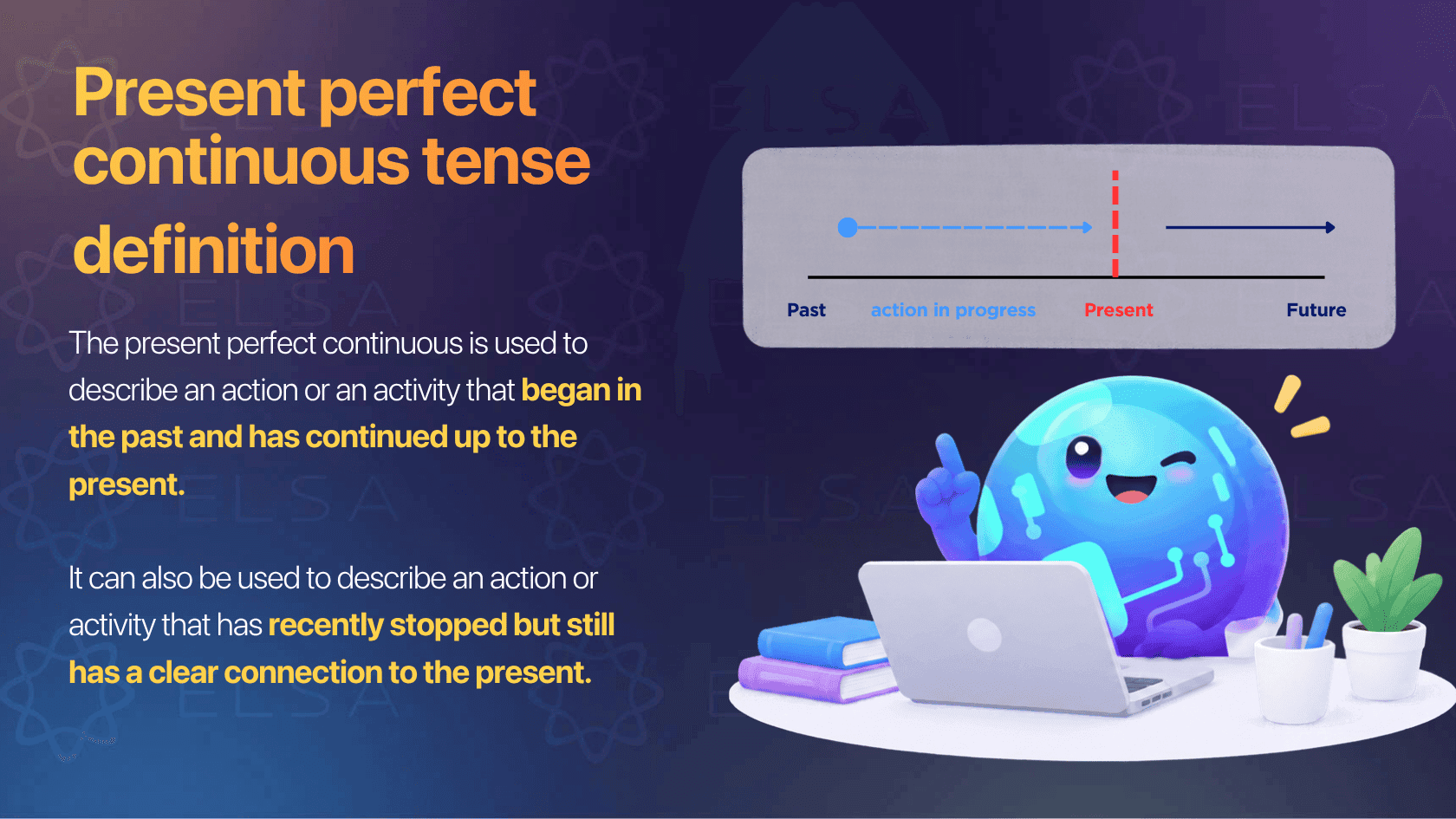
Unlike the present perfect tense which focuses on a result or completed action, the present perfect continuous is used to describe an action or an activity that began in the past and has continued up to the present. It can also be used to describe an action or activity that has recently stopped but still has a clear connection to the present.
Here are some present perfect continuous tense examples:
- She has been working in that company for 5 years.
- I have been studying German since 2020.
When to use the perfect present continuous tense?
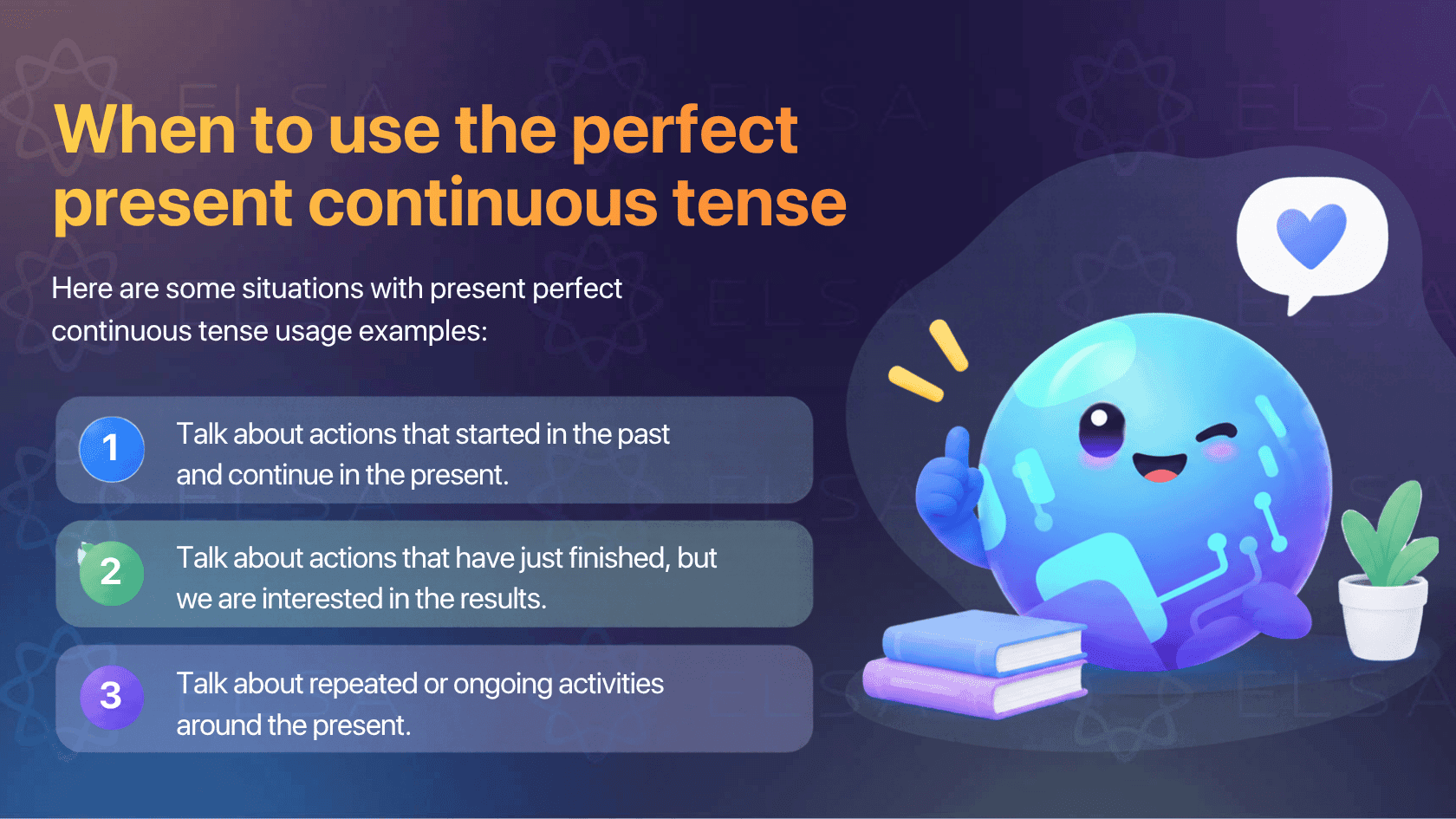
Here are some situations with present perfect continuous tense usage examples:
- Talk about actions that started in the past and continue in the present. Use this tense when you want to talk about an activity that began in the past and is still happening now. It is useful if you want to talk about the duration of an action.
- For example: John has been learning Spanish for 3 years.
- Talk about actions that have just finished, but results are being interested. Use it when an activity recently stopped and its effects are still noticeable or relevant now.
- For example: She has not been sleeping well, so she’s tired.
- Talk about repeated or ongoing activities around the present. Use it for activities that have been happening repeatedly or ongoing during a recent period, even if they are not happening at the exact moment of speaking.
- For example: He has been going to the gym a lot lately.
How to form the present perfect continuous tense?
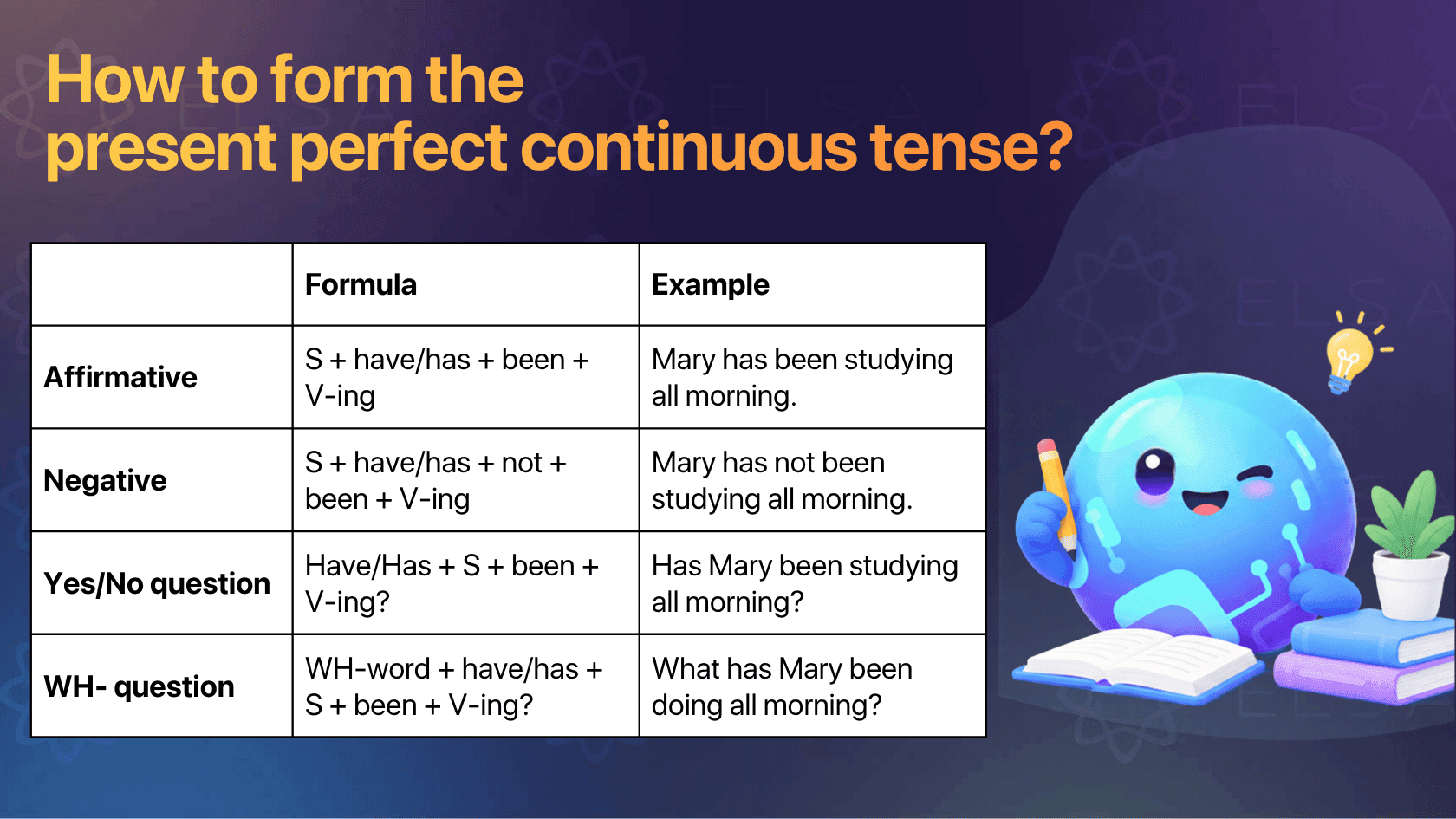
Below are the present perfect continuous tense formulas with examples:
| Formula | Example | |
| Affirmative | S + have/has + been + V-ing | Mary has been studying all morning. |
| Negative | S + have/has + not + been + V-ing | Mary has not been studying all morning. |
| Yes/No question | Have/Has + S + been + V-ing? | Has Mary been studying all morning? |
| WH- question | WH-word + have/has + S + been + V-ing? | What has Mary been doing all morning? |
Signal words for present perfect continuous
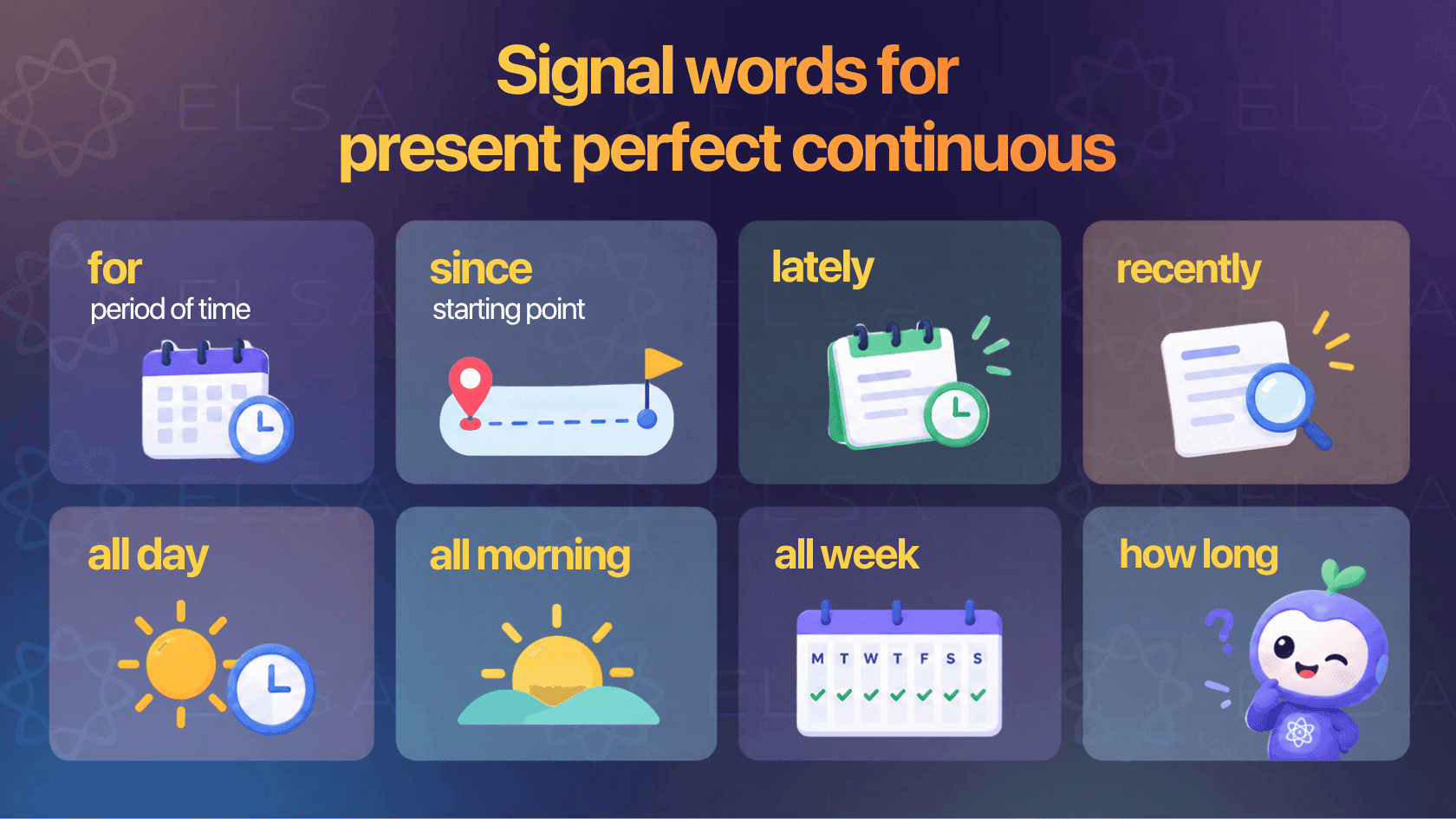
Below are signal words for the present perfect continuous tense structure:
| Signal word | Example |
| for + period of time | He has been reading for 2 hours. |
| since + starting point | She has been working since 9 a.m. |
| lately | He hasn’t been feeling well lately. |
| recently | We have been travelling a lot lately. |
| all day | He’s been playing the guitar all day. |
| all morning | Harry has been studying all morning. |
| all week | John and Dave have been preparing for the vacation all week. |
| how long | How long have you been staying here? |
Present perfect continuous vs. other tenses
Present perfect continuous vs. Present perfect tense
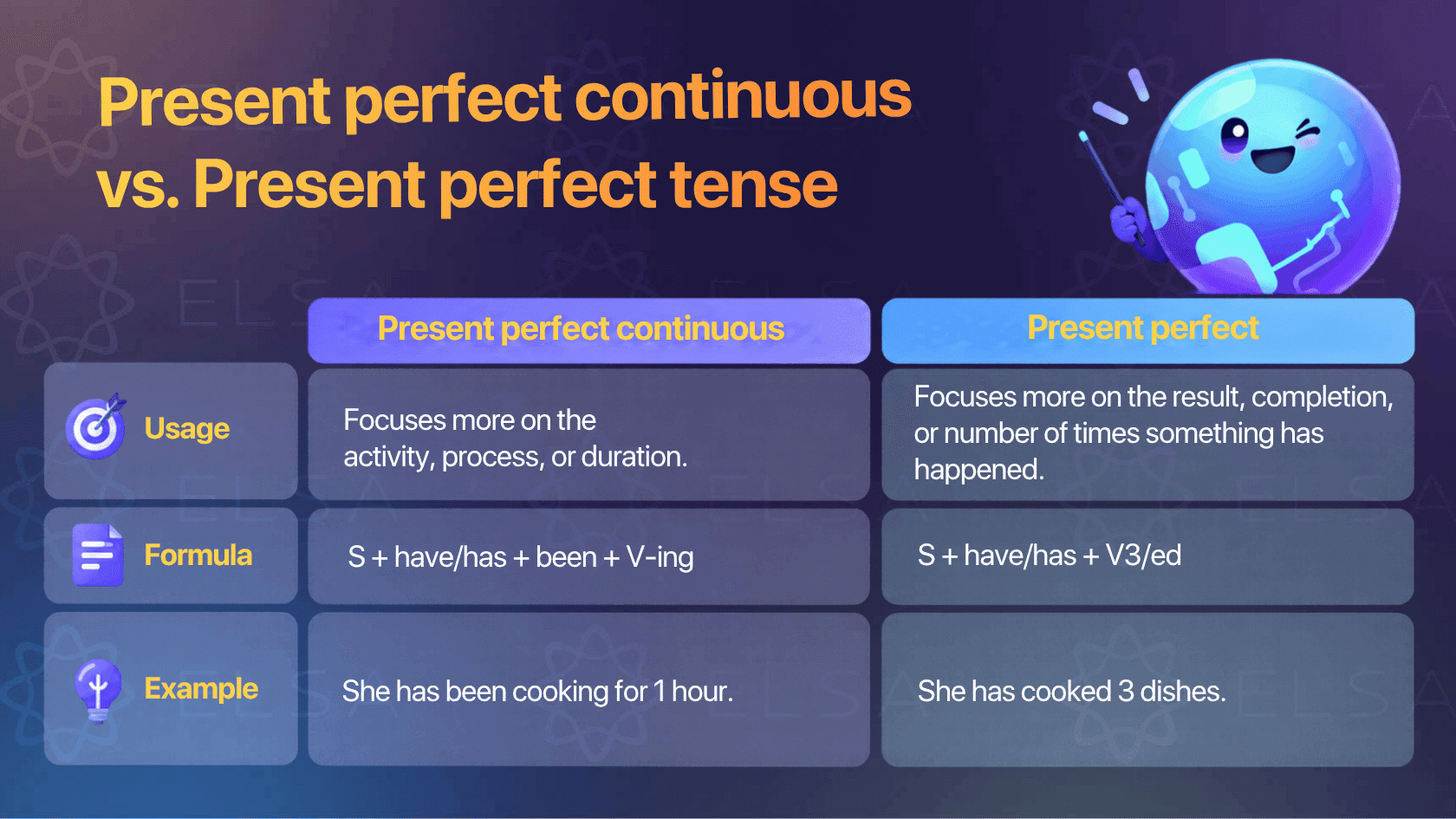
Both tenses can describe actions connected to the present, but they usually emphasize different aspects of the action.
| Present perfect continuous | Present perfect | |
| Usage | Focuses more on the activity, process, or duration. | Focuses more on the result, completion, or number of times something has happened. |
| Formula | S + have/has + been + V-ing | S + have/has + V3/ed |
| Example | She has been cooking for 1 hour. | She has cooked 3 dishes. |
Present perfect continuous vs. Present continuous
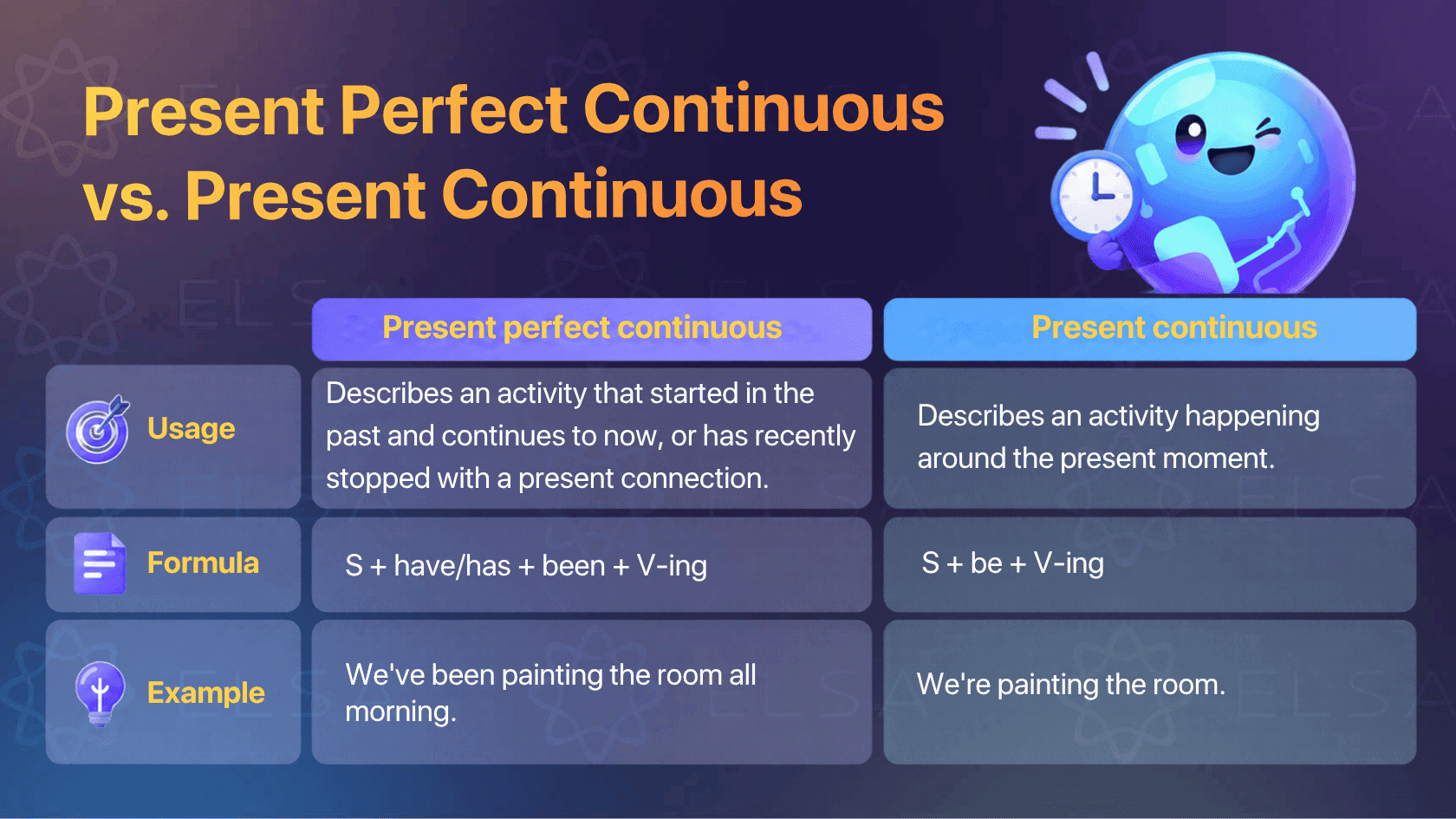
Both tenses can describe ongoing activities, but they place the activity at different points in time.
| Present perfect continuous | Present continuous | |
| Usage | Describes an activity that started in the past and continues to now, or has recently stopped with a present connection. | Describes an activity happening around the present moment. |
| Formula | S + have/has + been + V-ing | S + be + V-ing |
| Example | We’ve been painting the room all morning. | We’re painting the room. |
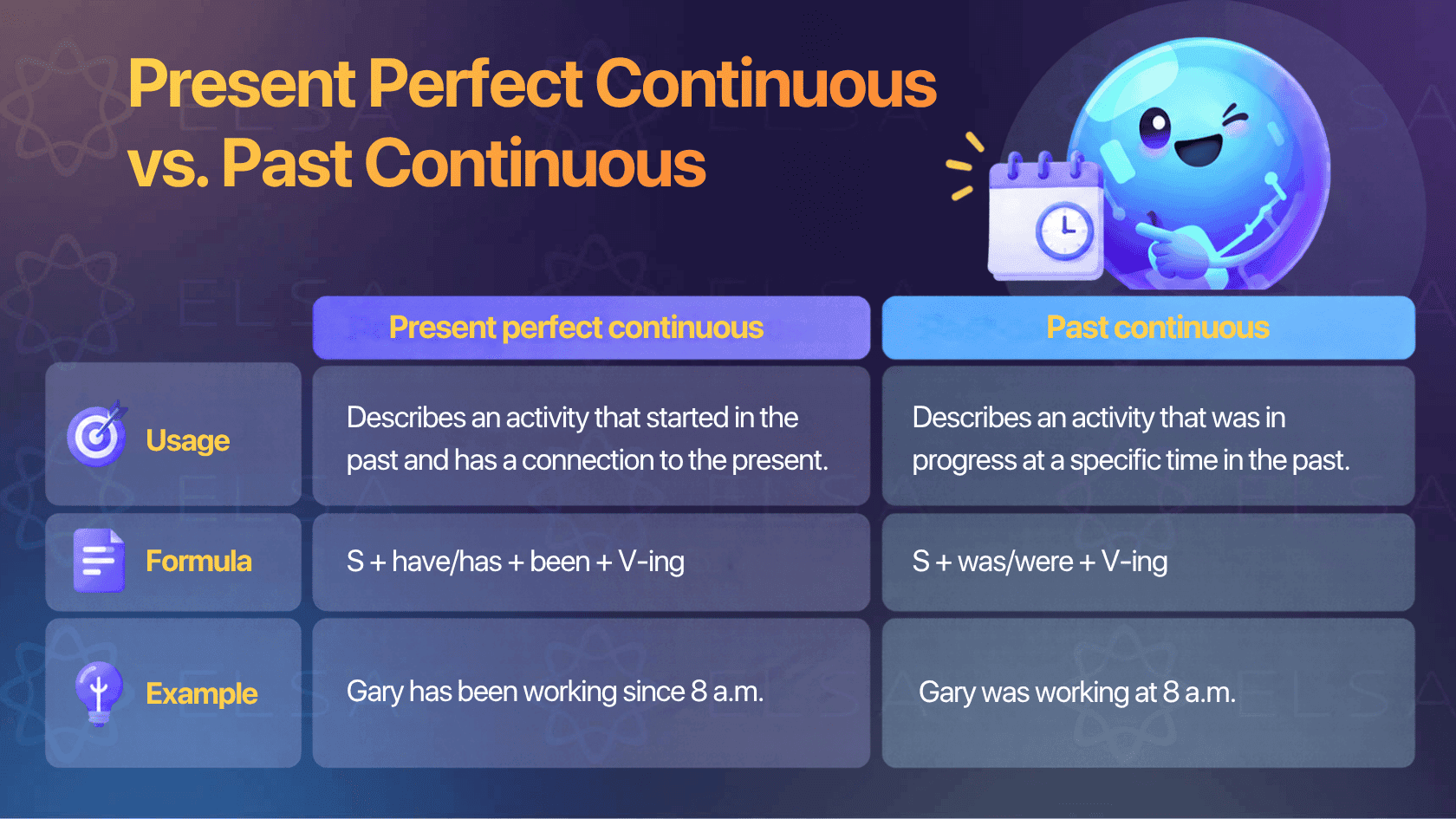
Present Perfect Continuous vs. Past Continuous
The main difference is the time reference. The present perfect continuous connects a past activity to now, while the past continuous places an ongoing activity at a specific point in the past.
| Present perfect continuous | Past continuous | |
| Usage | Describes an activity that started in the past and has a connection to the present. | Describes an activity that was in progress at a specific time in the past. |
| Formula | S + have/has + been + V-ing | S + was/were + V-ing |
| Example | Gary has been working since 8 a.m. | Gary was working at 8 a.m. |
Present perfect continuous vs. Simple present
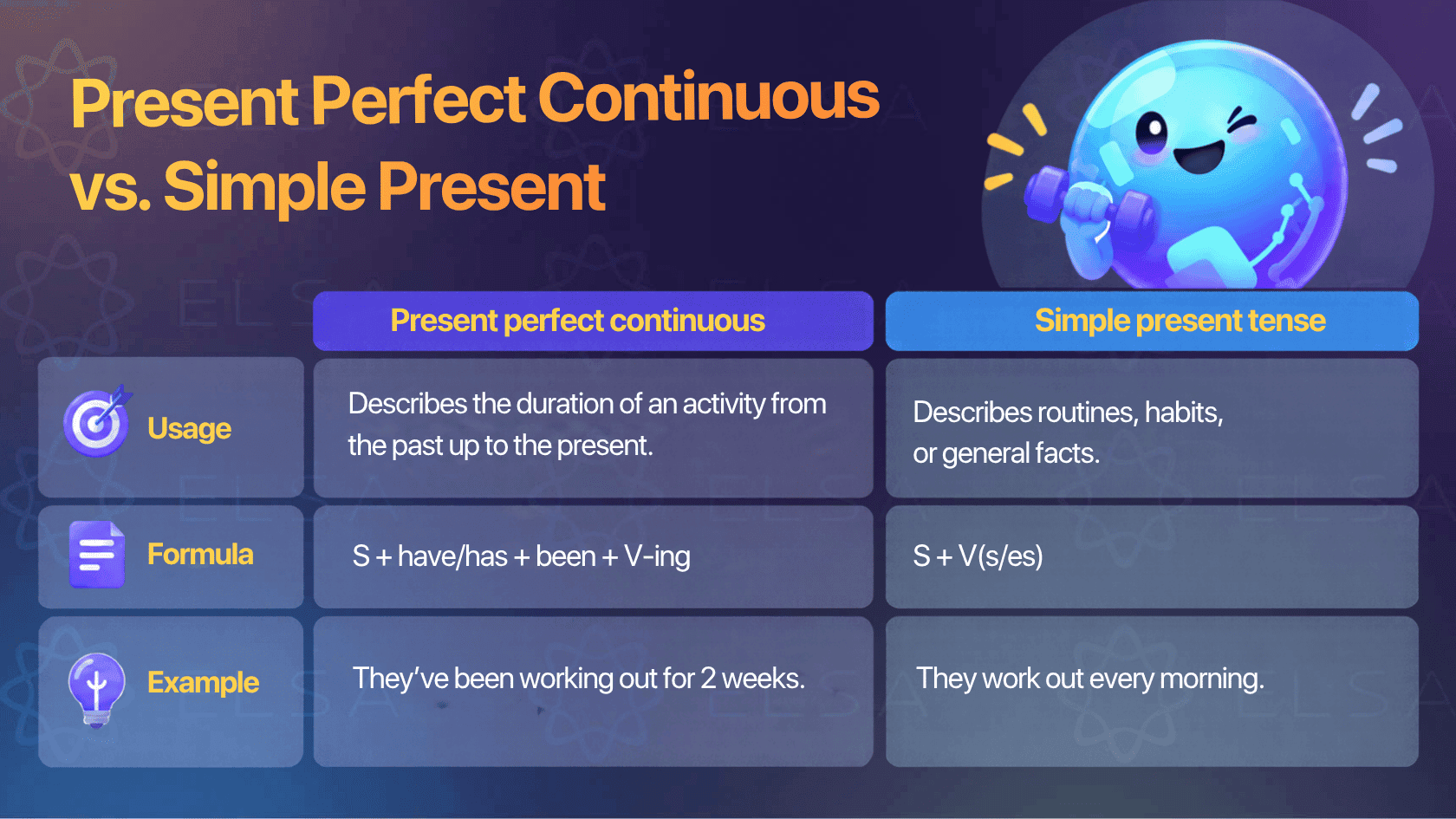
These tenses can both describe ongoing activities, but they answer different questions.
| Present perfect continuous | Simple present tense | |
| Usage | Describes the duration of an activity from the past up to the present. | Describes routines, habits, or general facts. |
| Formula | S + have/has + been + V-ing | S + V(s/es) |
| Example | They’ve been working out for 2 weeks. | They work out every morning. |
Stative verbs and the present perfect continuous
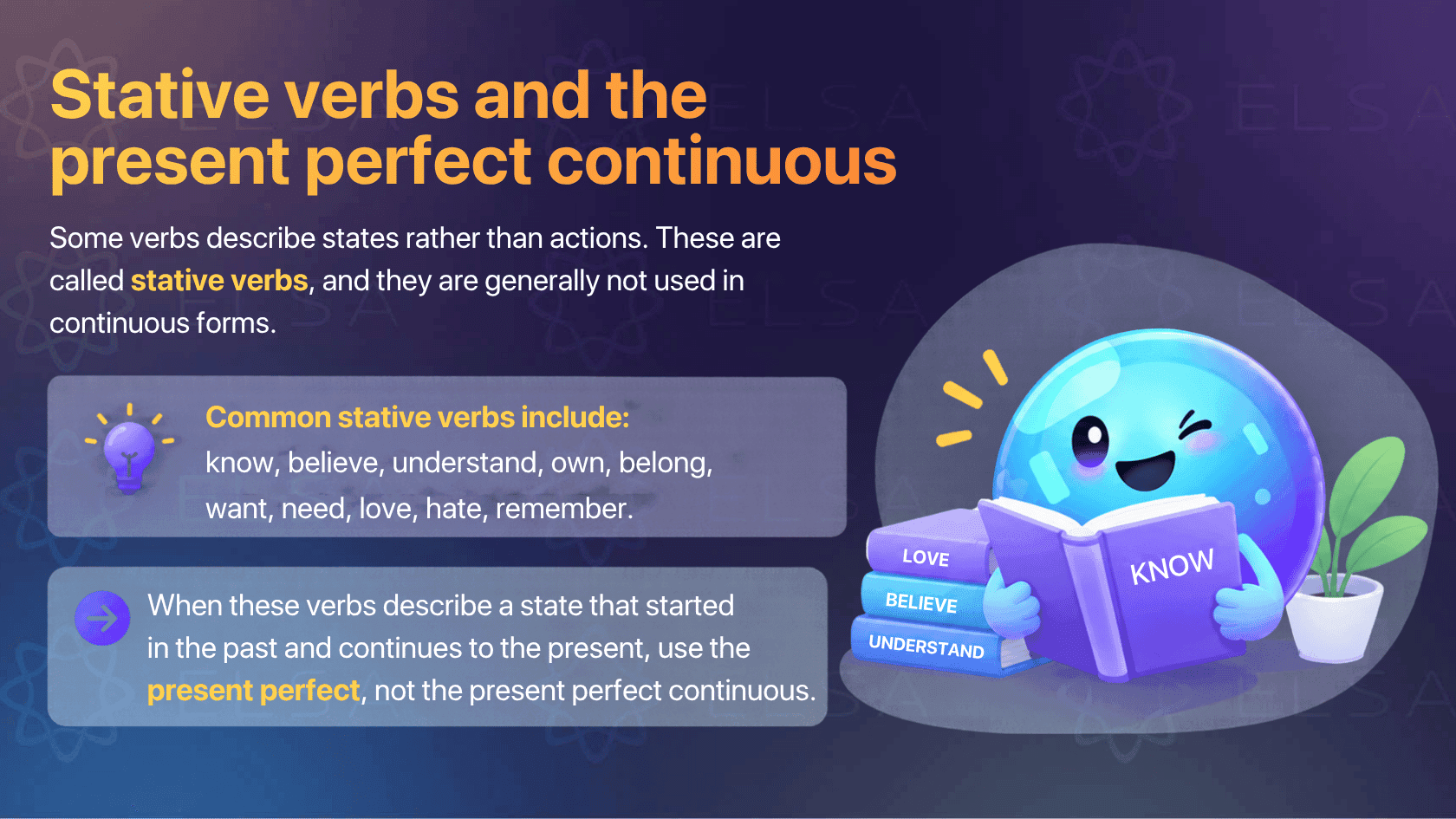
Some verbs describe states rather than actions. These are called stative verbs, and they are generally not used in continuous forms.
| Common stative verbs include: know, believe, understand, own, belong, want, need, love, hate, remember. |
→ When these verbs describe a state that started in the past and continues to the present, use the present perfect, not the present perfect continuous.
For example: I have known her for ten years.
Not: I have been knowing her for ten years.
→ Here, the verb “know” describes a state, so the present perfect is more appropriate.
Present perfect continuous tense exercises
Exercise 1: Complete each sentence using the correct form of the present perfect continuous.
- I ______ English for three years. (study)
- She ______ all morning. (work)
- They ______ for the bus for 20 minutes. (wait)
- He ______ a lot lately. (travel)
- We ______ this project since Monday. (work on)
- You look tired. ______ you ______? (run)
- My sister ______ for her exams all week. (study)
- It ______ since early this morning. (rain)
- How long ______ you ______ at this company? (work)
- The children ______ outside for hours. (play)
Exercise 2: Choose the correct answer
1. I ______ this book for two hours.
a. have read
b. have been reading
c. am reading
2. She ______ three emails this morning.
a. has written
b. has been writing
c. is writing
3. They ______ tennis since 4 p.m.
a. have played
b. have been playing
c. are playing
4. I ______ him since college.
a. have been knowing
b. have known
c. am knowing
5. Look at your clothes! You ______ in the garden.
a. have worked
b. have been working
c. are working
6. He ______ at this company for ten years.
a. has worked
b. has been working
c. Both can be correct depending on the intended emphasis.
7. We ______ a lot of progress recently.
a. have made
b. have been making
c. are making
8. How long ______ you ______ English?
a. have / been learning
b. are / learning
c. did / learn
9. She ______ the piano every evening lately.
a. has been practicing
b. is practicing
c. practiced
10. I ______ this car since 2020.
a. have been owning
b. have owned
c. am owning
The present perfect continuous tense helps you connect a past activity to the present, especially when you want to emphasize duration, ongoing activity, or a recent result. With regular practice, you can become more confident using the present perfect continuous in everyday conversations and writing. For more practical grammar lessons and English learning tips, visit the Grammar category on the ELSA Speak blog.