

Simple past tense: Rules, uses, examples with exercises
elsaspeakadmin
September 21, 2026
English tenses
The simple past tense is one of the most commonly used English tenses. It is often used to talk about completed actions or situations in the past. This guide will walk you through simple past tense definition, how to use it, along with past simple tense examples and exercises.
What is simple past tense?
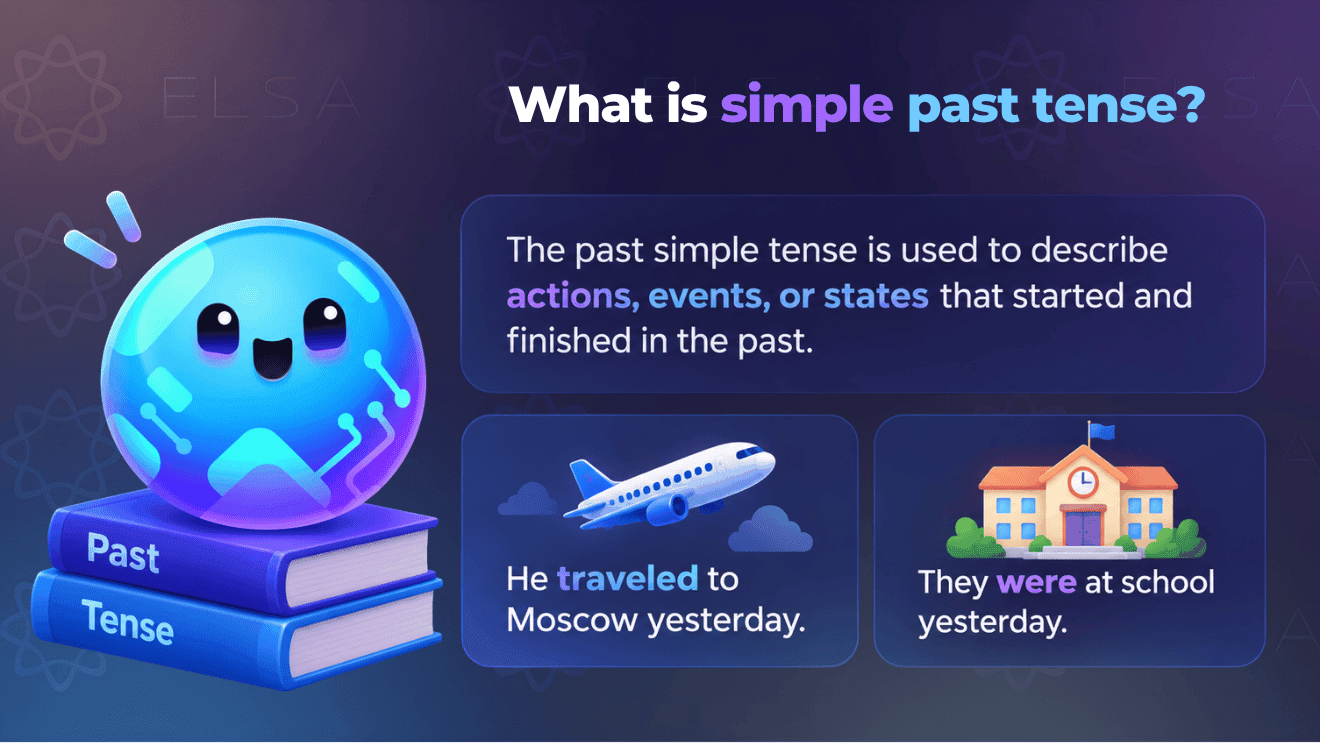
The past simple tense is used to describe actions, events, or states that started and finished in the past. The exact time may be stated or understood from the context.
For regular verbs, the past form is usually made by adding -ed to the base verb. Irregular verbs have their own past forms.
Simple past tense definition examples:
- He traveled to Moscow yesterday.
- They were at school yesterday.
When to use the past simple tense?
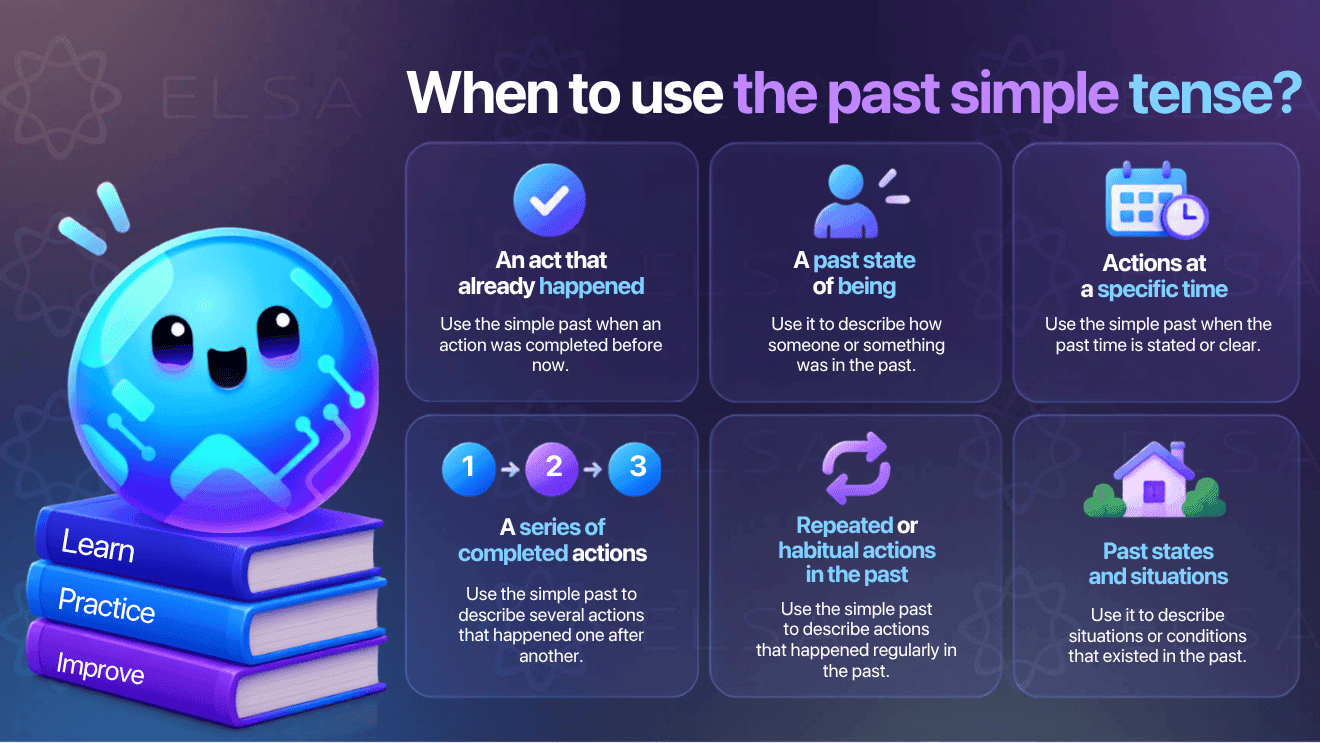
When talking about the past, the past simple tense can be used in several situations:
- To talk about an action that already happened: Use the simple past when an action was completed before now.
- For example: Ben finished his homework last night.
- To talk about a past state of being: Use it to describe how someone or something was in the past.
- For example: He was very tired after work.
- Actions that happened at a specific time: Use the simple past when the past time is stated or clear.
- For example: They went to bed at 9 p.m.
- A series of completed actions: Use the simple past to describe several actions that happened one after another.
- For example: We went home, had dinner, and went to bed.
- Repeated or habitual actions in the past: Use the simple past to describe actions that happened regularly in the past.
- For example: When I was a child, I played basketball every weekend.
- Past states and situations: Use it to describe situations or conditions that existed in the past.
- For example: My parents lived in Texas for many years.
Simple past tense formula
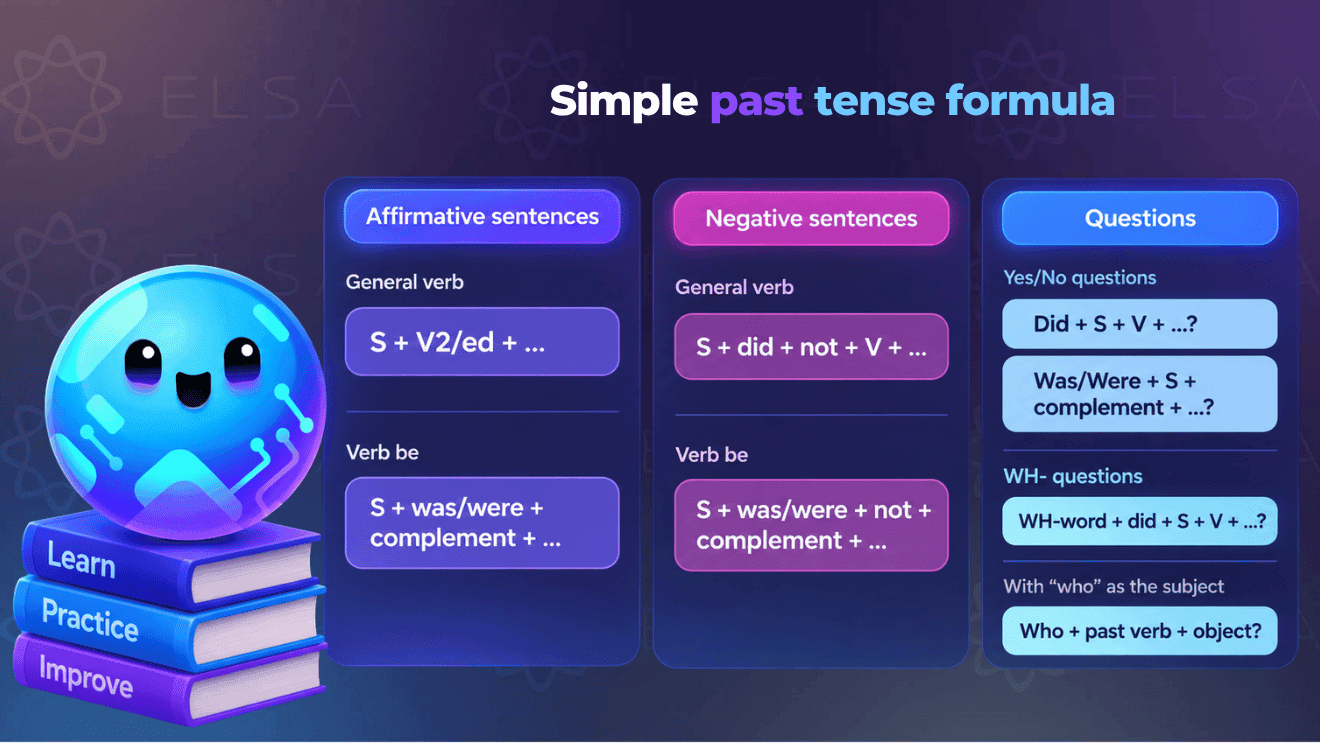
Here are the formulas along with simple past tense examples:
Affirmative sentences
Formula:
| S + V2/ed + … |
For example: He read the book at 8 P.M.
For the verb be, use was with I/he/she/it and were with you/we/they.
Formula:
| S + was/were + complement + … |
For example: They were tired after the party.
Negative sentences
Formula:
| S + did + not + V + … |
For example: She didn’t go to class yesterday morning.
With the verb be, use was not (wasn't) or were not (weren't) instead of didn't.
Formula:
| S + was/were + not + complement + … |
For example: He wasn’t sick last week.
Questions
Yes/No questions
Questions in the simple past generally use did + subject + base verb. With be, use was/were directly.
Formula with verb:
| Did + S + V + …? |
For example: Did you go to work yesterday?
Formula with be:
| Was/Were + S + complement + …? |
For example: Were they at home?
WH- questions
Formula:
| WH-word + did + S + V + ..? |
For example: Where did you go?
However, when the “who” word is the subject, did is not normally used:
| Who + past verb + object? |
For example: Who visited you last night?
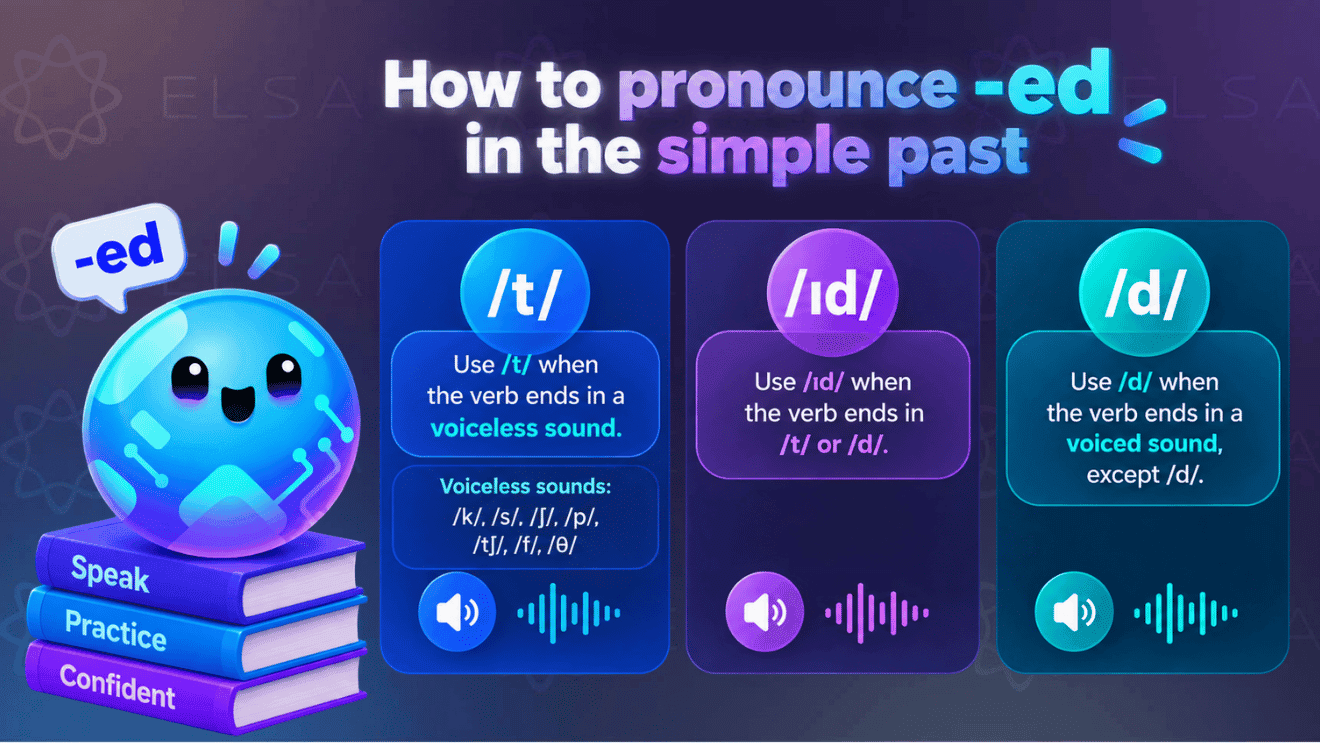
How to pronounce -ed in the simple past
In the past simple tense, the -ed ending of the verbs has three common pronunciations: /t/, /d/, and /ɪd/. However, each pronunciation depends on the final sound of the base verb, not its spelling:
- -ed is pronounced as /t/: When the verb ends in a voiceless sound (/k/, /s/, /ʃ/, /p/, /tʃ/, /f/, or /θ/).
- For example: washed /wɑːʃt/, laughed /læft/
- -ed is pronounced as /ɪd/: When the base verb ends in sounds /t/ or /d/.
- For example: wanted /ˈwɑːntɪd/, needed /ˈniːdɪd/
- -ed is pronounced as /d/: When the verb ends in a voiced sound, except /d/.
- For example: played /pleɪd/, cleaned /kliːnd/
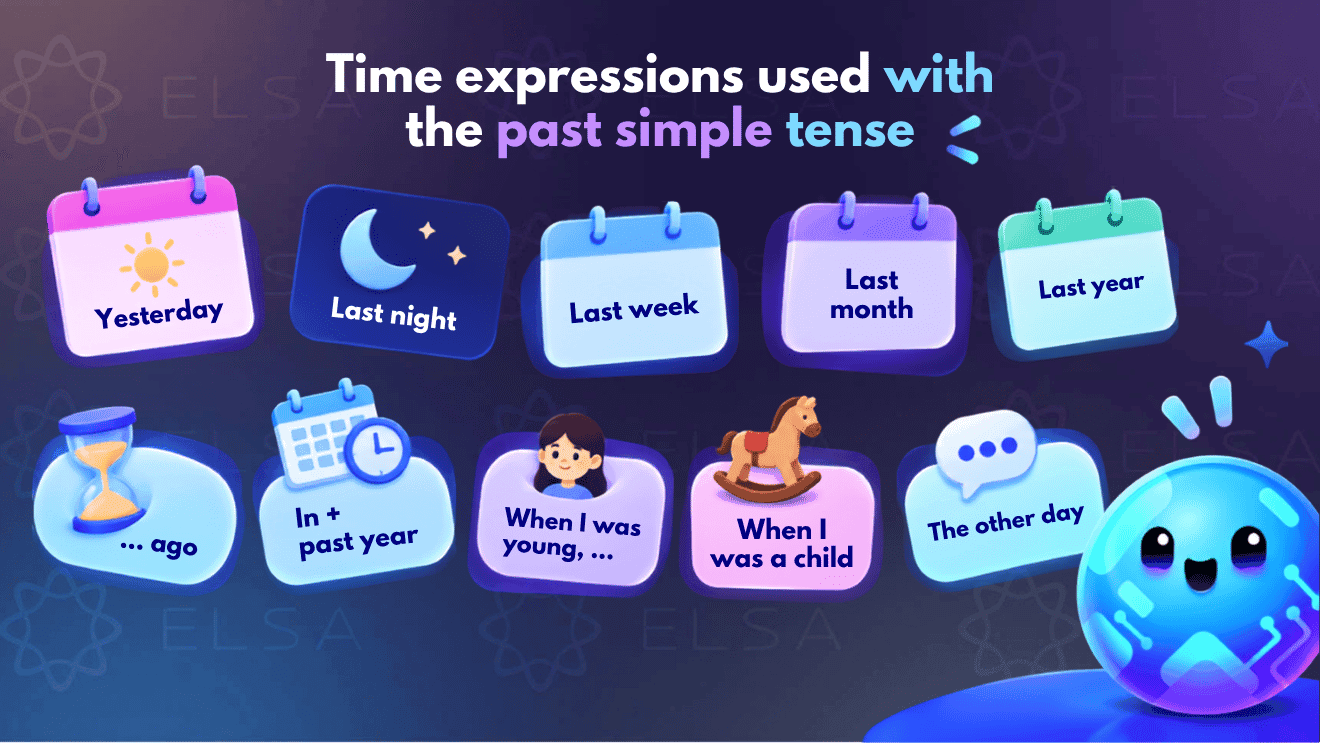
Time expressions used with the past simple tense
| Time expressions | Examples |
| Yesterday | He fixed his car yesterday. |
| Last night | They went to bed early last night. |
| Last week | She went to the store last week. |
| Last month | We went on a road trip last month. |
| Last year | Harry worked as a waiter last year. |
| …ago | Mary called him two hours ago. |
| In + past year | They moved to Vietnam in 2010. |
| When I was young, … | When I was young, I listened to the radio every weekend. |
| When I was a child | I loved playing on the monkey bars when I was a child. |
| The other day | He visited his grandparents the other day. |
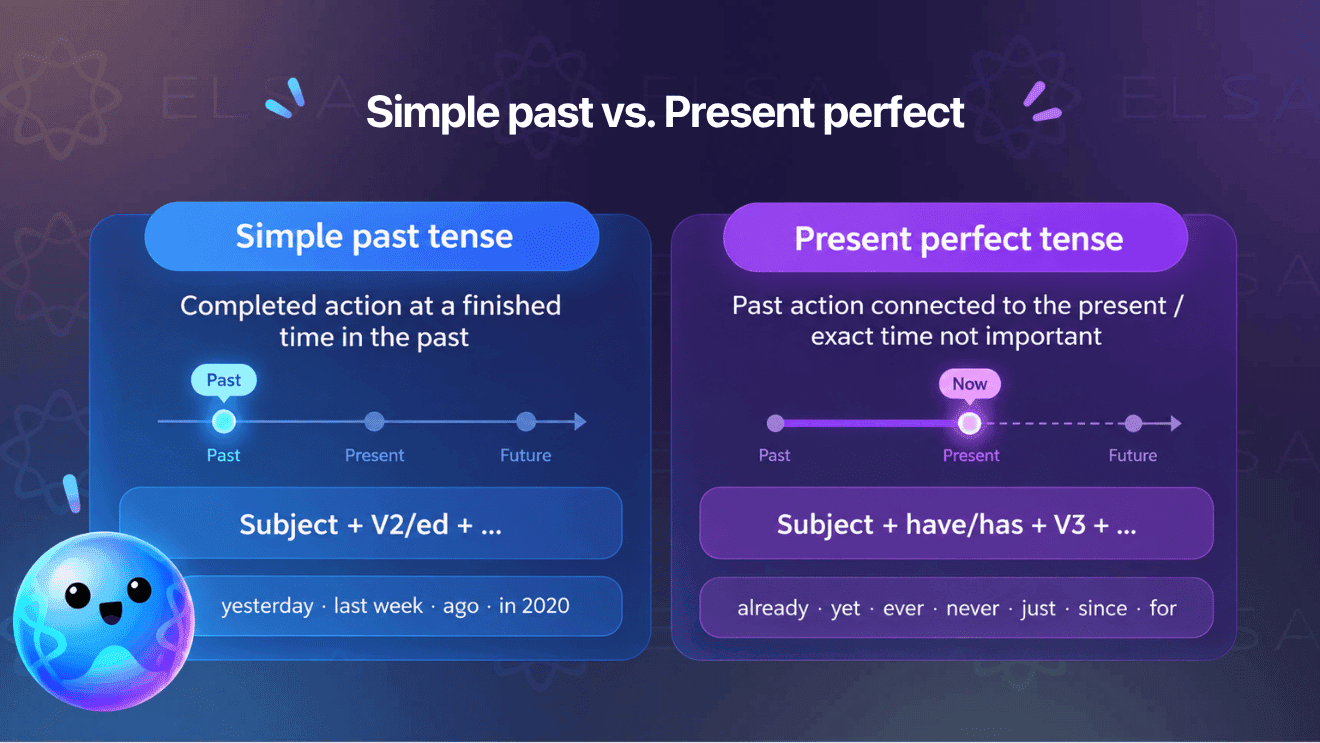
Simple past vs. Other English tenses
Understanding how the simple past differs from similar tenses can help you choose the correct tense more confidently.
Simple past vs. Present perfect
| Simple past tense | Present perfect tense | |
| Usage | For completed actions at a finished time in the past. | For past actions connected to the present or when the exact time is not important. |
| Formula | Subject + V2/ed + … | Subject + have/has + V3 + … |
| Common signals | yesterday, last week, ago, in 2020, etc. | already, yet, ever, never, just, since, for |
| Example | I visited Japan in 2023. | I have visited Japan three times. |
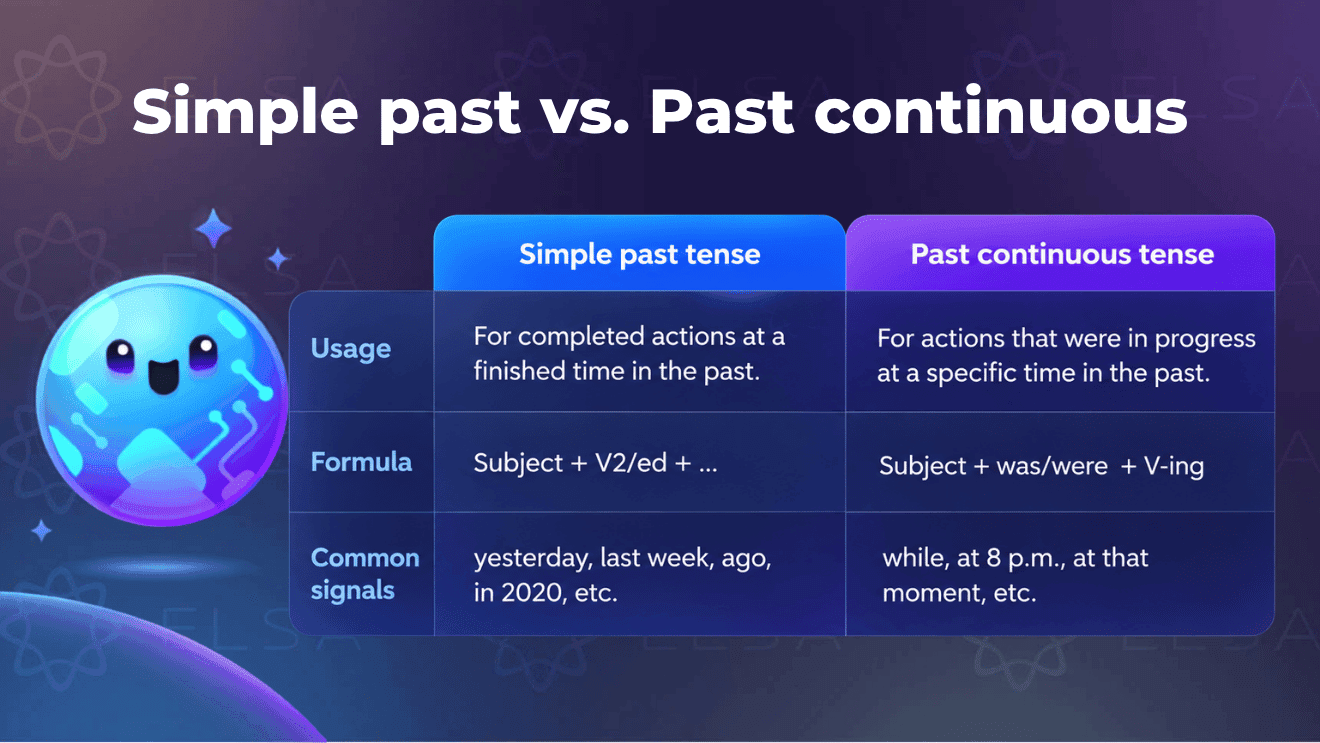
Simple past vs. Past continuous
| Simple past tense | Past continuous tense | |
| Usage | For completed actions at a finished time in the past. | For actions that were in progress at a specific time in the past |
| Formula | Subject + V2/ed + … | Subject + was/were + V-ing |
| Common signals | yesterday, last week, ago, in 2020, etc. | while, at 8 p.m., at that moment, etc |
| Example | I called her at 8 p.m. | I was calling her when you arrived. |
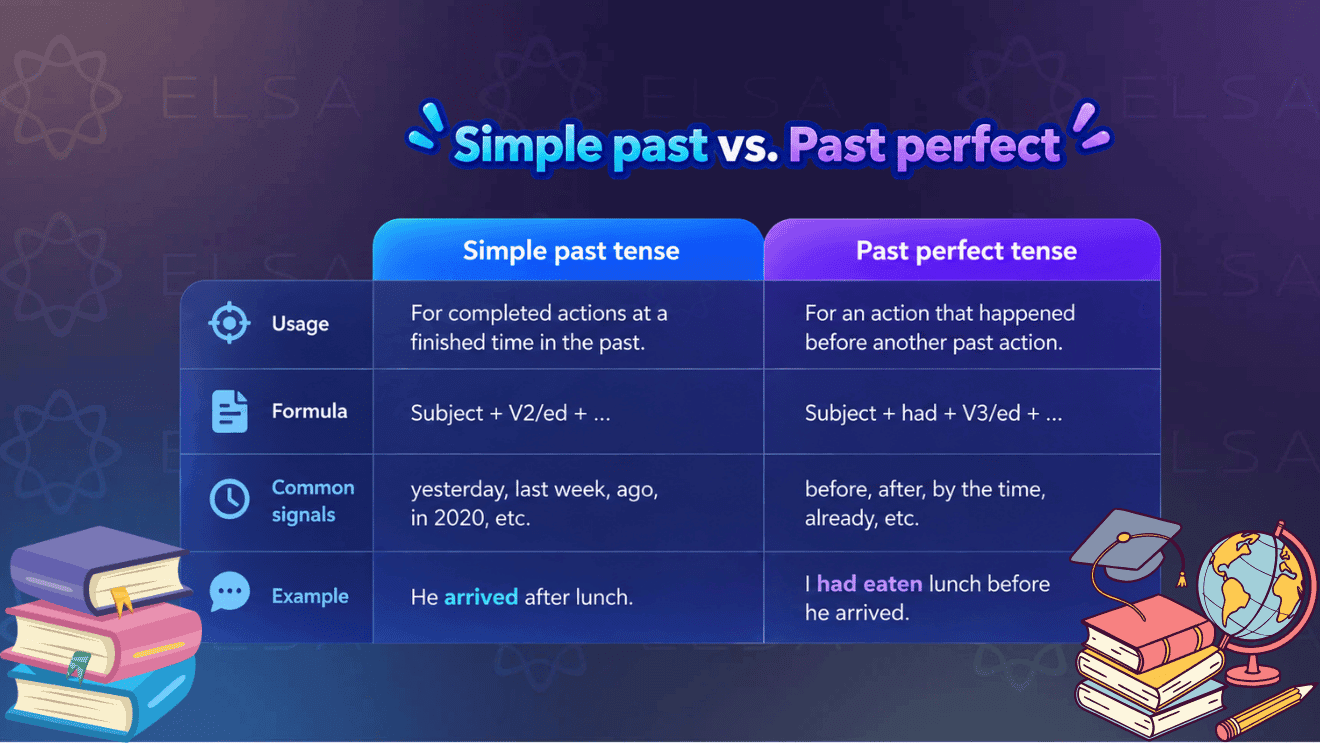
Simple past vs. Past perfect
| Simple past tense | Past perfect tense | |
| Usage | For completed actions at a finished time in the past. | For an action that happened before another past action |
| Formula | Subject + V2/ed + … | Subject + had + V3/ed + … |
| Common signals | yesterday, last week, ago, in 2020, etc. | before, after, by the time, already, etc. |
| Example | He arrived after lunch. | I had eaten lunch before he arrived. |
Simple past tense worksheet
Exercise 1: Complete each sentence with the correct simple past form of the verb in parentheses.
- He _______ (visit) his friend last weekend.
- Mary _______ (buy) a new phone yesterday.
- Jane and Tim _______ (watch) a documentary last night.
- We _______ (go) to the beach two days ago.
- He _______ (finish) his project on Wednesday.
- My parents _______ (live) in Manchester in 2010.
- I _______ (see) Sarah at the bakery.
- The students _______ (study) for the test last week.
Exercise 2: Rewrite each sentence using the negative form of the simple past.
- They watched TV last night.
- He went to the office yesterday.
- Both students finished the project on time.
- Ben called me this afternoon.
- He bought a new car last week.
- Sarah studied French yesterday.
- I saw her at the theater.
- They played badminton on Saturday.
Exercise 3: Choose the correct answer
| 1 | He ____ to work this morning. | A. go B. went C. has gone D. have gone |
| 2 | I ____ soccer everyday when I was a child. | A. play B. had played C. played D. plays |
| 3 | My grandparents ____ in Texas for many years. | A. lived B. had lived C. are living D. has been living |
| 4 | We ___ in college. | A. meet B. meets C. are meeting D. met |
| 5 | We ___ at home yesterday. | A. are B. had been C. were D. has been |
| 6 | They ____ their bags and ____ the hotel. | A. packs - leaves B. have packed - have left C. had packed - left D. packed - left |
| 7 | He _____ in 2020. | A. graduated B. had graduated C. graduating D. have graduated |
| 8 | She ____ her keys at home. | A. forgets B. forgot C. forgotten D. forget |
By mastering the simple past tense’s formulas, time expressions, and -ed pronunciation, you can talk more clearly about completed actions, past states, and events that happened at a finished time. For more practical lessons, visit the Grammar category on the ELSA Speak blog for expert tips to improve your English grammar and communication skills.