

Past continuous tense: Definition, examples, and exercises
elsaspeakadmin
September 30, 2026
English tenses
Just like the present continuous tense, the past continuous tense is also used to describe actions that were in progress at a specific time, but in the past for this case. In this guide, you’ll learn the past continuous tense explanation, formula, signal words, along with examples and exercises with detailed answer explanations.
Past continuous tense explanation
Past continuous tense definition
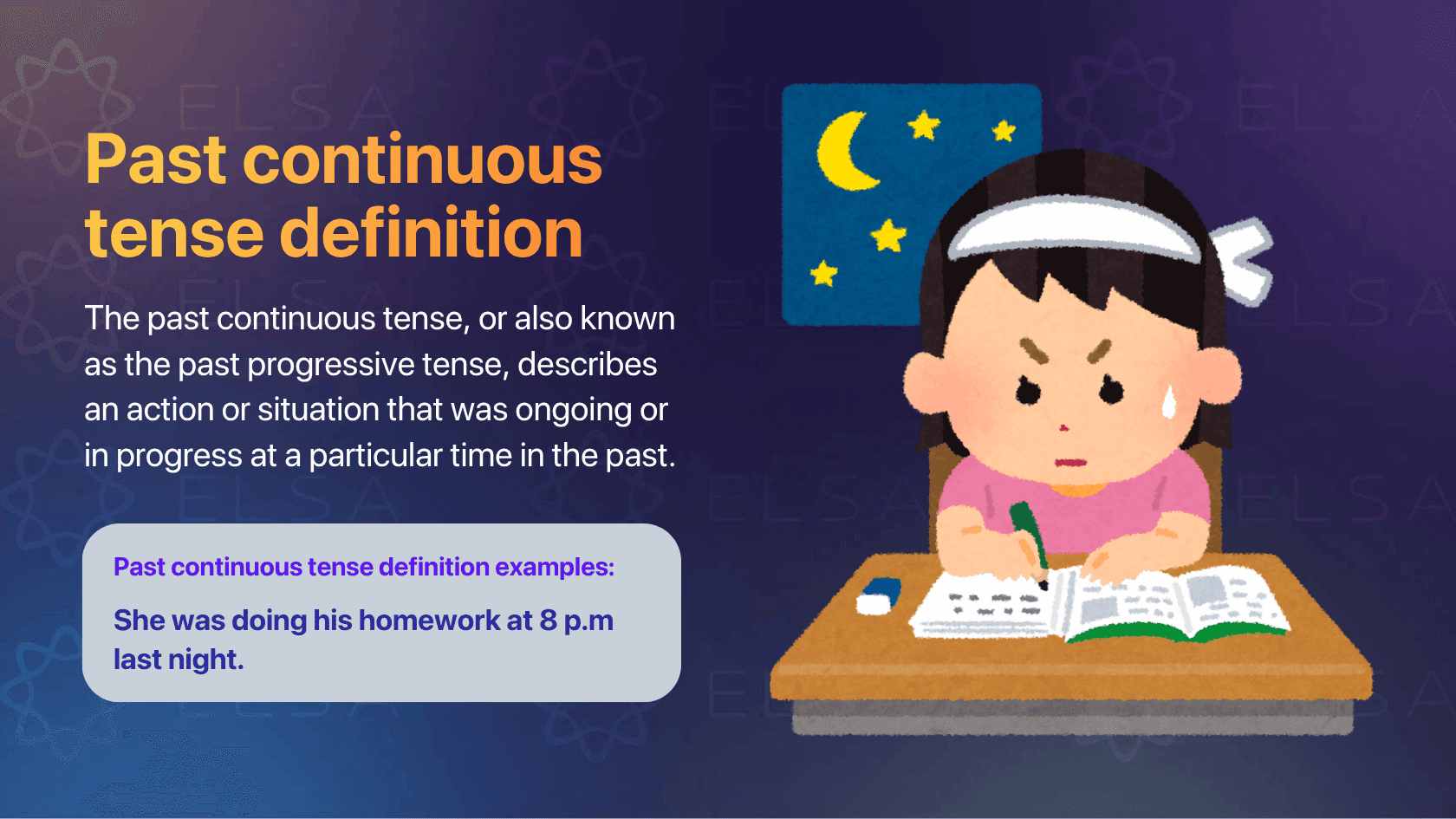
The past continuous tense, or also known as the past progressive tense, describes an action or situation that was ongoing or in progress at a particular time in the past.
Past continuous tense definition examples:
- She was doing his homework at 8 p.m last night.
- At this time yesterday, he was flying to New York.
When to use the past continuous tense?
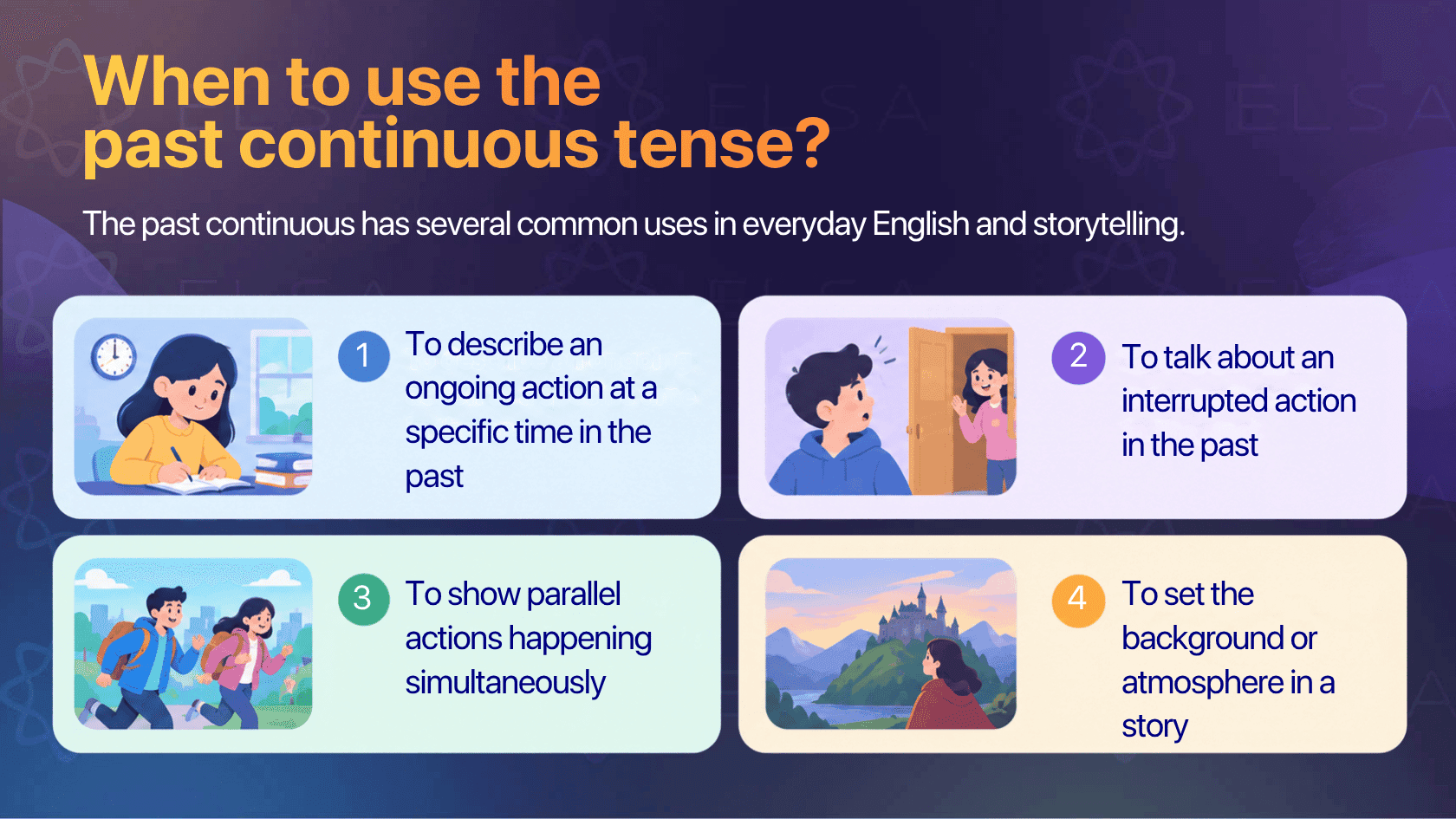
The past continuous has several common uses in everyday English and storytelling.
- To describe an ongoing action at a specific time in the past: Use the past continuous to focus on what was happening at a particular moment.
- For example: At 8 p.m. last night, I was studying.
- To talk about an interrupted action in the past: Use the past continuous for the longer action that was already in progress and the simple past for the shorter event that interrupted it.
- For example: The phone rang while I was watching TV.
- To show parallel actions happening simultaneously: Use the past continuous for two activities that were happening at the same time.
- For example: She was cooking while he was cleaning.
- To set the background or atmosphere in a story: The past continuous can describe ongoing situations, weather, or background activities that create the setting for another event.
- For example: The sun was shining, and the birds were singing when we arrived.
How to form the past continuous tense?
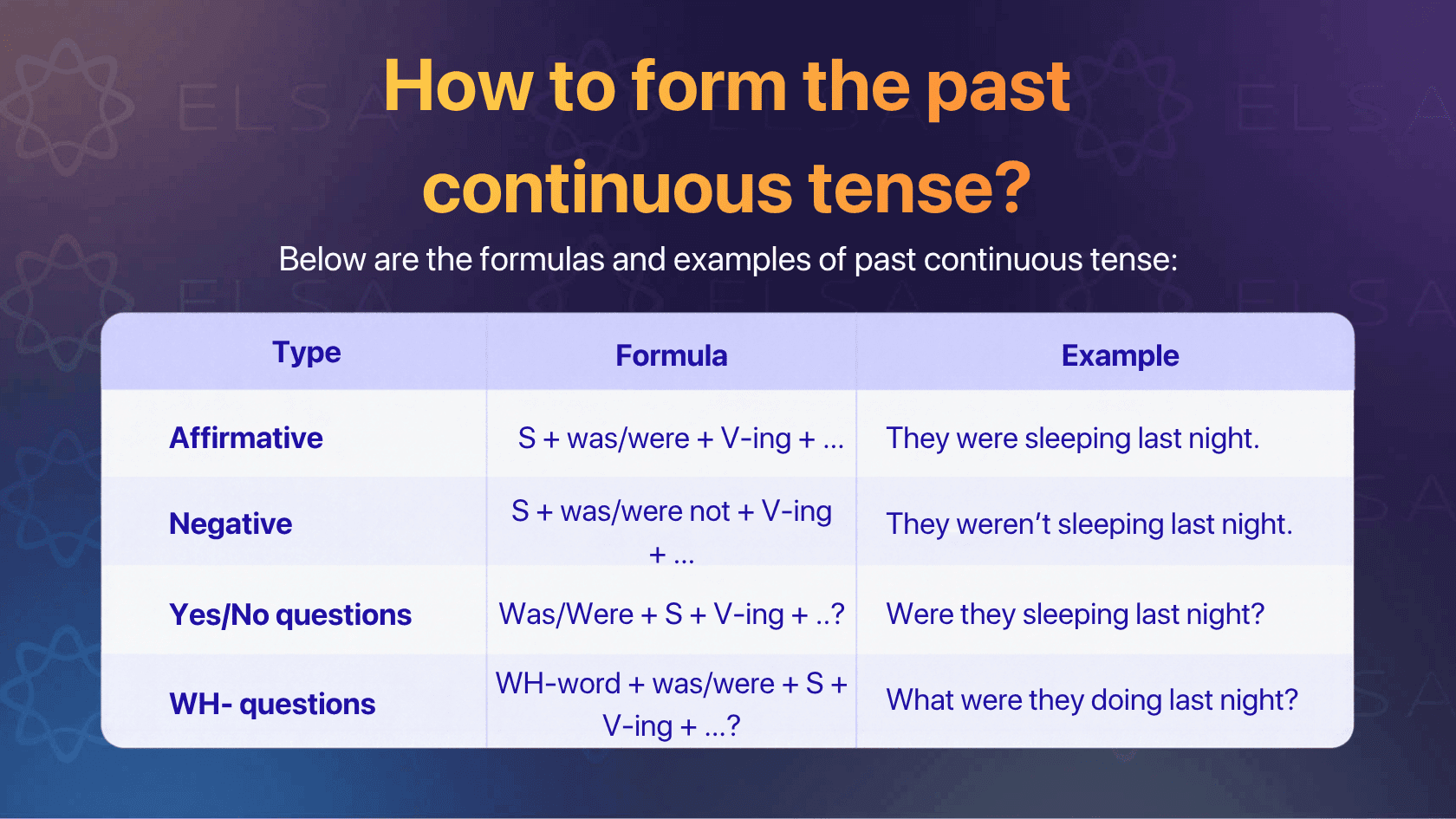
Below are the formulas and examples of past continuous tense:
| Formula | Example | |
| Affirmative | S + was/were + V-ing + … | They were sleeping last night. |
| Negative | S + was/were not + V-ing + … | They weren’t sleeping last night. |
| Yes/No question | Was/Were + S + V-ing + ..? | Were they sleeping last night? |
| WH- question | WH-word + was/were + S + V-ing + …? | What were they doing last night? |
Signal words for past continuous tense
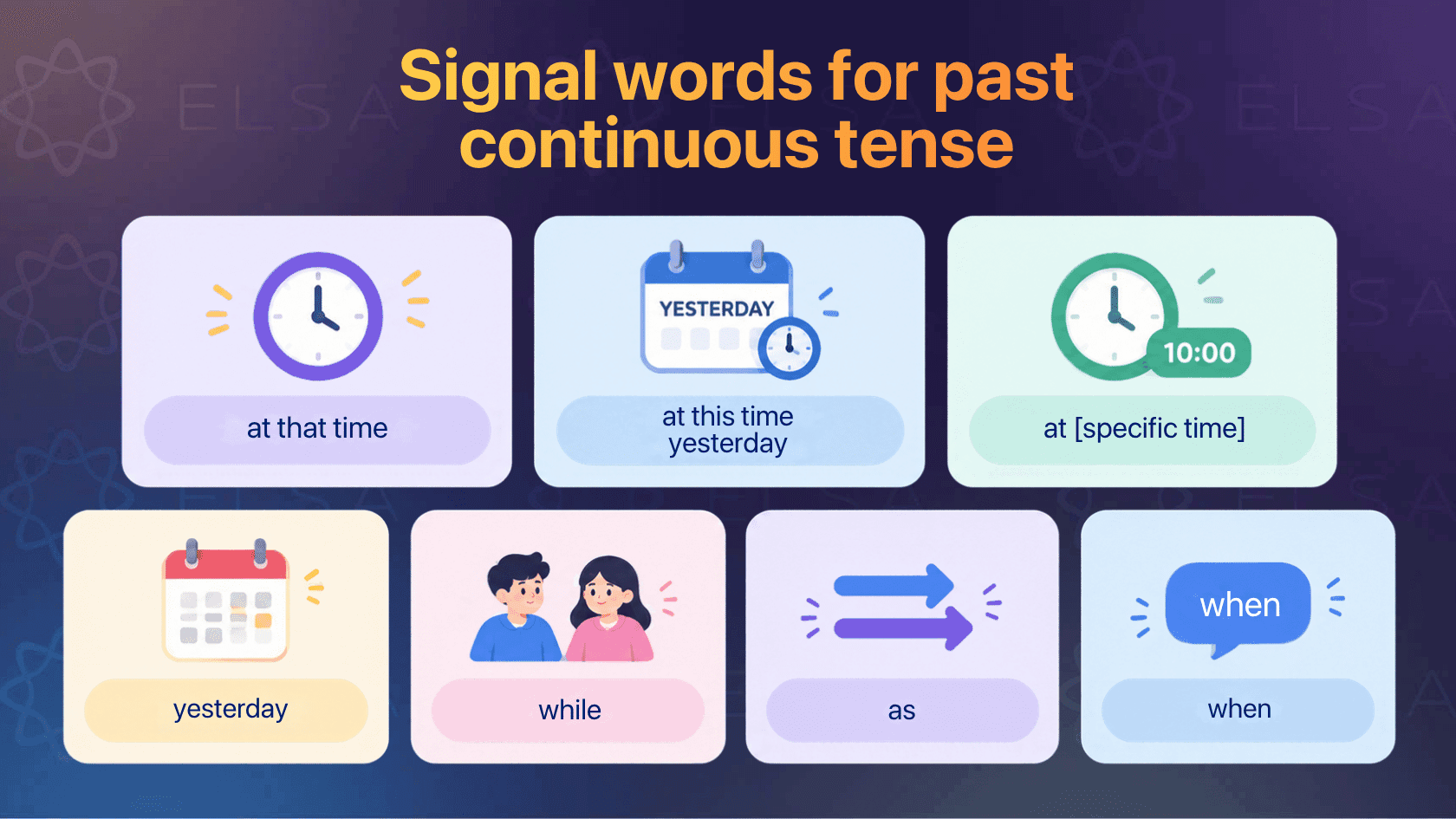
| Signal word | Example |
| at that time | He was skateboarding at that time. |
| at this time yesterday | They were going to the store at this time yesterday. |
| at [specific time] yesterday | At 10 a.m yesterday, John was cooking brunch. |
| while | My father was reading the newspaper while I was doing homework. |
| as | As they were walking home, the sky started to rain. |
| when | The bus was leaving when they arrived at the station. |
Past continuous vs. Simple past tense
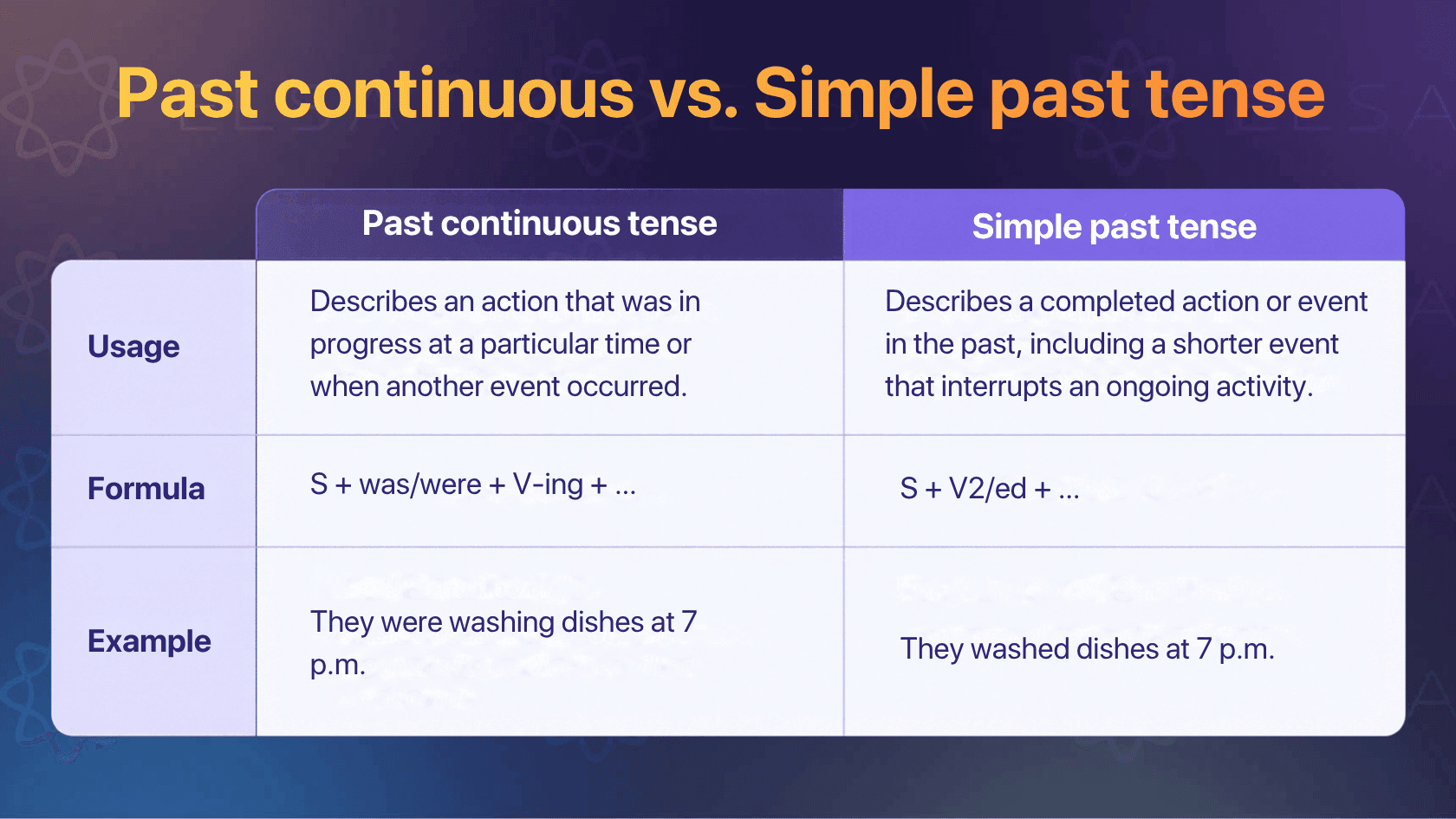
| Past continuous tense | Simple past tense | |
| Usage | Describes an action that was in progress at a particular time or when another event occurred. | Describes a completed action or event in the past, including a shorter event that interrupts an ongoing activity. |
| Formula | S + was/were + V-ing + … | S + V2/ed + … |
| Example | They were washing dishes at 7 p.m. | They washed dishes at 7 p.m. |
Common mistakes with the past continuous tense
Here are some mistakes that you should avoid when using the past continuous tense:
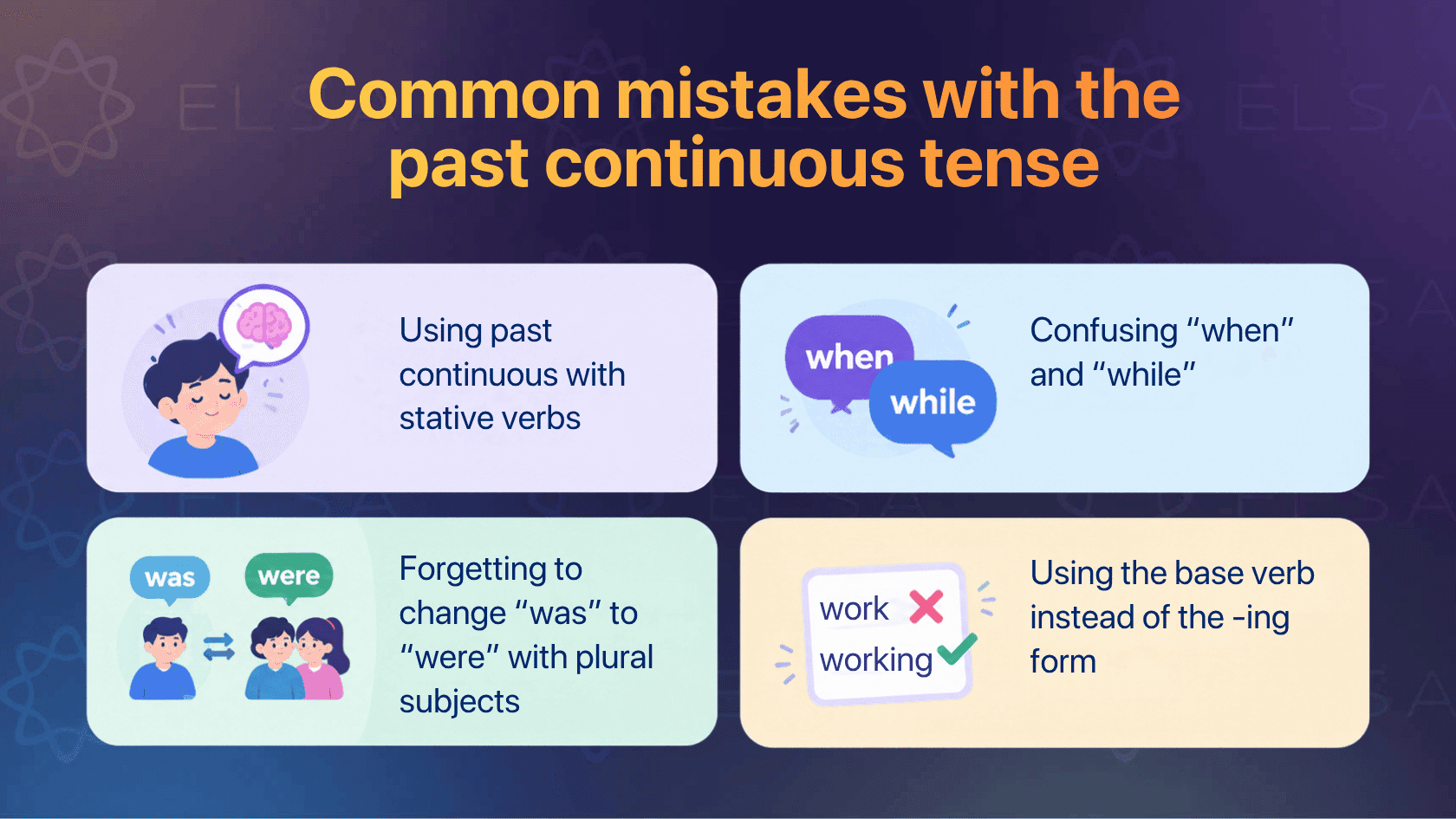
- Using past continuous with stative verbs: Most stative verbs describe states rather than actions and are not normally used in continuous forms. For example:
| Wrong | Correct |
| I was knowing him. | I knew him. |
- Confusing “when” and “while”: For an ongoing action interrupted by a shorter event, use the past continuous for the ongoing action and the simple past for the interrupting event.
- Example: I was sleeping when the alarm rang.
- Forgetting to change “was” to “were” with plural subjects: Use were with you, we, and they.
| Wrong | Correct |
| They was watching TV. | They were watching TV. |
- Using the base verb instead of the -ing form: The past continuous requires was/were + V-ing.
| Wrong | Correct |
| She was cook dinner. | She was cooking dinner. |
Past continuous tense exercises with answers
Exercise 1: Complete each sentence using the correct past continuous form of the verb in parentheses.
- At 7 p.m. last night, I ______ dinner. (cook)
- She ______ a book when I called her. (read)
- They ______ soccer at 4 p.m. yesterday. (play)
- We ______ home when it started to rain. (walk)
- He ______ for his exam all evening. (study)
- You ______ too loudly during the movie. (talk)
- The children ______ in the backyard when their mother came home. (play)
- At midnight, everyone ______. (sleep)
- I ______ to music while my sister was doing her homework. (listen)
- What ______ you ______ at 9 p.m. last night? (do)
Exercise 2: Choose the correct answer
1. I ______ TV when my friend called me.
a. watched
b. was watching
c. am watching
2. While Sarah ______ dinner, her brother was setting the table.
a. cooked
b. was cooking
c. cooks
3. They ______ to work when they saw the accident.
a. drove
b. were driving
c. are driving
4. At 10 p.m. last night, we ______.
a. were sleeping
b. slept
c. sleep
5. The children were playing outside when it ______ to rain.
a. was starting
b. starts
c. started
Exercise 3: Correct the sentences below:
- She were studying when I arrived.
- I was knowing the answer.
- They was watching a movie at 8 p.m.
- While I cooked, my sister was cleaning.
- He was walk home when he saw the accident.
The past continuous tense is useful for describing actions that were happening at a specific time in the past, especially when telling stories or showing how one event was happening when another occurred. To use this tense more confidently, practice forming past continuous sentences through exercises and real-life conversations in the Grammar category on ELSA Speak blog to improve your speaking and pronunciation in realistic English-learning activities.