

150+ passive voice exercises with answers (beginner to C1)
elsaspeakadmin
November 11, 2026
Grammar exercises
Passive voice is common in academic writing, news reporting, and business documents because it focuses attention on an action or its result rather than the person performing it. These 150 passive voice exercises with answers take you from beginner transformations to advanced academic paraphrasing. Practice each set before checking the explanations.
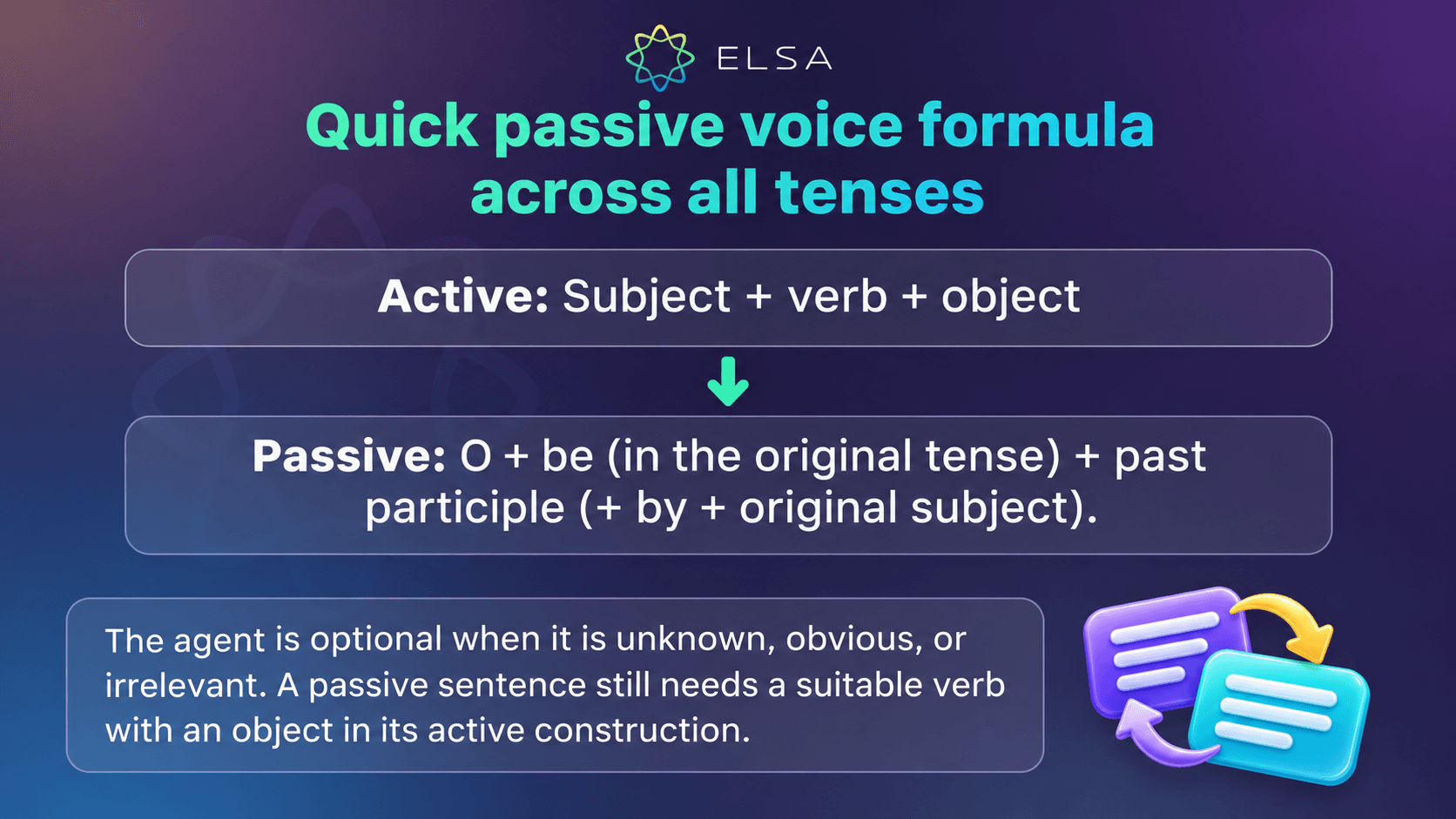
Quick passive voice formula across all tenses
The agent is optional when it is unknown, obvious, or irrelevant. A passive sentence still needs a suitable verb with an object in its active construction.
Formula:
Active: Subject + verb + object Passive: O + be (in the original tense) + past participle (+ by + original subject). |
| Tense | Passive formula | Active example | Passive example |
|---|---|---|---|
| Simple present tense | am/is/are + V3 | They take photos. | Photos are taken (by them). |
| Present continuous tense | am/is/are + being + V3 | She is writing a report. | A report is being written. |
| Simple past tense | was/were + V3 | A burglar stole a diamond ring. | A diamond ring was stolen. |
| Past continuous tense | was/were + being + V3 | They were testing the car. | The car was being tested. |
| Present perfect tense | have/has + been + V3 | My sister has drawn this portrait. | This portrait has been drawn by my sister. |
| Past perfect tense | had + been + V3 | The police had arrested the suspect. | The suspect had been arrested. |
| Simple future tense | will be + V3 | Rita will take a photograph. | A photograph will be taken by Rita. |
| Modal verbs | modal + be + V3 | We can solve this issue. | This issue can be solved. |
The agent is optional when it is unknown, obvious, or irrelevant. A passive sentence still needs a suitable verb with an object in its active construction.
Basic passive voice exercises (A1–A2)
Exercise: Multiple choice on simple present and past passive
Choose the best answer (A, B, C, or D) to complete each sentence.
- English ______ by millions of people around the world.
A. speaks B. is spoken C. is spoke D. are spoken - These packages ______ every Monday.
A. delivers B. is delivered C. are delivered D. were delivering - The museum ______ in 1998.
A. was opened B. is opening C. opened D. were opened - The windows ______ once a week.
A. cleans B. is cleaned C. were cleaning D. are cleaned - The letter ______ yesterday.
A. is send B. was sent C. were sent D. sent - Rice ______ in many countries.
A. grow B. are grown C. is grown D. was grow - The invitations ______ last Friday.
A. were mailed B. was mailed C. are mailing D. mailed - This room ______ every evening.
A. locks B. was lock C. are locked D. is locked - The bridge ______ after the storm.
A. is repair B. was repaired C. were repaired D. repairing - These books ______ in the school library.
A. keeps B. is kept C. are kept D. was keeping
Exercise: Fill in the blanks with correct passive forms
Complete each sentence using the simple present or simple past passive form of the verb in parentheses.
- The mail (deliver) ______ to our office at 9 a.m. every weekday.
- The suspect (arrest) ______ by the police last night.
- These cars (manufacture) ______ in Michigan.
- The cake (bake) ______ yesterday morning.
- Our classrooms (clean) ______ every afternoon.
- The contract (sign) ______ on Tuesday.
- Fresh vegetables (sell) ______ at this market.
- The missing keys (find) ______ under the couch last night.
- This software (update) ______ regularly.
- The old stadium (demolish) ______ in 2015.
Exercise: Active to passive transformation
Rewrite each active sentence in the passive voice. Keep its original tense.
- The dog chased the cat across the garden.
→ The cat ______. - The chef prepares lunch at noon.
→ Lunch ______. - The storm damaged several houses.
→ Several houses ______. - They wash the uniforms every Friday.
→ The uniforms ______. - The teacher praised the students.
→ The students ______. - A technician fixes the computers.
→ The computers ______. - The company launched the product in June.
→ The product ______. - The librarian organizes the shelves weekly.
→ The shelves ______. - The artist painted the mural in 2020.
→ The mural ______. - The team reviews applications every day.
→ Applications ______.
Exercise: Deciding to keep or omit the "By" phrase
Rewrite each sentence in the passive voice. Include a by phrase when the agent adds meaningful information; otherwise, omit it.
- Someone stole my bicycle outside the library.
→ ______ - Alexander Fleming discovered penicillin.
→ ______ - People speak Spanish in many countries.
→ ______ - A famous architect designed this building.
→ ______ - They canceled the meeting yesterday.
→ ______ - Marie Curie discovered radium with Pierre Curie.
→ ______ - Someone left a package at reception.
→ ______ - The police arrested the driver last night.
→ ______ - The local artist created the sculpture.
→ ______ - They publish the newsletter every month.
→ ______
Exercise: Active or passive voice identification
Label each sentence Active or Passive.
- The fire department extinguished the flames quickly.
- The flames were extinguished quickly.
- The manager approved the request.
- The request was approved yesterday.
- The children are drawing pictures.
- Pictures are being drawn by the children.
- The store sells handmade candles.
- Handmade candles are sold here.
- The technician repaired the printer.
- The printer was repaired this morning.
Intermediate Passive Voice Exercises (B1–B2)
Exercise: Passive Voice with Continuous and Perfect Tenses
Rewrite each sentence using the appropriate continuous or perfect passive construction.
- The road crew is repairing the main highway right now.
→ The main highway ______. - They were interviewing the candidates at noon.
→ The candidates ______. - The editor has corrected the errors.
→ The errors ______. - The staff had prepared the room before noon.
→ The room ______. - The engineers are inspecting the bridge.
→ The bridge ______. - Someone was painting the doors.
→ The doors ______. - The board has approved the budget.
→ The budget ______. - They had delivered the supplies before the storm.
→ The supplies ______. - The team is analyzing the results.
→ The results ______. - The auditors have reviewed the accounts.
→ The accounts ______.
Exercise: Passive voice with modal verbs
Change each active sentence into the passive voice without changing the modal meaning.
- You must submit all expense receipts by the end of the month.
→ All expense receipts ______. - They can resolve this problem.
→ This problem ______. - Employees should wear safety helmets.
→ Safety helmets ______. - The team might postpone the launch.
→ The launch ______. - You have to complete the form.
→ The form ______. - They will announce the winners tomorrow.
→ The winners ______. - The supervisor must check the figures.
→ The figures ______. - The library may extend the deadline.
→ The deadline ______. - The committee could revise the policy.
→ The policy ______. - You ought to follow these instructions.
→ These instructions ______.
Exercise: Passive with two objects (Direct vs. Indirect passive)
For each active sentence, write two passive versions: one beginning with the person receiving something and one beginning with the thing received. The answer table gives both.
- The director offered Sarah a senior partnership position.
→ Person: ______ / Thing: ______ - The teacher gave the class extra homework.
→ Person: ______ / Thing: ______ - They sent Maria an invitation.
→ Person: ______ / Thing: ______ - The company paid the workers a bonus.
→ Person: ______ / Thing: ______ - The host showed the guests the garden.
→ Person: ______ / Thing: ______ - The coach taught the players a new technique.
→ Person: ______ / Thing: ______ - The assistant handed the manager a folder.
→ Person: ______ / Thing: ______ - The school awarded Maya a scholarship.
→ Person: ______ / Thing: ______ - The chef served the customers dinner.
→ Person: ______ / Thing: ______ - The bank lent James some money.
→ Person: ______ / Thing: ______
Exercise: Error Identification and Correction in Passive Voice
Each sentence contains one passive-voice grammar error. Identify it and rewrite the sentence correctly.
- The confidential documents were destroy by the office shredder.
- The reports is checked every Friday.
- The bridge is being repair now.
- The letter was wrote yesterday.
- The results have been announce.
- The doors were being paint at noon.
- This issue can solved quickly.
- The files has been uploaded.
- The decision will been made tomorrow.
- The tickets were sell online.
Exercise: Passive questions transformation
Turn each active question into an equivalent passive question, keeping its tense and question type.
- Did the mechanic repair your car yesterday?
→ Was ______? - Does the company provide training?
→ Is ______? - Who wrote this article?
→ Who ______? - When did they build the bridge?
→ When ______? - Are the workers painting the wall?
→ Is ______? - Has the manager approved the plan?
→ Has ______? - Why did they cancel the flight?
→ Why ______? - Will the team publish the results?
→ Will ______? - Where do they store the records?
→ Where ______? - Had the chef prepared dinner before seven?
→ Had ______?
Advanced passive voice exercises (B2–C1)
Exercise: Impersonal passive and reporting verbs
Rewrite each statement in both forms: (1) It is/was + reporting participle + that-clause and (2) subject + is/was + reporting participle + infinitive.
- People believe that the billionaire owns several islands in the Pacific.
→ It ______ / Subject ______ - People say that the CEO resigned yesterday.
→ It ______ / Subject ______ - Experts think that the treatment is effective.
→ It ______ / Subject ______ - Journalists report that the bridge collapsed last night.
→ It ______ / Subject ______ - Researchers believe that the species lives in deep water.
→ It ______ / Subject ______ - People consider that the plan is risky.
→ It ______ / Subject ______ - Analysts say that sales increased in April.
→ It ______ / Subject ______ - Experts believe that the painting dates from the 1800s.
→ It ______ / Subject ______ - Officials report that the suspect escaped yesterday.
→ It ______ / Subject ______ - People think that the system works reliably.
→ It ______ / Subject ______
Exercise: Causative passive with "Have" and "Get"
Rewrite each situation using have/get + object + past participle. Assume the subject arranged the service.
- A professional mechanic serviced Sarah’s car yesterday.
→ Sarah had ______. - A technician repaired my laptop last week.
→ I got ______. - A stylist cut Mia’s hair on Saturday.
→ Mia had ______. - A company installed our new windows.
→ We had ______. - A dentist cleaned Ben’s teeth yesterday.
→ Ben got ______. - A tailor altered her jacket.
→ She had ______. - A professional photographer took our portraits.
→ We got ______. - A mechanic replaced the brakes on Alex’s car.
→ Alex had ______. - A technician checked their heating system.
→ They got ______. - A cleaner washed our carpets.
→ We had ______.
Exercise: Passive voice with gerunds and infinitives
Complete each sentence with being + V3, having been + V3, to be + V3, or to have been + V3, as appropriate.
- Most people dislike (criticize) ______ in front of colleagues.
- The report needs (review) ______ before publication.
- She hopes (select) ______ for the program.
- He denied (inform) ______ about the change.
- The equipment appears (damage) ______ during shipping.
- The children enjoy (praise) ______ for their work.
- The files are expected (upload) ______ tonight.
- She was relieved (invite) ______ to the conference.
- No one likes (ignore) ______ during meetings.
- The results seem (misinterpret) ______ in the earlier report.
Exercise: Reverse transformation (passive to active voice)
Change each passive sentence into active voice. If no agent is given, supply a reasonable one; more than one answer may be possible.
- A valuable diamond ring was stolen from the gallery last night.
→ A burglar ______. - The new policy was announced by the director.
→ ______ - The report has been completed.
→ ______ - The bridge is being inspected by engineers.
→ ______ - The contract had been signed before noon.
→ ______ - The package will be delivered tomorrow.
→ ______ - The rules must be followed by all visitors.
→ ______ - The windows were cleaned yesterday.
→ ______ - The final decision is made by the committee.
→ ______ - The results have been verified by independent experts.
→ ______
Exercise: Advanced synthesis and academic paraphrasing
Use the uppercase word in parentheses to rewrite each sentence in a formal passive construction without changing its meaning.
- Experts believe that the economic recession will end by Q4. (BELIEVED)
→ The economic recession ______. - Researchers say the drug reduced symptoms in the trial. (SAID)
→ The drug ______. - The laboratory will analyze all samples. (ANALYZED)
→ All samples ______. - The team has collected the data. (COLLECTED)
→ The data ______. - The auditors were reviewing the records. (REVIEWED)
→ The records ______. - Experts think the method is reliable. (THOUGHT)
→ The method ______. - The committee must approve the proposal. (APPROVED)
→ The proposal ______. - The researchers had completed the study before the deadline. (COMPLETED)
→ The study ______. - Observers report that the population declined last year. (REPORTED)
→ The population ______. - The agency is evaluating the applications. (EVALUATED)
→ The applications ______.
Tips for solving passive voice exercises and common pitfalls to avoid
1. Forgetting being in continuous tenses
Compare "The road was repaired (completed event)" with "The road was being repaired (action in progress at a past time)." Preserve the original aspect.
2. Making passive forms of intransitive verbs
Verbs such as happen, arrive, occur, die, and disappear do not take a direct object in these uses, so they cannot normally be passivized.
For example: say "The accident happened.", not "The accident was happened."
3. Misplacing adverbs
Adverbs of frequency commonly appear after the first auxiliary. Manner adverbs can naturally appear before the participle or after the verb phrase. Choose the placement that reads clearly; neither position is universally required.
4. Confusing past tense and past participles
Memorize irregular pairs.
For example:
- wrote → written
- stole → stolen
- broke → broken
- took → taken
The passive needs the past participle, not the simple past form.
5. Overusing by phrases
Keep agents when they identify a meaningful source, creator, or responsible party. A three-step method for passive voice practice:
- Identify the original tense and aspect. Is the verb simple, continuous, perfect, future, or modal?
- Identify the new subject. Move the active object into subject position and check whether it is singular or plural.
- Build the correct passive. Use the matching form of be plus the past participle, inserting being or been where necessary. Add the agent only if useful.
Passive voice exercises become easier to complete when you recognize its patterns and practice them in context. For more English grammar practice and speaking-focused learning, explore the Grammar category on ELSA Speak blog and continue building accuracy and confidence in real-world communication.