

150+ present continuous exercises with answers (A1 to C1)
elsaspeakadmin
November 13, 2026
Grammar exercises
Do you ever mix up temporary actions and regular habits, miss a doubled consonant, or use continuous forms with stative verbs in present continuous tense? Don’t worry. Work through these 150+ present continuous exercises with answers to check your understanding and use this tense more accurately.
Present continuous rules and formulas
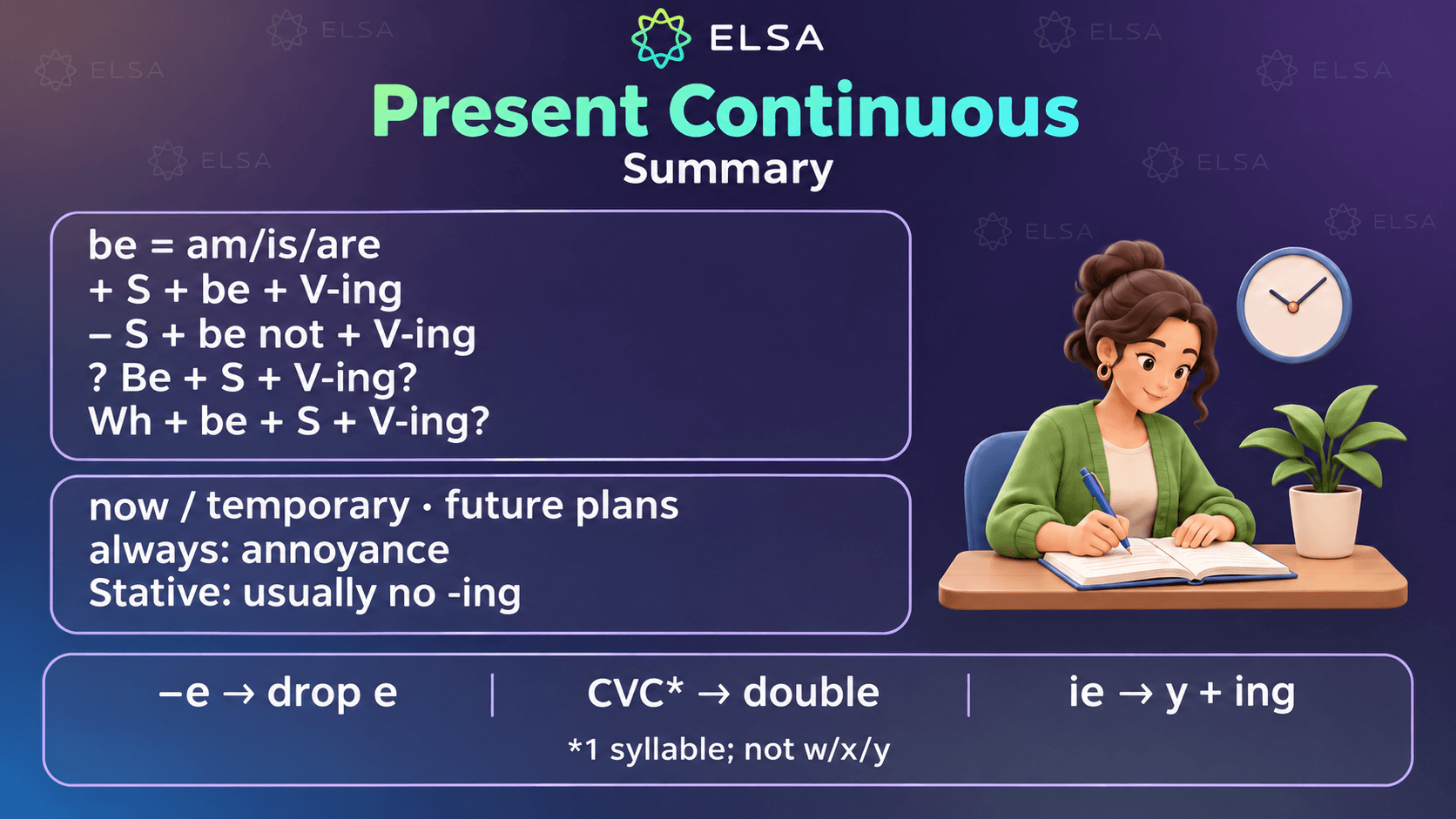
The present continuous tense, also called the present progressive, is used to describe an activity happening at the moment of speaking or during a temporary period around now. It is also used to express developing changes, confirmed future events, and repeated behavior which are irritating or annoying.
Present continuous formulas
| Form | Structure | Example |
|---|---|---|
| Affirmative (+) | S + am/is/are + V-ing (+ complement) | She is reviewing the report. |
| Negative (−) | S + am/is/are + not + V-ing (+ complement) | She is not reviewing the report. |
| Yes/no question | Am/Is/Are + S + V-ing (+ complement)? | Is she reviewing the report? |
| Wh-question | Wh-word + am/is/are + S + V-ing? | What is she reviewing? |
Below are some of the common expressions associated with the present continuous tense:
- Time expressions: Now, right now, at the moment, at present, currently, today, this week, etc.
- Attention-getting expressions: Look!, Listen!, Be quiet!, Watch out!, and Hurry up!
Remember the spelling rules for adding -ing:
- Verbs ending in a silent e: Drop the e and add -ing (make → making, write → writing).
- One-syllable verbs ending in a single vowel followed by a single consonant: Double the final consonant before adding -ing (run → running, stop → stopping, sit → sitting).
- Verbs ending in ie: Change ie to y, then add -ing (lie → lying, die → dying).
Note: Verbs such as know, believe, understand, want, need, own, and belong normally describe states and take the present simple. Be careful of this trap.
Basic present continuous exercises (A1-A2)
With the starting level from A1 to A2, these present continuous tense exercises will help you form complete sentences using the subject-verb agreement, negative forms, questions, and -ing spelling. Try to complete these to get the basics before you move on to choosing between tenses.
Exercise 1: Complete sentences with am, is, or are and V-ing
Instructions: Complete each sentence with the affirmative present continuous form of the verb in parentheses.
- Listen! The birds ______ (sing) outside our window.
- I ______ (write) an email right now.
- Look! The dog ______ (run) across the yard.
- We ______ (study) for our math test at the moment.
- Maya ______ (make) a sandwich in the kitchen now.
- You ______ (sit) in my seat.
- The children ______ (play) basketball right now.
- My brother ______ (swim) in the pool now.
- The bus ______ (stop) in front of our building now.
- My parents ______ (watch) a movie at the moment.
Exercise 2: Form negative sentences with “isn’t” and “aren’t”
Instructions: Rewrite each sentence in the negative. Use isn’t or aren’t.
- She is watching TV at the moment.
- They are waiting outside.
- He is wearing a jacket today.
- We are using the printer right now.
- The cat is sleeping on the couch.
- You are listening to the instructions.
- My sister is driving to work today.
- The students are taking notes.
- The washing machine is working.
- Our neighbors are moving this week.
Exercise 3: Basic question formation
Instructions: Use the prompts to write complete present continuous questions. Add punctuation.
- what / you / cook / right now
- she / read / the instructions
- where / they / go / now
- why / he / laugh
- we / wait / in the correct line
- who / speak / right now
- the children / sleep
- what / your brother / draw
- you / wear / my headphones
- when / Emma / leave / tomorrow
Exercise 4: Spelling rules for adding -ing
Instructions: Write only the correct -ing form of each verb. Use American English spelling.
- make
- run
- lie
- swim
- write
- begin
- open
- fix
- travel
- see
Exercise 5: Sentence rearrangement for beginners
Instructions: Put all the words in the correct order. Start with a capital letter and add the appropriate punctuation.
- now / coffee / drinking / in / kitchen / is / Marcus / the
- are / the / playing / outside / children
- not / I / working / am / today
- you / are / what / reading
- is / dinner / cooking / my / father
- we / waiting / for / are / bus / the
- is / why / crying / baby / the
- wearing / not / she / is / glasses
- students / taking / are / notes / the
- outside / raining / it / is
Intermediate present continuous exercises (B1–B2)
This next section focuses on meaning. These B1-B2 exercises will make you compare routines with temporary activities, distinguish states from actions, and use the present progressive tense for arrangements and complaints. Remember to read beyond a single time expression before selecting your answer.
Exercise 6: Present simple and present continuous exercises
Instructions: Complete each sentence with the present simple or present continuous form of the verb in parentheses.
- David usually ______ (walk) to work, but this week he ______ (take) the subway.
- My sister ______ (work) at a bank, but today she ______ (work) from home.
- Please be quiet. I ______ (try) to hear the announcement.
- Our store ______ (open) at nine every weekday.
- We ______ (stay) with my aunt this month while our apartment is being repaired.
- I ______ (not understand) this question. Can you explain it?
- Why ______ (you / wear) a coat indoors right now?
- Leo ______ (not drink) coffee; he dislikes its taste.
- The children normally ______ (play) outside after school, but today they ______ (paint) in the kitchen.
- Water ______ (freeze) at 32°F under standard atmospheric pressure.
In these present simple and present continuous exercises, the most useful question is whether the speaker describes a regular pattern, a state, or an activity unfolding during a limited period. A temporary situation does not have to be happening at the exact second of speaking.
Exercise 7: Stative vs. dynamic verbs in context
Instructions: Choose the present simple or present continuous form according to the meaning of the verb.
- I ______ (think) this proposal is promising, but right now I ______ (think) about its cost.
- Nina ______ (have) two bicycles, and she ______ (have) lunch right now.
- This soup ______ (taste) salty. Right now, the chef ______ (taste) another batch.
- These roses ______ (smell) wonderful. Look! Ava ______ (smell) one.
- I ______ (see) what you mean, and I ______ (see) my advisor tomorrow at our booked appointment.
- The suitcase ______ (weigh) 40 pounds. The agent ______ (weigh) it on the scale right now.
- The room ______ (measure) 12 feet across. The designer ______ (measure) the windows now.
- You ______ (look) tired in this photo. Why ______ (you / look) at it so closely right now?
- Owen ______ (be) usually polite, but he ______ (be) rude to the waiter right now.
- I ______ (believe) your explanation, but I still ______ (need) more time.
Exercise 8: Fixed arrangements for the near future
Instructions: Complete each sentence using the present continuous. The plans have already been confirmed.
- We ______ (fly) to San Francisco on Monday; our tickets are booked.
- I ______ (meet) my advisor at ten tomorrow; she confirmed the time.
- Sofia ______ (see) the dentist on Friday at her scheduled appointment.
- They ______ (move) into their new apartment this weekend; the movers are booked.
- Our manager ______ (travel) to Chicago next Tuesday; the hotel is reserved.
- You ______ (have) dinner with us at seven, as we agreed.
- The team ______ (present) the proposal tomorrow at the confirmed client meeting.
- My parents ______ (arrive) on the evening flight; I have their itinerary.
- I ______ (not attend) the workshop tomorrow. I canceled my reservation.
- What time ______ (you / pick up) the rental car? Your reservation says noon.
Exercise 9: Expressing annoyance with always and constantly
Instructions: Rewrite each statement as a complaint using the present continuous and the word in parentheses. Keep the original subject and main verb.
- My roommate leaves dirty dishes in the sink all the time. It annoys me. (ALWAYS)
- You interrupt me repeatedly. It is frustrating. (CONSTANTLY)
- The neighbors play loud music again and again. It bothers me. (ALWAYS)
- He borrows my charger repeatedly without asking. I dislike that. (CONSTANTLY)
- Our printer jams all the time. It drives me crazy. (ALWAYS)
- The delivery driver blocks our driveway repeatedly. It annoys us. (CONSTANTLY)
- My brother loses his wallet all the time. It is irritating. (ALWAYS)
- They change the meeting time again and again. It is frustrating. (CONSTANTLY)
- You forget to lock the door all the time. It worries me. (ALWAYS)
- The app sends unnecessary alerts repeatedly. They bother me. (CONSTANTLY)
Note: Always with the present continuous can also express praise or another emotional reaction: “She is always helping people.” Annoyance comes from the context, not from always alone.
Exercise 10: Error identification in contextual passages
Instructions: Each item contains one error. Write the corrected sentence. Keep the surrounding meaning.
- I am knowing the project manager well because we worked together in Seattle.
- Please wait. She answering a customer right now.
- The children is playing in the yard at the moment.
- Look! The dog is runing toward the gate.
- Why you are wearing my jacket right now?
- We aren’t use the conference room right now.
- I am usually taking the bus to work; it is my normal routine.
- This laptop is belonging to our office.
- The baby is lieing on the blanket right now.
- At the moment, my parents are have dinner.
Advanced present continuous exercises (B2-C1)
These advanced present continuous exercises with answers combine tense choice with passive voice structures, sensory verbs, professional reporting, and paraphrasing. Some individual forms are familiar from lower levels, as the challenge is to preserve meaning and explain why a form suits the context.
Exercise 11: Trends and developing situations
Instructions: Complete the sentences with the present continuous to emphasize an ongoing change. These are practice scenarios, not factual reports.
- Attendance at our weekly workshop ______ (grow) steadily this semester.
- Our neighborhood ______ (become) quieter as the construction project winds down.
- The days ______ (get) longer as spring approaches.
- Her presentation skills ______ (improve) with each practice session.
- More customers ______ (choose) the digital receipt option during this trial.
- The number of support requests ______ (rise) during the current rollout.
- Our team ______ (adapt) to the new software this month.
- The old paint ______ (peel) off the wall little by little.
- Local businesses ______ (change) their opening hours during the renovation.
- My confidence ______ (increase) as I practice speaking more often.
Exercise 12: Passive voice transformation in the present continuous
Instructions: Rewrite each sentence in the present continuous passive: am/is/are + being + past participle. Include the original agent with by for this exercise.
- The road crew is repairing the bridge right now.
- The technician is installing the new computers.
- The chef is preparing our meals.
- The editor is reviewing my article.
- The company is building two warehouses.
- The staff is checking the applications.
- The volunteers are organizing the event.
- The mechanic is fixing my car.
- The researchers are analyzing the samples.
- The manager is interviewing the candidates.
Note: Outside this transformation task, omit by + agent when the doer is unknown, obvious, or unimportant: “The bridge is being repaired.”
If you eliminated "being", “The bridge is repaired” does not express the same action in progress.
Exercise 13: Multiple choice on advanced sensory verbs
Instructions: Choose the best answer for the meaning and time context. Each item has one intended answer.
1. Right now, the chef ______ a spoonful of soup to check the seasoning.
A. is tasting
B. taste
C. is tasted
D. has taste
2. This sauce ______ too sweet to me.
A. is tasting
B. taste
C. tastes
D. is tasted
3. Look at the photo: Ava ______ a rose to check its fragrance.
A. smells
B. is smelling
C. smell
D. is smelled
4. The milk ______ sour, so I will throw it away.
A. smell
B. is smelled
C. is smell
D. smells
5. I ______ what you mean now.
A. am seeing
B. see
C. am seen
D. sees
6. I ______ the eye doctor tomorrow at my confirmed appointment.
A. am seeing
B. sees
C. am seen
D. seeing
7. Look! The customs officer ______ each bag on the scale.
A. weigh
B. is weighed
C. is weighing
D. weighing
8. According to the label, this package ______ exactly five pounds.
A. is weighing
B. weigh
C. is weighed
D. weighs
9. Why ______ at the ceiling right now?
A. you look
B. are you looking
C. you are looking
D. do looking you
10. That explanation ______ reasonable to me.
A. sounds
B. is sounding
C. sound
D. is sounded
Exercise 14: Present continuous in business and professional reporting
Instructions: Complete this short project update with the present simple or present continuous. Read the ten sentences as one report.
- Our company ______ (provide) payroll software to small businesses as its core service.
- This quarter, the product team ______ (test) a new mobile dashboard.
- At the moment, our analysts ______ (review) feedback from pilot customers.
- The standard subscription ______ (include) email support.
- For this pilot, we ______ (not charge) participating customers.
- Our lead designer ______ (work) with the accessibility consultant this week.
- The support department normally ______ (respond) within one business day.
- Currently, request volumes ______ (rise) as more users join the trial.
- We ______ (believe) the revised layout meets the pilot’s needs.
- The leadership team ______ (meet) the pilot customers next Friday at the confirmed review session.
Exercise 15: Sentence synthesis and paraphrasing
Instructions: Rewrite each sentence using the word in parentheses without changing that word. Preserve the original meaning and use the present continuous where appropriate.
- They have arranged to sign the partnership contract this Friday. (SIGNING)
- The engineers are in the process of testing the prototype. (BEING)
- My stay with my cousin is temporary while my apartment is repaired. (STAYING)
- The repeated interruptions from my colleague are annoying me. (ALWAYS)
- Our customer base shows ongoing growth this quarter. (GROWING)
- I have an appointment with the dentist tomorrow at nine. (SEEING)
- Right now, the technician is actively checking the device’s weight. (WEIGHING)
- The reviewers are examining our applications at the moment. (BEING)
- Lena normally works in Boston; her work in Denver lasts only this month. (WORKING)
- We have agreed to host the client demonstration on Tuesday. (HOSTING)
Tips for solving present continuous exercises and common pitfalls
Use this three-step check when working through present continuous exercises with answers. First decide what the sentence means, then check the verb form, and finally compare your answer with the explanation.
1. Read the time context
Words such as now, at the moment, and currently often suggest an action in progress. However, they do not automatically require the present continuous. Ask whether the sentence describes a routine, a temporary situation, a developing change, or a confirmed arrangement.
Compare:
- I am reading the instructions now. → Talks about an activity in progress.
- I understand the instructions now. → Talks about a present state.
2. Check the meaning of the verb
Pay attention to verbs such as know, own, believe, understand, and need. They normally describe states and take simple forms.
For verbs with more than one meaning, identify the intended use:
- I have a bike. → Possession.
- I am having lunch. → An activity.
- The soup tastes salty. → A quality.
- The chef is tasting the soup. → A deliberate action.
3. Check be and -ing spelling
A correct present continuous sentence needs an appropriate form of be and an -ing form. Before submitting your answer:
- Match am/is/are to the subject.
- Put not after be in negative statements.
- Put be before the subject in most direct questions.
- Check whether the verb drops e, doubles a consonant, or changes -ie to -y.
Common present continuous errors and corrections
| Common pitfall | Incorrect | Corrected | Rule / Fix |
|---|---|---|---|
| Missing be | She working now. | She is working now. | A continuous form needs be + verb-ing. |
| Using a continuous form for a state | I am knowing the answer. | I know the answer. | Know normally describes a state and takes the simple form. |
| Missing a doubled consonant | He is runing outside. | He is running outside. | Run doubles its final n before -ing. |
| Confusing a routine with a temporary action | I am walking to work every day as my regular routine. | I walk to work every day. | Use the present simple for a neutral statement of a regular routine. |
After checking an answer, say the complete sentence aloud and create a similar example about your own day.
- If you missed the tense, explain the time frame.
- If you missed the structure, rebuild the sentence as subject + be + verb-ing before adding other details.
Keep practicing these present continuous exercises until you can explain both the form and its meaning. Then turn your answers into spoken sentences about what you are doing, changing, and planning. Continue learning with ELSA Speak and explore more lessons in our Grammar category.