150+ Reported speech exercises with answers (Beginner to C1)

elsaspeakadmin

November 11, 2026

Grammar exercises

Knowing reported speech rules is only the beginning. To use indirect speech confidently, you need practice converting real sentences, questions, and requests. Work through 150+ direct and indirect speech exercises, check the explanations, and find out which grammar patterns need more practice.

📌 Key Takeaways
  • Reported speech exercises help you practice tense backshifting, pronoun changes, and time/place references in context.
  • Indirect questions use statement word order, not direct-question inversion.
  • Backshifting is common after a past reporting verb, but it is not always necessary when facts remain true or the context is current.
Remember: Reported speech depends on who is speaking, who is listening, and when the information is reported. Some answers below are model answers; other contextually accurate versions may also be possible.

Quick rules cheat sheet before practicing

  1. Statements: Subject + said (that) + subject + verb; or subject + told + object + (that) + subject + verb.
  2. Wh- questions: Subject + asked (+ object) + wh-word + subject + verb (no question inversion).
  3. Yes/No questions: Subject + asked (+ object) + if/whether + subject + verb.
  4. Commands and requests: Subject + told/asked + object + (not) to + base verb.
Direct verbReported verbDirect time/placeReported time/place
Present Simple (work/works)Past Simple (worked)now / right nowthen / at that moment
Present Continuous (am/is/are working)Past Continuous (was/were working)today / tonightthat day / that night
Past Simple / Present PerfectPast Perfect (had + past participle)yesterday / last nightthe day before / the previous night
Will / Can / MayWould / Could / Mighttomorrow / next weekthe next day / the following week
Must (obligation)Had tohere / this / thesethere / that / those
Could / Would / Should / MightUsually unchangedtwo days agotwo days before
Quick-reference table: tense backshifts and time/place changes in reported speech

For example: “I work here,” Mia said.

→ Mia said that she worked there.

Note: These shifts are context-dependent, not automatic. For example, today can stay today if the report is made on the same day; must expressing deduction often stays must.
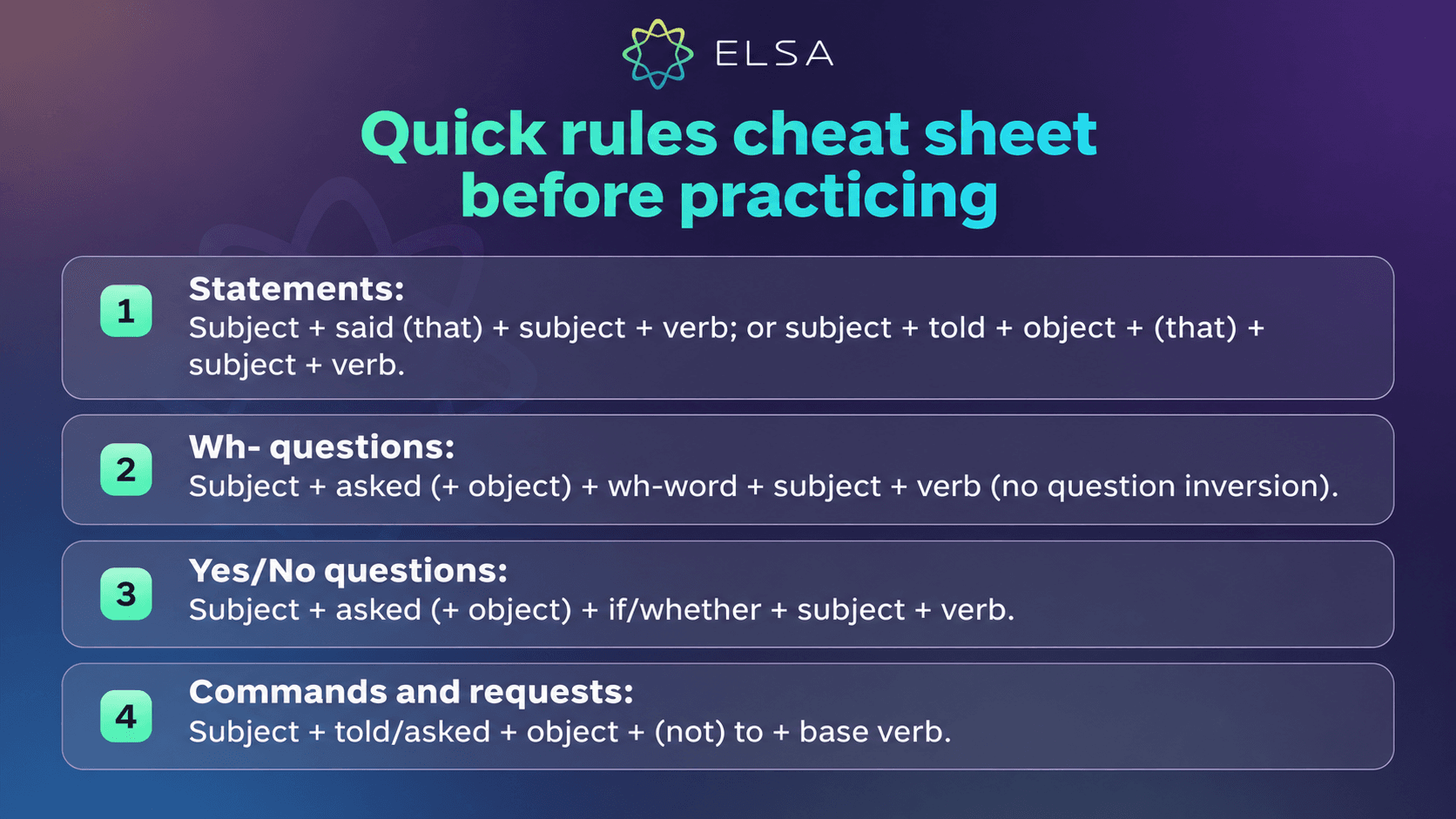
Quick rules cheat sheet before practicing the reported speech exercises

Basic reported speech exercises (A1–A2)

Exercise: Multiple choice on basic statements and pronouns

Instructions: Choose the best option (A, B, C, or D).
1. “I am very tired,” Marcus said. 
→ Marcus said that he ___ very tired. 
A. is 
B. was 
C. were 
D. be

2. “I love this song,” Anna said. 
→ Anna said that ___ loved that song. 
A. she 
B. he 
C. I 
D. they

3. “We are ready,” the players said. 
→ The players said that they ___ ready. 
A. are 
B. was 
C. were 
D. be

4. “My brother works here,” Lily said. 
→ Lily said that ___ brother worked there. 
A. his 
B. her 
C. my 
D. their

5. “I can swim,” Leo said. 
→ Leo said he ___ swim. 
A. can 
B. could 
C. will 
D. must

6. “I will help you,” Nina told Ben. 
→ Nina told Ben she ___ help him. 
A. will 
B. can 
C. would 
D. had

7. “I have a dog,” Tom said. 
→ Tom said he ___ a dog. 
A. has 
B. have 
C. had 
D. having

8. “These shoes are new,” Eva said. 
→ Eva said ___ shoes were new. 
A. this 
B. those 
C. that 
D. it

9. “I saw a movie,” Ryan said. 
→ Ryan said he ___ a movie. 
A. sees 
B. had seen 
C. has see 
D. seeing

10. “We live in Boston,” the sisters said. 
→ They said they ___ in Boston. 
A. lived 
B. lives 
C. living 
D. live

Answers
Answer
1. B. was
2. A. she
3. C. were
4. B. her
5. B. could
6. C. would
7. C. had
8. B. those
9. B. had seen
10. A. lived
Explanations
Explanation
1. Am normally backshifts to was after said.
2. I refers to Anna, so it becomes she.
3. Are becomes were with plural they.
4. My changes to her when Lily is the speaker.
5. Can commonly backshifts to could.
6. Will normally changes to would.
7. Present simple have backshifts to had.
8. These commonly changes to those when perspective shifts.
9. Past simple commonly backshifts to past perfect.
10. Live backshifts to lived in this past-reporting context.

Exercise: Fill in the Blanks with Correct Verb Forms

Instructions: Complete each sentence with the backshifted form of the verb in parentheses.

1. “I eat breakfast at seven,” Zoe said. 
→ Zoe said she ___ breakfast at seven. (eat)

2. “I am studying,” Noah said. 
→ Noah said he ___ . (study)

3. “We have finished,” they said. 
→ They said they ___ . (finish)

4. “I bought a ticket,” Mia said. 
→ Mia said she ___ a ticket. (buy)

5. “I will call later,” Jay said. 
→ Jay said he ___ later. (call)

6. “I can drive,” Ella said. 
→ Ella said she ___ . (drive)

7. “The store is closing,” Ava said. 
→ Ava said the store ___ . (close)

8. “We are hungry,” the children said. 
→ The children said they ___ hungry. (be)

9. “I have lost my keys,” Ben said. 
→ Ben said he ___ his keys. (lose)

10. “It rains a lot here,” Kim said. 
→ Kim said it ___ a lot there. (rain)

Answers
Answer
1. ate
2. was studying
3. had finished
4. had bought
5. would call
6. could drive
7. was closing
8. were
9. had lost
10. rained
Explanations
Explanation
1. Present simple eat changes to past simple ate.
2. Present continuous becomes past continuous.
3. Present perfect becomes past perfect.
4. Past simple becomes past perfect.
5. Will changes to would.
6. Can changes to could.
7. Is closing backshifts to was closing.
8. Are becomes were.
9. Has/have lost becomes had lost.
10. Rains becomes rained; here becomes there.

Exercise: Sentence rewriting for beginners

Instructions: Rewrite each quote as reported speech using the starter.

1. “I need some help with my homework,” David said. 
→ David said that ___.

2. “I am happy,” Rose said. 
→ Rose said that ___.

3. “We play soccer,” the boys said. 
→ The boys said that ___.

4. “I will visit my aunt,” Kate said. 
→ Kate said that ___.

5. “I found my wallet,” Oscar said. 
→ Oscar said that ___.

6. “My dad is cooking,” Grace said. 
→ Grace said that ___.

7. “We can stay,” the guests said. 
→ The guests said that ___.

8. “I have cleaned my room,” Max said. 
→ Max said that ___.

9. “These cookies taste great,” Emma said. 
→ Emma said that ___.

10. “I am going home now,” Peter said. 
→ Peter said that ___.

Answers
Answer
1. he needed some help with his homework.
2. she was happy.
3. they played soccer.
4. she would visit her aunt.
5. he had found his wallet.
6. her dad was cooking.
7. they could stay.
8. he had cleaned his room.
9. those cookies tasted great.
10. he was going home then.
Explanations
Explanation
1. I/my change to he/his; need backshifts to needed.
2. Am becomes was.
3. We becomes they and play becomes played.
4. Will becomes would and my becomes her.
5. Found commonly backshifts to had found.
6. My becomes her and is cooking becomes was cooking.
7. Can changes to could.
8. Present perfect changes to past perfect.
9. These changes to those; taste becomes tasted.
10. Am going becomes was going; now becomes then.

Exercise: True or false grammatical identification

Instructions: Mark each sentence True (T) or False (F). Correct every false sentence.

  1. Lena said that she was busy.
  2. He told that he was sick.
  3. She asked where did I live.
  4. Mark said he would arrive soon.
  5. They said that they has finished.
  6. Eva told me that she liked jazz.
  7. He asked if was I ready.
  8. The coach told us to run faster.
  9. Maya said that her parents was home.
  10. She asked me don't speak.
Answers
Answer
1. T
2. F — He said that he was sick.
3. F — She asked where I lived.
4. T
5. F — They said that they had finished.
6. T
7. F — He asked if I was ready.
8. T
9. F — Maya said that her parents were home.
10. F — She asked me not to speak.
Explanations
Explanation
1. Correct past reporting with was.
2. Told normally requires an object: told me that.
3. Indirect questions use statement word order.
4. Would is a standard backshift of will.
5. Use had with the past perfect.
6. Told correctly includes an object.
7. No inversion after if.
8. Told + object + to-infinitive reports a command.
9. Plural parents takes were.
10. Negative requests use not to + verb.

Exercise: Matching direct and reported speech pairs

Instructions: Match each numbered direct quote with the correct lettered reported sentence. Each letter is used once.

Column A: Direct speech

  1. “I am cold,” Eva said.
  2. “We will leave,” they said.
  3. “I can sing,” Ben said.
  4. “I like tea,” Nora said.
  5. “We are working,” the staff said.
  6. “I have eaten,” Tim said.
  7. “My bike is red,” Sue said.
  8. “I saw Leo,” Mia said.
  9. “This is mine,” Alex said.
  10. “I need water,” Dan said.

Column B: Reported speech

A. Sue said her bike was red.
B. Ben said he could sing.
C. Dan said he needed water.
D. Eva said she was cold.
E. The staff said they were working.
F. Alex said that was his.
G. They said they would leave.
H. Mia said she had seen Leo.
I. Nora said she liked tea.
J. Tim said he had eaten.

Answers
Answer
1. D — Eva said she was cold.
2. G — They said they would leave.
3. B — Ben said he could sing.
4. I — Nora said she liked tea.
5. E — The staff said they were working.
6. J — Tim said he had eaten.
7. A — Sue said her bike was red.
8. H — Mia said she had seen Leo.
9. F — Alex said that was his.
10. C — Dan said he needed water.
Explanations
Explanation
1. Match the speaker, pronouns, and backshifted verb.
2. Match the speaker, pronouns, and backshifted verb.
3. Match the speaker, pronouns, and backshifted verb.
4. Match the speaker, pronouns, and backshifted verb.
5. Match the speaker, pronouns, and backshifted verb.
6. Match the speaker, pronouns, and backshifted verb.
7. Match the speaker, pronouns, and backshifted verb.
8. Match the speaker, pronouns, and backshifted verb.
9. Match the speaker, pronouns, and backshifted verb.
10. Match the speaker, pronouns, and backshifted verb.

Intermediate reported speech exercises (B1–B2)

Exercise: Reported questions (Yes/No & Wh- questions)

Instructions: Rewrite each question as reported speech. Assume the questions are reported later.

  1. “Where did you buy this vintage leather jacket?” Jessica asked me.
  2. “Are you coming tonight?” Emma asked Noah.
  3. “Why are you laughing?” Sam asked Lily.
  4. “Have you finished the report?” the boss asked me.
  5. “When will the train arrive?” Mia asked the clerk.
  6. “Do you speak French?” Oliver asked Ava.
  7. “Who called you yesterday?” Nina asked Ben.
  8. “Can you open the window?” the teacher asked me.
  9. “Where have they gone?” Dad asked me.
  10. “Is the library open today?” Zoe asked the librarian.
Answers
Answer
1. Jessica asked me where I had bought that vintage leather jacket.
2. Emma asked Noah whether he was coming that night.
3. Sam asked Lily why she was laughing.
4. The boss asked me if I had finished the report.
5. Mia asked the clerk when the train would arrive.
6. Oliver asked Ava whether she spoke French.
7. Nina asked Ben who had called him the day before.
8. The teacher asked me if I could open the window.
9. Dad asked me where they had gone.
10. Zoe asked the librarian whether the library was open that day.
Explanations
Explanation
1. Remove did-inversion; bought backshifts to had bought.
2. Use whether/if and statement word order.
3. Put the subject before was.
4. Have finished backshifts to had finished.
5. Will becomes would; no inversion.
6. Remove do and backshift speak.
7. Who is the subject; backshift called.
8. Can changes to could in the reported question.
9. Have gone becomes had gone.
10. Is becomes was; today changes with time perspective.

Exercise: Reported commands, requests, and warnings

Instructions: Use the reporting verb in parentheses and rewrite each quote.

  1. “Please don’t park in front of the emergency garage,” the guard said to the driver. (asked)
  2. “Close the door,” Mom said to Jack. (told)
  3. “Please help me carry this,” Zoe said to Ben. (asked)
  4. “Watch out for the ice,” the officer said to us. (warned)
  5. “Remember to bring your ID,” the teacher said to Mia. (reminded)
  6. “Leave the building immediately,” the captain said to the crew. (ordered)
  7. “Don’t touch the wires,” Dad said to us. (warned)
  8. “Please sit down,” the receptionist said to me. (asked)
  9. “Keep your receipt,” the cashier said to Nina. (told)
  10. “Don’t forget the deadline,” the manager said to us. (reminded)
Answers
Answer
1. The guard asked the driver not to park in front of the emergency garage.
2. Mom told Jack to close the door.
3. Zoe asked Ben to help her carry that.
4. The officer warned us to watch out for the ice.
5. The teacher reminded Mia to bring her ID.
6. The captain ordered the crew to leave the building immediately.
7. Dad warned us not to touch the wires.
8. The receptionist asked me to sit down.
9. The cashier told Nina to keep her receipt.
10. The manager reminded us not to forget the deadline.
Explanations
Explanation
1. Asked + object + not to reports a polite prohibition.
2. Told + object + to-infinitive.
3. Change me to her and this to that.
4. Warned + object + to-infinitive.
5. Reminded + object + to-infinitive.
6. Ordered expresses an authoritative command.
7. Negative warning uses not to.
8. Please is expressed by asked.
9. Your changes to her.
10. Reminded + object + not to.

Exercise: Error identification in intermediate reported speech

Instructions: Find the grammatical error and correct the sentence.

  1. The manager said me that our sales targets had been met ahead of time.
  2. She asked where was the meeting.
  3. He told to me that he was late.
  4. They asked if did I know the answer.
  5. Mia said that she will call the next day.
  6. The coach told the players don't stop.
  7. Lena admitted to break the vase.
  8. He suggested us to leave early.
  9. Sam asked me where I did live.
  10. She apologized for be late.
Answers
Answer
1. The manager told me that our sales targets had been met ahead of time.
2. She asked where the meeting was.
3. He told me that he was late.
4. They asked if I knew the answer.
5. Mia said that she would call the next day.
6. The coach told the players not to stop.
7. Lena admitted breaking the vase.
8. He suggested that we leave early.
9. Sam asked me where I lived.
10. She apologized for being late.
Explanations
Explanation
1. Say does not take a direct personal object here; use told me.
2. No inversion in indirect questions.
3. Told takes the object directly.
4. Remove did and use statement word order.
5. Will usually backshifts to would.
6. Use not to after told + object.
7. Admit takes a gerund in this construction.
8. Suggest does not take object + to-infinitive.
9. Remove auxiliary did from the indirect question.
10. A preposition is followed by a gerund.

Exercise: Advanced reporting verbs transformation

Instructions: Use the specified reporting verb or phrase in each answer.

  1. “I will definitely pay you back the $500 next Friday,” Brad said to Mia. (promised)
  2. “I’m sorry I broke your mug,” Dan said to Eva. (apologized for)
  3. “You copied my essay,” Tina said to Leo. (accused ... of)
  4. “Yes, I took the last cookie,” Max said. (admitted)
  5. “I didn’t open your email,” Ava said. (denied)
  6. “I want to pay for dinner,” Noah said. (insisted on)
  7. “Let’s take a break,” Kim said. (suggested)
  8. “Well done on winning the award!” Mia said to Ben. (congratulated ... on)
  9. “No, I won’t sign the form,” Jake said. (refused)
  10. “I’ll cancel the deal if you tell anyone,” the buyer said to the seller. (threatened)
Answers
Answer
1. Brad promised Mia that he would pay her back the $500 the following Friday.
2. Dan apologized to Eva for breaking her mug.
3. Tina accused Leo of copying her essay.
4. Max admitted taking the last cookie.
5. Ava denied opening the email.
6. Noah insisted on paying for dinner.
7. Kim suggested taking a break.
8. Mia congratulated Ben on winning the award.
9. Jake refused to sign the form.
10. The buyer threatened to cancel the deal if the seller told anyone.
Explanations
Explanation
1. Promise + person + that-clause; will becomes would.
2. Apologize for + gerund.
3. Accuse + person + of + gerund.
4. Admit + gerund.
5. Deny + gerund.
6. Insist on + gerund.
7. Suggest + gerund is natural.
8. Congratulate + person + on + gerund.
9. Refuse + to-infinitive.
10. Threaten + to-infinitive; adjust pronouns and tense.

Exercise: Dialogue-to-paragraph reporting

Instructions: Read five two-line dialogues. Report both lines from each dialogue as complete sentences (10 answers total). Assume the dialogue is reported later.

Dialogue 1: Job interview

Interviewer: “Why do you want to work for our tech firm in Silicon Valley?”

Candidate: “I have admired your open-source projects for years.”

Dialogue 2: Restaurant

Server: “Would you like dessert?”

Guest: “I have already eaten enough.”

Dialogue 3: Project meeting

Manager: “Can you finish this by Friday?”

Analyst: “I will send it tomorrow.”

Dialogue 4: Airport

Agent: “Where did you leave your suitcase?”

Traveler: “I left it near the gate.”

Dialogue 5: Classroom

Teacher: “Have you read the chapter?”

Student: “I am reading it now.”

Answers
Answer
1. The interviewer asked the candidate why they wanted to work for the firm in Silicon Valley.
2. The candidate replied that they had admired the firm’s open-source projects for years.
3. The server asked the guest whether they would like dessert.
4. The guest said that they had already eaten enough.
5. The manager asked the analyst whether they could finish that by Friday.
6. The analyst said that they would send it the next day.
7. The agent asked the traveler where they had left their suitcase.
8. The traveler said that they had left it near the gate.
9. The teacher asked the student whether they had read the chapter.
10. The student replied that they were reading it then.
Explanations
Explanation
1. Report the first speaker with the appropriate question form.
2. Backshift where appropriate and adjust the speaker’s perspective.
3. Report the first speaker with the appropriate question form.
4. Backshift where appropriate and adjust the speaker’s perspective.
5. Report the first speaker with the appropriate question form.
6. Backshift where appropriate and adjust the speaker’s perspective.
7. Report the first speaker with the appropriate question form.
8. Backshift where appropriate and adjust the speaker’s perspective.
9. Report the first speaker with the appropriate question form.
10. Backshift where appropriate and adjust the speaker’s perspective.

Advanced reported speech exercises (B2–C1)

Exercise: Deciding whether to backshift (Exceptions to tense shifts)

Instructions: Rewrite each quote. Decide whether backshifting is necessary; assume the stated context.

  1. “Light travels faster than sound in a vacuum,” the astrophysics teacher told the students yesterday.
  2. “I live in Denver,” Maya said yesterday; she still lives there.
  3. “I am sick,” Leo said last month; he has recovered.
  4. “The Earth orbits the Sun,” the lecturer said.
  5. “I will call tonight,” Nora says.
  6. “I work remotely,” Ben told me yesterday; he still does.
  7. “We are staying in Chicago,” the guests said last year; the trip ended.
  8. “Water freezes at 32°F under standard atmospheric pressure,” the teacher said.
  9. “I have lost my passport,” Ella said last week; she found it yesterday.
  10. “I can speak Spanish,” Luis says.
Answers
Answer
1. The teacher told the students that light travels faster than sound in a vacuum.
2. Maya said that she lives in Denver.
3. Leo said that he was sick.
4. The lecturer said that the Earth orbits the Sun.
5. Nora says that she will call tonight.
6. Ben told me that he works remotely.
7. The guests said that they were staying in Chicago.
8. The teacher said that water freezes at 32°F under standard atmospheric pressure.
9. Ella said that she had lost her passport.
10. Luis says that he can speak Spanish.
Explanations
Explanation
1. A continuing scientific fact can retain present simple.
2. A still-true situation can retain present simple.
3. Past tense fits a condition no longer true.
4. A scientific fact need not backshift.
5. Present reporting verb does not require backshift.
6. Present tense is acceptable for a current fact.
7. Backshift because the stay is over.
8. General truth may stay in present tense.
9. Past perfect places the loss before the report.
10. With says, can can remain unchanged.

Exercise: Reporting conditionals and hypothetical statements

Instructions: Convert the following conditionals and hypothetical statements into reported speech.

  1. “If the weather is good tomorrow, we will hike in the Rocky Mountains,” Alex said.
  2. “If I had more time, I would travel,” Mia said.
  3. “If I had studied, I would have passed,” Ben said.
  4. “If you heat ice, it melts,” the teacher said.
  5. “If I were you, I would apologize,” Kate told Tom.
  6. “If the team wins, we will celebrate,” the coach said.
  7. “I wish I knew the answer,” Sam said.
  8. “If she had called, I could have helped,” Leo said.
  9. “If you need help, call me,” Nora told Ava.
  10. “I would buy it if it were cheaper,” Eva said.
Answers
Answer
1. Alex said that if the weather was good the next day, they would hike in the Rocky Mountains.
2. Mia said that if she had more time, she would travel.
3. Ben said that if he had studied, he would have passed.
4. The teacher said that if you heat ice, it melts.
5. Kate told Tom that if she were him, she would apologize.
6. The coach said that if the team won, they would celebrate.
7. Sam said that he wished he knew the answer.
8. Leo said that if she had called, he could have helped.
9. Nora told Ava to call her if she needed help.
10. Eva said that she would buy it if it were cheaper.
Explanations
Explanation
1. First conditional typically backshifts when reported later.
2. Unreal second conditional often remains unchanged.
3. Third conditional normally stays unchanged.
4. General truths can retain present tense.
5. Unreal were and would remain; pronouns shift.
6. Wins becomes won; will becomes would.
7. Unreal past knew need not become past perfect.
8. Past unreal conditional remains unchanged.
9. Report the imperative with to + verb.
10. Would and hypothetical were remain unchanged.

Exercise: Reverse transformation (reported to direct speech at C1 level)

Instructions: Reconstruct a plausible original quote. More than one direct quote may fit.

  1. The governor announced that the state would allocate twenty million dollars to rural healthcare the following year.
  2. Maya said that she had been working there since January.
  3. The scientist said that the samples might have been contaminated.
  4. The editor asked why the article had not been published the day before.
  5. The witness said that she could not remember what she had seen.
  6. The director told the actors not to move.
  7. Noah said that he would have finished by the following Friday.
  8. The consultant asked whether we had reviewed those figures.
  9. The lawyer said that the contract had to be signed that day.
  10. Ella said that she wished she had not made that decision.
Answers
Answer
1. The governor announced, “The state will allocate twenty million dollars to rural healthcare next year.”
2. Maya said, “I have been working here since January.”
3. The scientist said, “The samples may have been contaminated.”
4. The editor asked, “Why wasn’t the article published yesterday?”
5. The witness said, “I can’t remember what I saw.”
6. The director said to the actors, “Don’t move.”
7. Noah said, “I will have finished by next Friday.”
8. The consultant asked, “Have you reviewed these figures?”
9. The lawyer said, “The contract must be signed today.”
10. Ella said, “I wish I hadn’t made this decision.”
Explanations
Explanation
1. Would and following year can reverse to will and next year.
2. Reverse past perfect continuous and here/there.
3. Might can represent an original may, but might is also possible.
4. Restore question word order and yesterday.
5. Reverse could to can and had seen to saw.
6. Restore a negative imperative.
7. Reverse would have to will have in future perfect.
8. Restore yes/no inversion and demonstrative.
9. Had to can represent obligation must.
10. Wish + past perfect often stays the same; demonstrative shifts.

Exercise: Advanced synthesis and sentence rewriting

Instructions: Rewrite each sentence using the capitalized keyword without changing its form.

  1. “You stole the confidential client list from my laptop!” Marcus said to Frank. (ACCUSED)
  2. “Why don’t we postpone the launch?” Sara said. (SUGGESTED)
  3. “I’m sorry I missed the meeting,” Liam said. (APOLOGIZED)
  4. “I never shared the password,” Mia said. (DENIED)
  5. “I’ll help you with the proposal,” Ben told Zoe. (PROMISED)
  6. “Don’t enter the lab,” the technician told us. (WARNED)
  7. “You should apply for the grant,” the professor told Ava. (ADVISED)
  8. “Yes, I altered the records,” the accountant said. (ADMITTED)
  9. “If you publish this, I’ll sue,” the client told the publisher. (THREATENED)
  10. “Well done on completing your degree,” Dad told Nina. (CONGRATULATED)
Answers
Answer
1. Marcus ACCUSED Frank of stealing the confidential client list from his laptop.
2. Sara SUGGESTED postponing the launch.
3. Liam APOLOGIZED for missing the meeting.
4. Mia DENIED sharing the password.
5. Ben PROMISED Zoe that he would help her with the proposal.
6. The technician WARNED us not to enter the lab.
7. The professor ADVISED Ava to apply for the grant.
8. The accountant ADMITTED altering the records.
9. The client THREATENED to sue the publisher if the publisher published it.
10. Dad CONGRATULATED Nina on completing her degree.
Explanations
Explanation
1. Accuse + person + of + gerund.
2. Suggest + gerund.
3. Apologize for + gerund.
4. Deny + gerund.
5. Promise + object + that-clause.
6. Warn + object + not to-infinitive.
7. Advise + object + to-infinitive.
8. Admit + gerund.
9. Threaten + to-infinitive.
10. Congratulate + person + on + gerund.

Exercise: Advanced multiple choice quiz on subjunctive and complex reporting

Instructions: Choose the single best answer (A, B, C, or D).

1. The board of directors insisted that the chief executive officer ___ immediately. 
A. resigned B. resign C. resigns D. will resign

2. The lawyer recommended that the documents ___ securely. 
A. are stored B. were storing C. be stored D. stores

3. She denied ___ the confidential memo. 
A. to leak B. leaking C. leak D. leaked

4. The witness claimed ___ the suspect earlier that evening. 
A. seeing B. to have seen C. see D. to seeing

5. The director demanded that every employee ___ informed. 
A. is B. was C. be D. being

6. The journalist asked why the data ___ before publication. 
A. had not been verified B. had not verified C. were not verify D. did not verified

7. The company was reported ___ significant losses the previous year. 
A. to incur B. to have incurred C. incurring D. incur

8. He insisted on ___ a written explanation. 
A. receive B. to receive C. receiving D. received

9. The chair proposed that the vote ___ until Monday. 
A. postpone B. be postponed C. is postponed D. postponing

10. She asked whether the agreement ___ by both parties. 
A. had signed B. had been signed C. has signing D. was sign

Answers
Answer
1. B. resign
2. C. be stored
3. B. leaking
4. B. to have seen
5. C. be
6. A. had not been verified
7. B. to have incurred
8. C. receiving
9. B. be postponed
10. B. had been signed
Explanations
Explanation
1. Mandative subjunctive uses the base verb after insisted that.
2. Passive mandative subjunctive: be + past participle.
3. Deny is followed by a gerund.
4. Perfect infinitive marks an earlier event.
5. Base-form be follows a mandative demand.
6. Indirect question with past perfect passive.
7. Perfect infinitive shows losses preceded the report.
8. Insist on + gerund.
9. Passive subjunctive follows proposed that.
10. Past perfect passive uses had been + past participle.

Looking for more reported speech exercises? Check out our PDF file below. It contains 150+ exercises with answers for you to use this tense more accurately.

Download the reported speech exercises PDF here

Tips to avoid common traps in reported speech tests

1. Check the reporting verb first: 

A present reporting verb normally preserves the original tense

For example: “I am ready” 

→ She says she is ready. 

However, a past reporting verb (she said) often prompts backshifting: She said she was ready. Remember, backshifting is not mandatory for every still-true fact, so do not automatically eliminate all unshifted forms.

2. Remove question inversion

In indirect questions, use asked/wondered + if/whether/wh-word + subject + verb

For example: “Where does she work?” 

→ He asked where she worked, not where did she work. 

An indirect question embedded in a statement generally ends with a period.

3. Track speaker, listener, and pronouns

Identify each referent before changing I, we, you, my, or our.

For example: “I will email you,” Maya told Leo 

→ Maya told Leo she would email him. 

4. Review demonstratives and time/place expressions

This → that, these → those, here → there, today → that day, and ago → before are common when the reporting perspective changes. Keep the original expressions if the time or location remains the same. Remember these three-step self-check: 

  1. Identify the reporting verb and time context.
  2. Reassign pronouns and remove question inversion.
  3. Check backshift, reporting-verb patterns, and time/place references.

These reported speech exercises with answers provide structured written practice, from simple statements to complex reporting verbs. For more English learning resources, explore the Grammar category from ELSA Speak blog. You can also use ELSA Speak to practice pronunciation and speaking fluency as you read reported statements aloud and explain what someone said in your own words.
Related Articles

150+ present continuous exercises with answers (A1 to C1)

elsaspeakadmin

2026-11-13

150+ present continuous exercises with answers (A1 to C1)

Grammar exercises

150+ present perfect exercises with detailed answers (A1 to C1)

elsaspeakadmin

2026-11-13

150+ present perfect exercises with detailed answers (A1 to C1)

Grammar exercises

Modal verbs exercises with answers: 15 level-based practice sets

elsaspeakadmin

2026-11-13

Modal verbs exercises with answers: 15 level-based practice sets

Grammar exercises

150+ Passive voice Eexercises with answers (beginner to C1)

elsaspeakadmin

2026-11-11

150+ passive voice exercises with answers (beginner to C1)

Grammar exercises

Past indefinite tense exercises: 120+ questions with answers

elsaspeakadmin

2026-10-15

Past indefinite tense exercises: 120+ questions with answers

Grammar exercises

Simple present tense exercise: Practice with answers and rules

elsaspeakadmin

2026-09-30

Simple present tense exercise: Practice with answers and rules

Grammar exercises

Ready to See What ELSA Can Do for You?

Take your free AI assessment and get a personalized voice improvement plan in under 2 minutes.

Buy Now