

Modal verbs exercises with answers: 15 level-based practice sets
elsaspeakadmin
November 13, 2026
Grammar exercises
Modal verbs help you express ability, certainty, obligation, and advice in everyday and workplace situations. To help you understand there verbs more accurately, these modal verbs exercises guide you through 150 questions, from basic sentence patterns to advanced deductions, with answers and explanations after every set.
Functions and formulas of modal verbs
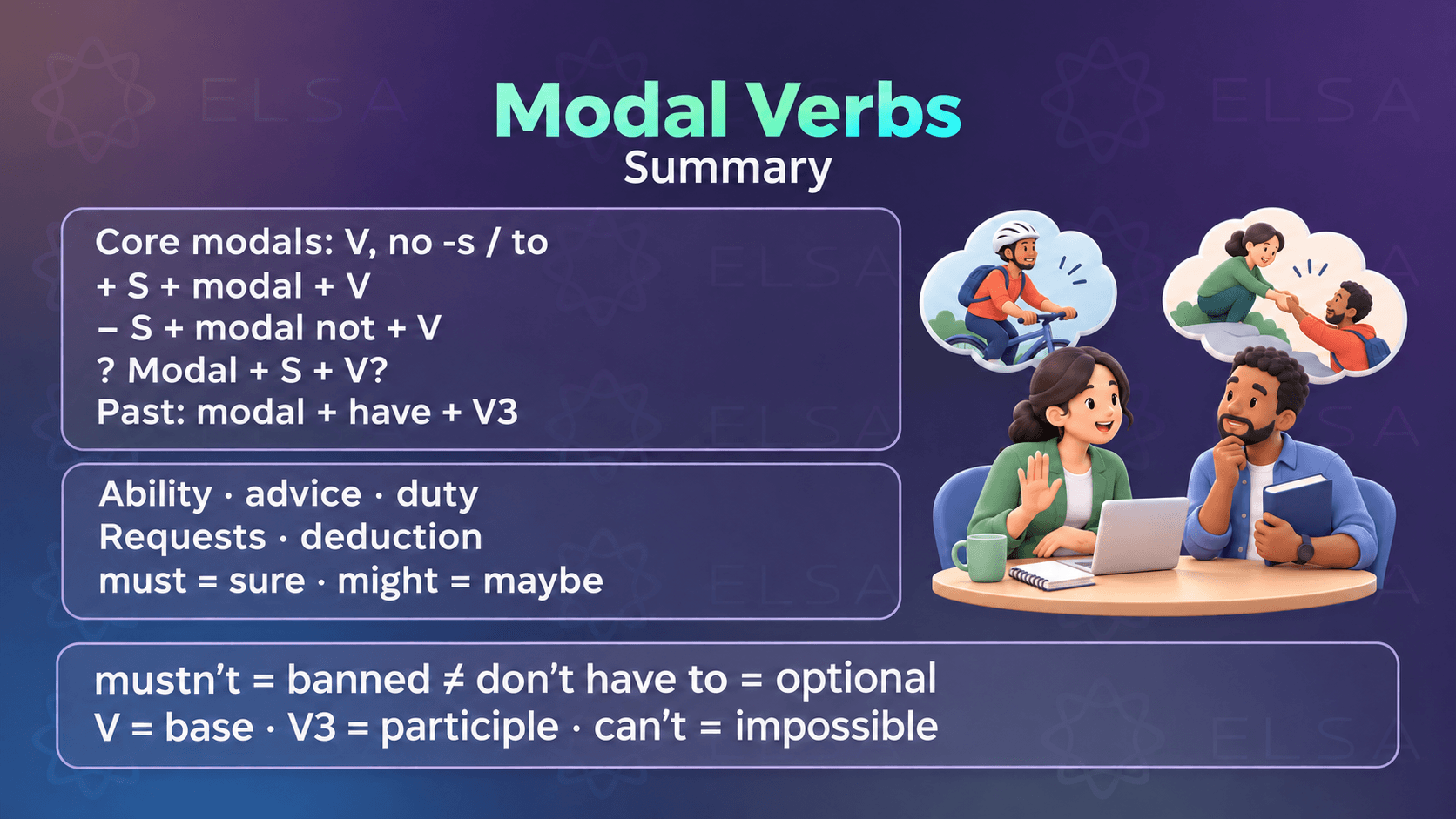
Modal verbs express how a speaker views an action or situation. They can indicate what someone is able to do, what is required, what is advisable, or how likely something seems. The core modal verbs include can, could, may, might, must, shall, should, will, and would.
Formulas:
| Form | Structure | Example |
|---|---|---|
| Affirmative | S + modal + V | She can speak Spanish |
| Negative | S + modal + not + V | She cannnot speak Spanish? |
| Question | Modal + S + V? | Can she speak Spanish? |
| Perfect modal | S + modal + have + past participle | She might have spoken Spanish. |
Modal verbs can be used to talk about several everyday situations:
- Express an ability. For example: She can solve the problem.
- Talk about obligation and prohibition. For example: Visitors must sign in.
- Talk about deduction and possibility. For example: That might be the delivery driver..
- Offer advice. For example: You should save a backup copy.
- Express earlier deductions, possibilities, or actions viewed critically. For example: I should have checked the address.
Basic modal verbs exercises (A1–A2)
These introductory modal verbs exercises focus on ability, permission, obligation, prohibition, and advice. Pay particular attention to the verb after the modal: it stays in the base form regardless of the subject.
Exercise 1: Can and could for ability and permission
Instructions: Fill each blank with can, can’t, could, or couldn’t. Follow the time reference and any specific instruction in parentheses.
| Example: My sister ___ speak four languages fluently. → My sister can speak four languages fluently. |
- I ___ swim now; I take lessons every week and swim without help.
- When Leo was six, he ___ already read simple books.
- I ___ open this jar right now. The lid is too tight.
- Before she took lessons, Maya ___ play the piano at all.
- My grandfather ___ run very fast when he was young.
- We ___ hear the speaker last night because the microphone was broken.
- My phone has no signal, so I ___ make a call right now.
- Noah is a skilled programmer. He ___ build simple apps.
- ___ I borrow your pen for a moment? (Use could for a polite permission request.)
- “Can I use this chair?” “Yes, you ___. Nobody is sitting there.”
Exercise 2: Must vs. mustn’t for obligation and prohibition
Instructions: Complete each sentence with must or mustn’t. Treat the rules stated in the sentences as the rules of each exercise situation.
- The instructions say every visitor ___ sign in at reception.
- This is a silent study room. You ___ talk on your phone here.
- All students ___ submit the form before joining the trip.
- The label says this file is private. You ___ share it outside the team.
- Participants ___ bring their registration confirmation; it is required for entry.
- You ___ write on the borrowed books. The library prohibits it.
- Every player ___ wear the team shirt during this tournament.
- The exam rules say students ___ use online translation tools.
- You ___ return your visitor badge before leaving the building.
- This folder is read-only. You ___ change its contents.
Exercise 3: Should and shouldn’t for giving advice
Instructions: Complete each sentence with should or shouldn’t, followed by the verb in parentheses.
- Your essay is due tomorrow. You ___ (start) working on it tonight.
- The instructions are unclear. You ___ (ask) for clarification.
- You want to save money. You ___ (buy) things you don’t need.
- Your presentation is too long. You ___ (remove) repeated points.
- You keep losing your files. You ___ (save) them in one organized folder.
- You are trying to concentrate. You ___ (check) your phone every minute.
- The email sounds rude. You ___ (rewrite) it before sending it.
- You don’t know the answer. You ___ (pretend) that you do.
- You want to improve your pronunciation. You ___ (practice) regularly.
- This information is unverified. You ___ (present) it as a confirmed fact.
Exercise 4: Multiple choice on basic modal functions
Instructions: Choose the answer that is grammatically correct and matches the stated meaning.
1. I’m sorry I ___ attend your dinner last night because I was out of town.
A. can’t
B. couldn’t
C. mustn’t
D. shouldn’t
2. Which option expresses present ability? “My sister ___ three languages.”
A. can speaks
B. cans speak
C. can speak
D. can to speak
3. Which option expresses a prohibition? “You ___ copy another student’s answers.”
A. mustn’t
B. don’t have to
C. might
D. can
4. Which option gives advice? “You ___ check the address before leaving.”
A. mustn’t
B. can’t
C. don’t have to
D. should
5. The extra worksheet is optional. You ___ complete it.
A. mustn’t
B. don’t have to
C. can’t
D. couldn’t
6. Which sentence correctly asks permission?
A. Do I can sit here?
B. Can I to sit here?
C. Can I sit here?
D. I can sit here?
7. When I was five, I ___ count to one hundred.
A. could
B. can
C. must
D. may
8. Choose the correct negative form: “He ___ join us today.”
A. doesn’t can
B. can’t to
C. cans not
D. cannot
9. Choose the correct form after should: “She should ___ her teacher.”
A. asks
B. ask
C. to ask
D. asking
10. Which modal makes a polite request? “___ you please close the door?”
A. Mustn’t
B. Shouldn’t
C. Could
D. Can’t have
Exercise 5: Sentence rearrangement with modal verbs
Instructions: Put all the words in the correct order. Add capitalization and punctuation.
- Spanish / Marcus / fluently / can / speak
- should / your / you / work / check
- here / mustn’t / visitors / park
- help / could / me / you
- the / might / late / train / be
- she / can / this / problem / solve
- the / we / must / deadline / meet
- shouldn’t / you / that / message / send
- may / a / I / question / ask
- they / couldn’t / the / instructions / understand
Intermediate modal verbs exercises (B1–B2)
These modal verb exercises develop your ability to interpret evidence, distinguish requirements from optional actions, and make polite requests. Focus on the speaker’s intended meaning. Two grammatically correct modals can communicate different attitudes.
Exercise 6: Modals of deduction in the present
Instructions: Use must for a strong positive conclusion, can’t when the speaker rules something out, and might/may for an uncertain possibility. Follow the meaning indicated.
- Someone is knocking. It ___ be the delivery driver, but I’m not sure. (uncertain possibility)
- The person in the photo ___ be Leo; Leo has never visited that location. (ruled out)
- Maya has worked through the night. She ___ be exhausted. (strong conclusion)
- I don’t know where my notebook is. It ___ be in my backpack. (uncertain possibility)
- This total ___ be correct; we have counted the same item twice. (ruled out)
- Everyone is looking toward the entrance. Something interesting ___ be happening. (strong conclusion)
- That ___ be our train; the destination on its display is different. (ruled out)
- The manager’s door is closed. She ___ be in a meeting, but I haven’t checked. (uncertain possibility)
- This apartment has five bedrooms and a private pool. It ___ be expensive. (strong conclusion)
- The missing page ___ be in the printer tray. Let’s look there. (uncertain possibility)
Note: Must here expresses a strong inference, not an objectively guaranteed fact. The exercise specifies the degree of certainty intended.
Exercise 7: Must vs. Have to vs. Don’t have to
Instructions: Complete each sentence with must, have to, has to, don’t have to, or doesn’t have to. Some affirmative sentences allow more than one answer; the key explains the preferred emphasis.
- I ___ remember to thank Nina. I really want to show my appreciation.
- Employees ___ submit their timesheets every Friday; it is company policy.
- This activity is optional, so you ___ participate.
- We will ___ book a larger room if more people register.
- She ___ wear a uniform because her employer requires one.
- Does everyone ___ bring a printed copy?
- He ___ attend the review session; attendance is optional.
- I may ___ work late tomorrow if the shipment is delayed.
- The tickets are free, so we ___ pay for admission.
- You ___ send the application today; the deadline is tonight.
Usage note: The personal-obligation versus external-obligation distinction is a useful tendency, not an absolute rule separating must and have to. Their affirmative uses often overlap. Their negatives differ sharply: mustn’t prohibits an action; don’t have to removes the requirement.
Exercise 8: Polite requests, offers, and permissions
Instructions: Rewrite each prompt as a polite question using the word in parentheses. More than one wording may be acceptable, but use the supplied modal.
- Ask someone to send you the updated schedule. (COULD)
- Ask permission to enter the room. (MAY)
- Invite someone to have some coffee. (WOULD)
- Offer to carry someone’s bag. (SHALL)
- Ask someone to speak more slowly. (COULD)
- Ask permission to leave a message. (MAY)
- Ask whether someone is willing to help you review a report. (WOULD)
- Suggest beginning the meeting. (SHALL)
- Ask someone to explain the final step. (COULD)
- Offer someone a window seat. (WOULD)
Note: For everyday American English, Can I carry your bag? and Should we begin? are also natural alternatives to the shall examples. Recognizing shall remains useful, especially in more formal or international contexts.
Exercise 9: Error identification in intermediate modal usage
Instructions: Each sentence contains one modal-related grammatical error. Rewrite the sentence correctly.
- He must to attend the orientation.
- She cans solve the problem.
- Do you can open this file?
- They don’t must work on Saturday.
- You should checks the details.
- We might to arrive late.
- Does she has to attend?
- I will can help you tomorrow.
- You ought check the instructions.
- He could have went home early.
Exercise 10: Sentence transformation with equivalent expressions
Instructions: Rewrite each sentence using an appropriate modal verb. Preserve the original meaning. Acceptable alternatives are included in the answer key.
- Ava is able to speak Mandarin.
- It is possible that the flight will be delayed.
- Students are not allowed to use phones during this exam.
- It is advisable for you to check the references.
- It is not necessary for us to print the document.
- Is it possible for you to help me with this form?
- I am certain that this is not the correct address.
- It is necessary for every participant to register.
- When I was younger, I was able to remember long poems.
- Perhaps the manager is working from home today.
Advanced modal verbs exercises (B2–C1)
These advanced modal verb exercises with answers focus on earlier events, missed opportunities, passive structures, and expressions whose meanings depend closely on context. Remember that modal + have + past participle is a perfect modal construction, not the past perfect tense.
Exercise 11: Past modals of deduction
Instructions: Complete each sentence with must have, can’t have, or might have, followed by the past participle of the verb in parentheses. Follow the certainty indicated.
- The floor is wet, and there is an empty mop bucket beside it. Someone ___ (clean) it. (strong conclusion)
- Nina ___ (send) that email at noon; she had no access to her account then. (ruled out)
- I’m not sure where my keys are. I ___ (leave) them at the office. (uncertain possibility)
- He knew every detail of the report. He ___ (read) it carefully. (strong conclusion)
- The package ___ (arrive) yesterday; the carrier still had it this morning. (ruled out)
- We don’t know why the meeting was canceled. The presenter ___ (become) unavailable. (uncertain possibility)
- All the chairs were rearranged after we left. Someone ___ (move) them. (strong conclusion)
- Leo ___ (attend) the event in person; he was abroad that entire week. (ruled out)
- The missing attachment ___ (go) to your spam folder. I haven’t checked. (uncertain possibility)
- The guests knew the new address. Someone ___ (tell) them. (strong conclusion)
Note: For uncertain answers, may have is also possible. For negative deductions, couldn’t have can often replace can’t have. These forms communicate the speaker’s assessment of the available evidence.
Exercise 12: Past regrets and missed opportunities
Instructions: Complete each sentence with should have, shouldn’t have, or could have, followed by the past participle. Follow the meaning in parentheses.
- You ___ (warn) me about the change before I submitted the form. (criticism: warning was the right action)
- I ___ (apply) for the scholarship, but I missed the deadline. (missed opportunity)
- We ___ (check) the address before leaving. We went to the wrong building. (regret about an omitted action)
- She ___ (share) that private message. It upset her colleague. (criticism of an action)
- They ___ (take) the earlier train, but they chose to wait. (unused option)
- I ___ (save) a backup copy. Now I have lost my work. (regret about an omitted action)
- He ___ (interrupt) the speaker so often. It was rude. (criticism of an action)
- We ___ (finish) yesterday, but we wasted the afternoon. (missed opportunity)
- You ___ (ask) for help instead of guessing. (advice about a past decision)
- I ___ (buy) the cheaper ticket, but I waited until the price increased. (missed opportunity)
Note: In other contexts, could have can express an uncertain past possibility rather than a missed opportunity. Here, the surrounding information establishes that the opportunity was not taken.
Exercise 13: Passive voice with modal verbs across tenses
Instructions: Rewrite each active sentence in the passive. Preserve the modal and time reference. Include the agent in a by phrase for this exercise.
Use the structure Modal + be + past participle or Modal + have been + past participle
- The committee must review every application.
- The technician can repair the printer.
- The editor should check the references.
- The organizers might postpone the workshop.
- The company will announce the results.
- The assistant must have mailed the invitations.
- The team could have prevented the error.
- The supervisor should have checked the figures.
- The administrator might have deleted the file.
- The intern cannot have completed the entire audit.
Note: In natural writing, omit the by phrase when identifying the agent adds no useful information.
Exercise 14: Multiple choice on nuanced and idiomatic modals
Instructions: Choose the answer that fits both the grammar and the context.
1. We bought far more food than necessary. We ___ so much food for only three people.
A. needn’t have bought
B. needn’t buy
C. don’t need buy
D. mustn’t have buy
2. Dinner was provided, so we ___ any food, and we did not buy any.
A. needn’t have bought
B. didn’t need to buy
C. must have bought
D. should have bought
3. The missing file may ___ be in the archive; several older files are stored there.
A. good
B. better
C. well
D. best
4. The video was so funny that I couldn’t help ___.
A. laugh
B. to laugh
C. laughed
D. laughing
5. The application closes in an hour. You had better ___ wait until tomorrow.
A. not
B. don’t
C. doesn’t
D. no
6. I would rather ___ home tonight than go out.
A. staying
B. stay
C. to stay
D. stayed
7. There is no earlier train, so we might as well ___ this one.
A. to take
B. taken
C. take
D. taking
8. We lost the final, but we ___ if we had used our chances better.
A. must have won
B. should win
C. can win
D. could have won
9. You needn’t ___ a printed copy; the digital version is enough.
A. bring
B. to bring
C. brings
D. bringing
10. She can’t have ___ the final email; it was never sent to her.
A. saw
B. seen
C. seeing
D. see
Important distinction: Needn’t have done explicitly refers to an action that happened but was unnecessary. Didn’t need to do states that there was no necessity; by itself, it does not conclusively establish whether the action happened. Context supplies that information.
In everyday American English, you may also hear “You didn’t have to buy so much food” when the purchase did happen. Learn needn’t have for recognition, but do not assume it is the only natural way to express this meaning.
Exercise 15: Sentence synthesis and academic paraphrasing
Instructions: Rewrite each sentence using the word or phrase in capitals. Preserve the meaning and do not change the supplied wording.
- I am certain that David did not take the company car. (CANNOT)
- The evidence strongly suggests that someone changed the settings. (MUST)
- It was a mistake not to check the original source. (SHOULD)
- You printed the entire report, but doing so was unnecessary. (NEEDN’T)
- It is possible that the researchers overlooked a relevant variable. (MIGHT)
- It is necessary for the review panel to examine every application. (MUST)
- The team had an opportunity to prevent the delay, but it failed to do so. (COULD)
- It would have been advisable for the authors to acknowledge this limitation. (OUGHT)
- It is quite possible that the difference reflects a change in sampling methods. (MAY WELL)
- Whenever I hear that story, I find it impossible to avoid smiling. (CANNOT HELP)
Tips for solving modal verb exercises and common pitfalls
- Check the form of the verb that follows: After core modal verbs (can, could, must, should, may, might, will, would), the verb must be in the bare infinitive form (the infinitive without to).
- Identify the time reference (present or past): To make a deduction about the present, use modal + bare infinitive. To make a deduction about a completed past event based on evidence, use modal + have + past participle (V3/-ed).
- Distinguish prohibition from lack of necessity: Mustn’t means something is prohibited (for example, by a rule or law). Don’t have to means something is unnecessary, you can choose whether to do it.
| Common pitfall | Incorrect | Corrected | Rule / Fix |
|---|---|---|---|
| Adding to after a core modal | You must to finish today. | You must finish today. | A core modal takes a base verb without to. |
| Adding third-person -s | She cans speak Spanish. | She can speak Spanish. | Core modals do not change with the subject. |
| Writing could of / should of | We should of checked | We should have checked. | The correct construction is should have, often contracted to should’ve. |
| Confusing prohibition and optional actions | (Context: jackets are optional. )You mustn’t wear a jacket. | You don’t have to wear a jacket. | Use don’t have to for lack of obligation, not prohibition. |
These modal verbs exercises help you choose language that matches your meaning, from a simple request with could to a past deduction with must have. Review the sets you found difficult, then practice saying your sentences aloud with ELSA Speak. Remember to explore more grammar guides and practice activities on the Grammar category on our blog.