

150+ present perfect exercises with detailed answers (A1 to C1)
elsaspeakadmin
November 13, 2026
Grammar exercises
The present perfect is usually used to describe life experiences, recent results, and situations that happened in the past and still continue today. However, some learners still struggle with using this tense. In this article, we gather present perfect exercises with 150 practice questions and answers, along with a PDF file to help you tackle the common mistakes and use the tense more accurately.
Present perfect rules and formulas grammar summary
The present perfect tense is used to describe an action that may have been completed, but its result or the experience still matters in the present. Additionally, it can also be used to talk about a situation that may have started earlier and still be true.
Let’s review the 4 common uses before starting the present perfect tense exercises:
- Life experiences: Usually goes with ever (for positive statements) and never (for negative statements).
For example: I have never visited Denver. - Situations that continue to the present: Use “since” to talk about the starting point, and “for” to measure the duration.
For example: They have known her for three years. - Recent actions with present results: Goes with words such as “just”, “already”, “recently”, etc.
For example: He has just finished his report. - Expected actions that have not happened up to now: At the end of the negative sentence or a question, the word “yet” usually appears to emphasize this usage.
For example: The letter hasn’t arrived yet.
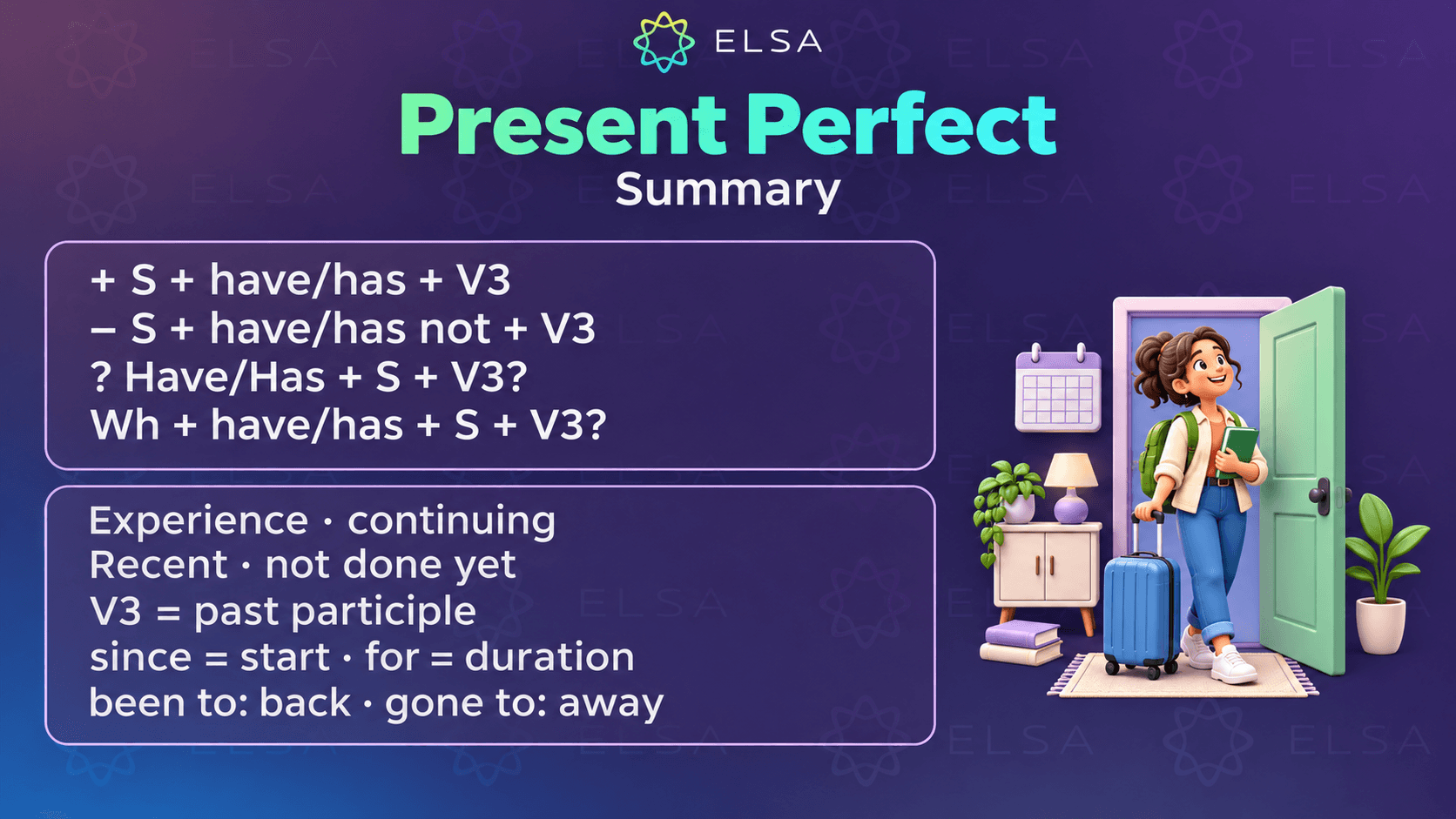
Present perfect formulas
| Form | Structure | Common adverbs and time expressions |
|---|---|---|
| Affirmative | S + have/has + past participle | already, just, recently, so far, since, for |
| Negative | S + haven't/hasn't + past participle | yet, still, never |
| Yes/no question | Have/Has + S + past participle? | ever, yet |
| Wh-question | Wh-word + have/has + S + past participle? | how long, since when |
Remember to distinguish between these two pairs:
- Have been to: Mention that a visit is complete; the person has returned from that visit.
- Have gone to: Mention that the person has left for a place and has not returned.
Basic present perfect exercises (A1 - A2)
These present perfect exercises with answers below with help you get started with auxiliary agreement, past participles, and basic word order. Note that full forms and standard contractions are both acceptable unless the instructions specify otherwise.
Exercise 1: Affirmative sentences with have/has and past participles
Instructions: Complete each sentence with the affirmative present perfect form of the verb in parentheses.
Example: I ___ (live) here for five years. → I have lived here for five years. |
- I ___ (finish) my homework, so I can relax now.
- Mia ___ (write) three emails so far today.
- We ___ (visit) that museum twice.
- The dog ___ (eat) its dinner.
- You ___ (make) a useful study plan.
- My parents ___ (buy) a new car.
- Leo ___ (take) the placement test.
- The students ___ (read) all five assigned chapters.
- Our teacher ___ (give) us some helpful feedback.
- I ___ (know) my best friend since kindergarten.
Exercise 2: Negative sentences with haven't/hasn't and yet
Instructions: Rewrite each sentence in the negative present perfect. Use haven't/hasn't and put yet at the end. Remove already where it appears.
Example: She has already finished her project. → She hasn't finished her project yet. |
- I have cleaned my room.
- Noah has already checked his email.
- We have booked our flights.
- The bus has arrived.
- You have returned the library books.
- Ava has already chosen a topic.
- They have paid the bill.
- My brother has packed his suitcase.
- The children have brushed their teeth.
- The store has opened.
Exercise 3: Yes/No questions with ever and short answers
Instructions: Use the prompts to write present perfect questions with ever. Complete the short answers using the indicated yes or no response.
Example: you / ever / eat / sushi (yes) → Have you ever eaten sushi? Yes, I have. |
- you / ever / see / a shooting star (yes)
- Lily / ever / ride / a horse (no)
- they / ever / visit / Texas (yes)
- your brother / ever / break / a bone (no)
- you / ever / make / bread (no)
- Ben / ever / swim / in the ocean (yes)
- your parents / ever / fly / in a helicopter (no)
- you / ever / meet / a famous athlete (yes)
- your sister / ever / win / a prize (yes)
- your friends / ever / sleep / in a tent (no)
Exercise 4: Prepositions of time: since vs for
Instructions: Fill each blank with since or for.
- Marcus has worked at this firm ___ three years.
- I have known Elena ___ 2019.
- The store has been closed ___ Monday.
- We have owned this car ___ six months.
- She has been a nurse ___ she graduated.
- They have lived next door ___ a long time.
- My phone has been off ___ 8:00 a.m.
- He has had that backpack ___ several years.
- You haven't called me ___ last weekend.
- The children have been awake ___ two hours.
Exercise 5: Sentence rearrangement for beginners
Instructions: Put every word into the correct order. Use standard mid-position for already and never, and put yet at the end. Add capitalization and punctuation.
- already / have / we / that / movie / seen
- her / has / she / keys / lost
- yet / finished / I / haven't / lunch
- ever / you / have / visited / Boston
- never / he / has / sushi / tried
- lived / they / here / have / since / May
- homework / has / your / brother / done / his
- hasn't / the / yet / train / arrived
- two / we / have / for / hours / waited
- you / have / how / known / long / her
Intermediate present perfect exercises (B1–B2)
The practice set below focuses more on meaning and context. In particular, these past simple and present perfect exercises will require you to decide whether a sentence locates an event in a finished past period, or looks back from the present. Follow each task’s tense instructions instead of assuming that “just”, “already”, or “yet” always requires the present perfect.
Exercise 6: Past simple vs present perfect differentiation
Instructions: Complete the sentences with the simple past tense or present perfect simple. Use the present perfect for an explicit up-to-now perspective and the past simple for a stated finished past time.
- I ___ (lose) my keys yesterday, and I still ___ (not/find) them.
- So far this semester, she ___ (submit) four essays.
- We ___ (move) to Phoenix in 2021.
- He ___ (be) a teacher since 2018, and he still teaches today.
- They ___ (visit) the aquarium last Saturday.
- Up to now, I ___ (not/read) any books by this author.
- ___ you ___ (see) Nina at the conference two days ago?
- My grandparents ___ (own) this house for forty years, and they still own it.
- Our team ___ (win) the championship in 2022.
- This is the first time I ___ (use) this software.
Exercise 7: Adverb placement: already, just, yet, and still
Instructions: Insert the adverb in parentheses. Use the usual mid-position for already and just, final position for yet, and the position before the negative auxiliary for still.
- The plane has landed. (just)
- I have finished the first chapter. (already)
- She hasn't replied to my message. (yet)
- We haven't received the invoice. (still)
- Have you checked the schedule? (yet)
- The children have fallen asleep. (just)
- He has paid the registration fee. (already)
- They haven't repaired the elevator. (still)
- Has your order arrived? (yet)
- Our guests have left. (just)
Note: Already can also appear at the end, as in “I have finished already.” The answer table uses the positions requested for this task.
Exercise 8: Have been to vs have gone to in context
Instructions: Complete each sentence with have/has been to or have/has gone to. Use the correct auxiliary for the subject.
- David isn't at his desk; he ___ the cafeteria and hasn't returned.
- I ___ Chicago three times, but I'm home in Austin now.
- Our neighbors ___ Florida for the winter. Their house is empty.
- Emma ___ the bank and is back with the cash.
- My parents ___ Canada several times. They're telling me about their trips at home.
- Jake ___ the pharmacy. He should be back in twenty minutes.
- We ___ that restaurant before; we ate there and came home last Friday.
- Sofia ___ the conference in Denver. She won't return until Sunday.
- The children ___ the library and have brought home six books.
- Our manager ___ the New York office. She is still there this week.
Exercise 9: Wh-questions with how long
Instructions: Use the prompts to write How long questions in the present perfect simple. Then write complete answers using the information provided. Keep since or for as given.
- you / know / your business partner (since 2020)
- Mia / own / her bike (for two years)
- they / be / married (for fifteen years)
- your brother / have / his license (since June)
- you / live / in Dallas (for six months)
- the store / be / open (since 9:00 a.m.)
- Alex / work / at the hospital (since 2017)
- your parents / own / their house (for twenty years)
- you / be / interested in astronomy (since middle school)
- the children / have / their pet rabbit (for three weeks)
Note: With verbs such as live and work, the continuous form can also describe duration. This exercise specifically practices the simple form.
Exercise 10: Error identification in intermediate sentences
Instructions: Each sentence contains one grammatical error. Correct it while preserving the intended meaning and time expression.
- I have seen that musical two weeks ago.
- She have finished her presentation.
- We have lived here since five years.
- He has went to the grocery store and hasn't returned.
- Have you ever ate Korean food?
- They hasn't received the package yet.
- I have known her for 2019.
- Did you ever been to Alaska?
- The movie has began.
- How long you have owned this laptop?
Advanced present perfect exercises (B2–C1)
The next sets combine tense choice with passive voice, experience patterns, and paraphrasing. Focus on whether the sentence emphasizes a completed result, an ongoing process, or a state continuing to the present.
Exercise 11: Present perfect simple vs Present perfect continuous
Instructions: Complete each sentence with the present perfect simple or present perfect continuous tense. Follow the focus in parentheses. If both forms are possible in general, choose the form that matches that stated focus.
- Emily ___ (paint) the living room all afternoon, and her clothes are covered in paint. (ongoing activity)
- She ___ (finish) only one wall so far. (completed quantity)
- I ___ (know) our director for ten years. (state)
- We ___ (process) 250 applications so far. (completed quantity)
- Why are your shoes muddy? — I ___ (work) in the garden. (recent activity)
- The technician ___ (repair) the printer; it works now. (completed result)
- They ___ (discuss) the proposal for two hours and are still discussing it. (ongoing process)
- He ___ (write) six pages of the report so far. (completed quantity)
- She ___ (own) this apartment since 2016. (state)
- How long ___ you ___ (wait) for the test results? (ongoing activity)
Exercise 12: Passive voice transformation in the present perfect
Instructions: Rewrite each active sentence in the present perfect passive: have/has + been + past participle. Keep the agent in a by phrase for this exercise, even when it could be omitted naturally.
- The cybersecurity team has patched the network vulnerability.
- The editor has revised the final chapter.
- The volunteers have distributed the food packages.
- The committee has approved the research proposal.
- The mechanic has replaced the brakes.
- The researchers have collected the samples.
- The company has updated its privacy policy.
- The organizers have postponed the workshop.
- The architect has redesigned the entrance.
- The city has installed new traffic lights.
Exercise 13: Special patterns with superlatives and “It is the first time”
Instructions: Complete each sentence with the present perfect form of the verb in parentheses. Put ever or never in its usual position when supplied.
- This is the first time I ___ (give) a presentation in English.
- It is the second time she ___ (miss) the deadline.
- This is the most useful course we ___ (ever/take).
- That is the best explanation he ___ (ever/hear).
- This is the third time they ___ (ask) the same question.
- It is the first time my son ___ (fly) alone.
- This is the hardest exam I ___ (ever/do).
- She is the most patient instructor we ___ (ever/meet).
- This is the first time our team ___ (win) this award.
- This is the only restaurant in town that I ___ (never/try).
Note: These are common present-reference patterns, not a rule that every superlative requires the present perfect. A finished past context can use the past simple, as in “That was the best meal we ate on the trip".
Exercise 14: Multiple choice on nuanced time expressions
Instructions: Choose the best answer. The context looks back from now; choose the form that matches the completed quantity, ongoing activity, or continuing state.
1. So far this month, the lab ___ four batches of samples.
A. tests
B. has tested
C. had tested
D. is testing
2. Up to now, the device ___ reliably, and it is still in use.
A. has operated
B. had operated
C. will operate
D. is operate
3. Over the past decade, the organization ___ ten new centers that are now open.
A. had opened
B. opening
C. has opened
D. is open
4. Lately, I ___ trouble sleeping, and the problem is continuing.
A. had had
B. have been having
C. will have
D. am have
5. Since the new policy took effect, the company ___ twelve complaints in total.
A. had received
B. is receiving
C. receive
D. has received
6. The analyst ___ the same discrepancy three times so far today.
A. has identified
B. had identified
C. is identifying
D. identifies yesterday
7. Over the last six weeks, our team ___ five training sessions, all now complete.
A. had delivered
B. is delivering
C. has delivered
D. deliver
8. She ___ the lead researcher since 2020 and still holds the position.
A. was being
B. had been
C. is been
D. has been
9. We ___ 60% of the interviews so far; the rest are scheduled for next week.
A. had completed
B. have completed
C. are completing
D. completes
10. Recently, the technicians ___ around the clock; the repairs are still underway.
A. have been working
B. had worked
C. will work
D. is working
Exercise 15: Sentence synthesis and academic paraphrasing
Instructions: Rewrite each sentence or pair of sentences using the word in capitals. Keep the meaning and use the present perfect. Do not change the capitalized word.
- The last time Michael contacted our support team was in July. (SINCE)
- We started owning this building in 2015, and we still own it. (OWNED)
- This is my first experience of reviewing a grant application. (NEVER)
- The committee approved the policy. The policy is now in effect. (BEEN)
- The research team began collecting data in January and is still collecting it. (SINCE)
- No previous version of this software was as reliable as this one, in my experience. (EVER)
- The last time the department hired a new employee was six months ago. (FOR)
- The technician completed three inspections, and that is the total up to now. (FAR)
- We became colleagues ten years ago, and we still work together. (BEEN)
- The conference organizers did not send a confirmation earlier, and we are still waiting for it. (YET)
Note: Other paraphrases may be acceptable if they preserve the meaning, include the required word, and use the target structure correctly.
Tips for solving present perfect exercises and common pitfalls
1. Check the time perspective before choosing the tense
Expressions such as ever, never, so far, up to now, since, and for can help you recognize an up-to-now perspective. Then ask: Is the sentence describing experience, a present result, or a situation that is still true?
2. Find any finished past time attached to the event
Use the past simple when the event itself is located at a finished past time: yesterday, two weeks ago, last year, in 2015, or when I was a child.
3. Separate starting points from durations
Use since + starting point:
- since 2010
- since Monday
- since 8:00 a.m.
- since I graduated
Use for + duration:
- for three hours
- for ten years
- for a long time
- for several weeks
As a quick check, since answers “From when?” and for answers “For how long?” These meanings also apply outside the present perfect.
| Common pitfall | Incorrect | Corrected | Rule / Fix |
|---|---|---|---|
| Dating the event with a finished past time | I have called her yesterday. | I called her yesterday. | When yesterday dates the event, use the past simple. |
| Confusing since and for | We have lived here since five years. | We have lived here for five years. | Five years is a duration. Since needs a starting point. |
| Confusing been to and gone to | Context: Nina has left for Rome and hasn't returned. “Nina has been to Rome.” | Nina has gone to Rome. | Gone to matches the current absence. Been to describes a completed visit. |
| Using the past simple form after have/has | He has wrote three reports. | He has written three reports. | Have/has requires the past participle, not the past simple form. |
Note: In American English usage, “Did you eat yet?” and “I already finished” are common American patterns. They should not automatically be marked wrong in open-ended communication practice. These exercises specify the present perfect where that is the structure being tested.
FAQs about present perfect practice
Why can't we use specific past time words like yesterday with the present perfect?
The present perfect looks back from the present without placing the event at a finished past time. Yesterday places the event in a period that has ended, so standard usage is “I finished it yesterday,” rather than “I have finished it yesterday.”
The restriction applies to how the event is dated, not to every appearance of a past-time expression. “I haven't eaten since yesterday” is correct because since yesterday identifies the start of a period continuing up to now.
What is the exact difference between have been to and have gone to?
- Have been to describes a completed visit.
For example: I have been to Paris twice. - Have gone to describes someone who has left for a destination and has not returned.
For example: Sarah has gone to Paris, she'll be back next week.
How do we choose between since and for?
Choose since for the starting point and for for the duration.
These present perfect exercises help you connect verb forms with the time and meaning you want to express. After checking your answers, turn several corrected sentences into examples about your own life: where you have been, what you have learned, and how long you have studied English.
Practice saying them aloud, then explore more lessons and practice in the Grammar category on the ELSA Speak blog.