


Numbers in English: 1 to 100 chart, rules & pronunciation
elsaspeakadmin
October 19, 2026
Common vocabulary
Numbers in English appear in everyday conversations and professional settings. In this guide, we will cover numbers in English 1 to 100 with spelling rules, pronunciation, examples, and common mistakes to avoid while spelling numbers.
Cardinal numbers: Counting from 1 to 100 in English
Cardinal numbers are numbers used to answer the question, “How many?” They usually express quantities, ages, and counts, and they are also used when reading phone numbers and identifying numerical values.
For example: Three books, thirty-five years old, twenty students, etc.
Learning the numbers in English 1 to 100 becomes easier when you understand the four basic groups.
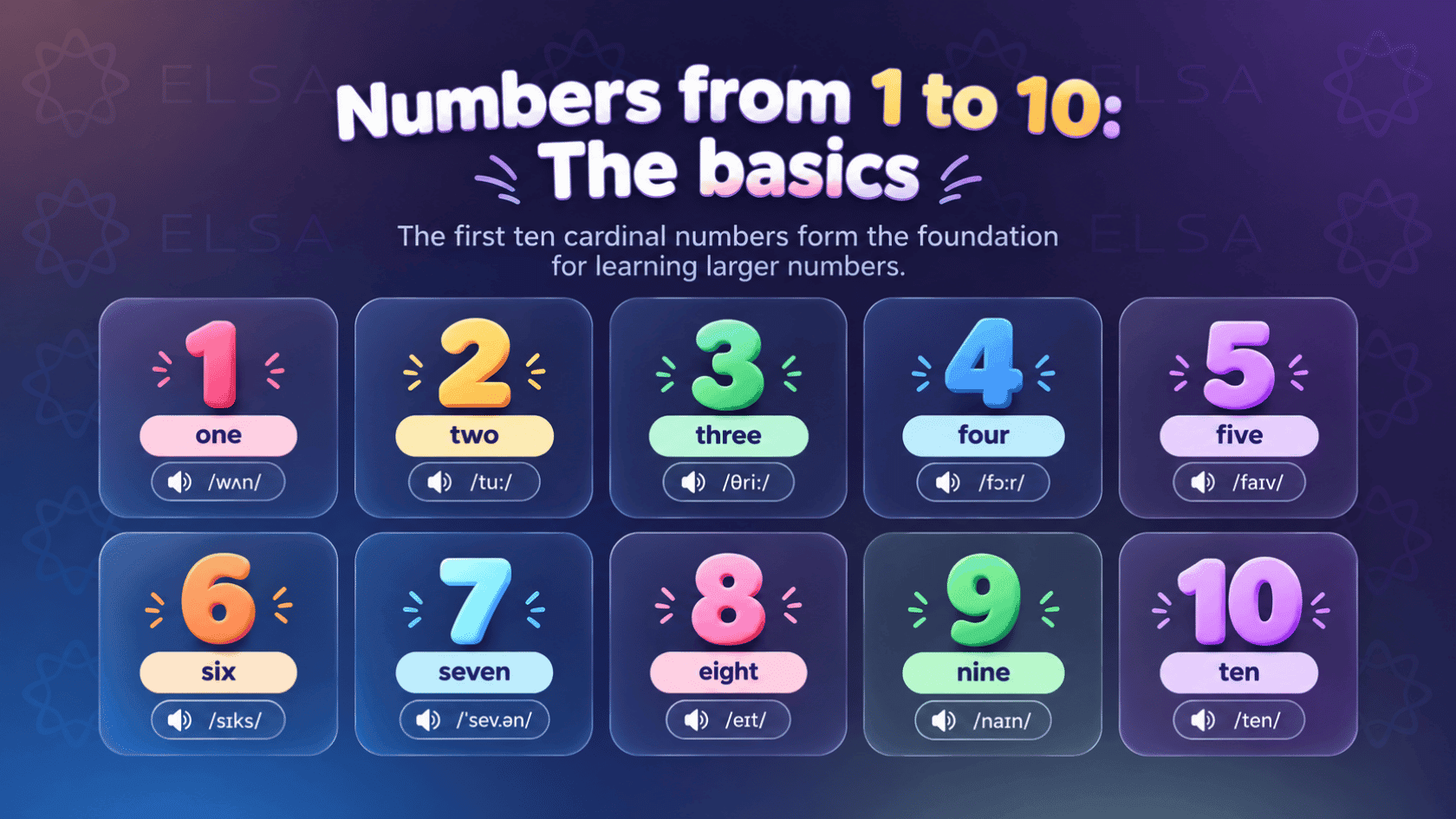
Numbers from 1 to 10: The basics
The first ten cardinal numbers form the foundation for learning larger numbers. Memorize their spelling and pronunciation before moving on to compound numbers.
| Numbers | Spelling | American English IPA |
|---|---|---|
| 1 | one | /wʌn/ |
| 2 | two | /tuː/ |
| 3 | three | /θriː/ |
| 4 | four | /fɔːr/ |
| 5 | five | /faɪv/ |
| 6 | six | /sɪks/ |
| 7 | seven | /ˈsev.ən/ |
| 8 | eight | /eɪt/ |
| 9 | nine | /naɪn/ |
| 10 | ten | /ten/ |
Numbers from 11 to 20
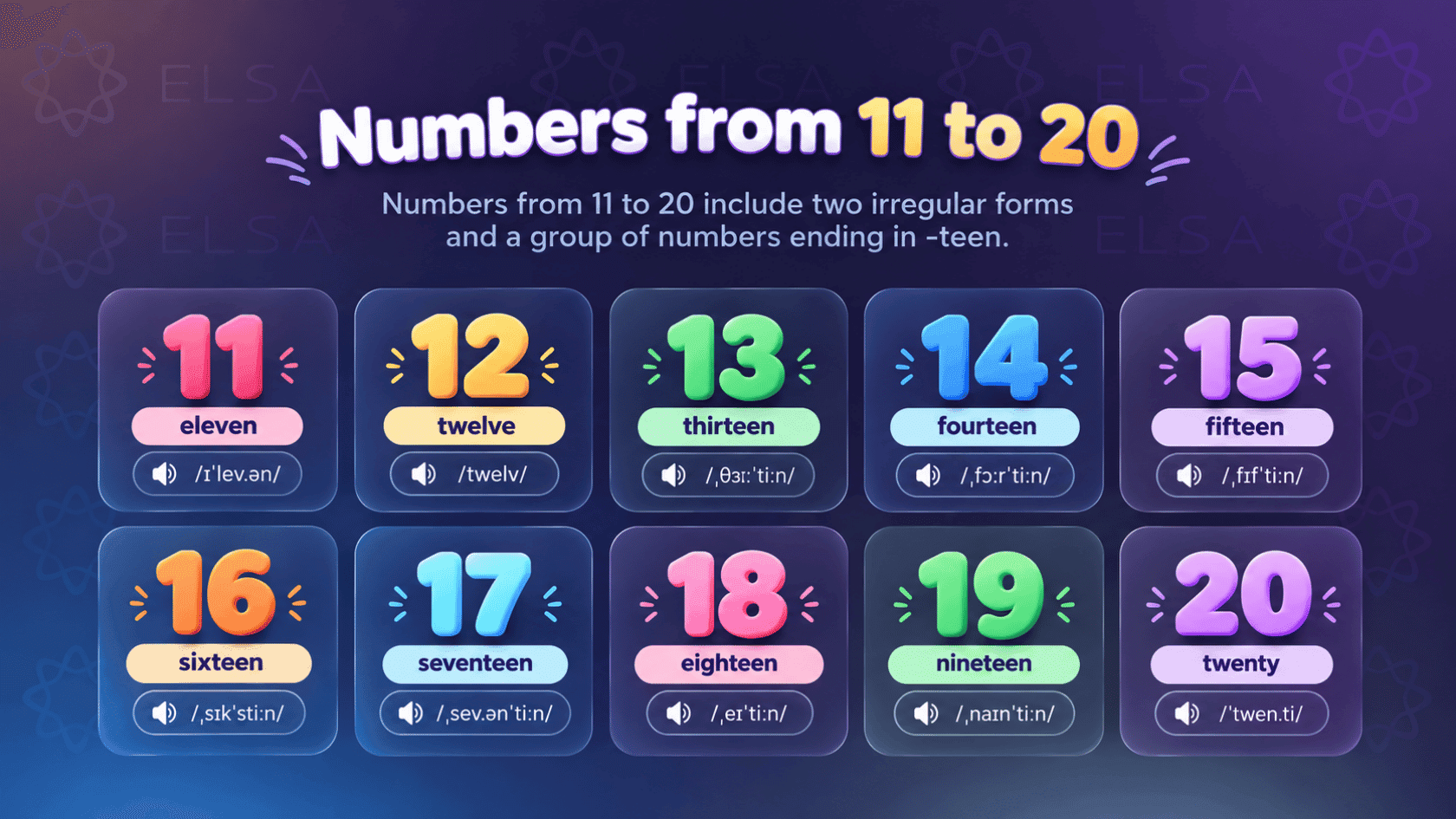
Numbers from 11 to 20 include two irregular forms and a group of numbers ending in "-teen".
| Numbers | Spelling | American English IPA |
|---|---|---|
| 11 | eleven | /ɪˈlev.ən/ |
| 12 | twelve | /twelv/ |
| 13 | thirteen | /ˌθɝːˈtiːn/ |
| 14 | fourteen | /ˌfɔːrˈtiːn/ |
| 15 | fifteen | /ˌfɪfˈtiːn/ |
| 16 | sixteen | /ˌsɪkˈstiːn/ |
| 17 | seventeen | /ˌsev.ənˈtiːn/ |
| 18 | eighteen | /ˌeɪˈtiːn/ |
| 19 | nineteen | /ˌnaɪnˈtiːn/ |
| 20 | twenty | /ˈtwen.ti/ |
Round tens: 30 to 90
Round tens represent multiples of ten. Most end in "-ty", and recognizing this pattern makes compound numbers easier to form.
| Numbers | Spelling | American English IPA |
|---|---|---|
| 30 | thirty | /ˈθɝː.ti/ |
| 40 | forty | /ˈfɔːr.ti/ |
| 50 | fifty | /ˈfɪf.ti/ |
| 60 | sixty | /ˈsɪk.sti/ |
| 70 | seventy | /ˈsev.ən.ti/ |
| 80 | eighty | /ˈeɪ.ti/ |
| 90 | ninety | /ˈnaɪn.ti/ |
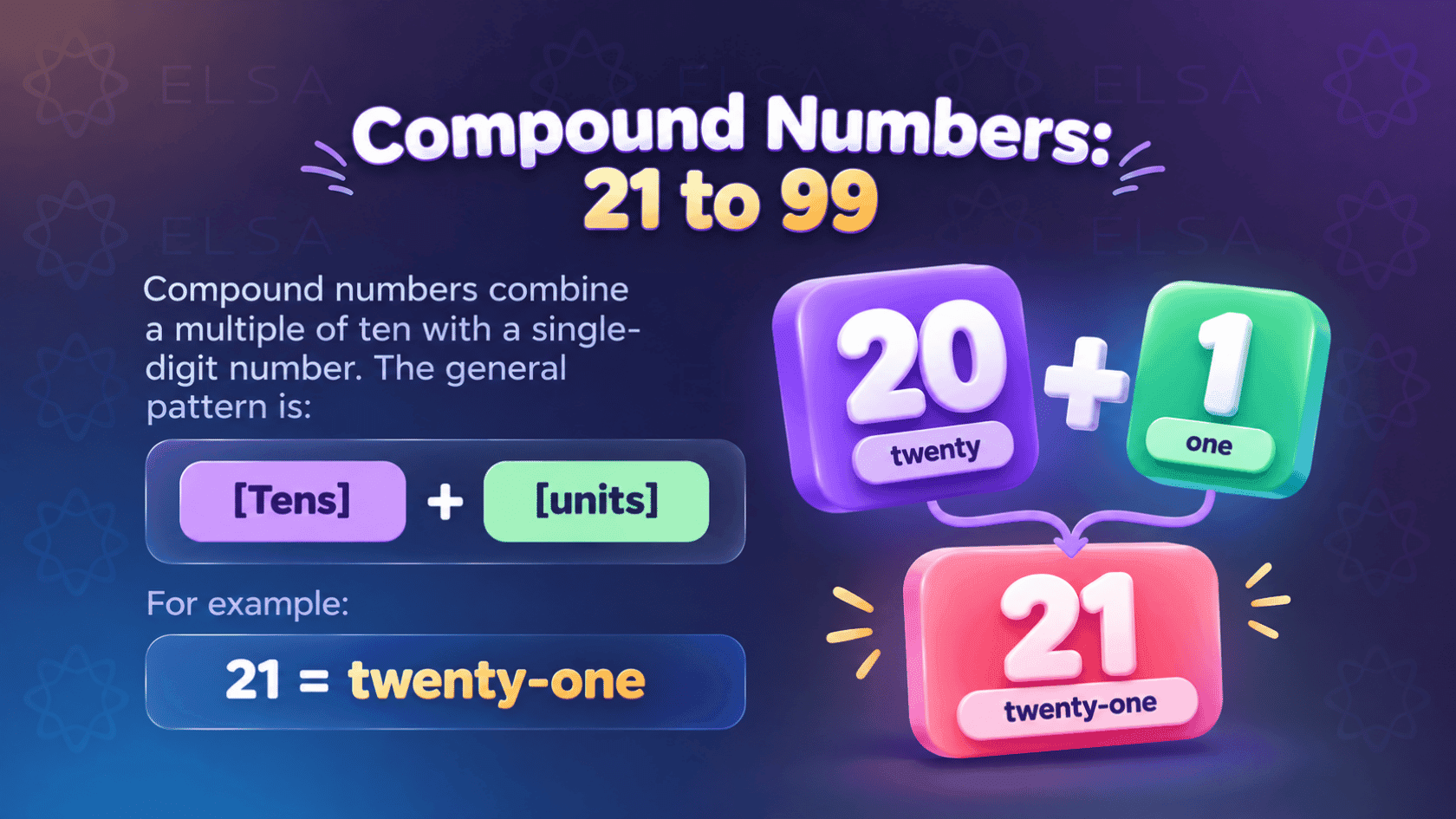
Compound numbers: 21 to 99
Compound numbers combine a multiple of ten with a single-digit number. The general pattern is:
| [Tens] + - + [units] |
For example:
- 21 = twenty-one
- 34 = thirty-four
- 45 = forty-five
- 68 = sixty-eight
- 72 = seventy-two
- 99 = ninety-nine
Numbers in English 1 to 100 chart
Use this numbers in English 1 to 100 chart to review your spelling and American English pronunciation:
| Range | Numbers in English words | American English IPA |
|---|---|---|
| 1-10 | one, two, three, four, five, six, seven, eight, nine, ten | /wʌn/, /tuː/, /θriː/, /fɔːr/, /faɪv/, /sɪks/, /ˈsev.ən/, /eɪt/, /naɪn/, /ten/ |
| 11-20 | eleven, twelve, thirteen, fourteen, fifteen, sixteen, seventeen, eighteen, nineteen, twenty | /ɪˈlev.ən/, /twelv/, /ˌθɝːˈtiːn/, /ˌfɔːrˈtiːn/, /ˌfɪfˈtiːn/, /ˌsɪkˈstiːn/, /ˌsev.ənˈtiːn/, /ˌeɪˈtiːn/, /ˌnaɪnˈtiːn/, /ˈtwen.ti/ |
| 21-30 | twenty-one, twenty-two, twenty-three, twenty-four, twenty-five, twenty-six, twenty-seven, twenty-eight, twenty-nine, thirty | /ˌtwɛnti ˈwʌn/, /ˌtwɛnti ˈtuː/, /ˌtwɛnti ˈθriː/, /ˌtwɛnti ˈfɔr/, /ˌtwɛnti ˈfaɪv/, /ˌtwɛnti ˈsɪks/, /ˌtwɛnti ˈsɛvən/, /ˌtwɛnti ˈeɪt/, /ˌtwɛnti ˈnaɪn/, /ˈθɝti/ |
| 31-40 | thirty-one, thirty-two, thirty-three, thirty-four, thirty-five, thirty-six, thirty-seven, thirty-eight, thirty-nine, forty | /ˌθɝti ˈwʌn/, /ˌθɝti ˈtuː/, /ˌθɝti ˈθriː/, /ˌθɝti ˈfɔr/, /ˌθɝti ˈfaɪv/, /ˌθɝti ˈsɪks/, /ˌθɝti ˈsɛvən/, /ˌθɝti ˈeɪt/, /ˌθɝti ˈnaɪn/, /ˈfɔrti/ |
| 41-50 | forty-one, forty-two, forty-three, forty-four, forty-five, forty-six, forty-seven, forty-eight, forty-nine, fifty | /ˌfɔrti ˈwʌn/, /ˌfɔrti ˈtuː/, /ˌfɔrti ˈθriː/, /ˌfɔrti ˈfɔr/, /ˌfɔrti ˈfaɪv/, /ˌfɔrti ˈsɪks/, /ˌfɔrti ˈsɛvən/, /ˌfɔrti ˈeɪt/, /ˌfɔrti ˈnaɪn/, /ˈfɪfti/ |
| 51-60 | fifty-one, fifty-two, fifty-three, fifty-four, fifty-five, fifty-six, fifty-seven, fifty-eight, fifty-nine, sixty | /ˌfɪfti ˈwʌn/, /ˌfɪfti ˈtuː/, /ˌfɪfti ˈθriː/, /ˌfɪfti ˈfɔr/, /ˌfɪfti ˈfaɪv/, /ˌfɪfti ˈsɪks/, /ˌfɪfti ˈsɛvən/, /ˌfɪfti ˈeɪt/, /ˌfɪfti ˈnaɪn/, /ˈsɪksti/ |
| 61-70 | sixty-one, sixty-two, sixty-three, sixty-four, sixty-five, sixty-six, sixty-seven, sixty-eight, sixty-nine, seventy | /ˌsɪksti ˈwʌn/, /ˌsɪksti ˈtuː/, /ˌsɪksti ˈθriː/, /ˌsɪksti ˈfɔr/, /ˌsɪksti ˈfaɪv/, /ˌsɪksti ˈsɪks/, /ˌsɪksti ˈsɛvən/, /ˌsɪksti ˈeɪt/, /ˌsɪksti ˈnaɪn/, /ˈsɛvənti/ |
| 71-80 | seventy-one, seventy-two, seventy-three, seventy-four, seventy-five, seventy-six, seventy-seven, seventy-eight, seventy-nine, eighty | /ˌsɛvənti ˈwʌn/, /ˌsɛvənti ˈtuː/, /ˌsɛvənti ˈθriː/, /ˌsɛvənti ˈfɔr/, /ˌsɛvənti ˈfaɪv/, /ˌsɛvənti ˈsɪks/, /ˌsɛvənti ˈsɛvən/, /ˌsɛvənti ˈeɪt/, /ˌsɛvənti ˈnaɪn/, /ˈeɪti/ |
| 81-90 | eighty-one, eighty-two, eighty-three, eighty-four, eighty-five, eighty-six, eighty-seven, eighty-eight, eighty-nine, ninety | /ˌeɪti ˈwʌn/, /ˌeɪti ˈtuː/, /ˌeɪti ˈθriː/, /ˌeɪti ˈfɔr/, /ˌeɪti ˈfaɪv/, /ˌeɪti ˈsɪks/, /ˌeɪti ˈsɛvən/, /ˌeɪti ˈeɪt/, /ˌeɪti ˈnaɪn/, /ˈnaɪnti/ |
| 91-100 | ninety-one, ninety-two, ninety-three, ninety-four, ninety-five, ninety-six, ninety-seven, ninety-eight, ninety-nine, one hundred | /ˌnaɪnti ˈwʌn/, /ˌnaɪnti ˈtuː/, /ˌnaɪnti ˈθriː/, /ˌnaɪnti ˈfɔr/, /ˌnaɪnti ˈfaɪv/, /ˌnaɪnti ˈsɪks/, /ˌnaɪnti ˈsɛvən/, /ˌnaɪnti ˈeɪt/, /ˌnaɪnti ˈnaɪn/, /wʌn ˈhʌndrəd/ |
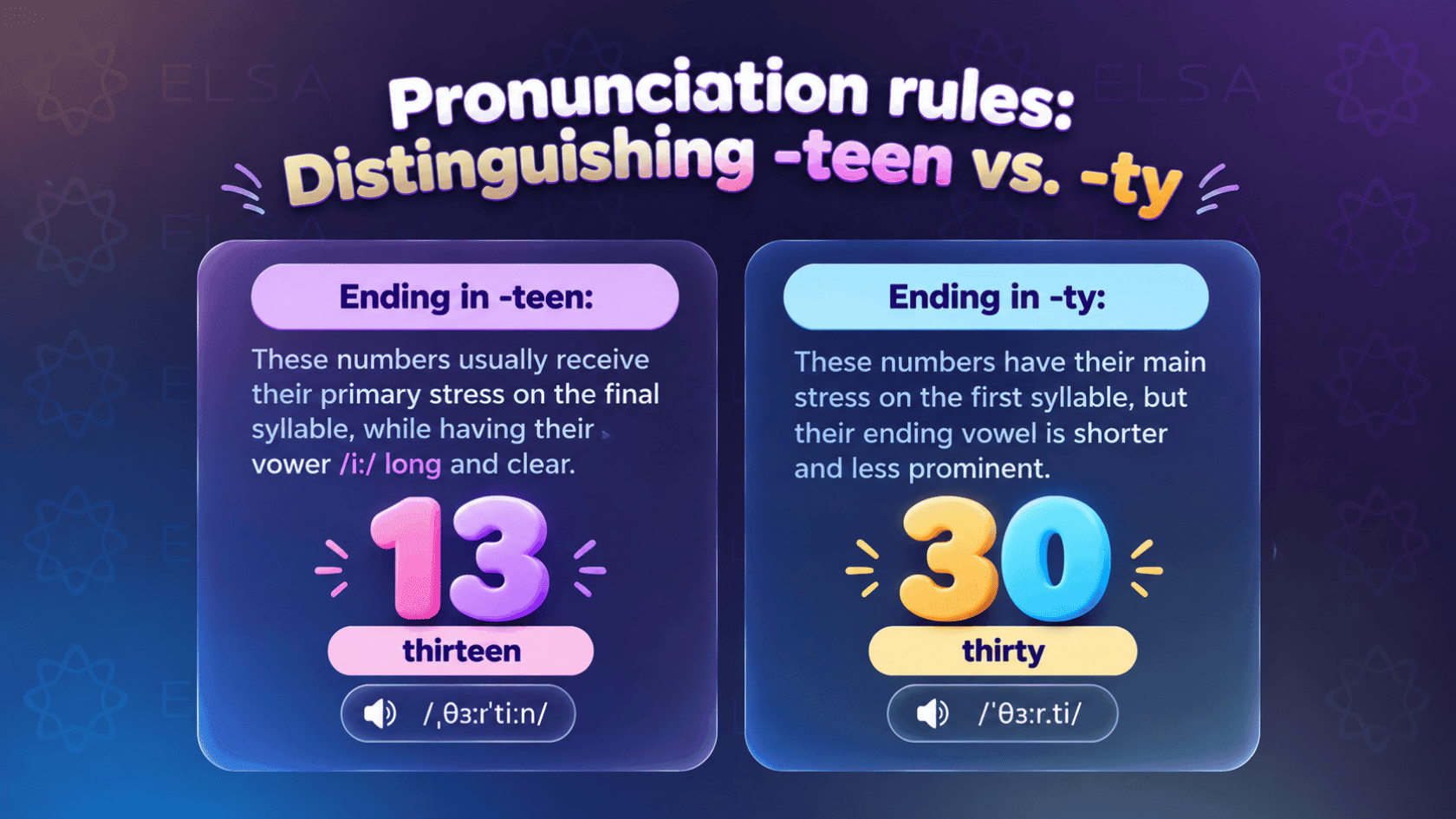
Pronunciation rules: Distinguishing -teen vs. -ty
When reading numbers in English, one of the most common pronunciation problems is differentiate -teen from -ty. While these endings can sound familiar, confusing them can lead to misunderstandings when used in everyday English settings.
- Ending in -teen: These numbers usually receive their primary stress on the final syllable, while having their vower /iː/ long and clear.
- Ending in -ty: These numbers have their main stress on the first syllable, but their ending vowel is shorter and less prominent. In American English, the /t/ in -ty may be realized as a flap [ɾ], which is a quick sound similar to a light /d/. This is why the ending may sound different from a clearly released /t/.
| Number pair | -teen number and IPA | -teen stress | -ty number and IPA | -ty stress |
|---|---|---|---|---|
| 13 vs. 30 | thirteen /ˌθɝːˈtiːn/ | Final syllable | thirty /ˈθɝː.ti/ | First syllable |
| 14 vs. 40 | fourteen /ˌfɔːrˈtiːn/ | Final syllable | forty /ˈfɔːr.ti/ | First syllable |
| 15 vs. 50 | fifteen /ˌfɪfˈtiːn/ | Final syllable | fifty /ˈfɪf.ti/ | First syllable |
| 16 vs. 60 | sixteen /ˌsɪkˈstiːn/ | Final syllable | sixty /ˈsɪk.sti/ | First syllable |
| 17 vs. 70 | seventeen /ˌsev.ənˈtiːn/ | Final syllable | seventy /ˈsev.ən.ti/ | First syllable |
| 18 vs. 80 | eighteen /ˌeɪˈtiːn/ | Final syllable | eighty /ˈeɪ.ti/ | First syllable |
| 19 vs. 90 | nineteen /ˌnaɪnˈtiːn/ | Final syllable | ninety /ˈnaɪn.ti/ | First syllable |
Ordinal numbers: Indicating rank, position, and dates
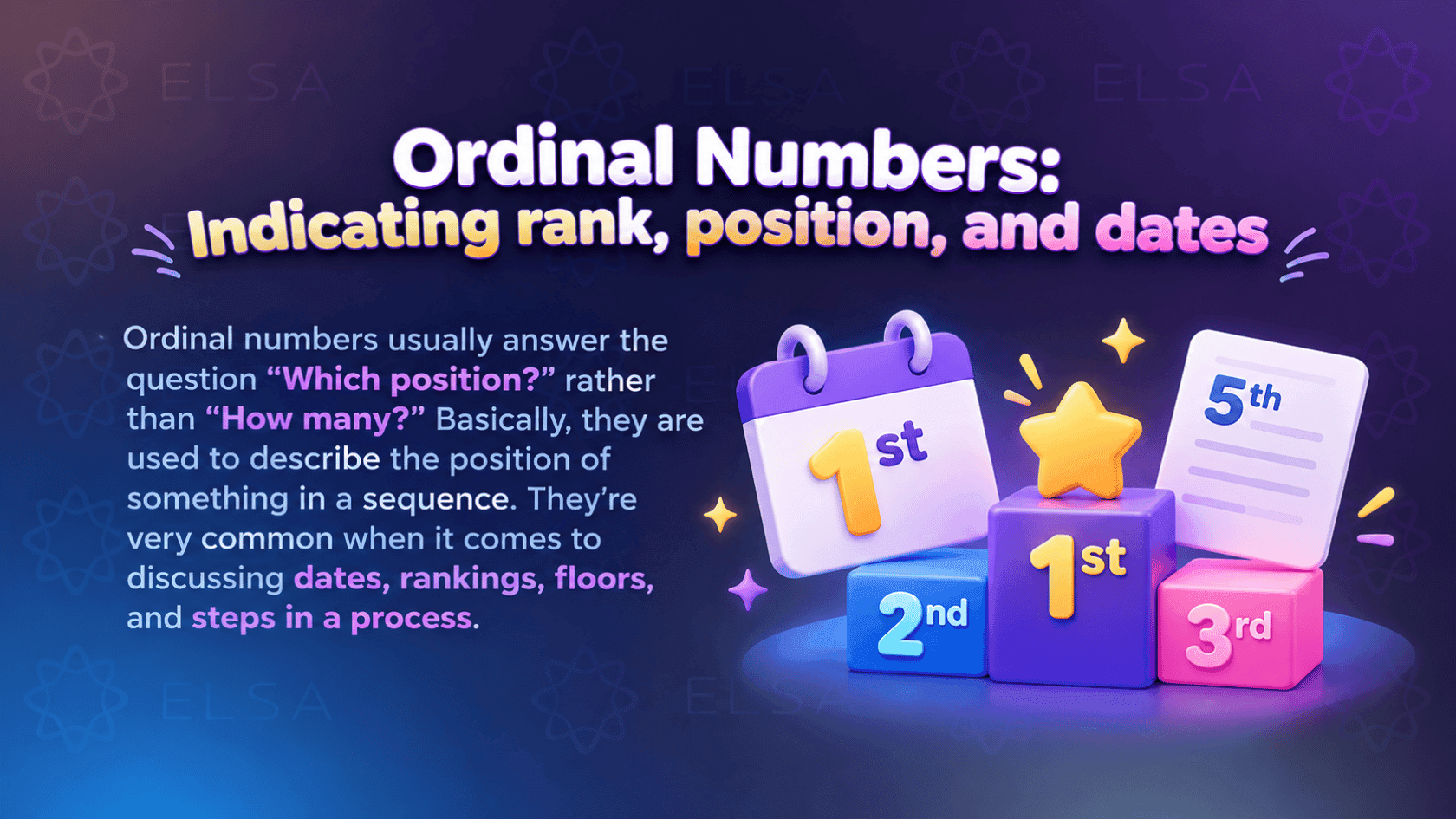
Ordinal numbers usually answer the question “Which position?” rather than “How many?” Basically, they are used to describe the position of something in a sequence. They’re very common when it comes to discussing dates, rankings, floors, and steps in a process.
For example: the third student, the fifth car, etc.
In ordinal numbers, the first three numbers do not follow the standard spelling pattern of [number]-th:
- 1st = first /fɝːst/
- 2nd = second /ˈsek.ənd/
- 3rd = third /θɝːd/
How to form ordinal numbers
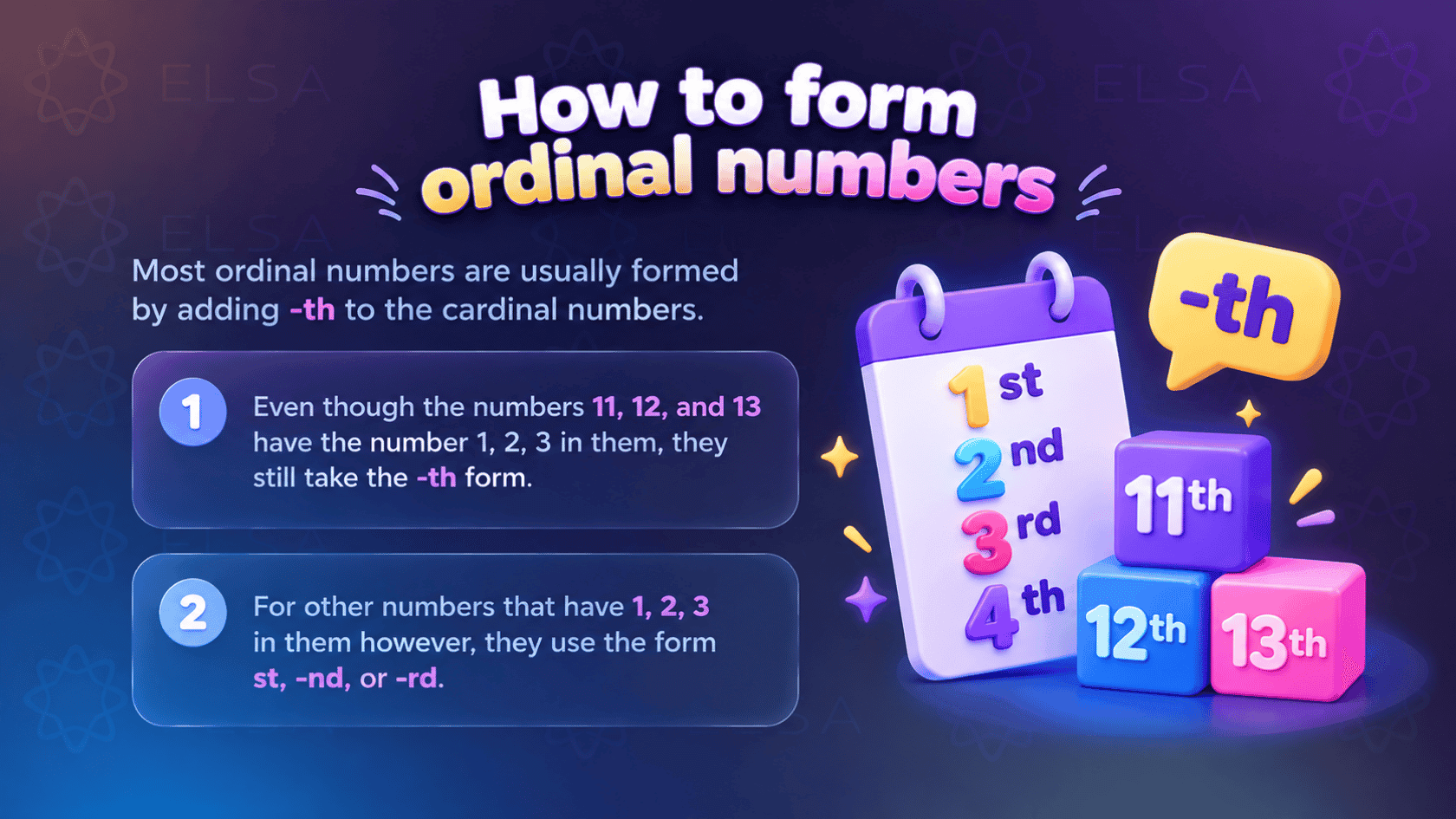
Most ordinal numbers are usually formed by adding -th to the cardinal numbers.
For example:
- 4th = fourth
- 5th = fifth
- 20th = twentieth
Ordinal numbers in compound numbers
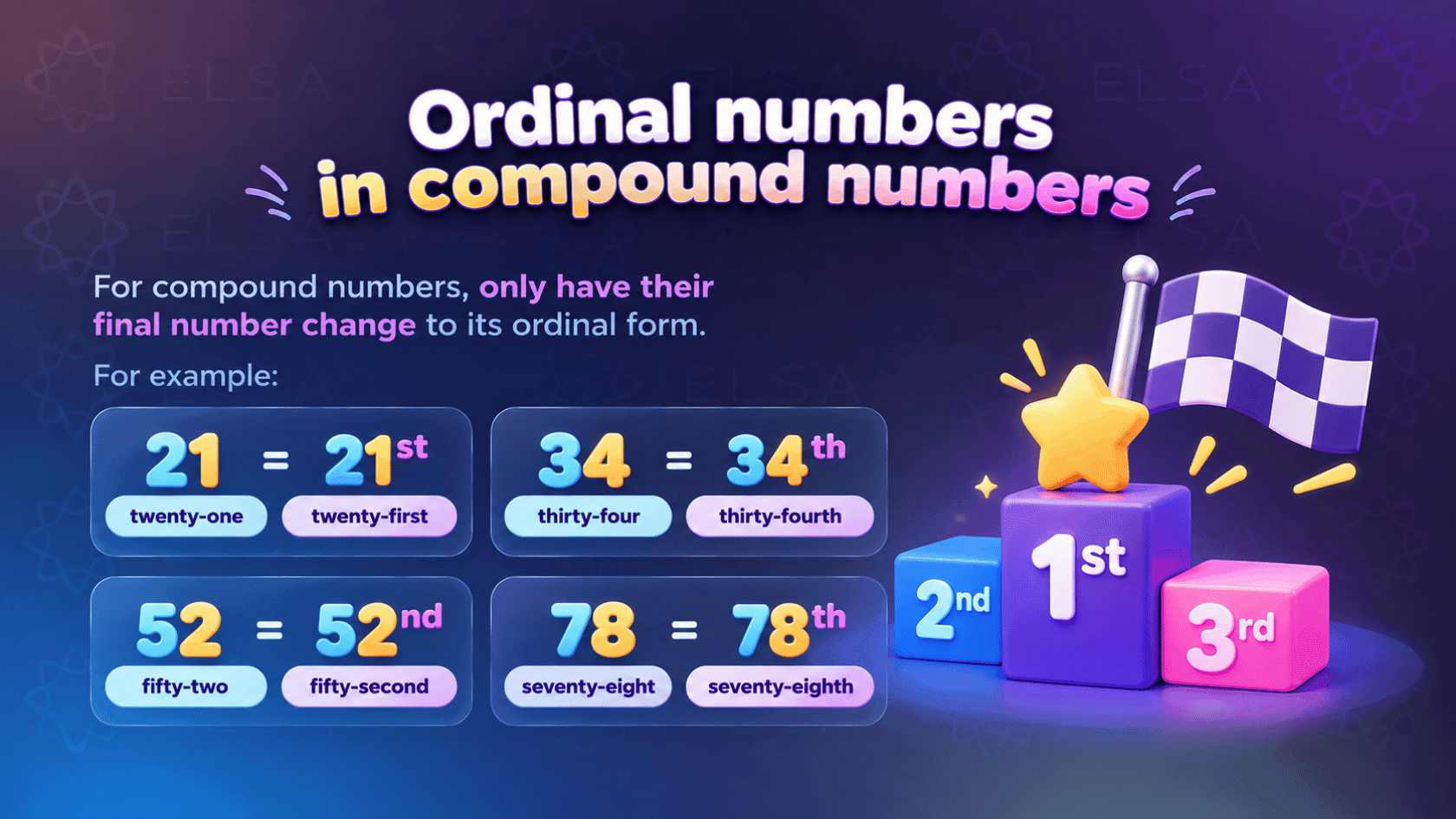
For compound numbers in English, only the final number changes to its ordinal form. For example:
- 21st = twenty-first
- 32nd = thirty-second
- 43rd = forty-third
- 54th = fifty-fourth
- 99th = ninety-ninth
Notice that the tens remain unchanged. For example, forty-two becomes forty-second, not fortieth-two.
Ordinal numbers chart
Below is a quick ordinal numbers chart for easy review:
| Abbreviation | Ordinal numbers in words | IPA | Example |
|---|---|---|---|
| 1st | first | /fɝːst/ | He was the first student in the class. |
| 2nd | second | /ˈsek.ənd/ | They live on the second floor. |
| 3rd | third | /θɝːd/ | She came in third during the race. |
| 4th | fourth | /fɔːrθ/ | The 4th of July is America's Independence Day. |
| 5th | fifth | /fɪfθ/ | This is the fifth question on the test. |
| 11th | eleventh | /ɪˈlev.ənθ/ | Her birthday is on the 11th. |
| 12th | twelfth | /twelfθ/ | The meeting is scheduled for the 12th of November. |
| 20th | twentieth | /ˈtwen.t̬i.əθ/ | Their office is on the 20th floor. |
| 21st | twenty-first | /ˌtwen.t̬iˈfɝːst/ | Our shop will re-open on the 21st of October. |
| 30th | thirtieth | /ˈθɝː.t̬i.əθ/ | They celebrated their 30th wedding anniversary last weekend. |
Large numbers: Hundreds, thousands, millions, and billions
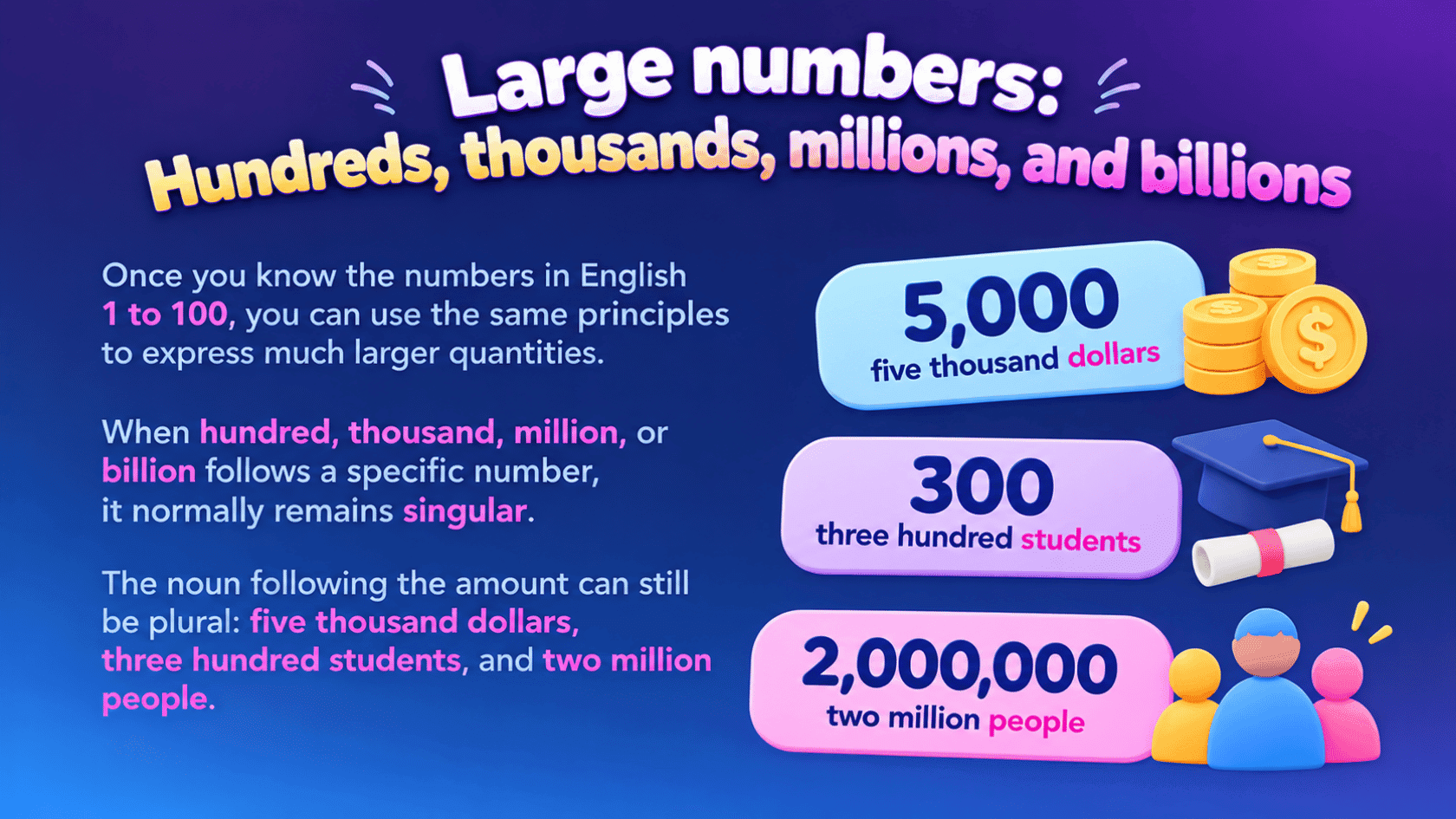
Once you know the numbers in English 1 to 100, you can use the same principles to express much larger quantities. When hundred, thousand, million, or billion follows a specific number, it normally remains singular.
For example:
- Correct: The company earned five thousand dollars.
- Incorrect: The company earned five thousands dollars.
The noun following the amount can still be plural: five thousand dollars, three hundred students, and two million people.
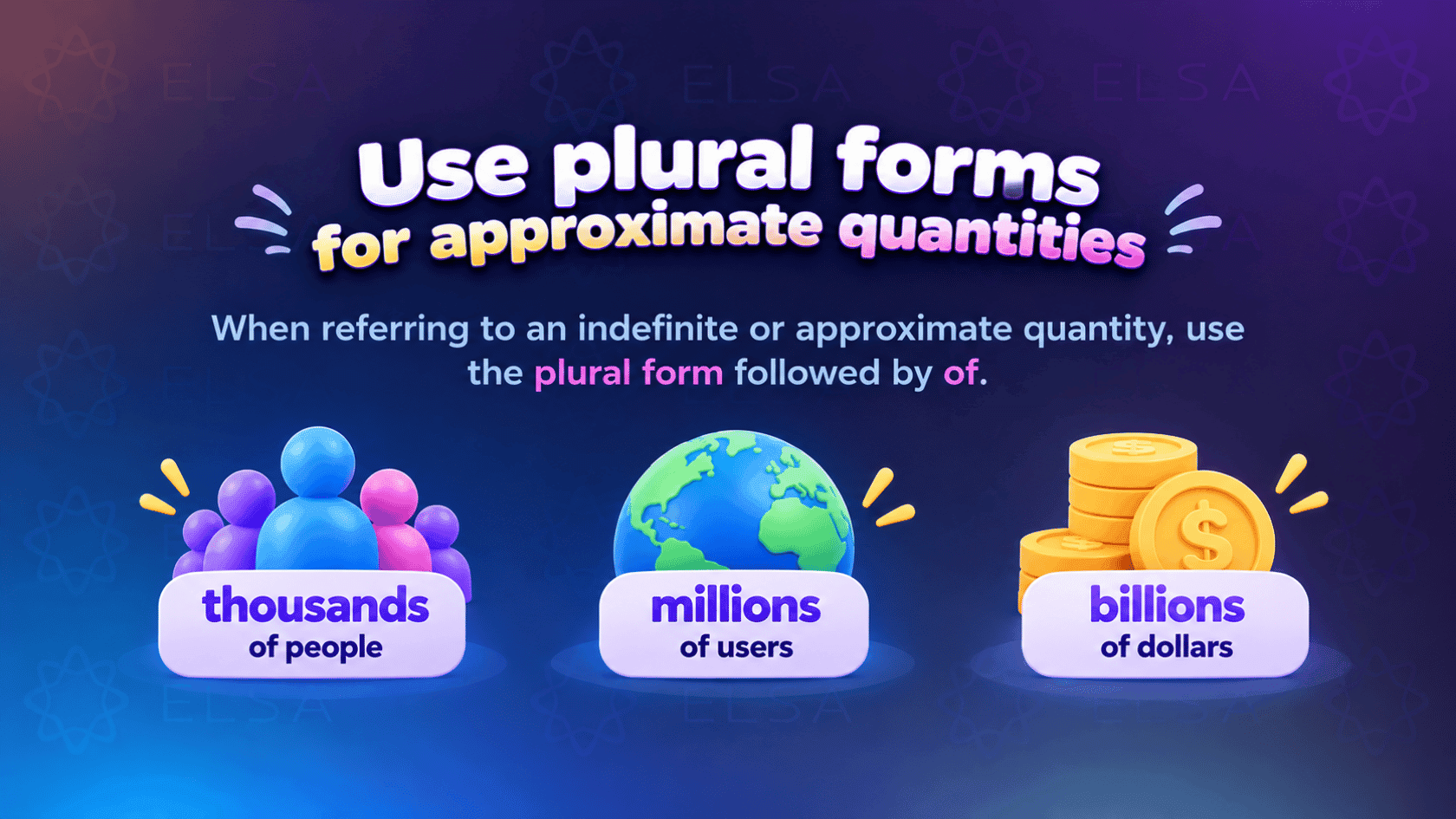
Use plural forms for approximate quantities
When referring to an indefinite or approximate quantity, use the plural form followed by of.
For examples:
- Hundreds of emails arrive every day.
- Thousands of visitors attend the festival.
- Millions of people use English at work.
- Billions of dollars are invested in technology.
Follow American number formatting
In American English, commas separate groups of three digits in large numbers, while periods indicate decimal points. This differs from the number-formatting conventions used in some countries.
For example:
- 100,000 = one hundred thousand
- 3.14 = three point one four
When reading whole numbers, American English commonly omits “and” between the hundreds and the tens or ones.
- American English: one hundred fifty
- British English: one hundred and fifty
Both forms are correct and understandable. However, the word “and” can still appear naturally in other contexts, such as when reading fractions or expressing amounts of money. For example: “I have one hundred and fifty dollars.”
Special number formats in everyday American English
In American English, special numbers in English such as phone numbers, years, decimals, addresses, fractions, and percentages each follow their own format.
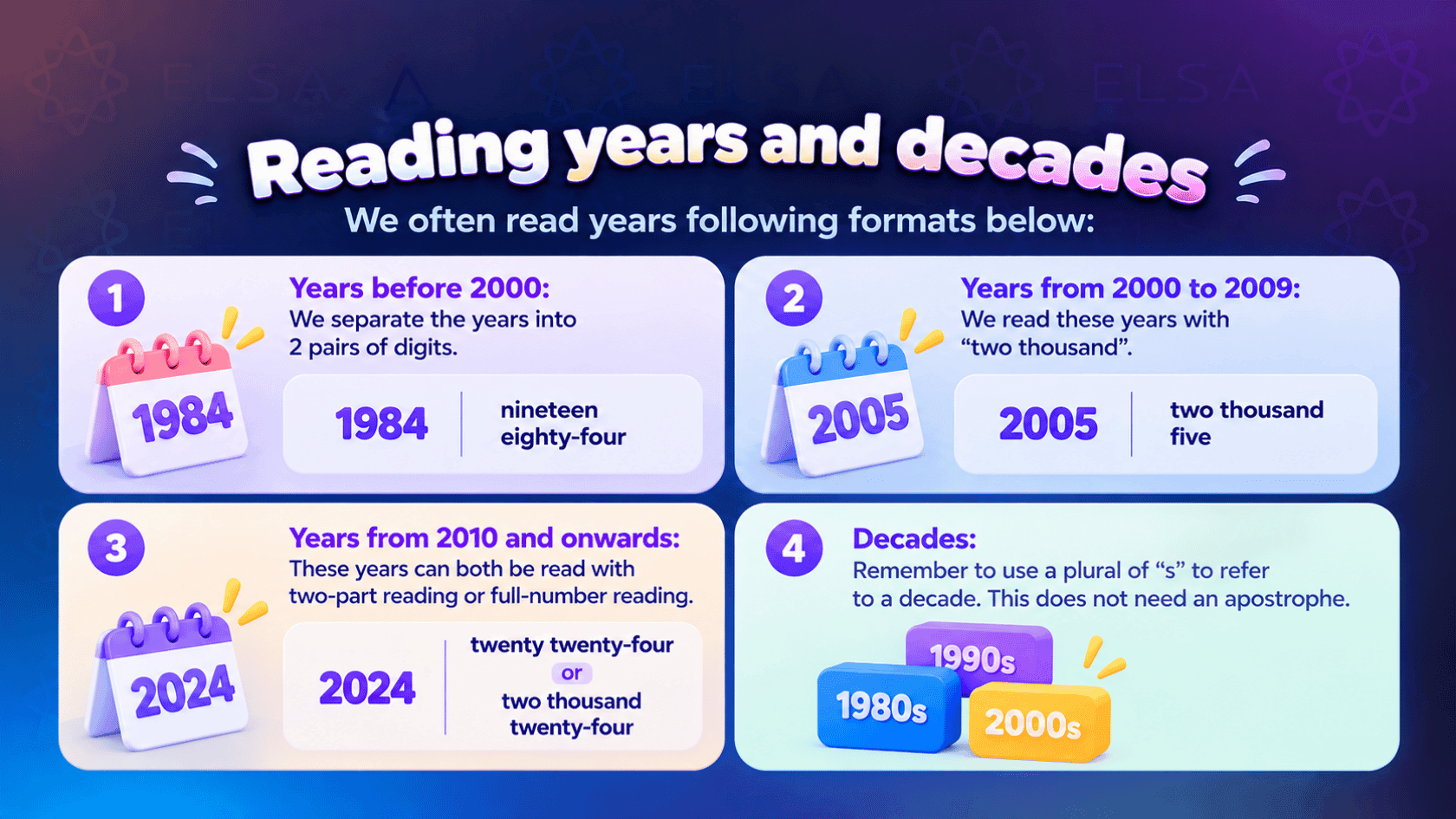
Reading years and decades
We often read years following formats below:
- Years before 2000: We separate the years into 2 pairs of digits.
- For example: 1984 = nineteen eighty four
- Years from 2000 to 2009: We read these years with “two thousand”.
- For example: 2003 = two thousand three
- Years from 2010 and onwards: These years can both be read with two-part reading or full-number reading.
- For example: 2024 = twenty twenty four or two thousand twenty-four
- Decades: Remember to use a plural of “s” to refer to a decade. This does not need an apostrophe.
- For example: the 1980s = the nineteen eighties
Phone numbers, addresses, and ZIP codes
- Phone numbers: We usually read digit by digit where zero is often pronounced as “oh”, but spelling “zero” is also acceptable.
- For example: (555) 234-8901 = five five five, two three four, eight nine oh one.
- Street addresses: We usually read in pairs or with “oh” when there’s a zero digit. However, keep in mind that the exact reading may vary by address and local convention, so it is best to prioritize clarity over a particular reading pattern when giving an address.
- For example: 1203 Oak Avenue = twelve oh three Oak Avenue
- ZIP codes: We generally read these numbers digit by digit.
- For example: 33776 = three three seven seven six
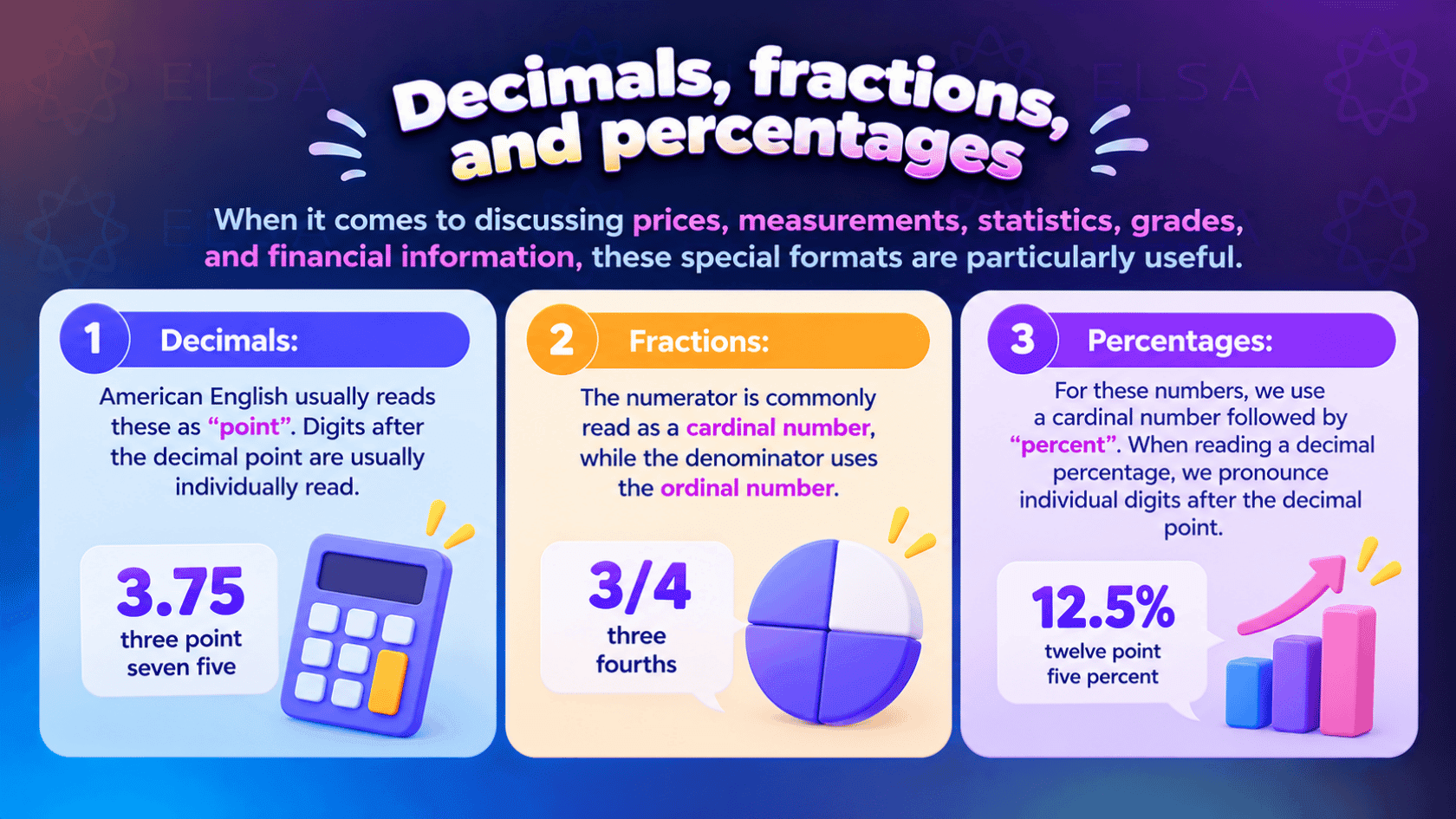
Decimals, fractions, and percentages
When it comes to discussing prices, measurements, statistics, grades, and financial information, these special numbers in English pronunciation are particularly useful.
- Decimals: American English usually reads these as “point”. Digits after the decimal point are usually individually read.
- For example: 3.06 = three point oh six
In informal speech however, speakers may omit “zero” at the beginning (for instance, 0.5 = point five), but the original reading is still clearer in many formal or technical situations.
- Fractions: The numerator is commonly read as a cardinal number, while the denominator uses the ordinal form. When the numerator is greater than one, the denominator will be plural.
- For example: 1/3 (one third), 2/5 (two fifths)
There are some fractions that have special names, such as one half (1/2) and three quarters (3/4).
- Percentages: For these numbers, we use a cardinal number followed by “percent”. When reading a decimal percentage, we pronounce individual digits after the decimal point.
- For example: fifty percent (50%), ninety-nine point nine percent (99.9%)
FAQs about numbers in English
Is It “fourty” or “forty”?
The correct spelling is “forty” without a u.
When should you spell out numbers in writing versus using digits?
The correct answer depends on the style guide, type of document, and also the context.
- In AP and Chicago Manual style, numbers 1 to 9 are commonly spelled out, while those which are 10 and above are usually written as numerals.
- Additionally, any sentence that begins with a number should be spelled out. However, measurements, percentages, and monetary amounts generally use numerals (for example: 5%, $10).
How do you pronounce the number 0 in English?
The pronunciation of zero depends on the context.
- Zero: Common in mathematics, scientific measurements, and temperatures.
- Oh: Often used for zero in phone numbers, years, and times.
- Nil: Used in some sports scores, especially in British English and football terms.
- Love: Used in tennis to mean a score of zero.
Why is 11th not written as 11st and 12th not written as 12nd?
The numbers 11, 12, and 13 are exceptions to the usual final-digit pattern for ordinal abbreviations. Their ordinal forms are eleventh, twelfth, and thirteenth, so their abbreviations are 11th, 12th, and 13th.
Learning numbers in English involves more than only memorizing the numbers one to one hundred. For more practical grammar explanations, vocabulary lessons, and pronunciation tips, explore the Vocabulary category on the ELSA Speak blog and continue building the skills you need to communicate confidently in English.