

450+ positive adjectives: List by category, traits, and usage
elsaspeakadmin
November 5, 2026
Common vocabulary
In workplace communication, having a wide range of positive adjectives can make your message sound more persuasive, especially in recommendation letters and resumes. This guide explores positive adjectives to describe a person, professional strengths, intellectual abilities, and more, with US pronunciation and practical examples to help you choose the right words for every context.
What are positive adjectives?
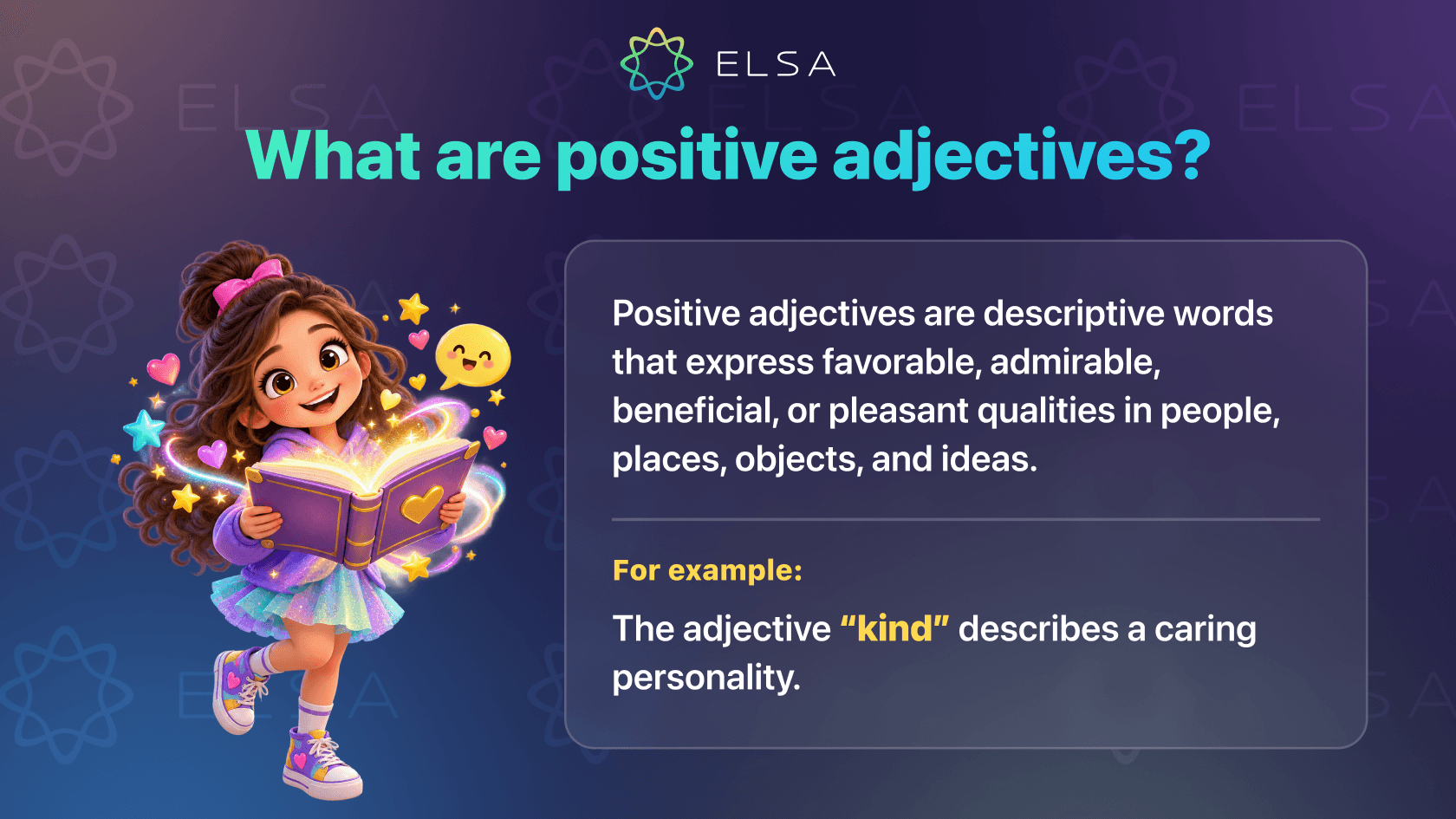
Positive adjectives are descriptive words that express favorable, admirable, beneficial, or pleasant qualities in people, places, objects, and ideas. They help communicate personality traits, professional abilities, intellectual strengths, visual appeal, and positive experiences.
Benefits of using positive adjectives
Using precise positive adjectives offers three key benefits.
- Improve resume impact: Words such as diligent, resourceful, and proactive communicate professional strengths more clearly than generic descriptions like good worker.
- Build positive workplace relationships: Sincere, considerate language helps you recognize colleagues' contributions and maintain constructive professional relationships.
- Add descriptive depth: In academic writing, storytelling, and travel descriptions, carefully chosen adjectives help readers understand the qualities and atmosphere you want to convey
What is a good adjective to use instead of “good”?
The best alternative depends on what you want to describe. There is no single good adjective that works in every situation. For example:
| Instead of “good” | More precise adjective | When to use it |
|---|---|---|
| A good employee | Diligent | To emphasize consistent effort and care |
| A good problem-solver | Resourceful | To highlight the ability to find effective solutions |
| A good teammate | Collaborative | To describe someone who works effectively with others |
| A good idea | Innovative | To emphasize originality or a new approach |
| A good view | Breathtaking | To describe an exceptionally impressive scene |
| A good presentation | Polished | To highlight a professional, well-prepared delivery |
| A good friend | Considerate | To emphasize thoughtfulness toward others |
By learning different positive words, you can communicate the exact quality you mean rather than relying on the same general adjective repeatedly.
Positive personality adjectives to describe a person
Positive personality adjectives describe a person's character, attitudes, and behavior toward others. They are useful in personal descriptions, recommendation letters, performance reviews, and professional introductions.
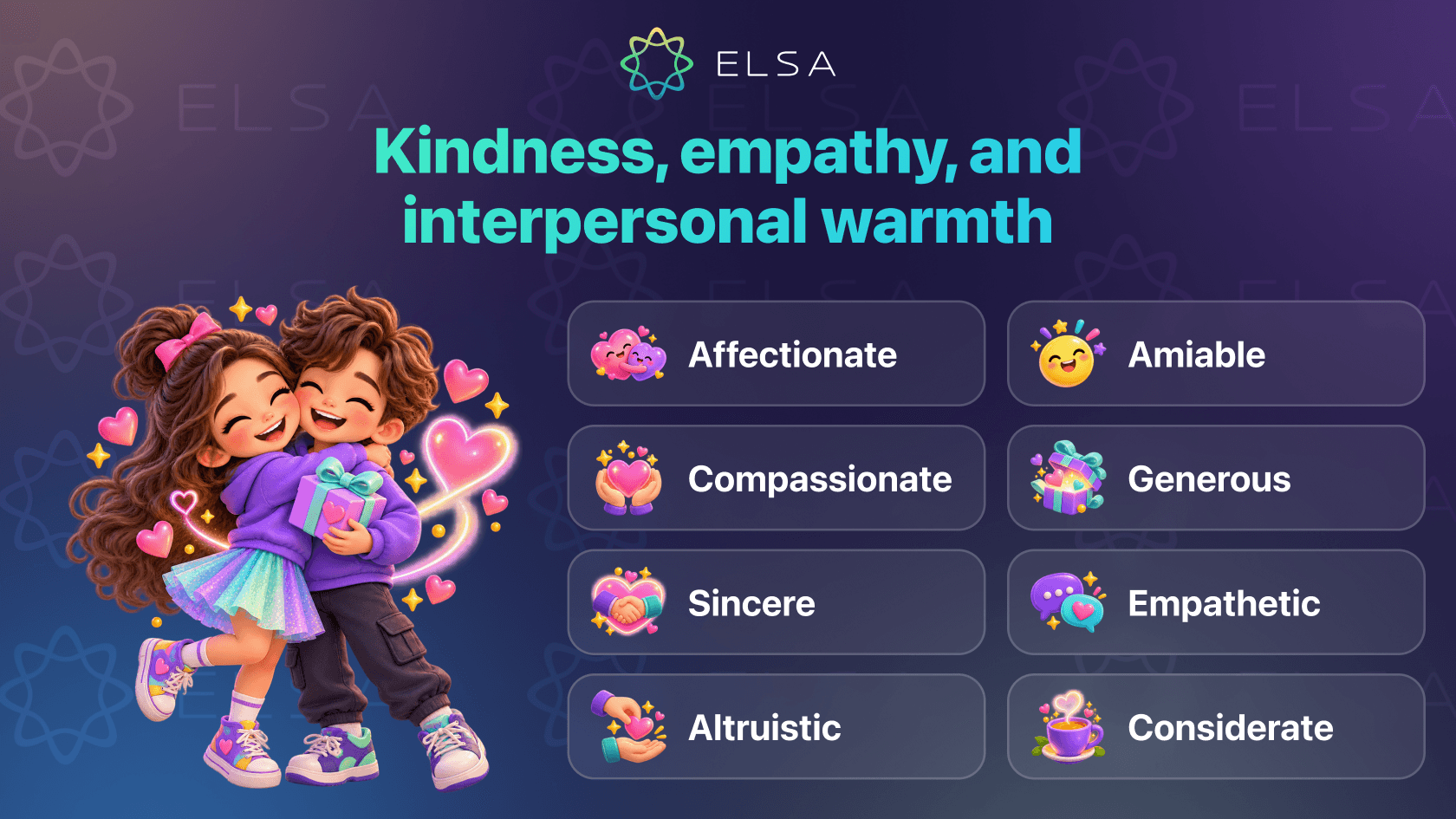
Kindness, empathy, and interpersonal warmth
These adjectives describe people who are caring, sincere, generous, respectful, and easy to interact with. They come with US IPA, and meanings to help you recognize when to use it precisely,
| Positive adjective | US IPA | Meaning | Example |
|---|---|---|---|
| Affectionate | /əˈfekʃənət/ | Showing love, warmth, or fondness toward others | She is an affectionate parent who always makes time for her children. |
| Amiable | /ˈeɪmiəbəl/ | Friendly, pleasant, and easy to get along with | His amiable personality helps him build strong relationships with clients. |
| Compassionate | /kəmˈpæʃənət/ | Showing sympathy and concern for people who are suffering | The compassionate nurse treated every patient with respect. |
| Generous | /ˈdʒenərəs/ | Willing to give time, money, help, or resources to others | Our generous neighbors donated supplies to the local shelter. |
| Sincere | /sɪnˈsɪr/ | Genuine, honest, and free from pretense | She offered a sincere apology for the misunderstanding. |
| Empathetic | /ˌempəˈθetɪk/ | Able to understand and share another person's feelings | An empathetic manager listens carefully to employees' concerns. |
| Altruistic | /ˌæltruˈɪstɪk/ | Concerned with the well-being of others rather than personal gain | His altruistic efforts helped improve access to community services. |
| Considerate | /kənˈsɪdərət/ | Thoughtful about other people's needs and feelings | It was considerate of her to check whether everyone could attend the meeting. |
| Benevolent | /bəˈnevələnt/ | Kind, well-meaning, and willing to help others | The benevolent donor funded scholarships for local students. |
| Courteous | /ˈkɝtiəs/ | Polite, respectful, and considerate in behavior | The receptionist remained courteous even during a busy afternoon. |
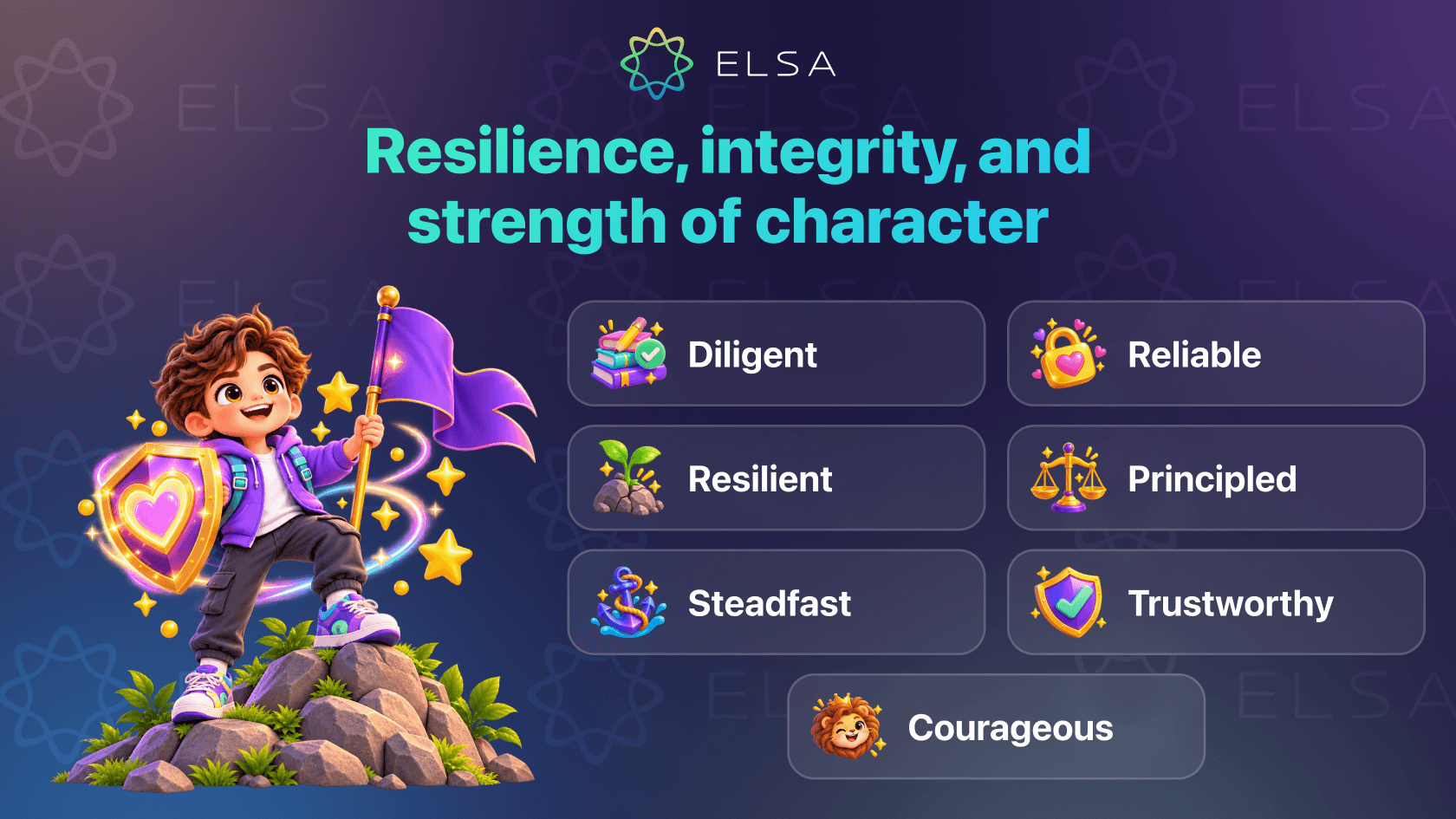
Resilience, integrity, and strength of character
These adjectives describe people who are dependable, honest, principled, and able to persevere through challenges.
| Positive adjective | US IPA | Meaning | Example |
|---|---|---|---|
| Diligent | /ˈdɪlədʒənt/ | Showing persistent effort, care, and attention to work | The diligent researcher checked every source before publishing the report. |
| Reliable | /rɪˈlaɪəbəl/ | Consistently able to be trusted or depended on | We need a reliable colleague who consistently meets deadlines. |
| Resilient | /rɪˈzɪliənt/ | Able to recover, adapt, or remain effective after difficulties | The resilient team adapted quickly after the project encountered setbacks. |
| Principled | /ˈprɪnsəpəld/ | Guided by strong moral or ethical beliefs | She is a principled leader who makes ethical decisions. |
| Steadfast | /ˈstedfæst/ | Firm, loyal, and unwavering in commitment or belief | He remained steadfast in his commitment to the community. |
| Authentic | /ɔˈθentɪk/ | Genuine and consistent with one's true character | Her authentic communication helps people trust her recommendations. |
| Courageous | /kəˈreɪdʒəs/ | Willing to face danger, difficulty, or uncertainty bravely | The courageous employee spoke up about an important safety concern. |
| Trustworthy | /ˈtrʌstˌwɝði/ | Deserving trust because of honesty and reliability | A trustworthy advisor handles confidential information responsibly. |
| Dependable | /dɪˈpendəbəl/ | Consistently available or reliable when needed | He is a dependable team member who follows through on his commitments. |
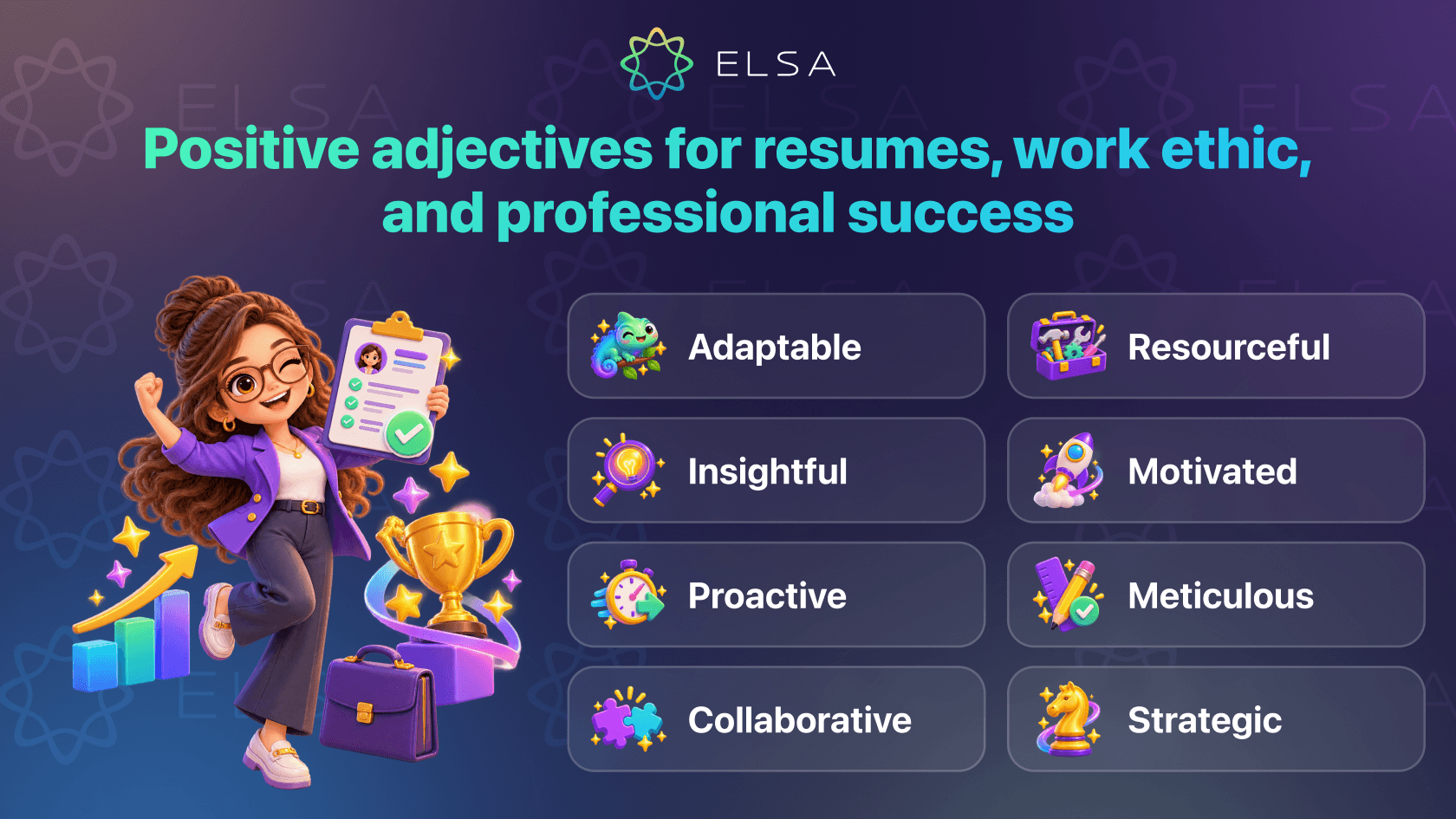
Positive adjectives for resumes, work ethic, and professional success
Professional positive adjectives can make resumes, cover letters, LinkedIn recommendations, and performance reviews more specific. Instead of simply claiming that you are a good employee, choose a word that reflects a relevant skill or behavior.
| Professional adjective | US IPA | Meaning | Resume example |
|---|---|---|---|
| Adaptable | /əˈdæptəbəl/ | Able to adjust effectively to new conditions or requirements | Adaptable software engineer experienced in pivoting across modern tech stacks. |
| Resourceful | /rɪˈsɔrsfəl/ | Skilled at finding practical solutions with available resources | Resourceful problem-solver capable of cutting operational costs by 15%. |
| Insightful | /ˈɪnsaɪtfəl/ | Showing a deep and accurate understanding of a subject | Delivered insightful market research that shaped the Q4 marketing campaign. |
| Motivated | /ˈmoʊtəˌveɪtɪd/ | Eager and willing to work toward a goal | A highly motivated sales executive with a consistent track record of exceeding quotas. |
| Proactive | /proʊˈæktɪv/ | Taking initiative rather than waiting for instructions or problems | Took a proactive approach to streamline inventory management workflows |
| Meticulous | /məˈtɪkjələs/ | Extremely careful and attentive to details | Applied meticulous attention to detail in financial compliance and contract reviews |
| Collaborative | /kəˈlæbəˌreɪtɪv/ | Able to work effectively with other people toward shared goals | Fostered a collaborative environment across cross-functional engineering teams |
| Strategic | /strəˈtidʒɪk/ | Focused on long-term goals and carefully planned decisions | Demonstrated strategic planning that expanded company operations into three states. |
How to use professional adjectives effectively:
Choose adjectives that align with the job description and support them with evidence.
- For adaptability: Describe a time you learned a new tool, adjusted to changing priorities, or worked across different teams.
- For problem-solving: Use resourceful or innovative when you can explain the challenge you addressed and the solution you developed.
- For attention to detail: Use meticulous when accuracy, quality control, compliance, or careful review is relevant to the role.
- For collaboration: Use collaborative when you can show how you coordinated with colleagues or contributed to a shared outcome
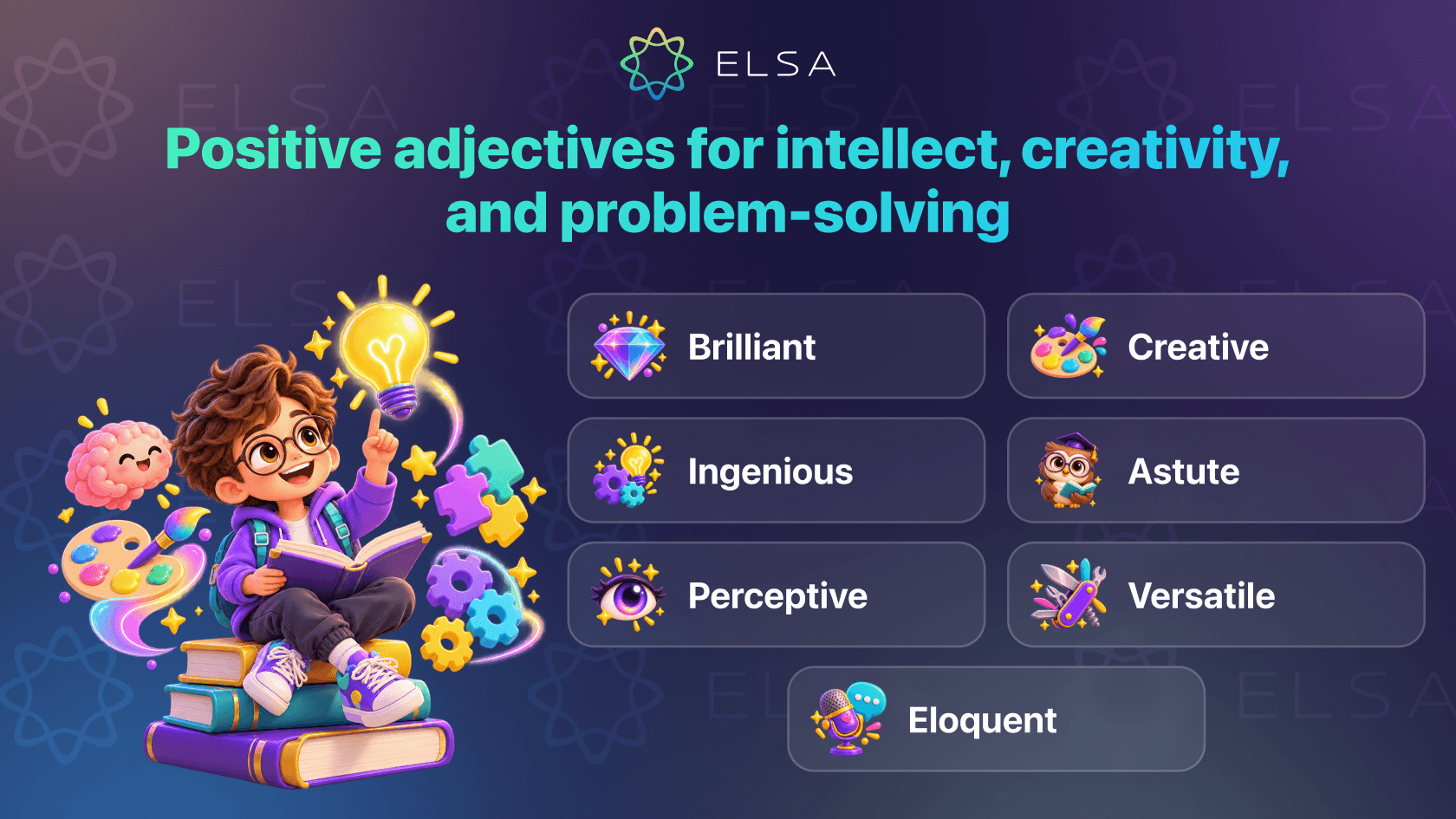
Positive adjectives for intellect, creativity, and problem-solving
These adjectives help you describe intellectual ability, critical thinking, creativity, and the capacity to solve complex problems.
| Positive adjective | US IPA | Meaning | Example |
|---|---|---|---|
| Brilliant | /ˈbrɪljənt/ | Exceptionally intelligent, talented, or impressive | She proposed a brilliant solution to a difficult technical problem. |
| Creative | /kriˈeɪtɪv/ | Able to produce original ideas or imaginative work | The creative designer developed a memorable visual identity for the brand. |
| Ingenious | /ɪnˈdʒiniəs/ | Clever, inventive, and effective in solving problems | Their ingenious design reduced material waste. |
| Astute | /əˈstut/ | Quick to understand situations and make sound judgments | The astute analyst recognized a shift in customer behavior. |
| Perceptive | /pərˈseptɪv/ | Able to notice and understand subtle details or meanings | Her perceptive comments revealed an overlooked weakness in the proposal. |
| Versatile | /ˈvɝsətəl/ | Able to perform many different tasks or serve several purposes | He is a versatile employee who can manage research, writing, and presentations. |
| Eloquent | /ˈeləkwənt/ | Fluent, expressive, and persuasive in speaking or writing | The eloquent speaker explained a complex issue in accessible language. |
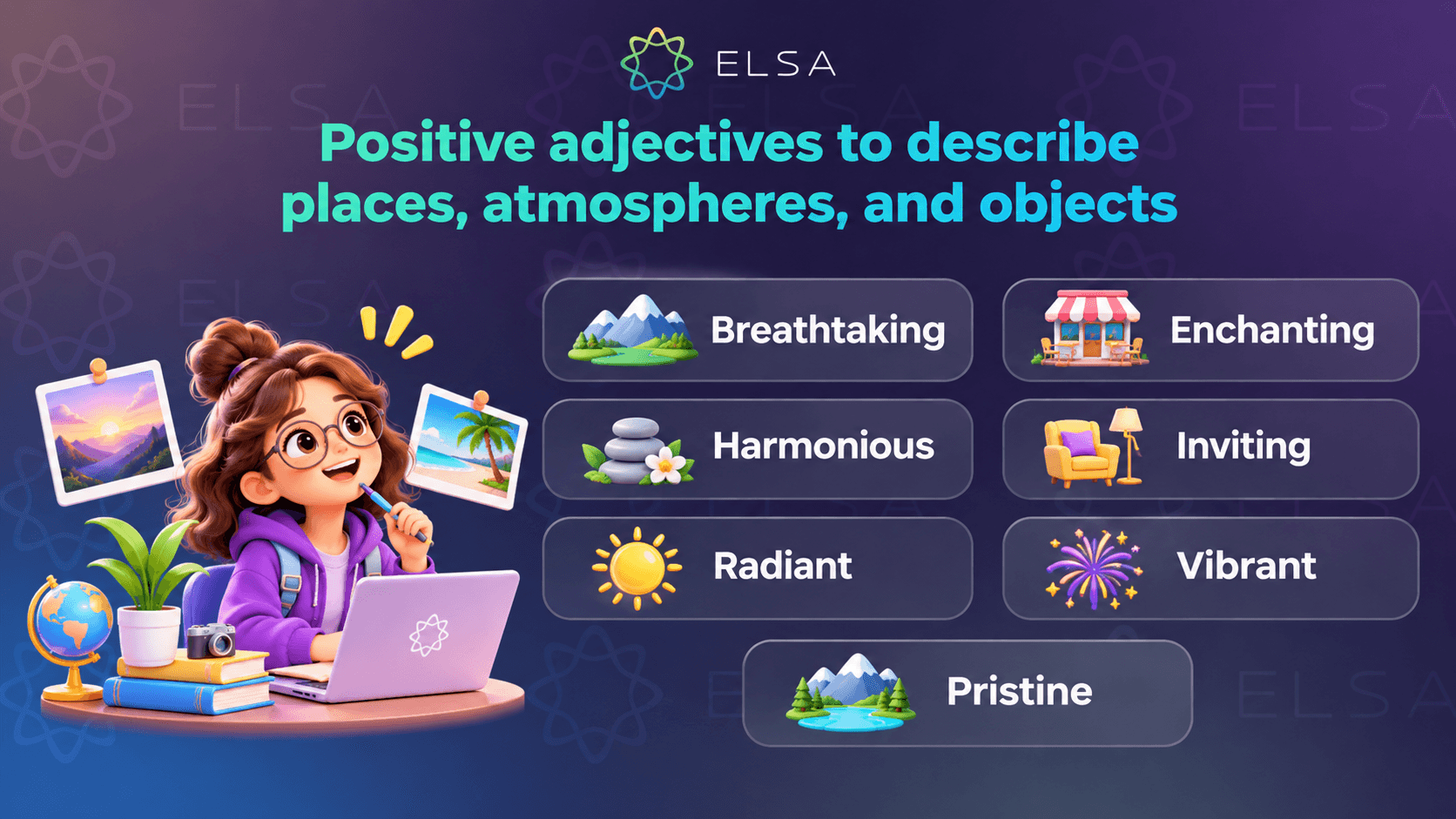
Positive adjectives to describe places, atmospheres, and objects
Positive adjectives can make descriptions of destinations, buildings, interiors, and travel experiences more vivid. The right word helps communicate not only how a place looks but also how it feels to experience it.
| Positive adjective | US IPA | Meaning | Example |
|---|---|---|---|
| Breathtaking | /ˈbreθˌteɪkɪŋ/ | Extremely beautiful, impressive, or awe-inspiring | The hikers enjoyed a breathtaking view of the mountains at sunrise. |
| Enchanting | /ɪnˈtʃæntɪŋ/ | Delightfully charming or captivating | We spent the evening walking through an enchanting old town. |
| Harmonious | /hɑrˈmoʊniəs/ | Balanced, consistent, and pleasing as a whole | The architect created a harmonious blend of traditional and modern design. |
| Inviting | /ɪnˈvaɪtɪŋ/ | Appealing, welcoming, or comfortable | The café has an inviting atmosphere and comfortable seating. |
| Radiant | /ˈreɪdiənt/ | Shining brightly or appearing full of happiness and energy | The garden looked radiant in the morning sunlight. |
| Vibrant | /ˈvaɪbrənt/ | Full of energy, activity, color, or life | Visitors explored the city's vibrant arts and food scene. |
| Pristine | /prɪˈstin/ | Extremely clean, fresh, or in an unspoiled condition | The travelers discovered a pristine beach far from the crowds. |
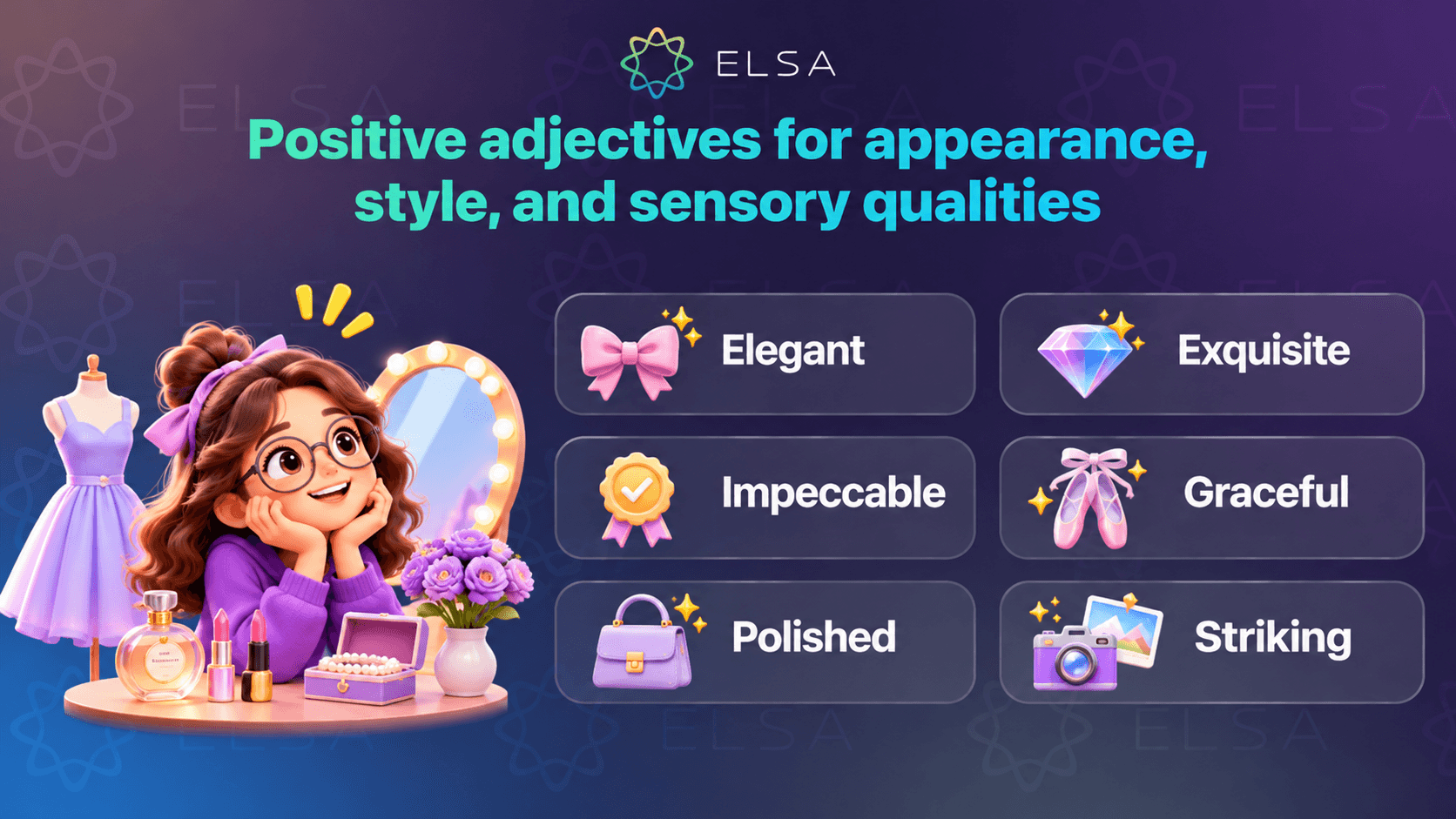
Positive adjectives for appearance, style, and sensory qualities
These adjectives are useful for describing clothing, personal style, product design, architecture, and visual presentation. They can also help writers communicate aesthetic qualities more precisely.
| Positive adjective | US IPA | Meaning | Example |
|---|---|---|---|
| Elegant | /ˈeləɡənt/ | Graceful, refined, and attractive in style | She wore an elegant black dress to the formal event. |
| Exquisite | /ɪkˈskwɪzɪt/ | Exceptionally beautiful or finely made | The museum displayed an exquisite piece of handmade jewelry. |
| Impeccable | /ɪmˈpekəbəl/ | Flawless or free from noticeable mistakes or defects | The hotel is known for its impeccable service and attention to detail. |
| Graceful | /ˈɡreɪsfəl/ | Moving or behaving in a smooth, controlled, and attractive way | The dancer made a graceful movement across the stage |
| Polished | /ˈpɑlɪʃt/ | Refined, professional, and carefully finished | Her presentation was clear, confident, and polished. |
| Striking | /ˈstraɪkɪŋ/ | Noticeably attractive or impressive | The building features a striking combination of glass and stone. |
Forming positive adjectives with productive suffixes
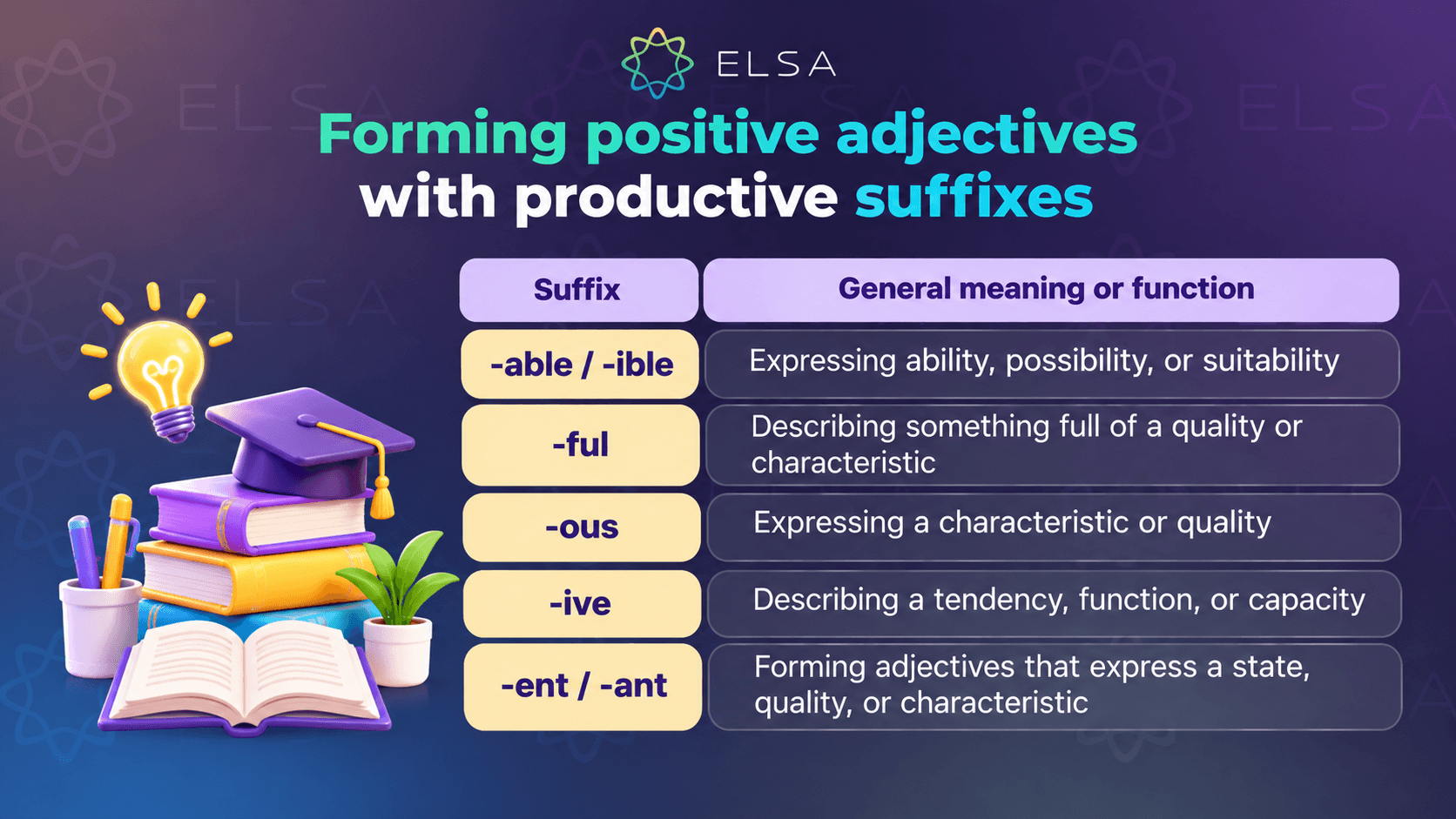
Many English adjectives are formed by adding a suffix to a noun, verb, or another word. Recognizing common adjective-forming suffixes can help you expand your vocabulary and infer the meaning of unfamiliar words.
| Suffix | General meaning or function | Word formation examples |
|---|---|---|
| -able / -ible | Expressing ability, possibility, or suitability | adapt → adaptable; access → accessible; rely → reliable |
| -ful | Describing something full of a quality or characteristic | insight → insightful; resource → resourceful; peace → peaceful |
| -ous | Expressing a characteristic or quality | courage → courageous; grace → gracious; generosity → generous |
| -ive | Describing a tendency, function, or capacity | create → creative; innovate → innovative; decide → decisive |
| -ent / -ant | Forming adjectives that express a state, quality, or characteristic | diligence → diligent; resile → resilient; shine → radiant |
1. The suffixes -able and -ible
These endings often create adjectives that describe capability, suitability, or whether something can be done. For example:
- Adaptable: Able to adjust to new conditions.
- Reliable: Able to be trusted or depended on.
- Accessible: Easy to reach, enter, use, or understand.
2. The suffix -ful
The suffix -ful often means “full of” or “characterized by” a quality. For example:
- Insightful: Showing a deep understanding.
- Resourceful: Able to find effective ways to solve problems.
- Peaceful: Calm and free from disturbance.
3. The suffix -ous
The suffix -ous forms adjectives that express a characteristic or quality. For example:
- Courageous: Showing courage.
- Gracious: Showing kindness, courtesy, or good manners.
- Generous: Willing to give or share.
4. The suffix -ive
The suffix -ive often describes a tendency, function, or characteristic. For instance:
- Creative: Able to produce original ideas.
- Innovative: Introducing new methods or ideas.
- Decisive: Able to make decisions confidently and promptly.
5. The suffixes -ent and -ant
These endings appear in adjectives that describe a quality, condition, or characteristic. Their formation is less predictable, so it is helpful to learn each adjective alongside its base word. For example:
- Diligent: Showing persistent effort and care.
- Resilient: Able to recover or adapt after difficulties.
- Radiant: Bright or glowing; also used to describe a visibly happy appearance.
How to use good adjectives effectively without sounding clichéd
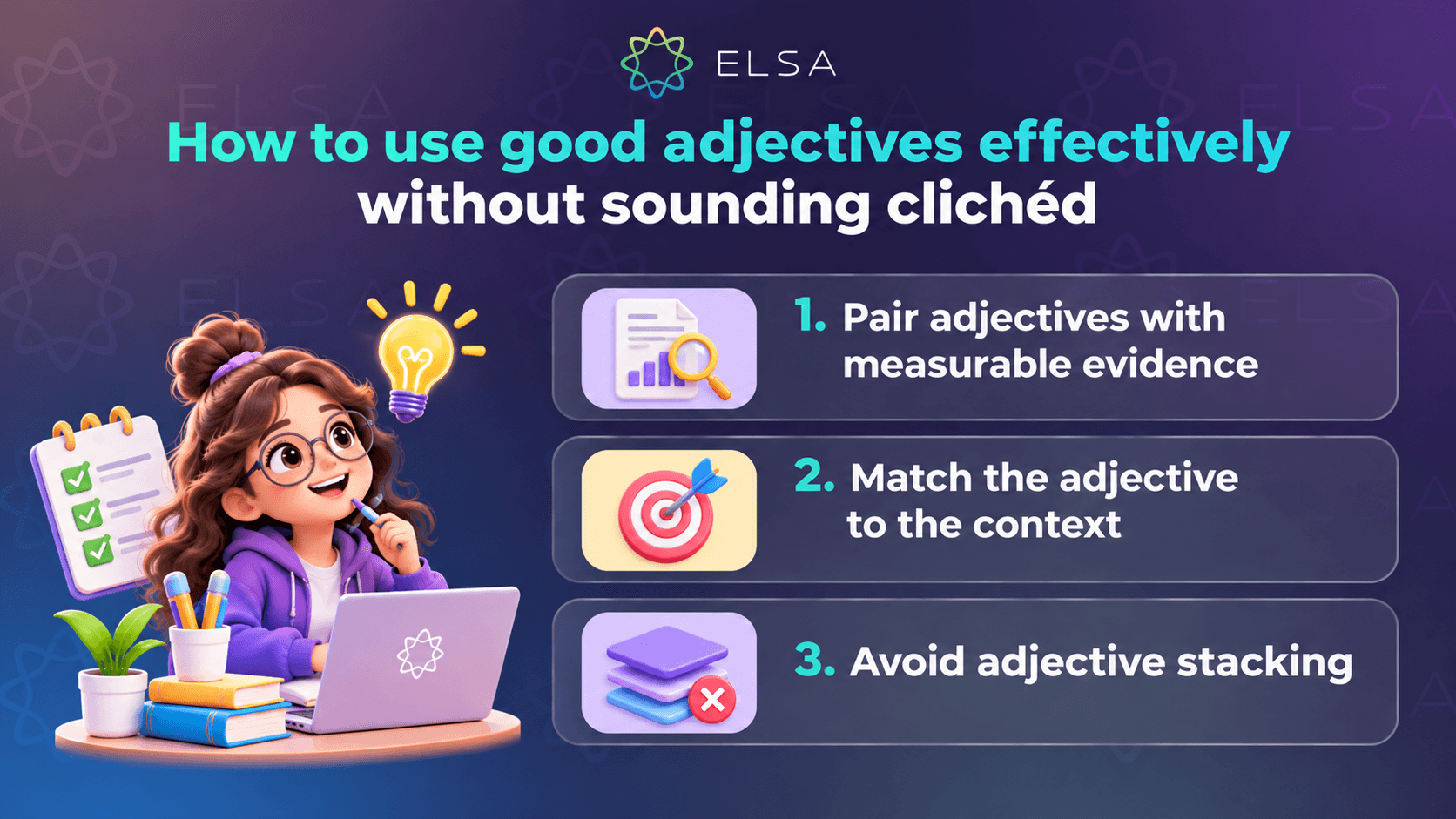
Positive adjectives are most effective when they communicate something specific. Follow these three principles to make your descriptions more credible and natural.
1. Pair adjectives with measurable evidence
In a resume or cover letter, an adjective should help readers understand a relevant strength. Whenever possible, connect it to an action, responsibility, or result. For example:
- Generic: “I am a successful and creative marketer.”
- More specific: “Creative marketer who drove a 35% increase in user acquisition through engaging content.”
The second example connects creative to a measurable outcome. Use this structure only when the figure accurately represents your work. You can apply the same approach to other professional adjectives:
- Resourceful: Resolved recurring workflow issues by developing a more efficient reporting process.
- Meticulous: Improved data accuracy by introducing a standardized review checklist.
- Collaborative: Coordinated with design and sales teams to deliver a cross-functional campaign.
- Proactive: Identified a content gap and proposed new articles to address customer questions.
These examples communicate professional strengths through actions rather than relying on adjectives alone.
2. Match the adjective to the context
A positive adjective that works well in one situation may sound exaggerated in another. Consider the audience, purpose, and degree of praise you want to express.
| Context | Suitable adjectives | Example |
|---|---|---|
| Resume or cover letter | Adaptable, resourceful, meticulous, proactive | A resourceful project coordinator who streamlined reporting workflows. |
| Recommendation letter | Diligent, trustworthy, collaborative, resilient | She is a trustworthy colleague who consistently follows through on commitments. |
| Everyday conversation | Lovely, helpful, thoughtful, pleasant | That was a thoughtful gift. |
| Travel writing | Breathtaking, enchanting, vibrant, pristine | We explored a vibrant neighborhood filled with local cafés. |
| Product or design review | Elegant, polished, innovative, practical | The product has a polished interface and an intuitive layout. |
Use breathtaking for a truly spectacular view, for example, but choose pleasant or lovely for a comfortable dinner. Matching the adjective to the context helps your writing sound natural rather than overstated.
3. Avoid adjective stacking
Adjective stacking happens when too many descriptive words appear together, especially when several adjectives communicate nearly the same idea. This can make writing feel repetitive or exaggerated.
As an example:
- Overloaded: “She is an amazing, brilliant, outstanding, talented, hardworking, and exceptional employee.”
- More effective: “She is a resourceful employee who developed a new reporting process that reduced manual work.”
⇒ The revised sentence is more persuasive because it gives readers a concrete reason to value the employee's contribution.
As a practical guideline, avoid piling up more than three positive adjectives before a noun. More importantly, prioritize relevant details and evidence over long strings of praise.
Want to learn more positive adjectives? Check out our PDF file below with compilation of 450+ adjectives with meaning and American IPA for you to use them more precisely:
FAQs about positive adjectives
What are the best positive adjectives to replace “good” on a resume?
Choose an adjective based on the skill or quality you want to communicate.
- Proficient or skilled: Demonstrates competence in a particular area.
- Meticulous or detail-oriented: Highlights careful, accurate work.
- Resourceful or innovative: Emphasizes problem-solving and new ideas.
- Collaborative: Highlights the ability to work effectively with others.
- Proactive: Shows initiative in identifying and addressing needs.
- Adaptable: Communicates the ability to adjust to changing circumstances.
For example, instead of writing “I am good at solving problems,” you could write, “Developed a resourceful solution that reduced processing time.” The stronger version describes an action and its impact.
What is the difference between positive adjectives and compliments?
Positive adjectives are a grammatical category: words that describe favorable qualities or characteristics. Compliments are complete communicative expressions used to show admiration, appreciation, or approval.
For example:
Positive adjective: Elegant
⇒ Compliment: “You look extraordinarily elegant tonight.”
The adjective describes a quality, while the full sentence functions as a compliment. A compliment may contain a positive adjective, but it can also express praise without one.
Can using too many positive adjectives weaken writing?
Yes. Excessive praise or adjective stacking can make writing sound vague, exaggerated, or less credible. This is especially problematic in academic writing, journalism, resumes, and professional recommendations, where readers expect clear and supportable claims.
Instead of listing several adjectives, choose the one that best captures the relevant quality and support it with an example.
For instance, “She is a diligent researcher who verified every source before publication” is more informative than “She is an amazing, brilliant, excellent researcher.”
⇒ The principle is simple: show the quality through evidence instead of relying on praise alone.
Building a strong vocabulary takes more than memorizing lists. Practice using new adjectives in complete sentences, pay attention to pronunciation, and apply each word in contexts where it sounds natural. For more English vocabulary tips, visit the Vocabulary category on the ELSA Speak blog to expand your vocabulary and communicate more clearly and confidently