

Compound adjectives: Hyphen rules, types & examples
elsaspeakadmin
November 5, 2026
Common vocabulary
Compound adjectives are words that help users to convey information concisely, precisely, and vividly. They are usually found in academic writing, journalism, and professional communication. In this guide, we explain the main types of compound adjectives, provide practical compound adjectives examples, and include exercises to help you apply the rules accurately.
What is a compound adjective?
A compound adjective is a modifier formed from two or more words that work together to describe a noun. Its components can include nouns, adjectives, adverbs, numbers, and participles. Together, they function as a single semantic unit rather than as separate modifiers with unrelated meanings.
For example: a high-quality product
⇒ In this example, the words high and quality combine to describe the product.
Why are hyphens important?
Hyphens help readers recognize which words belong together and can prevent ambiguity. This is especially important in academic writing, journalism, and professional documents, where a small punctuation difference can change the meaning of a sentence.
Compare these 2 examples:
- A man-eating shark: A shark that eats people.
⇒ Here, man-eating is a compound adjective describing the shark. - A man eating shark: A man who is eating a shark.
⇒ Here, eating a shark describes the man's action rather than functioning as a compound adjective before man.
The hyphen makes the relationship between the words clearer. This type of distinction is one reason compound adjective hyphen rules matter in precise English writing.
What is the general structure of a compound adjective?
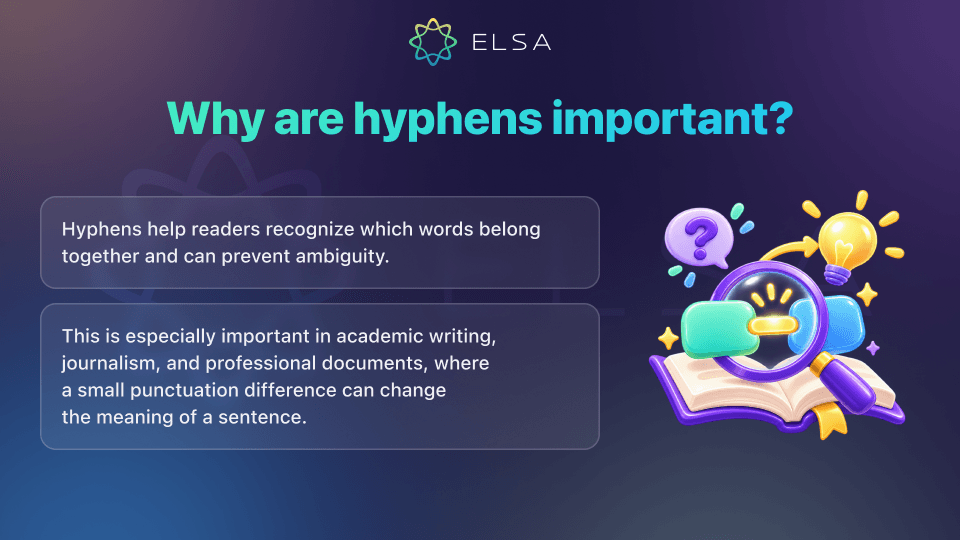
The common pattern is:
| [Word 1] + hyphen + [Word 2] + main noun |
For example:
- A five-star hotel offers high-quality accommodation.
- She accepted a full-time position at the company.
Common formation types of compound adjectives
There are several common ways to form compound adjectives in English. Understanding these patterns helps you identify the parts of a compound and recognize when a hyphen may be appropriate.
| Formation type | Pattern | Examples | Example sentence |
|---|---|---|---|
| Number + Noun | Number + singular noun | three-story, five-star, ten-minute | They rented a three-story house near the park. |
| Adjective + Noun | Adjective + noun | long-distance, full-time, high-quality | She applied for a full-time position. |
| Noun + Adjective | Noun + adjective | sugar-free, snow-white, world-famous | The bakery sells sugar-free desserts. |
| Noun + Past Participle | Noun + past participle | handmade, sun-dried, wind-powered | They bought a handmade table at the market. |
| Noun + Present Participle | Noun + present participle | heartwarming, English-speaking, time-saving | We watched a heartwarming movie together. |
| Adjective/Adverb + Participle | Adjective or adverb + participle | well-known, fast-moving, brightly lit | The company hired a well-known consultant. |
| Adjective + Adjective | Adjective + adjective | blue-green, bittersweet, deaf-mute | The artist painted the wall a blue-green shade. |
1. Number + Noun
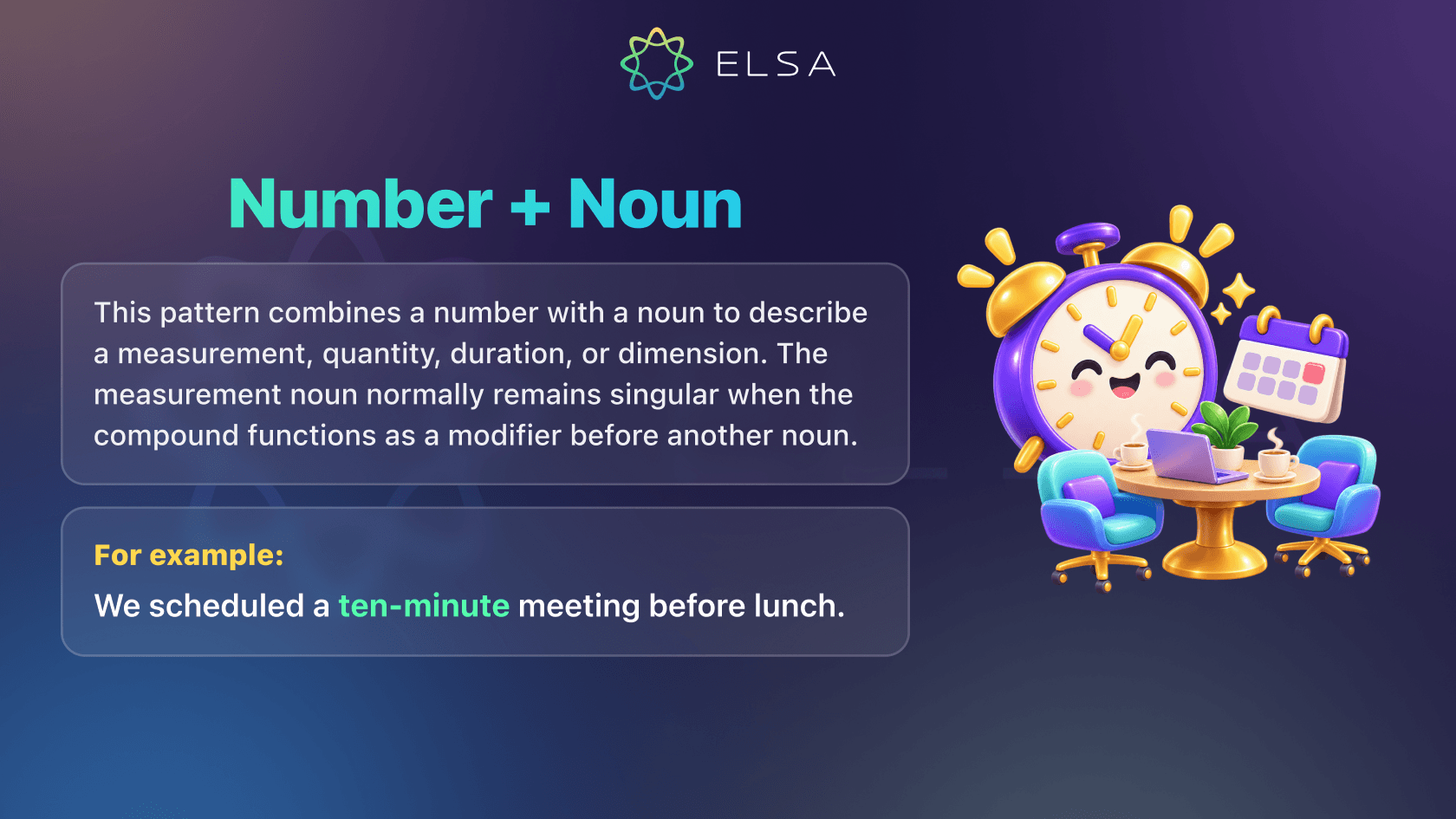
This pattern combines a number with a noun to describe a measurement, quantity, duration, or dimension. The measurement noun normally remains singular when the compound functions as a modifier before another noun.
For example: A three-story building stands at the end of the street.
2. Adjective + Noun
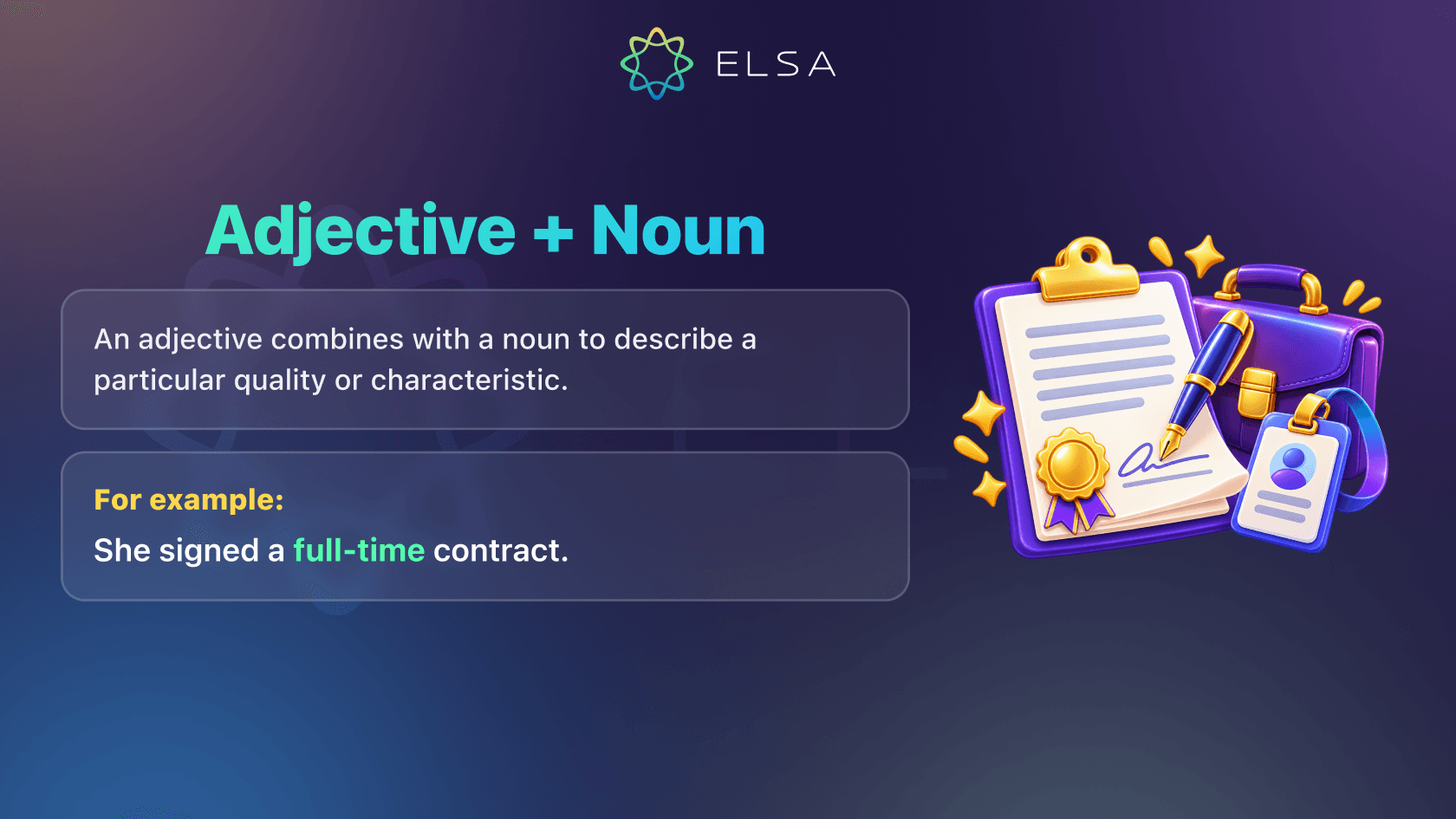
An adjective combines with a noun to describe a particular quality or characteristic.
For example: She signed a full-time contract.
3. Noun + Adjective
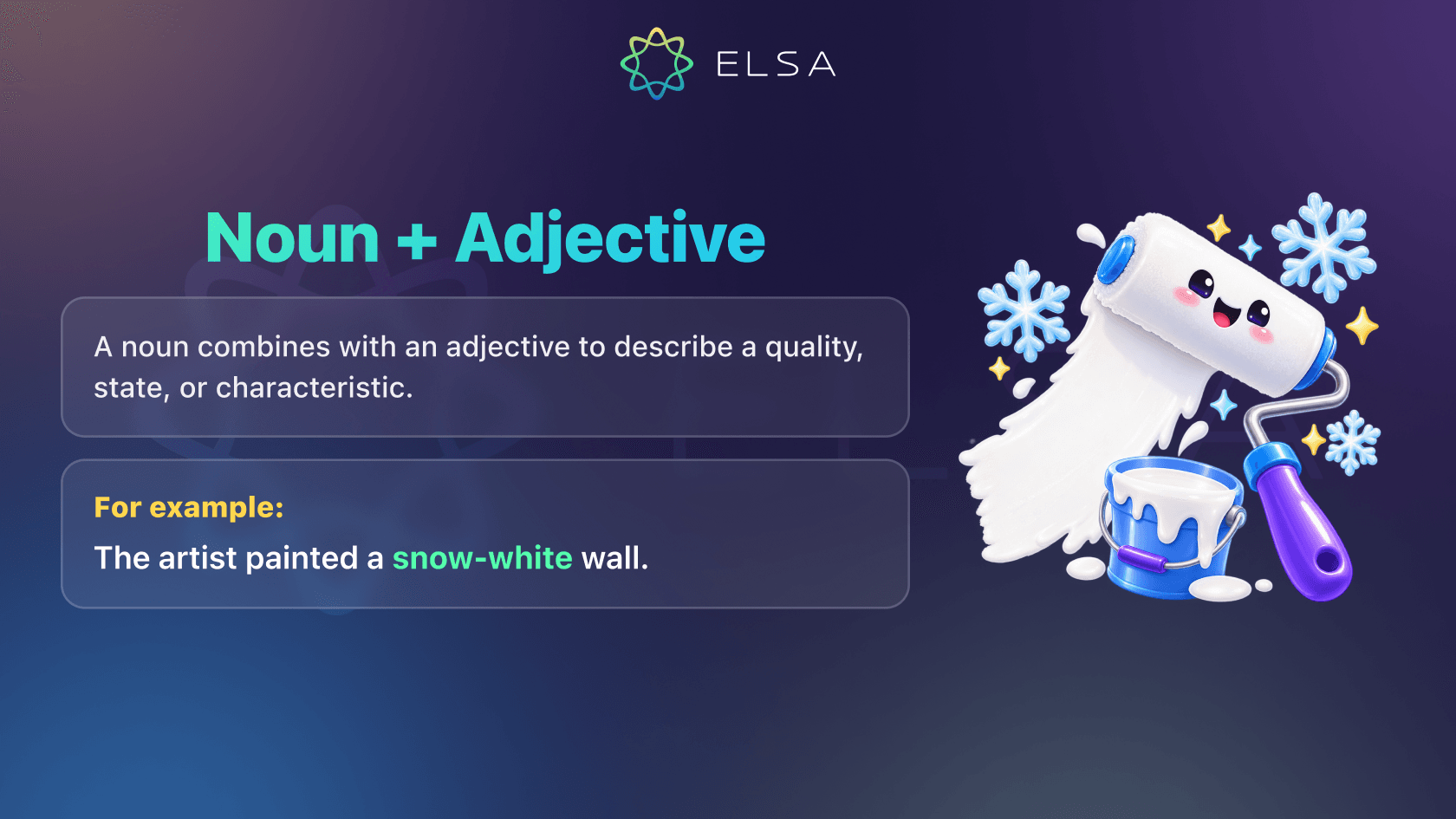
A noun combines with an adjective to describe a quality, state, or characteristic.
For example: The artist painted a snow-white wall.
4. Noun + Past Participle
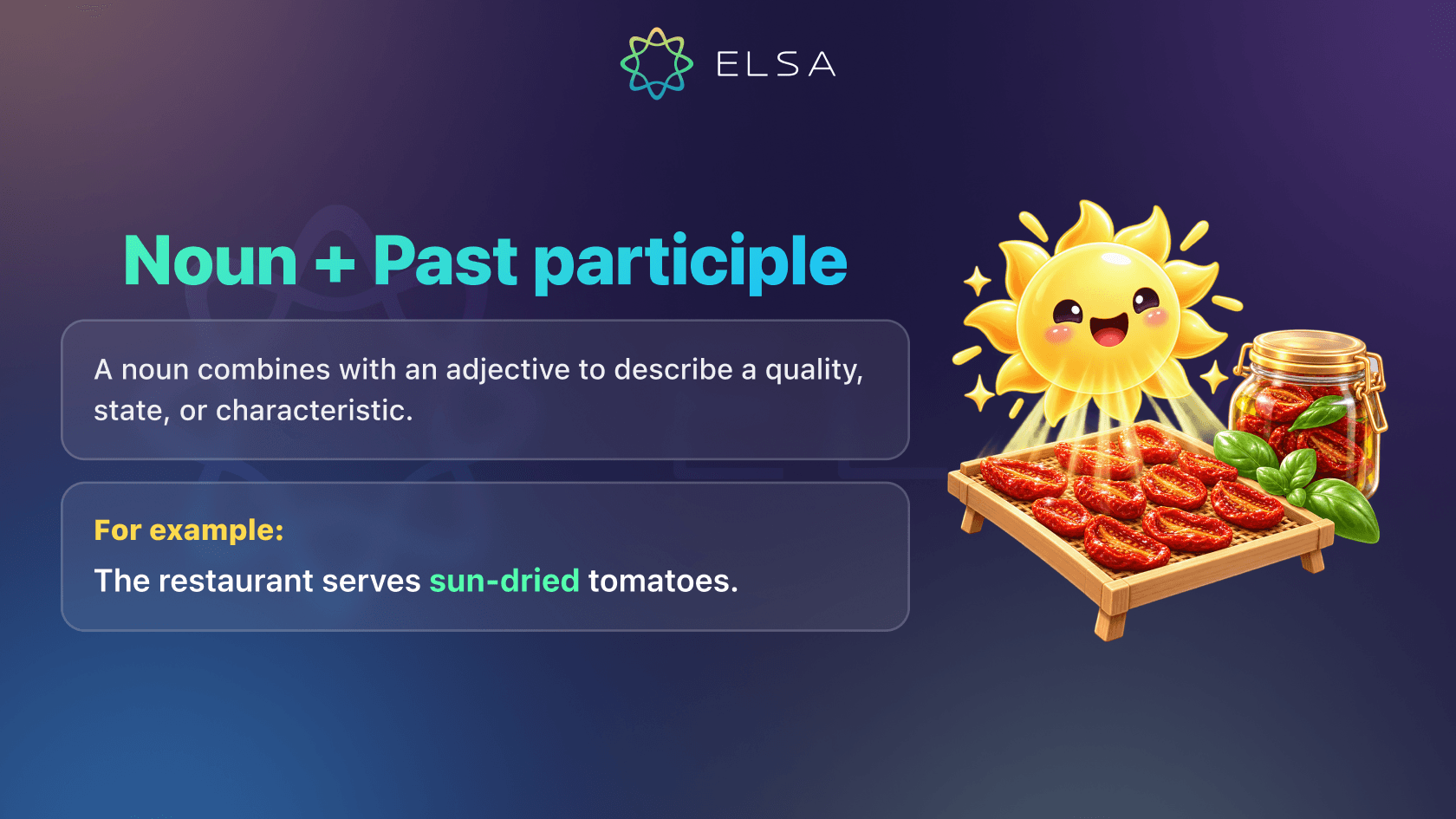
A noun combines with a past participle to describe something that has been made, treated, or affected in a particular way.
For example: The restaurant serves sun-dried tomatoes.
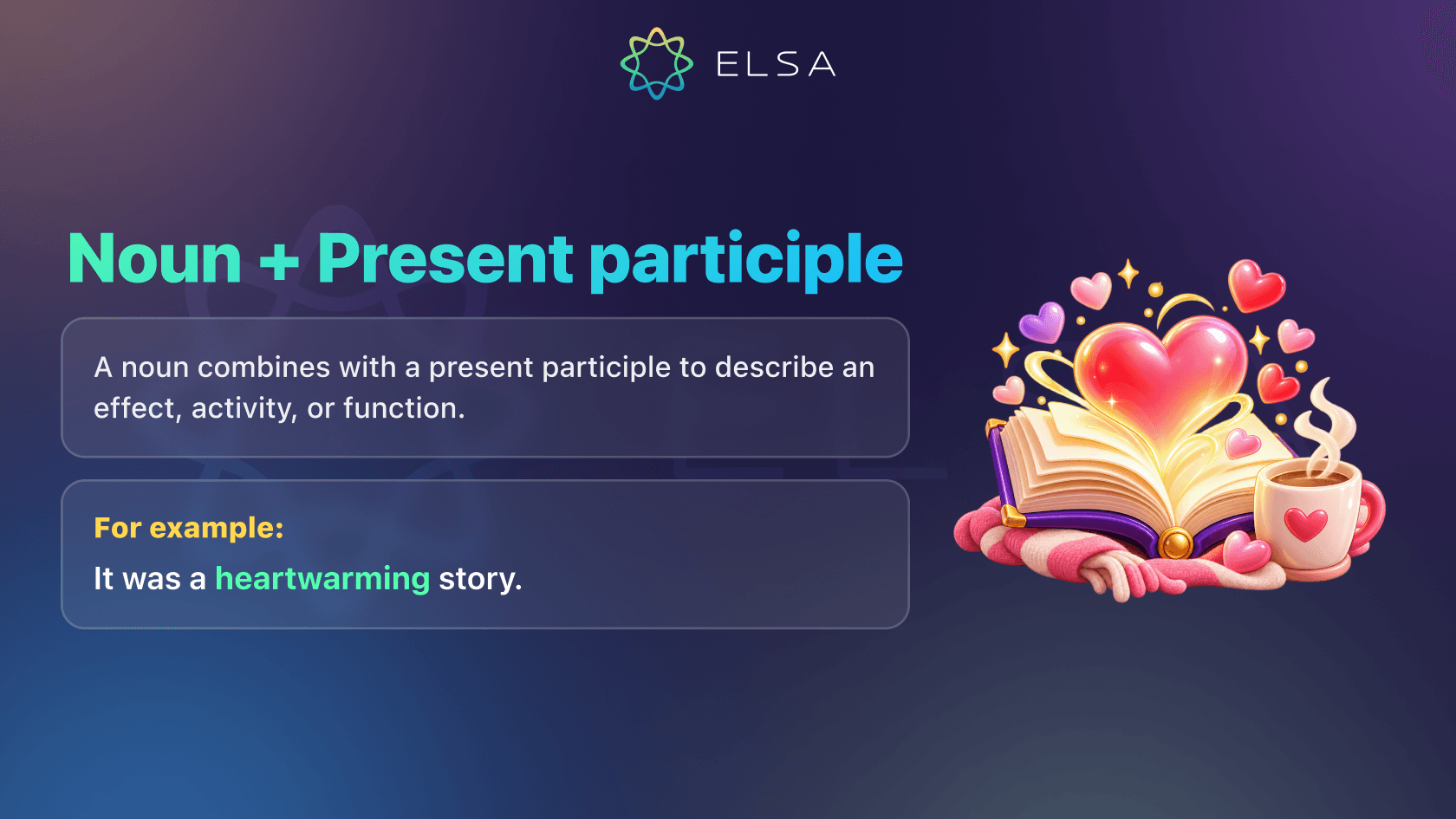
5. Noun + Present Participle
A noun combines with a present participle to describe an effect, activity, or function.
For example: It was a heartwarming story.
6. Adjective/Adverb + Participle
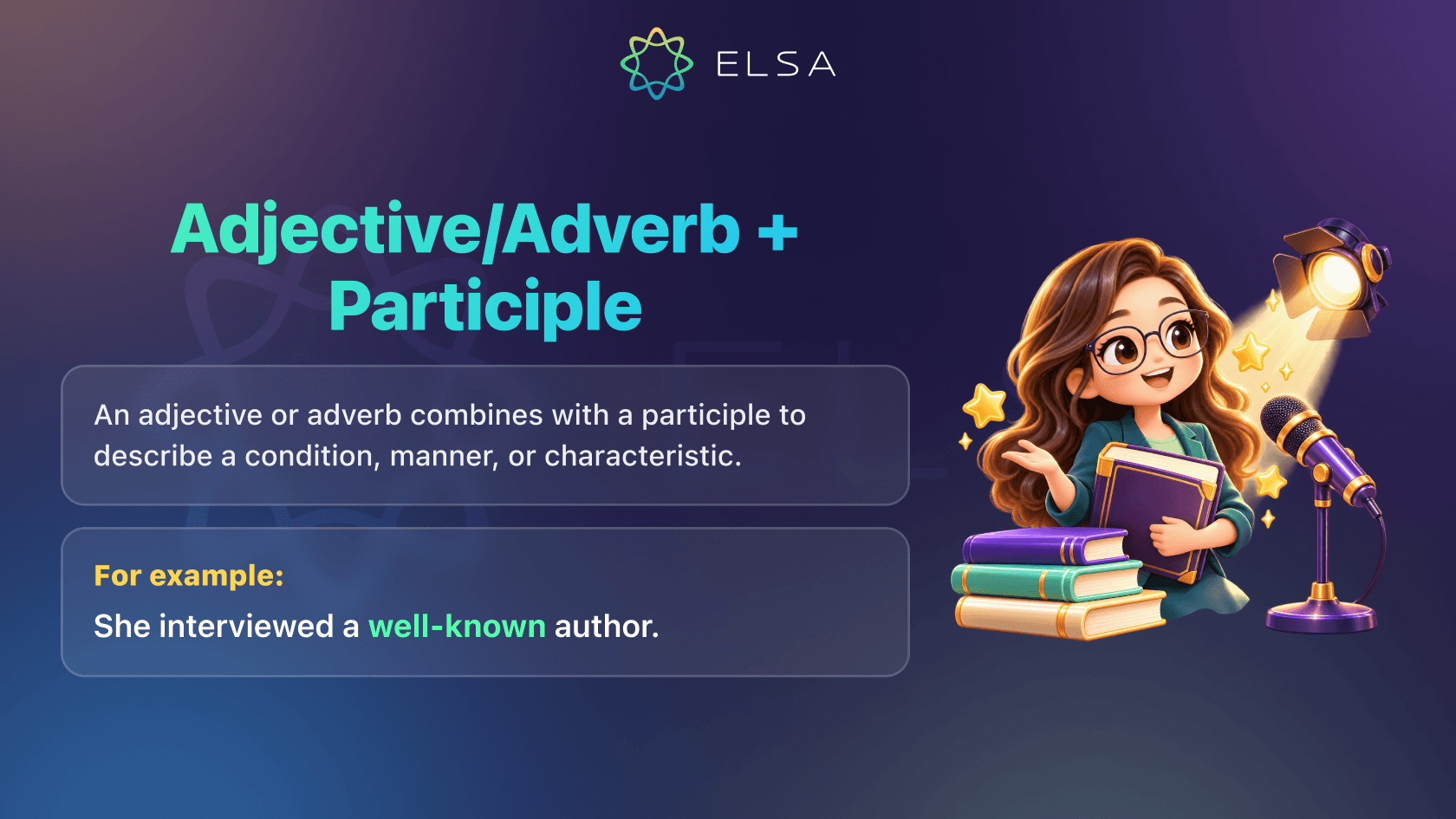
An adjective or adverb combines with a participle to describe a condition, manner, or characteristic.
For example: She interviewed a well-known author.
7. Adjective + Adjective
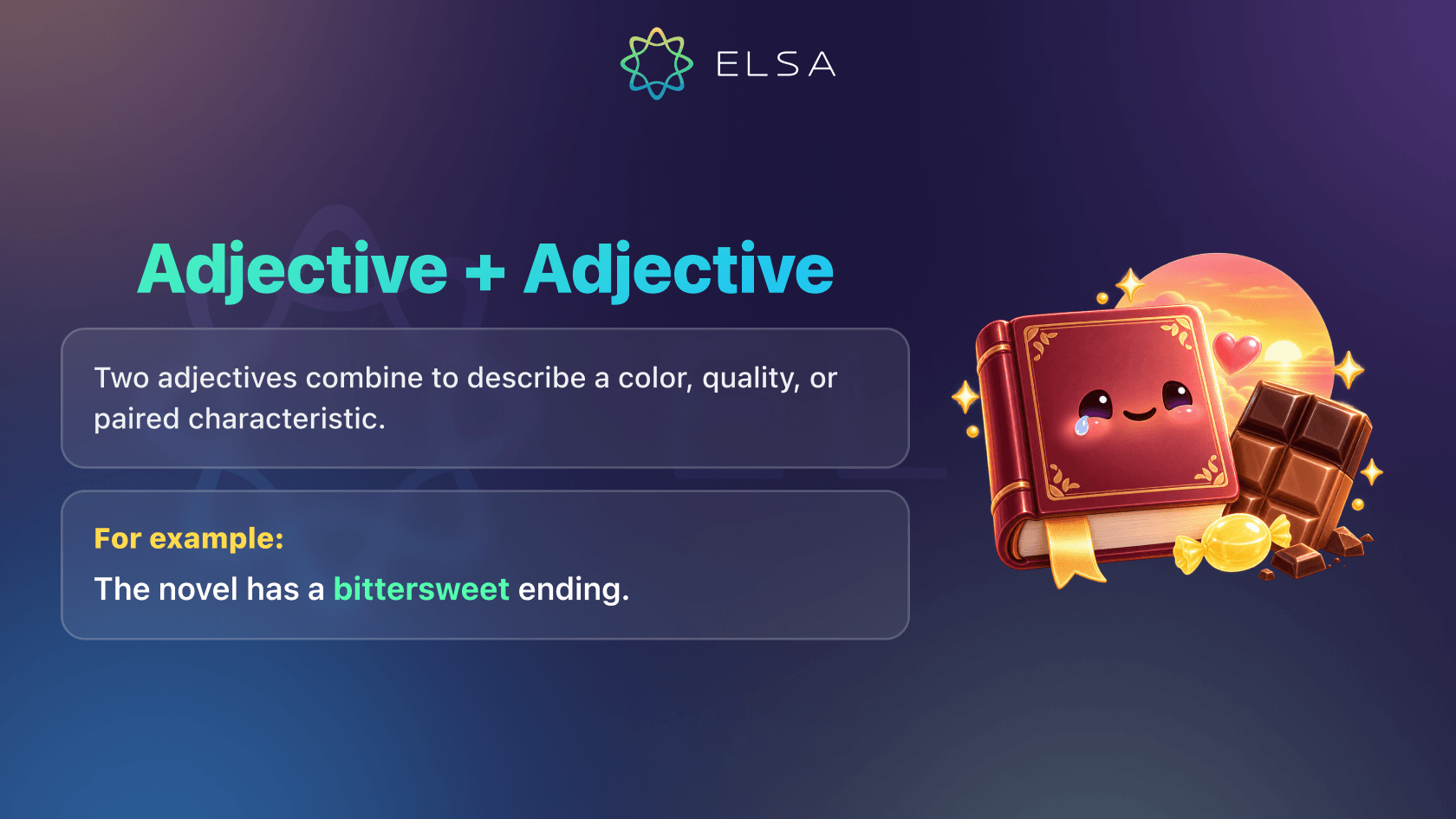
Two adjectives combine to describe a color, quality, or paired characteristic.
For example: The novel has a bittersweet ending.
Essential hyphenation rules for compound adjectives
The main purpose of hyphenation is to show that words work together as a single modifier. However, the correct punctuation depends on the compound's position, structure, and established usage.
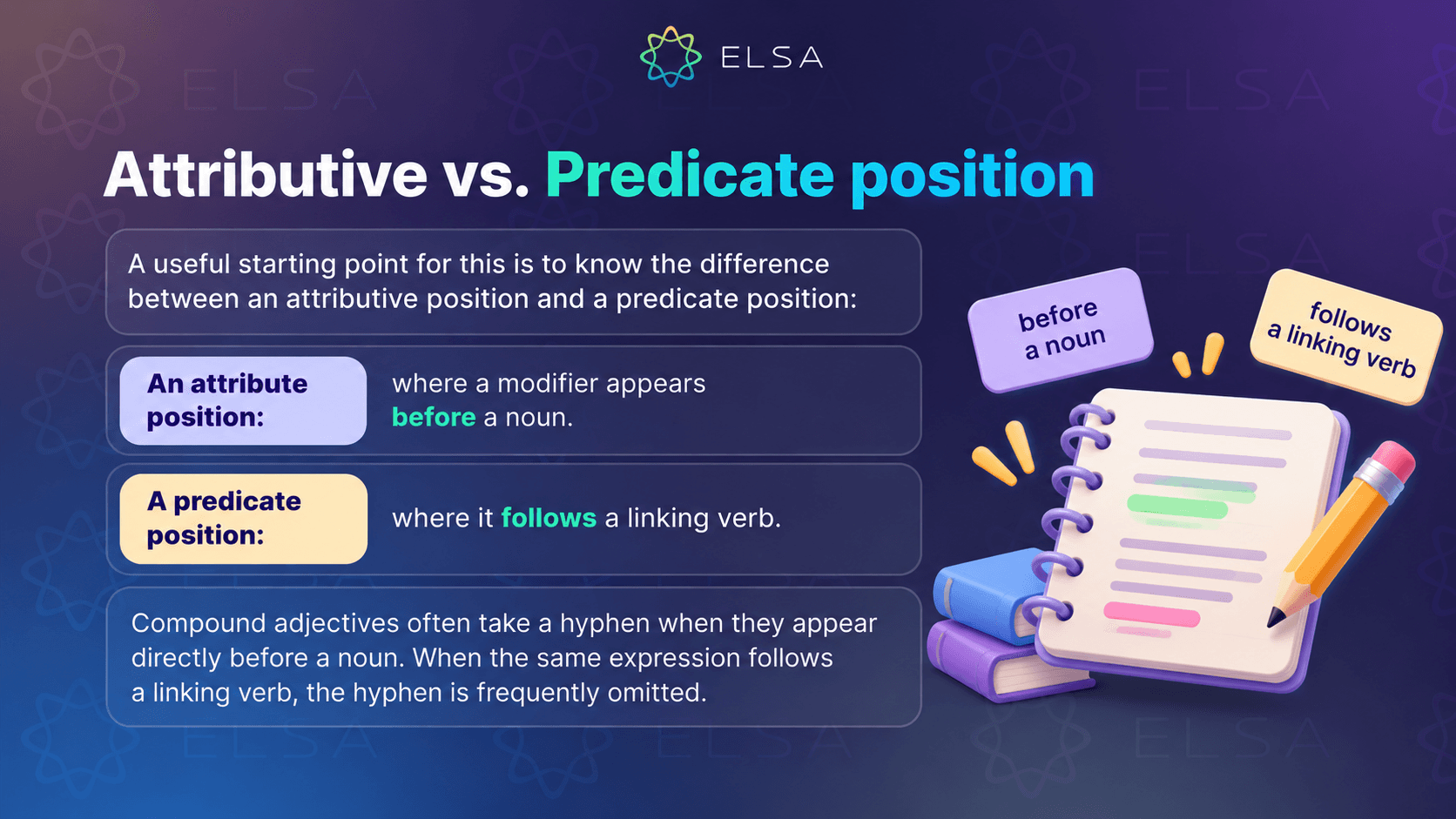
Attributive vs. Predicate position
A useful starting point for this is to know the difference between an attributive position and a predicate position:
- An attribute position: where a modifier appears before a noun
- A predicate position: where it follows a linking verb.
Compound adjectives often take a hyphen when they appear directly before a noun. When the same expression follows a linking verb, the hyphen is frequently omitted.
| Position | Example | Explanation |
|---|---|---|
| Before a noun | She adopted a two-year-old dog. | The hyphenated compound modifies dog. |
| After a linking verb | That dog is two years old. | The expression follows is, so it is written without hyphens. |
| Before a noun | This is a part-time contract. | Part-time functions as a compound modifier before contract. |
| After a linking verb | His employment is strictly part time. | Part time follows the linking verb and is written without a hyphen in this construction. |
The “-ly” adverb rule: Why no hyphen is needed
When an adverb ending in -ly modifies an adjective or participle, a hyphen is normally unnecessary. The -ly ending signals that the first word is an adverb, making the relationship between the words clear.
Consider these common compound adjectives hyphen mistakes:
- Incorrect: a highly-qualified applicant
- Correct: a highly qualified applicant
In these examples, the adverb modifies the adjective or participle that follows it. A hyphen adds no necessary clarification.
Compounds with “well” and “ill”
Compounds beginning with well or ill often follow a position-based hyphenation pattern.
| Position | Hyphenation rule | Example |
|---|---|---|
| Before a noun | Use a hyphen in common compound modifiers. | She interviewed a well-known scientist |
| After a linking verb | The hyphen is often omitted. | The scientist is well known. |
| When another adverb modifies the compound | The hyphen may be omitted in constructions such as the following, although conventions can vary by style guide. | A very well known scientist spoke at the event. |
Number-noun compound adjectives: The singular noun rule
One of the most common mistakes in compound adjectives is adding a plural -s to the noun in a measurement expression.
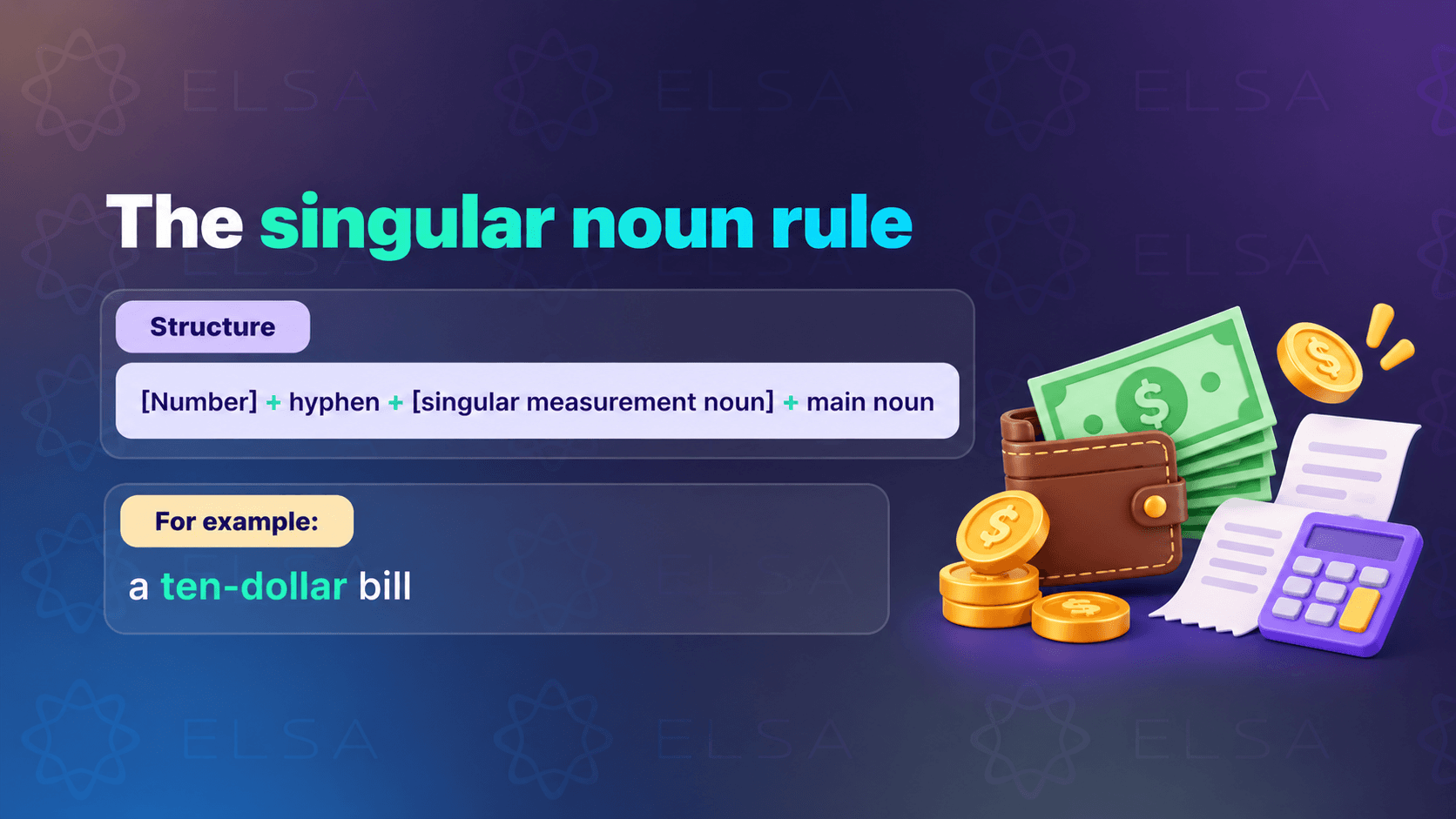
The singular noun rule
Structure
| [Number] + hyphen + [singular measurement noun] + main noun |
For example:
- Correct: a ten-dollar bill
- Incorrect: a ten-dollars bill
Common measurement expressions
| Measurement category | Correct compound adjective | Common error |
|---|---|---|
| Time | a three-week vacation | a three-weeks vacation |
| Money | a million-dollar contract | a million-dollars contract |
| Distance | a five-mile hike | a five-miles hike |
| Age | a six-year-old child | a six-years-old child |
| Dimension | a ten-foot ceiling | a ten-feet ceiling |
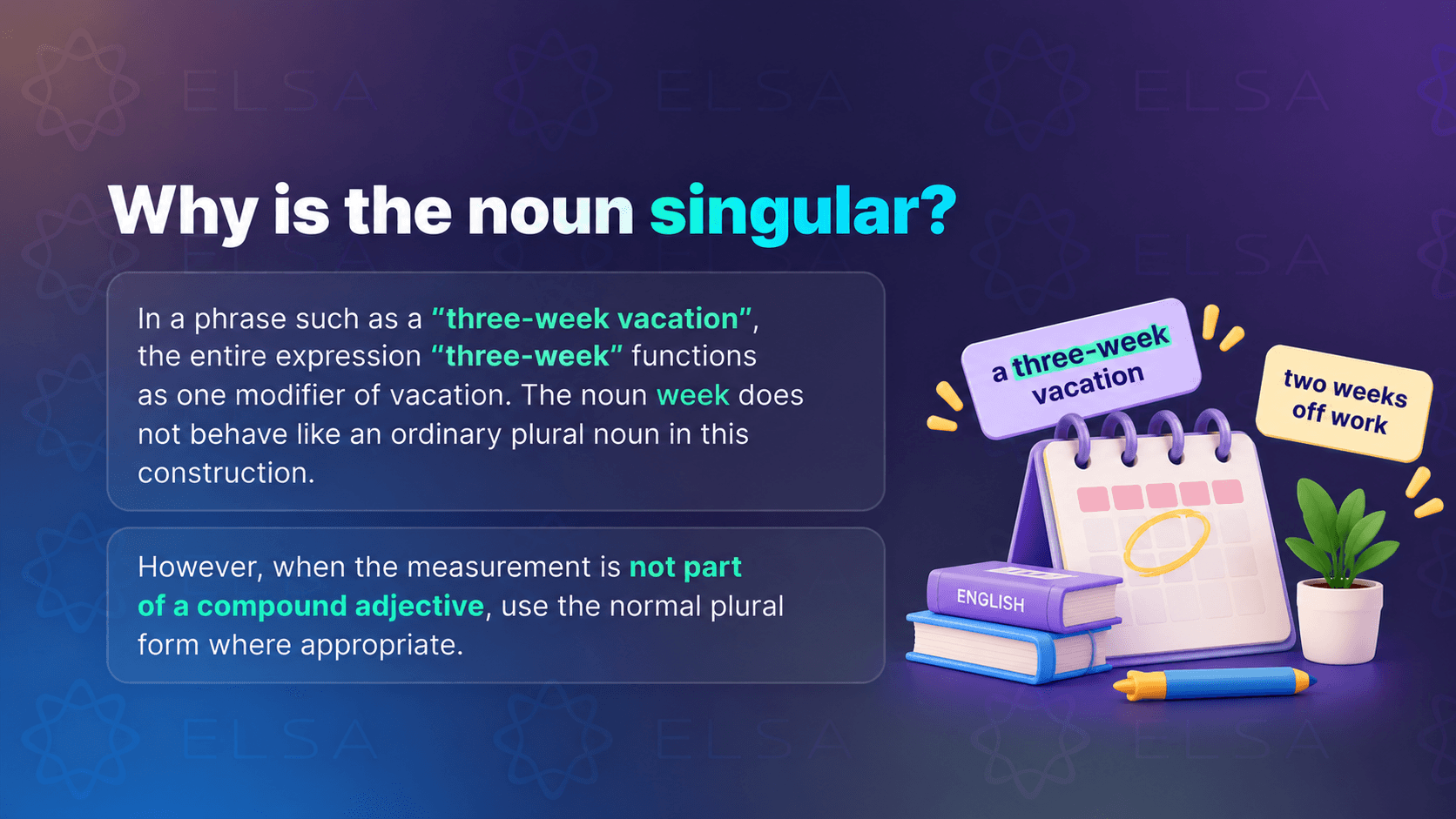
Why is the noun singular?
In a phrase such as a "three-week vacation", the entire expression "three-week" functions as one modifier of vacation. The noun week does not behave like an ordinary plural noun in this construction. However, when the measurement is not part of a compound adjective, use the normal plural form where appropriate.
Compare:
- Compound adjective: We took a three-week vacation.
- Ordinary noun phrase: Our vacation lasted three weeks.
Remember this distinction when writing measurements in academic papers, reports, product descriptions, and professional emails.
Practice exercises on compound adjectives
Exercise 1: Insert hyphens where necessary
Instruction: Rewrite each bold phrase with the correct hyphenation. If a hyphen is unnecessary, leave the phrase as it is.
- We are looking for a highly skilled technician to repair the machinery.
- They moved into a three bedroom apartment in downtown Seattle.
- She submitted a well written report before the deadline.
- The company launched a time saving tool for its customers.
- He accepted a full time position at the university.
- We stayed at a five star hotel near the beach.
- The manager gave a strongly worded response to the complaint.
- They adopted a two year old dog from the shelter.
- The team prepared a long term strategy for growth.
- She wore a brightly colored jacket to the event.
Exercise 2: Multiple-choice questions on compound modifiers
Instructions: Choose the best answer (A, B, C, or D) for each question.
1. Which sentence uses hyphenation correctly?
A. She is a highly-qualified engineer.
B. She is a highly-qualified-engineer.
C. She is a highly qualified-engineer.
D. She is a highly qualified engineer.
2. Which phrase is correct?
A. A three-year-old child
B. A three-years-old child
C. A three year-old child
D. A three-years old child
3. Which sentence is correct?
A. They booked a five-stars hotel.
B. They booked a five-star hotel.
C. They booked a five-stars-hotel.
D. They booked a five star-hotel.
4. Which option correctly completes the sentence?
The proposal was ______.
A. ill advised
B. ill-advising
C. ill-advised
D. ill-adviseds
5. Which phrase normally does not require a hyphen?
A. A well-known author
B. A long-term plan
C. A part-time job
D. A carefully designed system
6. Which sentence uses the measurement expression correctly?
A. We experienced a two-hour delay.
B. We experienced a two-hours delay.
C. We experienced a two-hour-delay.
D. We experienced a two-hours-delay.
7. Which sentence is correctly written?
A. The company hired a world famous-designer.
B. The company hired a world-famous-designer.
C. The company hired a world-famous designer.
D. The company hired a world-famously designer.
8. Which phrase is correctly written?
A. A brightly-lit room
B. A brightly lit room
C. A brightly-lit-room
D. A brightly light room
9. Which sentence is correct?
A. His employment is strictly part time.
B. His employment is strictly part-times.
C. His employment is strictly part-time's.
D. His employment is strictly part-time.
10. Which sentence correctly uses a compound adjective?
A. They developed a long-term strategy.
B. They developed a long term-strategy.
C. They developed a long-terms strategy.
D. They developed a long-term-strategy.
FAQs about compound adjectives
Why shouldn't we hyphenate adverbs ending in “-ly”?
An adverb ending in -ly already signals its grammatical role and clearly modifies the adjective or participle that follows. A hyphen is therefore normally unnecessary.
Is “high school student” a compound adjective?
No. In "high school student", high school is a compound noun functioning as a noun adjunct that modifies student. It is not a compound adjective, so the standard form is "high school student", without a hyphen.
How do I know whether to use a present participle (-ing) or past participle (-ed)?
The choice depends on the meaning and grammatical relationship between the words.
- Use a present participle (-ing) when the compound describes an action, process, or effect associated with the noun.
- Use a past participle (-ed or another V3 form) when the compound describes something that has undergone an action or is in a resulting state.
Understanding compound adjectives is one step toward more accurate and professional English writing. For more grammar explanations, tense guides, and practice exercises, visit the Grammar category on the ELSA Speak blog to strengthen your grammar, expand your vocabulary, and communicate more confidently in academic and workplace settings