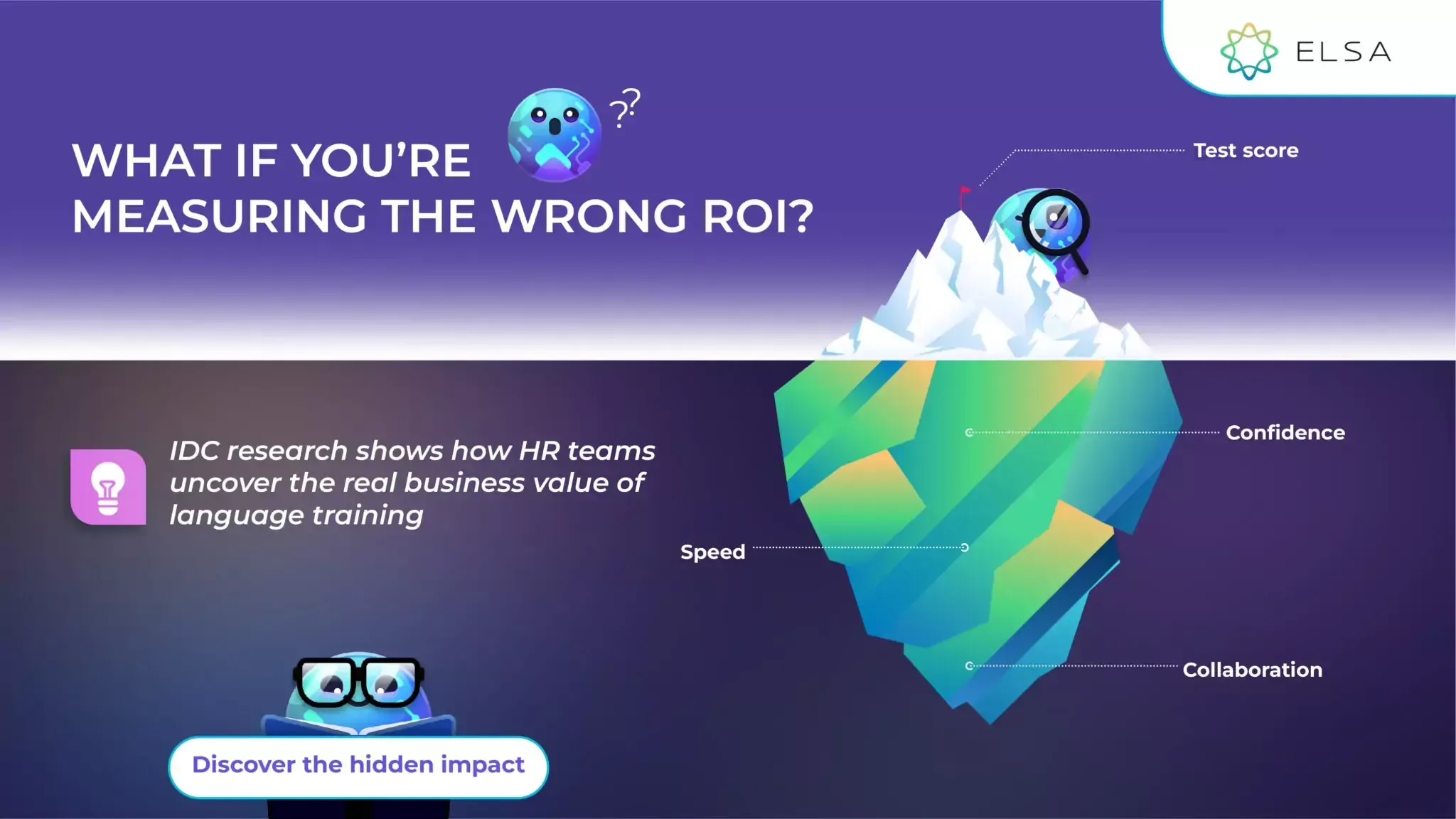
In many Asian organizations, corporate language programs have long been positioned as part of employee development. Their impact is often measured by attendance rates, course completion, or test scores. These indicators help track learning progress. However, they often fall short of answering a question that HR and L&D leaders increasingly face: How does language training translate into business performance?
For HR and L&D leaders, the ROI of corporate language training is no longer about the learning activity alone. It is about measurable changes in how employees communicate, collaborate, and perform in real work contexts.
As companies across Asia expand regionally and globally, English communication has become deeply embedded in daily operations. The challenge is no longer whether employees are learning, but whether improved language capability is enabling teams to work more effectively, respond faster, and collaborate with greater confidence.
Why are traditional training metrics no longer enough for measuring training ROI?
Most corporate language programs rely on familiar learning metrics: proficiency levels, assessment scores, or hours completed. These measures remain useful as baseline indicators, especially for tracking individual progress. However, they rarely capture how language capability shows up in real work contexts.
Industry analysis suggests that an over-reliance on traditional learning metrics creates a gap between training activity and real business impact. Analysis from eLearning Industry suggests that while many organizations track completion rates and assessment scores, these measures often fail to show whether employees apply new skills effectively on the job.
The same challenge applies to language programs. An employee may pass a language test yet still hesitate to speak up in meetings, respond slowly to customers, or avoid cross-border collaboration.
In Asia, where teams often operate in multilingual environments, this gap is particularly visible. IDC research highlights several performance-related challenges linked to language capability across Asia.
In the IDC survey (IDC AI-Powered Language Support Service Survey, 2024, commissioned by ELSA, n = 400):
- 42% of respondents said poor communication affects their organization’s ability to expand internationally, and 32% said it affects employee relationships.
- The top three challenges for employees were difficulty with speech and accent (40%), difficulty with technical or professional vocabulary (35%) and fear of making mistakes (34%).
- The business groups most often prioritized for language coaching were business development, sales and marketing (49%), customer support, service and success (43%), and executive management (40%).
- 65% believed English proficiency is a key benefit for successful global expansion, and 64% believed higher English proficiency inspires the professional growth of employees.
However, many organizations still struggle to connect language initiatives directly to performance outcomes.
How do you reframe ROI from learning outputs to performance signals?
To build a stronger business case, HR and L&D leaders are increasingly shifting their focus from learning outputs to performance-linked signals. These indicators do not replace traditional metrics. Instead, they complement them by showing how employees apply language skills at work, making the business impact of language training more visible. This shift aligns with broader workforce trends.
According to the World Economic Forum’s Future of Jobs Report 2025, workforce upskilling remains a top strategic priority for employers globally. Organizations are increasingly seeking measurable performance outcomes from their learning investments.
Investment in skills development continues to grow. As a result, the focus is shifting beyond participation and proficiency toward whether training translates into meaningful impact at work.
Common performance signals include:
- Confidence in communication: Employees who speak up more readily in meetings, contribute ideas, and engage in cross-functional discussions often demonstrate higher ownership and better decision-making.
- Response and resolution time: In customer-facing or operational roles, clearer communication can reduce clarification loops, accelerate responses, and improve service efficiency.
- Collaboration quality: Teams with stronger shared language capability tend to experience fewer misunderstandings, smoother handovers, and less rework across regions.
These performance signals provide HR teams with practical inputs for L&D performance measurement. They can be tracked using existing data sources such as engagement surveys, manager feedback, customer service metrics, and internal collaboration tools.
What patterns appear across industries in Asia?
Across industries, the impact of language capability follows consistent patterns. Clearer communication supports productivity and operational efficiency in manufacturing and logistics. In customer service and sales, its impact is reflected in response times, customer satisfaction, and retention. Meanwhile, professional services and technology rely on strong communication to enable faster collaboration and effective cross-border operations.
IDC’s Asia-Pacific research reinforces these trends. Organizations using modern language communication solutions report higher employee confidence, alongside improvements in customer-facing metrics such as first response rates, resolution time, and customer satisfaction.
The same survey asked respondents to name the top benefit of AI-powered English communication tools. Results by industry (percentage of respondents in each industry):
- Ability to expand globally: IT, software and consulting (64%); hospitality (48%)
- Improved efficiency and productivity: manufacturing (58%); financial services (54%)
- Enhanced customer service and support: fast-moving consumer goods (48%); business process outsourcing (39%)
- Better partner communications: education (45%); airlines (40%, indicative because of the low number of respondents); state-owned enterprises (35%)
- Competitive advantage: transportation and logistics (36%)
Asia-based respondents also named the customer metrics most positively impacted by AI-based English language communication tools:
- Customer retention rate (88%)
- Resolution time (87%)
- First response rate (87%)
- Customer satisfaction (86%)
- Sales revenue (86%)
- Net promoter score (83%)
- Customer lifetime value (82%)
These figures are survey responses, not measured outcomes.
Across sectors, these findings suggest that language capability directly influences operational execution, customer experience, and cross-border collaboration. This makes it a legitimate performance lever rather than a soft skill.
How do you build a credible ROI narrative for stakeholders?
For HR and L&D teams, reframing ROI is also about how language programs are positioned internally. Instead of being viewed as a learning expense, language initiatives can be framed as capability enablement that supports strategic priorities.
Linking language programs to measurable performance indicators helps bridge conversations with business leaders, transformation teams, and finance stakeholders. This is especially important in environments where budgets and priorities are closely scrutinized.
By connecting language capability to existing KPIs, people analytics, and operational data, ROI becomes more tangible, defensible, and aligned with business objectives.
How do organizations move from measurement to execution?
Some organizations in Asia are already operationalizing this shift by combining language learning with ongoing performance monitoring. AI-powered communication solutions, such as ELSA, are increasingly used to support continuous practice while providing insights into how communication skills evolve over time.
When integrated thoughtfully, these tools allow HR and L&D teams to move beyond static training metrics and demonstrate ROI through performance-aligned indicators. This shift helps language programs transition from training initiatives into measurable drivers of workplace effectiveness.
Frequently asked questions
Why are completion rates and test scores not enough to show the ROI of language training?
They remain useful as baseline indicators of individual progress, but they rarely capture how language capability shows up in real work contexts. An employee may pass a language test and still hesitate to speak up in meetings, respond slowly to customers or avoid cross-border collaboration.
Which data sources can HR and L&D teams use to track performance signals?
Performance signals can be tracked using existing data sources such as engagement surveys, manager feedback, customer service metrics and internal collaboration tools.
How can HR and L&D teams position language training for finance stakeholders?
By framing language initiatives as capability enablement that supports strategic priorities, rather than as a learning expense. Linking language programs to existing KPIs, people analytics and operational data makes ROI more tangible, defensible and aligned with business objectives.
References:
eLearning Industry. The ROI Reality Check: Learning Metrics vs. Business Impact. https://elearningindustry.com/the-roi-reality-check-learning-metrics-vs-business-impact
World Economic Forum. (2025). Future of Jobs Report 2025: Infographics. https://www.weforum.org/publications/the-future-of-jobs-report-2025/infographics-94b6214b36/
International Data Corporation (IDC). (2025, March). Unlocking Business Growth and Efficiency through AI-powered Communication Solutions (IDC InfoBrief, IDC. #AP242513IB).