

12 best movies to learn English by level (beginner to pro)
elsaspeakadmin
October 26, 2026
English for beginners
Watching movies is one of the most effective ways to learn English for beginners. In this guide, we’ll introduce you to 12 best movies to learn English, including the best movies to learn English for beginners, intermediate learners, and advanced speakers, and practical techniques that help turning screen time into a productive learning experience.
Top 12 movies for English learners
The best English movies to learn English speaking depend on your current proficiency level, preferred accent, and learning goals. The comparison below covers 12 popular films and one television series, highlighting their dialogue speed, genres, and educational value to help you choose the right starting point.
| Movie & Year | Skill Level | Genre | Dialogue Pacing | Core Learning Value |
|---|---|---|---|---|
| Forrest Gump (1994) | Beginner (A1–A2) | Drama, historical fiction | Generally measured and clear | Everyday vocabulary and American cultural references |
| The Lion King (1994) | Beginner (A1–A2) | Animation, family | Moderate and expressive | Basic emotional vocabulary, common phrases, and song lyrics |
| Cast Away (2000) | Beginner (A1–A2) | Survival, adventure | Sparse, with long stretches of silence | Survival vocabulary, objects, actions, and basic needs |
| Toy Story (1995) | Beginner (A1–A2) | Animation, comedy | Generally clear and conversational | Everyday conversations, greetings, and common expressions |
| The Pursuit of Happyness (2006) | Intermediate (B1–B2) | Drama, biographical | Natural, with workplace dialogue | Interview skills, professional English, and emotional conversations |
| The King's Speech (2010) | Intermediate (B1–B2) | Historical, biographical drama | Deliberate in speech exercises; varied elsewhere | Articulation, stress, and British pronunciation |
| Notting Hill (1999) | Intermediate (B1–B2) | Romantic comedy | Natural, witty, and conversational | Social English and British - American differences |
| Mean Girls (2004) | Intermediate (B1–B2) | Teen comedy | Fast and expressive | Slang, sarcasm, idioms, and informal conversations |
| The Social Network (2010) | Advanced (C1–C2) | Drama, technology | Very fast and densely packed | Technology vocabulary, argumentation, and business communication |
| Oppenheimer (2023) | Advanced (C1–C2) | Historical, biographical drama | Dense, technical, and formal | Scientific terminology, politics, and academic discourse |
| The Crown (2016–2023) | Advanced (C1–C2) | Historical drama series | Formal, measured, and nuanced | Formal vocabulary, complex sentences, and diplomatic language |
| Dead Poets Society (1989) | Advanced (C1–C2) | Drama, coming-of-age | Expressive and rhetorical | Literary metaphors, persuasive speaking, and public speaking |
Note that these levels are practical recommendations, not official CEFR ratings for the films. Dialogue difficulty varies by scene, speaker, and familiarity with the subject matter. The Crown is a television series rather than a feature film, but it is included for its rich examples of formal British English.
Best movies to learn English for beginners
Choosing the best movies to learn English for beginners means looking for films with relatively clear pronunciation, simple sentence structures, and visual storytelling. These features help A1–A2 learners connect spoken words with actions and emotions without constantly translating into their native language.
Forrest Gump (1994): Simple pacing and everyday American English
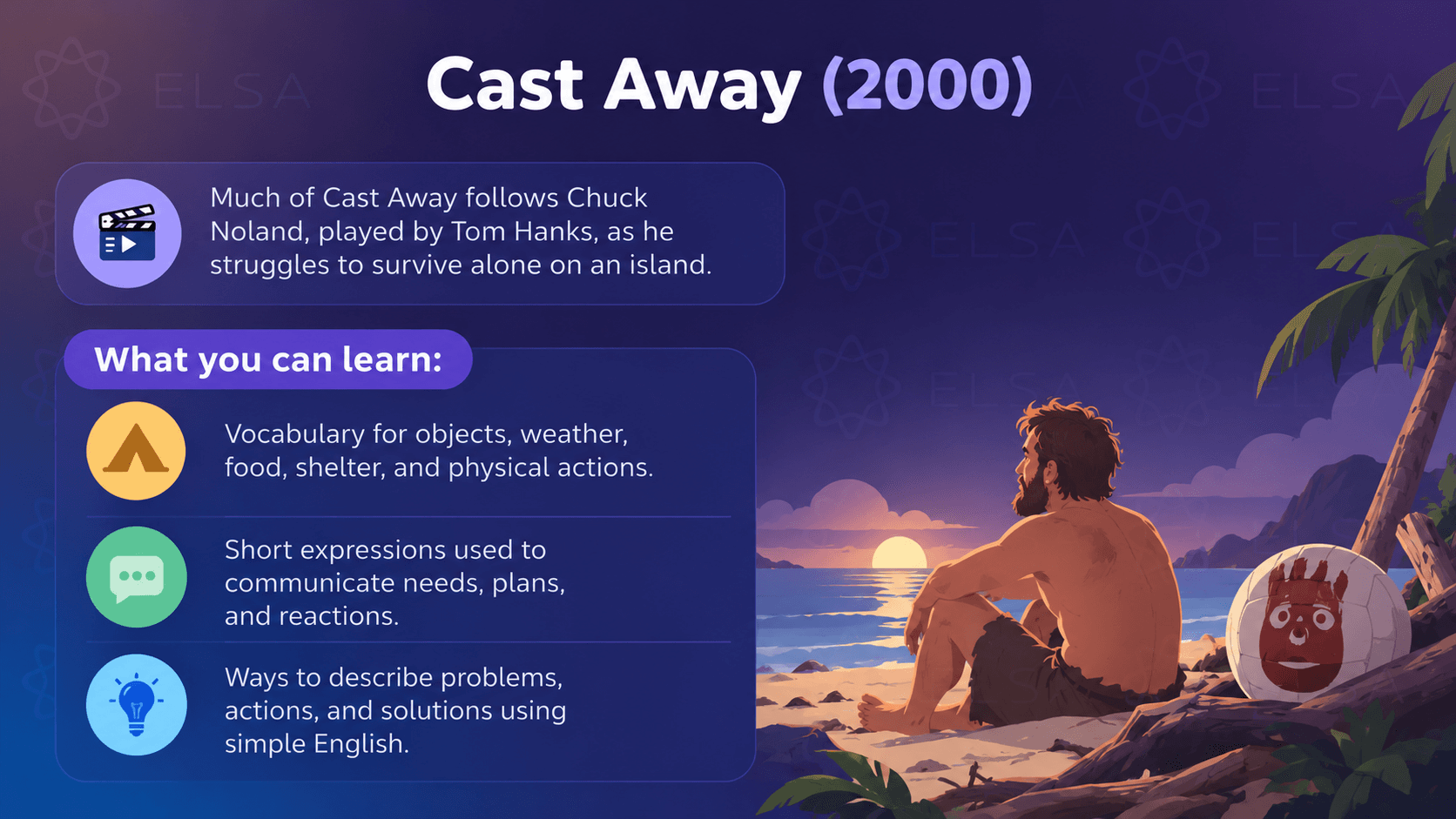
Why it's a good choice: Forrest Gump, played by Tom Hanks, narrates much of the story in a distinctive Southern American accent. His delivery is often measured, and the straightforward storytelling makes it easier to follow the main ideas, although some cultural references and regional pronunciation may be challenging.
What you can learn:
- Everyday sentence patterns for describing people, experiences, and events.
- Common expressions and memorable lines, including the famous comparison, "Life is like a box of chocolates."
- American cultural and historical references spanning much of the 20th century.
How to practice: Start with Forrest's conversations at the bus stop. Listen to a short passage, read the English subtitles, and repeat each sentence aloud. Pay attention to word stress and how he connects words in natural speech.
The Lion King (1994): Clear enunciation and emotional dialogue
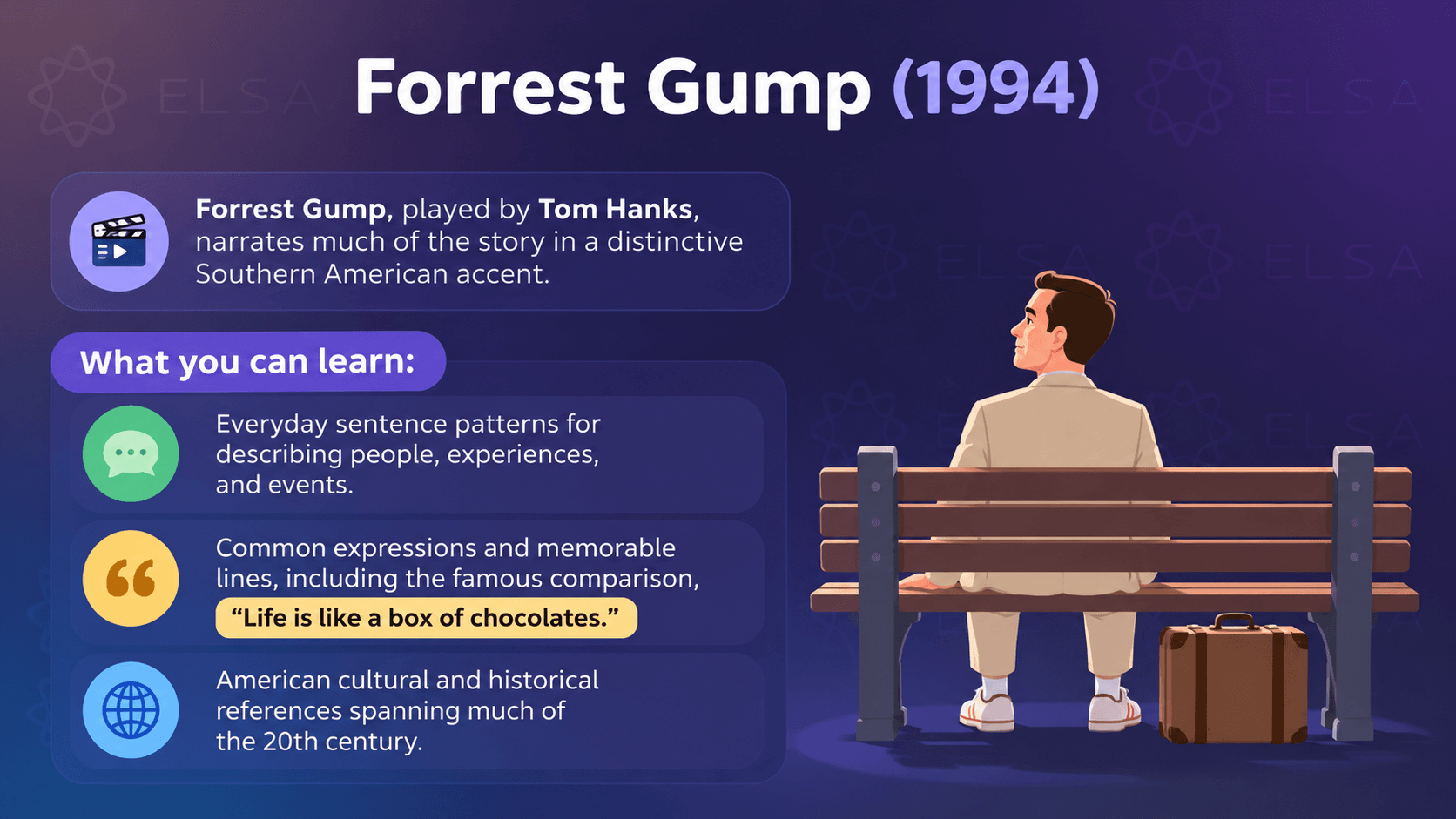
Why it's a good choice: Disney's animated classic combines expressive voice acting, memorable scenes, and a linear storyline. Visual cues help beginners understand the characters' intentions even when they miss a word or phrase.
What you can learn:
- Emotional vocabulary related to fear, courage, pride, friendship, and responsibility.
- Basic phrasal verbs and everyday expressions.
- Rhythm, pronunciation, and vocabulary through memorable songs such as "Hakuna Matata."
How to practice: Choose a short conversation between Simba and another character. Listen for simple present and past-tense sentences, then repeat the lines while matching the speaker's stress and emotion.
Cast Away (2000): Minimal dialogue and practical survival vocabulary
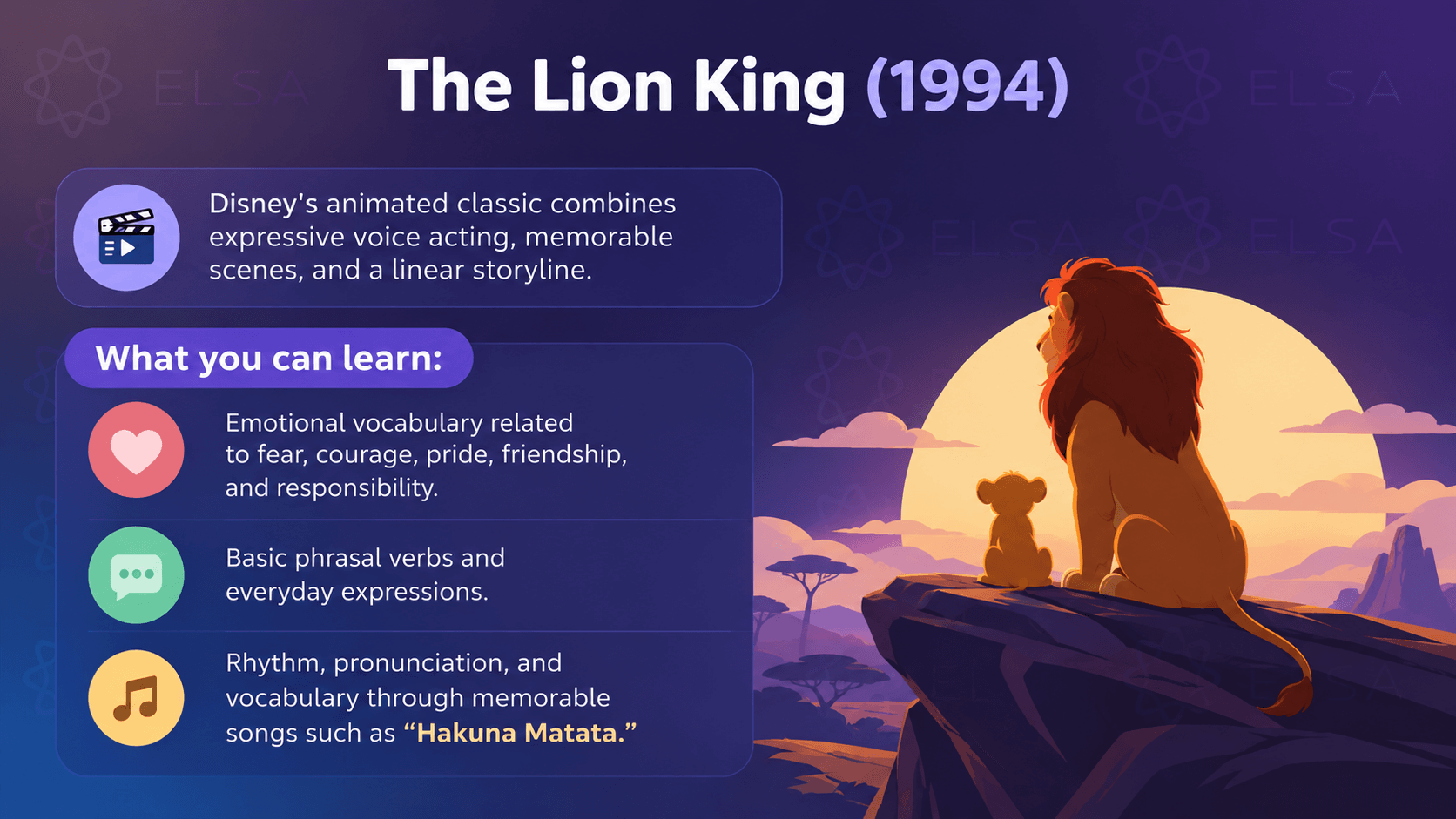
Why it's a good choice: Much of Cast Away follows Chuck Noland, played by Tom Hanks, as he struggles to survive alone on an island. The extended stretches with little dialogue give learners time to observe actions, infer meaning, and process individual lines.
What you can learn:
- Vocabulary for objects, weather, food, shelter, and physical actions.
- Short expressions used to communicate needs, plans, and reactions.
- Ways to describe problems, actions, and solutions using simple English.
How to practice: Pick a scene in which Chuck builds something, searches for food, or interacts with Wilson, his volleyball companion. Describe what happens using simple sentences, such as "He is looking for food" or "He needs to make a fire."
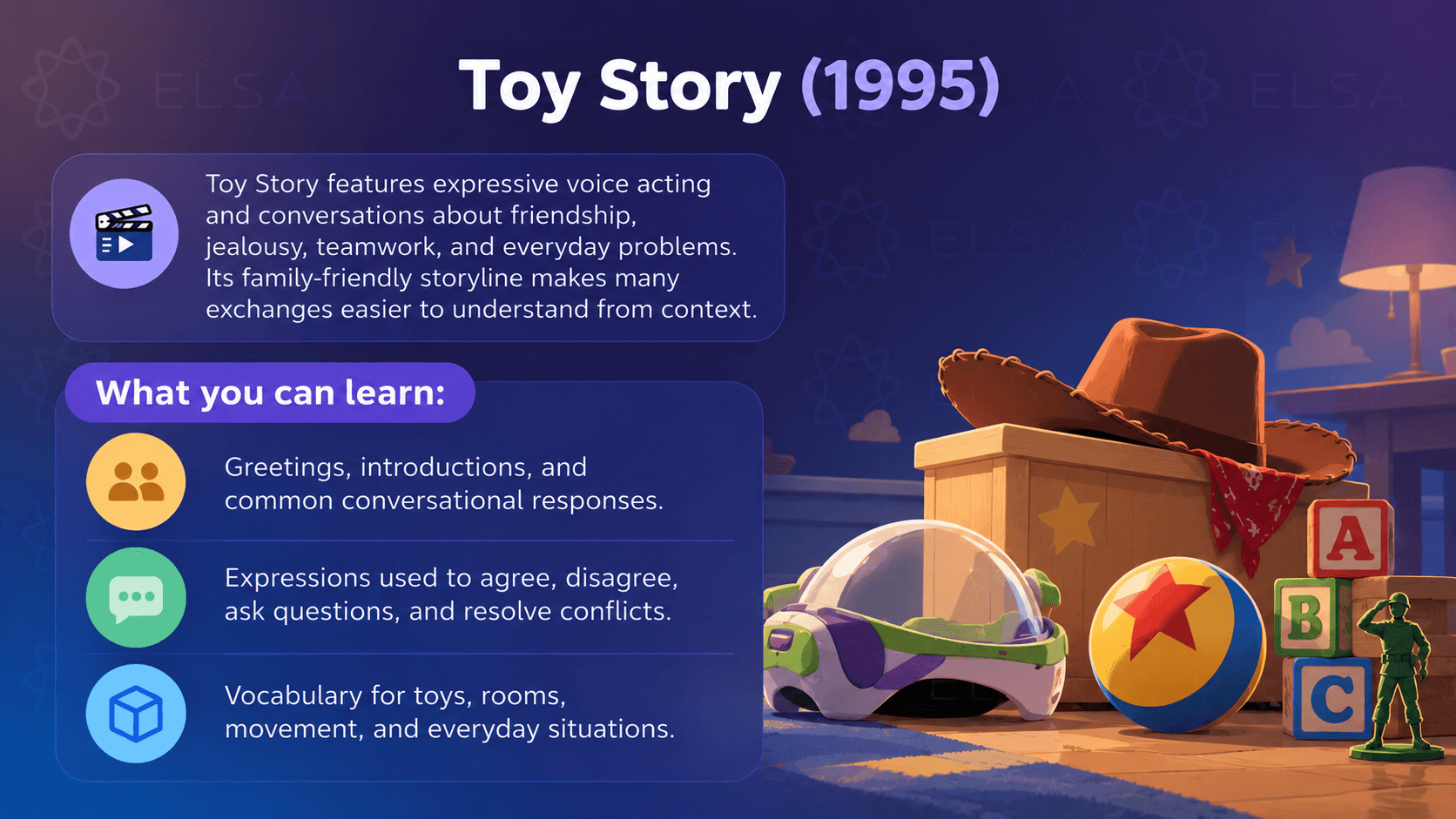
Toy Story (1995): Clear articulation and everyday conversations
Why it's a good choice: Toy Story features expressive voice acting and conversations about friendship, jealousy, teamwork, and everyday problems. Its family-friendly storyline makes many exchanges easier to understand from context.
What you can learn:
- Greetings, introductions, and common conversational responses.
- Expressions used to agree, disagree, ask questions, and resolve conflicts.
- Vocabulary for toys, rooms, movement, and everyday situations.
How to practice: Select a short exchange between Woody and Buzz Lightyear. Repeat each line, then cover the subtitles and try to reproduce the conversation from memory. Practice changing your tone when asking a question, expressing surprise, or disagreeing with someone.
Best movies to learn English for intermediate learners
The best movies to learn English for intermediate learners introduce more natural conversations, workplace vocabulary, idioms, and informal expressions. At the B1–B2 level, you can move beyond simple sentences and explore how native speakers communicate in professional and social situations.
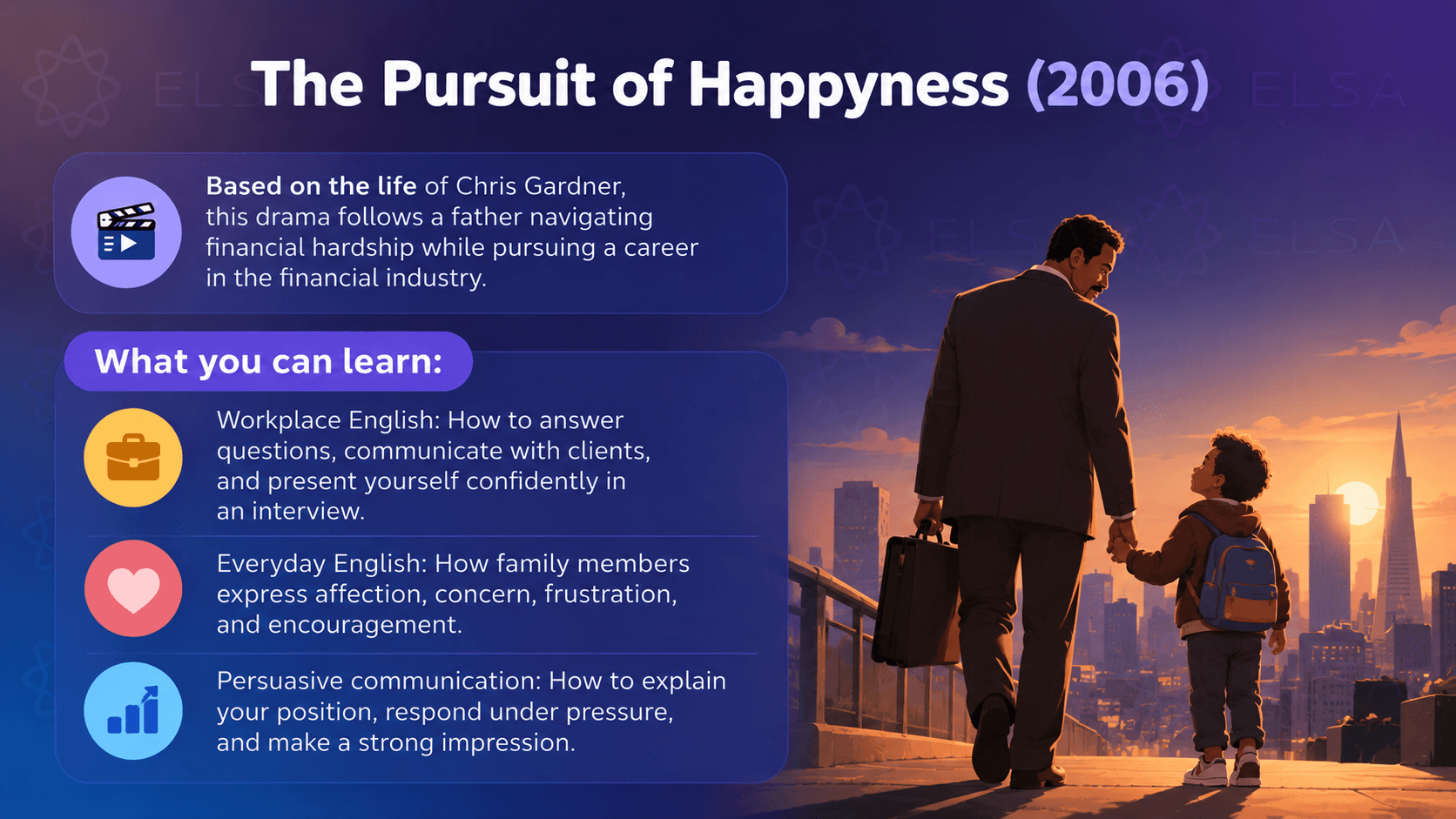
The Pursuit of Happyness (2006): Workplace English and emotional conversations
Why it's a good choice: Based on the life of Chris Gardner, this drama follows a father navigating financial hardship while pursuing a career in the financial industry. Its mix of professional situations and family conversations exposes learners to different communication styles.
What you can learn:
- Workplace English: How to answer questions, communicate with clients, and present yourself confidently in an interview.
- Everyday English: How family members express affection, concern, frustration, and encouragement.
- Persuasive communication: How to explain your position, respond under pressure, and make a strong impression.
How to practice: Choose one of Chris Gardner's interview or workplace scenes. Write down three useful phrases, identify how the speaker emphasizes key words, and then role-play the conversation as if you were applying for a job.
The King's Speech (2010): Articulation practice and British pronunciation
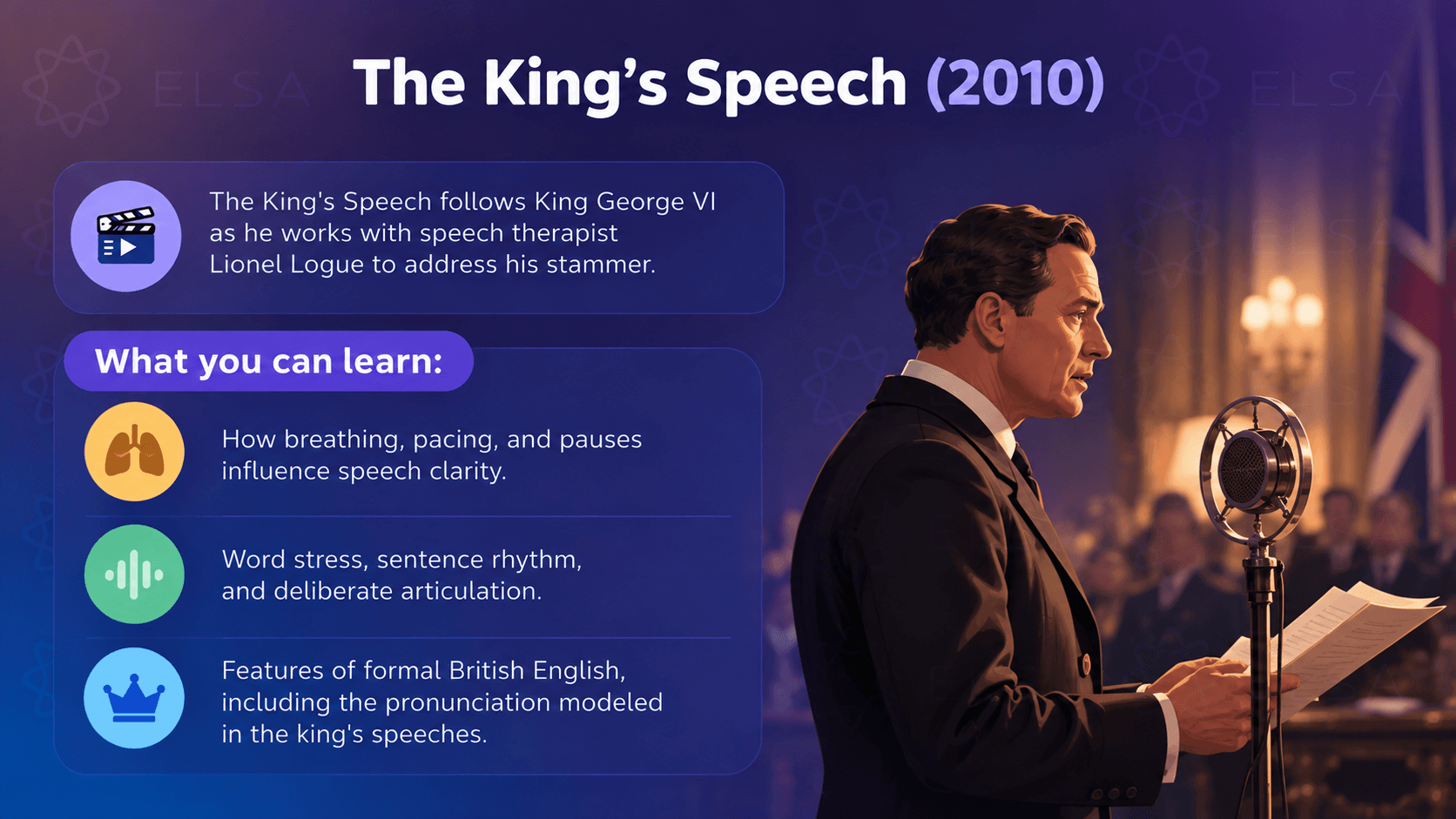
Why it's a good choice: The King's Speech follows King George VI as he works with speech therapist Lionel Logue to address his stammer. Speech exercises are central to the story, making the film especially relevant to learners interested in articulation, fluency, and public speaking.
What you can learn:
- How breathing, pacing, and pauses influence speech clarity.
- Word stress, sentence rhythm, and deliberate articulation.
- Features of formal British English, including the pronunciation modeled in the king's speeches.
How to practice: Listen to one of the speech-training scenes. Pause after each line and repeat it slowly before gradually increasing your pace. You can also practice English tongue twisters to improve coordination between sounds.
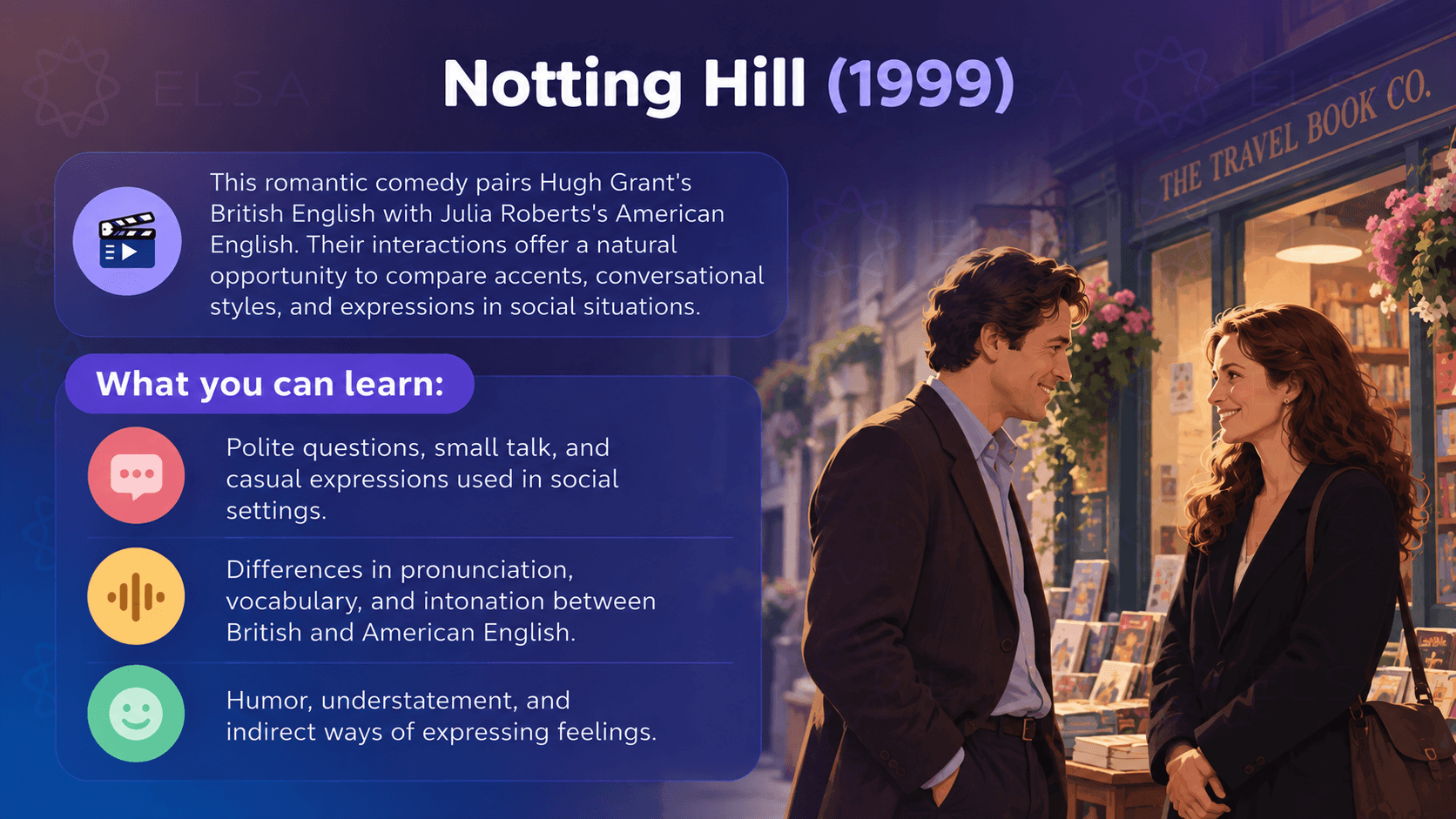
Notting Hill (1999): Casual British social interactions and romantic comedy
Why it's a good choice: This romantic comedy pairs Hugh Grant's British English with Julia Roberts's American English. Their interactions offer a natural opportunity to compare accents, conversational styles, and expressions in social situations.
What you can learn:
- Polite questions, small talk, and casual expressions used in social settings.
- Differences in pronunciation, vocabulary, and intonation between British and American English.
- Humor, understatement, and indirect ways of expressing feelings.
How to practice: Select a conversation between William and Anna. Identify one expression you would use in a real conversation, then repeat it in both a British-style and an American-style pronunciation where appropriate.
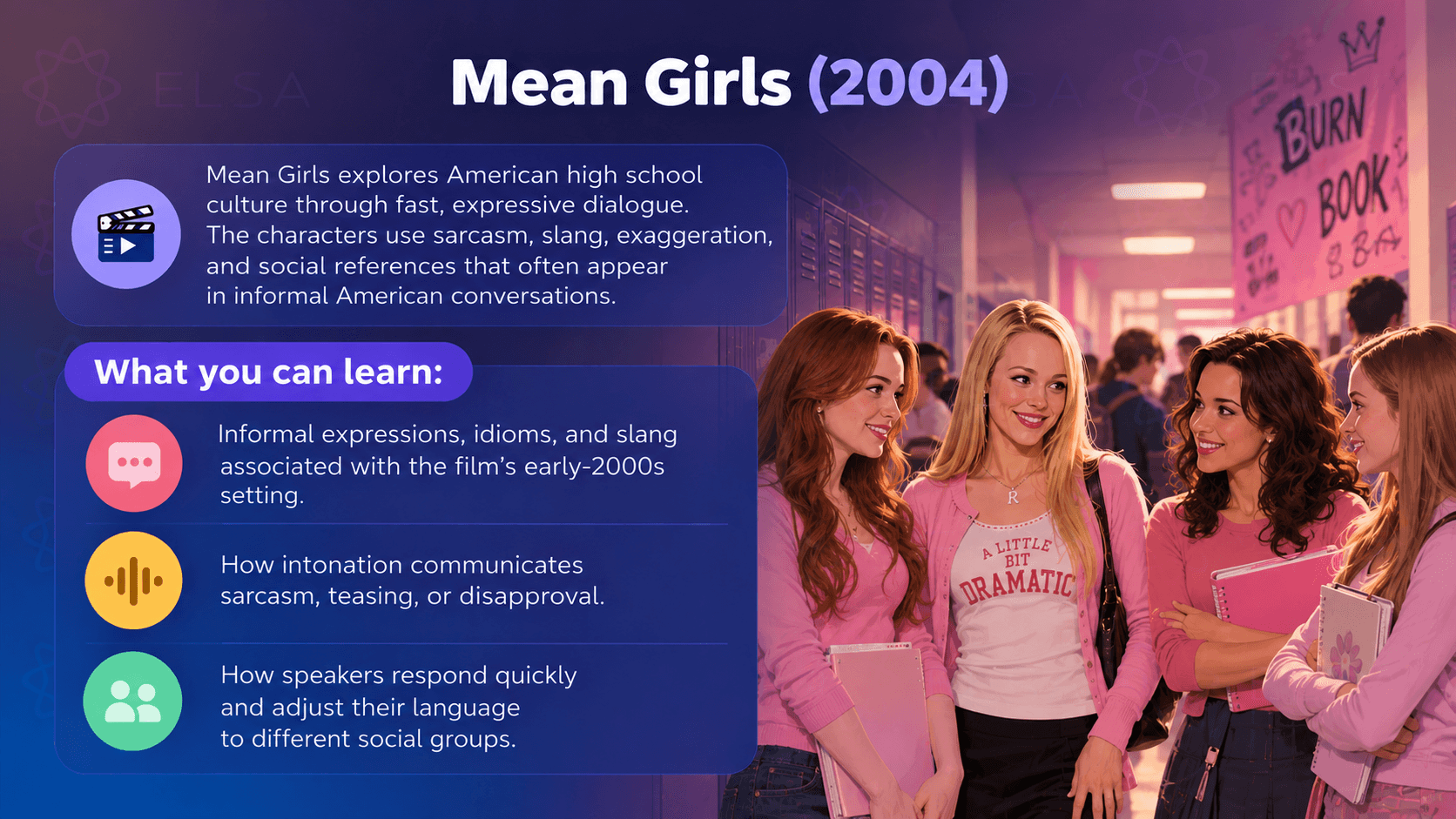
Mean Girls (2004): Slang, idioms, and high school conversations
Why it's a good choice: Mean Girls explores American high school culture through fast, expressive dialogue. The characters use sarcasm, slang, exaggeration, and social references that often appear in informal American conversations.
What you can learn:
- Informal expressions, idioms, and slang associated with the film's early-2000s setting.
- How intonation communicates sarcasm, teasing, or disapproval.
- How speakers respond quickly and adjust their language to different social groups.
How to practice: Choose a short conversation and identify which phrases are literal and which are sarcastic or exaggerated. Repeat the dialogue while matching the speaker's intonation, then rewrite one expression in neutral, polite English.
Note: Keep in mind that some slang in Mean Girls is dated or tied to high school culture. Learn the meaning and context before using an expression in professional or formal situations.
Best movies to learn English for advanced learners
For C1–C2 learners, films with fast dialogue, sophisticated arguments, specialized vocabulary, and complex sentence structures can help refine listening accuracy and expressive range. The following selections are particularly useful if you already understand everyday English and want to handle more demanding conversations.
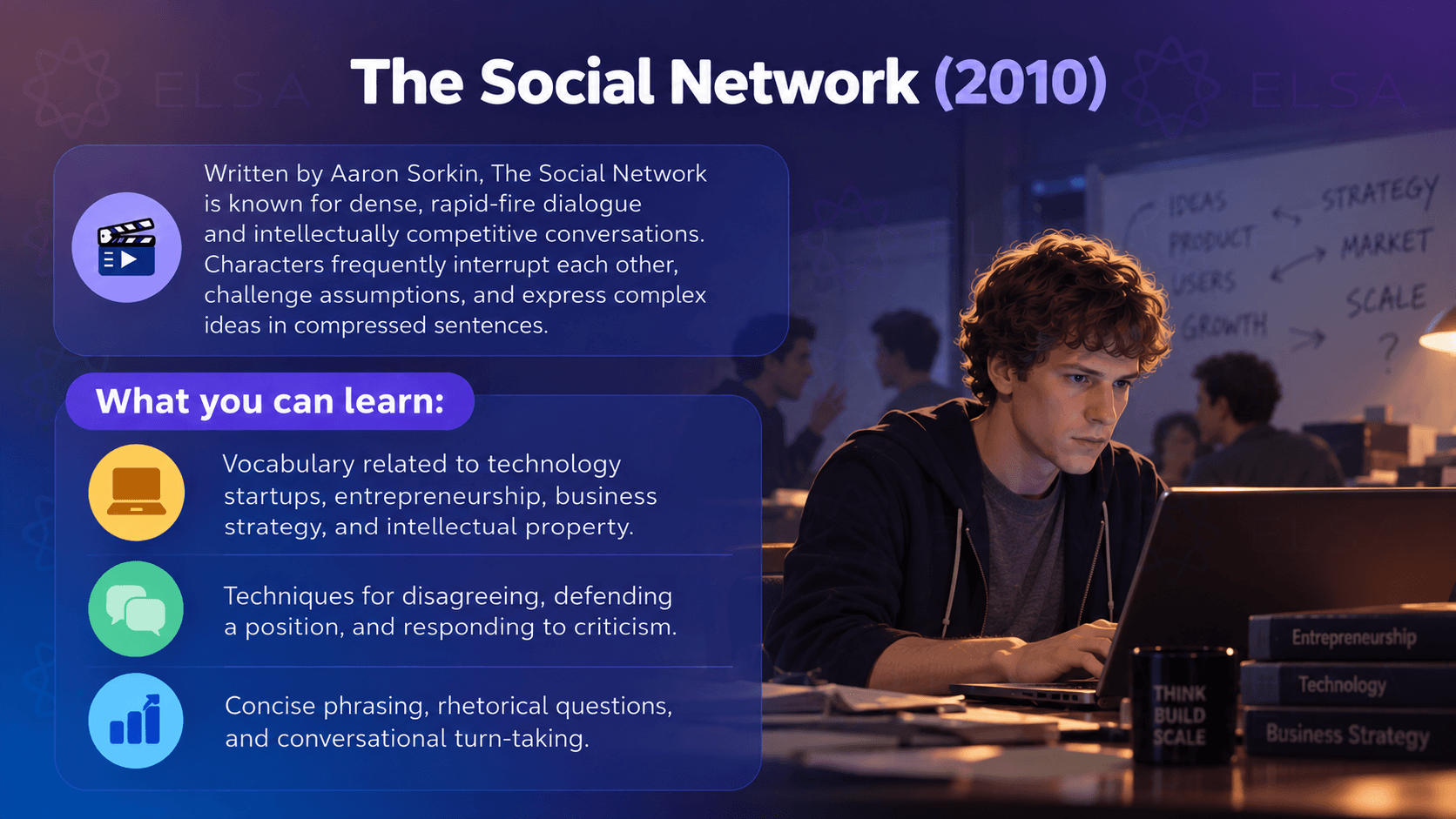
The Social Network (2010): Fast-paced dialogue and technology terminology
Why it's a good choice: Written by Aaron Sorkin, The Social Network is known for dense, rapid-fire dialogue and intellectually competitive conversations. Characters frequently interrupt each other, challenge assumptions, and express complex ideas in compressed sentences.
What you can learn:
- Vocabulary related to technology startups, entrepreneurship, business strategy, and intellectual property.
- Techniques for disagreeing, defending a position, and responding to criticism.
- Concise phrasing, rhetorical questions, and conversational turn-taking.
How to practice: Replay a short exchange between characters in a deposition or meeting. Summarize the argument in your own words, identify the speaker's main claim, and then practice presenting a counterargument.
Oppenheimer (2023): Scientific, political, and academic English
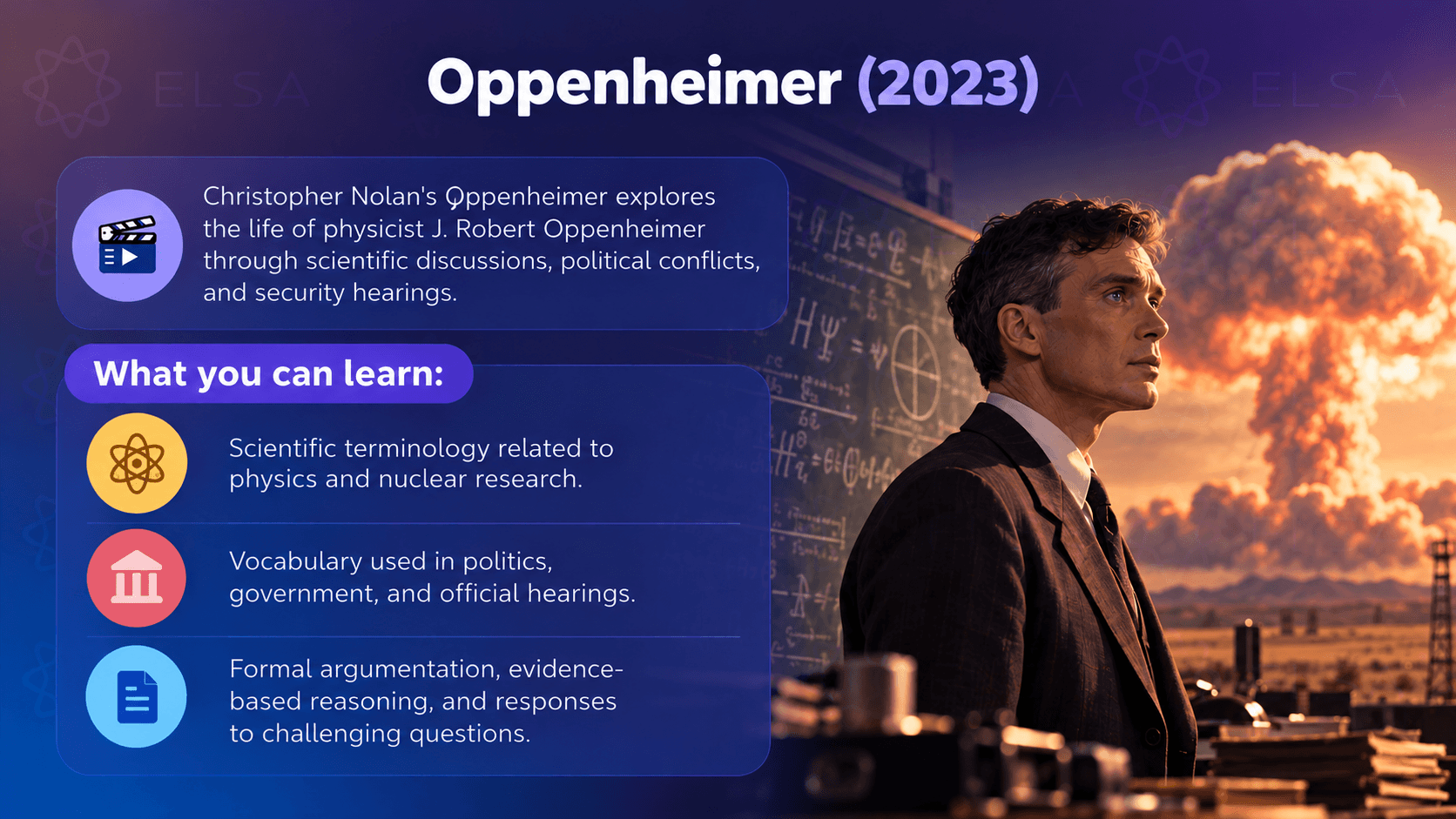
Why it's a good choice: Christopher Nolan's Oppenheimer explores the life of physicist J. Robert Oppenheimer through scientific discussions, political conflicts, and security hearings. The combination of technical and formal language challenges learners to interpret meaning beyond everyday vocabulary.
What you can learn:
- Scientific terminology related to physics and nuclear research.
- Vocabulary used in politics, government, and official hearings.
- Formal argumentation, evidence-based reasoning, and responses to challenging questions.
How to practice: Select a scientific discussion or hearing scene. Write down unfamiliar technical terms, infer their meaning from context, and summarize the central argument in three sentences. Focus on understanding the speaker's reasoning rather than memorizing every specialized term.
The Crown (2016–2023): Formal vocabulary and complex British English
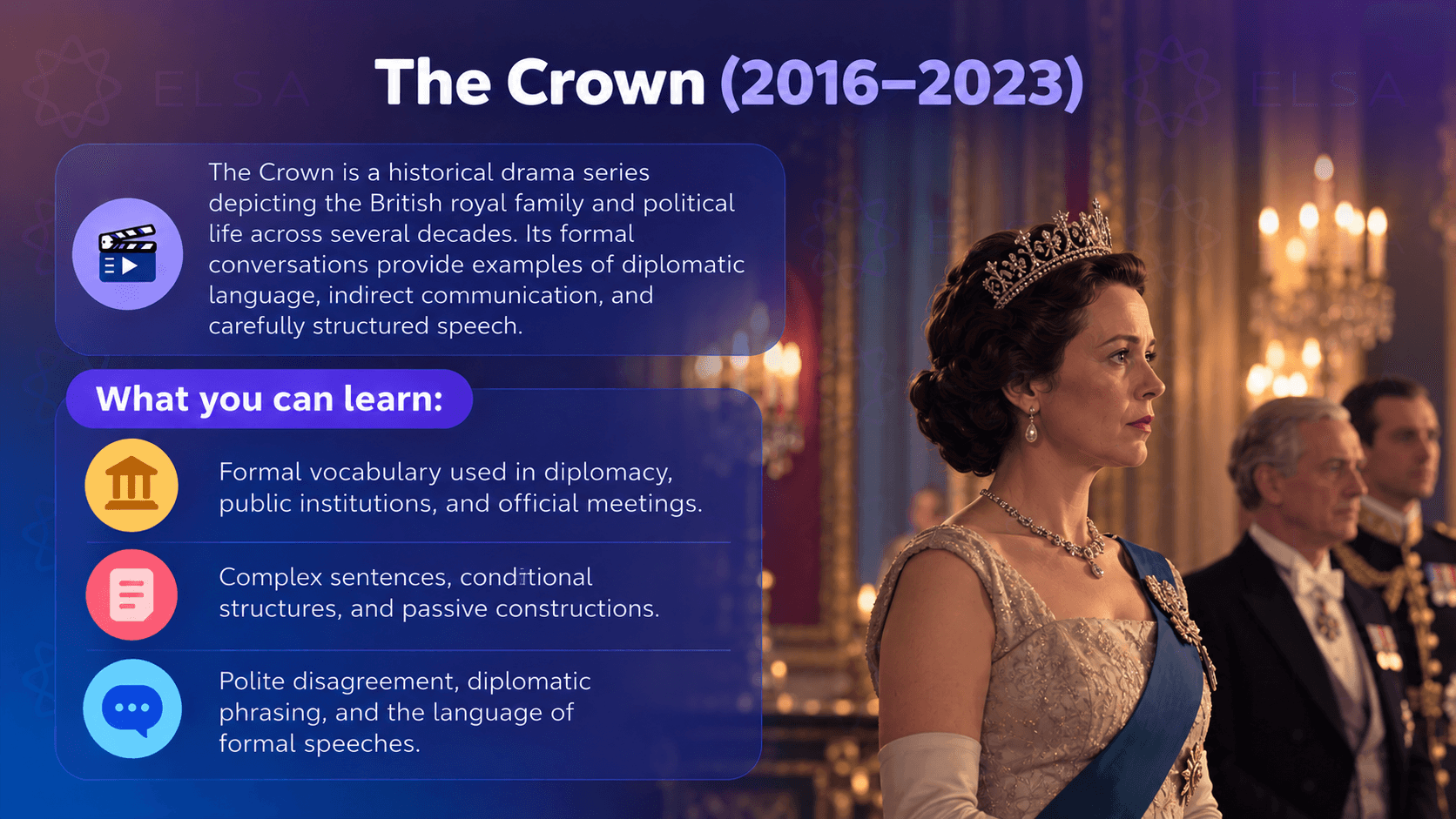
Why it's a good choice: The Crown is a historical drama series depicting the British royal family and political life across several decades. Its formal conversations provide examples of diplomatic language, indirect communication, and carefully structured speech.
What you can learn:
- Formal vocabulary used in diplomacy, public institutions, and official meetings.
- Complex sentences, conditional structures, and passive constructions.
- Polite disagreement, diplomatic phrasing, and the language of formal speeches.
How to practice: Choose a scene involving a formal meeting or public address. Identify the main clause in a complex sentence, rewrite the sentence in simpler English, and then practice delivering the original line with appropriate pauses and emphasis.
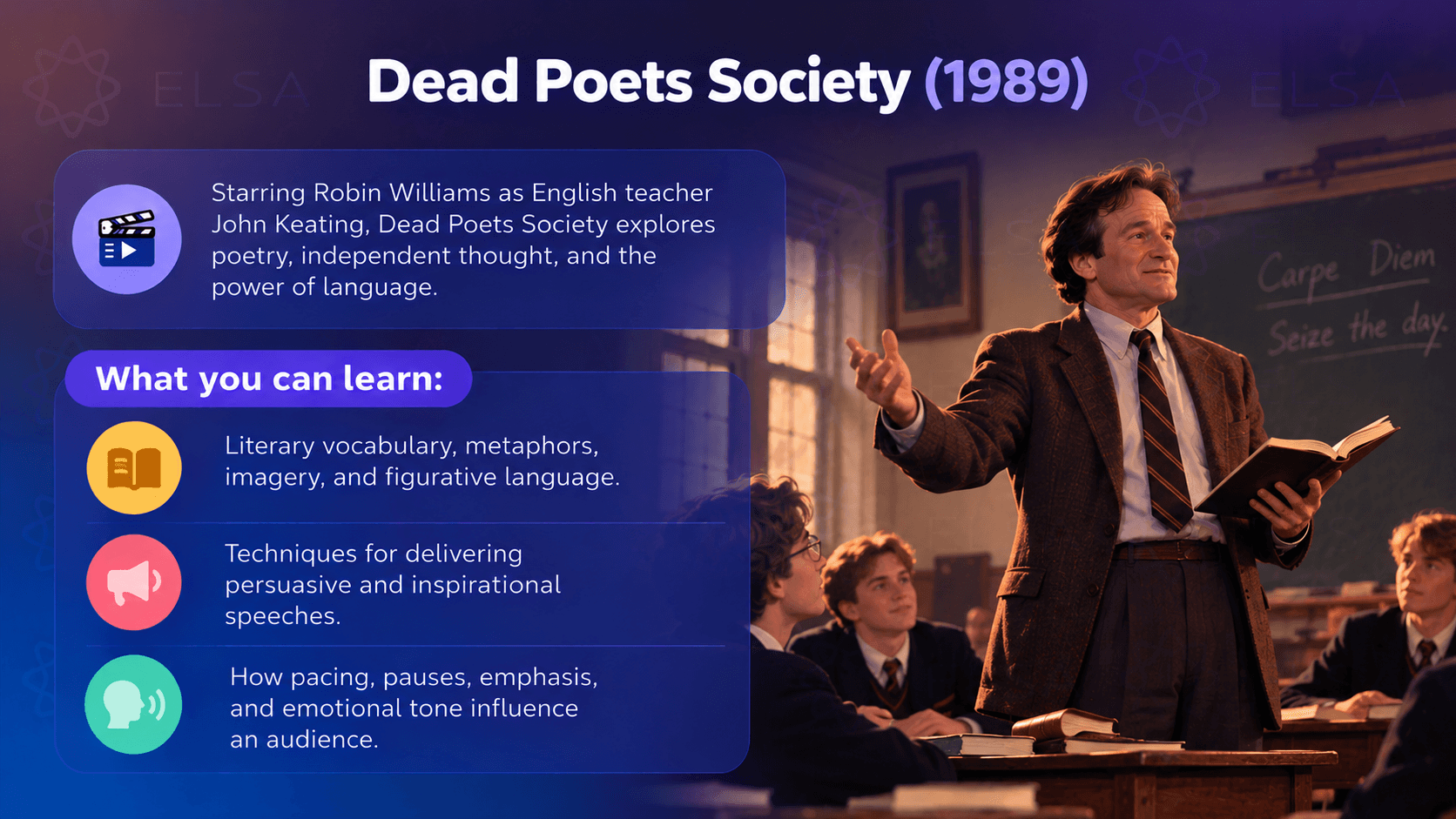
Dead Poets Society (1989): Literary metaphors and inspirational speaking
Why it's a good choice: Starring Robin Williams as English teacher John Keating, Dead Poets Society explores poetry, independent thought, and the power of language. Its literary discussions and speeches provide rich material for advanced learners who want to communicate ideas with greater precision and emotional impact.
What you can learn:
- Literary vocabulary, metaphors, imagery, and figurative language.
- Techniques for delivering persuasive and inspirational speeches.
- How pacing, pauses, emphasis, and emotional tone influence an audience.
How to practice: Watch one of Keating's classroom speeches. Identify the main message and two rhetorical techniques, then deliver a short summary in your own words. Record yourself and compare your pacing, stress, and clarity with the original.
Why learning English with movies actually works
Watching movies can help you develop English skills because it exposes you to language in meaningful situations. When you combine listening with observation and speaking practice, you can learn not only what words mean but also how people use them in real conversations.
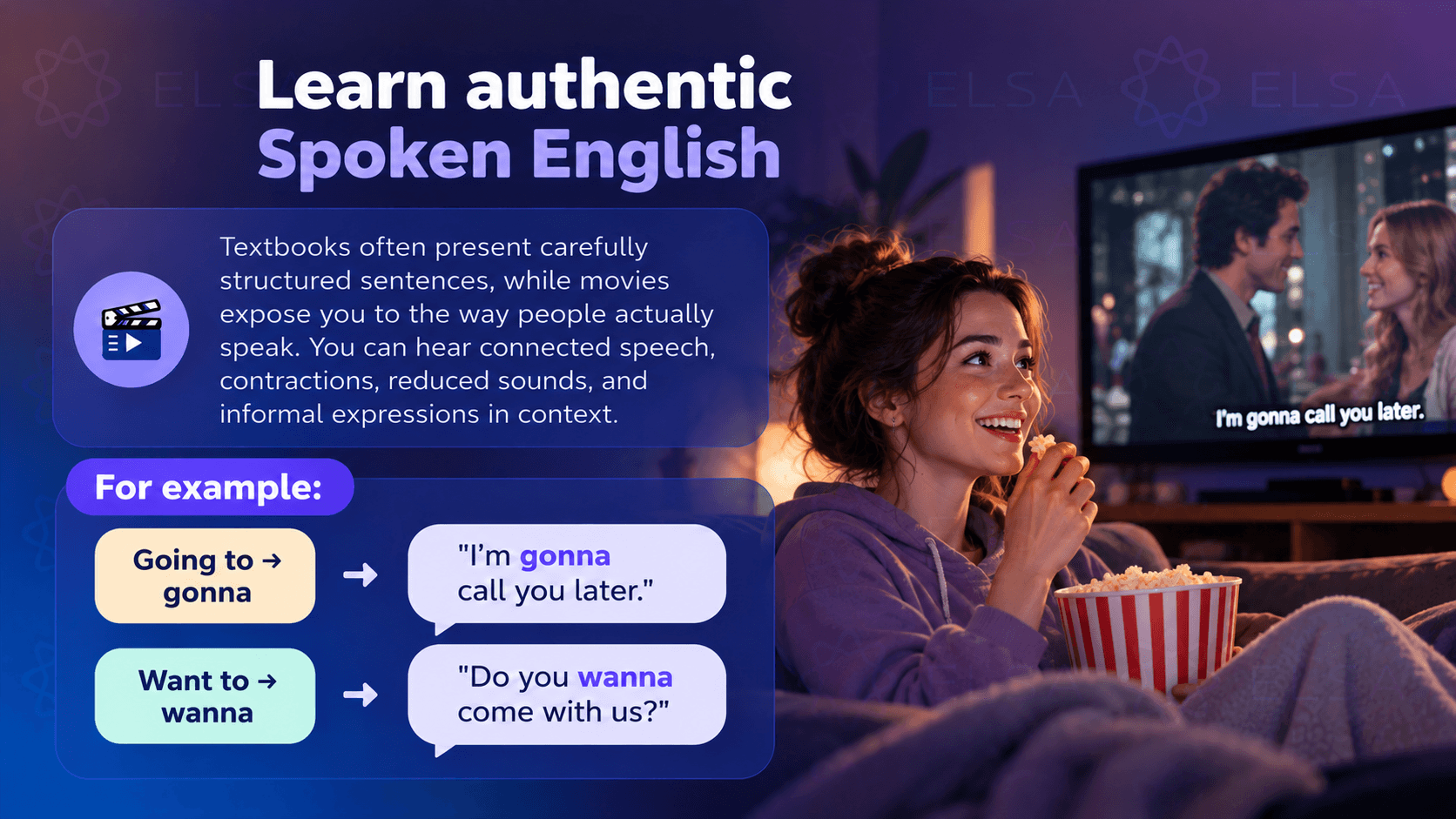
Learn authentic spoken English
Textbooks often present carefully structured sentences, while movies expose you to the way people actually speak. You can hear connected speech, contractions, reduced sounds, and informal expressions in context.
For example:
- Going to → gonna: "I'm gonna call you later."
- Want to → wanna: "Do you wanna come with us?"
These features help explain why understanding spoken English can be harder than reading it. By listening to different speakers and accents, you can gradually become more comfortable with natural speech.
Note: Remember that gonna and wanna are informal spoken forms. In formal writing, use going to and want to instead.
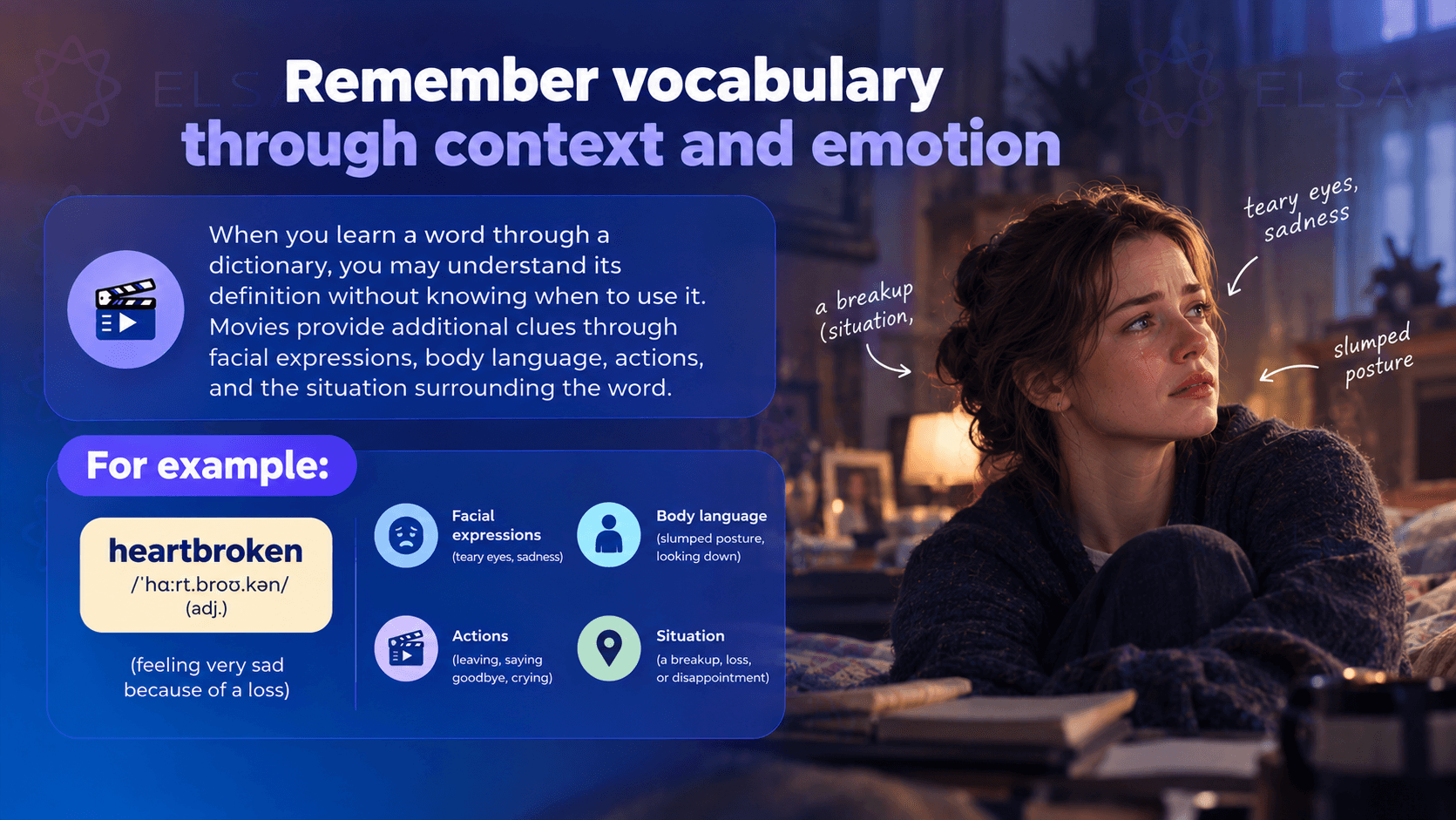
Remember vocabulary through context and emotion
When you learn a word through a dictionary, you may understand its definition without knowing when to use it. Movies provide additional clues through facial expressions, body language, actions, and the situation surrounding the word.
For example, when a character says "I'm relieved" after escaping danger, the scene helps you associate relieved with the feeling of worry disappearing. This combination of language and context can make new vocabulary easier to understand and recall.
To make the most of this benefit, record complete phrases rather than isolated words. Include the situation in which the expression appears and write one original sentence using it.
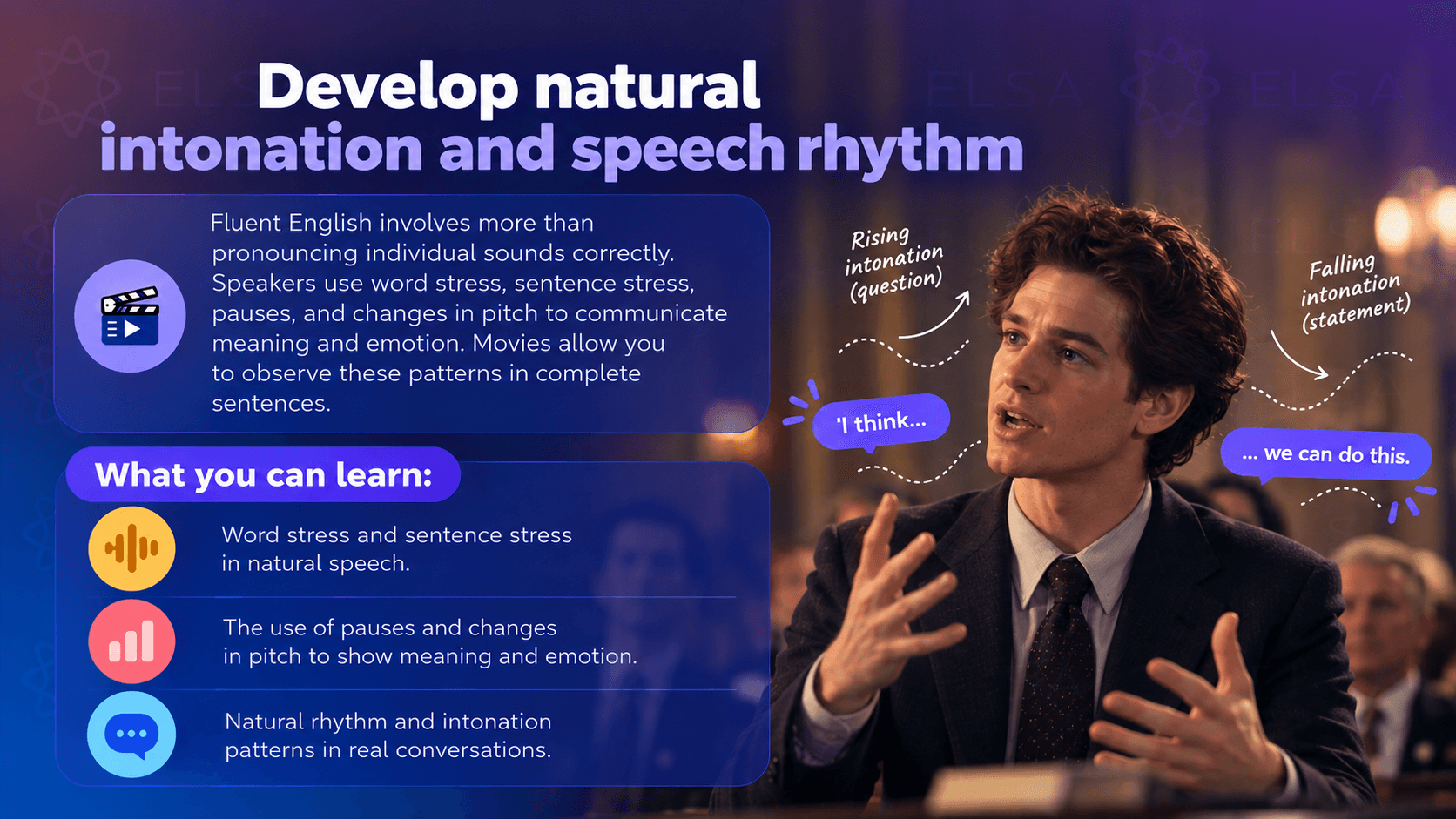
Develop natural intonation and speech rhythm
Fluent English involves more than pronouncing individual sounds correctly. Speakers use word stress, sentence stress, pauses, and changes in pitch to communicate meaning and emotion.
Movies allow you to observe these patterns in complete sentences.
Repeated listening and speaking practice can help you recognize these patterns and reproduce them more naturally. Shadowing is particularly useful because it encourages you to pay attention to pronunciation, rhythm, and emotion simultaneously.
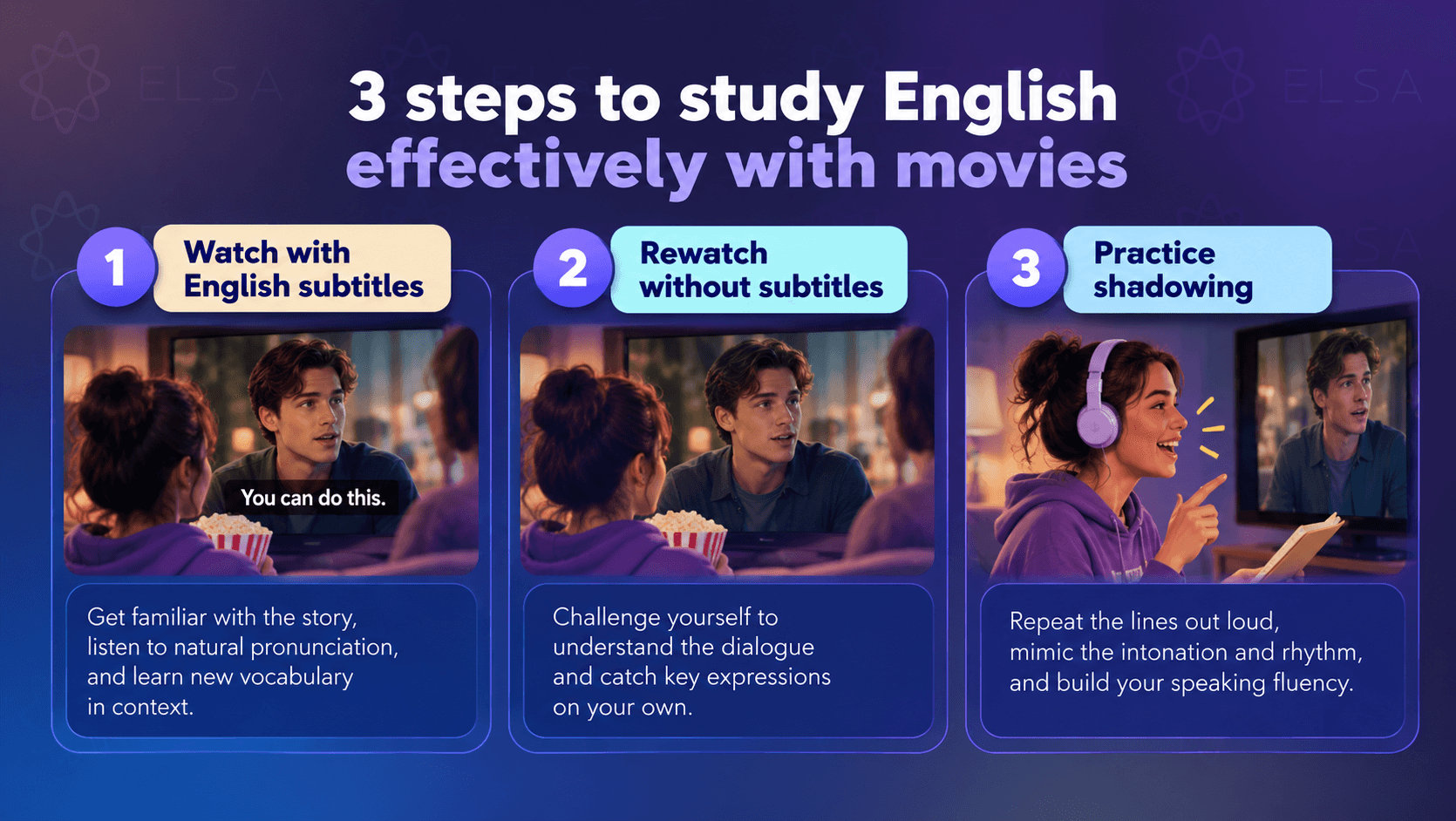
3 steps to study English effectively with movies
Using English movies to learn English speaking effectively requires more than watching and listening. By combining subtitles, repeated listening, and shadowing, you can turn memorable scenes into practical speaking exercises that improve pronunciation, intonation, and conversational fluency.
Step 1: Watch with English subtitles
Start by selecting a scene that lasts approximately two to five minutes. Watch it with English subtitles so you can connect the sounds you hear with the written words.
Follow these steps:
- Watch the scene once to understand the main idea.
- Note three to five useful words, phrases, or idioms.
- Check the meaning of expressions that are important for understanding the conversation.
- Pay attention to how written words sound when spoken naturally.
Avoid collecting too many new expressions at once. Choose phrases you could realistically use in your own conversations.
Step 2: Rewatch without subtitles
Watch the same scene again, this time turning off the subtitles. Focus on the sounds, stress patterns, and meaning rather than trying to translate every sentence.
Ask yourself:
- Can I identify the main idea without reading?
- Can I recognize the expressions I noted earlier?
- Can I understand the speaker's attitude from their tone of voice?
If you miss important information, replay the difficult section and turn the subtitles back on briefly. Then try listening again without them. The goal is to improve your ability to understand spoken English independently, not to achieve perfect comprehension immediately.
Step 3: Practice shadowing
Shadowing is a speaking technique in which you imitate a speaker's words, pronunciation, rhythm, and intonation. It helps connect listening comprehension with active speaking practice.
Use this process:
- Select three to five sentences from the scene.
- Listen to one sentence carefully, paying attention to stressed words and connected sounds.
- Pause the video and repeat the sentence aloud.
- Replay the original and compare your pronunciation, pacing, and intonation.
- Repeat until you can deliver the sentence smoothly without reading the subtitles.
For an additional challenge, record your voice and compare it with the original dialogue. Focus on one or two areas at a time, such as word stress or sentence rhythm, instead of trying to correct everything simultaneously.
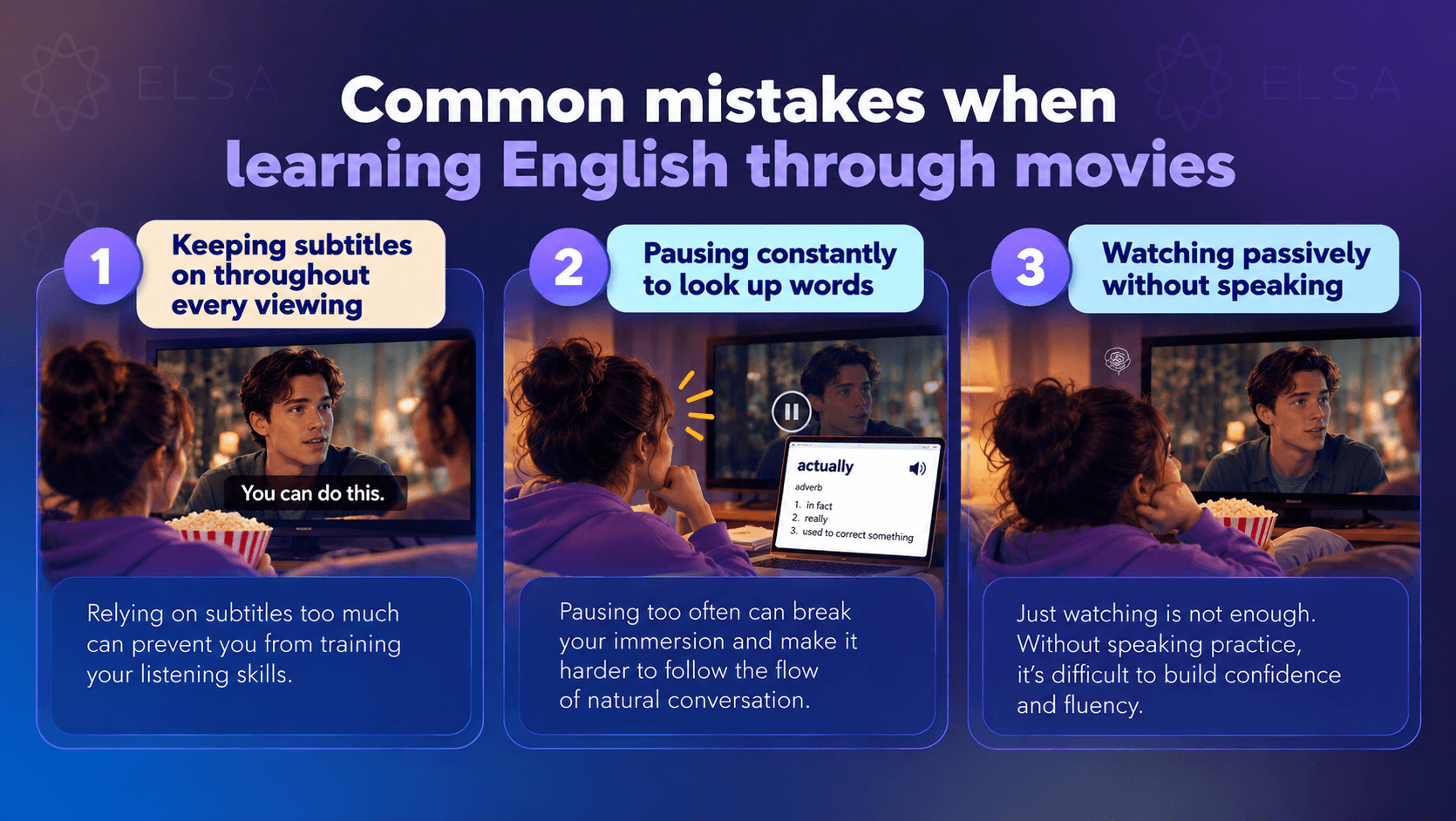
Common mistakes when learning English through movies and how to avoid them
Movies can provide valuable language input, but certain habits may prevent you from making meaningful progress. Avoid these three common mistakes to make your study sessions more effective.
Keeping subtitles on throughout every viewing
Reading subtitles throughout a movie can make it easier to follow the story, but it may also encourage you to rely on your eyes rather than process spoken English.
How to avoid it: Use English subtitles during your first viewing, then turn them off when rewatching selected scenes. If a passage is too difficult, switch the subtitles back on temporarily before trying again.
Pausing constantly to look up words
Looking up every unfamiliar word interrupts the story and makes it difficult to follow the flow of conversation. It can also leave you with a long vocabulary list that you never actually use.
How to avoid it: Focus on five to ten words or expressions per session, prioritizing phrases that appear repeatedly or are essential to understanding the plot. Try to infer other meanings from context and look them up later if necessary.
Watching passively without speaking
Listening alone can improve your familiarity with English, but it does not give you enough practice producing sounds, organizing sentences, or responding in real time.
How to avoid it: Set aside 10–15 minutes after watching to practice shadowing three to five memorable lines. You can also summarize the scene aloud or role-play one character's part.
FAQs about learning English with movies
Which movie is best to improve English for complete beginners?
The best movies to learn English for beginners include Forrest Gump and The Lion King.
- Forrest Gump offers many measured, clearly delivered lines, although its Southern American accent may take some getting used to.
- The Lion King combines expressive voice acting, simple exchanges, and visual context that helps beginners understand unfamiliar words. Start with short scenes and English subtitles before practicing without them.
Should I watch movies with English subtitles or no subtitles at all?
The most effective approach is to combine both. Watch a scene with English subtitles first to connect spoken words with their written forms. Then rewatch important sections without subtitles to test your listening comprehension. If you cannot follow the scene, use the subtitles again to identify what you missed before repeating the exercise.
How many times should you watch a movie scene to learn English effectively?
Watching a short scene two or three times is a useful starting point.
- During the first viewing, use English subtitles to understand the meaning.
- During the second, turn them off and focus on listening.
- During the third, pause after individual lines and practice shadowing.
- Repeat difficult sentences as needed, but prioritize understanding and clear pronunciation over matching every detail of the original performance.
Is watching animated movies better for learning English than live-action films?
Animated movies such as Toy Story and The Lion King are often helpful for beginners because expressive voice acting and visual storytelling make dialogue easier to follow. Live-action films can be more challenging because of overlapping conversations, background noise, and varied speaking styles.
However, neither format is inherently better for every learner. Choose based on your level and gradually introduce more challenging material as your listening skills improve.
Movies are a great way to build listening comprehension and learn natural expressions, but combining them with structured practice can help you develop a more balanced set of English skills. For more guided speaking practice, explore the English Communication Tips category on ELSA Speak blog to practice pronunciation to speak more confidently in everyday and professional situations.