

Future perfect exercises with answers: 15 practice sets (PDF)
elsaspeakadmin
November 16, 2026
Grammar exercises
The future perfect helps you describe what will be complete by a future deadline—whether you are discussing project milestones, delivery dates, or personal goals. These future perfect exercises cover the rules through 150 questions with answers and explanations. Review the formulas, complete the activities, and check your progress below.
Future perfect rules and formulas
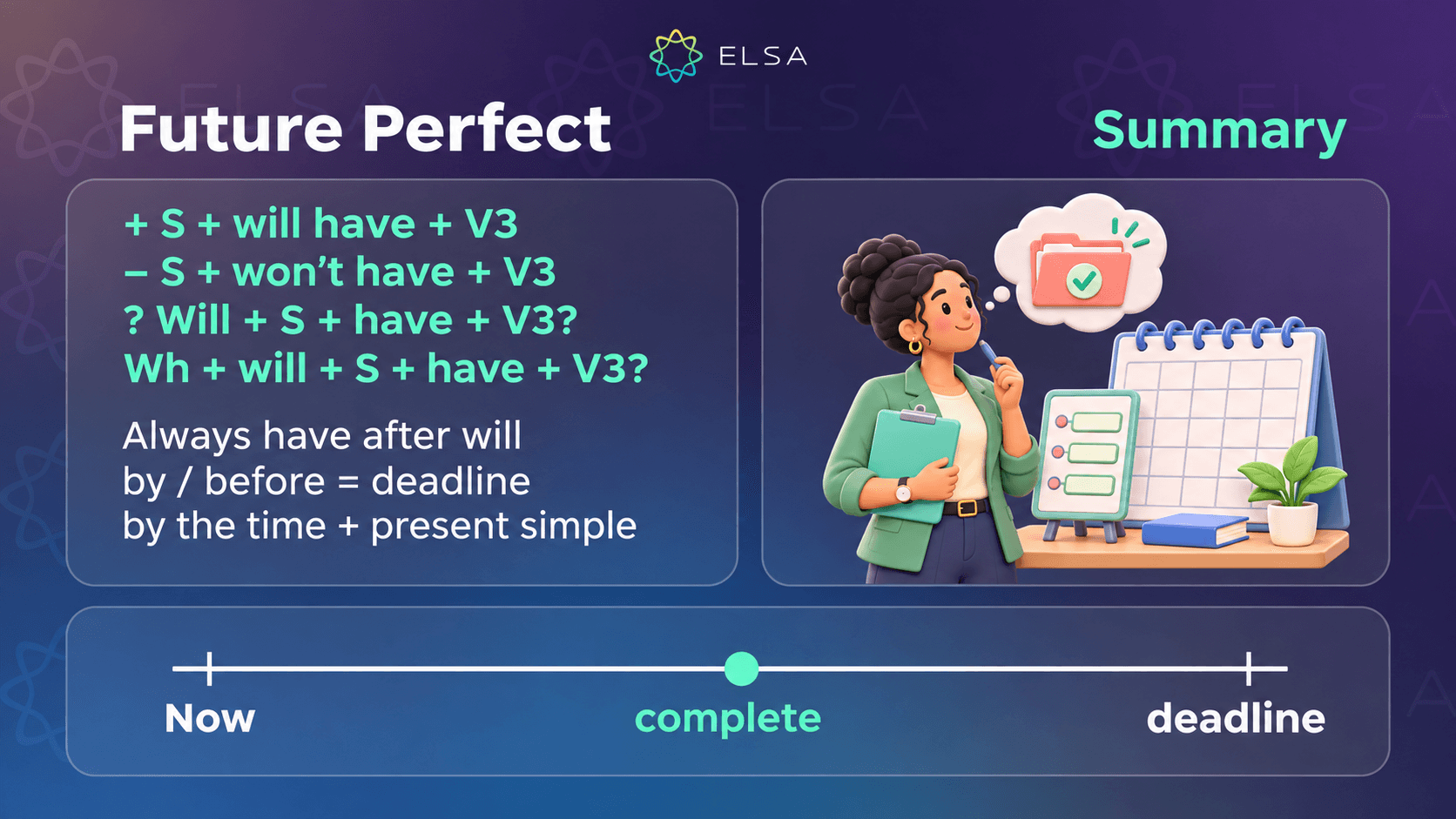
The future perfect describes an action that will be complete by a particular future time or before another future event.
| Form | Structure | Example |
|---|---|---|
| Affirmative (+) | S + will have + past participle | She will have finished by Friday. |
| Negative (−) | S + will not/won’t have + past participle | She won’t have finished by Friday. |
| Yes/No question | Will + S + have + past participle? | Will she have finished by Friday? |
| Wh-question | Wh-word + will + S + have + past participle? | How much will she have completed by Friday? |
Common time expressions:
- by + future time
- by the time + present-simple clause
- before + time/event
- by then / by that time
Basic future perfect exercises (A2–B1)
These introductory future perfect tense exercises focus on affirmative and negative forms, questions, time expressions, and sentence order. Complete each set before checking its answer table. Contractions such as I’ll have and won’t have are acceptable where appropriate.
Exercise 1: Complete sentences with will have and a [ast participle
Instructions: Complete each sentence using the affirmative future perfect form of the verb in parentheses.
- By 6 p.m., the courier ______ (deliver) all the packages.
- I ______ (finish) the application by Friday.
- She ______ (write) three chapters by the end of the month.
- We ______ (save) enough money by next summer.
- By noon, Daniel ______ (send) the invitations.
- The students ______ (complete) the course by June.
- By the time you return, I ______ (clean) the kitchen.
- They ______ (build) the new playground before the school year begins.
- By tomorrow morning, the temperature ______ (fall) below freezing.
- You ______ (read) the entire guide by the end of the week.
Exercise 2: Negative sentences with won’t have + past participle
Instructions: Complete each sentence using the negative future perfect.
- The workers ______ (not / finish) the repairs before Monday.
- I ______ (not / read) the whole book by tomorrow.
- She ______ (not / receive) the package by noon.
- We ______ (not / save) enough money by March.
- They ______ (not / complete) the training before the inspection.
- The paint ______ (not / dry) by the time the guests arrive.
- Ben ______ (not / write) the final chapter by Friday.
- You ______ (not / learn) every term after just one lesson.
- The company ______ (not / hire) a replacement by next week.
- I ______ (not / make) a decision before our next meeting.
Exercise 3: Basic question formation
Instructions: Use the prompts to write complete future perfect questions.
- you / finish the report / by Friday?
- she / graduate / by next summer?
- how many chapters / they / read / by Monday?
- we / receive the tickets / before the trip?
- what / he / complete / by the end of the day?
- the workers / repair the bridge / by December?
- how much money / you / save / by June?
- Emma / send the invitations / before noon?
- which tasks / the team / finish / by tomorrow?
- they / make a decision / by our next meeting?
Exercise 4: Time expressions matching with by and before
Instructions: Match each action with the most logical deadline or later event. Use each letter once.
| Number | Column A: Action | Letter | Column B: Time expression |
|---|---|---|---|
| 1 | The courier will have delivered the office supplies | A | before the concert begins. |
| 2 | The technicians will have completed the stage sound checks | B | by the admissions deadline. |
| 3 | The student will have submitted her college application | C | before the office closes for the day. |
| 4 | The baker will have finished the birthday cake | D | before the pool reopens to swimmers. |
| 5 | The runners will have completed the marathon | E | before the birthday party starts. |
| 6 | Our team will have uploaded the client presentation slides | F | by the monthly payday. |
| 7 | The library will have cataloged the new books | G | before the race route reopens to traffic. |
| 8 | The airline staff will have checked the passengers’ baggage | H | before the client presentation begins. |
| 9 | The maintenance team will have repainted the swimming pool | I | by the launch of the new-books display. |
| 10 | The payroll department will have processed salaries | J | before the passengers board the flight. |
Exercise 5: Sentence rearrangement for beginners
Instructions: Arrange the words into a complete sentence. Begin with the word shown and add punctuation.
- written / Sarah / by Friday / the report / have / will (Sarah)
- have / we / by noon / finished / will / the repairs (We)
- not / arrived / the package / by tomorrow / will / have (The package)
- you / completed / will / by Monday / have / the course (Will)
- saved / he / enough money / will / by June / have (He)
- by then / they / the invitations / sent / have / will (They)
- before the meeting / have / I / checked / will / the figures (I)
- have / she / will / by next month / graduated (She)
- made / we / a decision / have / will not / by Friday (We)
- how many books / read / will / by December / you / have (How many books)
Intermediate future perfect exercises (B1–B2)
These activities contrast completed actions with ongoing activities and future events. You will also practice time clauses, correct errors, and describe milestones.
Exercise 6: Future perfect vs. Future continuous
Instructions: Complete the sentences using the future perfect or future continuous. Choose completion or activity in progress according to the context.
- At 8 p.m., Brad ______ (have) dinner with clients. By 10 p.m., he ______ (finish) the meal.
- At this time tomorrow, we ______ (fly) to Denver. By tomorrow evening, we ______ (arrive).
- Don’t call at nine; I ______ (take) an exam then.
- By nine, I ______ (submit) my answers, so you can call afterward.
- At noon, the technicians ______ (install) the new system; the work will still be in progress.
- By the end of the day, the technicians ______ (install) all the required software.
- At three tomorrow, she ______ (present) the proposal.
- By four tomorrow, she ______ (complete) the presentation.
- This time next week, they ______ (travel) across the state.
- By the end of next week, they ______ (visit) all five regional offices.
Exercise 7: Future perfect vs. Simple future
Instructions: Use the simple future to state a future event and the future perfect to look back at completion from a later point.
- At 10 a.m., we ______ (sign) the agreement. By noon, we ______ (complete) all the paperwork.
- I promise I ______ (call) you tomorrow. By then, I ______ (review) your proposal.
- The workshop ______ (begin) at nine. By lunchtime, participants ______ (complete) the first module.
- We ______ (announce) the results on Friday. By Thursday evening, we ______ (check) every entry.
- The technician ______ (visit) tomorrow. By the end of the visit, she ______ (replace) the faulty part.
- I ______ (send) the draft tonight. By Monday, the editor ______ (read) it.
- The team ______ (launch) the survey next week. By the end of the month, it ______ (collect) 500 responses.
- We ______ (meet) at three. By then, I ______ (prepare) the agenda.
- The company ______ (open) the new branch in June. By July, it ______ (train) all the new employees.
- She ______ (start) her new role on Monday. By Friday, she ______ (complete) the orientation program.
Usage note: Other future forms may be natural in real conversation. This exercise specifically practices the contrast between stating a future event and looking back from a future reference point.
Exercise 8: Complex time clauses with by the time
Instructions: Use the present simple in the by the time clause and the future perfect in the main clause.
- By the time the manager ______ (arrive), we ______ (prepare) the slides.
- By the time you ______ (finish) lunch, I ______ (send) the documents.
- The guests ______ (leave) by the time we ______ (return).
- By the time the store ______ (open), the staff ______ (stock) the shelves.
- By the time she ______ (graduate), she ______ (complete) two internships.
- We ______ (review) the proposal by the time the client ______ (call).By the time the train ______
- (reach) Boston, we ______ (travel) more than 200 miles.
- The technician ______ (repair) the printer by the time the workshop ______ (begin).By the time
- they ______ (move) in, the painters ______ (finish) the bedrooms.
- I ______ (read) the report by the time our discussion ______ (start)
Exercise 9: Error identification in future perfect sentences
Instructions: Each sentence contains one error. Rewrite it correctly.
- She will has finished the report by Friday.
- By the time the train will reach Boston, we will have traveled 200 miles.
- They will have wrote the proposal by tomorrow.
- Will you have complete the course by June?
- We won’t had received the results by Monday.
- He will have took the exam by then.
- By the time she arrive, we will have prepared dinner.
- The package will have arrive before noon.
- How much will she has saved by December?
- I will not have saw the final version before the meeting.
Exercise 10: Transforming sentences with deadlines and milestones
Instructions: Rewrite each prediction using the future perfect and the opening provided. Keep the same deadline or reference point.
- We will finish the renovation by next year.
→ By next year, … - David will complete his thesis by December.
→ By December, … - The team will check every application before Friday.
→ Before Friday, … - I will save $2,000 by the end of June.
→ By the end of June, … - The painters will finish the living room before sunset.
→ Before sunset, … - She will read all six chapters by Monday.
→ By Monday, … - We will deliver all the orders by the end of the month.
→ By the end of the month, … - They will repair the elevator before the building reopens.
→ Before the building reopens, … - The students will submit their projects by tomorrow afternoon.
→ By tomorrow afternoon, … - I will organize the files by our next meeting.
→ By our next meeting, …
Advanced future perfect exercises (B2–C1)
These advanced future perfect tense exercises with answers cover passive voice, duration, present deductions, business milestones, and academic paraphrasing. Model answers are provided for rewriting tasks. Other wordings may be acceptable if they preserve the intended meaning and required structure.
Exercise 11: Passive Voice in the Future Perfect
Instructions: Rewrite each active sentence in the passive voice. Keep the agent.
- The council will have completed the new station by 2030.
- The editor will have reviewed the manuscript by Friday.
- The technicians will have installed the equipment before the launch.
- The committee will have evaluated all applications by June.
- The company will have trained the new employees by next month.
- The research team will have analyzed the samples before the conference.
- The courier will have delivered the documents by noon.
- The facilities team will have repaired the roof before winter.
- The auditors will have checked the records by the end of the week.
- The designer will have updated the website before the campaign begins.
Note: If the agent is unimportant, omitting it often makes the sentence smoother.
Exercise 12: Future perfect vs. Future perfect continuous
Instructions: Complete each sentence. Use the future perfect for completed quantities or states, and the future perfect continuous where the prompt emphasizes an ongoing activity’s duration.
- By Friday, I ______ (write) all five sections of the report. (Completed result)
- By noon, we ______ (wait) for two hours, and we will still be in line. (Ongoing duration)
- By the end of the month, she ______ (interview) 20 candidates. (Completed quantity)
- By next July, Dr. Adams ______ (work) at the university for 20 years. (Emphasize ongoing duration)
- By six, the team ______ (process) all 300 applications. (Completed result)
- By the time the break begins, they ______ (practice) continuously for three hours. (Ongoing duration)
- By December, I ______ (read) 12 novels this year. (Completed quantity)
- At five, she will still be painting. By then, she ______ (paint) for six hours. (Ongoing duration)
- By the end of the course, you ______ (complete) eight projects. (Completed quantity)
- By next summer, we ______ (know) each other for ten years. (State)
Important: A duration phrase does not automatically require the continuous. For example, will have worked can also describe a period of employment. This exercise requests the continuous where ongoing duration is the intended focus.
Exercise 13: Future perfect for present deduction and certainty
Instructions: Use will have + past participle to express a confident assumption about something already completed by now.
- The flight was scheduled to land two hours ago. It ______ (land) by now.
- The courier left this morning. She ______ (deliver) the package by now.
- The workshop ended at noon. The participants ______ (leave) by now.
- Maya usually checks her email first thing. She ______ (read) your message by now.
- The upload normally takes five minutes, and it started half an hour ago. It ______ (finish) by now.
- The store closed an hour ago. The staff ______ (lock) the doors by now.
- The team began the short briefing at nine. They ______ (complete) it by now.
- You sent the form yesterday, and confirmations are normally immediate. You ______ (receive) a confirmation by now.
- Ben’s train arrived at six, and the station is nearby. He ______ (reach) home by now.
- The editor promised a quick response this morning. She ______ (send) her comments by now.
Exercise 14: Corporate milestones and project deadlines
Instructions: Complete each sentence using the future perfect. Treat the statements as forecasts or expectations, rather than guarantees.
- According to the current forecast, the company ______ (generate) $2 million in sales by the end of the quarter.
- By the annual review, the operations team ______ (reduce) average processing time by 15%.
- We expect that the supplier ______ (deliver) all 500 units by September 30.
- By the next board meeting, the finance department ______ (prepare) the revised budget.
- According to the rollout plan, the IT team ______ (migrate) all user accounts by Friday.
- By the end of the pilot, we ______ (collect) feedback from 100 customers.
- The current schedule indicates that the contractor ______ (complete) phase one before the inspection.
- By the product launch, the marketing team ______ (finalize) the campaign materials.
- At the present rate, the support team ______ (resolve) the remaining cases by tomorrow evening.
- By the end of the fiscal year, the company ______ (open) three regional offices.
Exercise 15: Sentence synthesis and academic paraphrasing
Instructions: Rewrite each sentence using the capitalized word or phrase. Preserve the deadline and any expression of expectation.
- We expect the researchers to complete the analysis by Friday. (WILL HAVE)
- The team will finish all the experiments before the conference. (HAVE)
- We expect the auditors to inspect every record by Monday. (Use the passive.) (BEEN)
- The report will not be ready by tomorrow. (COMPLETED)
- Will the editor finish reviewing the manuscript before noon? (HAVE)
- The project will reach its final milestone by December. (REACHED)
- We expect the company to train all employees before the new system launches. (Use the passive.) (BEEN)
- The team will collect 1,000 responses by the end of the study. (COLLECTED)
- I will finish reading the article before our discussion begins. (READ)
- We expect the department to publish three reports by the end of the year. (WILL HAVE)
Tips for solving future perfect exercises and common pitfalls
Before choosing an answer, identify the future reference point and ask whether the sentence emphasizes completion, ongoing activity, or a future event.
- Look for by and before: When you see expressions such as by tomorrow, by the end of this month, by 2030, or before + a future time, check whether will have + past participle (V3/-ed) fits the meaning of completion before that point.
- Use the present simple after by the time: In future-time clauses introduced by by the time, normally use the present simple, rather than will (By the time you arrive, we will have finished).
- Remember “Always have, never has”: In the future perfect, use will have with every subject, including he, she, it, and singular nouns. Never use will has (She will have finished, not She will has finished).
| Common pitfall | Incorrected | Corrected | Rule / Fix |
|---|---|---|---|
| Using will has with a singular subject | She will has finished by Friday. | She will have finished by Friday. | Use base-form have after will. |
| Using predictive will inside a future-time clause | By the time he will arrive, we will have finished. | By the time he arrives, we will have finished. | Use present simple in this future-time clause. |
| Using an ongoing form for an intended completed result | By noon, I will be writing all three reports. (Intended meaning: all three will be complete.) | By noon, I will have written all three reports. | Use future perfect to express the intended completed result. |
| Using simple past instead of a participle | They will have wrote the proposal. | They will have written the proposal. | Have requires the past participle written. |
Regular practice with future perfect exercises helps you describe deadlines, milestones, and expected results more clearly. Review the explanations, revisit the questions you missed, and practice saying your own examples aloud with ELSA Speak. Explore the Grammar category on our blog for more grammar guides and practice activities.