

150+ first conditional exercises with detailed answers (PDF free)
elsaspeakadmin
November 16, 2026
Grammar exercises
The first conditional helps you communicate everyday situations, from discussing future plans, predicting weather, making promises, to giving warnings. If you’re still struggling with how to use this tense, these first conditional exercises will take you from basic to advanced exercises, with answers and detailed explanations.
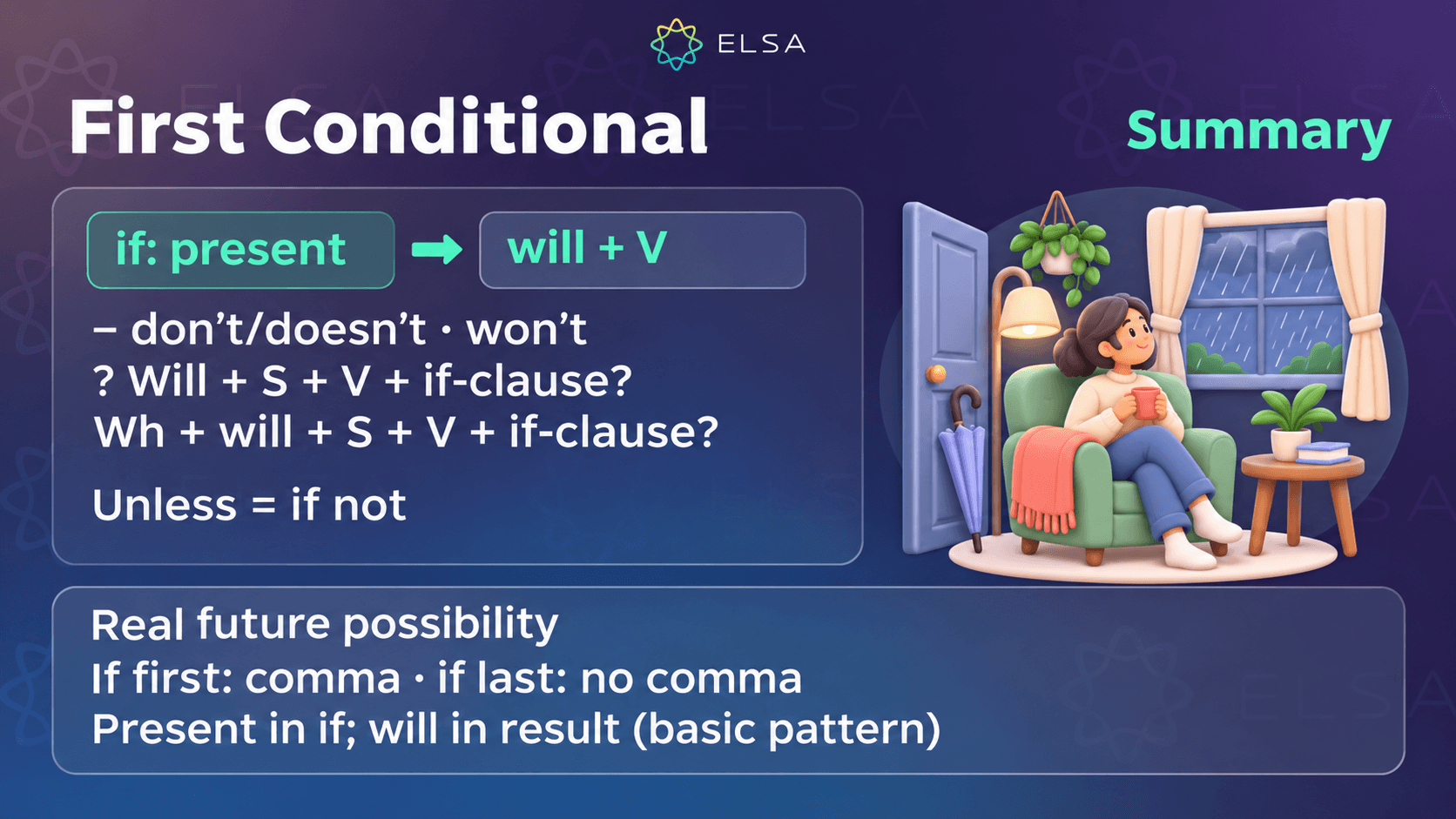
First conditional grammar summary: rules and formulas
The first conditional describes a real or possible future situation and its expected result. The condition does not have to be certain: the speaker presents it as a realistic possibility.
The basic formula is:
| If + subject + present simple, subject + will + base verb. |
Word order and punctuation
- When the if-clause comes first, place a comma between the clauses:
- When the result clause comes first, a comma is usually unnecessary:
- In straightforward negative conditions, unless can replace if … not:
- Do NOT use will in the if- clause, use the simple present tense instead.
| Form | Structure | Example |
|---|---|---|
| Affirmative (+) | If + S + present simple, subject + will + V | If she studies tonight, she will feel more prepared. |
| Negative (−) | If + S + don’t/doesn’t + V, S + won’t + V. | If she doesn't study tonight, she won't feel more prepared. |
| Yes/No question | Will + S + V + if + S + present simple? | Will she feel more prepared if she studies tonight? |
| Wh-question | Wh-word + will + S + V + if + S + present simple? | How will she feel if she studies tonight? |
Basic first conditional exercises (A1–A2)
These basic first conditional exercises focus on the present simple verb forms, using will/won’t, transforming and matching exercises, and word order. In this section, contractions such as I’ll, we’ll and won’t are acceptable equivalents of the full forms.
Exercise 1: Complete sentences with If + Present simple and Will + Verb
Instructions: Complete each sentence with the correct forms of the verbs in parentheses.
- If I ______ (finish) my homework early, I ______ (watch) a movie.
- If it ______ (rain) tomorrow, we ______ (stay) home.
- If Maya ______ (study) tonight, she ______ (feel) ready for the quiz.
- If you ______ (leave) now, you ______ (catch) the bus.
- If my brother ______ (call), I ______ (tell) him the news.
- If we ______ (save) enough money, we ______ (buy) a new laptop.
- If the store ______ (be) open, I ______ (get) some milk.
- If they ______ (invite) us, we ______ (go) to the party.
- If Leo ______ (take) this road, he ______ (reach) the airport faster.
- If you ______ (practice) every day this month, your English ______ (improve).
Exercise 2: Negative sentences with Won’t and Don’t/Doesn’t
Instructions: Complete the sentences. Use negative forms where not appears.
- If we ______ (not / hurry), we ______ (miss) the train.
- If she ______ (not / charge) her phone, it ______ (not / last) all day.
- If you ______ (not / ask), you ______ (not / know) the answer.
- If it ______ (rain), we ______ (not / eat) outside.
- If Tom ______ (not / set) an alarm, he ______ (not / wake up) on time.
- If I ______ (not / feel) better tomorrow, I ______ (stay) home.
- If they ______ (not / bring) their tickets, they ______ (not / get) in.
- If the café ______ (not / open) by eight, we ______ (go) somewhere else.
- If you ______ (send) the message now, I ______ (not / forget) the meeting.
- If we ______ (not / leave) soon, we ______ (not / arrive) before dark.
Exercise 3: Basic question formation: Yes/No and Wh-questions
Instructions: Use the prompts to write complete first conditional questions.
- you / help me / if / you / finish early?
- what / you / do / if / you / miss the bus?
- she / join us / if / we / invite her?
- where / they / stay / if / the hotel / be full?
- we / need a taxi / if / it / rain?
- who / you / call / if / your car / break down?
- Ben / be upset / if / we / cancel the trip?
- how / you / get home / if / the buses / stop running?
- they / wait / if / I / be late?
- what time / we / leave / if / the meeting / end at four?
Exercise 4: Matching If-clauses with logical result clauses
Instructions: Match each condition in column A with the most logical result in column B.
| Number | Column A: Condition | Letter | Column B: Result |
|---|---|---|---|
| 1 | If it rains during our picnic, | A | I will lend you mine. |
| 2 | If you forget your pen, | B | we will take the stairs. |
| 3 | If we miss the last bus, | C | the chef will make a fresh batch. |
| 4 | If Nina passes her driving test, | D | we will move indoors. |
| 5 | If the elevator is out of order, | E | we will call a taxi. |
| 6 | If the soup is too salty, | F | her parents will let her use their car. |
| 7 | If you send me the address, | G | I will put it in the correct mailbox. |
| 8 | If the library closes early, | H | I will find your house more easily. |
| 9 | If I receive your package by mistake, | I | we will study at my apartment. |
| 10 | If the team wins the final, | J | the fans will celebrate downtown. |
Exercise 5: Sentence rearrangement for beginners
Instructions: Put the words in order. Add capitalization and punctuation. Begin with if.
- if / it / is / sunny / tomorrow / we / will / visit / the / park
- if / you / call / me / I / will / answer
- if / Emma / finishes / early / she / will / cook / dinner
- if / we / do / not / hurry / we / will / miss / the / bus
- if / they / arrive / tonight / we / will / meet / them
- if / the / store / is / closed / I / will / come / back / tomorrow
- if / he / studies / hard / he / will / pass / the / exam
- if / you / are / tired / we / will / take / a / break
- if / my / phone / rings / I / will / step / outside
- if / she / does / not / bring / a / jacket / she / will / feel / cold
Intermediate first conditional exercises (B1–B2)
These intermediate activities develop your ability to choose conditional forms based on meaning. You will complete zero and first conditional exercises, practice modal verbs, rewrite sentences with unless, and work with related future-time expressions.
Exercise 6: Zero and first conditional differentiation
Instructions: Complete each sentence using the present simple or will + base verb. Decide whether it describes a general truth, a repeated routine, or a specific future possibility.
- If you heat ice, it ______ (melt).
- If the weather is nice this Saturday, we ______ (have) a picnic.
- If I drink coffee late at night, I usually ______ (sleep) badly.
- If I drink coffee after dinner tonight, I probably ______ (stay) awake.
- If you multiply any number by zero, the result ______ (be) zero.
- If Ava gets the job next week, she ______ (move) to Denver.
- If our printer runs out of paper, it always ______ (stop) printing.
- If the printer runs out of paper during tomorrow’s workshop, I ______ (refill) it.
- If customers enter the wrong password three times, the system automatically ______ (lock) their accounts.
- If you enter the wrong password again now, the system ______ (lock) your account.
Remember: The same situation can be presented as a general rule or as a prediction about one particular event. Read the whole sentence before choosing the verb form.
Exercise 7: Modal verbs in the result clause
Instructions: Complete each result clause using the modal and verb in parentheses. Notice how the modal changes the meaning.
- If you finish your assignment early, you ______ (can / join) us for dinner.
- If the client approves the design, we ______ (may / begin) production next week.
- If traffic gets worse, we ______ (might / arrive) late.
- If you receive a suspicious email, you ______ (should / report) it to IT.
- If visitors enter the laboratory, they ______ (must / wear) safety glasses.
- If the library is closed, you ______ (can / use) the online database.
- If the results are inconclusive, the researchers ______ (may / repeat) the experiment.
- If you leave now, you ______ (might / catch) the earlier train.
- If you want clearer feedback, you ______ (should / ask) a specific question.
- If employees work remotely, they ______ (must / follow) the company’s security policy.
Exercise 8: Sentence rewriting using unless
Instructions: Rewrite each sentence using the word in parentheses. Keep the original meaning.
- If you don’t leave now, you will miss the bus. (UNLESS)
- We won’t start dinner if Dad doesn’t get home before seven. (UNLESS)
- If she doesn’t save the file, she will lose her changes. (UNLESS)
- You won’t receive a confirmation email if you don’t enter a valid address. (UNLESS)
- If the weather doesn’t improve, we will cancel the hike. (UNLESS)
- Unless you wear your badge, security won’t let you in. (IF)
- I won’t buy the laptop unless the price drops. (IF)
- Unless Mia apologizes, Jordan won’t speak to her. (IF)
- The plants will die unless someone waters them. (IF)
- We won’t meet the deadline unless everyone helps. (IF)
Exercise 9: Future time clauses with when, as soon as, and in case
Instructions: Complete each sentence with if, when, as soon as, or in case. Use the meaning clue to choose the best answer.
- We haven’t decided whether to invite Taylor. ______ we invite her, I’ll send her the address. (Uncertain condition)
- The workshop is confirmed for Monday. ______ it begins, the instructor will introduce the schedule. (Expected event; no emphasis on immediacy)
- I’ll call you ______ I land—before I even leave the plane. (Immediately afterward)
- Save an offline copy ______ the internet stops working. (Precaution)
- ______ you decide to join us, let me know by Friday. (Uncertain decision)
- We’ll release the results ______ the review is complete, without any delay. (Immediately afterward)
- Bring a sweater ______ the meeting room is cold. (Precaution)
- ______ the semester ends, the school will hold its scheduled closing ceremony. (Expected event; no emphasis on immediacy)
- ______ the store has the shoes in my size, I’ll buy them. (Uncertain availability)
- Keep the receipt ______ you need to return the headphones. (Precaution)
Exercise 10: Error identification in intermediate conditionals
Instructions: Each sentence contains one grammatical error. Rewrite the sentence correctly.
- If it will rain tomorrow, we will postpone the picnic.
- If she finish early, she will join us.
- If you don’t hurry, you will missed the bus.
- Unless you don’t submit the form, your application will be rejected. (Intended meaning: submit it to avoid rejection.)
- Will you helps me if I ask?
- If he doesn’t brings his ID, security won’t let him in.
- We will go hiking if the weather are nice.
- If I see Maya, I tell her about tomorrow’s meeting. (Use a first conditional prediction.)
- What you will do if the store is closed?
- If they arrive late, we won’t waits for them.
Advanced first conditional exercises (B2–C1)
These advanced exercises focus on formal inversion, conditional instructions, changes in hypothetical meaning, business conditions, and sentence synthesis. Pay attention to the speaker’s intended meaning as well as the verb forms. More than one wording may be possible in rewriting tasks; the tables provide model answers.
Exercise 11: Formal inversion with should
Instructions: Rewrite each sentence beginning with Should. Omit if and preserve the main message.
- If you need assistance, please contact reception.
- If the client requests changes, we will revise the proposal.
- If any problems arise, notify the project manager.
- If you wish to cancel your reservation, please email us.
- If the shipment arrives early, we will update the schedule.
- If an applicant require a visa, the coordinator will provide guidance. (Correct the verb agreement as you rewrite.)
- If the system fails, the backup server will take over.
- If you have any questions, please reply to this email.
- If the supplier does not meet the deadline, we will contact an alternative vendor.
- If the payment is delayed, we will send a reminder.
Exercise 12: Imperative sentences in the result clause
Instructions: Combine each pair into one conditional sentence beginning with if. Use a positive or negative imperative sentence in the result clause.
- You may have questions. In that case, email the instructor.
- The document may contain errors. In that case, correct them before submission.
- Your password may expire. In that case, reset it through the official portal.
- You may finish early. In that case, check your answers.
- The printer may jam. In that case, follow the instructions on its display.
- You may need to reschedule. In that case, contact us at least 24 hours in advance.
- The link may look suspicious. In that case, do not click it.
- Someone may request your account password. In that case, do not share it.
- The file may be too large. In that case, compress it before uploading.
- You may notice a billing error. In that case, send us the invoice number.
Exercise 13: First vs. second conditional probability shifts
Instructions: Rewrite each sentence according to the prompt.
- Realistic future possibility → hypothetical: use if + past simple, would + base verb.
- Hypothetical → realistic future possibility: use if + present simple, will + base verb.
The change reflects how the speaker presents the situation, rather than a fixed numerical probability.
- If we save enough money, we will travel to Hawaii this summer. (Make it hypothetical.)
- If she gets the promotion, she will manage the new team. (Make it hypothetical.)
- If I find a larger apartment, I will adopt a dog. (Make it hypothetical.)
- If the company opens a Seattle office, we will apply for transfers. (Make it hypothetical.)
- If he has more free time next month, he will join the course. (Make it hypothetical.)
- If we had enough funding, we would launch the project. (Present funding as a realistic future possibility.)
- If Elena received an offer, she would move to Chicago. (Present the offer as a realistic future possibility.)
- If the weather improved, we would hold the event outside. (Present improvement as a realistic future possibility.)
- If I were available on Friday, I would attend the workshop. (Present availability as a realistic future possibility.)
- If they reduced the price, we would place an order. (Present the reduction as a realistic future possibility.)
Exercise 14: Business negotiations and workplace conditionals
Instructions: Complete each sentence using the present simple in the condition and will + base verb in the result. Provided that, on condition that, and as long as introduce requirements or conditions in these sentences.
- The vendor ______ (deliver) the hardware by Friday provided that we ______ (approve) the order today.
- We ______ (extend) the agreement as long as the supplier ______ (maintain) the current rates.
- The client ______ (sign) the contract on condition that we ______ (include) technical support.
- Provided that the finance team ______ (release) the funds, we ______ (begin) recruitment next week.
- We ______ (offer) a discount as long as you ______ (place) an order for at least 100 units.
- The manager ______ (approve) remote work on condition that each employee ______ (attend) the weekly team meeting.
- As long as the prototype ______ (meet) the specifications, we ______ (authorize) production.
- The company ______ (reimburse) the expense provided that the employee ______ (submit) a valid receipt.
- Provided that both parties ______ (agree) to the revised terms, the partnership ______ (continue).
- We ______ (reserve) the conference room on condition that your team ______ (confirm) the head count by noon.
Exercise 15: Sentence synthesis and academic paraphrasing
Instructions: Rewrite each sentence using the capitalized word or phrase. Preserve the original meaning as closely as possible.
- If you do not submit the report by Friday, you will receive a reminder. (UNLESS)
- We will publish the findings if the review committee approves them. (PROVIDED THAT)
- If you need additional documentation, please contact the coordinator. (SHOULD)
- We will retain the current schedule if all departments agree. (AS LONG AS)
- If the application is incomplete, return it to the applicant. (SHOULD)
- Immediately after we receive written approval, we will release the funds. (AS SOON AS)
- Keep a backup copy because the original file might become corrupted. (IN CASE)
- We will renew the license only if the provider includes technical support. (ON CONDITION THAT)
- If the data does not meet the inclusion criteria, we will exclude it from the analysis. (UNLESS)
- If any participant wishes to withdraw, they should notify the research team. (SHOULD)
Tips for solving first conditional exercises and common pitfalls
- The “no will in the if-clause” rule: In standard first conditional sentences, use the present simple in the if-clause, rather than will or won’t.
- Check third-person singular agreement in the if-clause: In the present simple, verbs following he, she, or it usually take -s or -es (If he finishes…, not If he finish…).
- Use an affirmative clause after unless: Unless means “if…not,” so an additional negative is usually unnecessary (Unless you study…, not Unless you don’t study… when you mean “If you don’t study…”).
| Common pitfall | Incorrect | Corrected | Rule / Fix |
|---|---|---|---|
| Using will for an ordinary future condition | If it will rain tomorrow, we will stay home. | If it rains tomorrow, we will stay home. | Use present simple in the condition. |
| Keeping the negative when changing if … not to unless | Unless you don’t study, you will fail. (Intended meaning: studying is necessary to avoid failure.) | Unless you study, you will fail. | Remove don’t when replacing if you don’t study with unless you study. |
| Forgetting third-person singular agreement | If he finish early, he will call. | If he finishes early, he will call. | Add -s/-es to affirmative present-simple verbs with singular subjects. |
| Using if when the intended meaning is an expected event | If the scheduled session begins, I will introduce the speaker. (Intended meaning: the session is expected to begin.) | When the scheduled session begins, I will introduce the speaker. | Use when to present the event as expected; if would introduce uncertainty. |
Regular practice helps you move from remembering a formula to using it naturally. Work through these first conditional exercises, review the explanations, and practice saying your own examples aloud with ELSA Speak. Explore the Grammar category on our blog for more guides and exercises to support your next study session.