

150 question tags exercises in all tenses and full answer key PDF
elsaspeakadmin
November 16, 2026
Grammar exercises
Question tags help you check information, invite agreement, and keep conversations moving naturally. However, choosing the correct auxiliary, switching between affirmative and negative forms, and handling exceptions such as aren’t I? can be challenging. These question tags exercises cover common tenses, modal verbs, special structures, and intonation.
Quick grammar summary: Rules and formulas for question tags
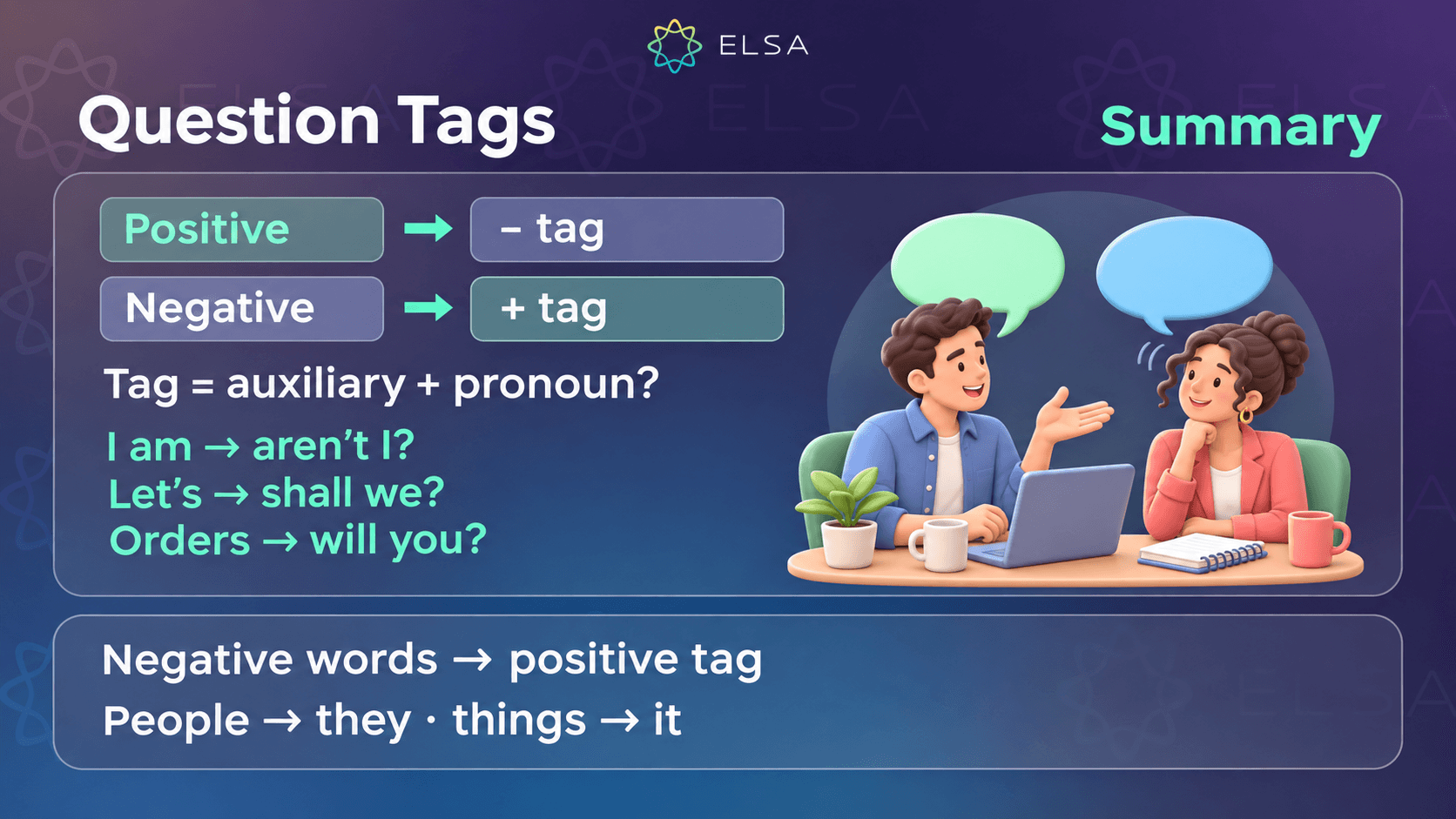
A question tag is a short question added to a statement. It can ask for confirmation or invite the listener to agree.
For standard confirmation tags:
- Affirmative statement + negative tag
- Negative statement + affirmative tag
Remember:
- Negative tags normally use contractions (aren't you, isn't it), while an uncontracted alternative is also possible, but its word order changes (are you not, is it not)
- When the statement already contains an auxiliary or modal, use it in the tag
| Statement form | Auxiliary rule | Tag structure | Example |
|---|---|---|---|
| Affirmative with be | Repeat be in the negative | isn’t/aren’t/wasn’t/weren’t + pronoun | The office is open, isn’t it? |
| Affirmative simple present | Add do/does | don’t/doesn’t + pronoun | Maya works here, doesn’t she? |
| Affirmative simple past | Add did | didn’t + pronoun | They called yesterday, didn’t they? |
| Affirmative present/past perfect | Repeat have/has/had | haven’t/hasn’t/hadn’t + pronoun | You have finished, haven’t you? |
| Affirmative I am | Use the conventional exception | aren’t I? | ’m next, aren’t I? |
Basic question tags exercises (A1–A2)
These introductory exercises for question tags focus on be, simple present and past auxiliaries, pronouns, and opposite polarity. Unless stated otherwise, complete the exercises with standard opposite-polarity confirmation tags.
Exercise 1: Complete the tag with be in the present and past
Instructions: Add the correct question tag using the appropriate form of be.
- You are ready for the meeting, ______?
- Emma isn’t at the office today, ______?
- The presentation was helpful, ______?
- They weren’t late yesterday, ______?
- We are in the correct classroom, ______?
- The café isn’t open yet, ______?
- Your parents were at the concert, ______?
- Daniel wasn’t upset, ______?
- She is working from home today, ______?
- The students weren’t waiting outside, ______?
Exercise 2: Complete the tag with simple present auxiliaries
Instructions: Complete each sentence using do, don’t, does, or doesn’t, plus the correct pronoun.
- Marcus works in Austin, ______?
- You don’t drink coffee, ______?
- The store closes at nine, ______?
- They live near the station, ______?
- Nina doesn’t drive to work, ______?
- We need another copy, ______?
- Your brother plays basketball, ______?
- These shoes don’t fit, ______?
- I sound nervous, ______?
- The printer uses recycled paper, ______?
Exercise 3: Complete the tag with simple past auxiliaries
Instructions: Add did or didn’t and the appropriate pronoun.
- They visited Seattle last summer, ______?
- You didn’t call yesterday, ______?
- Maya finished the assignment, ______?
- The package arrived this morning, ______?
- We didn’t miss the announcement, ______?
- Ben took the earlier train, ______?
- Your friends enjoyed the concert, ______?
- The machine didn’t stop automatically, ______?
- I sent the correct attachment, ______?
- Olivia didn’t bring her laptop, ______?
Exercise 4: Multiple choice on basic question tags
Instructions: Choose the best answer: A, B, C, or D.
- Sam isn’t a careless driver, ______?
A. isn’t he · B. is he · C. does he · D. doesn’t he - Your sister works downtown, ______?
A. isn’t she · B. does she · C. doesn’t she · D. didn’t she - They didn’t cancel the trip, ______?
A. did they · B. didn’t they · C. do they · D. were they - We were early, ______?
A. didn’t we · B. aren’t we · C. were we · D. weren’t we - The bus stops here, ______?
A. isn’t it · B. doesn’t it · C. don’t they · D. didn’t it - You don’t need this receipt, ______?
A. don’t you · B. are you · C. do you · D. did you - Nina brought the tickets, ______?
A. didn’t she · B. doesn’t she · C. wasn’t she · D. did she - These seats are available, ______?
A. isn’t it · B. are they · C. don’t they · D. aren’t they - The office wasn’t busy, ______?
A. wasn’t it · B. was it · C. did it · D. is it - I look tired, ______?
A. aren’t I · B. am I · C. don’t I · D. didn’t I
Exercise 5: Matching statements with correct question tags
Instructions: Match each statement in Column A with its tag in Column B. Use every letter once.
| Number | Column A: Statement | Letter | Column B: Tag |
|---|---|---|---|
| 1 | You enjoy iced coffee, | A | wasn’t it? |
| 2 | Maya is your colleague, | B | do we? |
| 3 | They didn’t attend the workshop, | C | doesn't he? |
| 4 | The presentation was useful, | D | aren’t they? |
| 5 | We don’t need more chairs, | E | don't you? |
| 6 | Ben works on Saturdays, | F | did they? |
| 7 | The students are ready, | G | was he? |
| 8 | Your brother wasn’t at home, | H | isn’t she? |
| 9 | I sent the invitation, | I | does it? |
| 10 | The printer doesn’t work, | J | didn't I? |
Intermediate question tags exercises (B1–B2)
These activities extend your practice to modal verbs, perfect tenses, requests, suggestions, and statements containing negative words. Read the entire statement before choosing the tag. A sentence can carry negative meaning without containing not.
Exercise 6: Question tags with modal verbs
Instructions: Complete each sentence using the modal from the statement and the correct pronoun.
- Sarah can speak three languages, ______?
- You couldn’t open the attachment, ______?
- We should confirm the reservation, ______?
- They won’t arrive before noon, ______?
- Daniel would accept the offer, ______?
- The children can’t reach the shelf, ______?
- You will send the revised draft, ______?
- She shouldn’t share that password, ______?
- This approach could reduce costs, ______?
- We wouldn’t need another meeting, ______?
Exercise 7: Question tags with perfect tenses
Instructions: Complete the tags. Keep the auxiliary from the statement.
- You have finished the report, ______?
- She hasn’t replied yet, ______?
- The committee has approved the budget, ______?
- They hadn’t met before the conference, ______?
- We have been waiting for an hour, ______?
- Ben had already left when you called, ______?
- The package hasn’t arrived, ______?
- I have sent the invoice, ______?
- Your colleagues have reviewed the proposal, ______?
- We hadn’t received the update before the meeting, ______?
Usage note: In "You have a car, don’t you?", "have" expresses possession as a main verb. In "You have bought a car, haven’t you?", "have" is a perfect auxiliary.
Exercise 8: Special exceptions
Instructions: Complete the tags. Use will you? for the imperative requests in this exercise.
- I’m on the guest list, ______?
- I’m not interrupting, ______?
- Let’s take a short break, ______?
- Close the window, ______?
- Don’t leave your bag here, ______?
- I’m speaking clearly, ______?
- Let’s not discuss this in the hallway, ______?
- Please send me the attachment, ______?
- I’m not responsible for the delay, ______?
- Turn down the volume, ______?
Usage note: Shall we? remains the conventional tag after let’s, including in American English. Some speakers may instead use informal alternatives such as okay?
Exercise 9: Negative adverbs and pronouns
Instructions: Complete each sentence with an affirmative confirmation tag.
- David rarely complains, ______?
- You never miss a deadline, ______?
- She has hardly spoken today, ______?
- Nobody called yesterday, ______?
- Nothing is missing, ______?
- We seldom eat out during the week, ______?
- The system barely works, ______?
- They had never visited Boston before that trip, ______?
- No one can access this folder, ______?
- The office is hardly ever empty, ______?
Exercise 10: Error Identification in Intermediate Question Tags
Instructions: Rewrite each sentence with the correct standard confirmation tag. Use will you? for the imperative and shall we? for the suggestion.
- I’m invited to the reception, amn’t I?
- She can use this software, doesn’t she?
- They haven’t replied, haven’t they?
- Let’s review the figures, will you?
- Don’t share this link, won’t you?
- Nobody has complained, has he?
- David rarely works late, doesn’t he?
- The manager was informed, didn’t she?
- You’ve been waiting long, aren’t you?
- I’m not on the wrong train, aren’t I?
Advanced question tags exercises (B2–C1)
These advanced question tags exercises focus on indefinite subjects, complex statements, same-way tags, and intonation. At this level, context matters. A different tag can sometimes be grammatical because it asks the listener to confirm a different part of the message.
Exercise 11: Indefinite pronouns as subjects
Instructions: Complete each tag. Use they for indefinite people and it for indefinite things.
- Everyone is ready, ______?
- Someone has moved the chairs, ______?
- Nobody attended the briefing, ______?
- Everything looks correct, ______?
- Nothing has changed, ______?
- Everybody received the invitation, ______?
- Somebody can help us, ______?
- No one was injured, ______?
- Something is blocking the entrance, ______?
- Everyone has submitted the form, ______?
Remember: The statement and tag can have different agreement patterns:
For example: Everyone is ready, aren’t they?
Exercise 12: Complex sentences wth opinion verbs
Instructions: Complete each tag to confirm the information identified in parentheses. For sentences beginning with I think, I believe, or I suppose, the tag can target the proposition that follows. However, this is not a rule for every complex sentence. The intended focus determines the tag.
- I think she is available, ______? (Confirm her availability.)
- I don’t think they will cancel, ______? (Confirm that cancellation is unlikely.)
- I believe you have met before, ______? (Confirm the previous meeting.)
- I suppose the office closes at six, ______? (Confirm the closing time.)
- I don’t believe he can access the account, ______? (Confirm his lack of access.)
- I think Maya sent the invoice, ______? (Confirm that Maya sent it.)
- I don’t suppose we need another meeting, ______? (Confirm that another meeting is unnecessary.)
- I believe the documents were signed, ______? (Confirm that they were signed.)
- It seems that the system is offline, ______? (Confirm the overall impression: “It seems that way.”)
- It seems that the delivery has been delayed, ______? (Confirm the overall impression: “It seems that way.”)
Focus note: In Question 9, isn’t it? could instead target the system is offline. In Question 10, hasn’t it? could target the delivery has been delayed. These are different confirmation targets.
Exercise 13: Same-way question tags for surprise, suspicion, and sarcasm
Instructions: Complete each affirmative statement with an affirmative tag. These are deliberately same-way tags, rather than the opposite-polarity confirmation tags used earlier.
- Oh, you work in publishing, ______? (Interested discovery)
- So she has already accepted, ______? (Surprise)
- You think this is funny, ______? (Challenge)
- So they can solve everything without help, ______? (Skepticism)
- Oh, he was the keynote speaker, ______? (New information)
- You’ve finished the entire report already, ______? (Surprise)
- So the new system will fix every problem, ______? (Skepticism)
- You’re the person in charge, ______? (Discovery or challenge, depending on tone)
- So Emma told you the whole story, ______? (Suspicion)
- You would refuse the offer, ______? (Surprise at a stated intention)
Exercise 14: Intonation matching
Instructions: Choose the intonation that best matches the speaker’s stated intention, and practice speaking it with the ELSA Speak app.
- You haven’t seen my keys, have you?
The speaker has no idea whether the listener has seen them. - It’s a beautiful day, isn’t it?
Both people are enjoying the sunshine; the speaker invites agreement. - The meeting starts at ten, doesn’t it?
The speaker cannot remember the scheduled time. - We handled that well, didn’t we?
The speaker is confident the task went well and seeks agreement. - You’re joining us tomorrow, aren’t you?
The speaker is unsure whether the invitation was accepted. - That was a difficult presentation, wasn’t it?
Both people have just discussed how challenging it was. - This train goes to Boston, doesn’t it?
The speaker is uncertain and needs accurate travel information. - You’ve worked hard today, haven’t you?
The speaker has watched the listener work all day and expresses recognition. - She hasn’t left yet, has she?
The speaker does not know whether she is still in the building. - We don’t need another copy, do we?
The speaker is confident there are enough copies and expects agreement.
Exercise 15: Sentence synthesis and academic paraphrasing
Instructions: Turn each assumption or expectation into a statement followed by a suitable confirmation tag. Use the capitalized word in the tag. The information should remain the same, but the rewritten sentence now explicitly invites confirmation.
- I assume that nobody disclosed the preliminary results. (DID)
- I understand that the researchers have completed the analysis. (HAVEN’T)
- I take it that the report is not final. (IS)
- I assume that everyone received the revised instructions. (DIDN’T)
- I understand that the committee rarely rejects a complete application. (DOES)
- I assume that the proposal had been reviewed before submission. (HADN’T)
- I understand that you can provide the supporting documents. (CAN’T)
- I assume that nothing has changed since the last review. (HAS)
- I understand that I am responsible for the next presentation. (AREN’T)
- I assume that the department will not publish the findings today. (WILL)
Tips for solving question tags exercises and common pitfalls
Before writing a tag, identify three things: the verb structure, the statement’s polarity, and the pronoun needed in the tag.
- Identify the tense and auxiliary in the main clause first: Underline the verb phrase. For ordinary verbs in the simple present, use do/does in the tag; for the simple past, use did. If the clause contains an auxiliary or modal verb, repeat it in the tag. With be as the main verb, use the corresponding form of be.
- Watch out for “stealth negatives”: Words such as never, rarely, seldom, hardly, nobody, and nothing give the statement a negative meaning, so a standard confirmation tag should be affirmative (She rarely complains, does she?).
- Use they for indefinite pronouns referring to people: When the subject is everyone, everybody, someone, or nobody, use they in the tag, with the corresponding auxiliary form (Everyone is ready, aren’t they? Nobody called, did they?).
| Common Pitfall | Incorrect | Corrected | Rule / Fix |
|---|---|---|---|
| Using amn’t I in standard US English | I’m next, amn’t I? | I’m next, aren’t I? | Use conventional aren’t I after affirmative I am. |
| Repeating a proper noun in a standard tag | Maya works here, doesn’t Maya? | Maya works here, doesn’t she? | Replace the noun subject with the appropriate pronoun. |
| Ignoring a negative adverb | He never complains, doesn’t he? | He never complains, does he? | Never requires an affirmative confirmation tag. |
| Keeping singular agreement with they | Everyone is ready, isn’t they? | Everyone is ready, aren’t they? | They takes are, even when referring back to everyone. |
Regular practice with question tags exercises helps you check information and invite responses more naturally. Review the explanations, revisit the questions you missed, and practice your own examples aloud with ELSA Speak. Explore the Grammar category on our blog for more grammar guides and practice activities.