

150+ possessive adjectives exercises: All forms and negative rules
elsaspeakadmin
November 16, 2026
Grammar exercises
Possessive adjectives are very useful if you want to show ownership and connections between people and things. However, some learners still struggle with choosing between different adjectives, spelling them correctly, and forming negative sentences. These possessive adjectives exercises will cover the rules through 15 practice sets from basic to advanced with detailed answer and explanations.
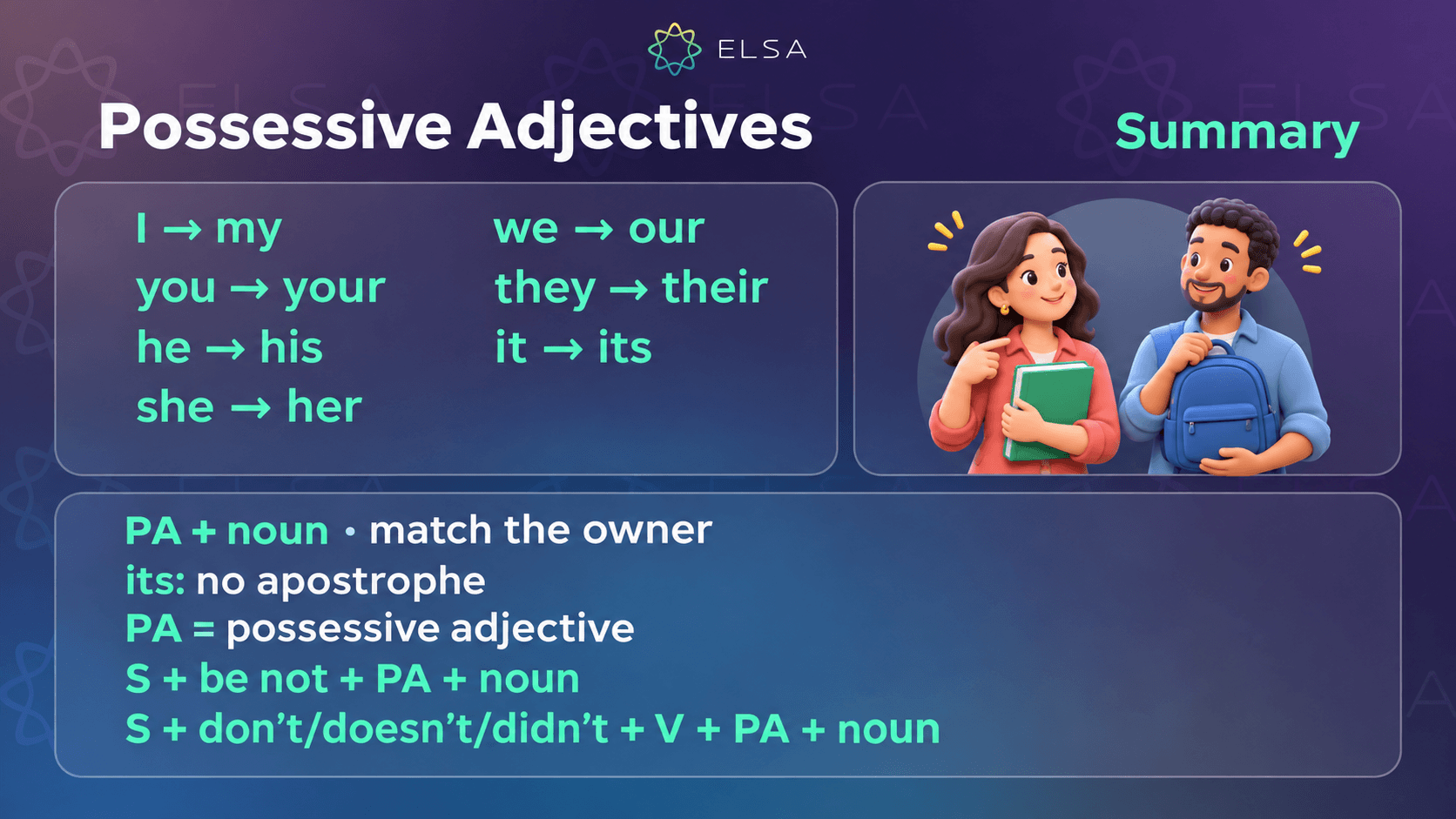
Possessive adjectives chart & negative rules
Possessive adjectives, or possessive determiners, identify whose possession, relationship, characteristic, or responsibility you are discussing.
| Subject pronoun | Possessive adjective |
|---|---|
| I | My |
| You | Your |
| He | His |
| She | Her |
| It | Its |
| We | Our |
| They | Their |
Possessive adjectives in negative sentences
- With be: S + am/is/are/was/were + not + possessive adjective + noun phrase
- For example: This is not my bag.
- With other verbs: S+ don’t/doesn’t/didn’t + base verb + possessive adjective + noun phrase
- For example: He doesn’t remember his password.
Note:
- In these possessive adjectives negative sentences, negation is formed with the verb. Do not insert not or no between the possessive adjective and its noun.
- The owner does not have to be the sentence’s subject.
Basic possessive adjectives exercises (A1–A2)
These beginner exercises practice choosing possessive adjectives, recognizing owners, and building affirmative and negative sentences. Complete each activity before checking its answer table.
Exercise 1: Complete sentences with my, your, his, and her
Instructions: Fill each blank with my, your, his, or her, using the pronoun in parentheses.
- I keep ______ keys in this drawer. (I)
- Is this ______ jacket? (you)
- Daniel rides ______ bicycle to school. (he)
- Maya is checking ______ email. (she)
- ______ favorite subject is English. (I)
- Please write ______ name at the top. (you)
- Ben forgot ______ lunch at home. (he)
- Olivia loves ______ new apartment. (she)
- I need to charge ______ phone. (I)
- Emma, ______ presentation was excellent. (you)
Exercise 2: Complete sentences with its, our, and their
Instructions: Fill each blank with its, our, or their, using the pronoun in parentheses.
- The dog is sleeping in ______ bed. (it)
- We are planning ______ summer vacation. (we)
- The students submitted ______ assignments. (they)
- The company updated ______ website. (it)
- My sister and I share ______ bedroom. (we)
- The neighbors painted ______ front door. (they)
- The robot lifted ______ arm. (it)
- We invited ______ cousins to dinner. (we)
- Carlos and Nina parked ______ car outside. (they)
- The museum announced ______ opening hours. (it)
Exercise 3: Possessive adjectives in negative sentences
Instructions: Complete each negative sentence with the possessive adjective corresponding to the pronoun in parentheses.
- I didn’t bring ______ notebook today. (I)
- You aren’t wearing ______ usual jacket. (you)
- David doesn’t remember ______ password. (he)
- Sofia didn’t finish ______ homework. (she)
- The printer isn’t in ______ usual location. (it)
- We don’t share ______ account details. (we)
- They didn’t receive ______ tickets. (they)
- This isn’t ______ seat. (I)
- Those aren’t ______ gloves, Emma. (you)
- The employees haven’t completed ______ training. (they)
Exercise 4: Multiple choice on subject pronouns vs. possessive adjectives
Instructions: Choose the best answer: A, B, C, or D.
- ______ am studying English, and ______ teacher is helpful.
A. My / I · B. I / my · C. Me / mine · D. Mine / my - ______ works downtown, and ______ office is near the station.
A. Her / she · B. Hers / her · C. She / her · D. She / hers - ______ are ready, but ______ driver is late.
A. They / their · B. Their / they · C. Them / theirs · D. Theirs / their - ______ is reading ______ favorite book.
A. His / he · B. Him / his · C. He / him · D. He / his - ______ live here, and this is ______ apartment.
A. Our / we · B. We / our · C. Us / ours · D. Ours / our - ______ left ______ umbrella in the classroom.
A. Your / you · B. Yours / your · C. You / your · D. You / yours - The machine stopped because ______ battery was empty.
A. its · B. it · C. it’s · D. itself - ______ don’t know where ______ keys are.
A. My / I · B. Mine / my · C. Me / mine · D. I / my - ______ is bringing ______ laptop to the meeting.
A. Her / she · B. She / her · C. Hers / her · D. She / hers - ______ finished ______ project yesterday.
A. Their / they · B. Them / theirs · C. They / their · D. Theirs / their
Exercise 5: Sentence rearrangement for beginners
Instructions: Arrange the words into a complete sentence. Add capitalization and punctuation. Begin with the word shown in parentheses.
- keys / forgot / his / Marcus / at / home (Marcus)
- not / my / this / is / jacket (This)
- their / students / checking / are / answers / the (The)
- room / we / our / cleaned / yesterday (We)
- doesn’t / her / she / password / remember (She)
- tail / the / wagged / its / dog (The)
- your / please / here / name / write (Please)
- tickets / bring / they / didn’t / their (They)
- my / I / phone / find / can’t (I)
- usual / isn’t / this / our / classroom (This)
Intermediate possessive adjectives exercises (B1–B2)
These activities develop your ability to distinguish possessive adjectives from possessive pronouns, avoid spelling traps, and form negative sentences. You will also practice possessive forms before -ing clauses in formal writing.
Exercise 6: Possessive adjectives vs. possessive pronouns
Instructions: Choose the correct form in parentheses.
- This isn’t ______ laptop; ______ is being repaired. (my / mine; my / mine)
- Is that ______ notebook, or is it ______? (your / yours; her / hers)
- We brought ______ lunch, and they brought ______. (our / ours; their / theirs)
- That is ______ seat; this one is ______. (his / him; my / mine)
- I like ______ design, but I prefer ______. (their / theirs; our / ours)
- She forgot ______ charger, so I lent her ______. (her / hers; my / mine)
- These aren’t ______ documents. Are they ______? (our / ours; your / yours)
- He checked ______ answers before looking at ______. (his / him; her / hers)
- ______ apartment is larger than ______. (Their / Theirs; our / ours)
- Please use ______ account, not ______. (your / yours; my / mine)
Exercise 7: Homophone traps (Its vs. It’s, Your vs. You’re, Their vs. They’re)
Instructions: Choose the correct word in parentheses.
- The company celebrated ______ tenth anniversary. (its / it’s)
- ______ going to need a valid ticket. (Your / You’re)
- The students left ______ bags outside. (their / they’re)
- I think ______ going to rain. (its / it’s)
- Is this ______ final answer? (your / you’re)
- ______ waiting in the lobby. (Their / They’re)
- The robot returned to ______ charging station. (its / it’s)
- ______ already finished the update. (Its / It’s)
- Please check ______ email before leaving. (your / you’re)
- The neighbors said ______ selling their house. (their / they’re)
Exercise 8: Negative sentence transformations with possessive modifiers
Instructions: Change each affirmative sentence to a negative sentence. Preserve the tense, subject, and possessive adjective. Keep the other words unless a grammatical change is necessary.
- Emily remembered her presentation notes.
- This is my assigned seat.
- They use their personal laptops for work.
- He checks his messages during class.
- We brought our identification.
- Those are your gloves.
- The company has updated its website.
- I can access my account.
- She was carrying her umbrella.
- We will share our results tomorrow.
Exercise 9: Possessive adjectives with gerunds
Instructions: Complete each sentence with the possessive adjective corresponding to the pronoun in parentheses. Use the formal possessive pattern requested here.
- We appreciate ______ helping us meet the deadline. (you)
- The manager objected to ______ arriving late. (I)
- They were grateful for ______ organizing the workshop. (we)
- I remember ______ explaining the process clearly. (she)
- The committee approved of ______ sharing the findings. (they)
- Thank you for ______ taking the time to respond. (you)
- We discussed ______ joining the research team. (he)
- The delay resulted from ______ missing the initial deadline. (we)
- I was surprised by ______ accepting the offer so quickly. (she)
- The supervisor insisted on ______ checking the figures again. (I)
Note: Possessive forms before gerunds are a traditional formal-writing choice. Object forms also occur in everyday usage, such as "Thanks for helping" or "I appreciate you helping." These exercises specifically practice the possessive construction.
Exercise 10: Error identification in intermediate sentences
Instructions: Each sentence contains one error involving a possessive form, a contraction, or the placement of a negative. Rewrite it correctly.
- The dog wagged it’s tail.
- Your going to enjoy this course.
- The students forgot they’re notebooks.
- This isn’t mine laptop.
- She doesn’t remember hers password.
- That is my not responsibility.
- We didn’t bring ours tickets.
- Please write you name clearly.
- The company changed it address.
- These documents are their’s.
Advanced possessive adjectives exercises (B2–C1)
These advanced activities cover formal -ing clauses, emphasis with own, double possessives, singular their, and academic paraphrasing. Pay attention to the intended owner, the grammatical role of the phrase, and whether a noun is expressed or replaced.
Exercise 11: Formal gerund subjects with possessive adjectives
Instructions: Complete each sentence with the appropriate possessive adjective. The entire possessive + -ing clause is the subject of the sentence.
- ______ arriving early gave us time to prepare. (we)
- ______ sharing the raw data improved transparency. (they)
- ______ leaving without notice disrupted the schedule. (he)
- ______ questioning the assumption strengthened the analysis. (she)
- ______ reviewing the draft carefully prevented several errors. (you)
- ______ overlooking the footnote caused confusion. (I)
- ______ collaborating across departments reduced duplication. (we)
- ______ refusing to participate affected the sample size. (they)
- ______ being available at short notice helped the team. (she)
- ______ responding promptly made the process easier. (you)
Writing note: These forms are grammatical, but a noun-based alternative may read more smoothly: Her availability helped the team or Your prompt response made the process easier.
Exercise 12: Emphatic possession with own in negative statements
Instructions: Complete each sentence with the appropriate possessive adjective + own.
- I don’t have ______ office yet. (I)
- She doesn’t use ______ laptop for company work. (she)
- They didn’t bring ______ equipment. (they)
- We can’t access ______ files during the outage. (we)
- He hasn’t developed ______ teaching materials yet. (he)
- You don’t need to use ______ money for this purchase. (you)
- The organization doesn’t have ______ training center. (it)
- I didn’t create ______ account; the administrator created it for me. (I)
- The students aren’t presenting ______ research today. (they)
- We won’t publish ______ conclusions before reviewing the evidence. (we)
Exercise 13: Double possessive structures (a friend of ours vs. our friend)
Instructions: Rewrite each sentence using the requested structure. Preserve the meaning.
For example: one of my friends → a friend of mine
- One of my colleagues recommended the course. (Use “a colleague of…”)
- We invited one of our neighbors to dinner. (Use “a neighbor of…”)
- She borrowed a book from one of her friends. (Use “a friend of…”)
- One of their clients requested a meeting. (Use “a client of…”)
- I spoke with one of your classmates. (Use “a classmate of…”)
- A friend of his works at the university. (Use “one of…”)
- A relative of ours lives in Denver. (Use “one of…”)
- A student of hers won the competition. (Use “one of…”)
- A colleague of mine shared the article. (Use “one of…”)
- A neighbor of theirs found the package. (Use “one of…”)
Exercise 14: Indefinite pronouns and gender-neutral Possession (their)
Instructions: Complete each sentence with the modern gender-neutral possessive adjective their.
- Everyone should check ______ contact information.
- Someone left ______ umbrella by the door.
- Each student must submit ______ assignment by Friday.
- Nobody should share ______ password.
- Every applicant needs to upload ______ résumé.
- A participant may withdraw ______ consent at any time.
- Anyone who needs help can raise ______ hand.
- Each employee should update ______ emergency contact details.
- Somebody forgot to collect ______ certificate.
- Every customer can review ______ order before paying.
Note: Singular they and its possessive form their are accepted in modern academic writing when referring to a person whose gender is unknown or irrelevant. They are also used for people who identify with they/them pronouns.
Keep the sentence’s verb agreement in mind:
- Everyone has their ticket.
- They have their ticket.
Exercise 15: Sentence synthesis and academic paraphrasing
Instructions: Rewrite each sentence using the capitalized word or phrase. Preserve the intended meaning.
- We appreciate the fact that you reviewed the manuscript. (YOUR REVIEWING)
- The committee objected to the fact that we changed the methodology. (OUR CHANGING)
- She does not have an office reserved exclusively for her. (HER OWN)
- One of my colleagues raised the concern. (OF MINE)
- Each researcher must disclose the funding sources supporting that researcher’s work. (THEIR)
- This report does not belong to us. (OURS)
- The fact that he refused to answer delayed the interview. (HIS REFUSING)
- They did not submit the version belonging to them; they submitted the version belonging to us. (THEIR / OURS)
- The organization has not updated the policy that applies to it. (ITS)
- I did not use the account belonging to you; I used the account belonging to me. (YOUR / MINE)
Tips for solving possessive adjective exercises and common pitfalls
The most useful checks are simple: identify the owner, locate the noun, and examine how the sentence forms its negative.
- Check for a following noun: Use a possessive adjective (my, her, their) before a noun or noun phrase (my car, her new job, their decision). Use a possessive pronoun (mine, hers, theirs) when it replaces the noun phrase.
- Use the replacement test for it’s vs. its: Try replacing the word with it is or it has. If the sentence still makes sense, use it’s. To express possession, use its, without an apostrophe.
- Place negatives correctly in possessive expressions: Keep the possessive adjective with its noun phrase. Place not before the whole phrase. With action verbs, use don’t/doesn’t + V (I don’t like my job).
| Common Pitfall | Incorrect | Corrected | Rule / Fix |
|---|---|---|---|
| Confusing its and it’s | The company updated it’s website. | The company updated its website. | Its shows possession; it’s means it is/it has. |
| Confusing your and you’re | Your responsible for the report. | You’re responsible for the report. | The sentence requires you are, not a possessive adjective. |
| Using a possessive pronoun before a noun | This isn’t mine laptop. | This isn’t my laptop. | Use my to introduce laptop; mine replaces my laptop. |
| Misplacing the negative | That is our not decision. | That is not our decision. | Place not after is, before the noun phrase our decision. |
Regular practice with possessive adjectives exercises helps you express ownership, relationships, and responsibility more clearly. Review the explanations, revisit the sentences you missed, and practice saying your own examples aloud with ELSA Speak. Explore the Grammar category on our blog for more grammar guides and exercises.