

15+ Second conditional exercises with detailed explanations
elsaspeakadmin
November 16, 2026
Grammar exercises
The second conditional helps you imagine different situations, discuss unlikely possibilities, and give advice with “If I were you.” If you're still struggling with this tense, check out our second conditional exercises below. They cover everything from basic verb forms to advanced sentence transformations. Review the rules, complete the activities, and check the explanations below.
Second conditional rules and formulas
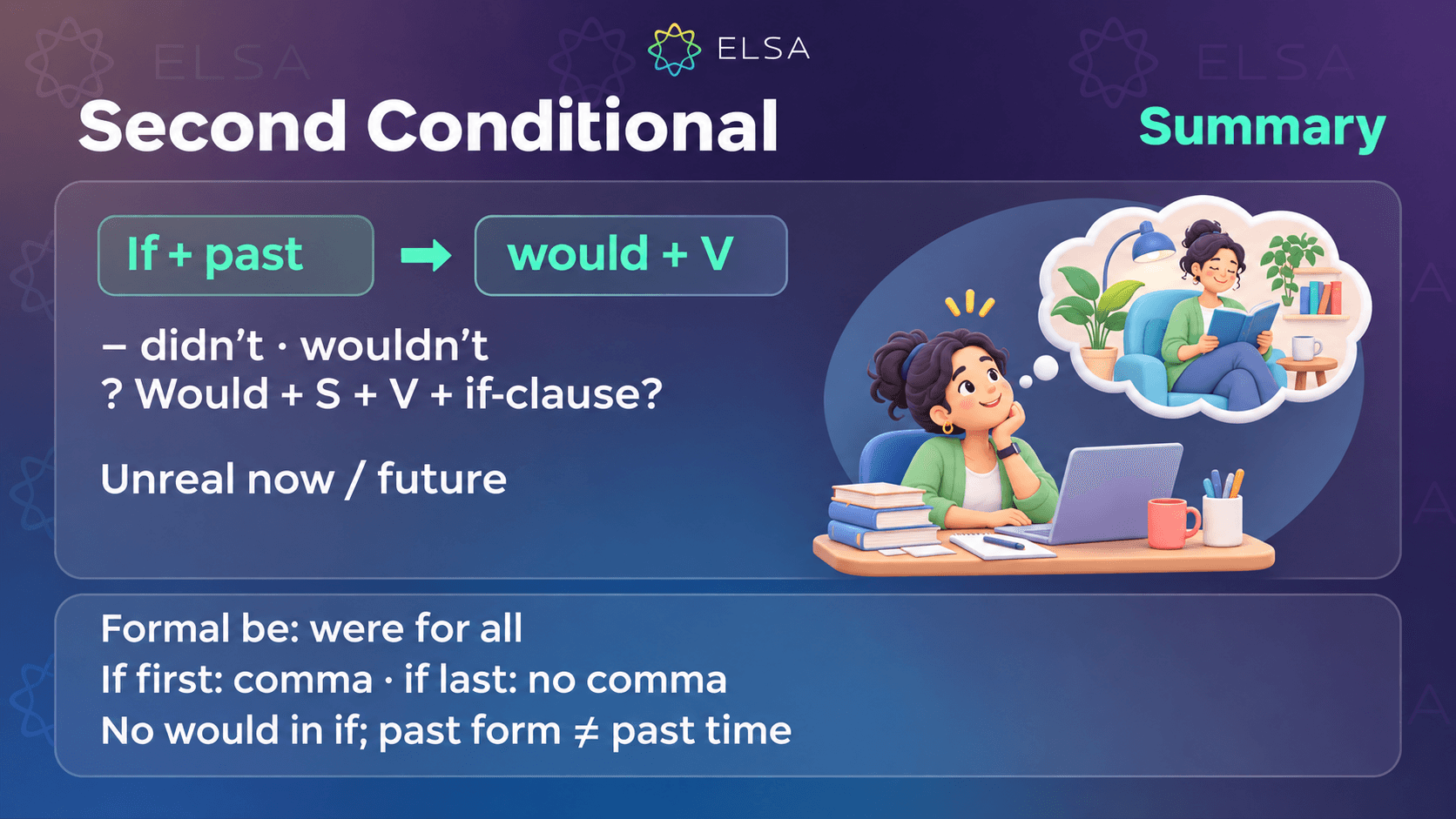
The second conditional describes an imaginary situation in the present or future and its imagined result. The situation may contradict a current fact or be presented as unlikely.
Remember the usage rule:
- Use a comma when the if-clause comes first.
- A comma is usually unnecessary when the result comes first.
- Do NOT use would in the if- clause.
The conditional type 2 formula:
| Form | Structure | Example |
|---|---|---|
| Affirmative (+) | If + S + past simple, S + would + V | If I need money, I would work here. |
| Negative (−) | If + S + didn’t + V, S + wouldn’t + V | If I didn't need money, I wouldn't work here. |
| Yes/No question | Would + S + V + if + S + past simple? | Would you work here if you needed money? |
| Advice | If I were you, I would/wouldn’t + V | If I were you, I would work here. |
Basic second conditional exercises (A1–A2)
The introductory set below provided basic practice with past and irregular verbs, with standard and advice formulas. Contractions (such as I'd and wouldn't) are acceptable unless the instruction says otherwise.
Exercise 1: Complete sentences with past simple and would + V
Instructions: Complete each sentence with the correct forms of the verbs in parentheses. Use were for hypothetical forms of be.
- If I ______ (have) more free time, I ______ (learn) to play the guitar.
- If she ______ (live) closer, we ______ (visit) her more often.
- If we ______ (own) a larger apartment, we ______ (invite) more friends over.
- If Daniel ______ (know) the answer, he ______ (tell) us.
- If you ______ (practice) more regularly, you ______ (feel) more confident.
- If my job ______ (be) less demanding, I ______ (spend) more time outdoors.If they ______ (speak)
- Spanish, they ______ (understand) this podcast.
- If I ______ (find) a better position, I ______ (leave) this company.
- If the tickets ______ (cost) less, we ______ (attend) the concert.
- If Emma ______ (be) here, she ______ (help) us organize the event.
Exercise 2: Multiple choice on basic hypothetical situations
Instructions: Choose the best answer: A, B, C, or D.
- If I had her phone number, I ______ her right now.
A. will call · B. would call · C. called · D. would have called - If he ______ more patient, he would enjoy teaching.
A. were · B. is · C. will be · D. would be - We would travel more if we ______ more vacation days.
A. have · B. will have · C. had · D. would have - If you knew the password, ______ you share it with me?
A. do · B. did · C. are · D. would - If Mia didn’t work on Saturdays, she ______ us more often.
A. visits · B. would visit · C. visited · D. will have visited - If I were you, I ______ that expensive course without reading reviews.
A. didn’t buy · B. don’t buy · C. wouldn’t buy · D. won’t bought - If our office ______ quieter, I would concentrate better.
A. were · B. would be · C. will be · D. has been - What would you do if you ______ your wallet?
A. lose · B. will lose · C. would lose · D. lost - If they offered me the position, I would ______ it.
A. accepted · B. accept · C. accepting · D. to accept - If she ______ so far away, we would meet every week.
A. doesn’t live · B. wouldn’t live · C. didn’t live · D. won’t live
Exercise 3: Giving advice
Instructions: Write advice using If I were you, I would/wouldn’t + V. Use the suggested action.
- Your friend feels overwhelmed by a long task list. (prioritize the most important tasks)
- Your coworker wants to send an angry email. (not send it immediately)
- Your classmate struggles to understand a lesson. (ask the teacher for clarification)
- Your friend wants to improve their spoken English. (practice speaking a little every day)Your
- teammate keeps missing deadlines. (use a calendar to track due dates)
- Your cousin wants to buy a laptop they cannot afford. (not spend all your savings on it)
- Your friend is preparing for a job interview. (research the company beforehand)
- Your colleague’s presentation is difficult to follow. (simplify the slides)
- Your classmate studies with constant phone notifications. (turn off notifications while studying)
- Your friend wants to accept an offer without reading it. (not sign anything before checking the terms)
Exercise 4: Matching if- clauses with imaginary results
Instructions: Match each condition in Column A with the most logical result in Column B.
| Number | Column A: Condition | Letter | Column B: Imaginary result |
|---|---|---|---|
| 1 | If I lived near the ocean, | A | we would have room for a vegetable garden. |
| 2 | If she knew how to code, | B | I would walk along the beach every morning. |
| 3 | If we had a bigger backyard, | C | they would understand the local radio programs. |
| 4 | If he owned a bicycle, | D | she would build her own website. |
| 5 | If they spoke Japanese, | E | he would ride it to work. |
| 6 | If the restaurant were less expensive, | F | you would arrive at work more easily. |
| 7 | If I had a home office, | G | we would eat there more often. |
| 8 | If you lived closer to the station, | H | she would read the signs more clearly. |
| 9 | If Maya wore her glasses, | I | I would stop working at the kitchen table. |
| 10 | If our school had a swimming pool, | J | students would take swimming lessons on campus. |
Exercise 5: Sentence rearrangement for beginners
Instructions: Put the words in order. Add capitalization and punctuation. Begin each sentence with if.
- more / would / I / if / travel / money / had / I
- you / I / would / were / if / apologize / I
- lived / visit / she / we / nearby / would / her / if
- buy / he / would / enough / a / had / car / money / if / he
- tired / were / not / would / I / join / if / you / I
- understood / they / would / the / if / joke / laugh / they
- we / larger / were / invite / apartment / more / would / our / people / if
- knew / tell / would / if / answer / the / I / you / I
- not / she / work / weekends / would / on / had / she / choice / a / if
- would / if / English / practiced / improve / your / you / more
Intermediate second conditional exercises (B1–B2)
These intermediate exercises focus on meaning as well as form. You will distinguish realistic future conditions from hypothetical situations, choose modal verbs, rewrite current facts, and form questions.
Exercise 6: First and second conditional differentiation
Instructions: Complete the sentences using the first or second conditional. Follow the context provided. Use were for hypothetical forms of be.
- The forecast says rain is likely tomorrow. If it ______ (rain), we ______ (move) the event indoors.
- I do not own a car. If I ______ (have) one, I ______ (drive) to work.
- The client’s approval is expected today. If they ______ (approve) the design, we ______ (start) tomorrow.
- I am not the department manager. If I ______ (be) the manager, I ______ (change) the meeting schedule.
- We have enough savings and are actively looking for a house. If we ______ (find) the right one, we ______ (buy) it.
- Lena does not speak Italian. If she ______ (speak) Italian, she ______ (apply) for that role in Rome.
- There is a real chance that my train will arrive early. If it ______ (arrive) before six, I ______ (meet) you for dinner.
- We cannot afford an overseas vacation. If we ______ (have) a larger travel budget, we ______ (visit) Japan.
- The repair technician is coming this afternoon. If she ______ (fix) the printer, we ______ (print) the brochures today.
- I do not expect to become famous. If I ______ (become) famous, I ______ (use) my platform to support libraries.
Remember: In first and second conditional exercises, context matters. The choice reflects how the speaker presents the situation, rather than a fixed percentage of probability.
Exercise 7: Modal variations
Instructions: Complete each sentence with modal verb would, could, or might. Follow the meaning clue to choose the intended answer.
- If I knew how to swim, I ______ join the swimming club. (Ability/opportunity)
- If she received that offer, she ______ accept it immediately; she has already decided. (Predicted result)
- If we moved downtown, we ______ spend more on entertainment, but I am not sure. (Uncertain possibility)
- If you had administrator access, you ______ change these settings. (Ability)
- If I were you, I ______ ask for written confirmation. (The speaker’s recommended choice)
- If the tickets were cheaper, more people ______ attend, although attendance would still be uncertain. (Uncertain possibility)
- If he spoke fluent French, he ______ communicate directly with the Montreal team. (Ability)
- If our office had more windows, it ______ feel brighter. (Predicted result)
- If we launched the product earlier, we ______ attract more customers—or we might not. (Uncertain possibility)
- If I had a reliable internet connection, I ______ work from home. (Ability/opportunity)
Exercise 8: Rewriting real situations into second conditional statements
Instructions: Rewrite each present situation as an opposite hypothetical condition. Begin with if. Use could where the original emphasizes ability.
- I don’t know his email address, so I can’t send him the agenda.
- She lives far from the office, so she spends a lot of time commuting.
- We don’t have enough chairs, so we can’t invite everyone.
- He doesn’t understand the software, so he needs help.
- I work on Sundays, so I don’t attend the weekend workshops.
- The apartment is too small, so we don’t have a home office.
- They don’t speak English confidently, so they avoid international meetings.
- You leave every assignment until the last minute, so you feel rushed.
- Our team doesn’t have a designer, so we outsource the graphics.
- I can’t play the piano, so I can’t accompany the singer.
Exercise 9: Question formation for hypothetical scenarios
Instructions: Use the prompts to write complete second conditional questions.
- what / you / do / if / you / find / a wallet on the subway?
- where / you / live / if / you / can / choose any city?
- you / accept the job / if / they / offer it to you?
- how / she / travel to work / if / she / not have a car?
- what / we / change / if / we / have a larger budget?
- who / you / ask for advice / if / you / need help?
- they / move abroad / if / they / receive a good offer?
- what / he / study / if / he / return to college?
- how / your routine / change / if / you / work from home?
- which skill / you / learn / if / you / have more time?
Exercise 10: Error identification in intermediate conditionals
Instructions: Each sentence contains oneerror in the standard second conditional pattern. Rewrite it correctly.
- If I would know the answer, I would tell you.
- If she had more time, she would learns Italian.
- If they didn’t lived so far away, we would visit more often.
- Would you accepted the offer if they increased the salary?
- If he were more organized, he wouldn’t forgot appointments.
- If I have a private office, I would concentrate better. (The speaker does not have one.)
- If we knew the address, we would to send an invitation.
- What you would do if you lost your phone?
- If the apartment were cheaper, we will rent it. (The apartment is currently unaffordable.)
- If she could speaks German, she would apply for the role.
Advanced second conditional exercises (B2–C1)
These advanced activities cover formal inversion, passive voice, contrasts with past hypotheticals, unreal wishes, and academic paraphrasing. Model answers are provided for rewriting tasks. Other answers may be acceptable if they preserve the intended meaning and use the required structure.
Exercise 11: Formal inversion with were
Instructions: Rewrite each sentence beginning with were. Omit if.
- If the board decided to relocate, several employees would resign.
- If the company introduced flexible hours, staff satisfaction would improve.
- If the researchers repeated the experiment, they might obtain different results.
- If the supplier raised its prices, we would review the agreement.
- If the city invested in public transit, traffic congestion might decrease.
- If the university offered evening classes, more working adults could enroll.
- If the office were larger, we could create a training room.
- If the proposal were more detailed, the committee would consider it.
- If it were not for your guidance, I would feel completely lost.
- If it were not for the grant, the research project would stop.
Exercise 12: Passive voice in second conditional clauses
Instructions: Rewrite both clauses in the passive voice. Keep the original tense, modal, and meaning. You may omit an agent when it is unnecessary.
- If the company promoted Michael, it would increase his salary.
- If the editor accepted the article, the journal would publish it next month.
- If the committee approved the proposal, the department would fund the project.
- If the team redesigned the website, more customers would notice the brand.
- If the university awarded Nina a scholarship, it would cover her tuition.
- If the manager extended the deadline, the team would complete the report.
- If the manufacturer reduced the price, more customers would buy the device.
- If the organizers recorded the workshop, remote employees would watch it.
- If the agency translated the brochure, international visitors would understand the information.
- If the company automated routine tasks, employees would process more orders.
Exercise 13: Second vs. Third conditional time-frame contrasts
Instructions: Complete each sentence using the second or third conditional. Pay attention to whether the condition and result concern the present/future or the past.
- I don’t know the answer now. If I ______ (know) it, I ______ (explain) it to you.
- We missed yesterday’s train. If we ______ (leave) earlier, we ______ (catch) it.She doesn’t speak
- Portuguese. If she ______ (speak) it, she ______ (apply) for the current vacancy.
- He forgot last week’s deadline. If he ______ (remember) it, he ______ (submit) the form on time.
- Our apartment is small. If it ______ (be) larger, we ______ (have) a separate office.
- The team lost the final last night. If they ______ (score) one more goal, they ______ (win).
- I work full time. If I ______ (have) more free time, I ______ (volunteer) regularly.
- You didn’t tell me about yesterday’s meeting. If you ______ (tell) me, I ______ (attend).
- The company doesn’t offer remote work. If it ______ (allow) it, I ______ (work) from home twice a week.
- They rejected our proposal last month. If they ______ (accept) it, we ______ (begin) the projectthat same week.
Note:
Watch out for mixed conditionals:
For example: If I had accepted that job last year, I would live in Boston now.
⇒ The example combines a past condition with a present result. It is a mixed conditional, rather than a standard second or third conditional.
Exercise 14: Expressing unreal wishes with wish and if only
Instructions: Rewrite each current situation as a present wish. Use the opening provided.
- I don’t have enough money to launch my business. (I wish…)
- Our office is too noisy. (If only…)
- She lives too far from her family. (She wishes…)
- I can’t speak English confidently. (I wish…)
- We don’t have a larger research budget. (If only…)
- He doesn’t understand the new software. (He wishes…)
- I have to work every Saturday. (I wish…)
- The apartment doesn’t have a balcony. (If only…)
- They can’t attend the conference. (They wish…)
- I am not more organized. (I wish…)
Exercise 15: Sentence synthesis and academic paraphrasing
Instructions: Rewrite each sentence using the capitalized word or phrase. Preserve the original meaning as closely as possible.
- Without your support, the project would fail. (WERE)
- I don’t have access to the database, so I can’t verify the figures. (COULD)
- If the institution introduced a mentoring program, staff development would improve. (WERE)
- The sample is too small for us to draw reliable conclusions. (IF)
- I would review the evidence before reaching a conclusion. (Give advice to another person.) (IF I WERE YOU)
- If the grant were unavailable, the study would not continue. (WITHOUT)
- If participants received clearer instructions, they might make fewer errors. (WERE)
- The proposal lacks sufficient detail, so the committee cannot evaluate it fully. (COULD)
- If the equipment were more reliable, we would repeat fewer tests. (WERE)
- I don’t have enough time to review the full report, although I want to. (WISH)
Tips for solving second conditional exercises and common pitfalls
Before choosing a verb form, identify the time frame and decide whether the speaker describes a realistic possibility or an imagined alternative.
- The “no would in the if-clause” rule: In standard second conditional sentences, use the past simple in the if-clause, rather than would or wouldn’t.
- Prefer were with all subjects: In formal hypothetical statements and academic grammar exercises, choose were rather than was with singular subjects (I, he, she, it).
- Check how realistic the situation is: Use the first conditional for a realistic future possibility. Use the second conditional for a situation that is contrary to present reality, imaginary, or considered unlikely in the future.
>> See more: Ready to master more grammar structures? Test your skills and review how to use real-life conditions with our first conditional exercises guide.
| Common pitfall | Incorrect | Corrected | Rule / Fix |
|---|---|---|---|
| Using would in a standard hypothetical if-clause | If I would know the answer, I would tell you. | If I knew the answer, I would tell you. | Use past simple in the condition for this pattern. |
| Using was where formal hypothetical were is expected | If I was you, I would ask for clarification. | If I were you, I would ask for clarification. | Use the conventional advice expression If I were you. |
| Mixing first and second conditional forms without the intended meaning | If I have more free time, I would learn French. (Intended meaning: I do not have enough time now.) | If I had more free time, I would learn French. | Match the unreal present condition with an imagined result. |
| Using the wrong verb form after would | If she lived nearby, I would to visit her. | If she lived nearby, I would visit her. | Use the base verb without to after would. |
Practicing second conditional exercises helps you express ideas beyond facts: what you would change, what you could do, and what might happen in an imagined situation. Review the explanations, create your own examples, and practice saying them aloud with ELSA Speak. Explore the Grammar category on our blog for more grammar guides and practice activities.