

Adverbs of frequency exercises with answers: 15 practice sets and 150 questions
elsaspeakadmin
November 16, 2026
Grammar exercises
Adverbs of frequency help you describe daily habits, workplace routines, and how often events happen. The challenge is often word order: usually comes before an ordinary main verb but after be, while never already carries a negative meaning. These adverbs of frequency exercises cover the rules through 15 practice sets with answers and explanations.
Adverbs of frequency scale & placement rules
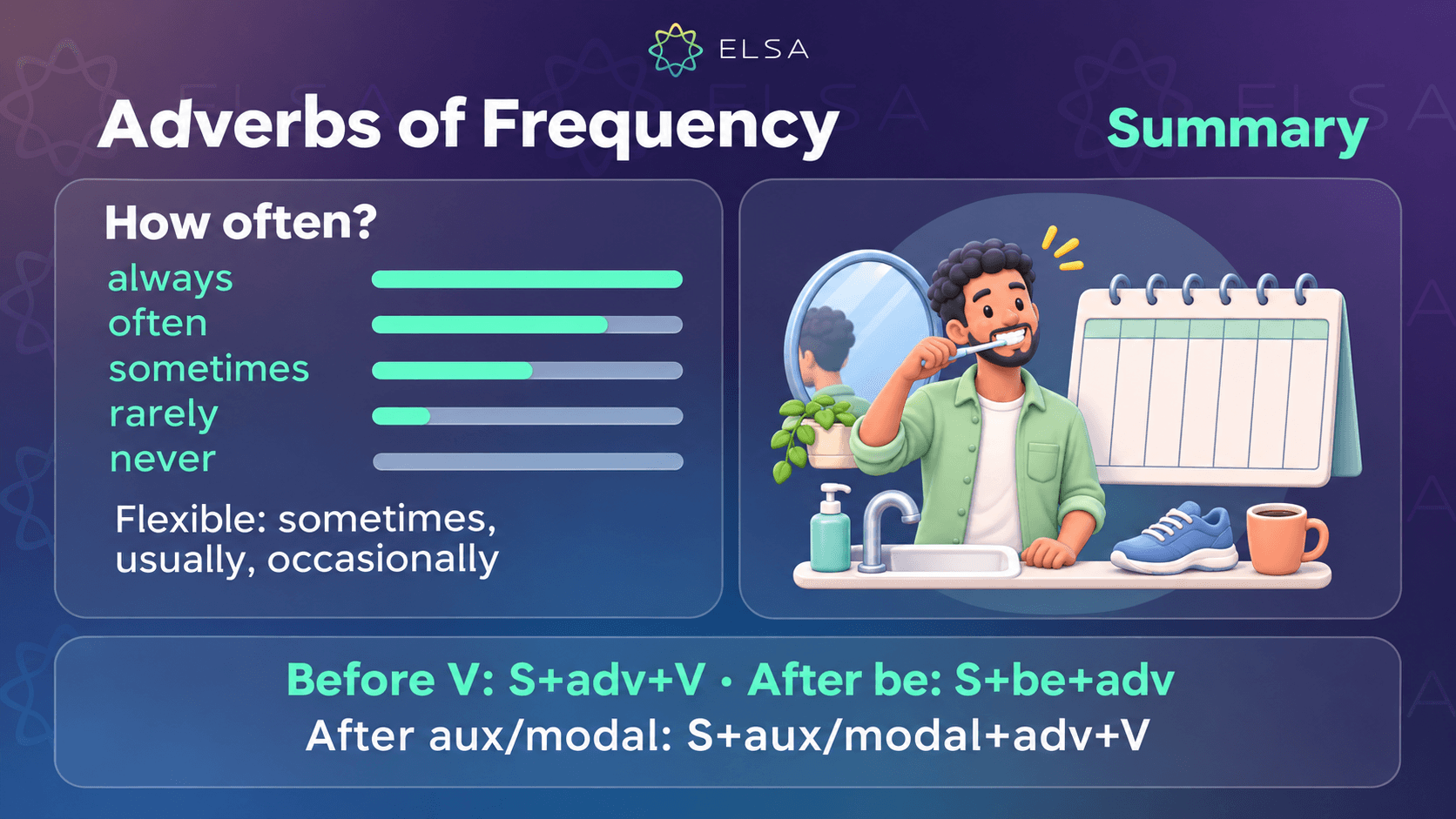
Adverbs of frequency describe how often an action or situation occurs:
- Always: every time; 100% on a simplified scale.
- Usually / normally / generally: on most occasions.
- Often / frequently: on many occasions.
- Sometimes: on some occasions.
- Occasionally: from time to time.
- Rarely / seldom: not often.
- Hardly ever: almost never.
- Never: at no time; 0% on a simplified scale.
There are 3 formulas of using adverbs of frequency:
- Before an ordinary main verb: S + frequency adverb + V
- After be when it is the main verb: S + be + frequency adverb + complement
- After the first auxiliary or modal: S + auxiliary/modal + frequency adverb + remaining verb phrase
| Approximate learning scale | Adverb | Typical placement |
|---|---|---|
| 100% | always | Before an ordinary main verb; after main-verb be |
| About 70-90% | often, usually, normally | Usually in mid-position |
| About 30-50% | occasionally, sometimes | Mid-position; front position is also common |
| About 5-10% | rarely, seldom, hardly ever | Usually in mid-position; already negative or near-negative in meaning |
| 0% | never | Usually in mid-position, without an additional negative for the same meaning |
Note: The percentages below are approximate classroom illustrations. There is no universal rule that often means exactly 70% or sometimes exactly 50%.
Also, use hardly ever or barely ever for very low frequency. Barely alone usually means “only just” or “almost not,” rather than functioning as a direct substitute for rarely.
Basic adverbs of frequency exercises (A1–A2)
These introductory activities focus on ordinary main verbs, be, negative meanings, and How often? questions. Complete each set before checking its answers.
Exercise 1: Choose the correct word order
Instructions: Choose the sentence that follows the standard neutral mid-position pattern taught above. Some alternative positions can occur with special emphasis, but choose the usual pattern here.
- A. She always checks her email before work.
B. She checks always her email before work. - A. Our teacher often is early.
B. Our teacher is often early. - A. I usually drink coffee with breakfast.
B. I drink usually coffee with breakfast. - A. They sometimes are tired after practice.
B. They are sometimes tired after practice. - A. Marcus never forgets his keys.
B. Marcus forgets never his keys. - A. The library usually is quiet.
B. The library is usually quiet. - A. We often visit our grandparents.
B. We visit often our grandparents. - A. You always are helpful.
B. You are always helpful. - A. Nina sometimes brings lunch from home.
B. Nina brings sometimes lunch from home. - A. The buses rarely are empty.
B. The buses are rarely empty.
Exercise 2: Insert the adverb into simple present sentences
Instructions: Rewrite each sentence with the adverb in its standard mid-position.
- I check the weather before leaving home. (always)
- She is busy on Monday mornings. (usually)
- We eat lunch together. (often)
- Daniel forgets his water bottle. (sometimes)
- The office is quiet after six. (normally)
- They visit museums on vacation. (occasionally)
- My brother cooks dinner. (rarely)
- You are late for class. (never)
- The train arrives on time. (usually)
- I am tired after a long flight. (always)
Exercise 3: Negative sentences with never vs. don’t/doesn’t often
Instructions: Rewrite each sentence using the word or phrase in parentheses. Preserve the meaning.
- I do not ever drink soda. (never)
- She does not ever arrive late. (never)
- We eat out, but not frequently. (don’t often)
- He visits us, but not frequently. (doesn’t often)
- They do not ever work on Sundays. (never)
- This printer is not ever available after hours. (never)
- I use cash, but not frequently. (don’t often)
- Maya does not ever forget a birthday. (never)
- Our team meets in person, but not frequently. (doesn’t often)
- These rooms are not ever empty during the day. (never)
Meaning check: "I don’t often eat out" allows occasional restaurant visits. "I never eat out" means there are no such occasions in the relevant context.
Exercise 4: Answering how often questions with frequency adverbs
Instructions: Write a complete answer using the subject in parentheses and the simplified practice key below. These percentages below are exercise clues, not exact dictionary definitions.
| Practice key: 100% = always; 90% = usually; 70% = often; 50% = sometimes; 30% = occasionally; 10% = rarely; 5% = hardly ever; 0% = never. |
- How often do you review your notes? (I; 100%)
- How often does Emma walk to work? (She; 90%)
- How often do they order lunch? (They; 70%)
- How often are you busy on Saturdays? (I; 50%)
- How often does Leo visit the museum? (He; 30%)
- How often do you miss the bus? (I; 10%)
- How often does your sister watch television? (She; 5%)
- How often are the students late? (They; 0%)
- How often do you practice together? (We; 90%)
- How often is the café crowded? (It; 70%)
Exercise 5: Sentence rearrangement for beginners
Instructions: Arrange the words into a sentence using standard mid-position. Add capitalization and punctuation. Begin with the word shown.
- breakfast / usually / Marcus / eats / at seven (Marcus)
- are / we / tired / sometimes / after practice (We)
- her calendar / checks / always / she (She)
- never / late / is / our teacher (Our teacher)
- on weekends / often / they / play / basketball (They)
- the train / rarely / I / miss (I)
- quiet / usually / the office / is (The office)
- occasionally / my cousins / visit / us (My cousins)
- forgets / never / he / his lunch (He)
- are / you / helpful / always (You)
Intermediate adverbs of frequency exercises (B1–B2)
These activities extend simple present tense and adverbs of frequency exercises to auxiliary verbs, modals, perfect tenses, and flexible sentence positions. You will also distinguish general frequency from expressions that specify an exact schedule.
Exercise 6: Placement with auxiliary and modal verbs
Instructions: Insert the adverb after the first auxiliary or modal, using the standard neutral pattern.
- You can rely on this service. (usually)
- She has submitted her reports on time. (always)
- We have discussed this issue. (often)
- The documents have been reviewed by an editor. (usually)
- They will remember your support. (always)
- I have seen this error before. (never)
- The manager can answer immediately. (sometimes)
- The equipment has been used outside the laboratory. (rarely)
- You should check the source before sharing a claim. (always)
- We have needed additional support. (occasionally)
Exercise 7: Definite vs. Indefinite frequency expressions
Instructions: Rewrite each sentence using the expression in parentheses. Put indefinite frequency adverbs in mid-position and definite frequency phrases at the end.
- Our department publishes a newsletter. (twice a month)
- She checks the project dashboard. (often)
- We inspect the equipment. (every Monday)
- The director is available after lunch. (usually)
- They review the budget. (once a quarter)
- I use the office printer. (rarely)
- The museum updates its exhibits. (three times a year)
- Our team meets online. (frequently)
- He attends a training session. (every other week)
- The building is crowded before eight. (seldom)
Exercise 8: Front and end position flexibility
Instructions: Add the adverb in the requested position. Preserve the rest of the sentence.
- We order lunch from the deli. (occasionally; beginning)
- I walk to work. (sometimes; beginning)
- The office opens at eight. (normally; beginning)
- She works from the downtown branch. (usually; beginning)
- They hold meetings outdoors. (occasionally; end)
- We take the train together. (sometimes; end)
- The team reviews progress on Fridays. (normally; beginning)
- I listen to podcasts while cooking. (sometimes; beginning)
- Our clients visit the studio. (occasionally; beginning)
- He brings his dog to work. (sometimes; end)
Punctuation note: A comma after a short introductory adverb is sometimes optional. The examples use commas where they help readability.
Exercise 9: Hardly ever, rarely, and seldom in negative contexts
Instructions: Rewrite each sentence using the expression in parentheses. Do not add not.
- David almost never takes time off in December. (hardly ever)
- We do not frequently receive complaints. (rarely)
- She does not often miss a deadline. (seldom)
- The office is almost never empty before six. (hardly ever)
- I do not often use paper forms. (rarely)
- They almost never travel during peak season. (hardly ever)
- This software does not frequently crash. (seldom)
- Our manager is not often unavailable. (rarely)
- The researchers almost never discard usable data. (hardly ever)
- He does not often request an extension. (seldom)
Exercise 10: Error identification in intermediate sentences
Instructions: Each sentence contains one error. Rewrite it correctly.
- She has finished always her reports before noon.
- We don’t never share account passwords.
- He usually check the dashboard before lunch.
- They meet twice month.
- I have never saw this message before.
- You should checks the figures regularly.
- The company publishes a newsletter two time a month.
- Our manager doesn’t often replies immediately.
- She is always in time for the meeting. (Intended meaning: punctual.)
- The team reviews the budget every quarterly.
Advanced Adverbs of Frequency Exercises (B2–C1)
These advanced exercises cover inversion, passive voice, professional writing, and paraphrasing.
Formal inversion can add emphasis, but ordinary word order is often clearer in everyday emails and reports.
Exercise 11: Negative inversion with frequency adverbs
Instructions: Rewrite each sentence beginning with the adverb or phrase shown.
- We rarely see such rapid progress. (Rarely…)
- She has never missed an important deadline. (Never…)
- The director seldom attends informal meetings. (Seldom…)
- I have hardly ever encountered this issue. (Hardly ever…)
- They never disclosed confidential information during the investigation. (Never…)
- The office is rarely this quiet. (Rarely…)
- He seldom asks for assistance. (Seldom…)
- We had never received such detailed feedback before that review. (Never…)
- The system hardly ever requires a manual restart. (Hardly ever…)
- Such opportunities are seldom available. (Seldom…)
Exercise 12: Passive voice with adverbs of frequency
Instructions: Change each sentence to the passive voice. Preserve the tense and place the adverb between be and the past participle. Keep the agent.
- The security team regularly updates the access codes.
- The editor always checks the references.
- The technicians usually inspect the equipment on Fridays.
- The committee often reviews these applications.
- The company never shares customer passwords.
- The staff occasionally rearrange the displays.
- The researchers frequently test the samples.
- The supervisor rarely rejects complete applications.
- The facilities team normally cleans the meeting rooms after hours.
- The auditors seldom question properly documented expenses.
Exercise 13: Emphatic fronting and stylistic inversion in professional contexts
Instructions: Choose the correct verb phrase to complete each formal sentence.
- Never ______ an unverified budget request.
A. the board has approved
B. has the board approved - Rarely ______ such a large discrepancy.
A. do our auditors encounter
B. our auditors do encounter - Seldom ______ necessary under normal conditions.
A. manual intervention is
B. is manual intervention - Hardly ever ______ a second extension.
A. does the committee grant
B. the committee grants - Never before ______ this level of demand.
A. the company had experienced
B. had the company experienced - Rarely ______ so thoroughly documented.
A. are the findings
B. the findings are - Seldom ______ the original forecast by this much.
A. actual costs exceed
B. do actual costs exceed - Never ______ without written authorization.
A. should confidential files be released
B. confidential files should be released - Hardly ever ______ an approved payment.
A. the finance team delays
B. does the finance team delay - Rarely ______ such consistent results.
A. have independent reviewers reported
B. independent reviewers have reported
Exercise 14: Multiple choice on nuanced workplace frequency and collocations
Instructions: Choose the answer that best matches the context and forms a standard English sentence.
- The policy requires verification on every occasion. Employees must ______ verify the recipient’s identity.
A. occasionally · B. rarely · C. always · D. hardly ever - The system had just one brief outage in five years. It ______ fails.
A. nearly always · B. hardly ever · C. usually · D. frequently - The board meets on the first business day of each month, so it meets ______.
A. once a month · B. once month · C. one a month · D. every monthly - The review occurs in March and September each year. It takes place ______.
A. twice a month · B. every two years · C. twice a year · D. once a year - Choose the standard form: The department ______ requests an external audit.
A. occasion · B. occasional · C. occasionally · D. occasionallyness - We meet on alternate Fridays. In other words, we meet ______.
A. every other Friday · B. every others Friday · C. every Friday twice · D. every other Fridays - The service team responds within an hour on most occasions, with occasional exceptions. It ______ responds within an hour.
A. never · B. usually · C. hardly ever · D. rarely - The company has a strict prohibition against selling personal data and has followed it without exception. It ______ sells personal data.
A. sometimes · B. frequently · C. never · D. normally - Choose the correct frequency expression: The team reviews access permissions ______.
A. every quarterly · B. once a quarter · C. once quarter · D. a once quarter - Most days are routine, but an unexpected issue appears from time to time. The team ______ handles an unusual request.
A. occasionally · B. always · C. never · D. invariably
Exercise 15: Sentence synthesis and academic paraphrasing
Instructions: Rewrite each sentence using the capitalized word or phrase. Preserve the meaning.
- Follow any instruction about the opening. It is unusual for this platform to crash during peak hours. (SELDOM)
- We have not encountered this problem at any time. (NEVER)
- The committee meets two times each month. (TWICE)
- On most occasions, the results are consistent. (USUALLY)
- The researchers almost never exclude complete responses. (HARDLY EVER)
- We rarely observe this pattern. (Begin with RARELY.)
- The editor checks every reference on every occasion. (ALWAYS)
- The team does not frequently request additional funding. (OFTEN)
- The department reviews the policy once every three months. (QUARTERLY)
- At no time has the board approved an unsigned agreement. (Begin with NEVER.)
Tips for solving frequency adverb exercises and common pitfalls
Most mistakes become easier to spot when you identify the verb structure before placing the adverb.
- Identify the main verb first (Verb-Type Check): In the usual neutral word order, place frequency adverbs after be but before other main verbs.
- Use the Sandwich Rule with auxiliaries: When a sentence contains auxiliary verbs or modals (have, has, will, can, could), frequency adverbs usually go after the first auxiliary or modal and before the main verb.
- Avoid double negatives with never, rarely, and seldom: These adverbs already express a negative or near-negative meaning. To express “not ever” or “almost never” in standard English, use them without don’t, doesn’t, or didn’t.
| Common pitfall | Incorrect | Corrected | Rule / Fix |
|---|---|---|---|
| Misplacing the adverb inside a be phrase | She is on usually time. | She is usually on time. | Put usually after is, before the complete phrase on time. |
| Separating a main verb from its object | He checks always his email before work. | He always checks his email before work. | Use the standard position before checks. |
| Adding an unnecessary negative with never | We don’t never share passwords. | We never share passwords. | Never supplies the intended negative meaning. |
| Misplacing the adverb in an auxiliary construction | She has submitted always her reports on time. | She has always submitted her reports on time. | Put always after the first auxiliary, has. |
Regular practice with adverbs of frequency exercises helps you describe habits and routines more clearly. Review the explanations, revisit the questions you missed, and practice saying your own examples aloud with ELSA Speak. Explore the Grammar category on our blog for more grammar guides and practice activities.